
Step 1 of 8
Find the Purpose and Next Action
Identify the purpose, key details, and requested action in a short work email.

Learning path · Level 9 · Tutorial 3
Write a work email that explains a problem and makes the next action clear. Read contrasting emails and listen to a spoken request. Choose the intended action and complete a short dictation. Practise polite requests aloud, then write a guided email of about 80–120 words. Adapt its key lines for a familiar colleague or a less familiar contact and check them against examples.

 Find the Purpose and Next Action
Identify the purpose, key details, and requested action in a short work email. 3 min
 Match the Tone to the Relationship
Choose greetings and closings for a familiar colleague and a less familiar contact, then compare the impressions created by two emails with the same purpose. 3 min
 Explain the Problem and Ask Clearly
Turn a workplace problem into a brief, polite request with a practical solution and a clear deadline. 3 min
 Put Phrasal-Verb Objects in the Right Place
Choose four workplace phrasal verbs and place noun and pronoun objects correctly in polite requests and responses. 4 min
 Choose Natural Professional Vocabulary
Choose clear, natural workplace vocabulary, preserve grammar when using alternatives, and keep spelling consistent. 3 min
 Hear and Say a Polite Request
Listen for the action and deadline in a workplace voice message, complete a short dictation, and practise two polite request forms in natural phrase groups. 3 min
 Draft a Problem-and-Solution Email
Turn the fixed workplace brief into a concise email to Jordan Lee. 4 min
 Adapt and Check Your Final Email
Adapt a professional email for a familiar colleague, check the original draft against clear criteria, and confirm its final length. 4 min
Step 1 of 8
Identify the purpose, key details, and requested action in a short work email.
A clear work email lets the reader find three things quickly: why you are writing, the details needed to understand the situation, and what the reader should do next.
Its visible structure supports this:
Short, separated paragraphs make the action easier to notice.

Think of each block as helping the reader move from context to one clear next action.
When you read, do not give every sentence the same importance. First identify the purpose. Then separate the facts that explain the situation from the action the reader needs to take.
Background answers why is this happening? Essential details help the reader make the decision. The requested action answers what should the reader do now?
Example
Subject: Project review: confirm Friday?
Hi Alex,
The report will not be ready until Thursday afternoon, so the project review at 10 a.m. on Thursday will not work.
Could you confirm whether 10 a.m. on Friday works for you by 3 p.m. on Wednesday? I need to update the invitation.
Thanks,
Maya
Tip
In this email, the report delay explains the problem. The proposed Friday time and the response deadline are essential details because Alex needs them to respond. The key action is to confirm whether the new time works.
Match each email part to its main function.
Tap an item and then its matching pair.
Read this email. Which option correctly identifies its purpose, one necessary detail, and the requested action?
Subject: Project review: confirm Friday?
Hi Alex,
The report will not be ready until Thursday afternoon, so the project review at 10 a.m. on Thursday will not work.
Could you confirm whether 10 a.m. on Friday works for you by 3 p.m. on Wednesday? I need to update the invitation.
Thanks,
Maya

Step 2 of 8
Choose greetings and closings for a familiar colleague and a less familiar contact, then compare the impressions created by two emails with the same purpose.
Tone is the impression your wording creates. It can sound friendly, distant, direct, or carefully professional.
Choose tone through the relationship, the purpose, and your workplace expectations—not job title alone. A familiar colleague can receive a warmer message, but it should still be clear and professional. A less familiar contact often needs a slightly more formal, natural message.
The business facts and requested action can stay the same.

Tone can change while the email structure, facts, and next action remain clear.
Both emails below communicate the same situation and ask for the same response. Notice how the wording changes for the recipient.
Example
Subject: Project review on Friday?
Hi Alex,
The report will not be ready until Thursday afternoon, so the 10 a.m. on Thursday review will not work. I suggest 10 a.m. on Friday instead.
Please let me know by 3 p.m. on Wednesday so I can update the invitation.
Thanks,
Maya
Example
Subject: Project review on Friday?
Dear Jordan,
I am writing to let you know that the report will not be ready until Thursday afternoon. For this reason, I propose moving the project review from 10 a.m. on Thursday to 10 a.m. on Friday.
Please reply by 3 p.m. on Wednesday so that I can update the invitation.
Kind regards,
Maya
Neither version is better in every situation. The key is to match the relationship while keeping the action easy to find.
| Feature | Familiar colleague | Less familiar contact |
|---|---|---|
| Greeting | Hi Alex, | Dear Jordan, |
| Opening style | Direct and warm | More explanatory |
| Request wording | Please let me know | Please reply |
| Closing | Thanks, | Kind regards, |
| Essential facts | Same | Same |
| Requested action | Reply by the deadline | Reply by the deadline |
Match each situation or email part to the suitable wording.
Tap an item and then its matching pair.
Maya needs to write to Alex Rivera, a familiar colleague, and Jordan Lee, a less familiar contact. Write a suitable greeting–closing pair for each recipient. Then write one sentence explaining one tone difference between the two emails.
Keep the intended action the same: each person needs to respond about moving the review to 10 a.m. on Friday by 3 p.m. on Wednesday.
Write at least 80 characters (0/80).

Step 3 of 8
Turn a workplace problem into a brief, polite request with a practical solution and a clear deadline.
A clear problem-and-request sequence helps the reader act quickly. Use this order:
For Maya’s project review, the report will not be ready for the planned Thursday-morning meeting. A new meeting time solves that problem; a reply deadline lets Maya update the invitation.

The solution, requested response, and deadline each follow directly from the problem.
Tip
Keep the problem neutral and brief. Explain the work effect, not every detail behind the delay. Then make the action easy to find.
Avoid vague endings such as “Let me know soon.” A reader needs to know what to reply about, when to reply, and why the timing matters.
Use either request pattern when it fits your purpose:
Use Could you to ask the reader to take a direct action. Use Would it be possible to to ask whether a proposed action can happen. In both patterns, the verb stays in its base form: confirm, move, reply—not confirms, moved, or replying.
Example
The report will not be ready until Thursday afternoon, so it will not be available for the project review at 10 a.m. on Thursday.
Would it be possible to move the project review to 10 a.m. on Friday? Could you confirm by 3 p.m. on Wednesday? I need your response then so I can update the invitation.
Tip
One brief reason makes a deadline sound practical: Maya needs the reply in order to update the invitation. Politeness does not require a long apology or an unclear request.
Build the polite question that proposes the new review time.
Your sentence
Available words
Improve this vague note for Jordan Lee:
“The report is late. Can we change the review? Let me know soon.”
Write exactly four short sentences. Include: a neutral problem statement and its effect; a practical solution; one grammatical polite request for Jordan’s response; and the response deadline with its reason. Keep the scenario facts accurate: the review is at 10 a.m. on Thursday, the report is ready Thursday afternoon, the proposed time is 10 a.m. on Friday, and Maya needs a response by 3 p.m. on Wednesday to update the invitation.
Write at least 180 characters (0/180).

Step 4 of 8
Choose four workplace phrasal verbs and place noun and pronoun objects correctly in polite requests and responses.
Phrasal verbs are common in clear, professional work emails. Learn each phrase as a unit, then choose the right place for its object.
In Maya’s situation, she may need to arrange the review, delay it, check the report problem, or reply to a colleague.

These four actions often appear when a meeting needs to change.
Match each phrasal verb to its practical workplace meaning.
| Phrasal verb | Workplace meaning | Maya’s situation |
|---|---|---|
| set up | arrange or create | arrange the project review |
| put off | delay until later | move the review to Friday |
| look into | investigate or check | check the report delay |
| get back to | reply later | send a response to someone |
Match each workplace action to its meaning.
Tap an item and then its matching pair.
With set up and put off, a noun object can go after the whole verb or between its two parts. However, a pronoun object goes between the parts.
With look into and get back to, keep the phrase together before its object. Do not separate these phrases.
The position depends on the phrasal verb and on the object type.
| Verb | With a noun object | With a pronoun object |
|---|---|---|
| set up | set up the project review / set the project review up | set it up |
| put off | put off the project review / put the project review off | put it off |
| look into | look into the problem | look into it |
| get back to | get back to Jordan | get back to you |
Example
Could you set it up for 10 a.m. on Friday?
Would it be possible to put it off until Friday?
I’ll look into it and get back to you by 3 p.m. on Wednesday.
Complete the four short request or response sentences. Use each workplace phrasal verb once.
The project review is currently scheduled for 10 a.m. on Thursday.

Could you  for 10 a.m. on Friday?

We need to  because the report will not be ready until Thursday afternoon.

Could you ?

I'll  by 3 p.m. on Wednesday.
Step 5 of 8
Choose clear, natural workplace vocabulary, preserve grammar when using alternatives, and keep spelling consistent.
Professional vocabulary is clear for the reader and purpose—not simply long or formal. A familiar phrasal verb can be natural in a professional email. Change it only when an alternative fits the relationship and keeps the meaning.
When you replace a phrasal verb, preserve its grammar too. For example, get back to Jordan can become reply to Jordan. The verb reply needs to before a person. In contrast, investigate the delay takes its object directly.
A clear request such as Could you look into it? can be polite and professional.

Changing wording should preserve both the action and the sentence pattern.
These alternatives can sound more formal in some messages. They are options, not automatic improvements: the phrasal-verb versions remain clear and professional.
| Meaning | Clear email phrase | Alternative | Pattern to keep |
|---|---|---|---|
| arrange a meeting | set up the project review | arrange the project review | verb + object |
| move to a later time | put off the project review | postpone the project review | verb + object |
| examine a problem | look into the delay | investigate the delay | verb + object |
| send a response | get back to Jordan | reply to Jordan | reply to + person |
Collocations are word combinations that readers recognize as natural. They make a message easier to scan and understand.
Choose the combination that expresses your purpose. Do not choose a longer word just to sound professional.
Example
Subject: Project review: Friday?
Dear Jordan,
I am writing to provide an update and raise a concern about the project review. The report will not be ready until Thursday afternoon, so the meeting at 10 a.m. on Thursday will not be useful.
I would like to suggest a solution: 10 a.m. on Friday. Could you confirm your availability by 3 p.m. on Wednesday so I can update the invitation?
Kind regards,
Maya
Tip
Keep one spelling system within an email. Organize is standard in American English. In British English, both organise and organize occur. Neither choice is automatically more professional; consistency matters.
True or false: A professional email should avoid all phrasal verbs and always use longer alternatives.
Match each email fragment to the completion that is natural and grammatically correct.
Tap an item and then its matching pair.

Step 6 of 8
Listen for the action and deadline in a workplace voice message, complete a short dictation, and practise two polite request forms in natural phrase groups.
A spoken work request has two layers. First, listen for the supporting details: the purpose, the problem, and the proposed change. Then listen for the requested response: what the other person needs to do and when.
The details explain the request, but the response tells the listener’s next action. In connected speech, Could you can link smoothly into the verb that follows. Listen for the whole request, especially the action verb and any deadline.

Use this sequence to separate the details that explain a request from the action the listener needs to take.
Listen to Maya’s voice message to Jordan. Focus on the response Maya needs, not only on the reason for the change.
Hello Jordan, quick update on the project review. The report will not be ready until Thursday afternoon, so 10 a.m. on Thursday will not work. Would it be possible to move the review to 10 a.m. on Friday? Could you confirm your availability by 3 p.m. on Wednesday? I need to update the invitation.
What response does Maya need from Jordan?
Listen and write what you heard.
Listen and type the sentence exactly.
Listen once. Then read the transcript, listen again, and say both questions aloud.
Could you confirm your availability for 10 a.m. on Friday by 3 p.m. on Wednesday? Would it be possible to move the project review to 10 a.m. on Friday?
Could you confirm your availability for 10 a.m. on Friday by 3 p.m. on Wednesday?
Would it be possible to move the project review to 10 a.m. on Friday?
Say each question aloud three times. Use these thought groups. The slashes show places where a brief pause can help the listener—not pauses between every word.
Could you confirm your availability / for 10 a.m. on Friday / by 3 p.m. on Wednesday?
Would it be possible to move the project review / to 10 a.m. on Friday?
On your final repetition, keep the request frame connected to its action. Make confirm and by 3 p.m. on Wednesday especially easy to hear.
Tip
Connect Could you directly to confirm, and connect Would it be possible to directly to move. A small pause before the deadline can help, but do not break the request frame away from its main verb.

Step 7 of 8
Turn the fixed workplace brief into a concise email to Jordan Lee.
A short brief is not an email yet. For a less familiar contact, select the context Jordan needs to make a decision:
Connect these points into short paragraphs. Do not simply copy the brief as a list. Keep the proposed meeting time separate from the response deadline: one is the suggested review time; the other tells Jordan when to reply.

The review is proposed for 10 a.m. on Friday; Jordan's response is needed by 3 p.m. on Wednesday.
Tip
Write with a clear chain of meaning: problem → effect → solution → requested response. This lets Jordan understand both what changed and what to do next.
Use this structure as support, but make the sentences flow naturally.
Subject: state the topic and proposed change.
Paragraph 1: give an update, explain that the report will be ready only later, and say why this affects the Thursday review.
Paragraph 2: suggest the Friday time, make a polite request, and ask for a response by Wednesday because you need to update the invitation.
Use a greeting and closing suited to Jordan, then sign your name. Count only the two body paragraphs: they should total 80–120 words.
Example
Useful phrases
Choose phrases that fit your own email. A clear subject, Dear Jordan, and Kind regards, help frame a message to this less familiar contact.
Which pair of sentences keeps the proposed meeting time and the response deadline clear?
Write the complete email to Jordan Lee.
Include a useful subject; Dear Jordan,; two short body paragraphs; Kind regards,; and Maya on the next line. In an 80–120-word body (not counting the subject, greeting, closing, or signature), explain the report delay, propose 10 a.m. on Friday, and request a response by 3 p.m. on Wednesday so the invitation can be updated.
Use at least one target phrasal verb correctly and one natural email collocation.

Step 8 of 8
Adapt a professional email for a familiar colleague, check the original draft against clear criteria, and confirm its final length.
Your email to Alex can sound more familiar, but its business facts must not change. Keep the same problem, proposed new time, requested response, deadline, and reason for the deadline.
Adjust relationship signals instead:
Friendly does not mean vague. Alex should still be able to see what needs to happen, by when, and why.
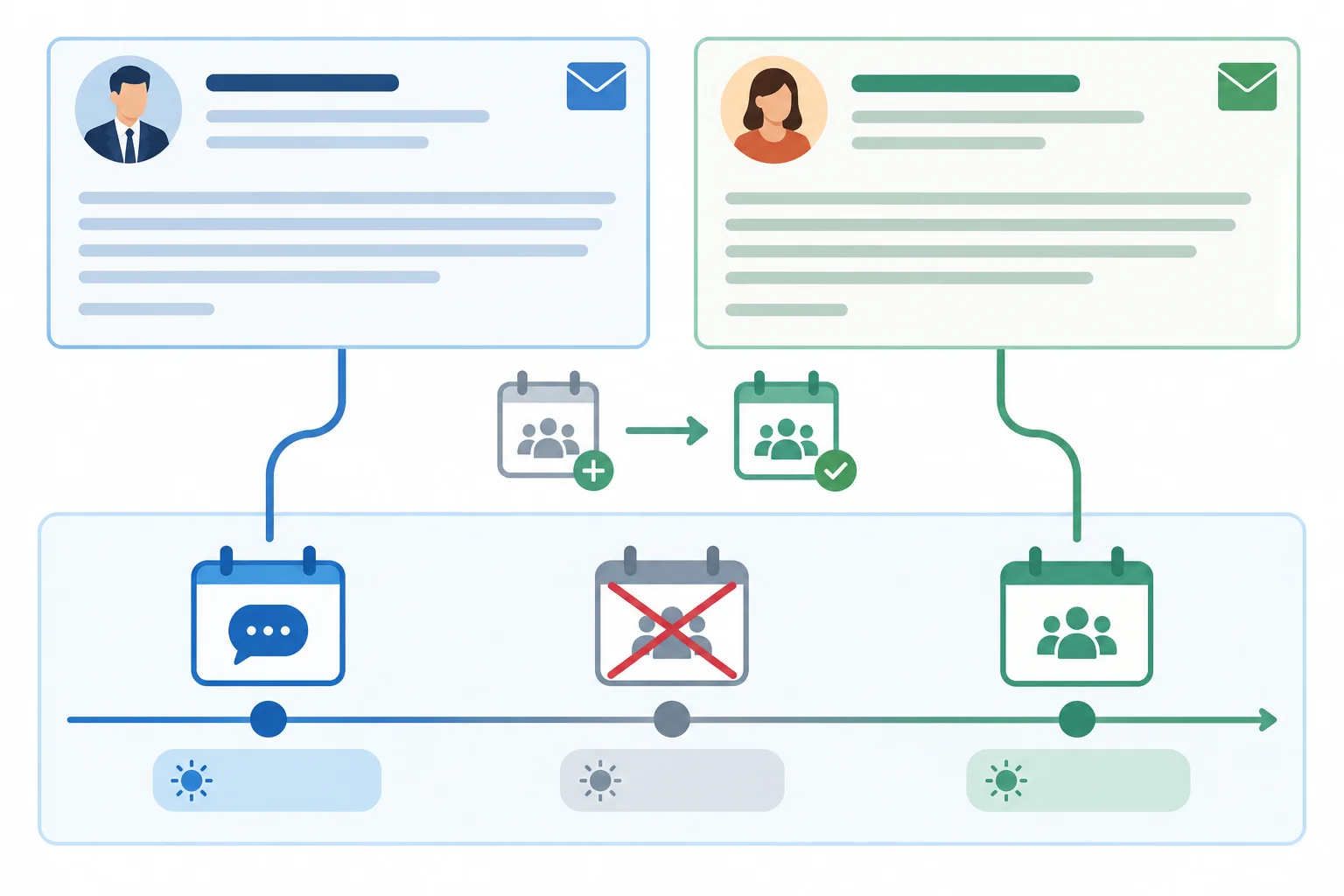
The recipient changes the tone, not the schedule, requested response, deadline, or reason.
Use the examples as references, not fixed scripts. The first three columns show choices that can change with the relationship. The final column identifies the information that must remain accurate.
| Email element | Less familiar contact | Familiar colleague | What must remain accurate |
|---|---|---|---|
| Greeting | Dear Jordan, | Hi Alex, | Use the correct recipient name |
| Problem wording | The report will not be ready. | The report will not be ready. | The report is ready only Thursday afternoon |
| Request style | Would it be possible to ...? | Could you ...? | A response is needed |
| Workplace wording | move the project review | put the project review off | The proposed review is at 10 a.m. on Friday |
| Closing | Kind regards, | Thanks, | Maya signs the email |
| Deadline and reason | reply by the deadline | let me know by the deadline | Respond by 3 p.m. on Wednesday so Maya can update the invitation |
Read the two reference emails. Notice their shared structure: subject, reason, practical effect, request, deadline, and closing. The wording changes, but each reader receives the same essential information.
Use these as models, not scripts. Your own clear, natural wording can also work.
Example
Subject: Project review: Friday?
Dear Jordan,
I am writing to provide an update about the project review scheduled for 10 a.m. on Thursday. The report will not be ready until Thursday afternoon, so we will not have the information needed for a useful discussion at the planned time.
Would it be possible to move the project review to 10 a.m. on Friday? Could you confirm your availability by 3 p.m. on Wednesday so I can update the invitation and let the team know about the change?
Kind regards,
Maya
Example
Subject: Project review: Friday?
Hi Alex,
I wanted to raise a concern about the project review scheduled for 10 a.m. on Thursday. The report will not be ready until Thursday afternoon, so we will not have the information we need for a useful discussion at that time.
Could you confirm whether 10 a.m. on Friday works for you by 3 p.m. on Wednesday? If it works, I can put the project review off and update the invitation so the team can read the report before we meet together.
Thanks,
Maya
Use this checklist on your original email to Jordan before adapting key lines for Alex.
| Check | Question for your draft |
|---|---|
| Purpose | Does the subject make the project-review change clear? |
| Problem | Does the email explain that the report is delayed and why that matters? |
| Solution | Is 10 a.m. on Friday clearly separate from the Thursday schedule? |
| Action | Can the reader identify exactly what response is needed? |
| Deadline | Is by 3 p.m. on Wednesday clear, with the reason for it? |
| Tone | Do the greeting, request, vocabulary, and closing suit the recipient? |
| Phrasal verb | If you use one, is its object in the correct position? |
| Length | Is the Jordan email body 80–120 words, excluding subject, greeting, closing, and Maya? |
First, revise your original email to Jordan using the reference emails and checklist on the previous screen. Then adapt four key lines for Alex.
Submit these labeled entries:
Keep the business action and deadline unchanged. Your Alex version should be friendly, clear, and professional.
Write at least 80 characters (0/80).
Summary
You can now adapt one workplace message for two relationships without changing its purpose.
Before sending a work email, ask one final question: Can this reader tell what to do, by when, and why?
Congratulations! You completed: Write Work Emails with the Right Tone
Thousands of online courses in video, ebooks and audiobooks.
To test your knowledge during online courses
Generated directly from your cell phone's photo gallery and sent to your email

Download our app via QR Code or the links below:.



Carry knowledge in your pocket.
Download the Cursa app.
There are hundreds of free courses available, with a free certificate of completion that is saved in your mobile image gallery.
Download the app to access the Course Completion Certificate for Free.


+ 10 million
students

Free and Valid
Certificate

60 thousand free
exercises

4.8/5 rating in
app stores

Free courses in
video and ebooks