
Step 1 of 8
Understand the Problem
Read Maya's study problem and identify what has happened, what is still difficult, and what help she needs.

Learning path · Level 5 · Tutorial 4
Understand an everyday problem and offer useful, polite advice. Read and listen to messages about study, work, or feeling unwell. Practise a conversation aloud and write a reply that fits the problem, with safe limits for health advice.

 Understand the Problem
Read Maya's study problem and identify what has happened, what is still difficult, and what help she needs. 2 min
 Give Advice with Should and Shouldn't
Give relevant positive and negative advice with should and shouldn't, then add a simple reason. 3 min
 Ask for Advice
2 min
 Offer Another Possibility
Offer realistic possible solutions in study and work situations with You could and Why don't you. 2 min
 Accept Advice or Explain a Difficulty
Respond to advice politely: accept a useful idea, or explain a practical difficulty so that the conversation can continue with a better suggestion. 2 min
 Hear the Advice and Say It Clearly
3 min
 Keep Health Advice Safe
Give limited, supportive advice about feeling unwell and recognise when a reply should suggest professional help. 2 min
 Put It All Together
Combine reading, listening, writing, and speaking to create a relevant, polite, and safe advice exchange. 4 min
Step 1 of 8
Read Maya's study problem and identify what has happened, what is still difficult, and what help she needs.
When you read a problem message, look for three things:
A completed action can be good news, but another part of the situation may still be a problem.
Example
Problem
Maya: I've finished one assignment, but I have two assignments due on Friday. I'm worried because I find the other one difficult.
Maya has completed part of her work. However, one assignment is still unfinished, and it is difficult for her.
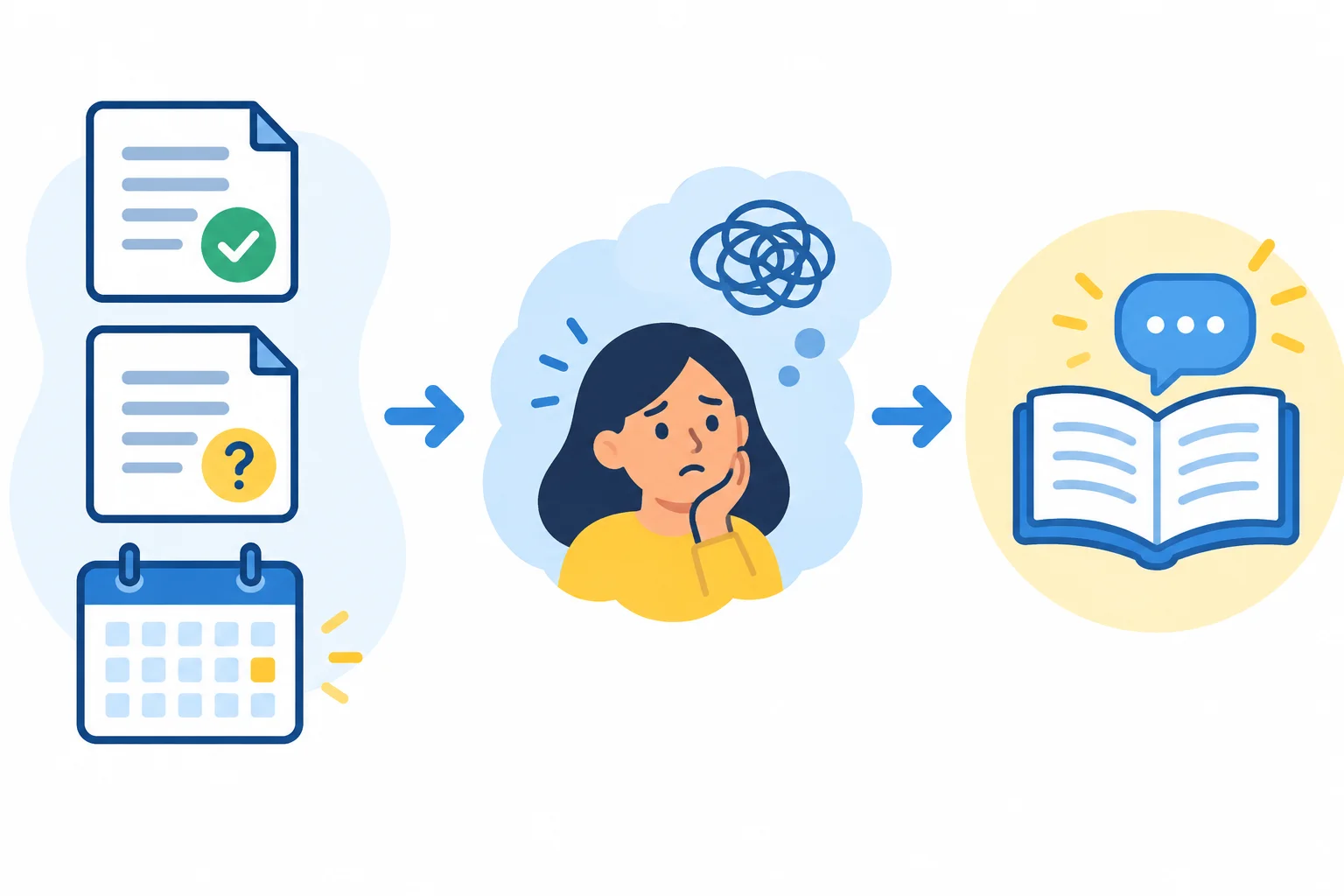
Read the map from the situation to the unfinished difficulty, then to the help Maya needs.
The words feel worried describe a concern: Maya is not calm about the situation.
The words find something difficult mean that an activity is hard for someone to do or understand.
Do not choose help from only one word. Connect all the details: Maya has a deadline, one task is complete, and the other task is difficult.
Example
Situation: two assignments are due on Friday.
What has happened: Maya has finished one assignment.
What is still a problem: the other assignment is difficult.
Need: Maya needs help with the unfinished assignment.
Understanding the need comes before giving advice.
Tip
A message can include both progress and a problem. Notice the contrast word but: it often introduces information that is still difficult or unfinished.
Maya has two assignments due on Friday. She has finished one, but she feels worried because she finds the other one difficult.
Match each detail to its meaning.
Tap an item and then its matching pair.

Step 2 of 8
Give relevant positive and negative advice with should and shouldn't, then add a simple reason.
Maya has two assignments due on Friday. She has finished one, but she feels worried because she finds the other one difficult.
Good advice connects to the person’s real difficulty. Maya needs help with planning and studying, not advice about an unrelated problem.
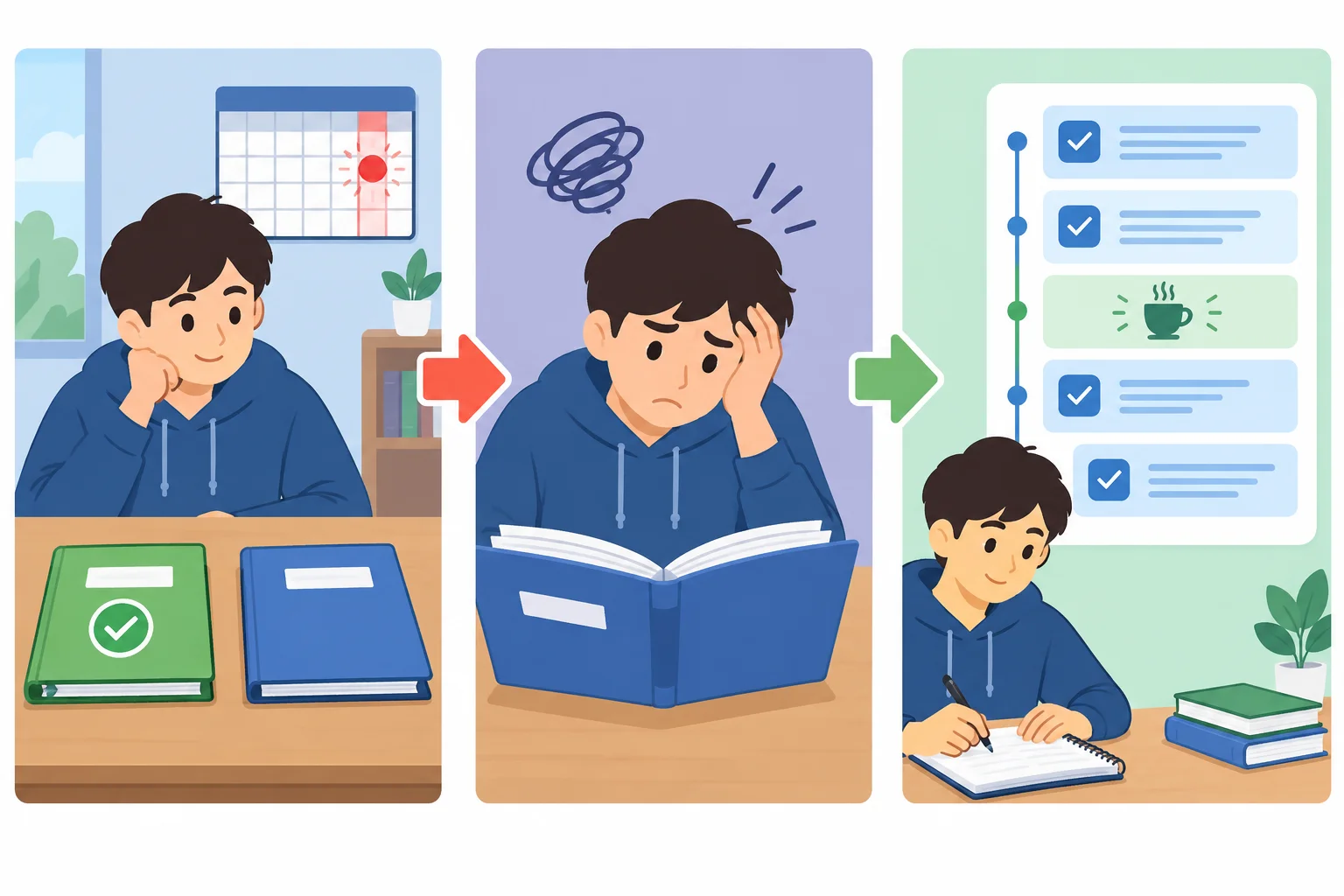
Start with the situation and difficulty, then choose advice that helps.
Use should + base verb to recommend a helpful action.
Advice: Maya should make a study plan.
The base verb is the action word after should: make, not makes or to make.
Use shouldn't + base verb to advise against an unhelpful action. Shouldn't means should not.
Both forms give advice. They are not rules.
Example
Advice with a reason
Maya should take a break because she feels worried.
Maya shouldn't study all night because she needs rest.
Use because to give a short reason why the advice is useful.
Earlier, you learnt have to for a requirement. Compare it with should for advice.
| Sentence | Type | Meaning |
|---|---|---|
| You should arrive early. | Advice | A helpful recommendation |
| You have to arrive by nine. | Requirement | A necessary action |
Which line gives Advice, not a requirement?
Complete the reason word:
Maya should take a break ___ she feels worried.
Build a helpful recommendation for Maya's remaining assignment.
Your sentence
Available words
Build a warning against an unhelpful way of studying.
Your sentence
Available words

Step 3 of 8
When you have a problem, choose the question that matches what you need.
Both questions help the other person understand what kind of help you need.
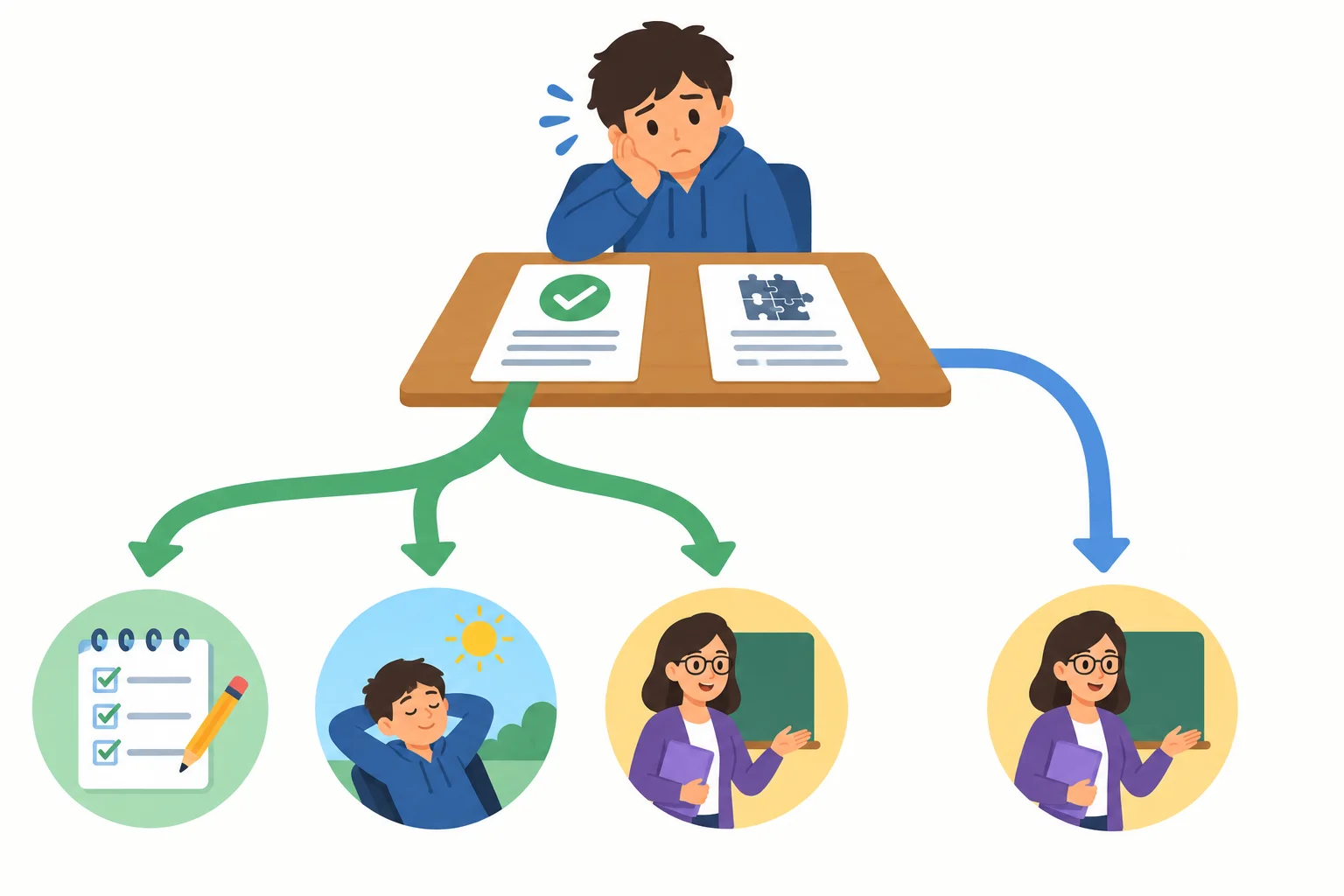
A broad question opens several possible ideas; a specific question asks about one action.
Example
Maya: I've finished one of my two assignments due on Friday, but I find the other one difficult. I feel worried. What should I do?
Alex: You should make a study plan.
Maya: Should I ask my teacher for help?
Alex: Yes, you should.
For a specific question, put should before the subject:
Should I + base verb ...?
The verb after I is the base verb. Do not start this question with I should ...? — that form gives advice; it does not ask for it.
Tip
Use What should I do? when the problem is broad. Use Should I + base verb ...? when you already have a possible action in mind.
Build the short exchange from the blocks. Start with Maya’s Problem, ask for general Advice, and then ask about one possible action.
Your sentence
Available words

Step 4 of 8
Offer realistic possible solutions in study and work situations with You could and Why don't you.
Use You could + base verb to offer a possible solution. It gives someone an option to consider; it does not state a requirement.
Problem: Maya has finished one of her two assignments due on Friday, but she finds the other one difficult.
Alex can offer a useful possible solution.
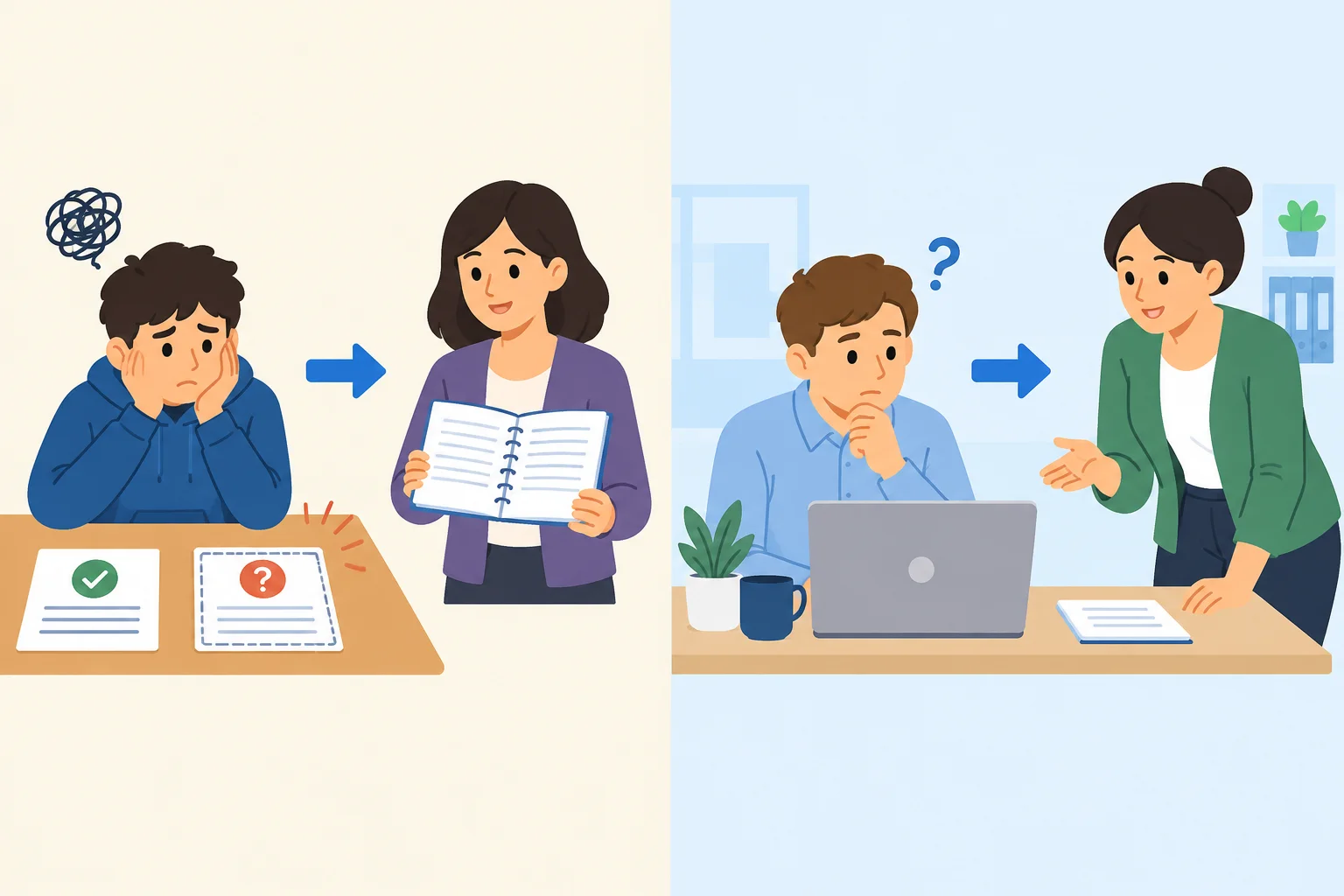
A possible solution should fit the person's situation and the help that is available.
Example
Advice
Alex: You could ask your teacher for help.
After could, use the base verb: ask, not to ask or asking.
Use Why don't you + base verb ...? to make a suggestion.
In an advice exchange, this question suggests an action. It is not asking for a reason why the person does not do it.
Problem: Alex has got a new task at work and doesn't understand it.
Example
Advice
Maya: Why don't you ask a colleague for help?
The base verb is ask. This suggestion fits because a colleague may understand the task.
All three forms can sound friendly. Choose the form that expresses your meaning; they are not a fixed politeness scale.
| Form | Example | Meaning |
|---|---|---|
| should + base verb | You should take a break. | Advice about a helpful action |
| could + base verb | You could make a study plan. | One possible solution |
| Why don't you + base verb ...? | Why don't you ask your teacher? | A suggestion in question form |
Match each Problem to the suggestion that fits it best.
Tap an item and then its matching pair.
For a worried student who needs a short pause, build a suggestion with You could.
Your sentence
Available words
For Maya and her two assignments due on Friday, build a suggestion with Why don't you.
Your sentence
Available words

Step 5 of 8
Respond to advice politely: accept a useful idea, or explain a practical difficulty so that the conversation can continue with a better suggestion.
When someone gives Advice, you have two polite Response paths.
If the advice is useful and possible, accept it: “That’s a good idea. I’ll try that.”
If it is difficult to follow, explain the practical problem: “I’m not sure I can do that because ...” Give a real reason, not only “no”. This helps the other person offer a better suggestion.
Use the flow to decide whether to accept advice or explain why it is difficult.
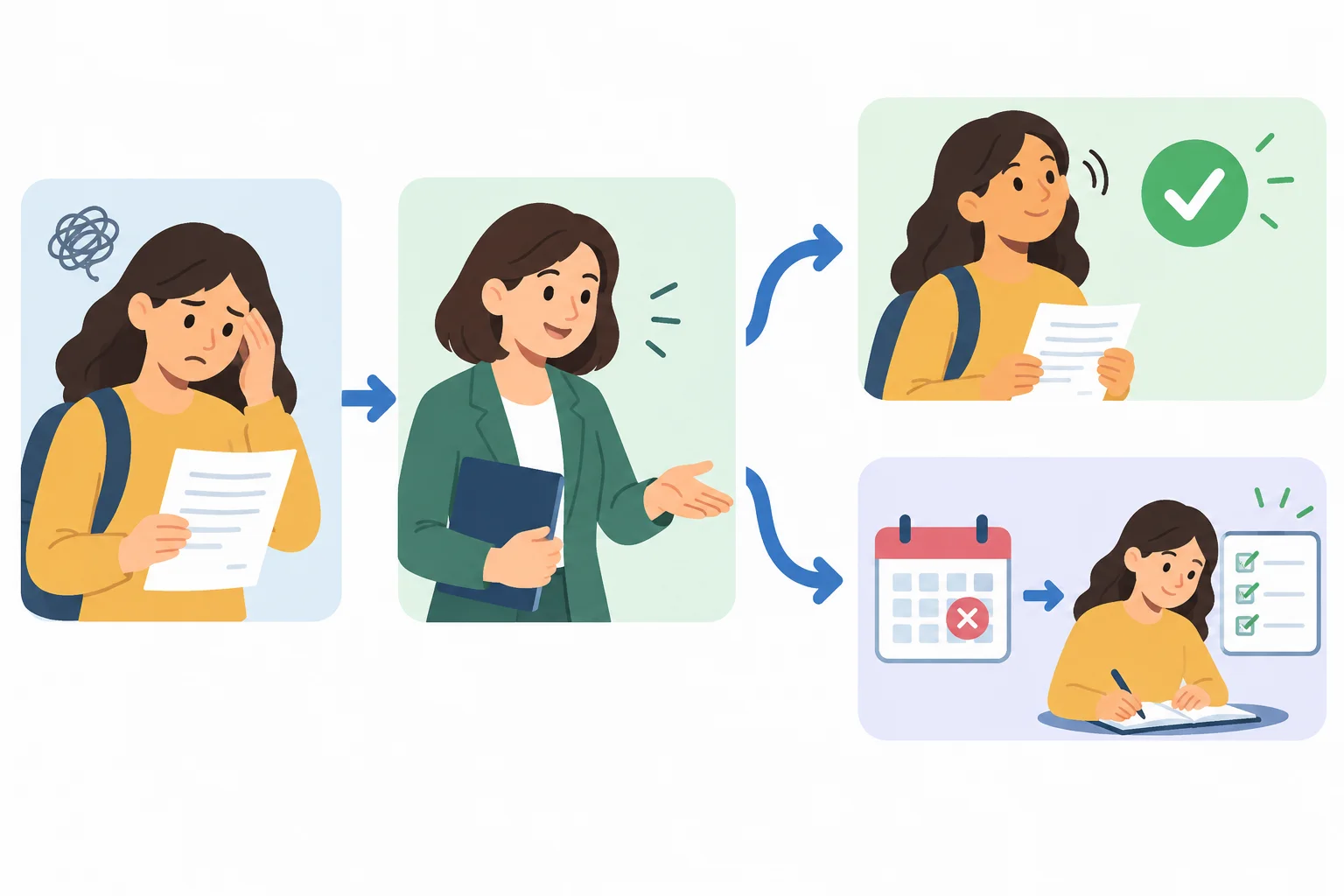
A helpful conversation can continue in two different ways after Advice.
Example
Problem
Maya: I’ve finished one of my two assignments due on Friday, but I find the other difficult. I feel worried.
Advice
Alex: You should make a study plan.
Response
Maya: That’s a good idea. I’ll try that.
Sometimes Advice does not fit the person’s situation. The Response can explain the difficulty politely: “I’m not sure I can do that because ...”
Then the adviser can acknowledge it briefly: “That sounds difficult.” After that, offer another suggestion that the person can realistically follow. This keeps the exchange helpful.
Example
Problem
Maya: I’ve finished one assignment, but I find the other one difficult.
Advice
Alex: Why don’t you ask your teacher for help?
Response
Maya: I’m not sure I can do that because my teacher isn’t at school today.
Advice
Alex: That sounds difficult. You could make a study plan for the assignment.
Response
Maya: That’s a good idea. I’ll try that.
Tip
A practical difficulty can be about time, availability, or what is possible now. Listen to the reason before you offer another suggestion.
Problem: Alex has a work report due tomorrow. A colleague suggests, “You could ask a colleague for help.” Alex knows that everyone has gone home. Which Response fits the situation?
Arrange this short exchange. The first suggestion is unsuitable because of the stated situation; it is followed by a polite explanation and a better option.

Step 6 of 8
When you listen to Advice, find two things: the recommended action and whether the meaning is positive or negative.
In connected speech, should can sound short and weak. With shouldn't, do not wait for a strongly pronounced final t. Listen to the whole phrase for its negative meaning, then listen carefully for the important action words.
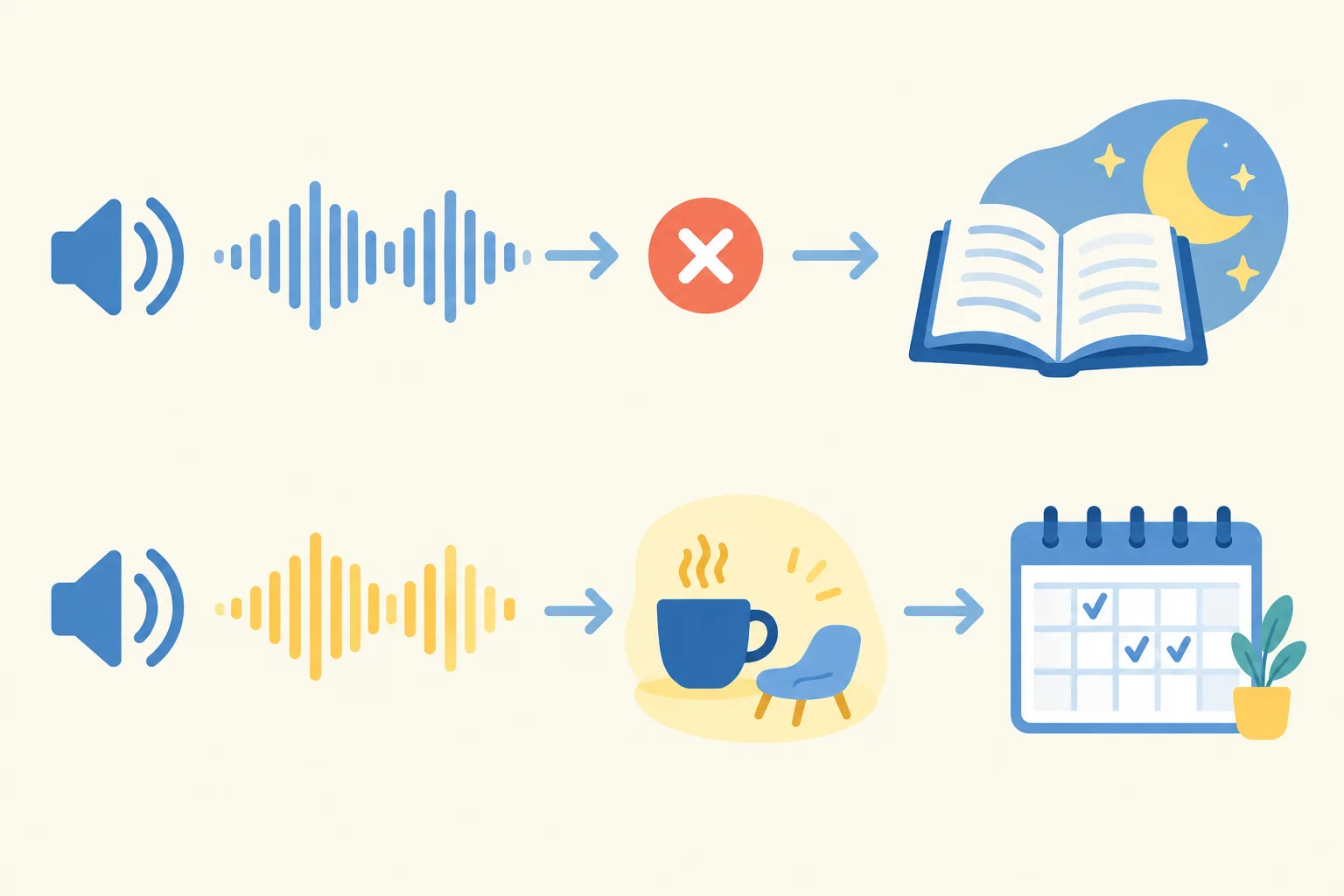
Listen for the negative meaning in shouldn't, then listen for the action.
Listen and follow the transcript. Notice how the main action words are clearer than should.
Maya: I've finished one assignment, but I'm worried about the other.
Alex: You shouldn't study all night. You should make a study plan.
Maya: I've finished one assignment, but I'm worried about the other.
Alex: You shouldn't study all night. You should make a study plan.
Tip
For a clear, friendly negative, say shouldn't as one unit. Give a little stress to the action words, such as study all night. Keep your voice calm and helpful, not sharp or angry.
Listen and choose an option.
Listen to the short conversation. Which action does Alex recommend?
Maya: I feel worried about my assignment.
Alex: You shouldn't study all night. You should take a break and make a study plan.
Listen and write what you heard.
Listen twice and write the complete sentence you hear.
Now practise the whole exchange aloud. Read Maya's first line, then Alex's two Advice lines, then Maya's Response. Repeat once and switch roles. Use a friendly, supportive voice.
Example
Problem
Maya: I've finished one assignment, but I find the other one difficult. I'm worried.
Advice
Alex: You shouldn't study all night. You should make a study plan.
Response
Maya: That's a good idea. I'll try that.
Tip
After you speak, check three things:
Clear meaning matters more than making every sound strong.
Practise the transcript aloud in both roles. Then write a short self-check: say whether you made the negative meaning clear, stressed the action words, and kept a friendly voice.

Step 7 of 8
Give limited, supportive advice about feeling unwell and recognise when a reply should suggest professional help.
When someone feels unwell, keep your advice general and kind. You can suggest a simple supportive action:
Advice: You should get some rest.
This is everyday advice. It does not say what illness the person has or how to treat it.
Problem: “I've felt unwell for a few days.”
Response: “That sounds difficult. You should get some rest.”
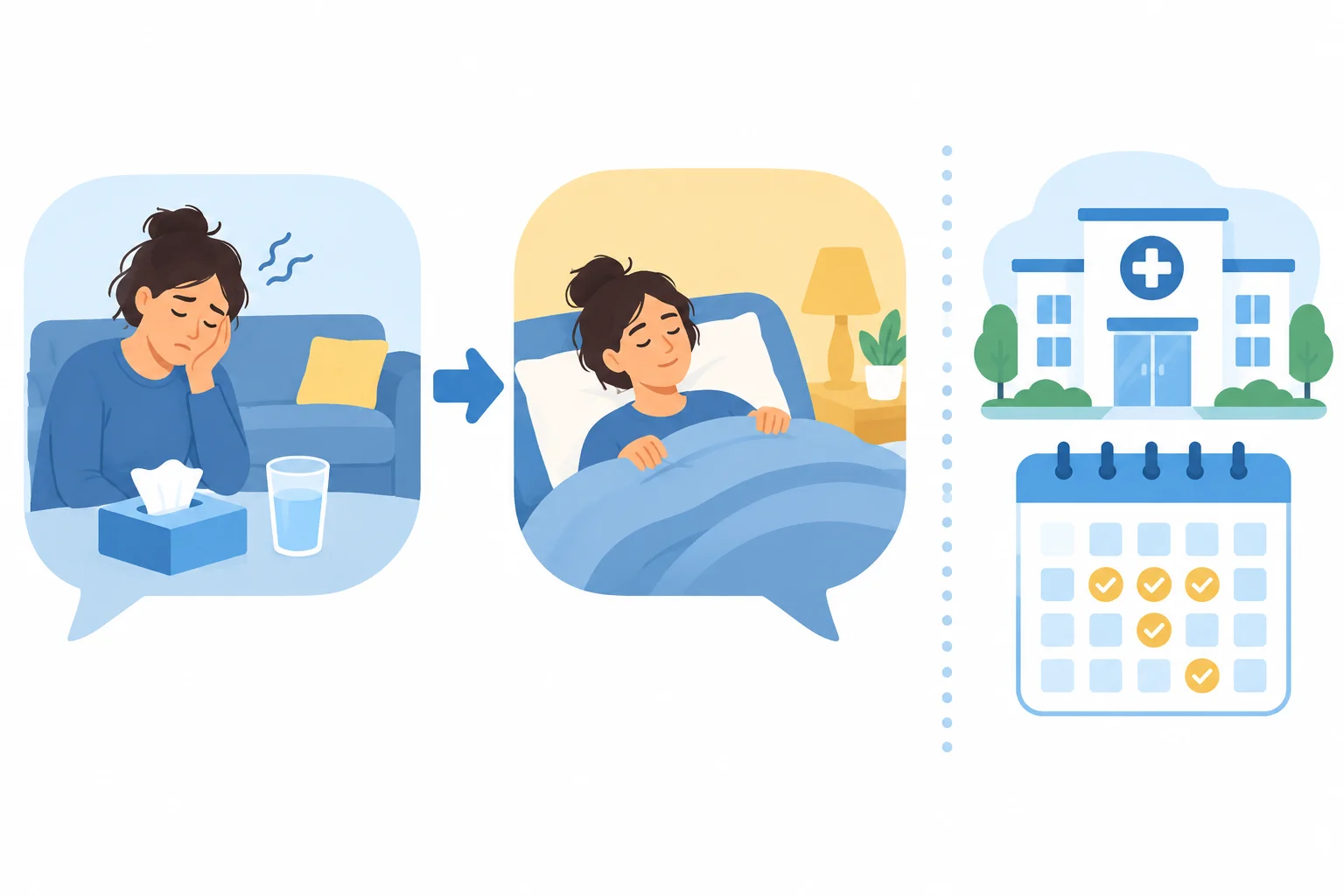
Everyday support can be helpful, but serious or lasting concerns need a health professional.
Use advice for simple support, not for diagnosis or treatment. A health professional can help with concerns that are serious or last for a while.
Choose a reply that fits the concern and stays within everyday advice.
| Problem | Advice | Response |
|---|---|---|
| “I feel unwell today.” | Get some rest. | “You should get some rest.” |
| “I've felt unwell for several days.” | Speak to a health professional. | “I think you should speak to a health professional.” |
| “This feels serious.” | Get urgent local medical help. | “Please get urgent local medical help.” |
Warning
Do not recommend medicines, doses, or treatment. Do not try to decide what illness a person has.
If someone describes an urgent health concern, they need urgent local medical help, not only everyday advice.
Example
Problem: “I've felt unwell for several days, and I'm worried.”
Response: “That sounds difficult. I think you should speak to a health professional because it has lasted for several days.”
The response is kind, gives a reason, and does not diagnose the problem.
Problem: “I've felt unwell for several days, and it seems to be getting worse.”
Which response is most helpful and safe?
Complete the Response.
Problem: “I've felt unwell for several days, and I'm worried.”
“I think you should speak to a ___.”

Step 8 of 8
Combine reading, listening, writing, and speaking to create a relevant, polite, and safe advice exchange.
Alex: I've finished part of a report, but I haven't finished the last section. It is due Friday. I've felt unwell for several days, and I'm worried.
Read the message, then listen for the practical difficulty. A useful reply must respond to both the unfinished task and the health concern.
Listen to the follow-up.
Maya: That sounds difficult. Have you asked your colleague for help?
Alex: I'm not sure I can do that because she's away until Friday.
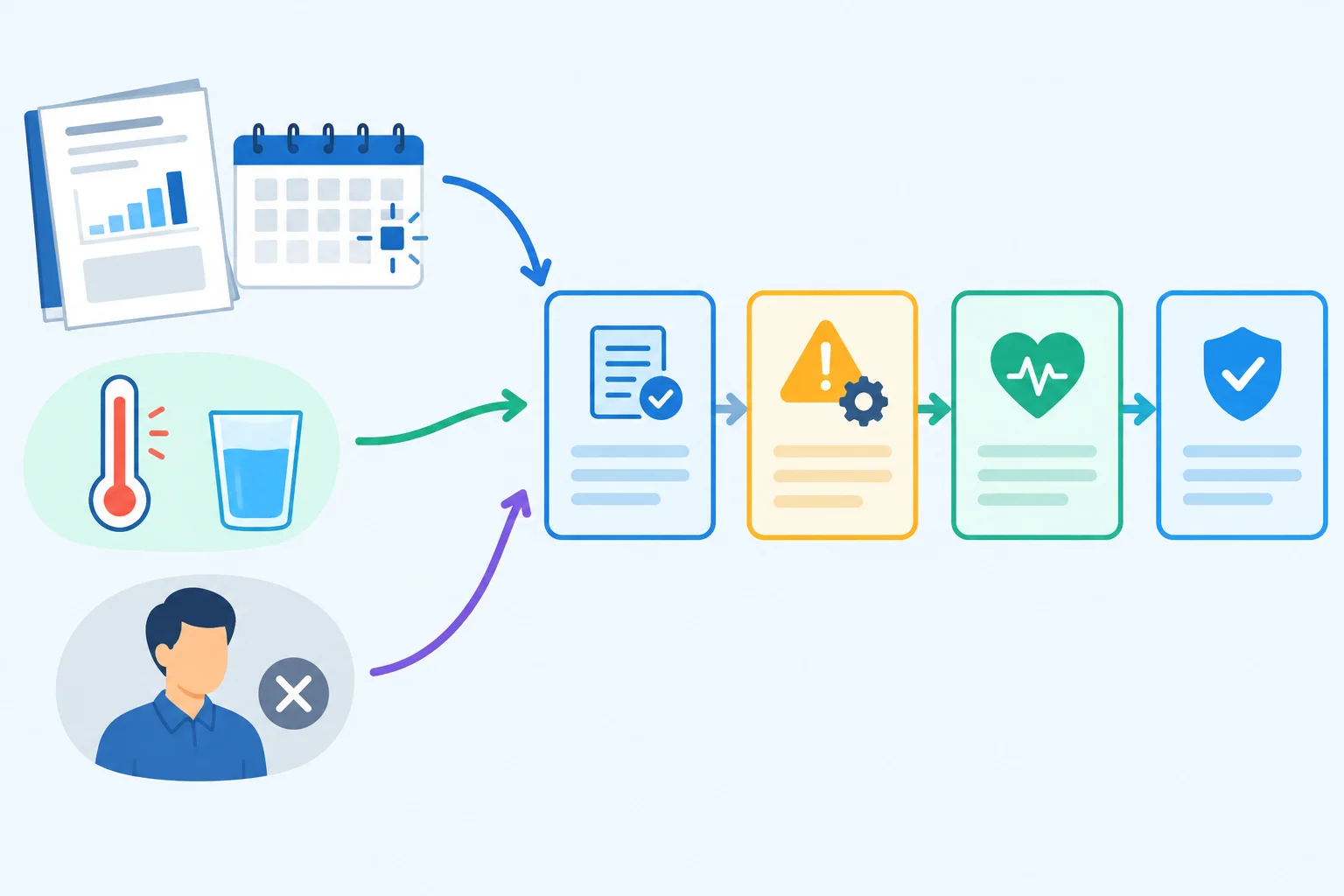
Use every part of the situation: the task, the difficulty, and the health concern.
Warning
Everyday advice is not diagnosis or treatment. For serious or lasting health concerns, suggest a health professional. For urgent health concerns, seek urgent local medical help.
Build your reply in this order:
The colleague is away until Friday, so choose a different practical next step. Do not recommend medicine or treatment.
Write a first draft of 50–70 words to Alex. Include an acknowledgement, advice about the report, a reason, a different practical next step, and safe advice about feeling unwell for several days.
Write at least 250 characters (0/250).
Example
That sounds difficult, Alex. You should tell your manager that you're unwell and make a short plan for the last section, because the report is due on Friday. You could ask your manager which part is most important first. As you've felt unwell for several days, you should contact a health professional. I hope you feel better soon.
Listen once. Then take both roles and say the exchange aloud. Keep shouldn't clear, but use a friendly voice.
Alex: What should I do?
Maya: You shouldn't work all night. You should tell your manager you're unwell. Why don't you contact a health professional?
Alex: That's a good idea. I'll try that.
Tip
Compare your draft with the model. Check that it:
Now revise your reply in your own words. Write 50–70 words for Alex using all the information from the message and follow-up. Then practise aloud: say Alex's question for advice, say your revised reply, and add either an accepting response or a polite explanation of a difficulty.
Write at least 250 characters (0/250).
Summary
Congratulations! You completed: Give and Respond to Everyday Advice
You completed this level!
Up next: B1: Stories and Possibilities
 Describe What Was HappeningDescribe what was happening when something else happened. Listen to and read short accounts of everyday interruptions, choose matching audio, and write a short sentence you hear. Then explain a scene aloud and write connected sentences, using a model to check your work.
Thousands of online courses in video, ebooks and audiobooks.
To test your knowledge during online courses
Generated directly from your cell phone's photo gallery and sent to your email

Download our app via QR Code or the links below:.



Carry knowledge in your pocket.
Download the Cursa app.
There are hundreds of free courses available, with a free certificate of completion that is saved in your mobile image gallery.
Download the app to access the Course Completion Certificate for Free.


+ 10 million
students

Free and Valid
Certificate

60 thousand free
exercises

4.8/5 rating in
app stores

Free courses in
video and ebooks