 Cosmology
 Black Holes
 Space Exploration
 Dark Energy
 Rocket Propulsion
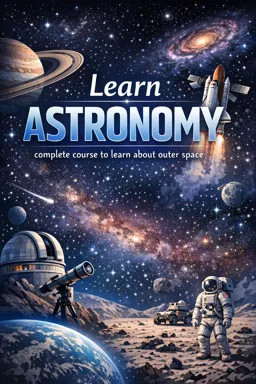
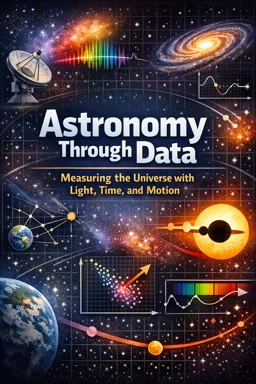


You can explore the Solar System, stars, galaxies, cosmology, telescopes, exoplanets, and the origins of the universe.

10

1

2


Understand the night sky with a free astronomy course—planets, seasons, eclipses, and space exploration basics. Learn fast with short lessons and quizzes.
5

(4)

9h07m

12 exercises
Understand the Big Bang and cosmic expansion in this free online course with quick lessons and exercises—learn CMB, inflation, and galaxy formation fast.
4.7

(57)
2h56m
24 exercises
Explore how the universe works and sharpen your astronomy skills in a free online course—planets, solar storms, black holes, and the search for life.
4.7
(7)
43m
8 exercises
Free CourseCosmology
5
(1)
5h18m
17 exercises
Free CourseExoplanets and the search for Life in the Universe
5
(1)
49m
6 exercises
Free CourseIntroduction to Astronomy - Solar System, Stars and Cosmology
5
(2)
25h55m
49 exercises
Free CourseRocket Science for Everyone
5
(1)
3h31m
23 exercises
Free CourseGeneral Astronomy
New
15h56m
29 exercises
Free CourseCosmology Fundamentals: Hubble’s Law, FLRW Models, Inflationand Structure Formation
New
19h52m
1 exercises
Free CourseDescriptive Astronomy: From Orbits to the Big Bang
New
19h21m
23 exercises
Exercises
Test your knowledge of exoplanet transits, radial velocities, direct imaging, orbital analysis, and atmospheric spectroscopy.
Start exercisesTest your astronomy knowledge with questions on stars, planets, galaxies, eclipses, light-years, the Sun, and the universe.
Start exercisesTest your astronomy knowledge with this cosmic phenomena quiz on galaxies, black holes, stars, planets, comets, auroras, and the Big Bang.
Start exercisesTest your astronomy knowledge with questions on planets, stars, galaxies, eclipses, light-years, and our solar system.
Start exercisesTest your astronomy knowledge with this celestial mysteries quiz on planets, Saturn's rings, eclipses, galaxies, light-years, and stars.
Start exercisesTest your astronomy knowledge with this solar system quiz on planets, moons, eclipses, gravity, the Sun, and the Milky Way galaxy.
Start exercises
Why the Ocean Has Tides: The Moon, the Sun and Two Bulges a Day
A clear beginner’s guide to tides: why the Moon creates two bulges, how the Sun adds spring and neap tides, and why coastlines differ so much.

Understanding the Phases of the Moon: A Beginner’s Guide to Lunar Cycles
Discover how the phases of the Moon work, why its shape changes, and how to recognize each stage of the lunar cycle in the night sky.

What Is a Light-Year? How Astronomers Measure the Distances Between Stars
A light-year measures distance, not time. Learn what it really means, why looking at stars is looking into the past, and how it compares to other units.

A Beginner’s Guide to Stargazing: How to Start Observing the Night Sky
Discover how to start stargazing with nothing but your eyes. Learn to find dark skies, spot constellations, and explore the night sky as a beginner.

A Beginner’s Guide to Space Exploration: Reaching Beyond Our World
Learn the basics of space exploration—its purpose, milestones, and how you can get involved in uncovering the mysteries of the universe.

Innovations in Space Technology: How We Explore the Cosmos Today
Discover how modern space technology—robots, reusable rockets, and global partnerships—is transforming how we explore the cosmos today.

Private Companies and the New Era of Space Exploration
Discover how private companies like SpaceX and Blue Origin are reshaping space exploration, from reusable rockets to Mars colonization plans.

The International Space Station: Humanity’s Outpost in Orbit
Explore the history, research, and future of the International Space Station, humanity’s collaborative outpost in orbit.
Explore free online courses designed to develop scientific literacy and a structured understanding of celestial phenomena. Study observational methods, planetary science, stellar evolution, galaxies, spacetime, orbital mechanics, astrophysics and the origin of the universe. These learning resources support beginners, students and lifelong learners through accessible lessons, educational exercises and free certification upon course completion.
The collection ranges from introductory instruction to more advanced theoretical content. Learners can examine the Solar System, stars, exoplanets and the search for extraterrestrial life before progressing to Hubble’s Law, FLRW models, cosmic inflation, structure formation and Big Bang theory. Rocket science lessons also introduce propulsion, trajectories and the physical principles behind spaceflight. Exercises reinforce concepts, encourage review and help learners assess their comprehension throughout the educational process.
Every course is free and includes free certification. To access the courses, users must install the Cursa app. Android users can obtain it through Google Play at Download for Android. iPhone users can install it from the App Store at Download for iOS / iPhone.
Expand your studies with free educational content about Cosmology, including models of cosmic origin and evolution, or discover missions, spacecraft and technological development through Space Exploration. These related subjects offer useful pathways for broadening knowledge of astrophysical processes and humanity’s investigation of space.
Choose a course aligned with your academic interests, complete the lessons and exercises on mobile, and develop a stronger foundation in scientific reasoning, mathematical models and the observation of the cosmos.
What can I learn in an online astronomy course?
You can explore the Solar System, stars, galaxies, cosmology, telescopes, exoplanets, and the origins of the universe.
Is Astronomy 101 suitable for beginners?
Yes. Astronomy 101 courses typically introduce fundamental concepts without requiring prior astronomy knowledge.
What is cosmology in astronomy?
Cosmology is the study of the universe’s origin, structure, evolution, and ultimate fate.
How do telescopes help us study space?
Telescopes collect and focus light, allowing astronomers to observe faint and distant objects in greater detail.
What are exoplanets?
Exoplanets are planets that orbit stars beyond our Solar System.
Can I learn astronomy without advanced math?
Yes. Introductory and descriptive astronomy courses emphasize concepts, while advanced cosmology may use more mathematics.
What does Hubble’s Law explain?
Hubble’s Law shows that distant galaxies generally move away faster, providing evidence that the universe is expanding.

Complete any course and issue your certificate via the app — at no cost.

Download the app! to have access to more than 4,000 Online Courses + Certificate, all free!
Download the app! 100% free courses.


Carry knowledge in your pocket.
Download the Cursa app.
There are hundreds of free courses available, with a free certificate of completion that is saved in your mobile image gallery.
Download the app to access the Course Completion Certificate for Free.


+ 10 million
students

Free and Valid
Certificate

60 thousand free
exercises

4.8/5 rating in
app stores

Free courses in
video and ebooks
What are people saying about free online courses of Astronomy
Leopold Kossack
I really love your Course. I learned much about the Big Bang.
CourseAstronomy
Muzammil Anwar
I really appreciate this Course, thank you so much professor for help us to provide free knowledge
CourseAstronomy 101 complete lessons