
Step 1 of 7
Make It Clear Which One
Use identifying information to make a general noun clear.

Learning path · Level 7 · Tutorial 1
Make it clear which person, thing, or place you mean at a study center or workplace. Read short descriptions, listen and choose the matching person or object, and complete a short dictation. Use pronunciation tips to say descriptions aloud, then write a short note with help from a model.

 Make It Clear Which One
Use identifying information to make a general noun clear. 2 min
 Identify People with Who
Use who to identify a person clearly and avoid an extra subject pronoun. 3 min
 Identify Things with Which
Use which to identify useful objects by what they do or what information they have. 2 min
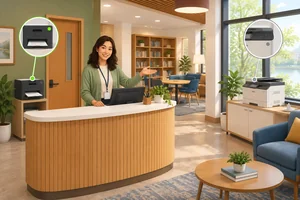 Use That for People and Things
Use that as an equivalent identifying word for people and things, while keeping the clause clear and avoiding an extra subject pronoun. 2 min
 Identify Places with Where
Use where to identify places by the activities that happen there. 3 min
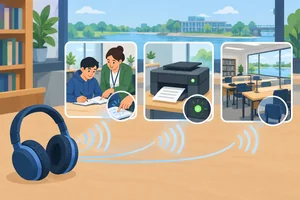 Listen for the Identifying Detail
Listen for the full identifying clause, choose the matching person or object, write a short place description, and practise clear spoken grouping. 3 min
 Write and Say a Helpful Welcome Note
Write and say a clear welcome note that helps a visitor find the right people, objects, and places at Riverside Study Center. 4 min
Step 1 of 7
Use identifying information to make a general noun clear.
At Riverside Study Center, a general word can match more than one person, thing, or place. For example, there are assistants, printers, and rooms.
Add identifying information to show exactly which one you mean. This extra information is called a defining relative clause. It helps the listener find the right person, thing, or place.
American English: center | British English: centre

The words after a general noun can help us choose one exact person, thing, or place.
A defining relative clause goes directly after the noun it identifies. Together, they form this useful pattern:
noun + identifying information
Do not put a comma between the noun and information that is needed to identify it.
Example
Talk to the assistant who helps new students.
Use the printer which works.
Go to the room where we study.
Tip
Read the noun and its identifying information as one unit: “the printer which works.” The listener needs both parts to know which printer you mean.
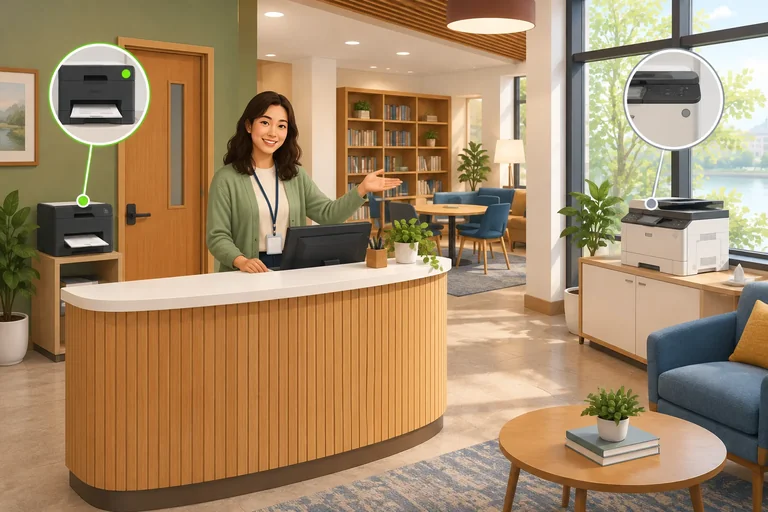
At Riverside Study Center, choose the picture for: the printer which works.
After you choose, say the identifying words that made your choice clear.

Step 2 of 7
Use who to identify a person clearly and avoid an extra subject pronoun.
At Riverside Study Center, two assistants have different jobs. A general noun such as assistant does not always tell us which person we mean.
Use who to add identifying information about a person. This information is called a defining relative clause. It comes directly after the noun and helps identify the person.
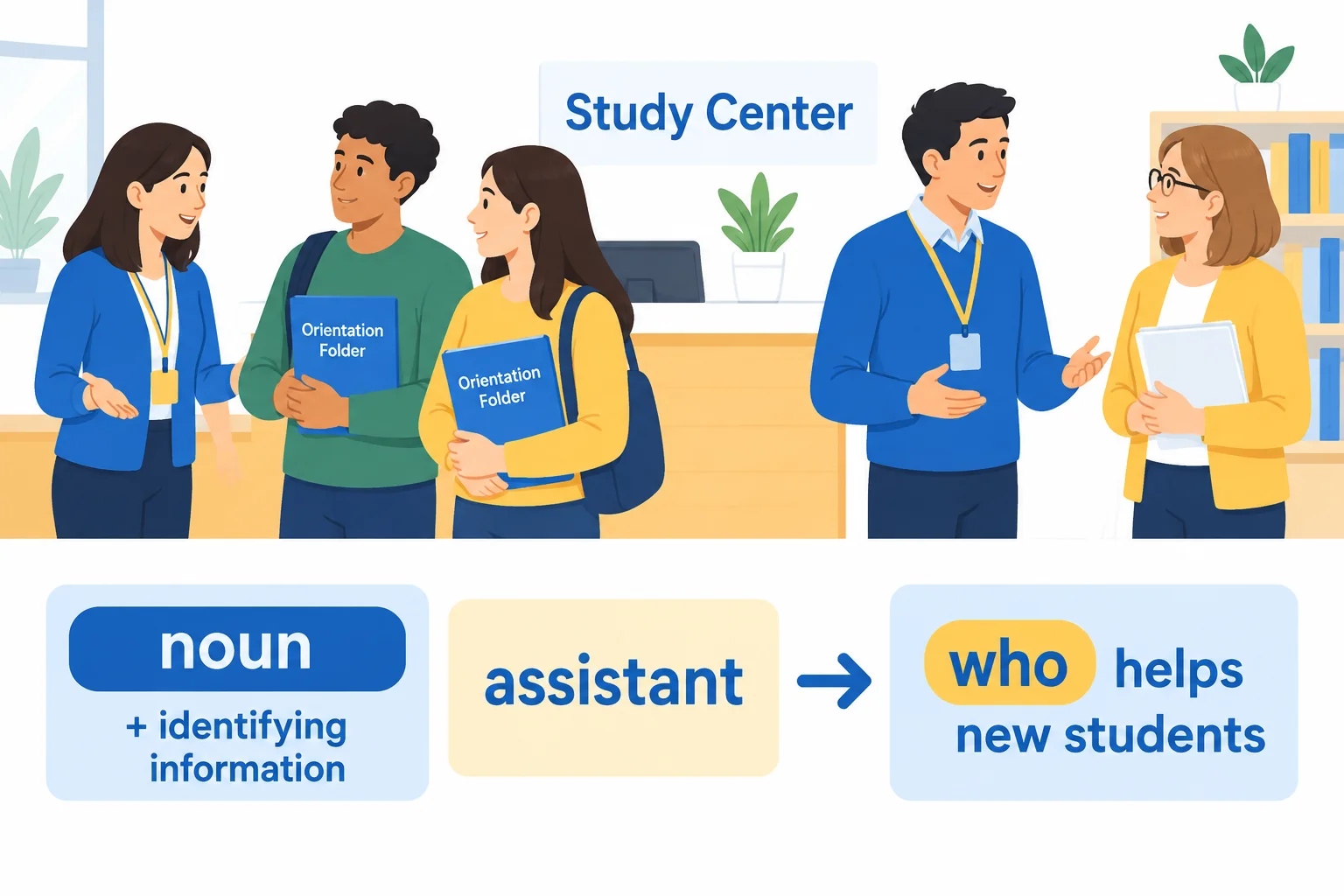
Use noun + identifying information to show exactly which person you mean.
Example
Hana is the assistant who helps new students.
Leo is the assistant who helps teachers.
The underlined defining relative clause gives the identifying information. It follows the noun assistant immediately.
You can join two statements about the same person.
In the joined description, replace the repeated name with who. In this target pattern, who is the subject of the defining relative clause, so a verb comes next.
Example
Maya is the receptionist who welcomes visitors.
For the meaning “the assistant helps new students,” say: who helps new students.
Do not add she, he, or they after who in this pattern. Who already does the subject’s job.
Tip
Read the noun and its identifying information as one unit: “the assistant who helps new students.” Keeping the words together makes the meaning easier to hear.
Put the blocks in order to identify Hana, rather than the other assistant.
Your sentence
Available words
Choose the correct sentence.

Step 3 of 7
Use which to identify useful objects by what they do or what information they have.
Use which to add identifying information about a thing. Put it directly after the noun.
noun + identifying information
the printer + which works
In this pattern, which is the subject of the identifying clause. Follow it with a verb; do not add it or they.
Two printers can have the same name, but the detail after printer tells us which one we mean.
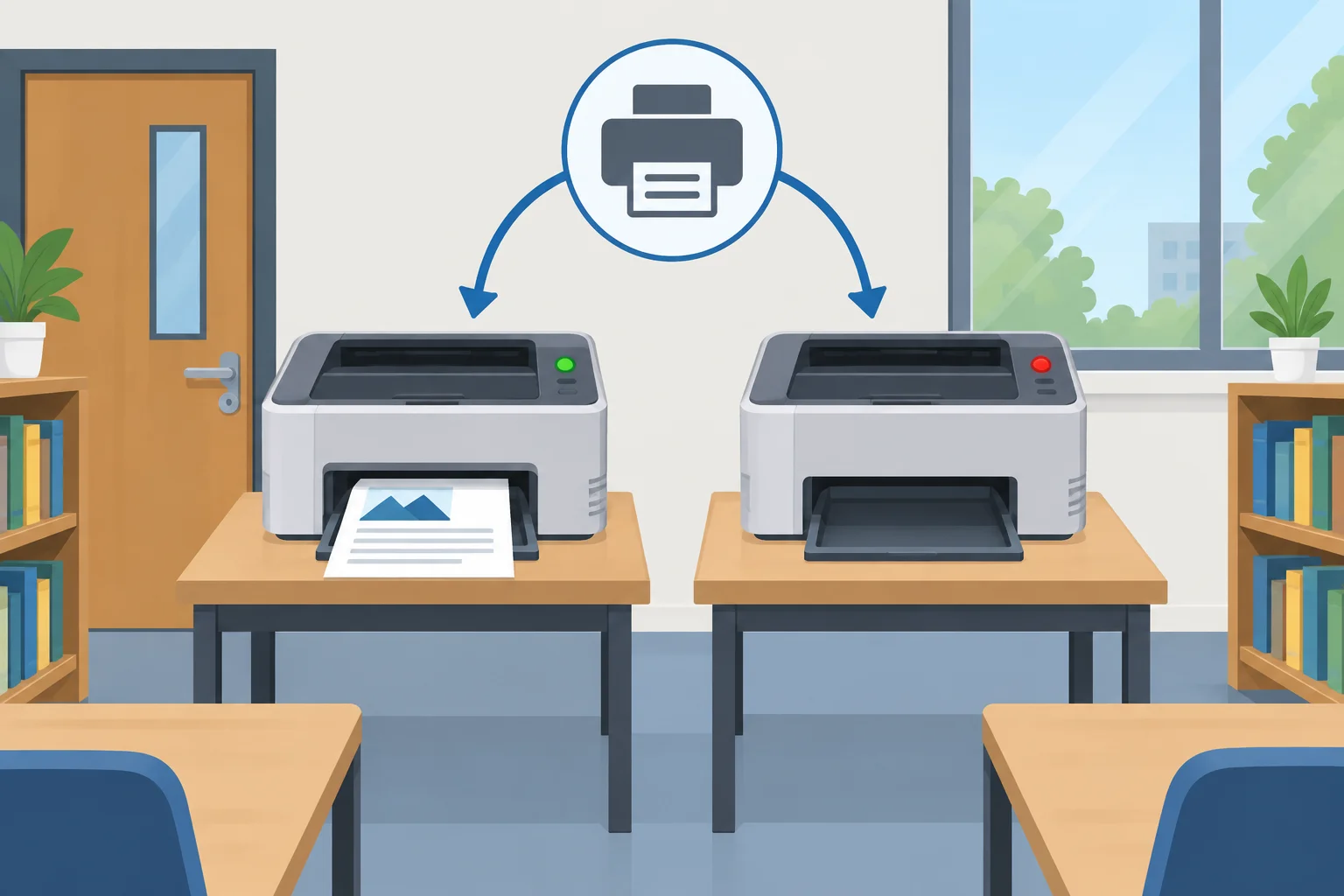
The general noun is the same. Its identifying information selects the intended printer.
Example
The printer which works is by the door.
The form which asks for a name and course is on the reception desk.
The underlined clause identifies the thing. It gives the detail a listener needs, not just another fact.
Match each description to the correct object at Riverside Study Center.
Tap an item and then its matching pair.
Build one clear study-center sentence from the blocks.
Your sentence
Available words
Step 4 of 7
Use that as an equivalent identifying word for people and things, while keeping the clause clear and avoiding an extra subject pronoun.
You already use who for people and which for things. In these defining relative clauses, that can replace either word. The identifying information stays directly after the noun and keeps the same meaning.
The assistant who helps new students is Hana.
The assistant that helps new students is Hana.
The printer which works is by the door.
The printer that works is by the door.
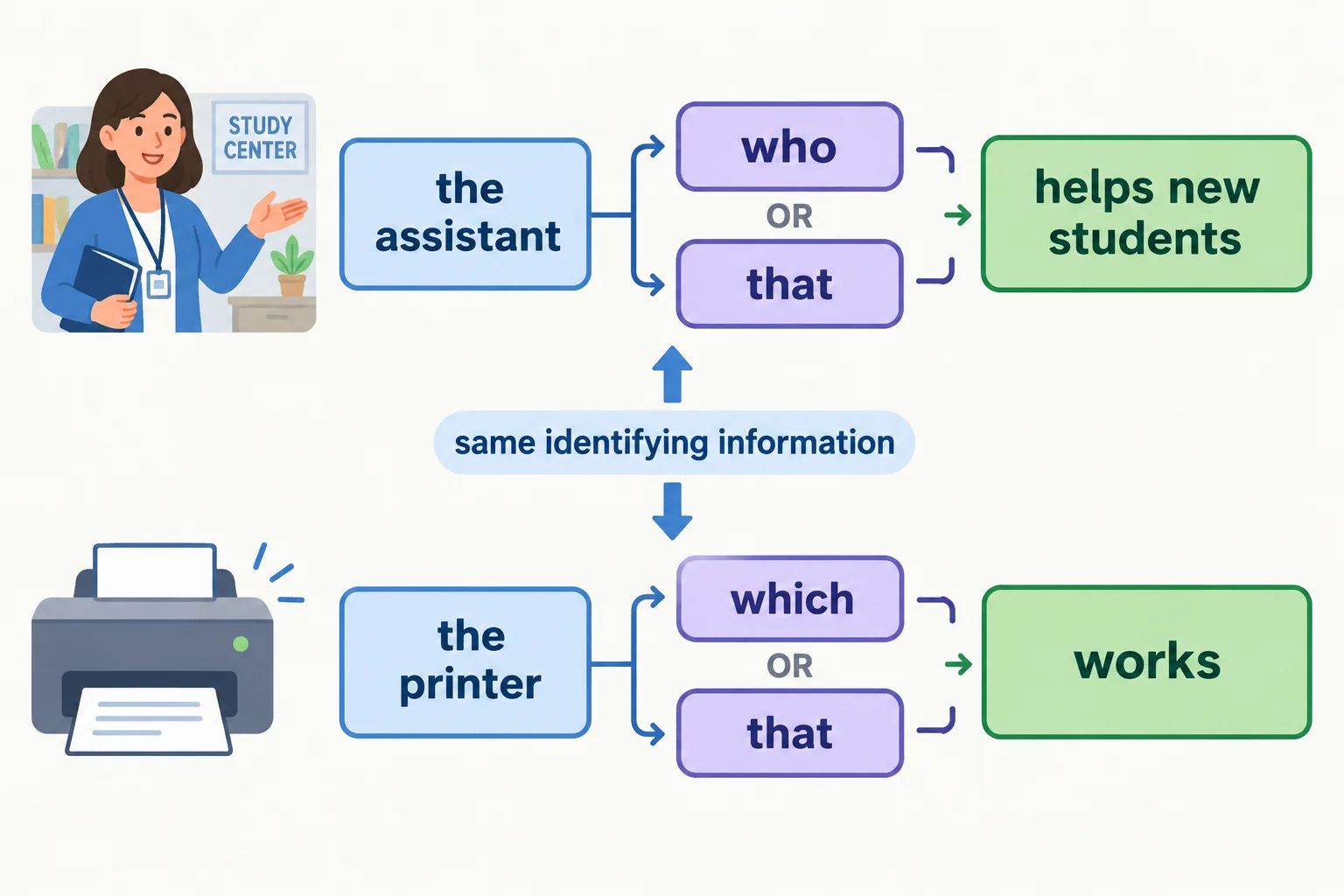
For people, who or that can introduce the identifying information. For things, which or that can do the same.
Both choices are valid in these examples. Choose that when you want one form for either a person or a thing.
Do not add another subject after that. It already does the subject’s job in these patterns: the assistant that helps and the printer that works.
| Noun | Earlier choice | Equivalent with that |
|---|---|---|
| the assistant | who helps new students | that helps new students |
| the printer | which works | that works |
Choose the sentence with the same identifying meaning as: “The printer which works is by the door.”
True or false: “the assistant who helps new students” and “the assistant that helps new students” can identify the same person.
Rewrite this description with that:
“The assistant who helps new students is Hana.”
Complete the new description: “The assistant ____ new students is Hana.”

Step 5 of 7
Use where to identify places by the activities that happen there.
Use where to add identifying information about a place. The clause tells us what happens in that place.
Structure: noun + identifying information
place + where + subject + verb
Reception where visitors meet the receptionist is near the entrance.
Unlike who, which, and that in the subject patterns you know, where does not replace the subject. Keep a subject after where: visitors meet.
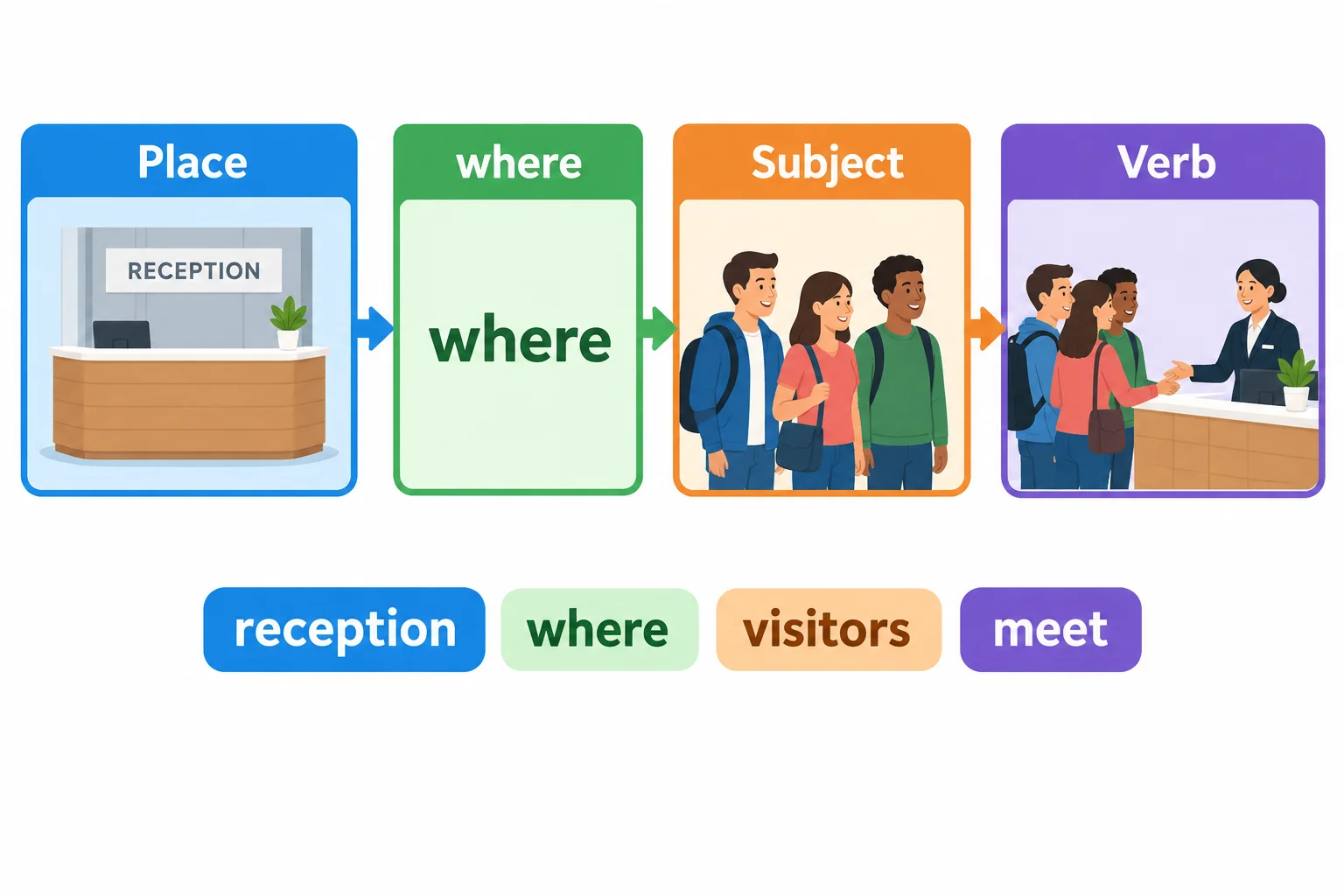
A place clause keeps its subject: place + where + subject + verb.
At Riverside Study Center, activities help identify each place:
The activity after where tells you exactly which place someone means.
Compare the word after the linker.
| Linker | It identifies | What follows |
|---|---|---|
| who | a person | a verb: helps |
| which or that | a thing | a verb: works |
| where | a place | a subject + verb: visitors meet |
Complete the sentence.
Reception is the area ___ visitors meet the receptionist.
At Riverside Study Center, build a complete description for the place used for studying.
Your sentence
Available words
Step 6 of 7
Listen for the full identifying clause, choose the matching person or object, write a short place description, and practise clear spoken grouping.
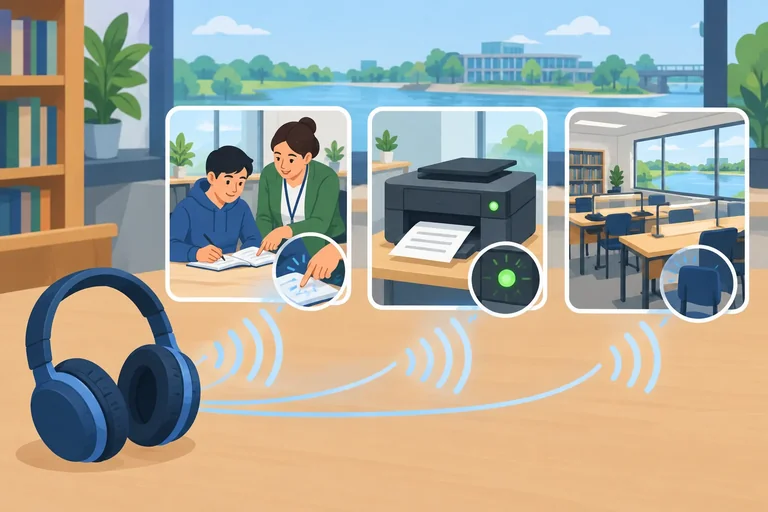
When you hear an identifying description, keep the noun and its identifying information together as one meaning unit. Do not decide after the first noun; listen until the short clause ends.
Stress the detail that shows which one you mean:
You do not need to stress every word. Make the useful identifying detail clear.
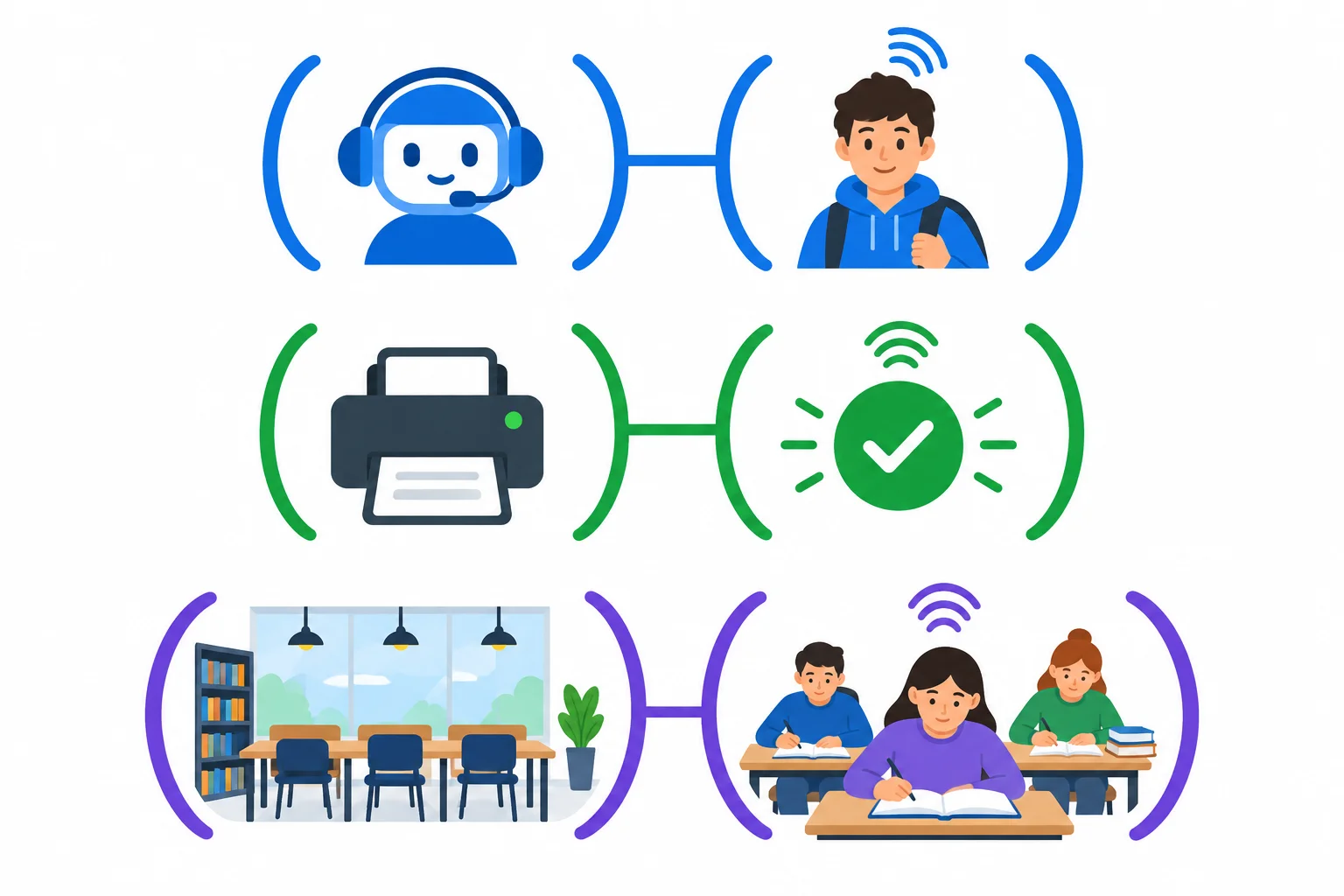
Treat each noun + identifying information group as one unit when you listen and speak.
Listen to three complete groups. Notice how the identifying detail stays connected to the noun.
The assistant who helps new students. The printer that works. The room where we study.
The assistant who helps new students. The printer that works. The room where we study.
Tip
Before you choose, wait for the final identifying detail. A noun such as assistant or printer may match more than one thing at Riverside Study Center.
Listen and choose an option.
Listen without a transcript. Which person is described?
The assistant who helps teachers.
Listen and choose an option.
Listen without a transcript. Which object is described?
The printer that works.
Listen and write what you heard.
Listen and type exactly what you hear.
Say this description aloud twice:
The form which asks for a name and course.
First, keep the whole noun-and-clause group together. Then say it again and make name and course clear. Complete the short self-check below.
After speaking, write two short points: where you kept the group together, and which words you stressed.
Write at least 20 characters (0/20).

Step 7 of 7
Write and say a clear welcome note that helps a visitor find the right people, objects, and places at Riverside Study Center.
A helpful welcome note gives a visitor enough information to find the right person, object, and place. Use the identifying information immediately after its noun, so the reader knows exactly which one you mean.
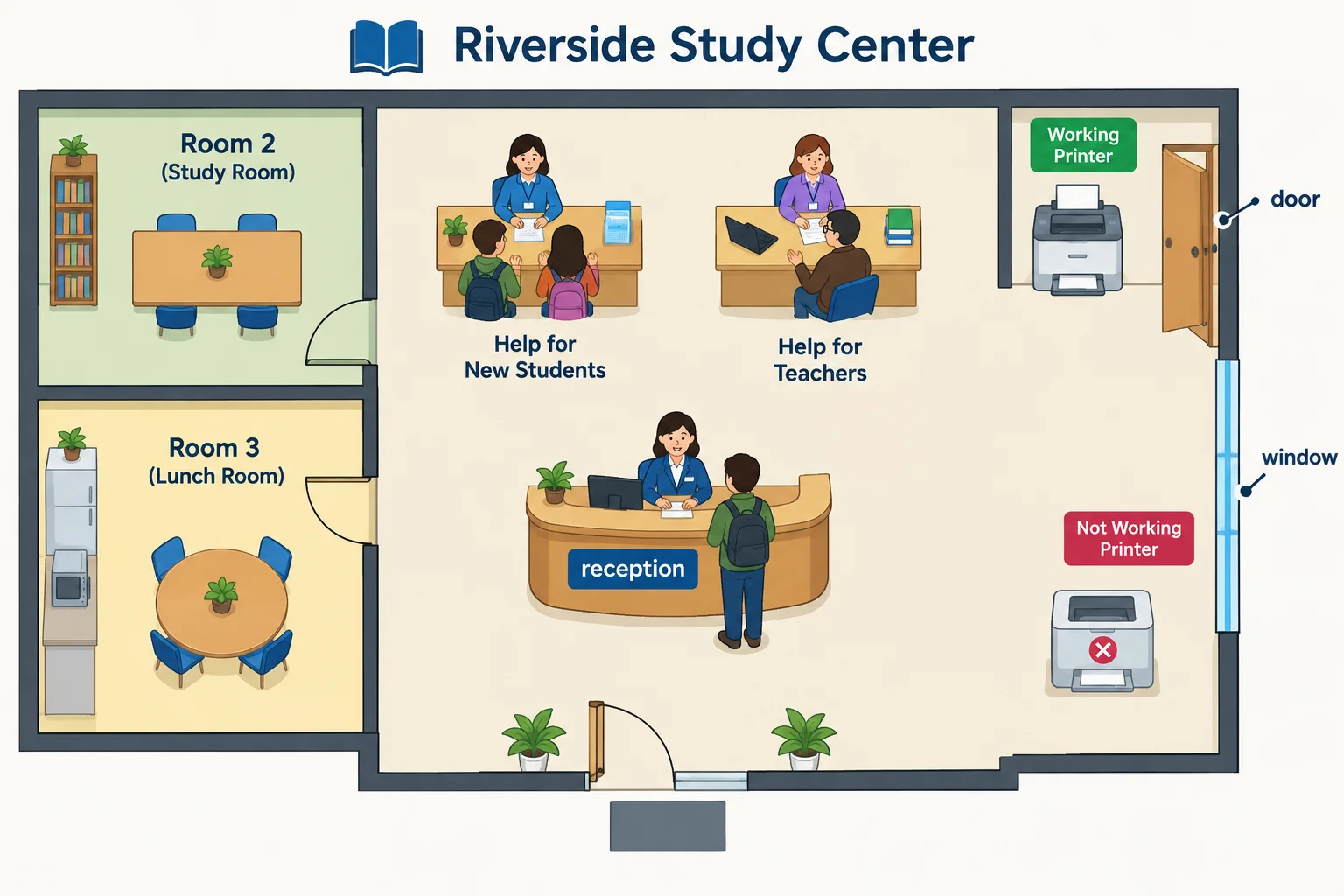
A welcome note should select details that distinguish one person, object, or place from another.
Example
Model note:
Welcome to Riverside Study Center. Maya is the receptionist who welcomes visitors. Hana is the assistant who helps new students. Use the printer which works by the door. Room 2 is the room where we study.
Analysis: Maya is the receptionist who welcomes visitors.
Bold marks the noun. Underline marks the identifying clause. Notice that the clause is directly after the noun and has no comma.
Listen to the model, then say these meaning groups aloud: the assistant who helps teachers; the printer that works; the room where students have lunch. Keep each full group together and stress the detail that distinguishes it.
Welcome to Riverside Study Center. Maya is the receptionist who welcomes visitors. Hana is the assistant who helps new students. Use the printer which works by the door. Room 2 is the room where we study.
Welcome to Riverside Study Center. Maya is the receptionist who welcomes visitors. Hana is the assistant who helps new students. Use the printer which works by the door. Room 2 is the room where we study.
Use this information card for the listening task and for your own note. Choose only the details a visitor needs.
Useful people, objects, and places at Riverside Study Center
| Referent | Identifying information | Location or use |
|---|---|---|
| Hana | assistant who helps new students | at reception |
| Leo | assistant who helps teachers | at reception |
| Maya | receptionist who welcomes visitors | at reception |
| Printer by the door | printer which works | printing |
| Printer by the window | printer which does not work | not available |
| Form | form on the reception desk | asks for a name and course |
| Room 2 | room where students study | studying |
| Room 3 | room where students have lunch | lunch |
Tip
Quick self-check: Put identifying information directly after its noun, with no comma. After subject who, which, or that, use a verb—not he, she, it, or they. After where, include a subject and a verb. When you read aloud, keep the noun and its identifying information in one meaning group.
Listen and choose an option.
Listen to the visitor's request. Which set does the visitor need?
Hello. I am visiting Riverside Study Center. I need the assistant who helps teachers. I need the printer which works. I also need the room where students have lunch.
Write a welcome note for the visitor. Use the three referents you selected in the listening task. Write 4 or 5 complete sentences, including at least one person, one object, and one place. Use identifying information for each of those three items. Then read your note aloud, keeping each noun and its identifying information together.
Write at least 120 characters (0/120).
Summary
Congratulations! You completed: Identify People, Things, and Places
30 XP
Thousands of online courses in video, ebooks and audiobooks.
To test your knowledge during online courses
Generated directly from your cell phone's photo gallery and sent to your email

Download our app via QR Code or the links below:.



Carry knowledge in your pocket.
Download the Cursa app.
There are hundreds of free courses available, with a free certificate of completion that is saved in your mobile image gallery.
Download the app to access the Course Completion Certificate for Free.


+ 10 million
students

Free and Valid
Certificate

60 thousand free
exercises

4.8/5 rating in
app stores

Free courses in
video and ebooks