
Step 1 of 8

Learning path · Level 9 · Tutorial 1
Give clear updates about what must happen and what has already been done. Read a short project update and listen to a team message, then choose the meaning you hear and complete a brief dictation. Practise hearing and saying passive verb phrases. Give an update aloud and write a guided status note, checking both against models.

 State Requirements and Recommendations
3 min
 Describe Options and Ask About Next Steps
Describe possible and planned actions, report a current restriction, and ask clear modal passive questions about next steps. 3 min
 Report What Has Been Completed
Report completed work that has a useful result now with the present perfect passive. 3 min
 Check Completion and Explain What Is Pending
Ask about completed work, report what is still pending, and state the required next action. 3 min
 Explain What Had Already Been Done
Explain an earlier completed workshop action by looking back from a later past event. 3 min
 Choose the Right Form for a Status Update
Read a team workshop update, classify its facts by meaning and time, and select passive forms that preserve the project status. 3 min
 Hear and Say Passive Verb Phrases
Listen for passive verb phrases in a team workshop update, distinguish be from been and has been from had been, complete a short dictation, and rehearse a clear connected-speech model. 3 min
 Give Your Work Update
Combine a project status board and team message to give a concise spoken update and written status note. 4 min
Step 1 of 8
A modal passive focuses on the work item, not on the person doing the work.
Pattern: modal + be + past participle
Use must for a requirement:
The draft agenda must be submitted by Thursday.
Use should for a recommendation:
The draft agenda should be checked before submission.
In both patterns, be stays between the modal and the past participle.
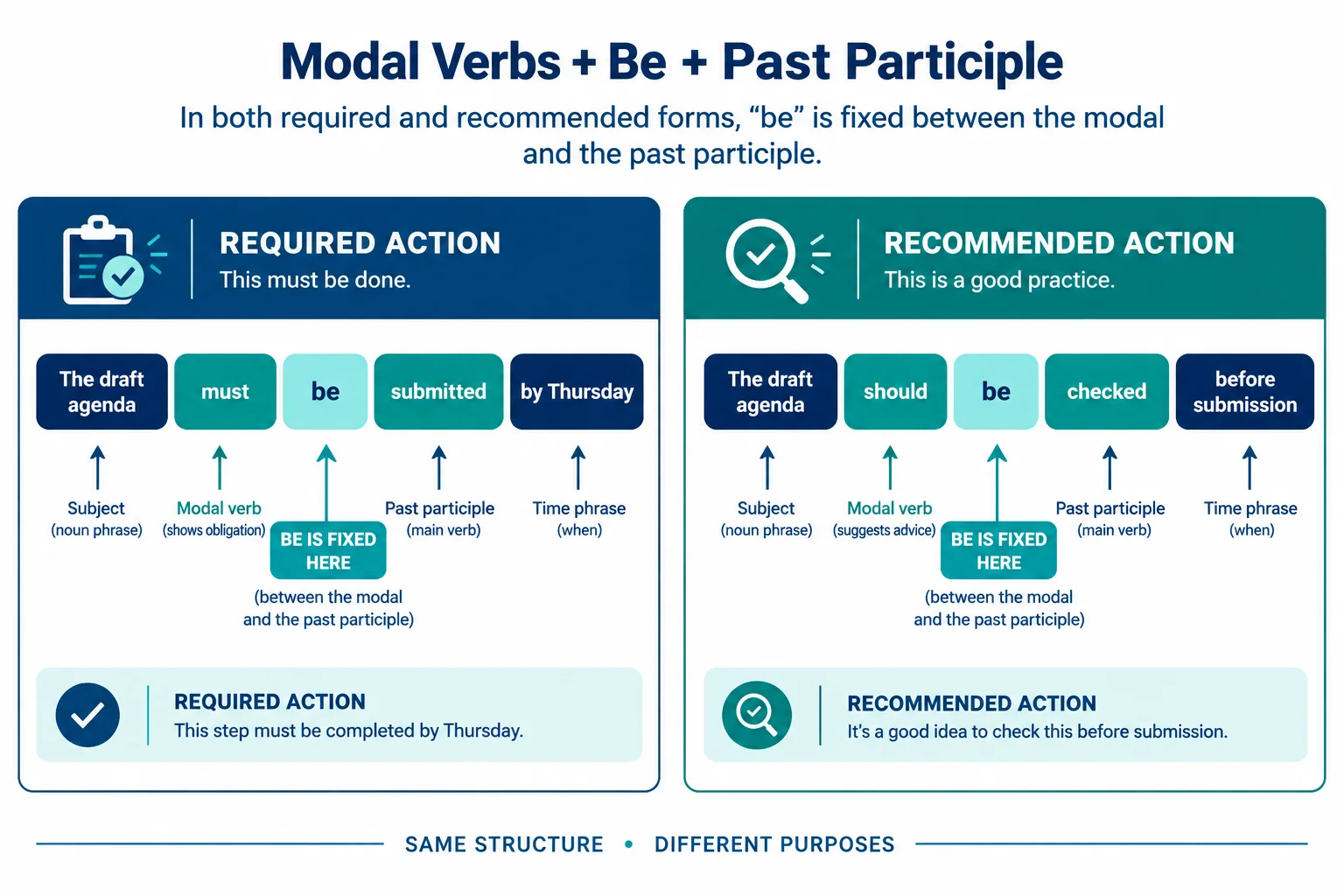
The work item comes first. Then use a modal, be, and a past participle.
Both statements are about the same draft agenda, but their meanings are different.
| Purpose | Modal passive | Meaning |
|---|---|---|
| Requirement | must be submitted | This action is necessary. |
| Recommendation | should be checked | This action is advisable. |
Match each workshop update to its meaning.
Tap an item and then its matching pair.
Build the recommended update about the draft agenda.
Your sentence
Available words

Step 2 of 8
Describe possible and planned actions, report a current restriction, and ask clear modal passive questions about next steps.
Use a modal passive when the work item receives the action.
can + be + past participle The room can be changed.
will + be + past participle The final schedule will be shared on Friday.
modal + not + be + past participle The room request cannot be approved yet.
Choose the modal for the meaning: can means an available option; will announces a plan; cannot says something is not possible now.
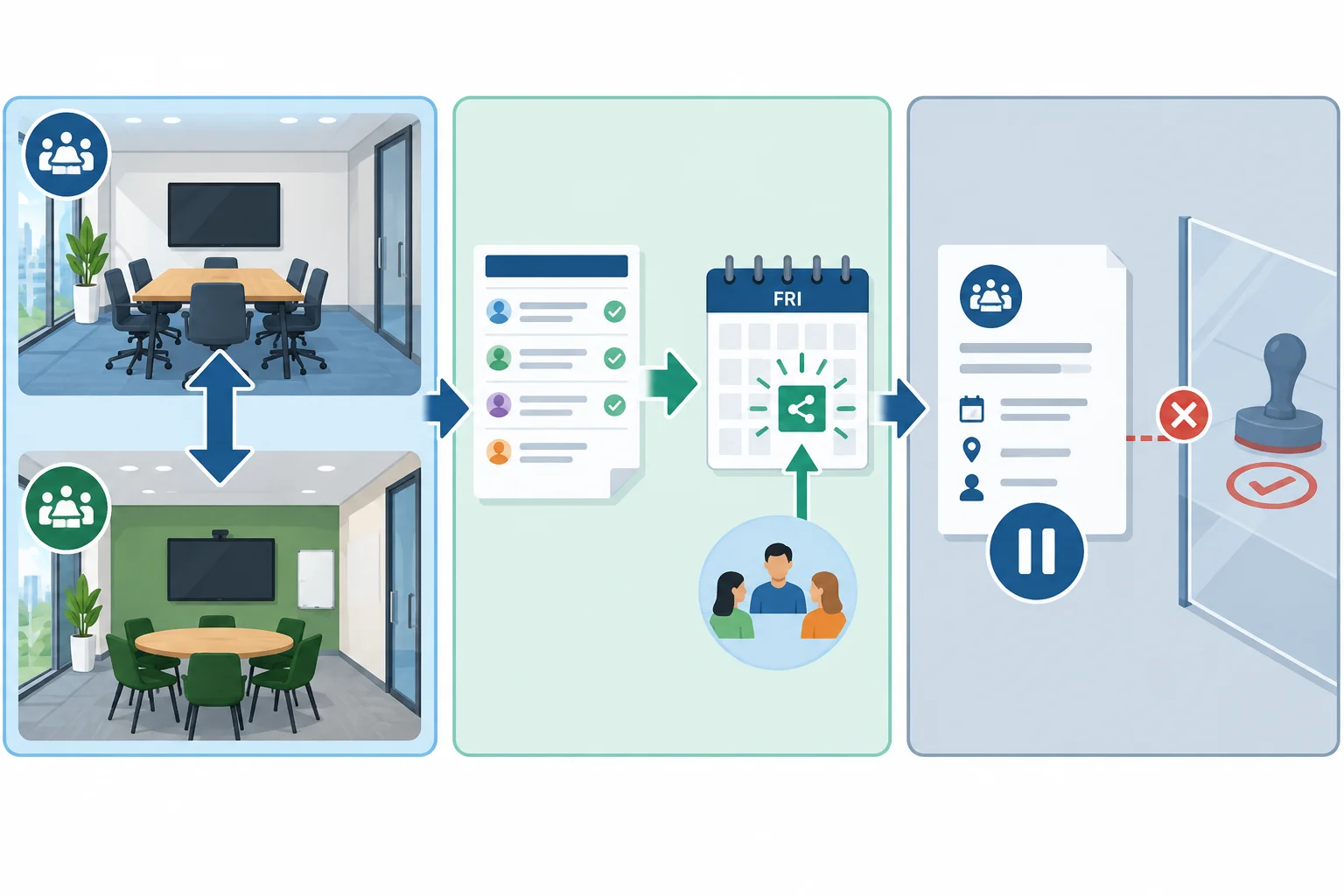
The same passive structure changes meaning with the modal: option, planned action, or current restriction.
Example
Team workshop update
Notice that be stays between the modal and the past participle: can be changed, will be shared, cannot be approved.
For a modal passive question, put the modal before the subject:
modal + subject + be + past participle?
Do not add do or does. The modal already begins the question.
Use when to ask about timing. Use can to ask whether an option is available. Use should to ask about a recommended or expected next action.
Tip
Compare the meanings in this workshop:
The past participle names the action; the modal tells the listener how to understand it.
Which update matches these meanings: the room is an available option to change, and sharing the final schedule is planned for Friday?
Complete the update.
Because approval is still awaited, the room request ___ yet.
Build a question that asks about the submission timing of the draft agenda.
Your sentence
Available words

Step 3 of 8
Report completed work that has a useful result now with the present perfect passive.
A present perfect passive reports completed work that matters now. It focuses on the work item and its current result, not on the person who did the work.
Pattern: has/have + been + past participle
For the team workshop: The schedule has been revised. The revision is complete, and the schedule is ready to use as the current version.
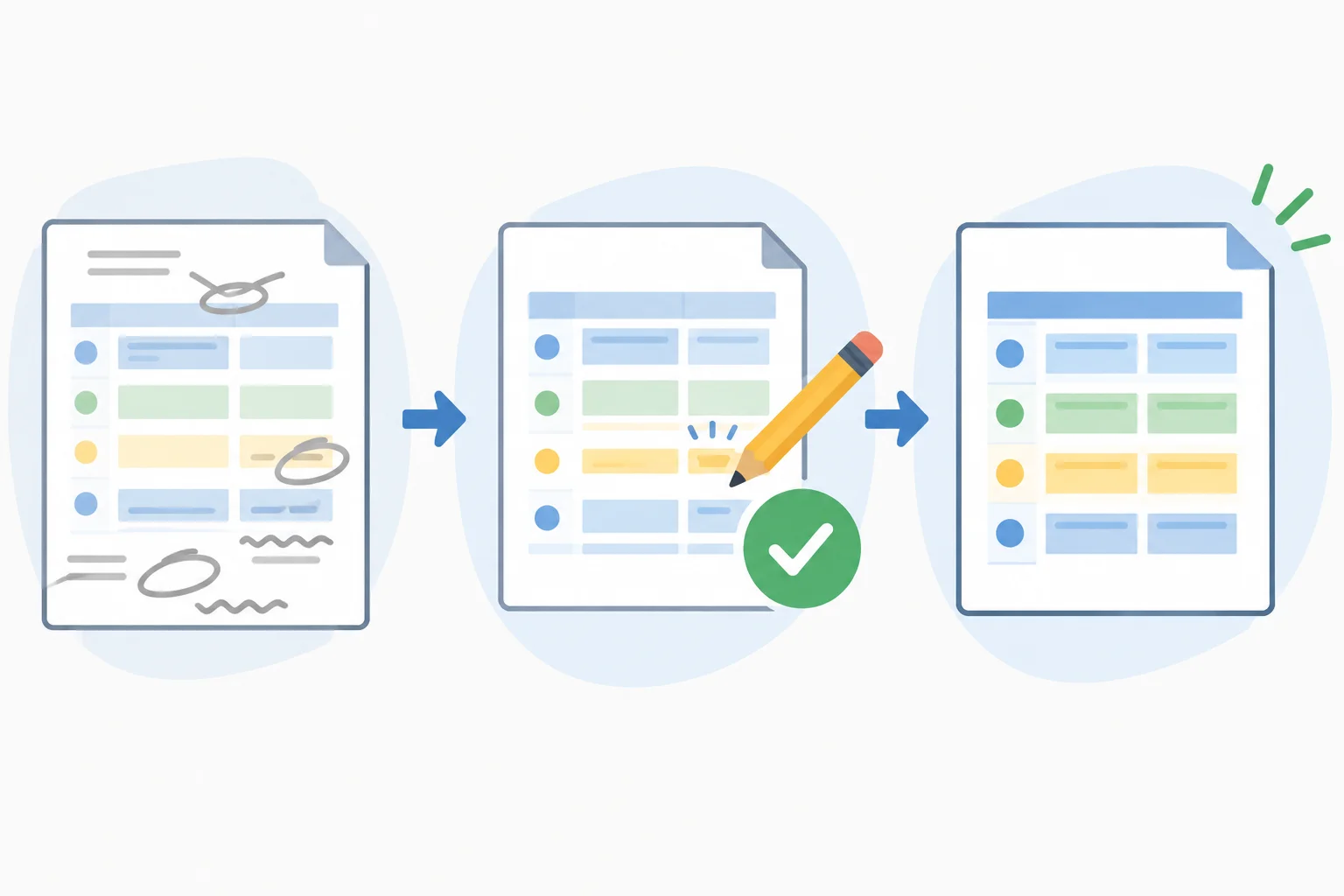
The completed revision creates a result that is important in the current update.
Choose the auxiliary by looking at the work item:
After been, use a past participle: revised, approved, sent. In this completed-result pattern, do not put an -ing form after been.
Example
Use revise a schedule when you change the schedule to make a new version:
The schedule has been revised.
Use approve a request when an authorized person accepts it:
A request has been approved.
These are form models. In the workshop update, the schedule has been revised; the room request is still pending approval.
Compare singular and plural work items.
| Work item | Completed-result update |
|---|---|
| The schedule | has been revised |
| The invitations | have been sent |
| A request | has been approved |
| Several requests | have been approved |
Complete the current workshop update:
The schedule ____.
Build the affirmative update.
Your sentence
Available words

Step 4 of 8
Ask about completed work, report what is still pending, and state the required next action.
Use a present perfect passive to check a work item’s completion now.
Negative: has not / have not + been + past participle
In conversation, use hasn't been and haven't been. Ask with Has/Have + subject + been + past participle?
Use already for a completed result and yet in a question or negative: “The schedule has already been revised.” “Has the room request been approved yet?”
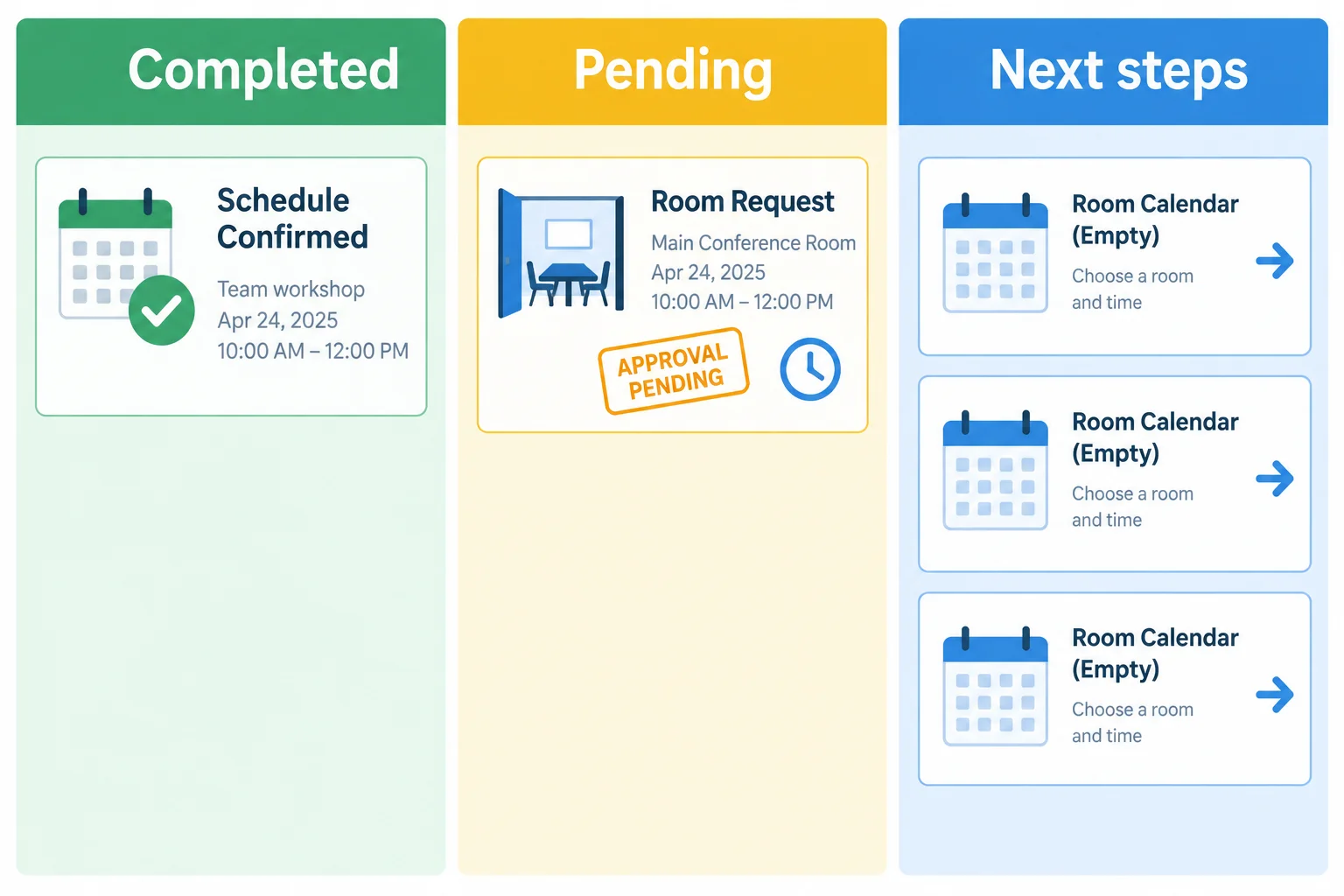
A pending item is not complete yet. State its status first, then state the required next action.
Example
Question: Has the room request been approved yet?
Short answer: No, it hasn't. It is pending approval.
Status and next action: The rooms have not been booked yet, so they must be booked.
Match the short answer to the question’s auxiliary: use hasn't after Has ...? and haven't after Have ...?.
Complete the conversational update:
“The rooms ___ booked yet.”
Build the complete status check and update.
Your sentence
Available words
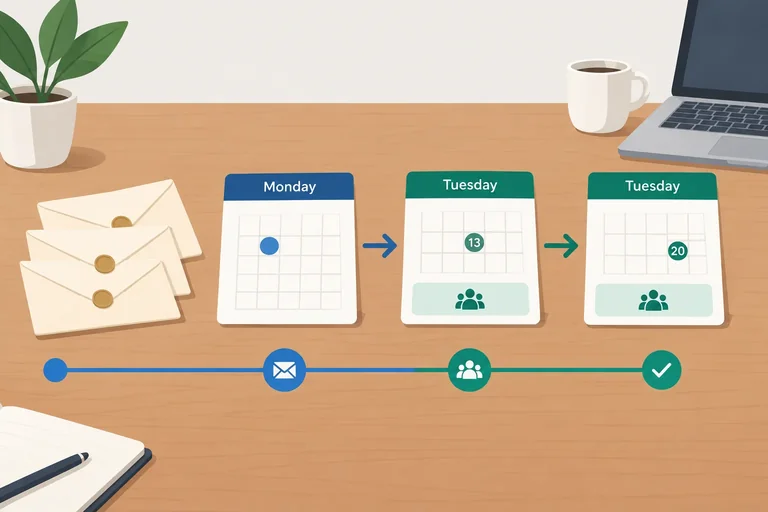
Step 5 of 8
Explain an earlier completed workshop action by looking back from a later past event.
Use the past perfect passive when you look back from one past event to work completed earlier.
Pattern: had + been + past participle
The form is the same with singular and plural subjects:
For the team workshop, the past reference point is Tuesday, when the workshop date changed. The earlier action happened on Monday.
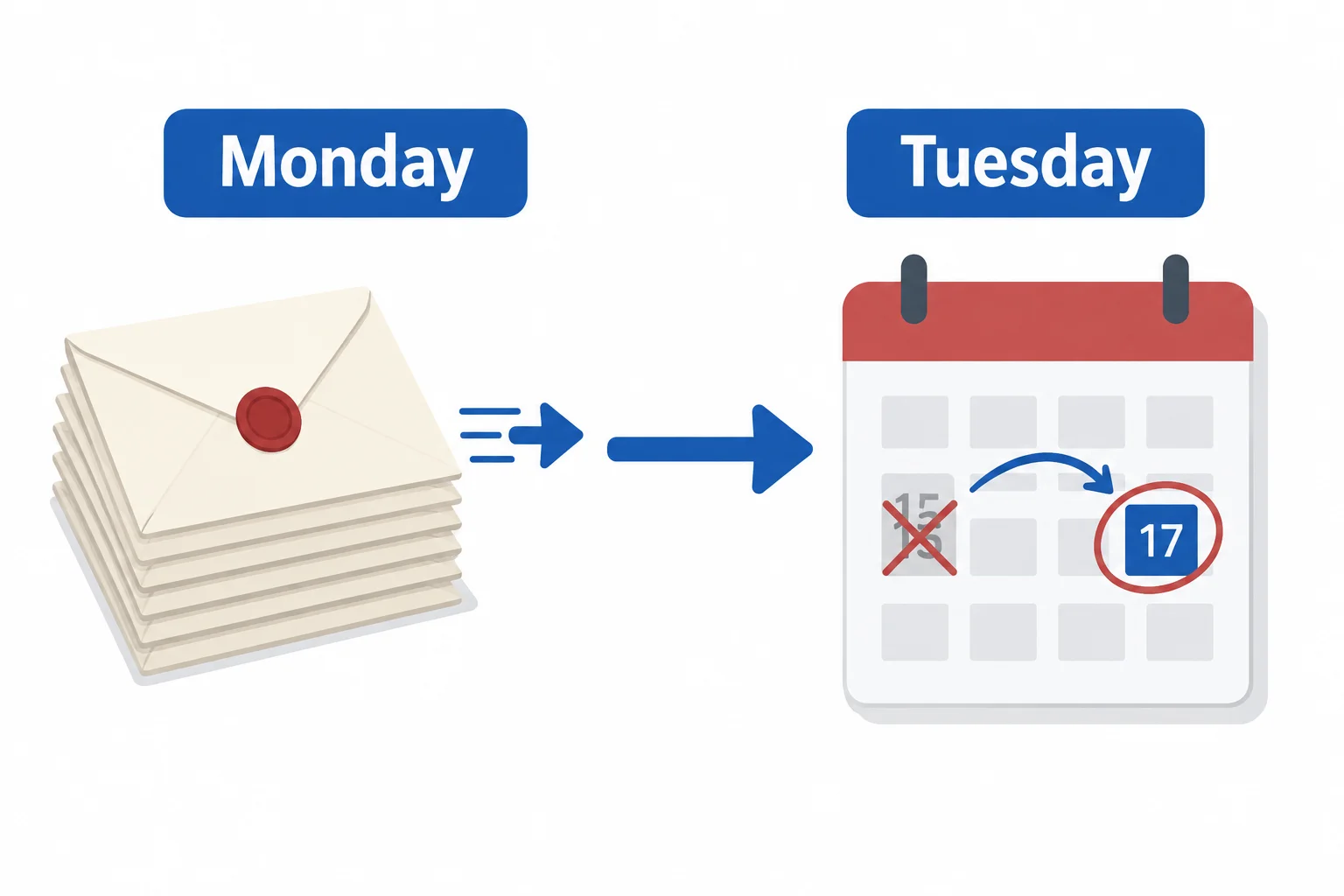
Look from Tuesday back to Monday: the invitations had been sent before the date changed.
Choose the viewpoint before choosing the tense.
Do not use had been just because something happened a long time ago. Name or clearly imply the later past reference point.
Example
Now: The schedule has been revised.
Looking back from Tuesday: The invitations had been sent before the workshop date changed.
In the second sentence, “the workshop date changed” is the later past event. Had been sent describes the earlier completed action.
Put these events in time order, from earliest to latest.
Write one concise status sentence about the timeline. Explain what had already happened before the later past event, and name that later event. Use had been + past participle.
Write at least 35 characters (0/35).

Step 6 of 8
Read a team workshop update, classify its facts by meaning and time, and select passive forms that preserve the project status.
Read this Wednesday update for the team workshop. Do not choose a form by looking at one word alone. First identify whether each fact is completed now, still pending, a next action, or earlier history.
The schedule has been revised. The room request is pending approval, and the rooms have not been booked. The draft agenda must be submitted by Thursday and should be checked before submission. The room can be changed if necessary. The final schedule will be shared on Friday.
For background: the invitations had been sent on Monday before the workshop date changed on Tuesday.
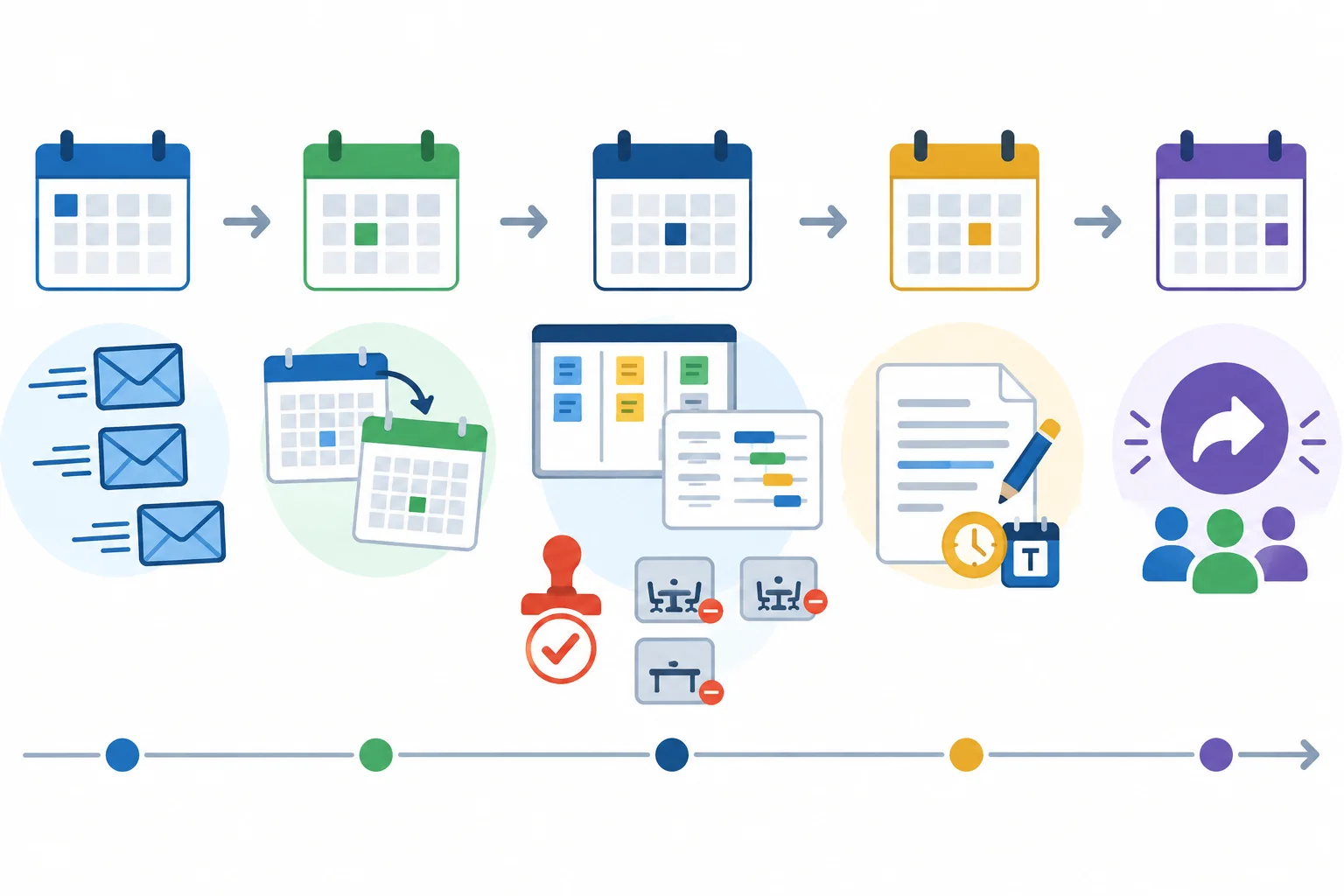
Use the timeline to separate a current result from an action that was already complete before Tuesday.
Match the form to the meaning and time relationship. Keep the source facts unchanged: pending approval does not mean approved, and an available option does not mean a fixed plan.
Use this quick comparison after you identify the meaning of the update.
| Meaning | Pattern | Workshop example |
|---|---|---|
| Requirement | modal + be + past participle | The draft agenda must be submitted. |
| Recommendation | modal + be + past participle | It should be checked. |
| Available option | modal + be + past participle | The room can be changed. |
| Announced plan | modal + be + past participle | The final schedule will be shared. |
| Completed by now | has/have + been + past participle | The schedule has been revised. |
| Completed before a past event | had + been + past participle | The invitations had been sent before the date changed. |
Tip
Time clues help: by now points to a present perfect passive; before the date changed on Tuesday needs a past perfect passive. A deadline or future day usually points to a modal passive.
Classify each statement from the update by its meaning.
Tap an item and then its matching pair.
Complete the update: By now, the schedule __.
Complete the update: The draft agenda __ by Thursday.
Complete the update: If needed, the room __.
Complete the update: The invitations __ before the date changed on Tuesday.
Complete the update: The final schedule __ on Friday.

Step 7 of 8
Listen for passive verb phrases in a team workshop update, distinguish be from been and has been from had been, complete a short dictation, and rehearse a clear connected-speech model.
In a fast update, listen for the whole passive phrase and its time meaning—not one vowel alone.
modal + be + past participle names a next action: must be submitted.has/have + been + past participle reports a result relevant now: has been revised.had + been + past participle looks back from a later past event: had been sent.Useful cues: be has no final n; been ends with an audible n. In natural speech, small auxiliaries may be reduced, so also listen for the final consonant in has (/z/) or had (/d/) and for the time context. On Wednesday, has been revised reports the current result. Before the Tuesday date change, had been sent reports the earlier action.
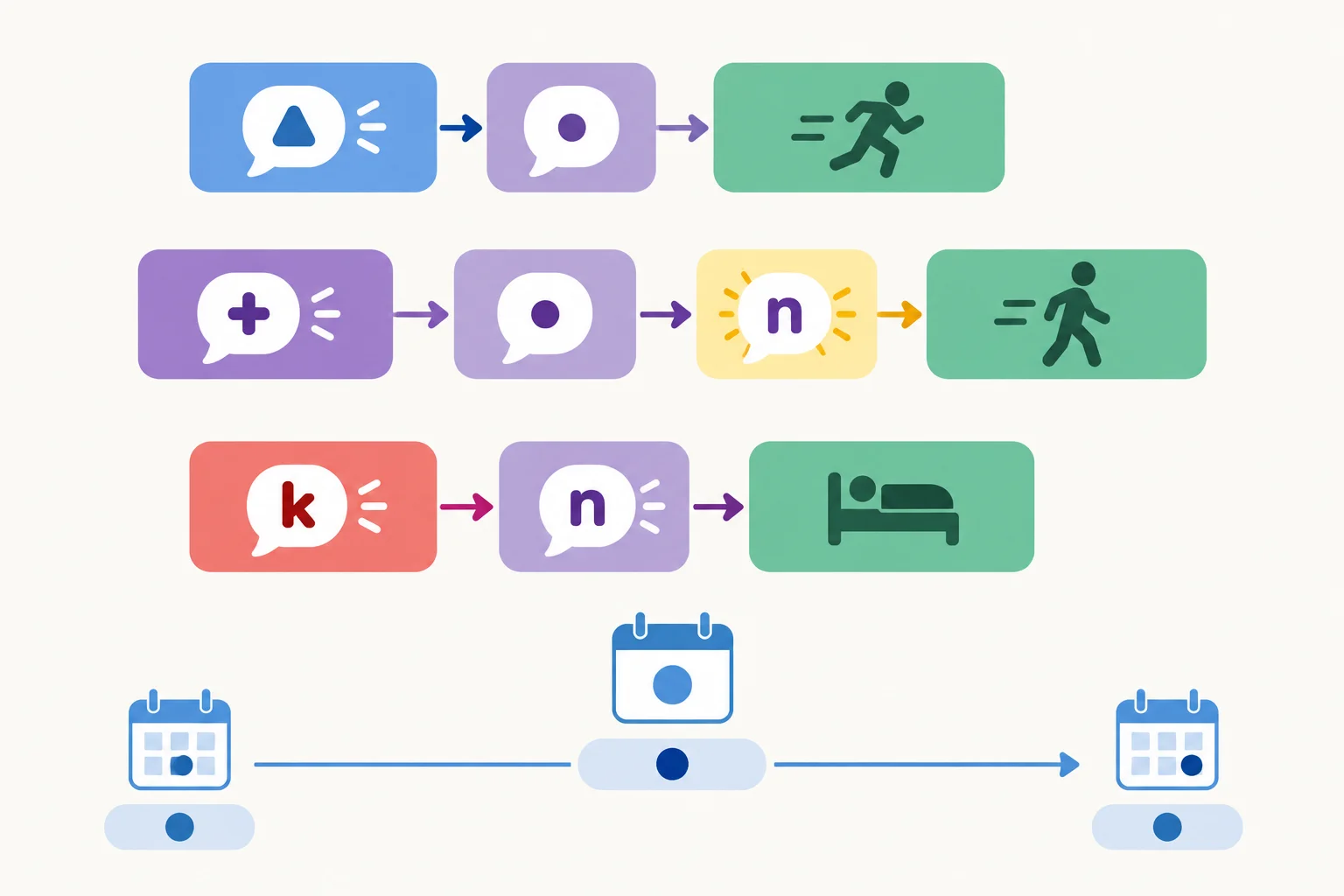
Listen for the complete auxiliary chain: a modal is followed by be, while perfect passives contain been. Time context helps distinguish has been from had been.
Listen once for the team workshop status. Replay it and notice each complete passive verb phrase.
Quick team workshop update. The schedule has been revised. The room request is pending approval, so the rooms have not been booked. The draft agenda should be checked and must be submitted by Thursday. The room can be changed. The final schedule will be shared on Friday. Remember: the invitations had been sent on Monday before the workshop date changed on Tuesday.
Quick team workshop update. The schedule has been revised. The room request is pending approval, so the rooms have not been booked. The draft agenda should be checked and must be submitted by Thursday. The room can be changed. The final schedule will be shared on Friday. Remember: the invitations had been sent on Monday before the workshop date changed on Tuesday.
Listen and choose an option.
Which complete update did you hear?
The draft agenda must be submitted by Thursday.
Listen and choose an option.
Which pair of updates did you hear?
The schedule has been revised. The invitations had been sent on Monday before the workshop date changed on Tuesday.
Listen and write what you heard.
Listen and type the complete excerpt.
Use the replay model for an aloud rehearsal. Pause after each sentence and repeat it. Keep has, had, been, and be audible, but give the strongest stress to the main action or important deadline.
Self-check:
been end with an n sound?There is no recording to submit; use the model to check yourself.
Replay, pause, and repeat each sentence aloud.
The schedule has been revised. The invitations had been sent before the date changed. The draft agenda must be submitted by Thursday.
The schedule has been revised. The invitations had been sent before the date changed. The draft agenda must be submitted by Thursday.
Tip
Do not force every small word to sound equally strong. Keep the auxiliary sequence connected and audible, then emphasize the key information: has been **revised**; had been **sent**; must be **submitted** by **Thursday**.

Step 8 of 8
Combine a project status board and team message to give a concise spoken update and written status note.
You will combine two sources about the team workshop: this status board and a short team message. Keep the information in three clear sections: what is complete now, what is unresolved, and what happens next. Use earlier history only when it explains a later past change.
Use this board as your written source.
| Completed | Pending | Next steps |
|---|---|---|
| The schedule has been revised. | The room request is pending approval. | The draft agenda must be submitted by Thursday. |
| — | The rooms have not been booked. | It should be checked before submission. |
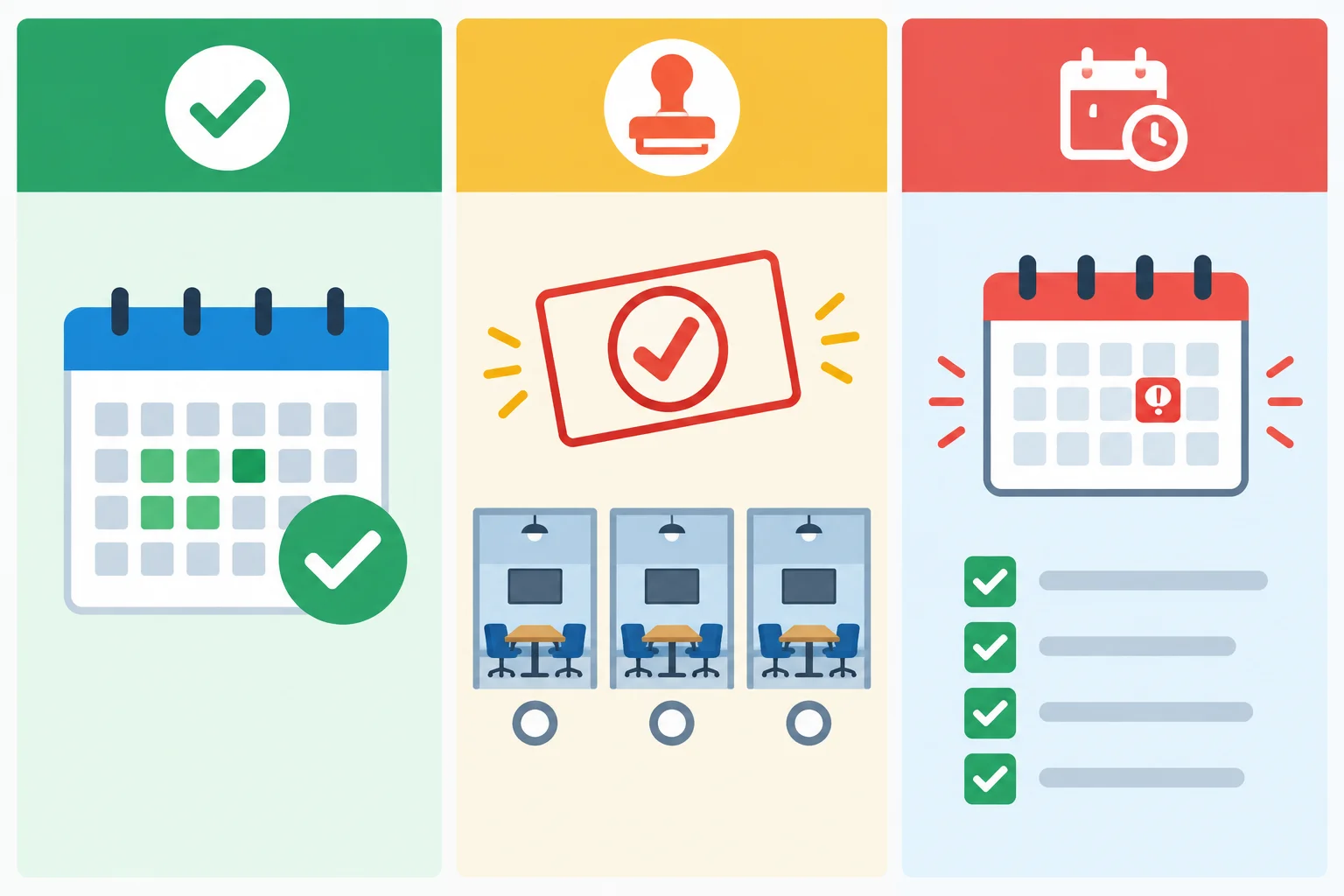
Organize an update from current result to pending work to next action.
Tip
Keep the meanings accurate: a required action is not just a recommendation, and a possible change is not a confirmed plan.
Now listen for the project history and the two future-related details that are not on the board. Replay the message if needed.
Quick update on the team workshop. The invitations had been sent on Monday, before the workshop date changed on Tuesday. The room can be changed if needed. The final schedule will be shared on Friday.
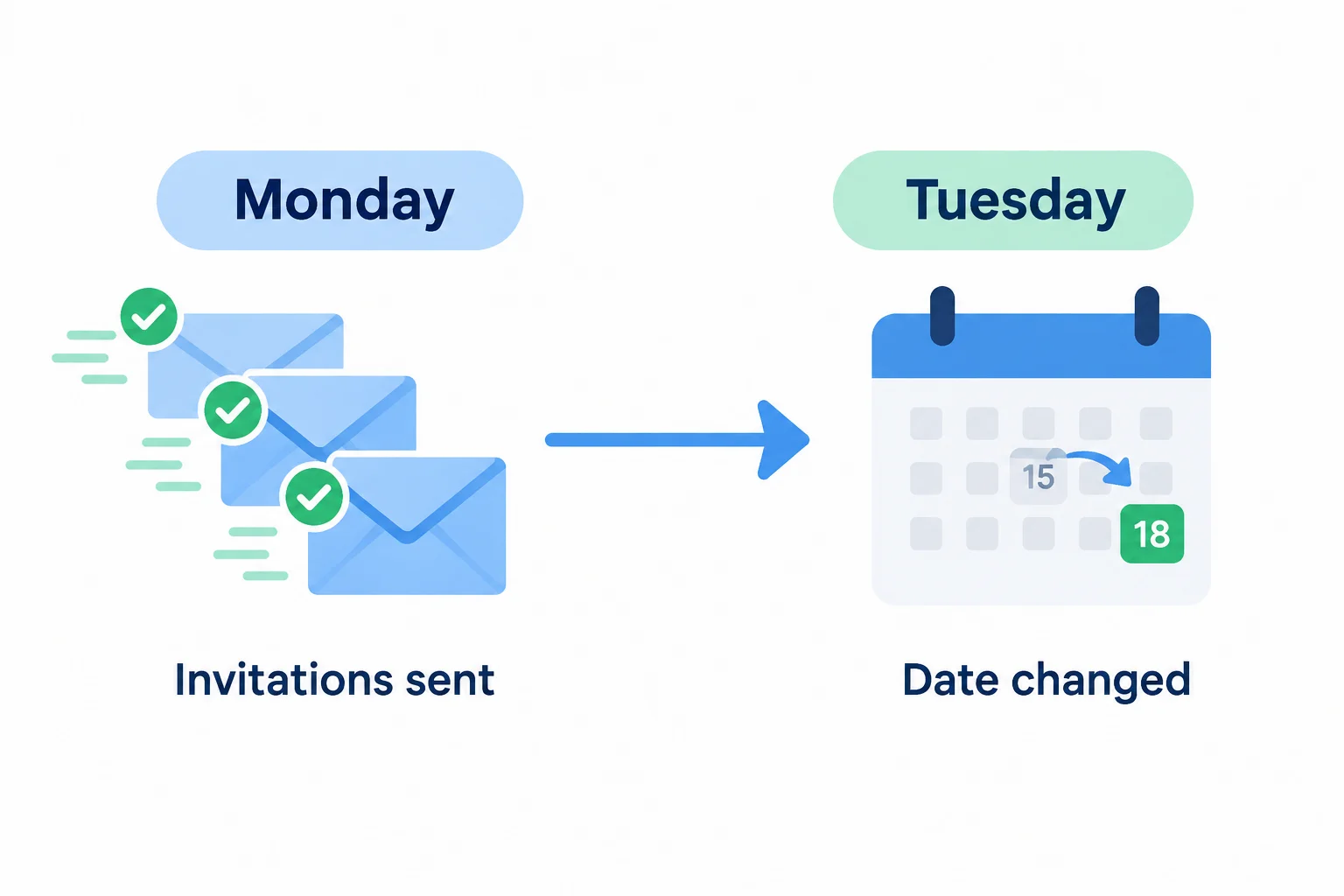
The earlier completed action explains the later past change.
Use both sources. First, give a 40–50-second update aloud. Organize it around Completed, Pending, and Next steps.
Across your spoken update and written note, include: a current completed result; an earlier completion before the Tuesday change; pending work; a required next action; an option or a plan; and one completion question about a detail the sources do not confirm.
Speak first. There is no recording to submit.
Write a 50–70-word status note using the labels Completed, Pending, and Next steps. Include one completion question about an unconfirmed detail. Check that each passive phrase has the right auxiliary order and past participle.
Write at least 250 characters (0/250).
Example
Here is the latest update on the team workshop. The schedule has been revised, so the current plan reflects the new date. The invitations had been sent on Monday before the workshop date changed on Tuesday. The room request is still pending approval, and the rooms have not been booked. Next, the draft agenda must be submitted by Thursday, and it should be checked first. The room can be changed if needed, and the final schedule will be shared on Friday. Has the draft agenda been checked?
Example
Completed: The schedule has been revised. The invitations had been sent on Monday before the workshop date changed on Tuesday.
Pending: The room request is pending approval, and the rooms have not been booked.
Next steps: The draft agenda must be submitted by Thursday and should be checked first. The room can be changed if needed. Has the draft agenda been checked?
Summary
Compare the models with your own update. Check facts, timing, and whether you kept requirements, recommendations, options, plans, and completed results distinct.
After comparing with the models, write one sentence about one correction you made or one strength you confirmed. Focus on meaning, auxiliary order, or a past participle; do not rewrite your full note.
Write at least 15 characters (0/15).
Congratulations! You completed: Give Work Updates with Modal and Perfect Passives
Thousands of online courses in video, ebooks and audiobooks.
To test your knowledge during online courses
Generated directly from your cell phone's photo gallery and sent to your email

Download our app via QR Code or the links below:.



Carry knowledge in your pocket.
Download the Cursa app.
There are hundreds of free courses available, with a free certificate of completion that is saved in your mobile image gallery.
Download the app to access the Course Completion Certificate for Free.


+ 10 million
students

Free and Valid
Certificate

60 thousand free
exercises

4.8/5 rating in
app stores

Free courses in
video and ebooks