Step 1 of 8
Find the Shape of a Story
Learn to recognize the four parts that give a short past story a clear shape: Where and when, Problem, Response, and Ending.

Learning path · Level 6 · Tutorial 2
Turn a series of past events into a clear story with a problem and an ending. Read and listen to short stories about everyday surprises. Choose audio, complete a short dictation, and use a simple plan to tell and write your own story with time, cause, and result connections.
 Find the Shape of a Story
Learn to recognize the four parts that give a short past story a clear shape: Where and when, Problem, Response, and Ending. 2 min
 Keep the Details That Help
Choose details that clarify Maya’s problem, response, and clear ending without creating an unrelated side story. 2 min
 Guide the Reader Through Time
Use time expressions to guide a reader from an opening situation through later events, a surprise, and a clear outcome. 2 min
 Show the Result with So
Use so to show that one past event caused another event. 2 min
 Explain the Reason with Because Of
Choose because or because of by identifying whether a clause or a noun phrase follows, then keep cause and result clear in a short story connection. 2 min
 Listen for an Ending That Fits
Listen to Alex’s classroom story, identify its key parts, choose an ending that resolves the problem, and write a short cause-and-result sentence you hear. 3 min
 Make the Story Easy to Hear
Use meaningful pauses and key-word stress to make a short story easy for a listener to follow. 2 min
 Write, Tell, and Check Your Story
Write an 80–100-word story with a clear ending, check it against a model, and tell it aloud from brief notes. 6 min
Step 1 of 8
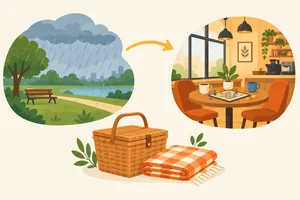
Learn to recognize the four parts that give a short past story a clear shape: Where and when, Problem, Response, and Ending.
A clear short story has four parts:
A clear ending answers the main problem. It does not have to be happy, but the reader needs to know the result.

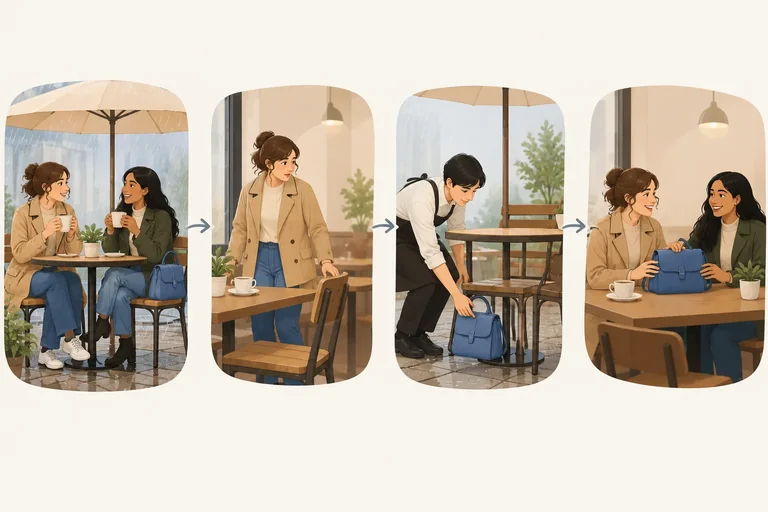
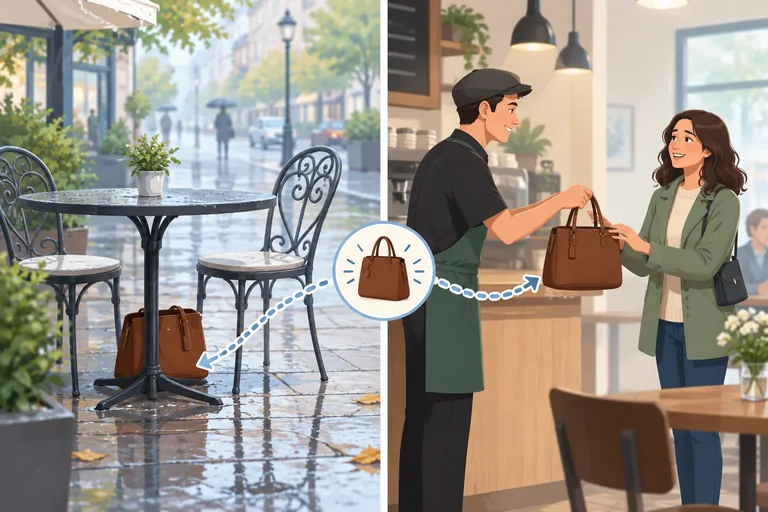
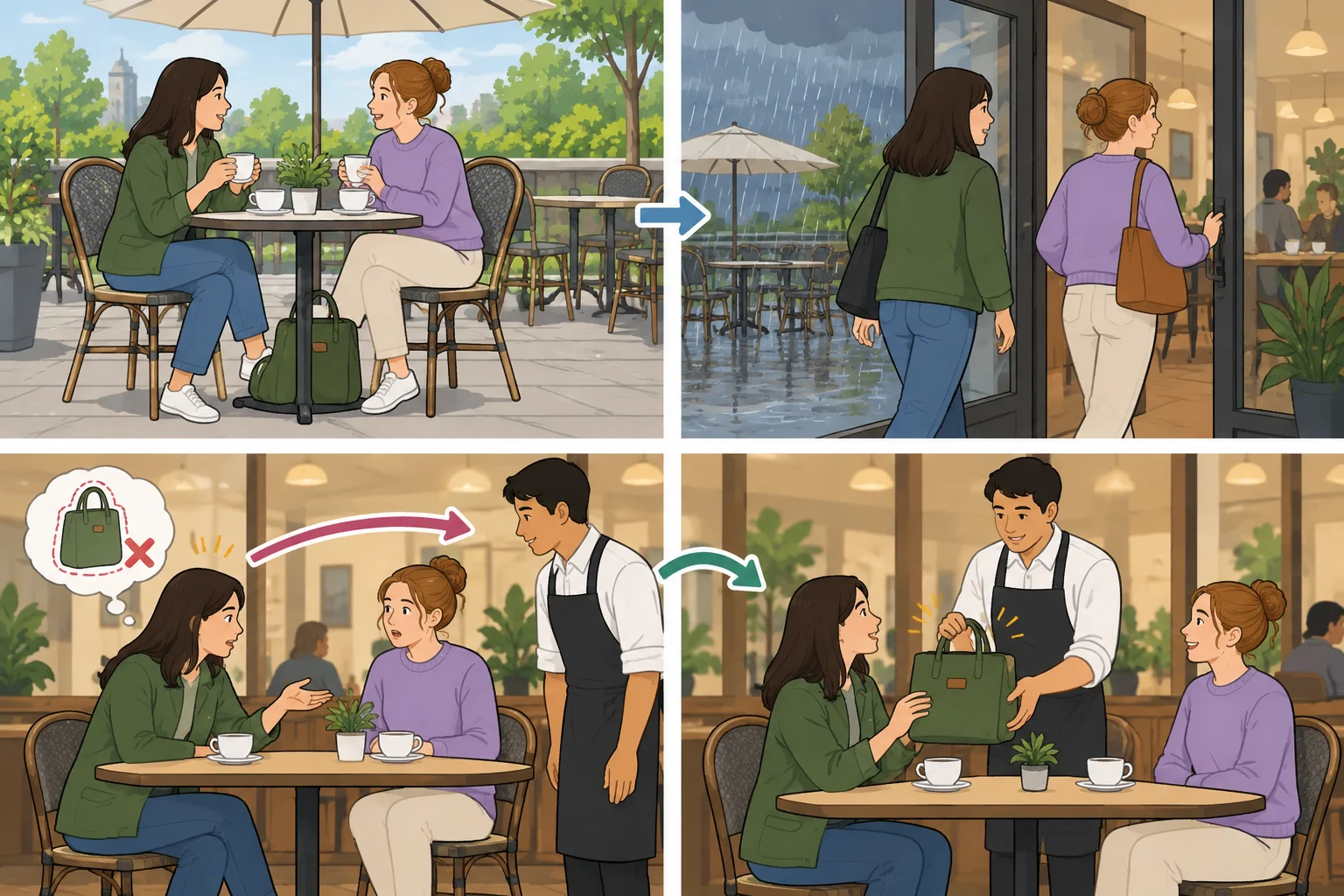
The pictures move from the situation to a problem, a response, and an ending.
Tip
When you read a story, do not only ask, “What happened next?” Also ask:
These questions help you find the shape of the story.
In Maya’s story, notice means to see or realize something important: “I noticed my bag was missing.”
Get something back means that something returns to you: “I got my bag back.”
Example
On Saturday afternoon, I met my friend Sam at a café. It started to rain, and we moved inside. I looked for my bag and noticed it was missing. I asked a café worker for help. The worker found it under our outdoor table. I got my bag back and continued my meeting with Sam.
Maya’s missing bag is the problem. Asking the worker for help is her response. Getting the bag back shows the result, so the story has a clear ending.
Read the five sections from Maya’s story. Match each section to its role. For the final special label, identify the event that resolves the missing-bag problem.
Tap an item and then its matching pair.
Step 2 of 8
Choose details that clarify Maya’s problem, response, and clear ending without creating an unrelated side story.
A short story needs a few details, not every detail. Keep a detail if it makes one part of the plan clearer:
Where and when: Does it help the reader picture the situation?Problem: Does it explain the difficulty?Response: Does it help explain an action?Ending: Does it show that the problem is finished?A brief feeling or observation can be useful. It can help the reader understand a response. Leave out descriptions and side events that do not help the problem or its clear ending.
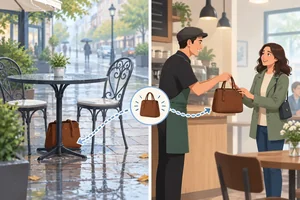
The map connects a detail about the bag’s location to the Problem, and Maya’s worried reaction to the Response.
Example
Compare these possible additions:
Useful: “My bag was under the outdoor table.”
This helps the reader understand the problem: the bag was outside when Maya moved indoors.
Unrelated: “Sam bought a new phone last month.”
This does not explain the problem, response, or ending. It starts a different story.
A useful detail can be very short. It needs a clear job in the story plan.
Unexpected describes something surprising. “I noticed an unexpected problem: my bag was missing.”
Find a solution means find a way to deal with a problem. “The worker found a solution, and I got my bag back.”
Which detail helps the reader understand why Maya asked a café worker for help?
Match each possible addition to the part of the story map it helps. Match an unrelated addition with “Leave out.”
Tap an item and then its matching pair.

Step 3 of 8
Use time expressions to guide a reader from an opening situation through later events, a surprise, and a clear outcome.
A short story is easier to follow when time expressions show the important changes.
At first, ... introduces the opening situation.A few minutes later, ... shows that a short time passes.Suddenly, ... introduces an unexpected event.In the end, ... introduces the final outcome.Use them for meaningful moments. You do not need a time expression in every sentence.
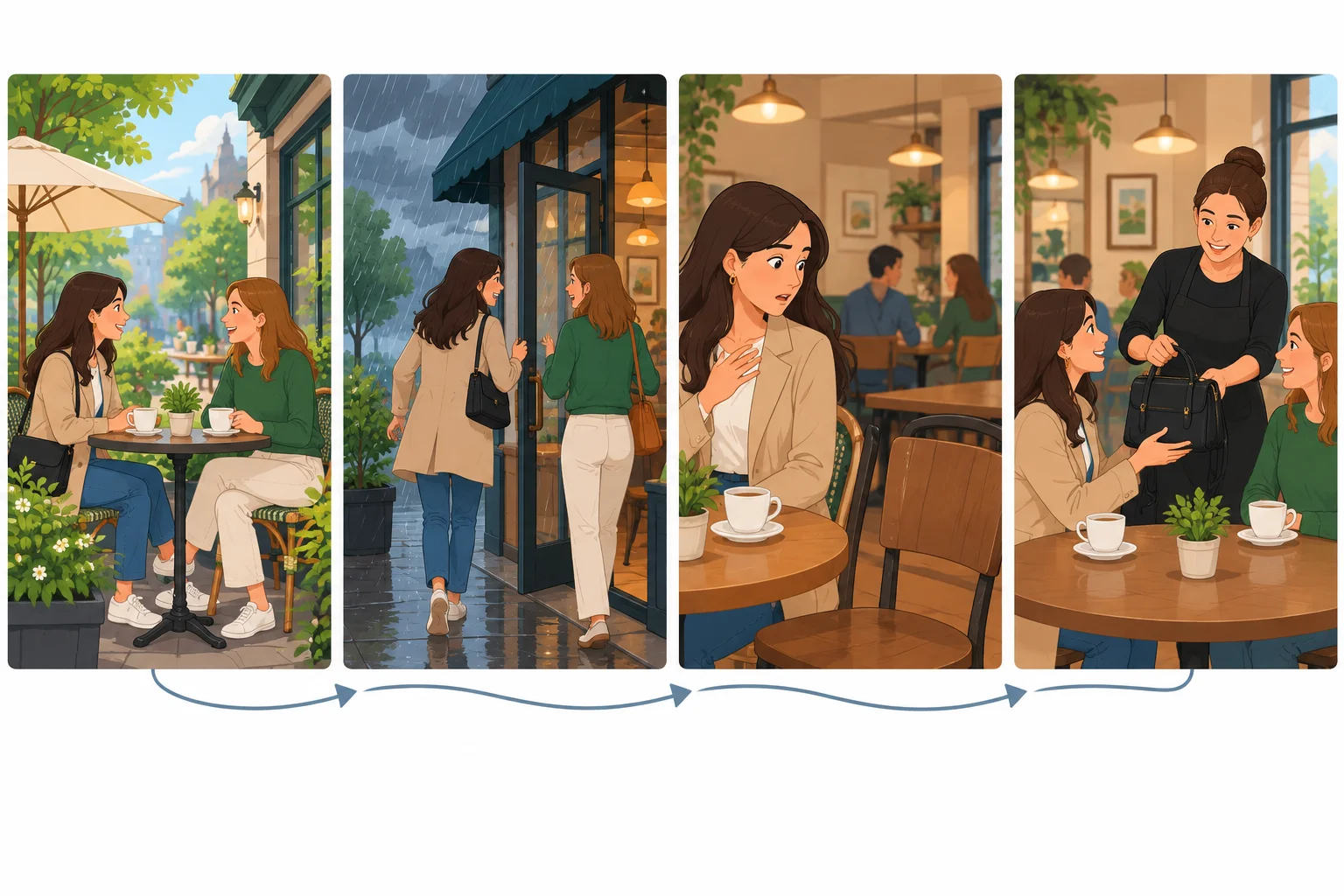
The story moves from an opening situation to a later change, a surprise, and a final outcome.
Use each expression for its particular job.
| Expression | What it introduces | Use it when |
|---|---|---|
| At first, ... | the opening situation | the story will change later |
| A few minutes later, ... | a later event | a short time passes |
| Suddenly, ... | an unexpected event | something surprising happens |
| In the end, ... | the final outcome | the main problem has an outcome |
Example
At first, I was meeting Sam at a café on Saturday afternoon. A few minutes later, it started to rain, and we moved indoors. Suddenly, I noticed my bag was missing. I asked a café worker for help. In the end, the worker found my bag under our outdoor table. I got my bag back and continued my meeting with Sam.
Choose the best beginning for this sentence: “___ I noticed my bag was missing without warning.”
Put these four events in the order they happened.
Complete the sentence: “___ I met Sam at a café on Saturday afternoon.”
Complete the sentence: “___ it started to rain, and we moved indoors.”
Complete the sentence: “___ I noticed my bag was missing without warning.”
Complete the sentence: “___ the worker found my bag, and I got my bag back.”

Step 4 of 8
Use so to show that one past event caused another event.
A cause explains why something happened. A result is what happened because of that cause.
Use so to connect them:
cause, so result.
Put the cause before so and the result after it. In a story, this helps the reader understand why a character acted.
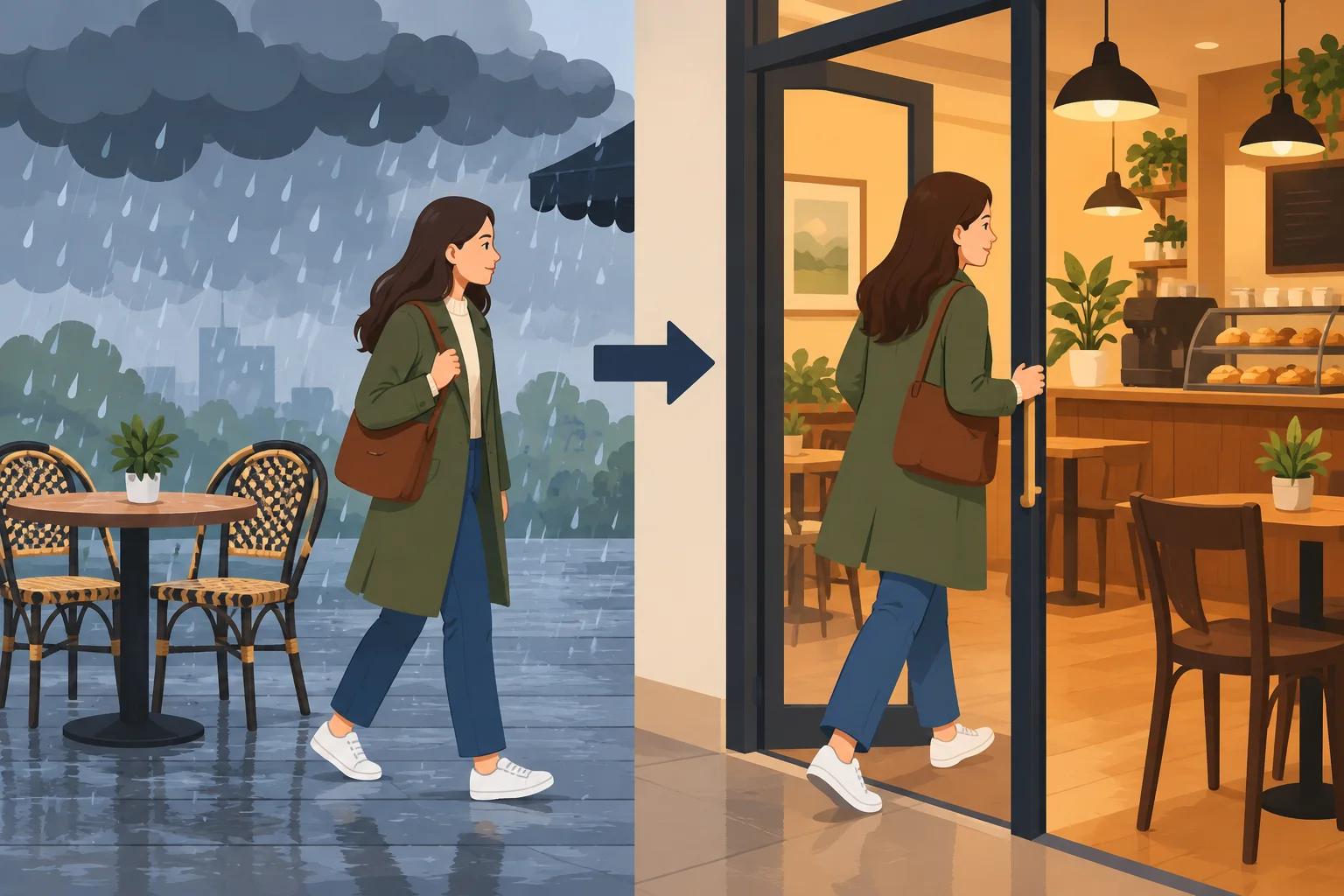
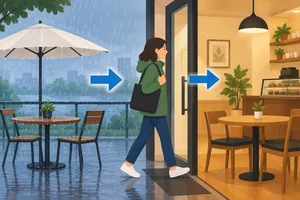
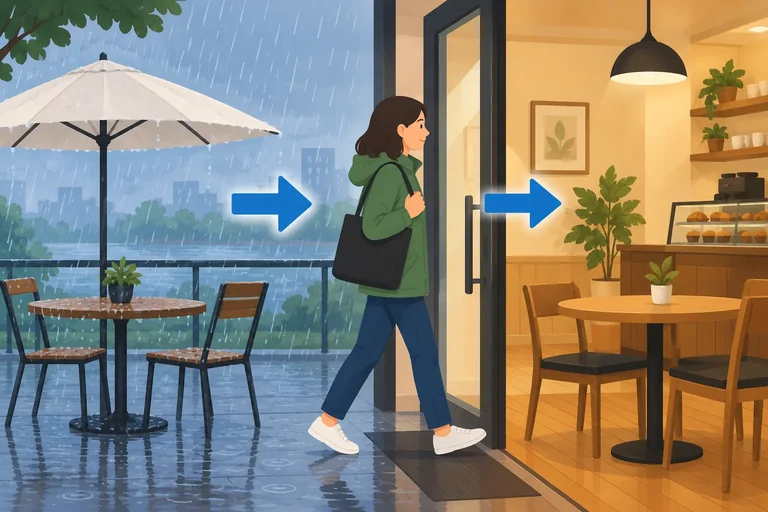
The rain is the cause. Going inside is the result.
Example
It started to rain, so I went inside.
Build one sentence with a cause followed by so and its result.
Your sentence
Available words
Do not use so only because one event happened after another. Ask: Did the first event explain or cause the second event?
If yes, draw an arrow from the cause to the result. If no arrow makes sense, the events are only a sequence. Use a simple time connection instead.
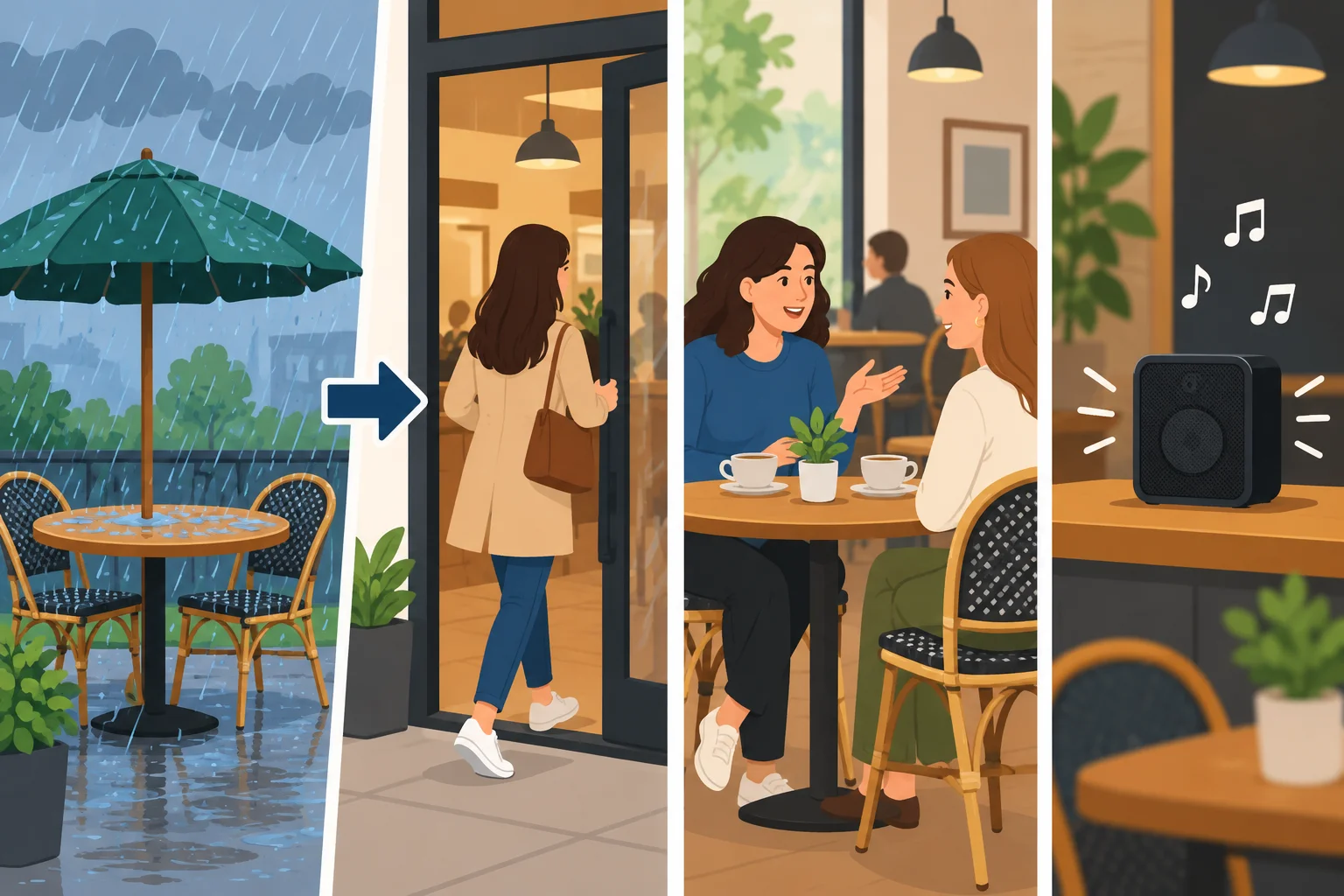
Use a cause-to-result arrow only when the first event explains the second.
Tip
A story can contain events in order without a cause-and-result connection. For example, Sam could order coffee while Maya asked for help. One action did not make the other action happen.
True or false: This sentence shows a real cause-and-result connection.
“I asked a café worker for help, so Sam ordered coffee.”
Step 5 of 8
Choose because or because of by identifying whether a clause or a noun phrase follows, then keep cause and result clear in a short story connection.
You already know because + a clause. A clause has a subject and a verb.
Use because of + a noun phrase. A noun phrase names a thing, person, or situation.
Look at the words immediately after the connector. Do they contain a subject and verb, or do they name a reason?
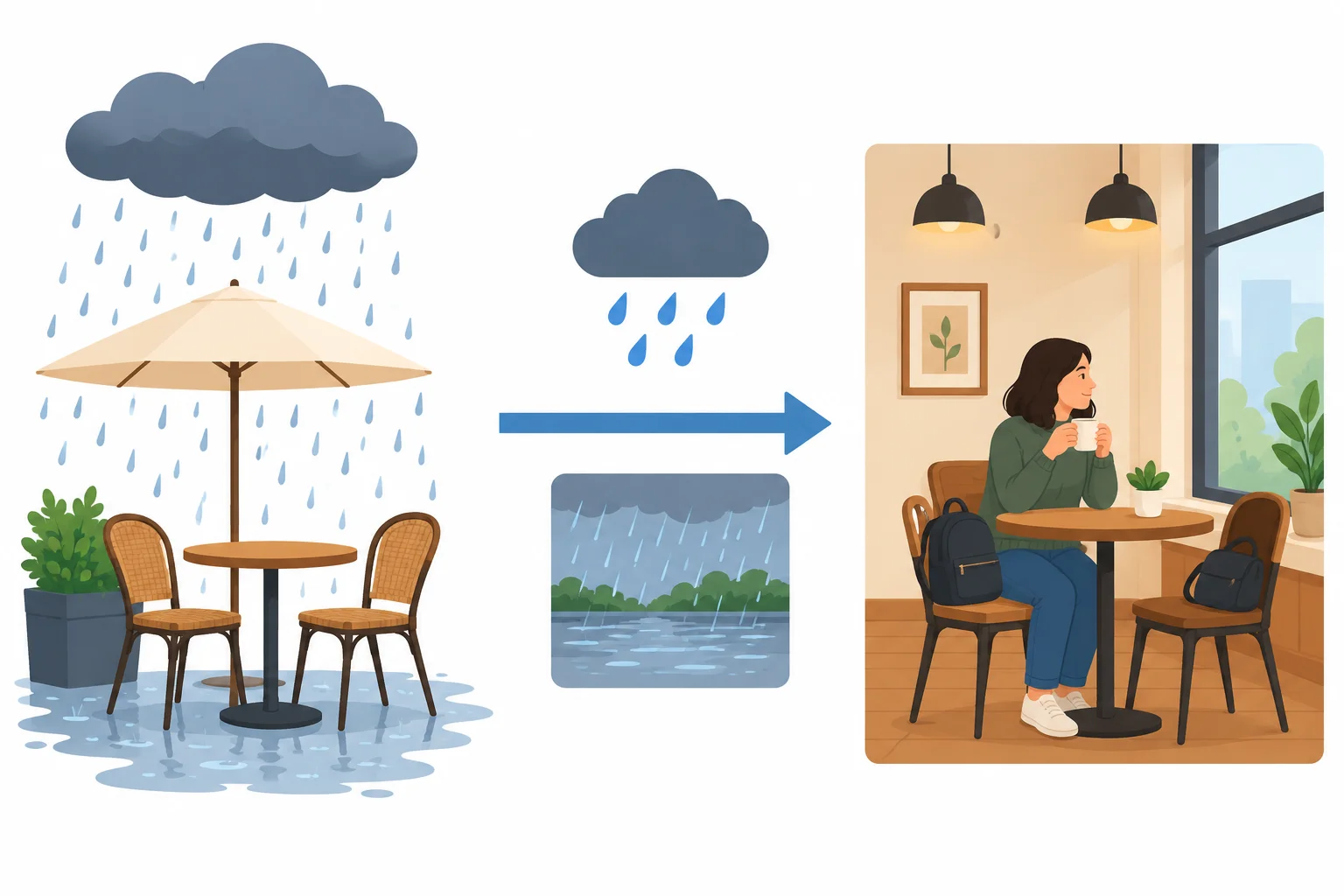
A reason can be named with a noun phrase, such as “the rain,” or expressed with a clause, such as “it was raining.”
Choose the connector by looking at what comes next.
| Connector | What follows | Example ending |
|---|---|---|
| because | a clause | it was raining |
| because of | a noun phrase | the rain |
| because of | a noun phrase | a missing bag |
So presents a result after a cause. Because and because of introduce a reason.
When you reshape a sentence with so, a useful pattern is to state the result first and then give the reason. The examples below show the same connection in three ways.
The key choice between because and because of is not the position in the sentence. It is whether the reason is a clause or a noun phrase.
Example
It started to rain, so I went inside.
I went inside because it was raining.
I went inside because of the rain.
Tip
Use so when you present the cause and then its result. Use because or because of to introduce the reason. Then check what follows: a clause after because, or a noun phrase after because of.
Complete Maya’s story connection:
I got my bag back ____ the worker found it.
Complete Maya’s story connection:
I got my bag back ____ the worker’s help.
This sentence gives a cause and its result:
“It started to rain, so I went inside.”
Build an equivalent sentence that begins with the result and gives the reason.
Your sentence
Available words
Step 6 of 8
Listen to Alex’s classroom story, identify its key parts, choose an ending that resolves the problem, and write a short cause-and-result sentence you hear.
A suitable ending does two jobs: it agrees with the earlier events and answers the main problem.
A final sentence can sound complete but still leave the problem unanswered. Listen for the problem first, then listen for the action that helps solve it.
Luckily signals a helpful or fortunate development. It often introduces the part that moves a story toward a clear ending.
Listen to Alex’s story. Do not read a transcript yet. Focus on the place, the problem, and Alex’s response.
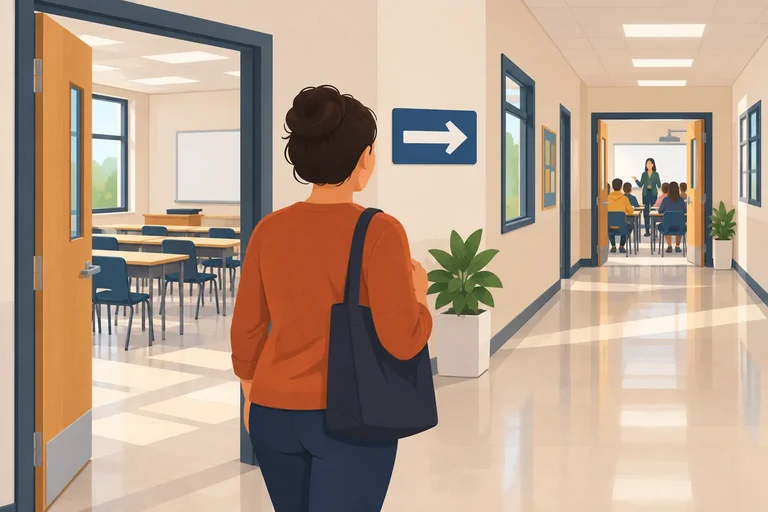
At first, I went to Room 2 for my class. A few minutes later, I saw that the room was empty. Suddenly, I noticed a sign directing me to Room 4. I followed the sign.
Match each story-plan label to the event you heard.
Tap an item and then its matching pair.
Listen and choose an option.
Listen to the final sentence. Which sentence did you hear, and which ending fits Alex’s story?
Luckily, I joined the class.
Listen and write what you heard.
Listen and write the 10-word sentence. Include the cause, so, and the result.
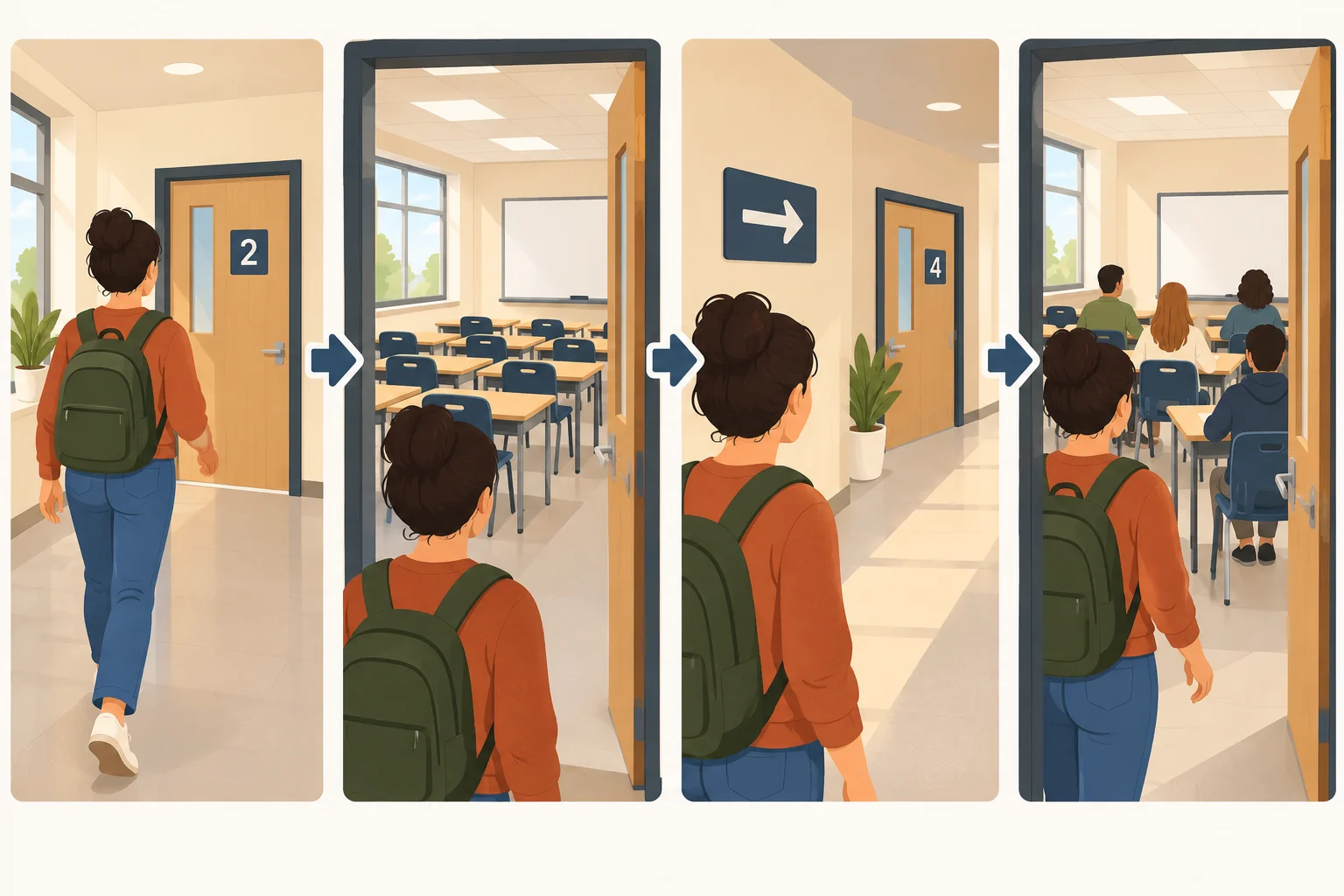
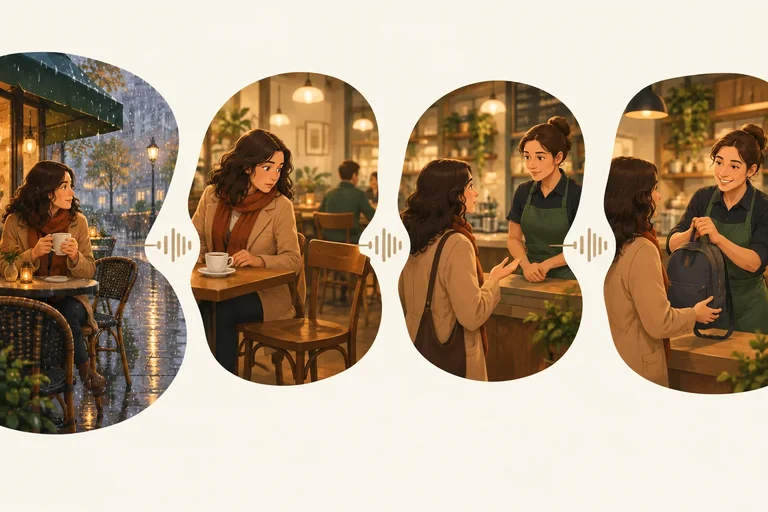
The map shows how the empty room leads to a response and then to a clear ending.
Now compare the full transcript with the story map.
At first, I went to Room 2 for my class. A few minutes later, I saw that the room was empty. Suddenly, I noticed a sign directing me to Room 4. I followed the sign. Luckily, I joined the class.
The empty room is the Problem. Following the sign is the Response. Joining the class is a clear ending because it answers what happened to Alex’s problem.
Step 7 of 8
Use meaningful pauses and key-word stress to make a short story easy for a listener to follow.
A spoken story is easier to follow when you divide it into its main parts. Make a short pause after a complete part: Where and when, Problem, Response, or Ending.
Do not pause after every few words. Too many pauses can break the meaning. The rain and moving indoors are background events that lead to Maya’s main problem: her missing bag. For an unexpected event, stress one important word: say it a little stronger and clearer.
In pronunciation practice, / means a short pause and CAPITAL letters show stress.
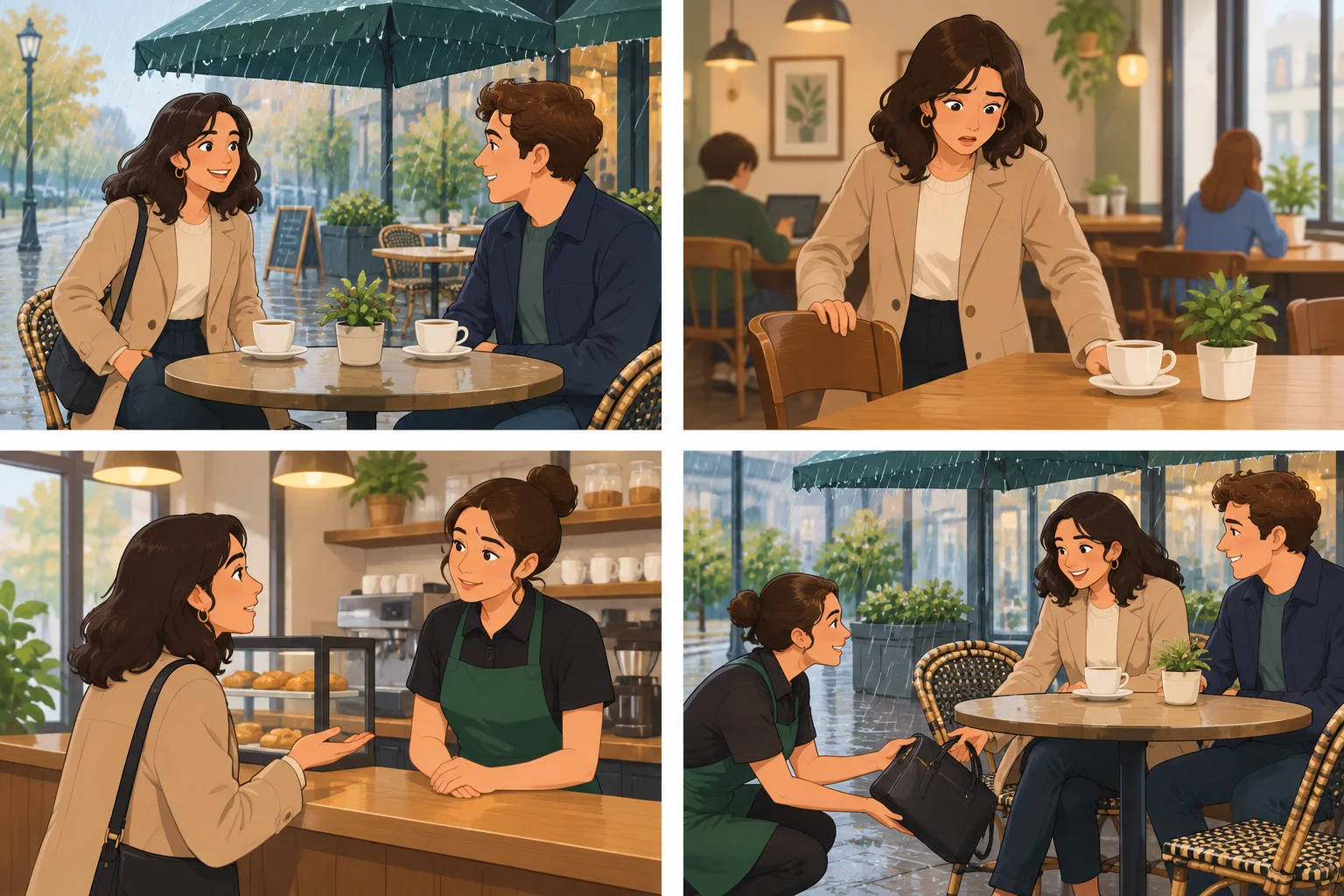
Pause briefly when the story moves from one main part to the next.
Example
At first, I met Sam at a café on Saturday afternoon. It started to rain, so I went inside. / Suddenly, I noticed my BAG was missing. / I asked a café worker for help. / In the end, the worker found it under my outdoor table, so I got my bag back and continued my meeting with Sam.
At first, I met Sam at a café on Saturday afternoon, then it started to rain so I went inside, suddenly I noticed my bag was missing, I asked a café worker for help, and in the end the worker found it under my outdoor table, so I got my bag back and continued my meeting with Sam.
At first, I met Sam at a café on Saturday afternoon. It started to rain, so I went inside. Suddenly, I noticed my bag was missing. I asked a café worker for help. In the end, the worker found it under my outdoor table, so I got my bag back and continued my meeting with Sam.
Which version makes the story easier to follow?
Mark three places for a short pause by typing / in the excerpt. Then say the excerpt aloud once, using your pauses. Do not pause inside a story part.
At first, I went to Room 2 for my class. A few minutes later, I saw that the room was empty. Suddenly, I noticed a sign directing me to Room 4. I followed the sign. Luckily, I joined the class.
Tip
Use notes, not full sentences, when you retell a story. Look at one part, speak it, and move to the next part. This helps your story sound connected instead of read aloud.
Use these notes for a short spoken retelling.
| Story part | Notes |
|---|---|
| Where and when | Saturday afternoon; café; meeting Sam; rain made us move indoors |
| Problem | Noticed my bag was missing |
| Response | Asked a café worker for help |
| Ending | Worker found bag under outdoor table; got it back; continued meeting |
Tell this story aloud for 30–40 seconds from the four-part notes. Use at least two short pauses between story parts. Emphasize one key word when you describe the unexpected event.
After speaking, report the choices you made: name two places where you paused, write the key word you emphasized, and say whether your ending answered the problem.
Write at least 40 characters (0/40).
Step 8 of 8
Write an 80–100-word story with a clear ending, check it against a model, and tell it aloud from brief notes.
Bring everything together with one simple path: Where and when → Problem → Response → Ending.
For your final story, choose one everyday surprise. Give only details that help a reader understand the problem or how it ended. A clear ending answers the main problem—even if the ending is not happy.
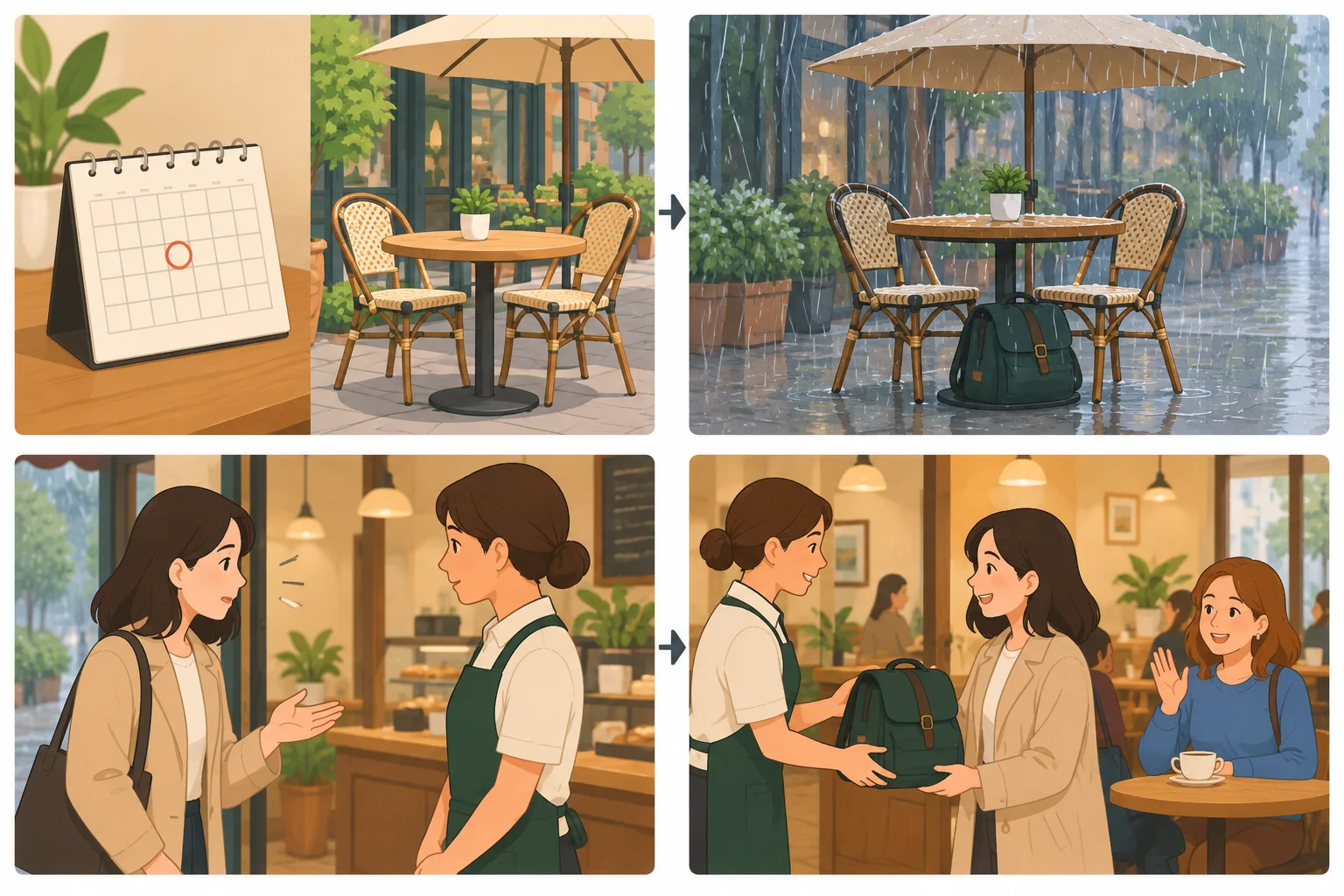
Use these labels for the four panels: Where and when, Problem, Response, and Ending.
Read Maya’s complete model. Notice how the final sentence answers the missing-bag problem.
Example
On Saturday afternoon, I met my friend Sam at a café. At first, we sat at an outdoor table and talked. It started to rain, so I went inside. Sam followed me. A few minutes later, I noticed my bag was missing. Suddenly, I felt worried because of the rain and the busy café. I asked a café worker for help. She found my bag under our outdoor table. In the end, I got my bag back and continued my meeting with Sam.
Use this checklist after you draft. Compare your story with the model, but keep your own events and details.
| Check | Ask yourself |
|---|---|
| Where and when | Does the opening say where and when the story happened? |
| Problem | Is the main difficulty easy to identify? |
| Response | Does the reader know what I did about the problem? |
| Ending | Does the ending answer what happened to the problem? |
| Connections | Do time expressions show changes? Do so and because of connect the right ideas? |
| Details and past forms | Does each detail help? Are familiar past forms clear? |
Create a real or invented story about an everyday surprise.
First, write four short labeled notes: Where and when, Problem, Response, and Ending. Then write your story beneath them. The story itself must be 80–100 words; the four plan notes do not count.
Use useful details only. Include at least two suitable time expressions, one meaningful connection with so, and one with because of. Check your draft against Maya’s model and the checklist on the previous screen. Revise unclear links or familiar past forms before you submit.
Write at least 450 characters (0/450).
Now turn your revised story into a spoken story. Make four very short notes—one for each story-plan label. Do not read every sentence.
Tell the story aloud once in 45–60 seconds. Pause between the main parts, especially before the problem or ending. Stress a key word when you describe the unexpected event.
After you speak, report your delivery. Include your approximate time, where you paused, the word or phrase you stressed for the unexpected event, and one change you made after using the checklist.
Write at least 80 characters (0/80).
Summary
You can now plan a short story, keep its details focused, connect events clearly, and finish by answering the main problem.
Congratulations! You completed: Tell a Story with a Clear Ending
30 XP
Thousands of online courses in video, ebooks and audiobooks.
To test your knowledge during online courses
Generated directly from your cell phone's photo gallery and sent to your email

Download our app via QR Code or the links below:.



Carry knowledge in your pocket.
Download the Cursa app.
There are hundreds of free courses available, with a free certificate of completion that is saved in your mobile image gallery.
Download the app to access the Course Completion Certificate for Free.


+ 10 million
students

Free and Valid
Certificate

60 thousand free
exercises

4.8/5 rating in
app stores

Free courses in
video and ebooks