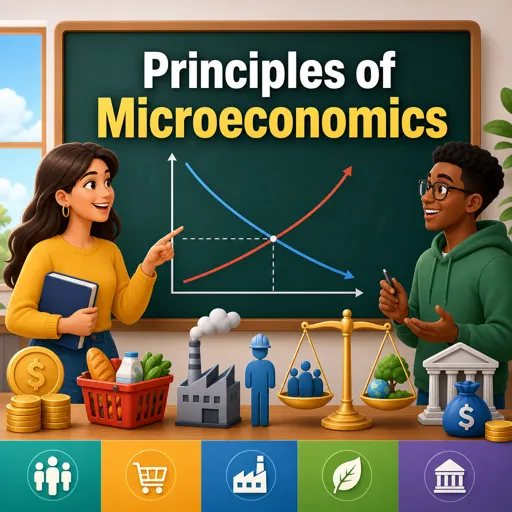
 Microeconomics
 Macroeconomics


Economics is the study of how people, businesses, and governments allocate scarce resources to satisfy needs and wants.

7

4


Free CourseFundamentals of Economy
5

(3)

1h53m

12 exercises
Free CourseMicroeconomics: Basic Economics Concepts
4.7

(3)
7h39m
50 exercises
Free CoursePrinciples of Macroeconomics
4.6
(5)
14h24m
15 exercises
Free CourseIntro to Economics
4.3
(3)
3h46m
26 exercises
Free CoursePrinciples of Macroeconomics
New
19h50m
29 exercises

Free CourseFinancial Markets
New
27h51m
23 exercises
Exercises
Test your knowledge of dominant strategies, Nash equilibrium, payoff matrices, repeated games, and credible threats.
Start exercisesTest your knowledge of corporate economic strategies, inflation, interest rates, trade, diversification, market structures, and fiscal policy.
Start exercisesTest your knowledge of business finance, budgeting, economic strategies, capital structure, SWOT analysis, inflation, and financial statements.
Start exercisesTest your knowledge of business economics, spending management, inflation, cost control, recession strategy, and long-term growth.
Start exercisesTest your business economics knowledge with questions on inflation, GDP, opportunity cost, market equilibrium, elasticity, and economies of scale.
Start exercisesTest your knowledge of business economy management, financial analysis, opportunity cost, market research, sustainability, and strategic planning.
Start exercises
Opportunity Cost and Trade-Off Thinking: The Economics Skill That Improves Every Decision
Learn how opportunity cost and trade-off thinking improve decisions in money, time, and career planning with practical examples and frameworks.

Market Power and Pricing: How Firms Set Prices (and Why It Matters for Your Career)
Learn how firms set prices across market structures using elasticity, competition, and cost strategies to make smarter business decisions.

Comparative Advantage Made Practical: How Trade Creates Value (and When It Doesn’t)
Learn how comparative advantage works in real life, from business decisions to global trade, and why specialization increases total value.

An Introduction to Microeconomics: Understanding Individual Choices
Learn the basics of microeconomics, including supply and demand, elasticity, market structures, and consumer choice, to understand individual economic decisions.

Elasticity in Microeconomics: Measuring Responsiveness in Markets
Learn about elasticity in microeconomics, including price, income, and cross-price elasticity, and how it affects markets, pricing, and policy decisions.

How Market Structures Shape Microeconomic Outcomes
Explore how different market structures—perfect competition, monopoly, oligopoly, and monopolistic competition—impact pricing, efficiency, and consumer choice.

The Role of Supply and Demand in Microeconomics
Explore the basics of supply and demand in microeconomics and learn how they determine prices, market equilibrium, and resource allocation.

An Introduction to Macroeconomics: Understanding the Big Picture
Learn the basics of macroeconomics, including GDP, inflation, unemployment, and policies that shape the overall economy.
Develop a structured understanding of how individuals, firms, governments, and financial institutions allocate scarce resources. These free online courses introduce essential educational concepts such as supply and demand, opportunity cost, market equilibrium, elasticity, consumer behavior, production, economic growth, inflation, unemployment, monetary policy, and fiscal policy. The learning content is suitable for beginners, students, professionals, entrepreneurs, and anyone seeking accessible economics education. Every course is free, includes free certification, and features exercises that help reinforce theoretical knowledge and evaluate learning progress.
Build foundational knowledge through lessons that examine economic systems at both individual and aggregate levels. Microeconomic study addresses consumer choice, business decisions, costs, competition, pricing, and resource allocation. Macroeconomic study explores national income, gross domestic product, business cycles, international trade, public finance, and policy instruments. Together, these subjects support analytical reasoning, quantitative interpretation, and informed decision-making.
Course exercises encourage learners to apply models, interpret graphs, assess policy choices, and connect academic principles with real economic events. This active-learning approach can strengthen critical thinking, financial literacy, problem-solving, and data interpretation. After studying the lessons and completing the required learning activities, participants can obtain free certification. The flexible online format makes it easier to learn independently and revisit concepts whenever additional review is needed.
To access these free courses, users must install the Cursa app on a mobile device. Android users can get the application from Google Play by selecting Download for Android. Apple users can install it from the App Store by selecting Download for iOS / iPhone. Once the app is installed, choose a course and begin studying at your own pace.
Whether your goal is academic preparation, career development, business knowledge, or a clearer understanding of global markets, this collection provides a practical route into economic analysis. Explore the linked courses, complete the exercises, expand your educational foundation, and earn free certification while learning through the Cursa app.
What is economics?
Economics is the study of how people, businesses, and governments allocate scarce resources to satisfy needs and wants.
What is the difference between microeconomics and macroeconomics?
Microeconomics examines individual consumers, firms, and markets, while macroeconomics studies the economy as a whole, including inflation, growth, and unemployment.
What will I learn in an introductory economics course?
You will typically learn scarcity, opportunity cost, incentives, supply and demand, market equilibrium, GDP, inflation, and unemployment.
What is supply and demand in economics?
Supply is the amount producers are willing to sell, and demand is the amount consumers are willing to buy at different prices.
What is opportunity cost?
Opportunity cost is the value of the next-best alternative you give up when making a choice.
What are the main topics in macroeconomics?
Key macroeconomics topics include national income, GDP, inflation, unemployment, economic growth, monetary policy, and fiscal policy.
Do I need prior knowledge to take an economics course?
No. Introductory economics courses generally start with basic concepts and are suitable for beginners.

Complete any course and issue your certificate via the app — at no cost.

Download the app! to have access to more than 4,000 Online Courses + Certificate, all free!
Download the app! 100% free courses.


Carry knowledge in your pocket.
Download the Cursa app.
There are hundreds of free courses available, with a free certificate of completion that is saved in your mobile image gallery.
Download the app to access the Course Completion Certificate for Free.


+ 10 million
students

Free and Valid
Certificate

60 thousand free
exercises

4.8/5 rating in
app stores

Free courses in
video and ebooks
What are people saying about free online courses of Economics
Dev Lekhwani
Good course for understanding Macroeconomics deeply
CoursePrinciples of Macroeconomics
Anas Aljofi
Thanks from the bottom of my heart ❤️. great job continuing your support for us.
CoursePrinciples of Microeconomics