
Step 1 of 8
Recognize Rules and Responsibilities
Identify everyday rule vocabulary and distinguish required, forbidden, and optional actions.

Learning path · Level 5 · Tutorial 3
Explain what people need to do, what is not allowed, and what is optional. Read and listen to rules for a class, library, or cycling club. Ask about responsibilities and write a clear message for someone new.
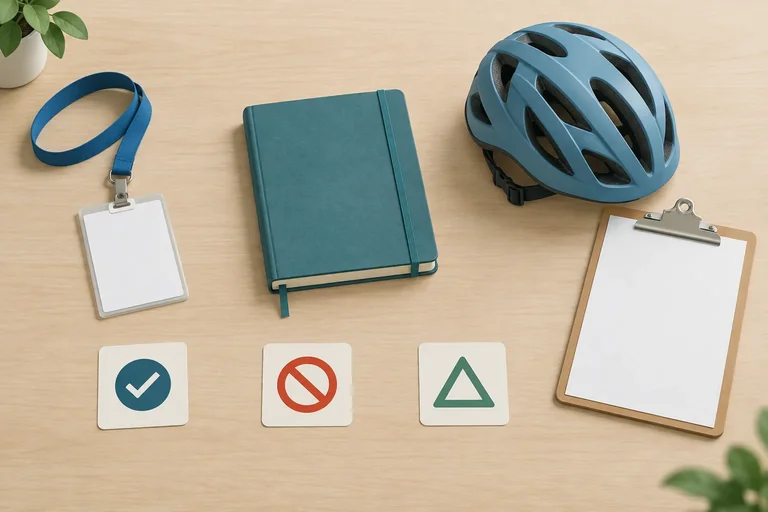
 Recognize Rules and Responsibilities
Identify everyday rule vocabulary and distinguish required, forbidden, and optional actions. 1 min
 State a Requirement with Must
Use must to make clear statements about required actions in rules and strong instructions. 2 min
 Describe Responsibilities with Have To
Use have to and has to accurately for personal responsibilities and requirements that apply to other people. 2 min
 Separate Forbidden Actions from Choices
Choose negative forms carefully so that forbidden actions and optional choices keep their intended meanings. 3 min
 Ask What Is Required
Ask and answer practical questions about whether someone needs to do something. 2 min
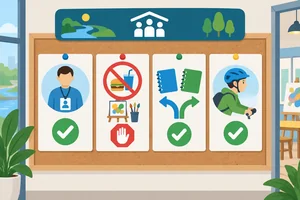 Read Notices Without Changing the Meaning
Read short notices carefully and keep their required, forbidden, or optional meaning tied to the right people and place. 2 min
 Hear and Say the Rule Clearly
Practise hearing and saying rules clearly without changing whether an action is required, forbidden, or optional. 2 min
 Welcome Someone New
Read, hear, write, and say a clear welcome for a new visitor at Riverside Learning Center. 3 min
Step 1 of 8
Identify everyday rule vocabulary and distinguish required, forbidden, and optional actions.
At Riverside Learning Center, Maya is a new visitor, and Sam is an art-class helper.
A rule tells people what is expected or allowed in a particular place or activity. A responsibility is a task that a person needs to do.
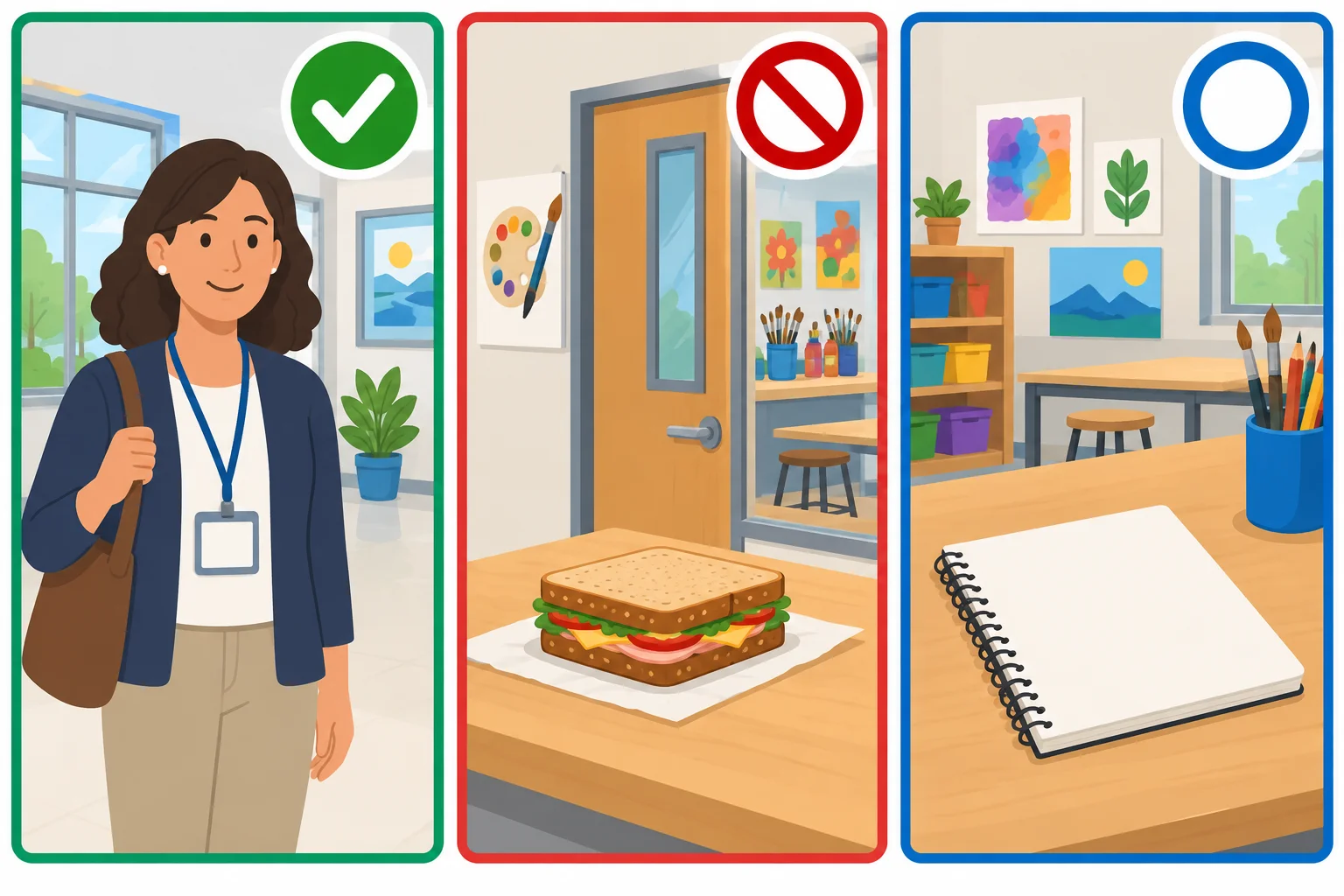
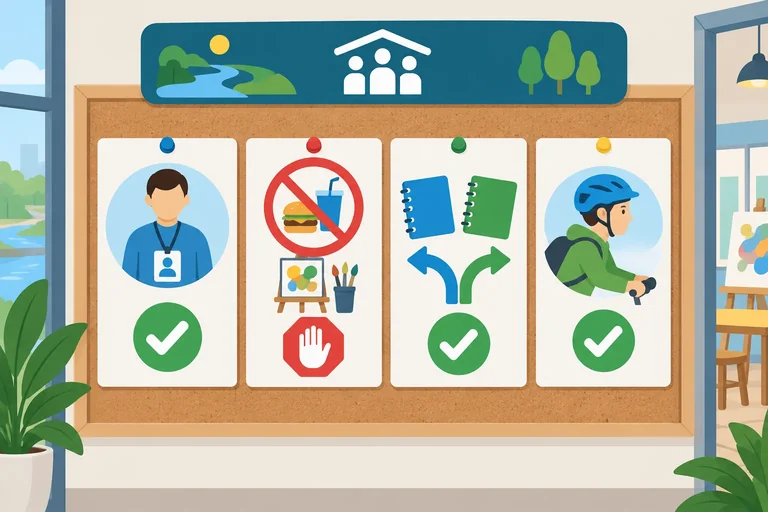
The symbols show three rule meanings: required, forbidden, and optional.
Use these meaning labels to understand a rule before you study its grammar:
These rules apply at Riverside Learning Center.
| Meaning | Symbol | At Riverside Learning Center |
|---|---|---|
| required | checkmark in a circle | Visitor badge |
| forbidden | crossed-out circle | Food in the art room |
| optional | open circle | Notebook |
Example
Sam’s responsibility: bring the visitor badges.
Class task deadline: Friday.
A deadline is the last time a task needs to be finished. Class members need to finish their class task by Friday.
Match each object description or plain-English rule description to its name or meaning label.
Tap an item and then its matching pair.

Step 2 of 8
Use must to make clear statements about required actions in rules and strong instructions.
Use must to state a strong rule or a necessary action. In a written notice or a strong instruction, must tells people that an action is required.
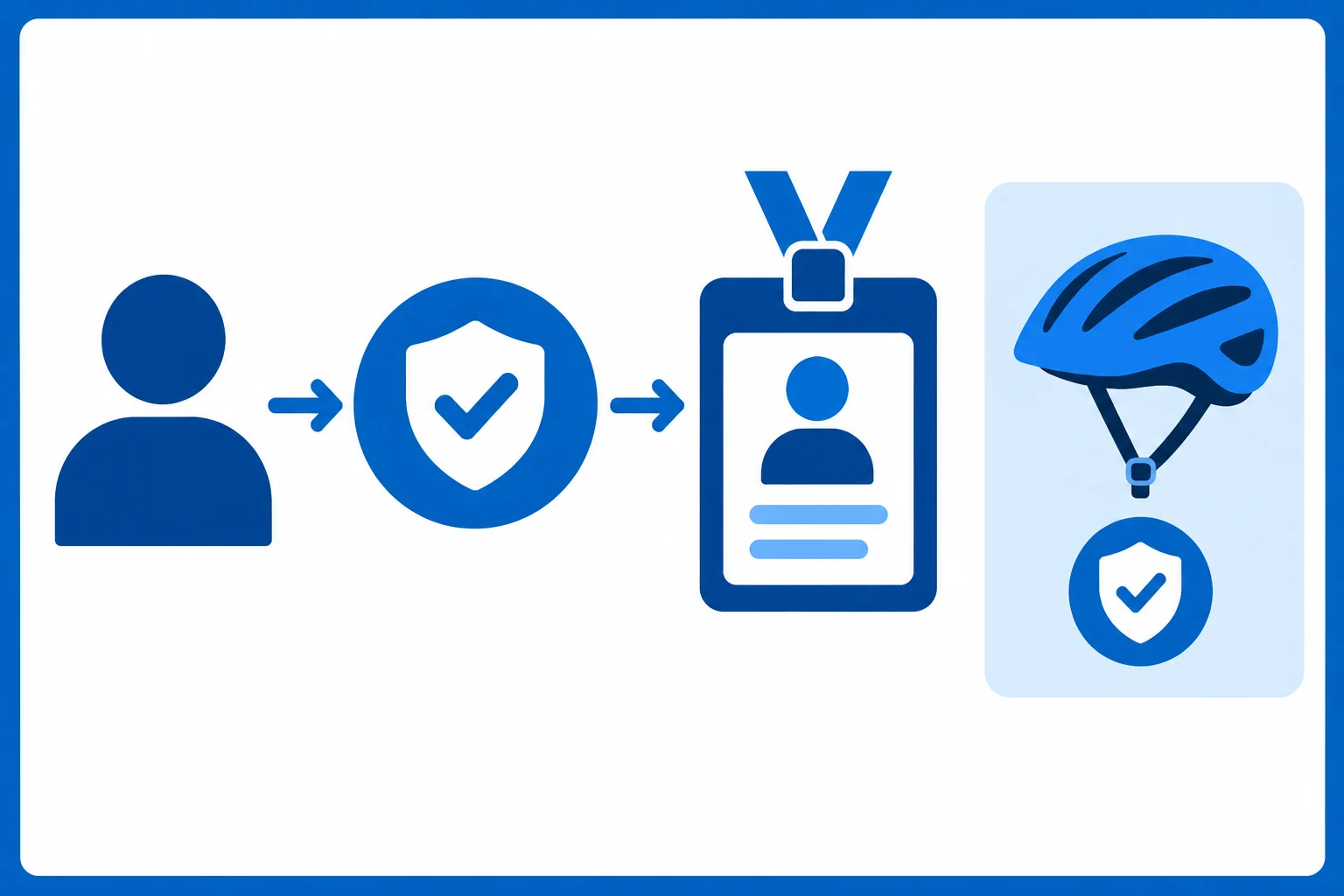
The shield with a check mark is the symbol for required.
Example
Visitor notice
You must wear a visitor badge.
Pattern: subject + must + base verb
After must, use the base verb: wear, bring, or arrive. Do not add -s to the verb, and do not add to.
Must stays the same with every subject.
The form of must does not change, even with a singular name.
| Subject | Rule |
|---|---|
| I | must wear a visitor badge. |
| You | must wear a visitor badge. |
| Maya | must wear a visitor badge. |
| They | must wear a visitor badge. |
Example
At this cycling club, members must wear a helmet. This is a rule for this particular club.
Build the cycling-club requirement from the word blocks.
Your sentence
Available words
Complete the Riverside visitor rule.
Maya ___ wear a visitor badge.

Step 3 of 8
Use have to and has to accurately for personal responsibilities and requirements that apply to other people.
A responsibility is something a person needs to do. Use have to or has to + a base verb to describe it.
The verb after the form is always the base verb: has to bring, not “has to brings.”
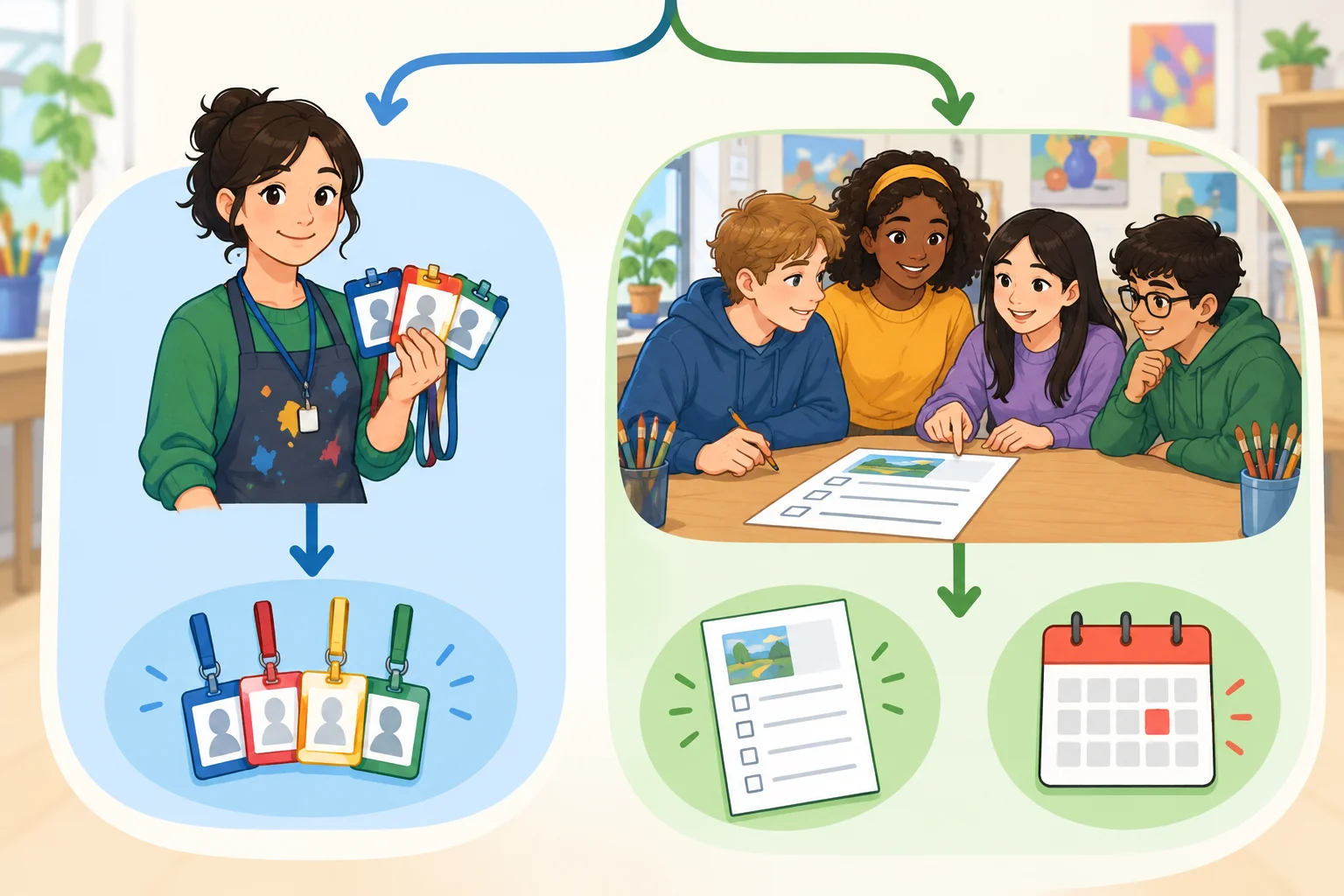
Use has to for one person or one name; use have to for I, you, we, and they.
Match the subject to the correct form before the base verb.
| Subject | Form | Base-verb example |
|---|---|---|
| I | have to | wear a visitor badge |
| You | have to | wear a visitor badge |
| We / they | have to | finish the class task by Friday |
| He / she / Sam | has to | bring the visitor badges |
At Riverside Learning Center, Sam is an art-class helper. His responsibility is to bring the visitor badges.
Class members also have a task with a deadline. A deadline is the last time something needs to be finished. Their deadline is Friday.
Example
Sam has to bring the visitor badges.
Class members have to finish their class task by Friday.
For a requirement, must and have to / has to can express the same essential meaning. Do not treat one as a stronger level of necessity.
A written notice may say, “Visitors must wear a visitor badge.” You can also explain this rule as, “Visitors have to wear a visitor badge.”
Complete the responsibility.
Class members ___ finish their class task by Friday.
Write two answers.
A. Complete the responsibility: Sam ___ bring the visitor badges.
B. Rewrite this requirement with have to without changing its essential meaning: “Visitors must wear a visitor badge.”
Write at least 35 characters (0/35).

Step 4 of 8
Choose negative forms carefully so that forbidden actions and optional choices keep their intended meanings.
A negative rule can have two very different meanings.
Changing mustn't to don't have to does not make a rule softer. It changes a ban into a choice.
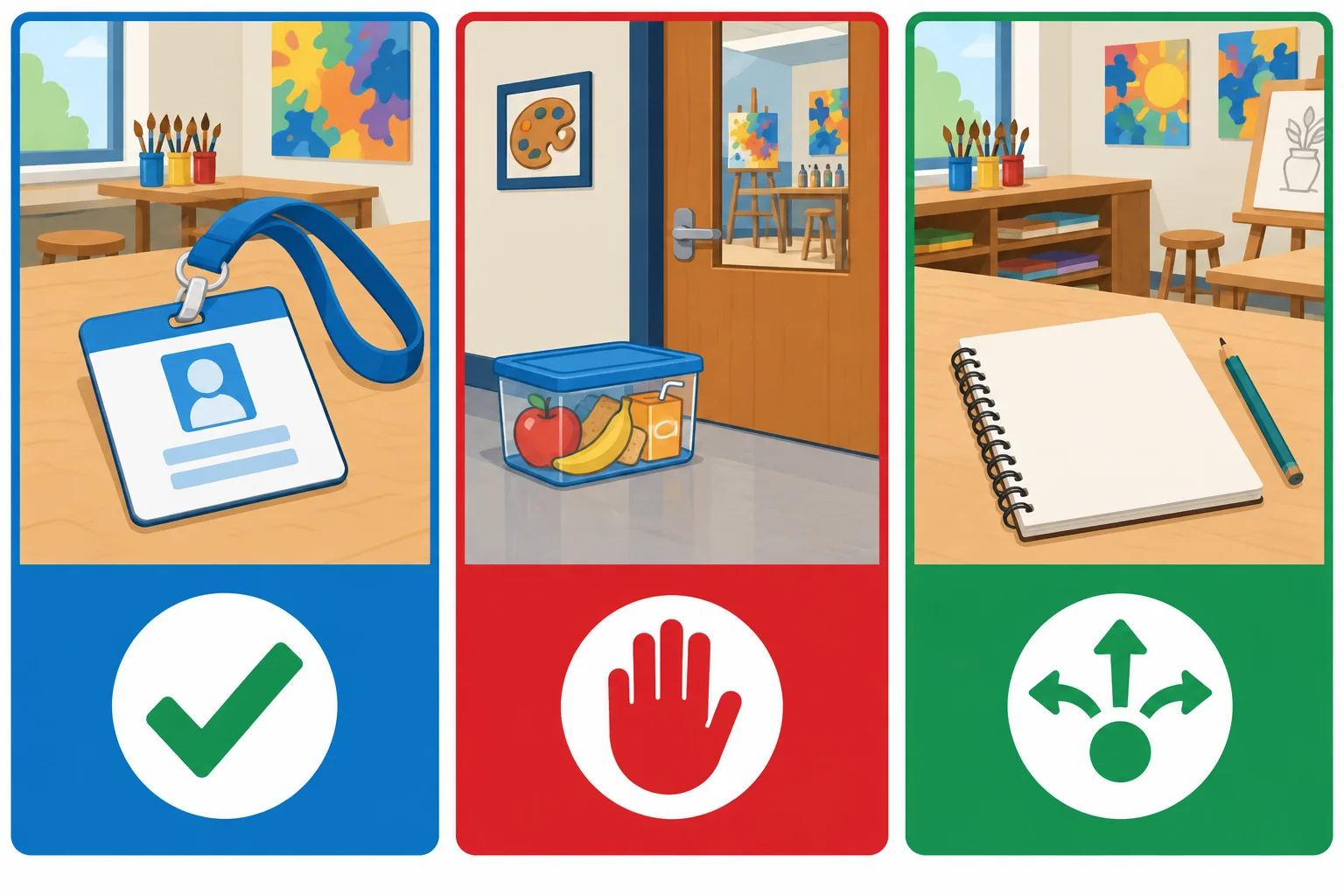
The symbols show three meanings: required, forbidden, and optional.
Compare the meaning before you choose a negative form.
| Meaning | Example | What it means |
|---|---|---|
| required | You must wear a visitor badge. | The action is needed. |
| forbidden | You mustn't bring food into the art room. | The action is not allowed. |
| optional | You don't have to bring a notebook. | The action is a choice. |
Use mustn't (the short form of must not) plus a base verb for a forbidden action. The form stays the same with every subject:
For an optional action, use don't have to with I, you, we, and they. Use doesn't have to with he, she, or one name. After doesn't, use have to — not has to.
Example
At Riverside Learning Center, Sam explains the rules clearly:
“You mustn't bring food into the art room. It is forbidden.”
“You don't have to bring a notebook. It is optional.”
“Maya doesn't have to bring a notebook either.”
Warning
Do not replace mustn't with don't have to just to make a rule sound less strong. A forbidden action is not a choice; an optional action is a choice.
Match each rule to its meaning.
Tap an item and then its matching pair.
Write four parts to check your understanding.
A. Give the meaning label for: “You mustn't bring food into the art room.”
B. Give the meaning label for: “Maya doesn't have to bring a notebook.”
C. Complete these three sentences with the correct negative forms:
D. Write the changed food rule that would incorrectly make bringing food a choice.
Write at least 80 characters (0/80).

Step 5 of 8
Ask and answer practical questions about whether someone needs to do something.
Use Do to ask about I, you, we, or they. Use Does to ask about he, she, or one person’s name.
Do + subject + have to + base verb?
Does + subject + have to + base verb?
After Do or Does, the form stays have to. Do not use has to in these questions.
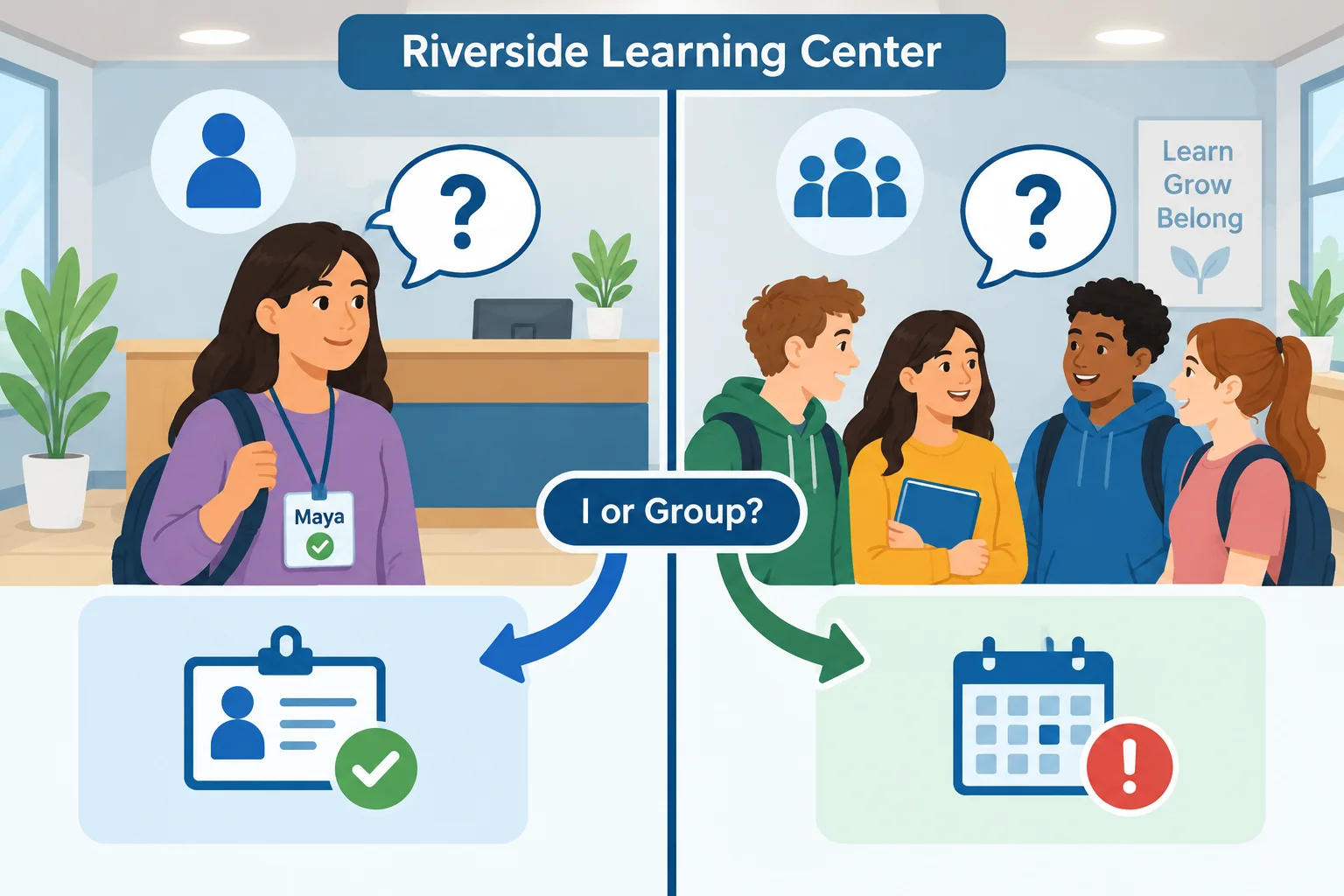
A singular person or name takes Does. I and groups take Do. Both question forms continue with have to + base verb.
Example
Maya: Do I have to bring a notebook?
Sam: No, you don't. It is optional.
Sam: Does Maya have to wear a visitor badge?
Class helper: Yes, she does.
Short answers repeat do or does, not have or has.
For a question beginning with Do, use do or don't. For a question beginning with Does, use does or doesn't.
Notice the listener’s point of view: when someone asks Do I ...?, answer about that person with you.
A negative answer such as No, you don't means the action is not required. It does not mean the action is forbidden.
Match the helper and the subject in the short answer.
| Question | Short answer | Meaning |
|---|---|---|
| Do I have to bring a notebook? | No, you don't. | optional |
| Does Maya have to wear a visitor badge? | Yes, she does. | required |
| Do class members have to finish their class task by Friday? | Yes, they do. | required |
Complete the question about Sam’s responsibility.
Does Sam ___ to bring the visitor badges?
Build the question about the class task and its deadline.
Your sentence
Available words
Build the question about Sam’s responsibility.
Your sentence
Available words
Match each question to its grammatically correct short answer.
Tap an item and then its matching pair.
At Riverside Learning Center, Sam says, “No, you don't,” after Maya asks about bringing a notebook. What does Sam mean?
Step 6 of 8
Read short notices carefully and keep their required, forbidden, or optional meaning tied to the right people and place.
Short notices often leave out words. Read each one in three parts:
Then make a complete sentence without changing any of those three parts. A label such as “required” can become must + base verb. A label such as “optional” can become don’t have to + base verb.
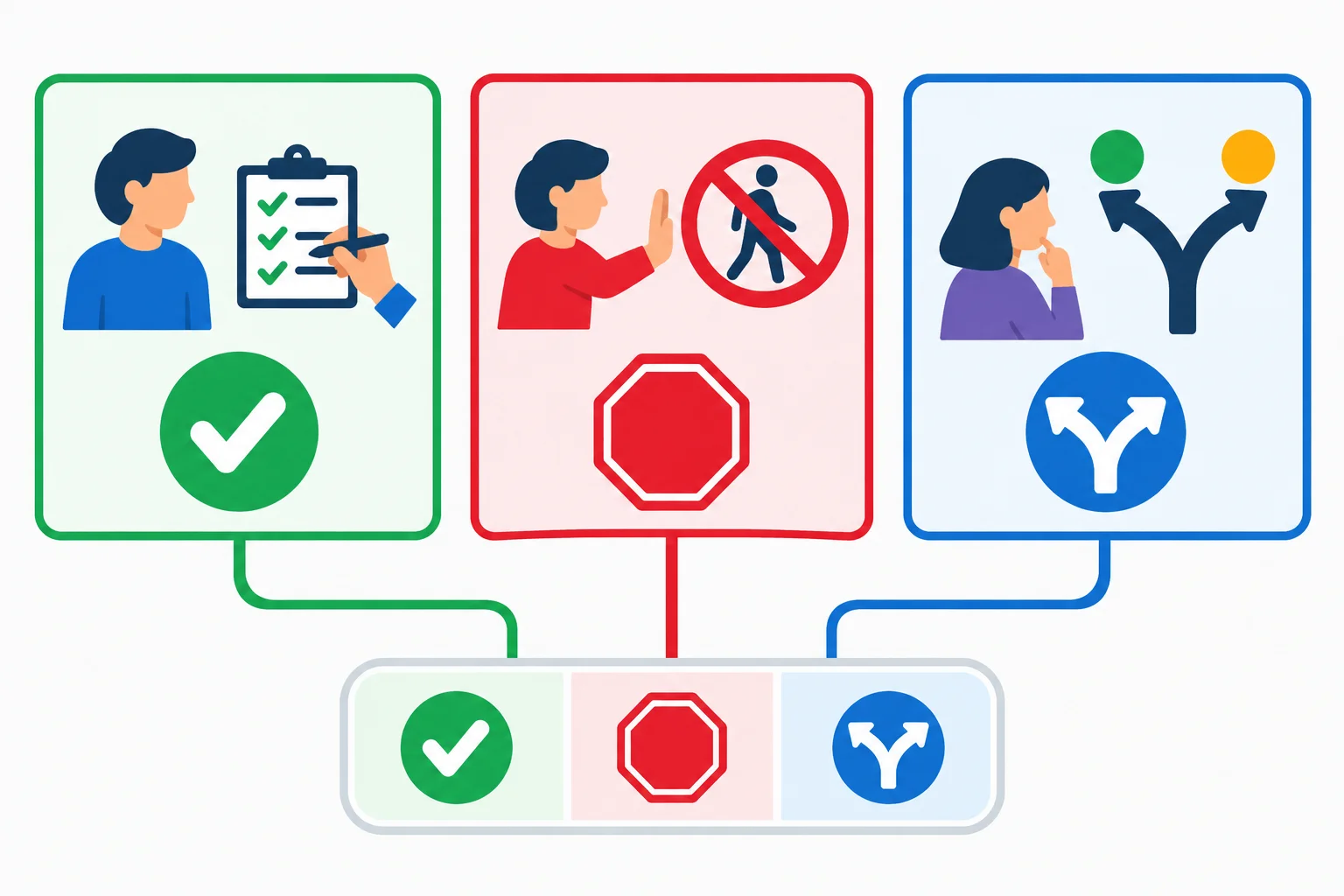
Use the symbols as a guide: checkmark = required; stop sign = forbidden; two paths = optional.
Tip
Keep the notice’s scope. Do not make a rule bigger or smaller than it is.
If a notice is for visitors, do not change it to a rule for everyone. If it names the art room, do not apply it to every room. If it says “by Friday,” keep the deadline.
A brief label can give the same information as a complete rule. Notice how the person, place, action, and meaning stay the same.
Read across each row. The complete sentence explains the short notice; it does not add a new rule.
| Who or place | Short notice | Complete meaning |
|---|---|---|
| Riverside visitors | Visitor badge required | Visitors must wear a visitor badge. |
| Riverside art room | No food | You mustn't bring food into the art room. |
| Riverside visitors | Notebook optional | You don't have to bring a notebook. |
| Cycling-club rides | Helmet required | Club members must wear a helmet on club rides. |
Tip
The library and cycling club have their own policies. A cycling-club helmet rule applies to that club’s rides; it does not state a rule for every place or activity.
Sort each notice by its meaning.
Tap an item and then its matching pair.
A cycling-club notice says: “Club rides: helmet required.”
Does this restatement preserve the notice’s meaning and scope?
“At this cycling club, members must wear a helmet on club rides.”
Step 7 of 8
Practise hearing and saying rules clearly without changing whether an action is required, forbidden, or optional.
In connected speech, have to often has an f sound at the end of have. In has to, the end of has often has an s sound. The word to is often light and quick.
Listen for the subject, then listen for have to or has to. When you write, always use the standard forms: have to and has to.
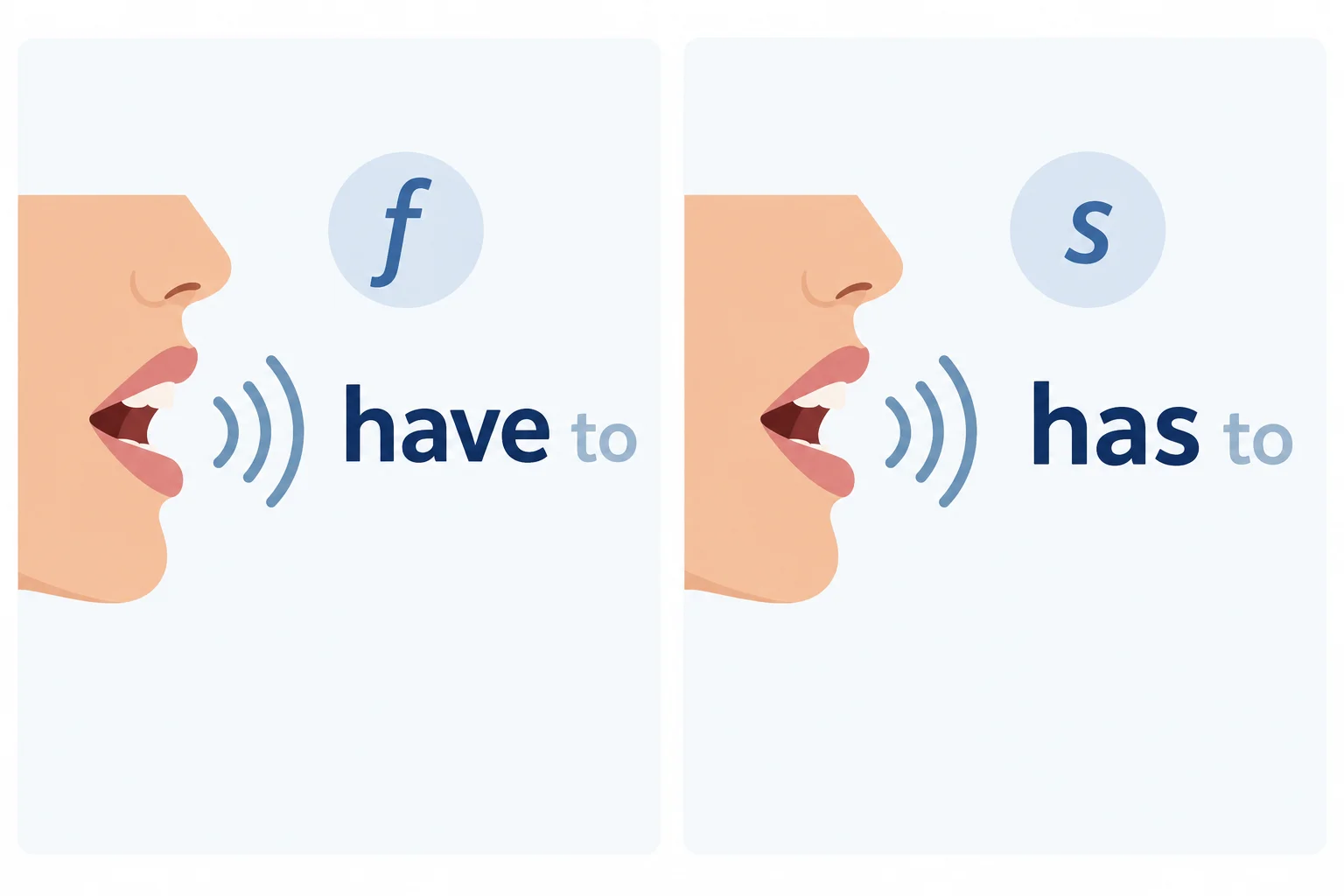
Listen for an f-like ending in have to and an s-like ending in has to. Keep to light.
Listen twice. Notice the different subject before each expression.
I have to wear a visitor badge. Maya has to wear a visitor badge.
I have to wear a visitor badge. Maya has to wear a visitor badge.
Listen and choose an option.
Which rule do you hear?
You mustn't bring food into the art room.
Listen and write what you heard.
Listen and type the complete sentence.
Listen and write what you heard.
Listen and type the complete sentence.
Listen to the model, then repeat the full sequence twice. Make the meaning clear with stress:
Check that a listener could tell: required, forbidden, and optional.
Use this as your speaking model.
You must wear a visitor badge. You mustn't bring food into the art room. You don't have to bring a notebook.
You must wear a visitor badge. You mustn't bring food into the art room. You don't have to bring a notebook.
Tip
You do not need an exaggerated final sound. Make mustn't and don't clear enough to protect the meaning. A listener must not confuse a ban with an optional choice.

Step 8 of 8
Read, hear, write, and say a clear welcome for a new visitor at Riverside Learning Center.
Required: Visitors must wear a visitor badge.
Forbidden: Visitors mustn't bring food into the art room.
Optional: Visitors don't have to bring a notebook.
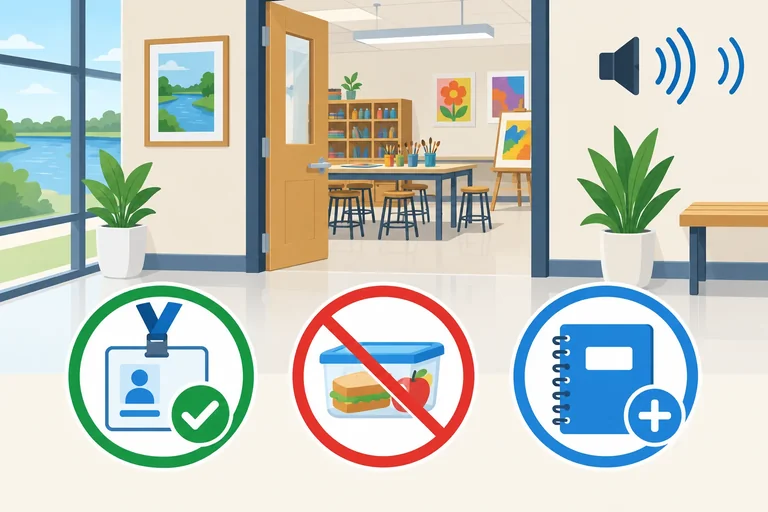
Use the object and its symbol to keep the three rule meanings separate.
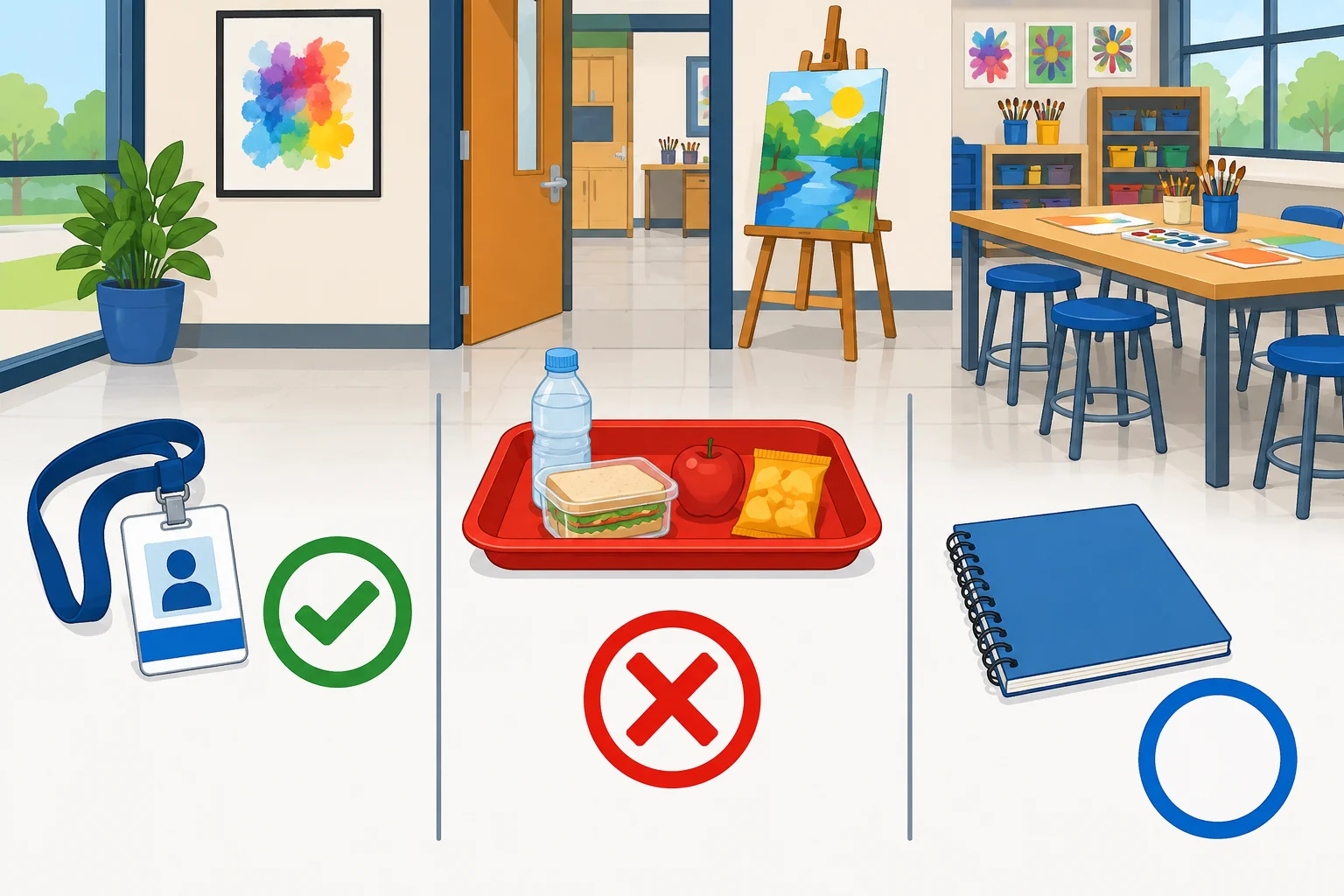
The symbols show required, forbidden, and optional actions.
Listen twice. This welcome adds the responsibility and deadline that are not in the written notice.
Welcome, Maya. Sam has to bring the visitor badges. Class members have to finish their class task by Friday. Friday is the deadline.
Match each source cue to the complete information it gives. Use both the written notice and the spoken welcome.
Match each cue to its complete meaning.
Tap an item and then its matching pair.
Organize your message so Maya can act on it easily:
When you speak, stress must, mustn't, and don't have to so the three meanings are clear.
Use this quick check as you write. It helps you keep the grammar and the meaning accurate.
| Message part | Check |
|---|---|
| Requirement | must or have to + base verb |
| Ban | mustn't + base verb |
| Choice | don't have to + base verb |
| Sam's task | Sam has to + base verb |
| Question | Do/Does + subject + have to + base verb? |
| Short answer | Use do, does, don't, or doesn't |
Use both sources. Write a 70–90-word welcome message to Maya. Include the three visitor rules from the written notice, Sam's responsibility and the deadline from the spoken welcome, and a Do or Does question with its short answer. Then say aloud the required rule, the ban, and the optional choice from your message. Stress the words that show each meaning.
Write at least 300 characters (0/300).
Example
Compare after writing. Your message may use different friendly wording, but it should keep every rule meaning, responsibility, and question form accurate.
Check your own message against the model and the two sources.
| Check | What to verify |
|---|---|
| Sources | The visitor rules come from the notice. |
| Sources | Sam's task and Friday deadline come from the audio. |
| Meaning | One required action is clear. |
| Meaning | One forbidden action is clear. |
| Meaning | One optional action is clear. |
| Agreement | Sam has to is correct. |
| Question | The Do or Does question uses have to. |
| Answer | The short answer matches the question. |
| Speaking | You stressed the words showing the three meanings. |
Summary
The three negative and positive meanings need careful checking.
Congratulations! You completed: Explain Rules and Responsibilities
20 XP
Thousands of online courses in video, ebooks and audiobooks.
To test your knowledge during online courses
Generated directly from your cell phone's photo gallery and sent to your email

Download our app via QR Code or the links below:.



Carry knowledge in your pocket.
Download the Cursa app.
There are hundreds of free courses available, with a free certificate of completion that is saved in your mobile image gallery.
Download the app to access the Course Completion Certificate for Free.


+ 10 million
students

Free and Valid
Certificate

60 thousand free
exercises

4.8/5 rating in
app stores

Free courses in
video and ebooks