
Step 1 of 8
Who Does the Work?
Learn to distinguish doing work yourself from arranging for a service provider to do it.

Learning path · Level 9 · Tutorial 2
Explain which services you will arrange and which tasks you will do yourself. Read a service conversation and listen to an arrangement being confirmed. Choose what the speaker means and write a short dictation. Practise saying causative phrases, rehearse a service request aloud, and write a guided confirmation note with the service and agreed date.
 Who Does the Work?
Learn to distinguish doing work yourself from arranging for a service provider to do it. 2 min
 Build the Have Pattern
Build an arranged-service statement with have by keeping the object before the past participle. 2 min
 Choose Have or Get
Choose have or get for the same arranged service while keeping the object, service action, provider, and timing clear. 2 min
 Show When the Service Happens
Choose forms that show whether an arranged service is routine, completed, or still planned. 3 min
 Ask and Answer About Services
Ask and answer clearly about completed services and future service arrangements, including accurate past and future negative statements. 2 min
 Read and Make a Service Request
Read a service conversation, identify the confirmed arrangement details, and make a clear request for an arranged service. 3 min
 Hear and Say the Arrangement
Listen to a service confirmation, identify its meaning and timing, then practise and write short causative phrases. 2 min
 Confirm the Service Arrangement
Rehearse a service request, listen to a provider’s confirmation, and write a clear future arrangement note. 3 min
Step 1 of 8
Learn to distinguish doing work yourself from arranging for a service provider to do it.
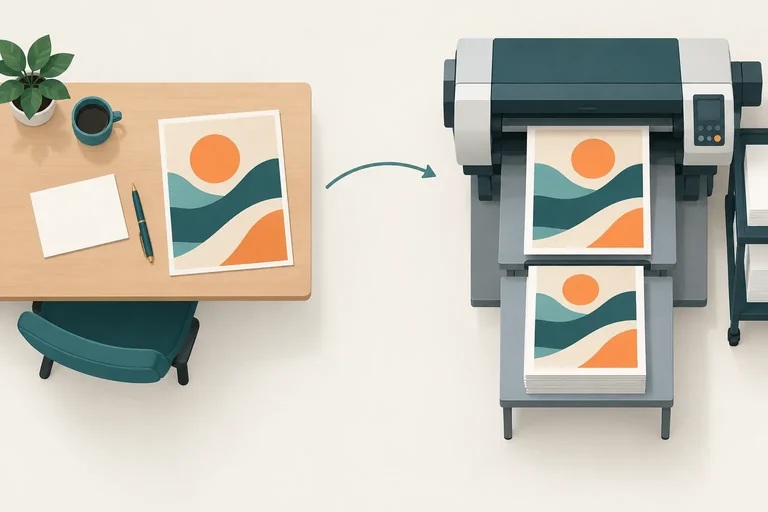
Maya is coordinating a workplace workshop on 18 July. Her team designs 40 posters themselves. For the printing, they arrange a service with City Print.
When you do it yourself, you perform the task. When you arrange a service, another person or company performs it. That person or company is the service provider.

The team does the design themselves; City Print performs the printing service.
Compare these two statements:
We printed the posters.
The team did the printing themselves.
We had the posters printed.
The team arranged a service. City Print performed the printing.
In the second statement, we names the people who arranged the work. It does not mean that they operated the printer.
Example
We printed the posters.
The team performed the action.
We had the posters printed.
The team arranged the action, and a service provider performed it.
Tip
To understand a service statement, ask two questions: “Who arranged the work?” and “Who actually performed it?”
Choose the visual summary that matches both statements in this order:

Step 2 of 8
Build an arranged-service statement with have by keeping the object before the past participle.
When you arrange a service, use this order:
subject + have + object + past participle
In We had the posters printed, We is the subject: the team arranged the work. The team did not necessarily print the posters.
The object receives the service. Put it directly after have. The past participle names the service action.
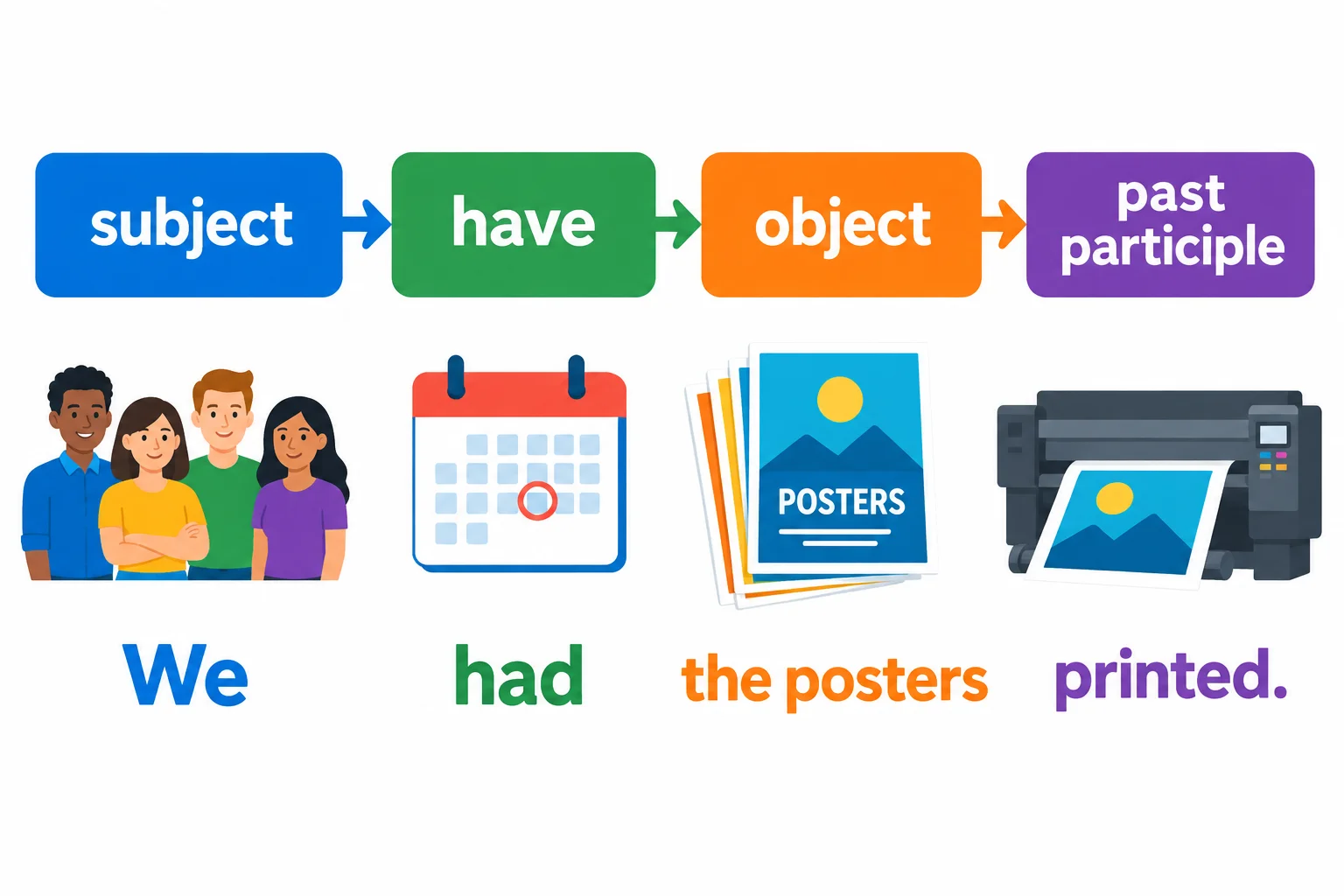
Keep the object in the middle: subject + have + object + past participle.
The past participle tells us what service happens: checked, repaired, or printed.
A named object can be replaced by a pronoun, but its position does not move:
Maya had the projector checked on 10 July.
Maya had it checked on 10 July.
The projector is singular, so use it. For the plural posters, use them in the same object position.
Example
Named object: We had the posters printed.
Pronoun object: We had them printed.
Only the object changes. Have stays before it, and printed stays after it.
Tip
Do not move the pronoun before have. Say had it checked, not it had checked, when Maya arranged the service.
Put the blocks in order to make an arranged-service statement.
Your sentence
Available words
Complete the arranged-service statement.
On 10 July, Maya had ____.

Step 3 of 8
Choose have or get for the same arranged service while keeping the object, service action, provider, and timing clear.
Get can replace have when you describe an arranged service.
subject + have/get + object + past participle
Maya is going to have the posters printed by City Print on 16 July.
Maya is going to get the posters printed by City Print on 16 July.
Both sentences mean that Maya arranges the service; City Print performs the printing. Have is broadly neutral. Get often sounds more conversational in everyday workplace speech.

Whether Maya says have or get, the arranger, service provider, object, and result can stay the same.
When you substitute get for have, keep the object before the past participle. The choice does not automatically change the service provider or the timing.
Both versions describe the same planned printing service.
| Choice | Sentence | What stays the same |
|---|---|---|
| Neutral | Maya is going to have the posters printed by City Print on 16 July. | The posters, City Print, and 16 July |
| Conversational | Maya is going to get the posters printed by City Print on 16 July. | The posters, City Print, and 16 July |
Tip
Get something done can sometimes focus only on the completed result: “We need to get the posters printed.” On its own, this does not name the service provider. Add by City Print, or use a context where the provider is already clear, when that detail matters.
City Print is the agreed service provider. Which sentence expresses the same arrangement as this one?
Maya is going to have the posters printed by City Print on 16 July.
Build the more conversational version of this arrangement:
Maya is going to have the projector repaired by a technician on 15 July.
Your sentence
Available words

Step 4 of 8
Choose forms that show whether an arranged service is routine, completed, or still planned.
Today is 14 July. The service core stays in place when time changes:
subject + have/get + object + past participle
For example: We had the posters printed.
Only have/get, or the words before it, change to show whether a service is routine, completed, or planned.
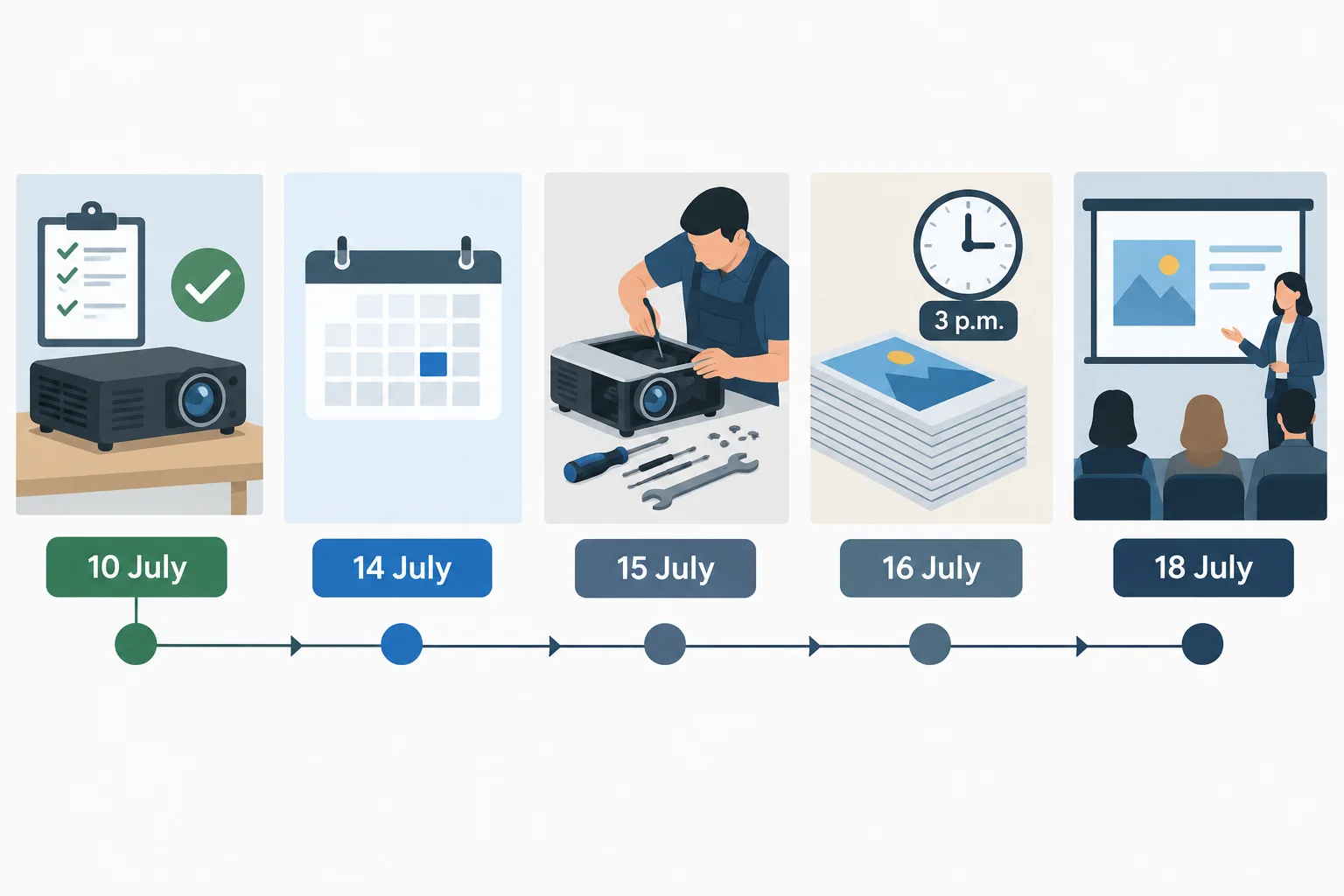
The projector was checked on 10 July. Its repair is booked for 15 July. City Print confirms printing 40 posters on 16 July, with collection at 3 p.m. The workshop is on 18 July.
For a routine or completed service, change have/get. For a future arrangement, put going to or will before have/get. In every form, keep the object + past participle together in the same order.
These forms describe the same type of arranged service at different times.
| Time and status | Service statement | Meaning |
|---|---|---|
| Routine | Maya has the projector checked before each workshop. | A regular service |
| Completed | Maya had the projector checked on 10 July. | Finished in the past |
| Completed | Maya got the projector checked on 10 July. | Finished in the past |
| Future arrangement | Maya is going to have the projector repaired on 15 July. | A booked future service |
| Future arrangement | Maya will get the posters printed on 16 July. | A future service arrangement |
Example
A plan is not proof of confirmation.
Maya is going to have the posters printed on 16 July. states Maya's plan or arrangement. By itself, it does not report confirmation from the service provider.
City Print confirms printing 40 posters on 16 July, with collection at 3 p.m. adds confirmed information.
The projector repair is booked for 15 July, so describe it as future, not completed.
Match each service statement to its time and completion status.
Tap an item and then its matching pair.
Change the projector service from the timeline into a completed-service statement. Write one sentence with the date.
Write at least 25 characters (0/25).

Step 5 of 8
Ask and answer clearly about completed services and future service arrangements, including accurate past and future negative statements.
The question changes the beginning of the sentence, but the service sequence stays together. Use this pattern when you arrange a service, not when you do it yourself. The service provider performs the work.
Core pattern: subject + have/get + object + past participle
We had the posters printed.
For a completed service, put Did first and use base-form have or get:
Did + subject + have/get + object + past participle?
Did Maya have the projector checked?
Do not use had or got after Did. The final past participle stays the same: checked, repaired, or printed.

Read the timeline from left to right: the technician checked the projector on 10 July; its repair is booked for 15 July; City Print confirms printing 40 posters on 16 July, with collection at 3 p.m.; the workshop is on 18 July.
For a future arrangement, use either going to or will before the same service sequence.
Is + subject + going to have/get + object + past participle ...?Will + subject + have/get + object + past participle ...?To ask only about the date, use When: When will Maya get the posters printed? — On 16 July.
Match your short answer to the question auxiliary: is → she is; will → she will.
Tip
Use a past negative for a service that did not happen, and a future negative for a service that is not planned.
Maya didn't get the projector repaired on 10 July. The repair did not happen then.
Maya isn't going to get it repaired on 16 July. That is not the plan: it is booked for 15 July.
After didn't, use base-form have or get. Keep the past participle, repaired, at the end of the service sequence.
Notice how the answer auxiliary and the time detail match the question.
| Status | Question | Matching answer |
|---|---|---|
| Completed service | Did Maya have the projector checked? | Yes, she did. The technician checked it on 10 July. |
| Future arrangement | Is Maya going to have it repaired on 15 July? | Yes, she is. It is booked for 15 July. |
| Future arrangement | Will Maya get them printed on 16 July? | Yes, she will. City Print confirmed the service. |
Choose the update that correctly says the repair did not happen on 10 July and is not planned for 16 July.
Write a four-line service update.
Use have or get in both questions. Use a past-service question for the check and a future-arrangement question for the repair.
Write at least 80 characters (0/80).

Step 6 of 8
Read a service conversation, identify the confirmed arrangement details, and make a clear request for an arranged service.
Use these collocations when you arrange a service:
A printing company prints materials. A technician checks and repairs equipment. Both can be a service provider: they do the work, while Maya arranges it.
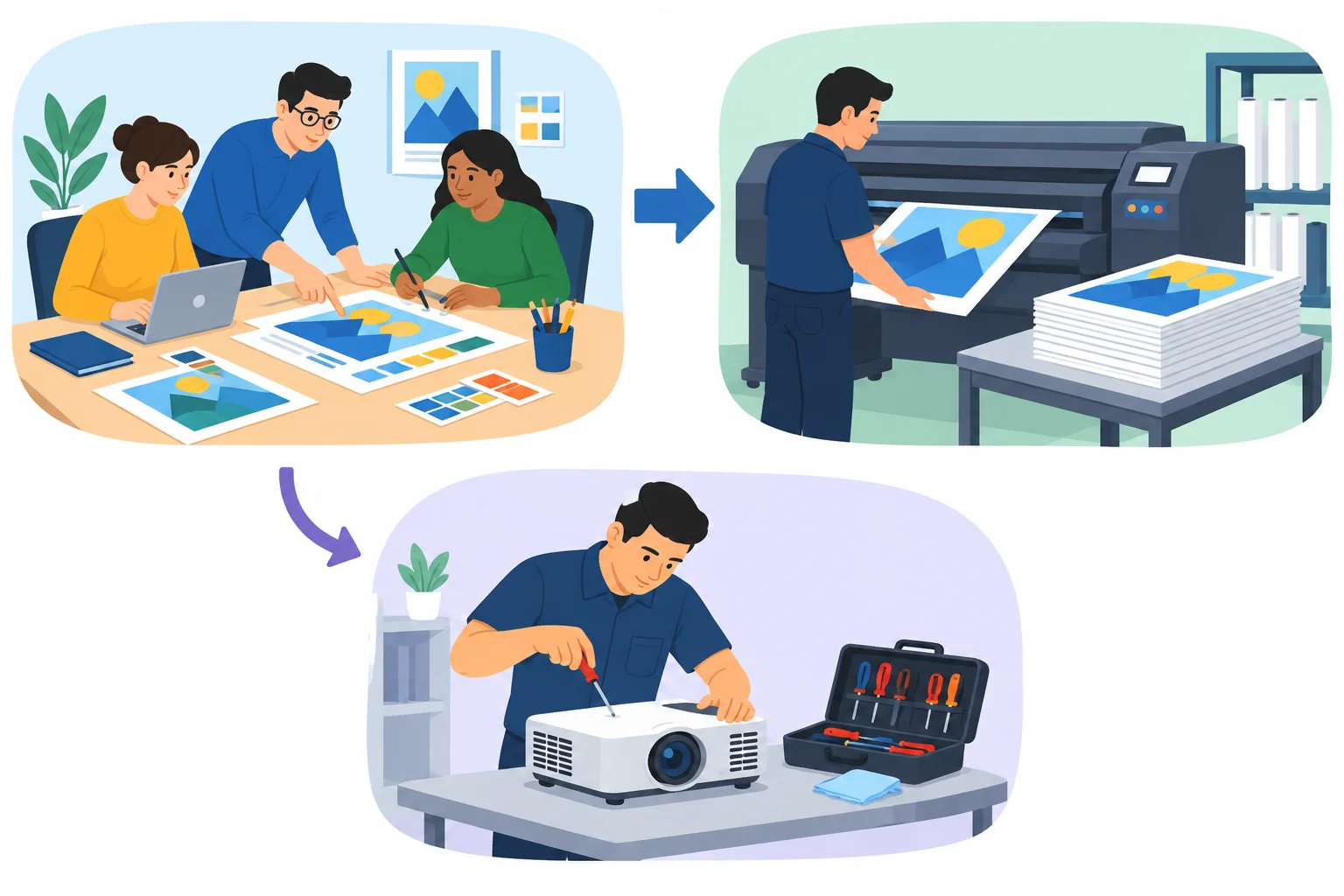
The team does the design itself. City Print prints the posters, and a technician handles projector services.
Example
When the provider is important, add by + service provider after the past participle:
We’re going to have 40 posters printed by City Print on 16 July.
The team arranges the service; City Print performs it. Use the provider phrase in a summary or confirmation when the reader needs to know who will do the work.
Read for five details: the requested service, quantity, provider, proposed date, and the final confirmation. A date is only agreed after the service provider confirms the booking.
Example
Maya: Can we get 40 posters printed on 16 July?
City Print: Yes, City Print can print them on 16 July. Collection at 3 p.m. is available.
Maya: That works. Please book the service.
City Print: Great—we’re confirming the booking. We’ll print 40 posters on 16 July, and you can collect them at 3 p.m.
Tip
Maya’s first question asks about availability, so on 16 July is a proposed date then. City Print says the date and collection time are available. Maya asks to book the service, and City Print’s final line confirms the arrangement. At that point, 16 July is the agreed service date.
Match each arrangement detail with the information in the conversation.
Tap an item and then its matching pair.
Build Maya’s initial request. At this point, the date is proposed; City Print has not confirmed the booking yet.
Your sentence
Available words

Step 7 of 8
Listen to a service confirmation, identify its meaning and timing, then practise and write short causative phrases.
City Print is confirming Maya’s poster arrangement. Listen twice. Identify the service provider, the service, the service date, and the collection time. You do not need to understand every word.
Maya: Hi, this is Maya. We’re going to get the 40 posters printed on 16 July, right?
City Print: That’s right. City Print will print them, and they’ll be ready for collection at 3 p.m.
Which statement matches the confirmation?
Say each phrase aloud after the model. Keep the words together, then make the service action clear at the end. Do not pause between have/get and it/them.
Have it checked. Get them printed.

Say: have‿it CHECKED; get‿them PRINTED.
Tip
Finish CHECKED and PRINTED clearly. The capital letters show the main stress; they do not mean that you should shout.
Listen and write what you heard.
Listen and type exactly what you hear. Use normal spelling and punctuation.

Step 8 of 8
Rehearse a service request, listen to a provider’s confirmation, and write a clear future arrangement note.
Today is 14 July, and the workplace workshop is on 18 July. Maya’s team will design 40 posters themselves. Maya now needs to contact City Print about arranging the printing on 16 July.
First, prepare to speak. Decide what you need to ask City Print for: the service, the object, the quantity, and the proposed date.

The team does the design themselves; the printing company provides the printing service.
Tip
Say one complete request aloud now. Build it from the brief rather than reading a model. Use have or get, put the posters before printed, and ask whether City Print can do the service on 16 July. You do not need to record your voice.
Listen to City Print’s confirmation. Focus on the planned service, quantity, date, and collection time.
City Print: Hello, Maya. We can confirm that we’re going to print 40 posters on 16 July. You can collect them at 3 p.m.
Write a 35–55-word confirmation note. Use the task brief and the recording; replay the confirmation if necessary.
Your note must identify the planned service, quantity, service provider, agreed date, collection time, and the task the team will do themselves. Keep the service in the future: it is confirmed, but it is not completed yet.
Example
Compare your note with this model after you have written your own.
“On 18 July, Maya’s team will run the workshop. We’re going to have 40 posters printed by City Print on 16 July, and we’ll collect them at 3 p.m. The team will design the posters themselves. The arrangement is confirmed.”
Summary
Use this final check before you send a confirmation note.
Congratulations! You completed: Arrange Services with Have or Get Something Done
Thousands of online courses in video, ebooks and audiobooks.
To test your knowledge during online courses
Generated directly from your cell phone's photo gallery and sent to your email

Download our app via QR Code or the links below:.



Carry knowledge in your pocket.
Download the Cursa app.
There are hundreds of free courses available, with a free certificate of completion that is saved in your mobile image gallery.
Download the app to access the Course Completion Certificate for Free.


+ 10 million
students

Free and Valid
Certificate

60 thousand free
exercises

4.8/5 rating in
app stores

Free courses in
video and ebooks