 Cryptography
 Digital Forensics
 SQL Injection

Cyber security is the practice of protecting computers, networks, applications, and data from attacks, unauthorized access, and disruption.

21

5

2



Build in-demand cybersecurity skills with a free course on security management, risk, access control, cryptography and incident response—ideal for career starters.
5

(8)

2h55m

15 exercises
Boost your cyber security skills with a free online course on system and web protection, network defenses, and real-world attacks—study fast and earn a certificate.
4.8
(151)
29h44m
20 exercises

Build job-ready IT security skills with a free online course: risk management, Linux, networks, incident detection, and Python—plus tips for resumes and interviews.
4.8
(19)
15h04m
18 exercises
Free CourseFoundations of Cryptography: Symmetric, Public-Key, Hashing and Signatures
5
(1)
32h51m
57 exercises
Free CourseAdvanced Topics in Cryptography
5
(2)
22h34m
9 exercises

Free CourseInformation security lessons
4.8
(49)
7h15m
11 exercises
Free CourseCyber security
4.8
(376)
2h07m
24 exercises

Free CourseCyber Security Masterclass
4.6

(22)
1h36m
6 exercises
Free CourseIntroduction to Cybersecurity
4.6
(18)
7h43m
6 exercises
Free CourseCompTIA Security course
4.4
(5)
26h11m
41 exercises

Free CourseCyber Security full course
4.3
(10)
11h03m

Free CourseCyber security full course
4
(4)
11h06m

Free CourseCyber Security
4
(1)
11h30m
7 exercises

Free CourseCyber Security For Beginners
3.8
(5)
37h48m
6 exercises
Free CourseCryptography and Network Security
14h43m
28 exercises
Free CourseCyber Security CISSP Exam
New
9h39m
12 exercises
Free CourseSQL Injection Masterclass - Web Security Academy Labs
New
9h42m
17 exercises

Free CourseNetwork Penetration Testing Course
New
28h44m
11 exercises
Free CourseModern Cryptography for Beginners: Encryption, Hashing, Signatures and Secure Computation
New
24h07m
25 exercises
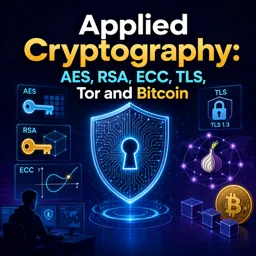
Free CourseApplied Cryptography: AES, RSA, ECC, TLS, Tor and Bitcoin
New
12h04m
16 exercises
Exercises
Test your knowledge of Active Directory security, Kerberos attacks, privileged access, delegation, certificates, monitoring, and recovery.
Start exercisesTest your knowledge of cyber security risk management, including risk assessment, CIA, risk appetite, impact, residual risk, and frameworks.
Start exercisesTest your cybersecurity expertise with an advanced malware analysis quiz covering sandboxes, IOCs, hashes, reverse engineering, and detection.
Start exercisesTest your knowledge of data protection and security measures, including encryption, MFA, access controls, backups, phishing, and audits.
Start exercisesTest your information security awareness with questions on firewalls, phishing, malware, HTTPS, passwords, wireless security, and digital certificates.
Start exercisesTest your web application security knowledge with questions on SQL injection, XSS, CSRF, HTTPS, secure cookies, and input validation.
Start exercises
Understanding Zero Trust Security: A Beginner’s Guide
Learn what Zero Trust security is, the core principles behind it, and why organizations are adopting this modern approach to cybersecurity.

Ransomware Explained: How It Works and How to Protect Yourself
Learn what ransomware is, how it infects devices, and the practical steps you can take to protect your data and stay safe.

How to Spot Phishing Emails: A Practical Guide
Learn the practical warning signs of phishing emails and how to protect your accounts from online scams.

Threat Modeling for Beginners: How to Think Like an Attacker to Build Safer Systems
Learn threat modeling step by step to identify risks, prioritize threats, and design safer systems with practical cyber security habits.

Security Operations Center (SOC) Fundamentals: How Blue Teams Detect, Triage, and Respond
Learn SOC fundamentals including detection, triage, investigation, and response to build practical cyber security defense skills.

Building a Practical Cyber Security Learning Path: From First Concepts to Hands-On Defense
Learn a practical cyber security learning path from fundamentals to hands-on defense, including hardening, monitoring, and incident response.

An Introduction to Node.js: Building Fast and Efficient Backends
Discover what Node.js is, its key features, and why it’s a top choice for building fast, scalable, and efficient backend applications.

A Beginner’s Guide to Progressive Web Apps: Bridging Native and Web Experiences
Learn how Progressive Web Apps (PWAs) blend web and native features to deliver fast, secure, and offline-capable user experiences across all devices.
Web Development

Programming Languages ( Python, Ruby, Java, C )

Office Productivity (Excel, Word and More)

Artificial Intelligence and Machine Learning

App Development

Databases

Software testing

Cloud Computing and Web Servers

Robotics and Drones

Data Science and Business Intelligence
Backend development

Programming Fundamentals

Developer and IT Tools

Hardware, Operating Systems and IT Support

Computer Basics

Game development
Develop practical digital defense skills through free online courses designed for beginners, IT learners, and professionals expanding their technical knowledge. Study essential concepts such as threat identification, risk assessment, access control, network protection, vulnerability management, incident response, secure system architecture, and information security governance. The learning paths combine educational theory with applied examples, helping students understand how security principles protect computers, applications, data, and communication infrastructures.
Explore structured lessons covering malware, social engineering, authentication, security policies, penetration testing, encryption, hashing, and common web vulnerabilities. Every course is free, includes free certification, and features exercises that reinforce comprehension and support self-paced learning. These activities help learners review terminology, evaluate security scenarios, and apply defensive methodologies.
Choose introductory instruction or advance into technical subjects such as SQL injection, public-key infrastructure, AES, RSA, ECC, TLS, digital signatures, secure computation, and post-quantum fundamentals. Learners can also study security management and preparation topics related to CISSP and CompTIA Security. This flexible online education supports independent study, professional development, academic review, and foundational preparation for cybersecurity roles.
For deeper study of encryption algorithms, key management, hashing, and secure protocols, browse the related free cryptography courses. Connecting cryptographic theory with network and application security provides a broader understanding of confidentiality, integrity, authentication, and non-repudiation.
To access the courses, exercises, and free certification, users must install the Cursa app. Get it on Android through Google Play at Download for Android or install it on an iPhone through the App Store at Download for iOS / iPhone. Start learning from any location and progress through the lessons according to your schedule.
What is cyber security?
Cyber security is the practice of protecting computers, networks, applications, and data from attacks, unauthorized access, and disruption.
Which cyber security course is best for beginners?
Start with a cybersecurity fundamentals or introduction course covering threats, networking, passwords, malware, and basic security practices.
Do I need programming skills to learn cyber security?
No. Beginners can start without coding, though Python, scripting, SQL, and networking knowledge are valuable for advanced roles.
What topics are covered in a cyber security course?
Courses may cover network security, ethical hacking, penetration testing, cryptography, cloud security, incident response, and information security management.
What is the difference between cyber security and information security?
Cyber security focuses on protecting digital systems from cyber threats, while information security protects information in any format, including physical records.
Can I learn ethical hacking through online courses?
Yes. Ethical hacking and penetration testing courses teach authorized methods for finding, testing, and reporting security vulnerabilities.
Which cyber security certifications can beginners prepare for?
Beginner-friendly paths often prepare learners for CompTIA Security+ fundamentals, while advanced learners may pursue CISSP or specialized penetration testing certifications.

Complete any course and issue your certificate via the app — at no cost.

Download the app! to have access to more than 4,000 Online Courses + Certificate, all free!
Download the app! 100% free courses.


Carry knowledge in your pocket.
Download the Cursa app.
There are hundreds of free courses available, with a free certificate of completion that is saved in your mobile image gallery.
Download the app to access the Course Completion Certificate for Free.


+ 10 million
students

Free and Valid
Certificate

60 thousand free
exercises

4.8/5 rating in
app stores

Free courses in
video and ebooks
What are people saying about free online courses of Cyber Security
Masooma Batool
53 is prime. Miller-Rabin: a=2, 2^13 mod53=30, 2^26 mod53=52≡-1. Pass.
CourseCryptography and Network Security
Masooma Batool
GCD(790,121): 790 mod 121 = 64 121 mod 64 = 57 64 mod 57 = 7 57 mod 7 = 1 7 mod 1 = 0 → GCD=1, so relatively prime.
CourseCryptography and Network Security
Rich Rios
Just finished CS Intro Part 1 — Eli’s teaching style is great and funny. I’ll post another review after a few more sections.
CourseCyber Security
Notheron Clarke
easy to understand and it starts you out slowly
CourseIntroduction to Cybersecurity
Masooma Batool
Q1: 2 is primitive root of 11? Powers of 2 mod 11: 2,4,8,5,10,9,7,3,6,1 → all residues, so yes. Q2: Primitive roots of 5: Test 1-4: 2: 2,4,3,1 → yes
CourseCryptography and Network Security
Nosisa Mahlamvana
so far im still interested and im so happy with the aproach
CourseCyber Security full course
Chantelle Khumalo
it actually teaches something that you can practically do it on your own by applying the knowledge you leant and my tutor Davin Malin is the best
CourseIntroduction to Cybersecurity
Tinyiko malungana
getting more important information
CourseCyber security
Masooma Batool
GCD(529,123): 529 mod 123 = 37 123 mod 37 = 12 37 mod 12 = 1 12 mod 1 = 0 → GCD = 1 (co-prime)
CourseCryptography and Network Security
Mackenzie Wise
it's really difficult to keep up with all the terminology. A list of terms and their definitions would be extremely helpful.For example, what does heap mean? It's never really explained in detail. I'm only on episode 3 and I'm so lost ☹️. I'm so overwhelmed by the amount of knowledge I'm just expected to know.
CourseComputer systems security