Step 1 of 9
Start with Taller and Cheaper
Learn to compare two people or things with -er and than.

Learning path · Level 4 · Tutorial 2
Compare people, places, and things to buy. Read and listen to information about different choices. Say which one is cheaper, better, or more comfortable. Write a short message explaining your choice.

 Start with Taller and Cheaper
Learn to compare two people or things with -er and than. 3 min
 Get the Spelling Right
Learn the spelling changes in nicer, bigger, and busier, then use them in clear comparisons. 2 min
 Use More Expensive and More Comfortable
Compare hotel prices and comfort with more expensive than and more comfortable than. 2 min
 Find the Tallest and the Cheapest
Choose one person or product from a group of three and use the and -est forms accurately. 3 min
 Find the Most Comfortable
Use the most with expensive and comfortable, and name the hotel group in a superlative sentence. 2 min
 Use Better, Best, Worse, and Worst
Use irregular forms to compare hotel guest scores: better, best, worse, and worst. 2 min
 Ask Which and Give a Reason
Ask Which questions about bags and hotels, then choose an option that fits a person’s needs and explain your choice with because. 3 min
 Hear and Say Comparisons
Listen for comparison words and names, write a spoken sentence, and practice clear word stress. 3 min
 Make and Explain Your Choice
Use hotel information to choose an option, write a comparison message, and explain your choice aloud. 4 min
Step 1 of 9
Learn to compare two people or things with -er and than.
A comparative shows a difference between two people or things.
Use tall for height, cheap for a low price, fast for something that moves in less time, and slow for something that moves in more time.
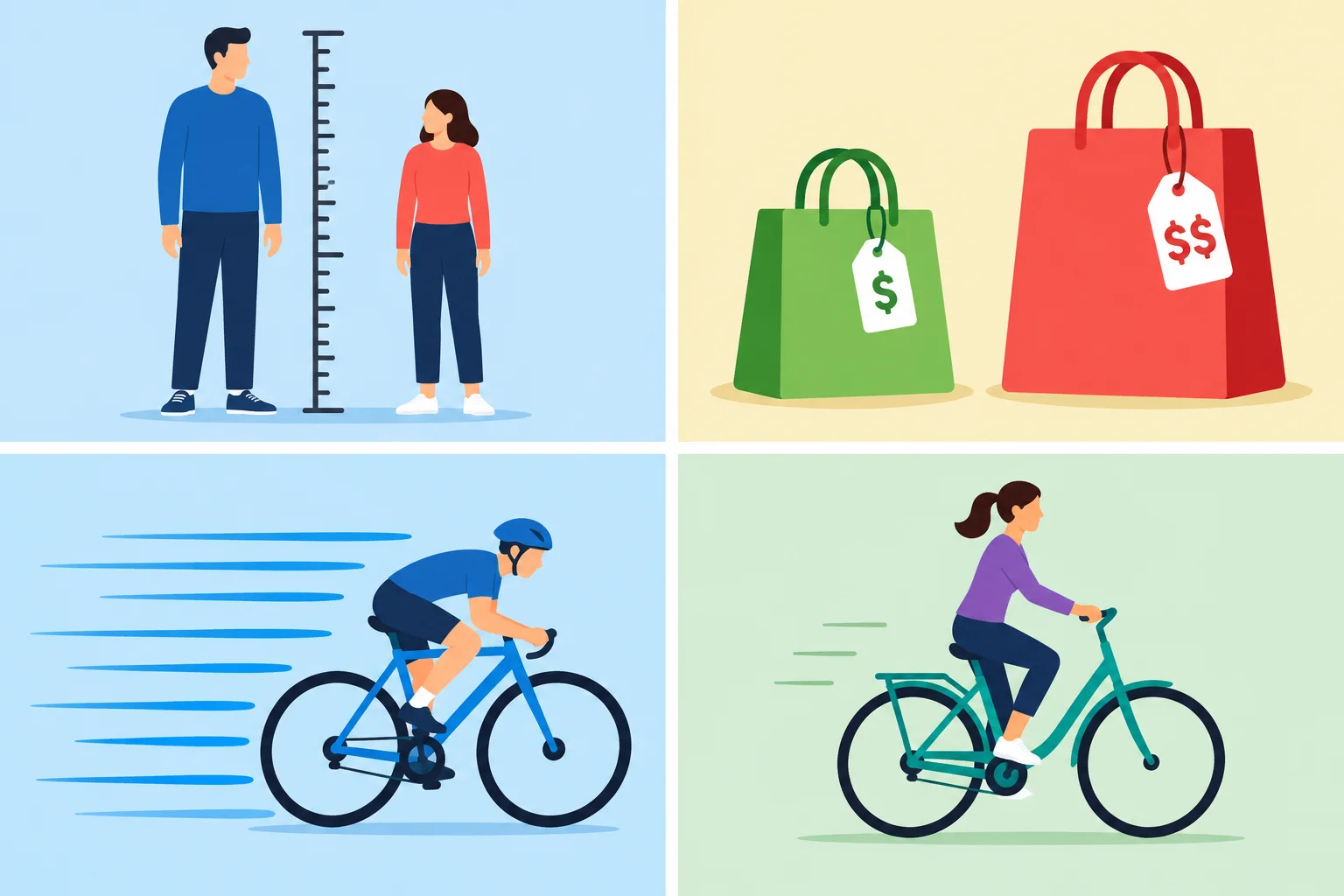
Height, price, and speed can be different.
Add -er to these short adjectives when you compare two things.
| Word | Meaning | Comparative |
|---|---|---|
| tall | more height | taller |
| cheap | low price | cheaper |
| fast | moves in less time | faster |
| slow | moves in more time | slower |
Use this pattern to compare two people or things:
person or thing + is + comparative + than + person or thing
Use than before the second person or thing. Start the sentence with the person or thing that has the quality you describe.
Example
Lina is 160 cm. Omar is 175 cm.
Omar is taller than Lina.
The green bag is $20. The blue bag is $35.
The green bag is cheaper than the blue bag.
Tip
For taller, begin with the person with more height. For cheaper, begin with the product with the lower price.
Listen to the two comparison sentences. Then say them aloud.
Omar is taller than Lina. The green bag is cheaper than the blue bag.
Match each word to its meaning.
Tap an item and then its matching pair.
Build two accurate comparisons in this order.
Your sentence
Available words
Step 2 of 9
Learn the spelling changes in nicer, bigger, and busier, then use them in clear comparisons.
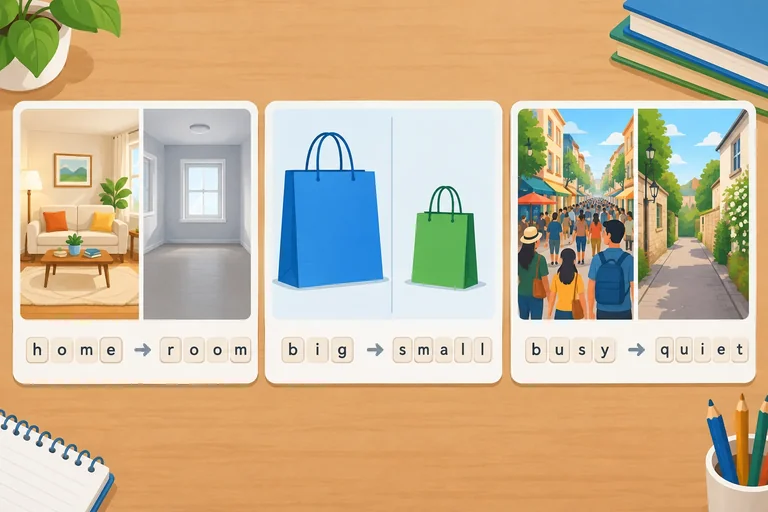
We can describe rooms, products, and places with nice, big, and busy.
To compare two things, these words change before than.

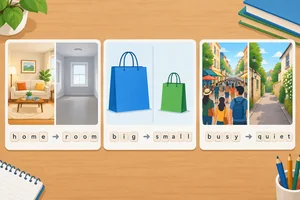
Use what you can see: room quality, bag size, and the number of people and cars on a street.
The comparative form has a small spelling change for each word. Learn these three forms exactly.
| Adjective | Spelling change | Comparative |
|---|---|---|
| nice | add -r | nicer |
| big | double g, add -er | bigger |
| busy | change y to i, add -er | busier |
Example
This room is nicer than that room.
The blue bag is bigger than the green bag.
Market Street is busier than Park Lane.
Tip
Do not add extra letters: write nicer, not “niceer”; bigger, not “biger”; and busier, not “busyier.”
Which sentence is spelled correctly?

Room A is on the left. Market Street is the crowded street; Park Lane is the quiet lane.
Complete the three comparisons with the correctly spelled comparative forms. Use the picture to check the meaning.
Room A is  than Room B.
The blue bag is  than the green bag.
Market Street is  than Park Lane.
Step 3 of 9
Compare hotel prices and comfort with more expensive than and more comfortable than.
Hotels can be cheap or expensive. Expensive means it costs a lot of money. A place can also be comfortable: it feels good to stay there.
Look at the price and comfort information together. The comfort scale is: 1 = not comfortable and 5 = very comfortable.
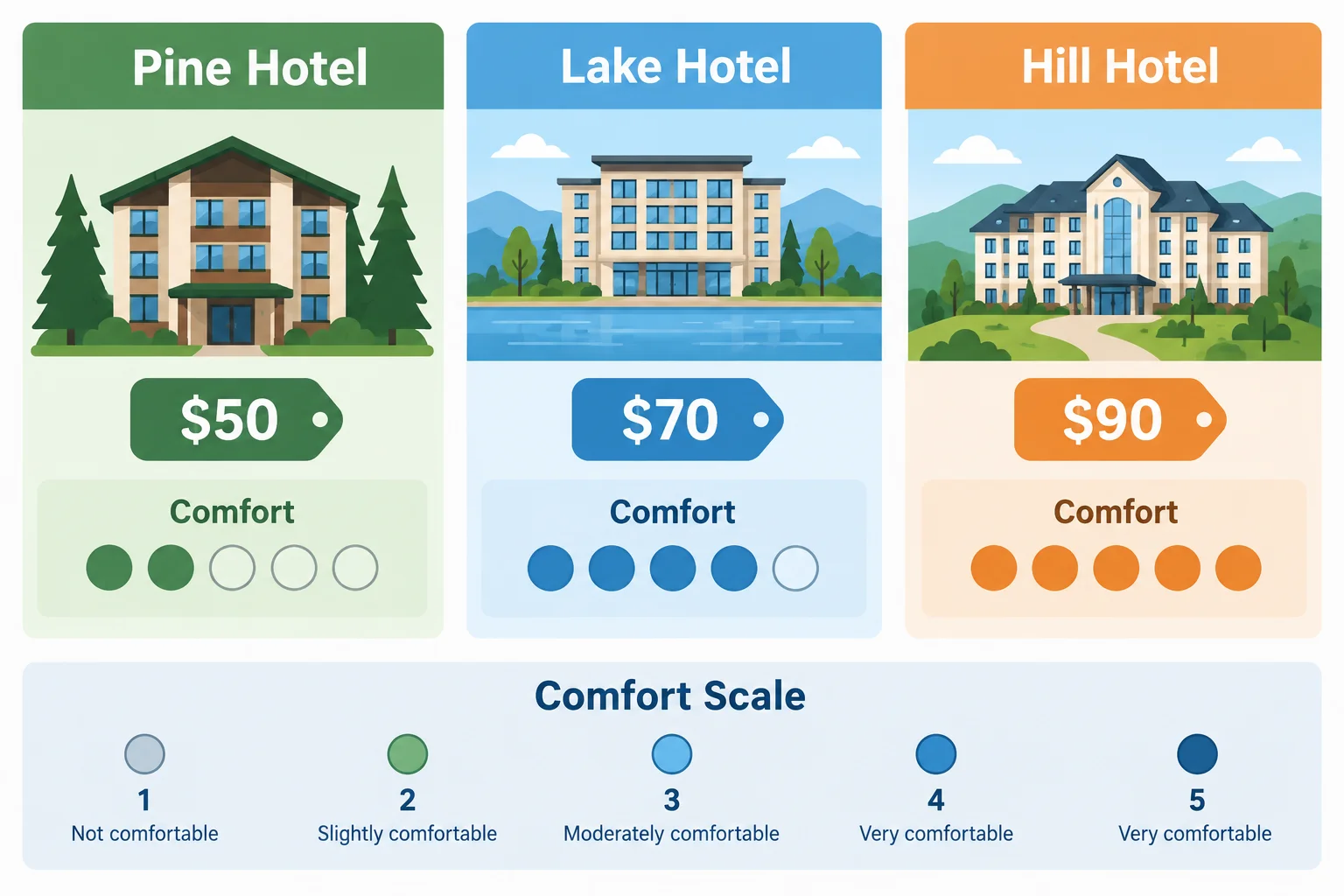
Pine Hotel is $50 and comfort 2/5. Lake Hotel is $70 and comfort 4/5. Hill Hotel is $90 and comfort 5/5.
Use more before these adjectives when you compare two hotels:
Keep the adjective unchanged. Do not add -er after more.
Use one form, not both: more expensive, not “more expensiver.”
Use these complete comparison sentences.
| Adjective | Comparative form | Hotel example |
|---|---|---|
| expensive | more expensive than | Hill Hotel is more expensive than Lake Hotel. |
| comfortable | more comfortable than | Lake Hotel is more comfortable than Pine Hotel. |
Tip
The words than and is stay in the sentence pattern you already know. Only the comparative part changes: use more expensive or more comfortable.
Choose the correct sentence about Lake Hotel and Pine Hotel.
Hill Hotel costs $90. Lake Hotel costs $70.
Build one complete comparison sentence from these facts.
Your sentence
Available words

Step 4 of 9
Choose one person or product from a group of three and use the and -est forms accurately.
With two choices, use a comparative: Omar is taller than Lina.
With a group of three, use a superlative to identify one person or thing at the top or bottom of a stated quality. Use this pattern:
the + adjective-est
Use the before the superlative. The chart shows a group of three people and a group of three bags.
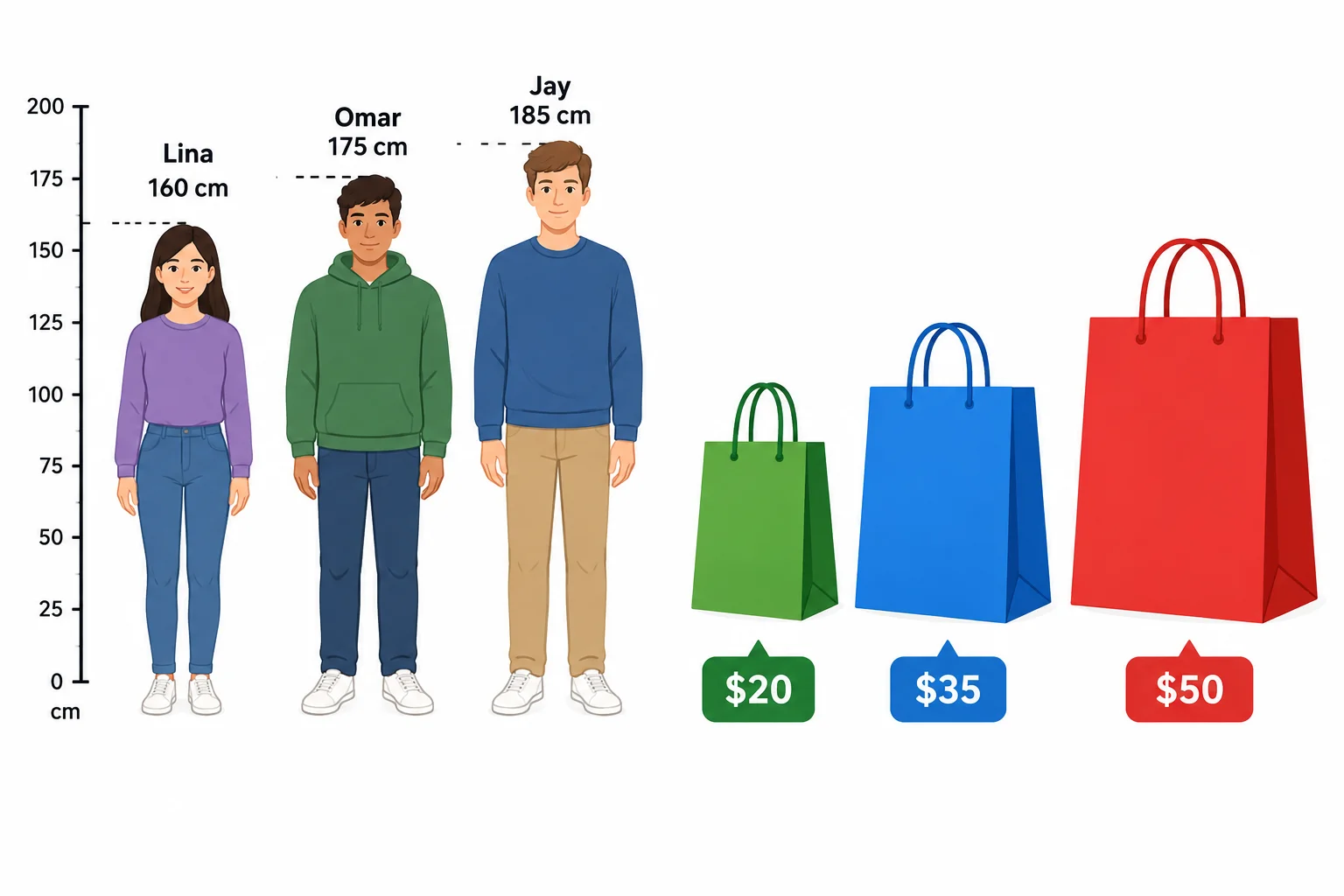
Use the stated heights and prices to find one choice in each group.
Example
Comparative: Omar is taller than Lina.
Superlative: Jay is the tallest of the three people.
The green bag is the cheapest of the three bags. A superlative identifies one choice in a clearly visible or stated group.
Use the before an -est superlative. The spelling patterns are like the patterns you used with -er:
These forms name one choice in a group.
Read across each row: base adjective, comparative for two choices, then superlative for a group.
| Base adjective | Comparative: two | Superlative: group |
|---|---|---|
| tall | taller | the tallest |
| cheap | cheaper | the cheapest |
| nice | nicer | the nicest |
| big | bigger | the biggest |
| busy | busier | the busiest |
Example
The red bag is the biggest. Its physical size is greater than the green bag's and the blue bag's.
Which sentence is a superlative sentence?
Using the height chart, which person completes this sentence?
___ is the tallest.
Type four answers in order, separated by commas.
The green bag is ___.
nice → ___
big → ___
busy → ___
Step 5 of 9
Use the most with expensive and comfortable, and name the hotel group in a superlative sentence.
A superlative chooses one option from a group. For longer adjectives, use the most + adjective.
Keep the adjective unchanged after the most. Do not add -est.
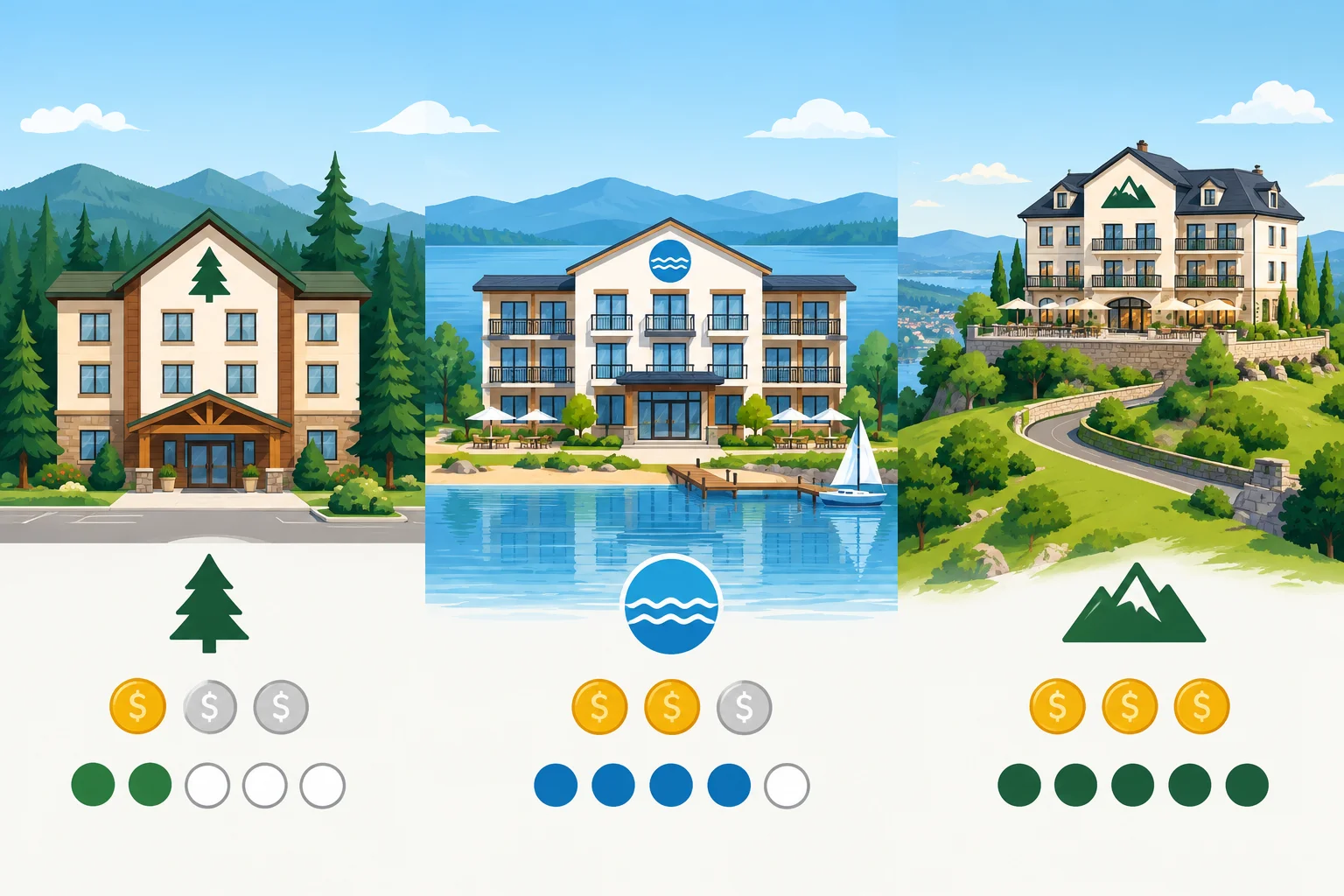
Compare the three hotels by price and comfort.
All prices are for one night. On the comfort scale, 1 = not comfortable and 5 = very comfortable.
| Hotel | Price | Comfort |
|---|---|---|
| Pine Hotel | $50 | 2/5 |
| Lake Hotel | $70 | 4/5 |
| Hill Hotel | $90 | 5/5 |
Choose the form that matches the adjective:
Use the before every superlative. Then name the group, so the reader knows which options you mean.
Example
Pine Hotel is the cheapest hotel in the town.
Hill Hotel is the most expensive hotel in the town.
Hill Hotel is the most comfortable hotel in the town.
Each sentence names the hotel group: hotels in the town.
Tip
Before you make a superlative statement, check:
True or false?
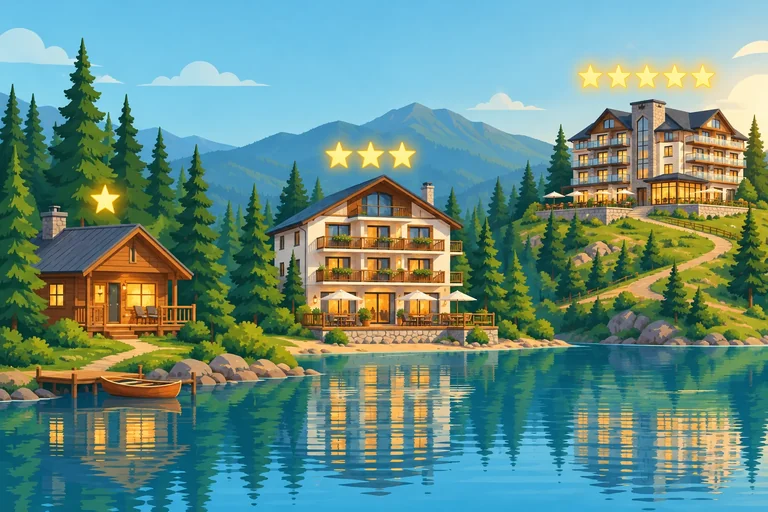
Lake Hotel is the most comfortable hotel in the town.
Build one true statement about the three hotels.
Your sentence
Available words
Step 6 of 9
Use irregular forms to compare hotel guest scores: better, best, worse, and worst.
Hotel guest scores show guests’ opinions. Use the displayed scores as the basis for these comparisons—not as a rule for every traveler.
On this scale, 1 = bad and 5 = good. A higher guest score means better guest opinions.
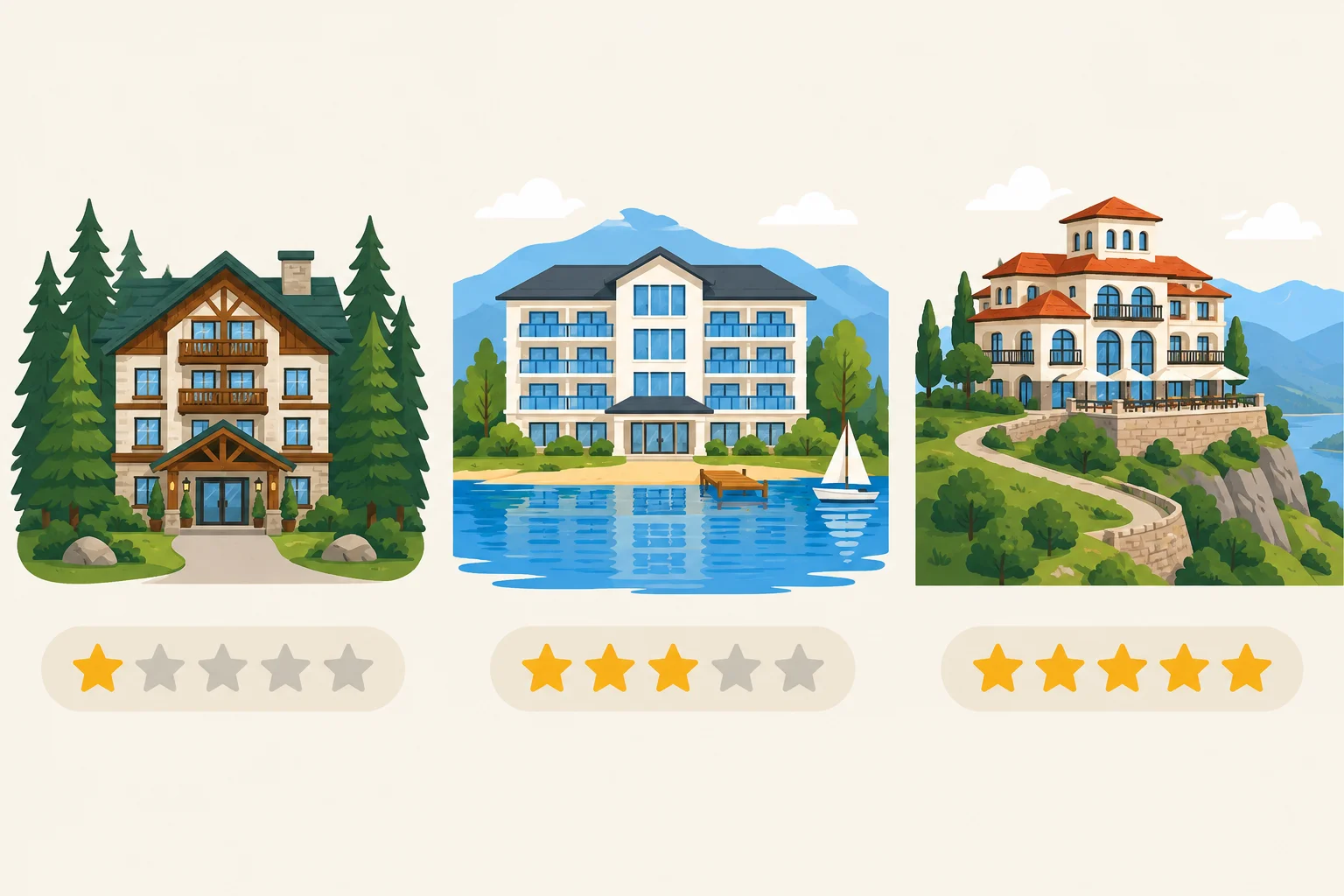
The guest-score bars rise from Pine Hotel to Lake Hotel to Hill Hotel.
All prices are for one night. Comfort and guest scores use a five-point scale.
| Hotel | Price | Comfort | Guest score |
|---|---|---|---|
| Pine Hotel | $50 | 2/5 | 1/5 |
| Lake Hotel | $70 | 4/5 | 3/5 |
| Hill Hotel | $90 | 5/5 | 5/5 |
For guest opinions, good and bad have special comparison forms. Use a comparative for two hotels and a superlative for the group of three hotels.
These are irregular forms: they do not use -er or -est.
| Base word | Compare two | Choose from three |
|---|---|---|
| good | better | the best |
| bad | worse | the worst |
Example
Lake Hotel’s guest score is better than Pine Hotel’s guest score.
Pine Hotel’s guest score is worse than Lake Hotel’s guest score.
Hill Hotel’s guest score is the best of the three hotels.
Pine Hotel’s guest score is the worst of the three hotels.
Warning
Do not add more or -er to these forms. Say better, not more better or gooder. Say worse, not badder.
Match each base word and purpose to the correct form.
Tap an item and then its matching pair.
Complete the sentence.
Lake Hotel’s guest score is _ than Pine Hotel’s guest score. (Lake: 3/5; Pine: 1/5)
Complete the sentence.
Pine Hotel’s guest score is _ than Lake Hotel’s guest score. (Pine: 1/5; Lake: 3/5)
Complete the sentence.
Hill Hotel’s guest score is the _. (Hill: 5/5; Lake: 3/5; Pine: 1/5)
Complete the sentence.
Pine Hotel’s guest score is the _. (Pine: 1/5; Lake: 3/5; Hill: 5/5)
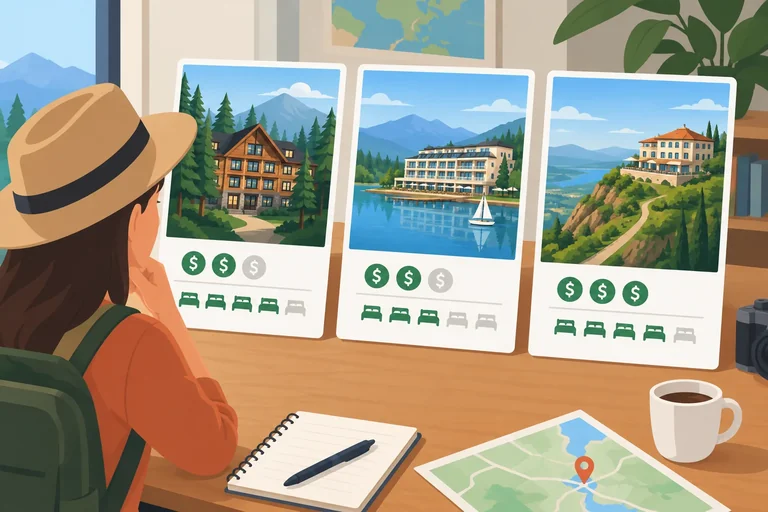
Step 7 of 9
Ask Which questions about bags and hotels, then choose an option that fits a person’s needs and explain your choice with because.
Use Which to ask about a choice. When two bags are in the conversation, ask: Which bag is cheaper?
Then answer with the bag name and a complete comparison. The green bag costs $20. The blue bag costs $35.

Compare the green bag and the blue bag using the price facts.
Example
Question: Which bag is cheaper?
Answer: The green bag is cheaper than the blue bag.
For a group of three hotels, ask: Which hotel is the best? Read the person’s need first. Here, best means the best choice for that need.
The cheapest hotel or the hotel with the highest guest score is not automatically the best choice for every person.
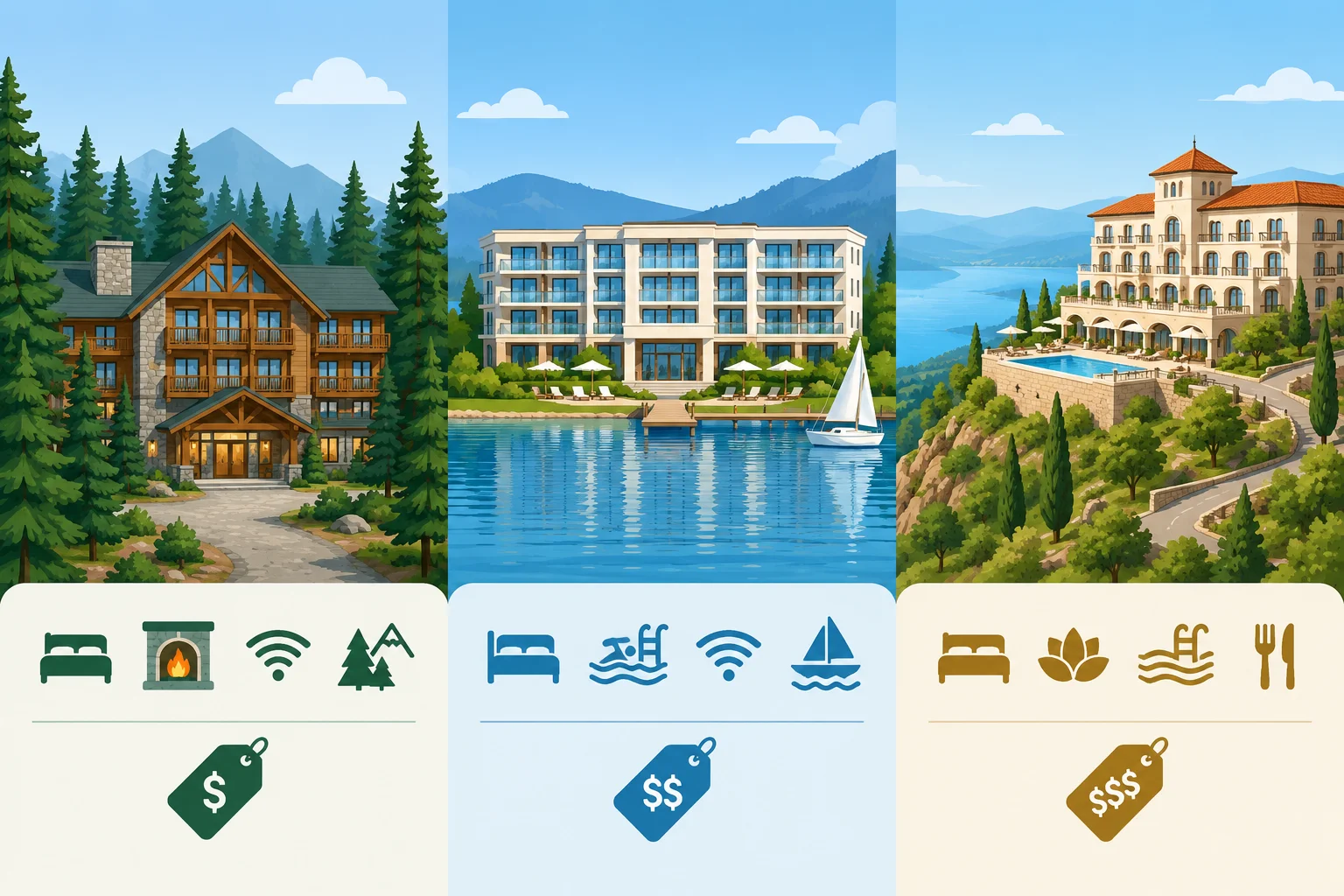
Use the hotel facts and the guest’s needs to make a choice.
All prices are for one night. Comfort: 1 = not comfortable; 5 = very comfortable. Guest score: 1 = bad; 5 = good. A guest score shows guests’ opinions.
| Hotel | Price | Comfort | Guest score |
|---|---|---|---|
| Pine Hotel | $50 | 2/5 | 1/5 |
| Lake Hotel | $70 | 4/5 | 3/5 |
| Hill Hotel | $90 | 5/5 | 5/5 |
Example
Guest need: “I want the most comfortable hotel.”
Choice: I choose Hill Hotel because it has comfort 5/5.
A guest can spend $70 or less and wants the highest comfort available. Which hotel should the guest choose?
Put the words in order to make a question about two bags.
Your sentence
Available words
A guest can spend $70 or less for one night and wants a hotel with comfort 4/5 or higher.
Write a Which question about the hotel group. Then choose a hotel and give one complete reason with because. Include the hotel name, its price, and its comfort score.
Write at least 70 characters (0/70).

Step 8 of 9
Listen for comparison words and names, write a spoken sentence, and practice clear word stress.
Word stress is the strong beat in a word. In these pronunciation guides, capitals show the strong beat:
CHEAPer • CHEAPest • exPENsive • COMfortable
In a full sentence, than is often quick and quiet. Do not leave it out: write than normally. Listen for the names and for the direction of the comparison.

From top to bottom, the strong beat matches CHEAPer, CHEAPest, exPENsive, and COMfortable.
Listen to the four words. Replay them and notice the strong beat.
Cheaper. Cheapest. Expensive. Comfortable.
Tip
Say each word after the audio. Make the strong beat a little clearer and longer; do not try to copy every detail of the voice.
Listen and choose an option.
Listen, then choose the picture with the two bags named in the comparison.
The blue bag is more expensive than the green bag.
Listen and write what you heard.
Listen and type the complete sentence.
Listen to the model. Say it aloud, then replay it. Notice the strong beat in COMfortable and the quick sound of than.
Next, make your own choice sentence about two hotels or two bags. Say your sentence aloud before you type it.
Use this as a replayable speaking model.
I choose Lake Hotel because it is more comfortable than Pine Hotel.
I choose Lake Hotel because it is more comfortable than Pine Hotel.
Tip
Your sentence needs a choice, a complete reason after because, and a comparison with than. Clear stress matters more than copying the speaker's accent.
Say your own complete choice sentence aloud. Replay the model to check your stress, then type the sentence you said.
Write at least 30 characters (0/30).
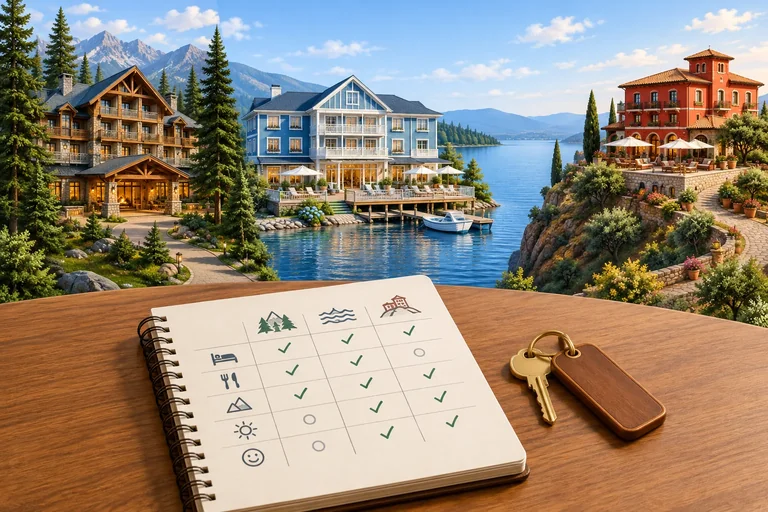
Step 9 of 9
Use hotel information to choose an option, write a comparison message, and explain your choice aloud.
Listen for the traveler’s needs. Then read the hotel information. Prices are for one night.
A traveler describes what matters for one night.
I can spend up to eighty dollars for one night. I want a comfortable hotel. I do not need the highest guest score.
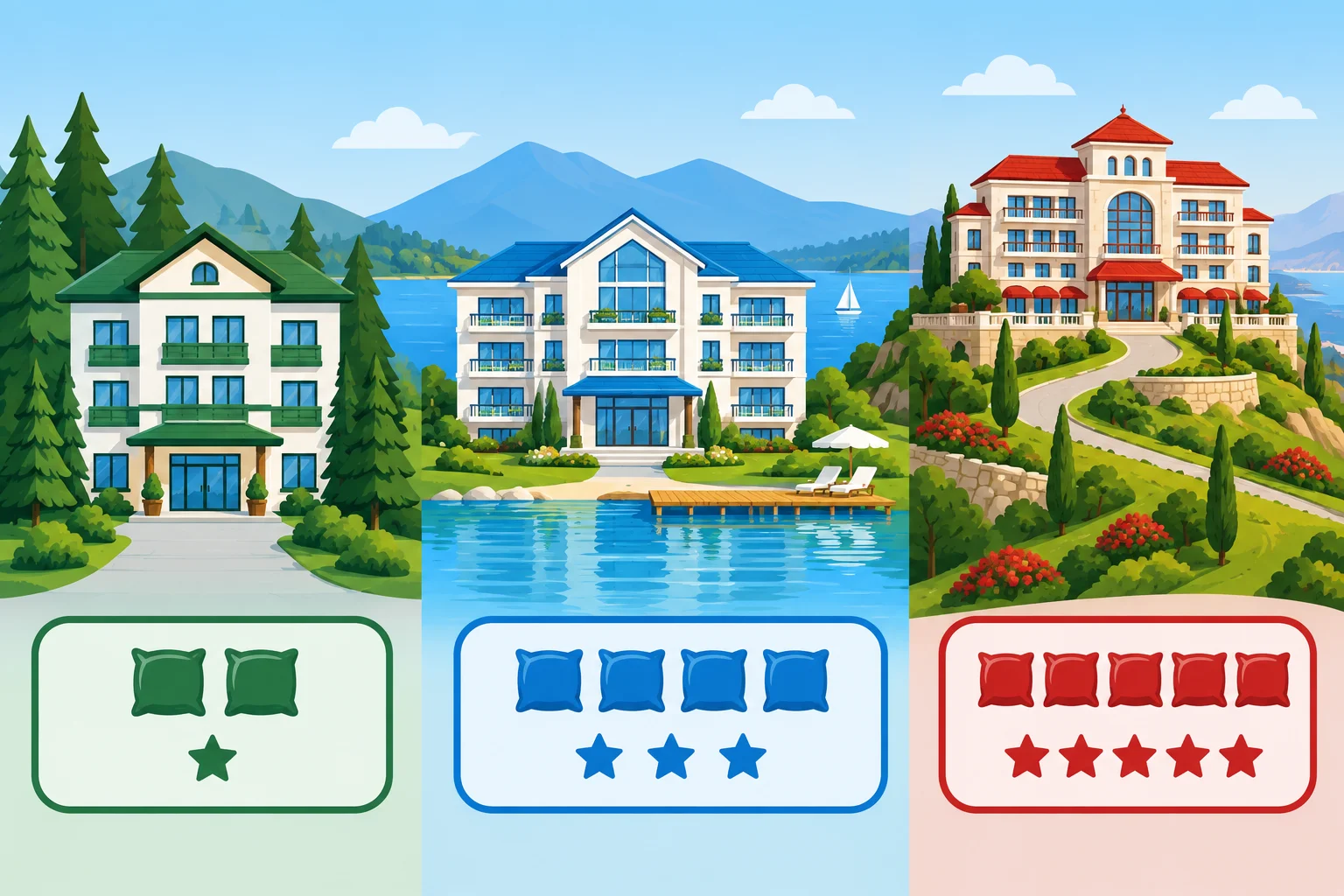
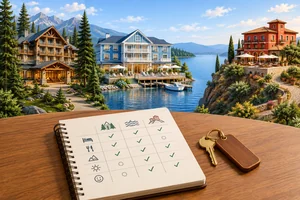
The picture shows the relative comfort and guest scores. Use the table for the exact information.
Compare the traveler’s needs with all three hotels.
| Hotel | Price | Comfort | Guest score |
|---|---|---|---|
| Pine Hotel | $50 | 2/5 | 1/5 |
| Lake Hotel | $70 | 4/5 | 3/5 |
| Hill Hotel | $90 | 5/5 | 5/5 |
Which hotel is the best choice for the traveler in the recording?
Write a short message with a clear purpose. Use comparisons to show the facts, then explain why the choice fits the traveler’s needs.
A comparative compares two hotels: “Pine Hotel is cheaper than Lake Hotel.”
A superlative chooses one from the whole group: “Hill Hotel is the most comfortable hotel in the town.”
Example
This model is for a traveler whose main priority is the lowest price, not for the traveler in the recording:
“I choose Pine Hotel because it is cheaper than Lake Hotel. It is cheaper than Hill Hotel. Hill Hotel is the most comfortable hotel in the town. Pine Hotel is the best choice for a traveler who wants the lowest price.”
Tip
Before you write, check these points:
Use the recording and hotel chart from earlier. Write a 4–5 sentence message for the traveler. Choose a hotel, include at least two comparisons with than, include one accurate superlative statement about the hotels in the town, and explain your choice with because.
Then read your message aloud. Check it against the model and checklist on the previous screen before you submit.
Write at least 120 characters (0/120).
Summary
You can now make a practical choice from listening and reading information.
Check the meaning first: comparing two is different from choosing one from a group.
Congratulations! You completed: Compare People, Places, and Products
Thousands of online courses in video, ebooks and audiobooks.
To test your knowledge during online courses
Generated directly from your cell phone's photo gallery and sent to your email

Download our app via QR Code or the links below:.



Carry knowledge in your pocket.
Download the Cursa app.
There are hundreds of free courses available, with a free certificate of completion that is saved in your mobile image gallery.
Download the app to access the Course Completion Certificate for Free.


+ 10 million
students

Free and Valid
Certificate

60 thousand free
exercises

4.8/5 rating in
app stores

Free courses in
video and ebooks