
Step 1 of 9
See How an Academic Argument Works
Identify how a compact academic discussion answers a contestable question through a central claim, source support, a counterargument, and a warranted conclusion.

Learning path · Level 11 · Tutorial 2
Develop a short academic argument from a clear question and a small set of sources. Read a model discussion and listen to an academic exchange, using audio choices and brief dictation to track concessions. Write a guided argument with accurate attribution, then rehearse a spoken response to a counterargument.

 See How an Academic Argument Works
Identify how a compact academic discussion answers a contestable question through a central claim, source support, a counterargument, and a warranted conclusion. 3 min
 Turn the Question into a Limited Thesis
Turn the shared question into a contestable thesis whose strength and scope match the available evidence. 2 min
 Connect Evidence to a Reason
Select relevant evidence for a paragraph-level claim and explain the reasoning link without exceeding the sources’ limits. 3 min
 Make Source Ownership Clear
Use consistent author–date attribution to show exactly where a source finding ends and your own evaluation begins. 3 min
 Concede a Point Without Losing Your Position
Acknowledge a relevant objection fairly, then use while or despite to explain why the available evidence does not settle the argument. 3 min
 Hear the Position Beyond the Concession
Listen for the difference between an acknowledged point and a speaker’s final academic position, then transcribe a concessive sentence accurately. 2 min
 Plan the Progression and Bound the Conclusion
Organise a four-paragraph argument and ensure that its conclusion remains proportionate to the available evidence. 2 min
 Make Your Spoken Response Clear
Use pausing, prominence, and respectful tone to make a concession distinct from your maintained academic position. 2 min
 Write and Defend Your Academic Argument
Write a four-paragraph academic argument from Fictional practice sources, then defend your position aloud. 8 min
Step 1 of 9
Identify how a compact academic discussion answers a contestable question through a central claim, source support, a counterargument, and a warranted conclusion.
The guiding question is contestable: To what extent can lecture recordings replace attendance in first-year university courses? An academic argument does more than report what sources say. It answers with a thesis, the argument’s central claim.
A short discussion usually gives supporting evidence, considers a counterargument, and ends with a warranted conclusion. A warranted conclusion stays within what the evidence—and its limitations—can support.

A compact argument moves from a question to a thesis, supporting evidence, a counterargument, and a warranted conclusion.
Example
Paragraph 1
Lecture recordings should complement, rather than replace, attendance in first-year university courses. This thesis makes a central claim about replacement rather than simply introducing the topic.
Example
Paragraph 2
Chen (2023) reports that 58 of 80 first-year students used recordings to revisit difficult points. This supporting evidence suggests that recordings can assist revision. However, the survey did not measure learning outcomes, so it cannot show whether recordings can replace attendance.
Tip
Notice the difference between the source reference and the writer’s reasoning. The reference identifies the reported material; the explanation states why that material matters to the central claim. The final sentence also identifies a limitation: what the survey does not establish.
Example
Paragraph 3
A counterargument is that attendance may be unnecessary because Malik (2024) found similar mean examination scores among regular attendees and students mainly using recordings in one first-year course. This is relevant evidence, but the students chose their own attendance patterns. The comparison therefore does not by itself establish that the two approaches are equivalent.
Example
Paragraph 4
Overall, recordings appear to be a useful revision resource, but the available evidence does not warrant treating them as a complete replacement for attendance in first-year university courses.
Fictional practice sources
Sources
Chen, L. (2023). Lecture recordings and revision. Fictional teaching source.
Malik, A. (2024). Recordings and examination performance. Fictional teaching source.
Rivera, M. (2024). Participation in live lectures. Fictional teaching source.
All authors, studies, and findings in this corpus are invented for language practice.
Match each passage from the model to its argumentative function.
Tap an item and then its matching pair.

Step 2 of 9
Turn the shared question into a contestable thesis whose strength and scope match the available evidence.
The guiding question is: To what extent can lecture recordings replace attendance in first-year university courses?
A thesis is the argument’s central claim: a direct, contestable answer to that question. A reader could reasonably challenge it, but it must still make a commitment.
A useful thesis here does three things:
A topic announcement, such as “This discussion considers lecture recordings”, is not a thesis because it gives no answer.

A defensible thesis answers the question after weighing what the evidence supports and where its boundaries lie.
These are Fictional practice sources. They offer useful supporting evidence, but each has a limitation. Use both the finding and its boundary when deciding how strong your thesis can be.
Use the evidence to make a clear but proportionate claim.
| Source | Supporting evidence | Limitation |
|---|---|---|
| Chen (2023) | 58 of 80 students used recordings to revisit difficult points. | The survey did not measure learning outcomes. |
| Malik (2024) | Two groups had similar mean examination scores in one course. | Students chose their attendance patterns. |
| Rivera (2024) | 12 tutors described live discussion as a chance to test interpretations. | The interviews did not measure learning outcomes. |
Example
A limited thesis is not weak simply because it has boundaries. It makes a meaningful position while showing what the evidence does not establish.
Too vague: “Lecture recordings may possibly be useful.”
Too broad: “Recordings can replace attendance in every university course.”
Defensible: “In first-year university courses, recordings can support revision, but the available evidence does not justify treating them as a complete replacement for attendance.”
Notice the position: recordings have a role, yet the evidence is insufficient to establish full equivalence with attendance.
Revise the statement below into one 25–45-word thesis.
Lecture recordings should replace attendance in all university courses because students use them to revisit difficult points.
Your thesis must directly answer the guiding question, preserve a meaningful position, and set a defensible boundary based on the Fictional practice sources.
Write at least 100 characters (0/100).

Step 3 of 9
Select relevant evidence for a paragraph-level claim and explain the reasoning link without exceeding the sources’ limits.
All material in this step comes from the Fictional practice sources. Select supporting evidence because it helps a particular claim answer the guiding question:
To what extent can lecture recordings replace attendance in first-year university courses?
A source can be relevant without proving the whole argument. First identify the specific point you want to make; then choose evidence that genuinely bears on that point, including its limitation.
Each source offers a different kind of supporting evidence. Use the finding for the narrow conclusion it can support.
| Source | Fixed evidence | What it can support | Limitation |
|---|---|---|---|
| Chen (2023) | 58 of 80 students used recordings to revisit difficult points | Recordings can support revision | Learning outcomes were not measured |
| Malik (2024) | In 1 first-year course, 60 students in total had self-selected attendance patterns; regular attendees and students mainly using recordings had similar mean examination scores | Scores were similar in 1 course | Students chose their own attendance patterns |
| Rivera (2024) | 12 tutors described live discussion as an opportunity to test interpretations | Attendance may offer a discussion opportunity | Learning outcomes were not measured |
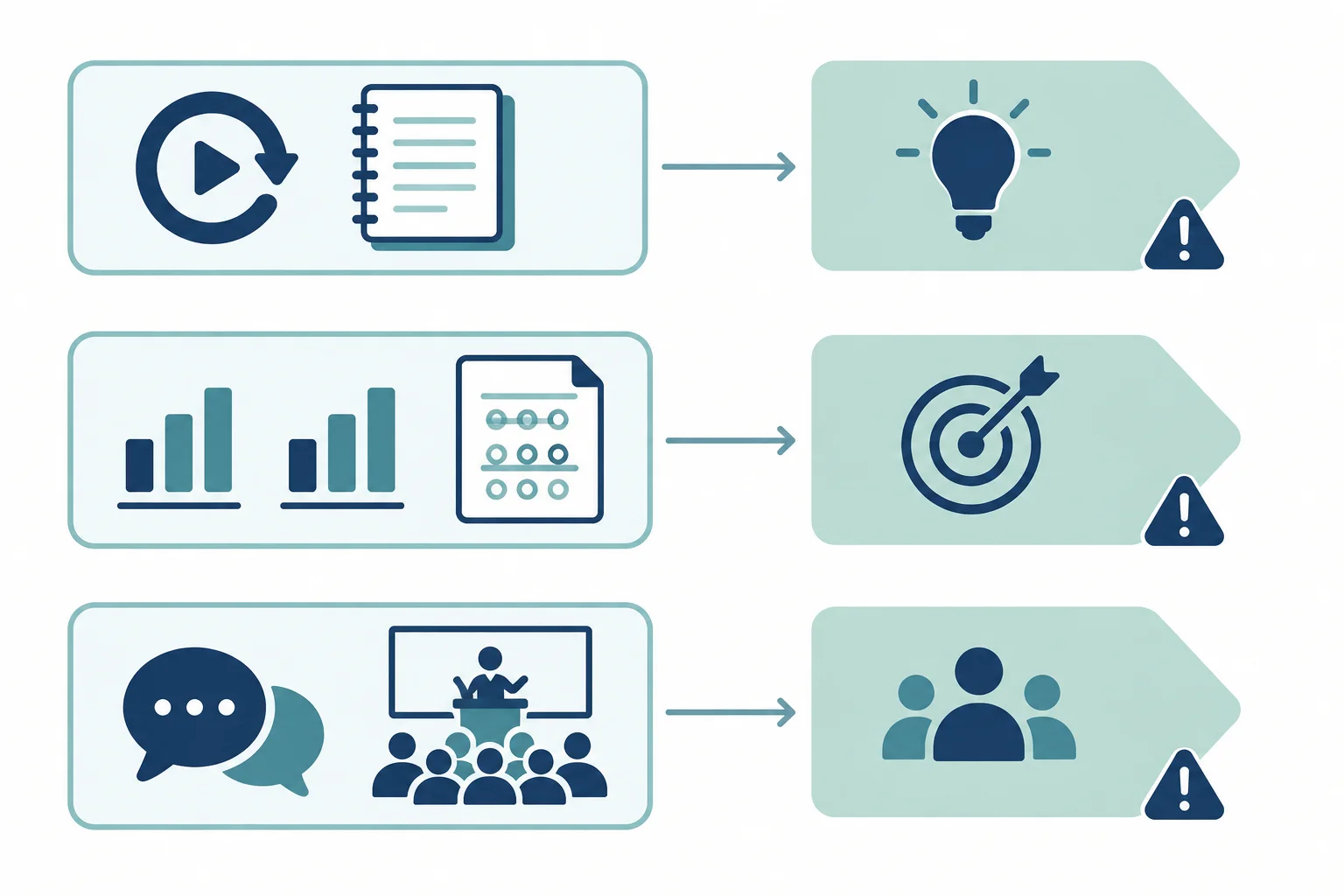
The same topic does not make every source equally useful for every claim. Match the evidence type to the point you need to make.
A paragraph advances an argument when its parts do different jobs:
The inferential link is the reasoning step. It identifies what the evidence suggests, without claiming more than the source can establish.
Example
Topic sentence: Lecture recordings can support revision of difficult material for first-year students.
Integrated source support: Chen (2023) surveyed 80 first-year students, and 58 reported using recordings to revisit difficult points.
Inferential link: This reported use suggests that recordings can give students an additional opportunity to return to material they found difficult.
Connection to the thesis: The finding therefore supports treating recordings as a supplement to attendance, rather than proof that they can replace it.
Tip
Keep the verbs proportionate to the evidence. A report of use can suggest a possible benefit; it cannot by itself demonstrate improved learning or prove that attendance is unnecessary.
Match each paragraph-level claim to the most suitable supporting evidence.
Match each claim with the evidence that best supports it.
Tap an item and then its matching pair.
Arrange these sentences into a coherent short paragraph. Start with the paragraph-level claim.
Write the missing inferential link after this observation:
“In Malik’s study of 60 students in total in one first-year course, regular attendees and students mainly using recordings had similar mean examination scores.”
In one sentence, explain what this finding suggests and why it does not establish that recordings can replace attendance. Do not add a new finding.
Write at least 80 characters (0/80).

Step 4 of 9
Use consistent author–date attribution to show exactly where a source finding ends and your own evaluation begins.
A source reference tells readers whose finding you are reporting. Your argument must then show what you infer from that finding.
Use narrative attribution when the author is part of the sentence grammar: Chen (2023) reports that ...
Use parenthetical attribution when you state the finding first: ... difficult points (Chen, 2023).
In this simplified author–date convention, place a parenthetical citation before the sentence’s final full stop. The author surname and year must match an entry in the supplied source list.
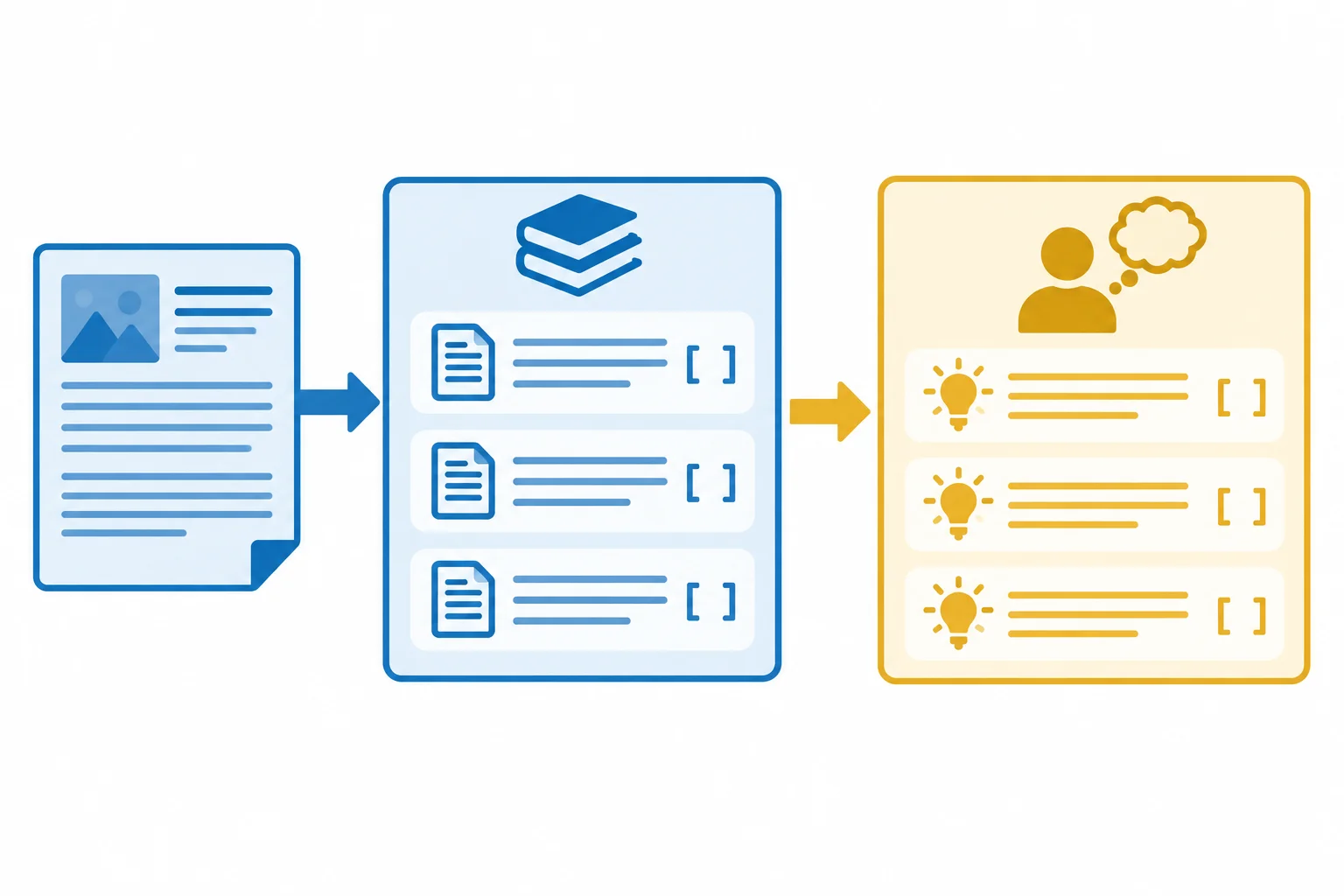
The citation establishes the source boundary. A following evaluation is the writer’s reasoning, not another reported finding.
The shared corpus is labelled Fictional practice sources. Use its alphabetised entries to check the surname, year, and source title behind every in-text citation.
A clear paragraph does not leave readers to guess whether a later sentence still reports the source. Signal your own inference explicitly with wording such as This finding supports ..., This suggests ..., or However, this does not establish ....
Fictional practice sources
| Source entry | Fixed evidence | Limitation |
|---|---|---|
| Chen, L. (2023). Lecture recordings and revision. Fictional teaching source. | Survey: 58 of 80 first-year students used recordings to revisit difficult points. | Learning outcomes were not measured. |
| Malik, A. (2024). Recordings and examination performance. Fictional teaching source. | In one first-year course, regular attenders and mainly recording users had similar mean examination scores. | 60 students chose their own attendance patterns. |
| Rivera, M. (2024). Participation in live lectures. Fictional teaching source. | 12 tutors described live discussion as a chance to test interpretations. | Learning outcomes were not measured. |
Example
Source report: Malik (2024) reports that, in one first-year course, regular attenders and students mainly using recordings had similar mean examination scores, but the groups chose their own attendance patterns.
Writer’s evaluation: This finding supports a cautious claim that recordings may be considered alongside attendance; it does not establish that recordings can replace attendance.
The first sentence preserves the study’s scope and limitation. The second sentence makes the writer’s inference visible.
Match each in-text citation to its correct entry in the Fictional practice sources list.
Tap an item and then its matching pair.
Repair this passage in 2–3 sentences.
58 of 80 first-year students reported using recordings to revisit difficult points. Regular attenders and students mainly using recordings had similar mean examination scores. This proves that recordings can replace attendance in all first-year university courses.
Add parenthetical citations that match the relevant supplied source entries. Then make the boundary clear between the reported findings and your evaluation. Preserve important limits, including the relevant study scope or limitation.
Write at least 250 characters (0/250).

Step 5 of 9
Acknowledge a relevant objection fairly, then use while or despite to explain why the available evidence does not settle the argument.
A counterargument challenges your thesis or one of its important supporting reasons. It is relevant when it addresses the same question, not merely a related issue.
In the Fictional practice sources, Malik (2024) studied 60 students in total in one first-year course. Regular attendees and students mainly using recordings had similar mean examination scores, and students chose their own attendance patterns. This is a strong relevant objection because similar scores may suggest that attendance is not necessary for examination performance.
A concession gives that point genuine weight. It does not automatically accept the opposing conclusion. Your response must explain why the finding does not settle the wider question.

Similar scores make a relevant counterargument. The self-selected groups limit what the comparison can establish.
The key limitation is self-selection: the study compares groups that students chose for themselves. It does not show that recordings caused the similar scores. The evidence also comes from one course.
A reasoned response can therefore retain a limited central claim. It acknowledges that scores were similar, then explains that this finding alone does not establish that recordings can replace attendance across first-year university courses. Keep the source report and your inference visibly separate, as you practised in the previous step.
A concessive sentence makes two moves: it acknowledges a valid point, then states the writer's position. The main clause carries the response.
Use while before a finite clause: a clause with a subject and verb. Use despite before a noun phrase or an -ing form. Do not put a bare finite clause after despite.
In each pattern, the opening words acknowledge the counterargument; the rest of the sentence prevents that point from deciding the whole issue.
Both patterns preserve the relationship between a valid finding and a limited central claim.
| Pattern | Accurate form |
|---|---|
| While + subject + verb, main clause | While the scores were similar, the groups were self-selected. |
| Despite + noun phrase, main clause | Despite similar scores, uncertainty remains. |
| Despite + -ing form, main clause | Despite acknowledging this finding, the writer questions its wider relevance. |
Tip
Do not dismiss the counterargument. A strong response accepts what the evidence suggests, then limits only the conclusion that the evidence cannot warrant.
Build the concessive sentence using while.
Your sentence
Available words
Build the concessive sentence using despite + noun phrase.
Your sentence
Available words
Build the concessive sentence using despite + -ing form.
Your sentence
Available words
Write 2 sentences (35–55 words) responding fairly to the counterargument.
Your first sentence must report that Malik studied 60 students in total in one first-year course, that the groups had similar mean examination scores, and that students chose their own attendance patterns. Include the source attribution with that reported finding. Use either while or despite accurately.
In your second sentence, begin a clearly separate writer's inference with Therefore, this finding does not establish ... Explain why the result does not establish that recordings can replace attendance in first-year university courses.
Write at least 35 characters (0/35).

Step 6 of 9
Listen for the difference between an acknowledged point and a speaker’s final academic position, then transcribe a concessive sentence accurately.
In an academic exchange, a speaker can acknowledge an objection without accepting its conclusion. Track the response in three moves:
Do not stop listening at the concession. The final position usually appears when the speaker explains what the evidence does—or does not—justify.
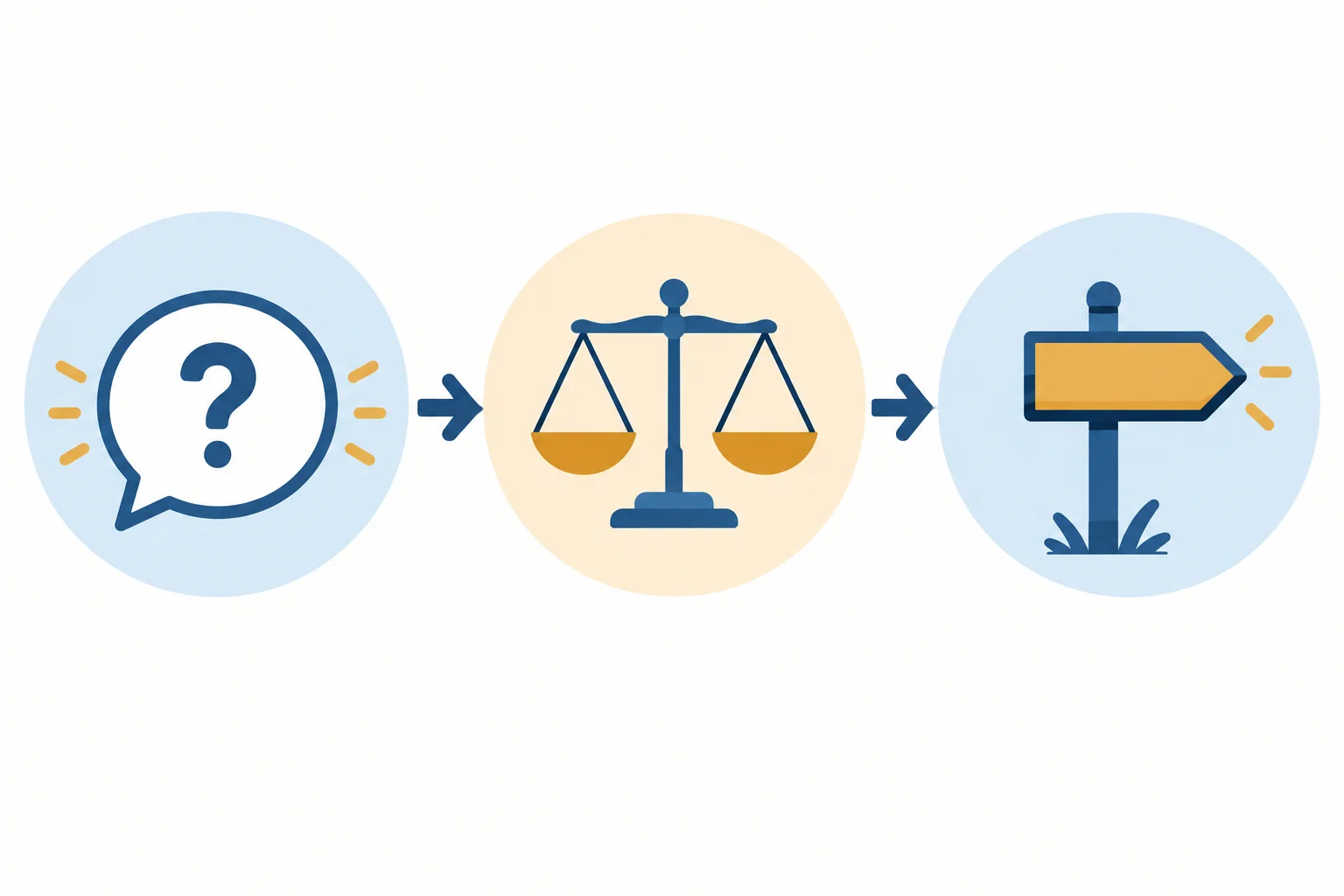
The concession is a middle move, not necessarily the speaker's final conclusion.
Listen and choose an option.
Listen to the exchange from the Fictional practice sources. What is Speaker B’s final position?
Speaker A: Malik (2024) found similar mean examination scores for regularly attending students and students who mainly used recordings. Does that mean recordings can replace attendance?
Speaker B: The finding matters. While the examination scores were similar, the groups were self-selected by students. Malik studied 60 students in one course, so this comparison does not establish equivalent learning. Recordings can support revision, but they should complement rather than replace attendance; live discussion may still let students test interpretations.
Listen and write what you heard.
Listen and type the concessive sentence exactly. Use normal written punctuation.

Step 7 of 9
Organise a four-paragraph argument and ensure that its conclusion remains proportionate to the available evidence.
Your thesis is the central claim that guides the whole discussion. In a compact argument, each paragraph should do a different job. The reader should be able to see how the argument moves from an answer, through support and challenge, to a warranted conclusion.

Paragraph 1 states the thesis; Paragraph 2 develops supporting evidence and reasoning; Paragraph 3 addresses a counterargument through concession and response; Paragraph 4 gives a warranted conclusion.
A conclusion should answer the guiding question after considering the argument. It is not a place to add a new benefit, make a broader claim, or treat an unmeasured outcome as established. Let the evidence and its limitations set the boundary of your final answer.
Fictional practice sources: use these details to decide what your conclusion can and cannot claim.
| Source detail | What it can support | What it cannot establish |
|---|---|---|
| Chen (2023): 58 of 80 students used recordings to revisit difficult points | Recordings can support revision | Improved learning outcomes |
| Malik (2024): groups had similar mean examination scores | Scores were similar in one course | That recordings and attendance are equivalent |
| Rivera (2024): 12 tutors described live discussion as a chance to test interpretations | Attendance may offer a distinct discussion opportunity | Measured learning outcomes |
Put these paragraph purposes into the most coherent order for an academic argument.
Revise the overextended conclusion below in 35–55 words.
“Lecture recordings can replace attendance in every first-year university course because they improve learning and give all students the same benefits as live lectures.”
Answer the guiding question directly. Use only these records: Chen reports revision use but no learning outcomes; Malik reports similar scores in self-selected groups; Rivera reports tutors’ views of live discussion but no learning outcomes. Include at least one limitation and do not add new evidence.
Write at least 180 characters (0/180).

Step 8 of 9
Use pausing, prominence, and respectful tone to make a concession distinct from your maintained academic position.
A spoken response can make its reasoning easier to follow without adding more words. First acknowledge the objection; then pause briefly before returning to your main position. Mark that thought-group boundary with / in speaking practice.
Give one word in the returning main position renewed prominence. Prominence is usually a little clearer, longer, or more strongly pitched—not louder throughout. It tells the listener which idea still governs your response.
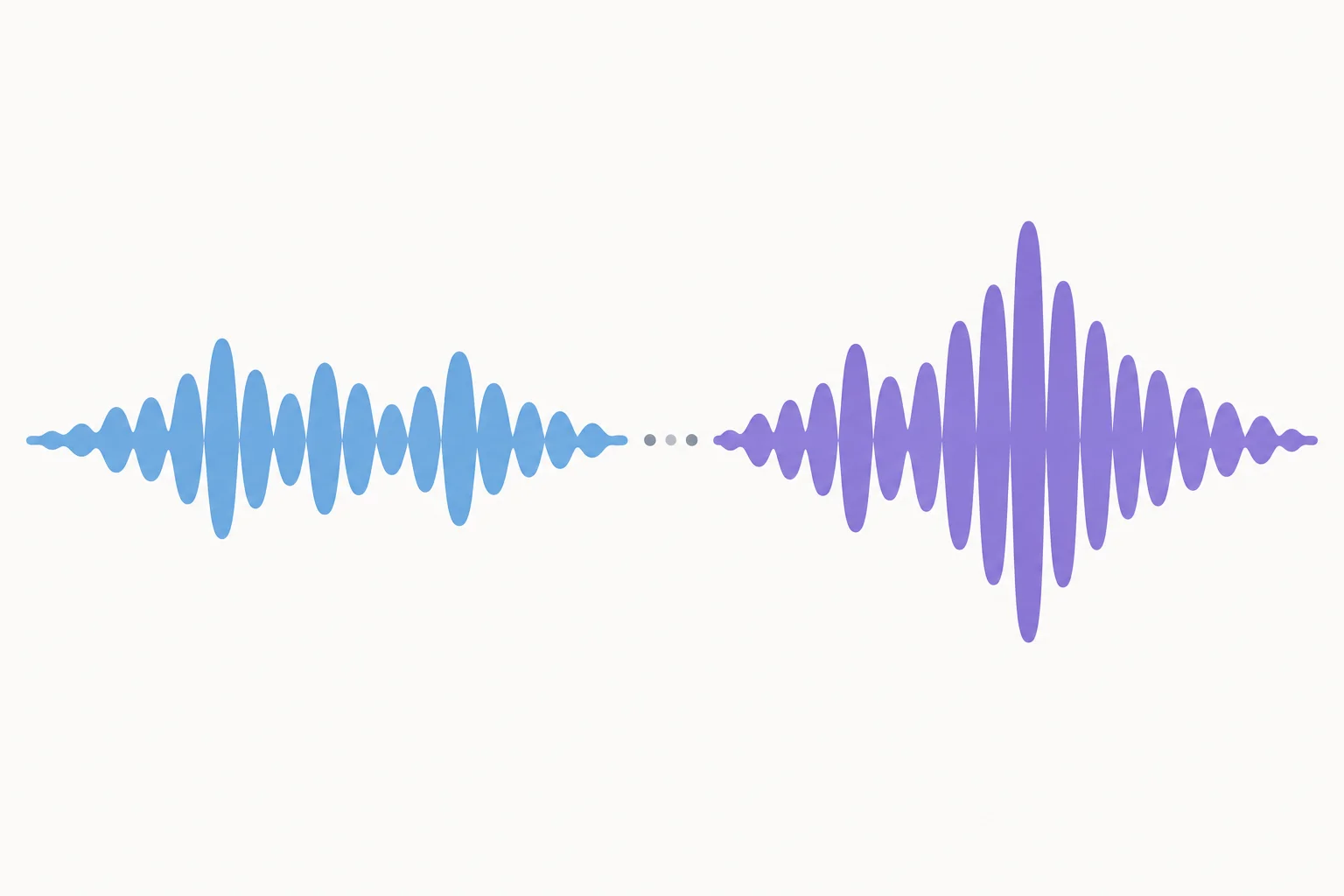
The pause separates the concession from the main position; the stronger peak represents renewed prominence on a key word.
Listen for the pause after the concessive point and the renewed prominence when the speaker returns to the argument.
While the scores were similar, this does not establish equivalence because the groups were self-selected.
While the scores were similar / this does not establish EQUIVALENCE because the groups were self-selected.
Example
The opening clause recognises a relevant finding. The second thought group gives the maintained position and one reason: the comparison cannot establish equivalence when students selected their own attendance patterns.
Tip
Do not rush the concession or make it sound sarcastic. Use an even, acknowledging tone up to the boundary. Then let the key word in your main position carry the contrast.
Use the audio model again. Copy the response below, add / where you would pause, and write ONE key word in CAPITALS for renewed prominence.
While the scores were similar, this does not establish equivalence because the groups were self-selected.
Then say your marked response aloud twice. After it, add one short sentence reporting whether the main position sounded distinct from the concession.
Write at least 80 characters (0/80).

Step 9 of 9
Write a four-paragraph academic argument from Fictional practice sources, then defend your position aloud.
Write an independently worded answer to this question:
To what extent can lecture recordings replace attendance in first-year university courses?
Your argument must contain 4 short paragraphs and 180–220 words, excluding the source list. Your thesis is the central claim. Use relevant supporting evidence, explain why it matters, represent a fair counterargument, and reach a warranted conclusion that recognises a limitation.
Use at least 2 sources. Cite each source clearly as Chen (2023) or (Chen, 2023), with a parenthetical citation before the final full stop. In Paragraph 3, use either while or despite accurately.

Map the four paragraphs: central claim; supporting evidence and reasoning; counterargument, concession, and response; warranted conclusion.
All material below belongs to the Fictional practice sources. Use only the findings and limitations shown here; do not add results that the sources did not report.
| Source | Fixed evidence | Limitation |
|---|---|---|
| Chen (2023) | 58 of 80 first-year students used recordings to revisit difficult points | Learning outcomes were not measured |
| Malik (2024) | In 1 course, regular attendees and students mainly using recordings had similar mean examination scores | 60 students chose their own attendance patterns |
| Rivera (2024) | 12 tutors described live discussion as a chance to test interpretations | Learning outcomes were not measured |
When you submit Sources, include every work you cite, alphabetised by surname:
Chen, L. (2023). Lecture recordings and revision. Fictional teaching source.
Malik, A. (2024). Recordings and examination performance. Fictional teaching source.
Rivera, M. (2024). Participation in live lectures. Fictional teaching source.
This is the simplified author–date convention for this practice task, not a complete institutional style guide.
Submit the argument in the 3 fields below. Keep each pair of paragraphs at approximately 90–110 words. Write normal sentence case and punctuation in this written task.
while or despite for a concession and evidence-based response.List only the sources you actually cite, alphabetised by surname.
Write Paragraphs 1–2 of your argument. Together, they should be approximately 90–110 words.
Write at least 450 characters (0/450).
Write Paragraphs 3–4 of your argument. Together, they should be approximately 90–110 words. Include a fair counterargument and an accurate concession using while or despite.
Write at least 450 characters (0/450).
Enter the full source entries for every source cited in your four paragraphs. Put them in alphabetical order by surname.
Write at least 80 characters (0/80).
Listen to the objection. Then prepare and say a 30–45-second response aloud. Acknowledge the point fairly, return clearly to your position, and give one supporting reason.
The examination scores were similar, so lecture recordings can replace attendance in first-year courses.
Speak your response before typing it. In the typed rehearsal, use / once to mark the thought-group boundary after your concession and write one prominent word in CAPITALS. Keep the concession separate from the main position; do not simply repeat the objection.
After speaking aloud, type the wording you used. It should acknowledge the objection, state your maintained or qualified position, and give one reason.
Write at least 260 characters (0/260).
Summary
Before finishing, audit the argument you submitted. Revision is part of academic writing: correct any unsupported extension, unclear source boundary, or citation that does not match its source entry.
while introduces a clause, and despite is followed by a noun phrase or an -ing form./ and renewed prominence.Complete this concise audit after revising if needed. Identify one source-based reason supporting your thesis, name the limitation that keeps your conclusion qualified, and state whether your spoken response included an audible concession-to-main-claim shift.
Write at least 120 characters (0/120).
Congratulations! You completed: Build an Academic Argument
Thousands of online courses in video, ebooks and audiobooks.
To test your knowledge during online courses
Generated directly from your cell phone's photo gallery and sent to your email

Download our app via QR Code or the links below:.



Carry knowledge in your pocket.
Download the Cursa app.
There are hundreds of free courses available, with a free certificate of completion that is saved in your mobile image gallery.
Download the app to access the Course Completion Certificate for Free.


+ 10 million
students

Free and Valid
Certificate

60 thousand free
exercises

4.8/5 rating in
app stores

Free courses in
video and ebooks