
Step 1 of 8
Focus on What Happens
Identify the receiver of an action and see why process explanations can begin with it.

Learning path · Level 7 · Tutorial 2
Explain how a simple process works, such as checking and returning a form. Use present and past passive forms to describe usual steps and a completed example. Read a process description, listen and choose the correct details, and complete a short dictation. Practise pronunciation, explain the steps aloud, and write your own description using a model.

 Focus on What Happens
Identify the receiver of an action and see why process explanations can begin with it. 2 min
 Describe the Usual Steps
Build affirmative present simple passive sentences for the usual steps in a study center process. 4 min
 Describe What Happened Yesterday
Use was or were with a past participle to describe completed process events. 3 min
 Make Negatives and Questions
Use passive negatives and questions to describe missing process steps and ask for process details. 3 min
 Choose Active or Passive
Choose active or passive wording according to whether responsibility or the process result matters most. Decide when a by phrase adds useful information. 3 min
 Put the Process in Order
Organize a short passive process explanation with a purpose, ordered steps, and a clear completed result. 3 min
 Hear the Steps and Say Them Clearly
Listen for key passive details, write what you hear, and practise stress and pauses in a short process explanation. 3 min
 Explain a Process Yourself
Write, say, and self-check a short passive process explanation with a usual routine and a completed example. 4 min
Step 1 of 8
Identify the receiver of an action and see why process explanations can begin with it.
A process has three useful parts:
At a study center, an assistant checks a form. The assistant does the action. Checking is the action. The form receives the action.

The action moves from the person doing it to the receiver.
Example
The assistant checks the form.
An active sentence starts with the person doing the action:
The assistant checks the form.
A passive sentence can start with the receiver:
The form is checked.
Use the passive when the process, the action, or its result is more important than the person doing the action. In a process explanation, readers often need to know what happens to the form.
Tip
Do not worry about building every passive form yet. First, notice the focus: active begins with the person doing the action; passive begins with the receiver.
Example
Active: Who does the checking? The assistant.
Passive: What happens in the process? The form is checked.
Match each part of the sentence with its job.
Tap an item and then its matching pair.

Look at the image. Which option correctly identifies what receives the checking action and puts that item first to focus on the process?

Step 2 of 8
Build affirmative present simple passive sentences for the usual steps in a study center process.
For a usual process, begin with the receiver and use the present simple passive:
receiver + am/is/are + past participle
The receiver can be one form, several forms, a copy, or a person. The form of be changes with the receiver; the past participle names the action.

A receiver may be singular or plural. The process action stays the same, but the form of be changes.
Use is with one receiver and are with more than one. Use am with I. The past participle does not change when the receiver becomes plural.
For this process, the participles are: complete → completed; check → checked; approve → approved; print → printed; send → sent; return → returned.
Notice: the past participle of send is sent, not sended.
Choose the form of be from the receiver. Keep the past participle unchanged.
| Receiver | Be | Sentence |
|---|---|---|
| I | am | I am sent a copy. |
| the form | is | The form is completed. |
| the forms | are | The forms are checked. |
| the copy | is | The copy is printed. |
| the copies | are | The copies are returned. |
Example
Usually, the process is described in this order:
First, the form is completed.
Then, the form is sent to the assistant.
After that, the form is checked.
Then, the form is approved.
After that, a copy is printed.
Finally, the copy is returned to the learner.
Build the usual process sentence.
Your sentence
Available words
Complete the routine sentence: The forms ___ (check).
Complete the routine sentence: The form ___ (approve).
Complete the routine sentence: The form ___ to the assistant (send).

Step 3 of 8
Use was or were with a past participle to describe completed process events.
A completed action on a specific occasion uses the past simple passive.
receiver + was/were + past participle
Use was with one receiver and were with more than one receiver.
Yesterday, one form was approved. Yesterday, one printed copy was returned to the learner. The past participle stays the same: approve → approved; return → returned.
One receiver takes was; more than one receiver takes were. Both patterns use a past participle.
Time information helps you choose the form of be. Usually introduces a routine, so it uses present passive forms. Yesterday introduces a completed event, so it uses past passive forms.
The past participle does not change. Only the form of be changes: is/are becomes was/were.
Compare the same action with different time information.
| Time | Receiver | Passive sentence |
|---|---|---|
| Usually | one form | Usually, the form is approved. |
| Yesterday | one form | Yesterday, one form was approved. |
| Usually | the forms | Usually, the forms are checked. |
| Yesterday | the forms | Yesterday, the forms were checked. |
Tip
Read the time information and the receiver first. Usually signals a routine; yesterday signals a completed event. Then choose the matching form of be.
Match each passive statement to its context.
Tap an item and then its matching pair.
Complete the past passive sentences. The base verb in parentheses tells you which past participle to use.
Yesterday, one form  . (approve)
Yesterday, the forms  . (check)
Step 4 of 8
Use passive negatives and questions to describe missing process steps and ask for process details.
Passive negatives describe a process action that does not happen.
Put not directly after am, is, are, was, or were. The receiver stays first.
Present: receiver + am/is/are + not + past participle
Past: receiver + was/were + not + past participle
Do not add do, does, or did. The form of be carries the grammar.
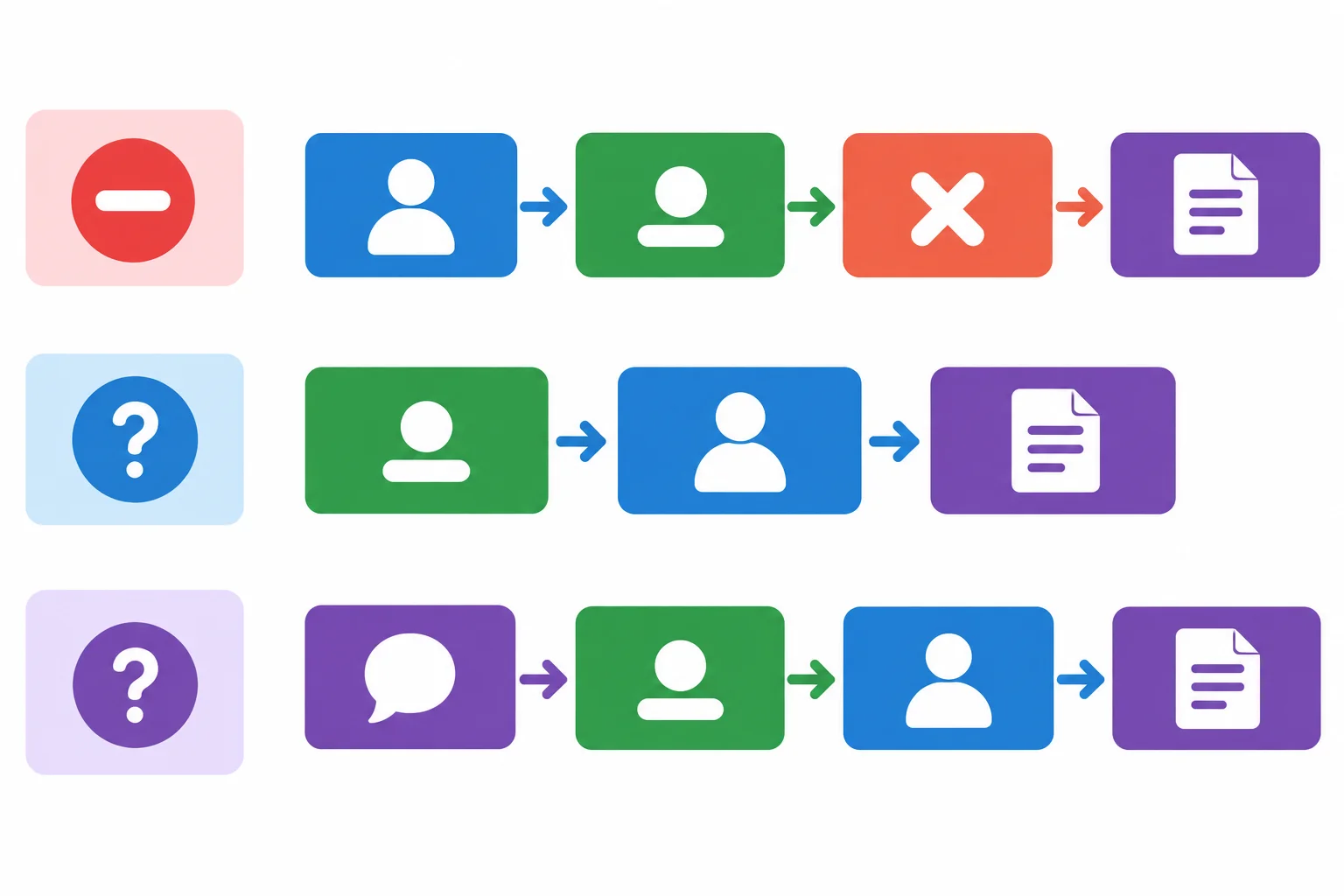
In a negative, the receiver stays first. In a question, the form of be moves before the receiver.
Example
Practice variation
Usually, the form is not checked.
Yesterday, the copy was not returned to the learner.
The past participles stay the same: check → checked and return → returned. The form of be changes for present or past time.
For a passive yes/no question, put am, is, are, was, or were before the receiver.
For a detail question, put the question word before be. The past participle stays after the receiver.
Use these patterns to ask about the process.
| Question type | Pattern | Example |
|---|---|---|
| Usual step | Is/Are + receiver + past participle? | Is the form checked? |
| Completed action | Was/Were + receiver + past participle? | Was the form approved yesterday? |
| Detail question | Question word + was/were + receiver + past participle? | When was the form checked? |
Warning
Do not use do, does, or did in these passive questions. Say “Was the form approved?” not “Did the form approved?”
Build the question about the usual checking of several forms. Use all the blocks.
Your sentence
Available words
Practice variation: Complete the usual-process negative. Use the verb in parentheses.
Usually, the form ___ . (check)
Practice variation: Complete the completed-action negative. Use the verb in parentheses.
Yesterday, the copy ___ to the learner. (return)
Which question correctly asks about the completed approval?
Build the question that asks about the time of the returned copy. Use all the blocks.
Your sentence
Available words

Step 5 of 8
Choose active or passive wording according to whether responsibility or the process result matters most. Decide when a by phrase adds useful information.
Choose the sentence focus that helps the reader.
Use an active sentence when the person doing the action, or responsibility, is the main message: Usually, the manager approves the form.
Use a passive sentence when the receiver, the process, or the result is the main message: Usually, the form is approved. The receiver comes first.

Active wording highlights the person doing the action. Passive wording highlights the receiver or the result.
A passive sentence does not always need to name the person doing the action.
Leave the person out when that person is unknown, obvious, or unimportant: Usually, the form is checked. In a routine guide, readers need to follow the step; the assistant is not the focus.
Add (by + person doing the action) when the receiver or process is still the focus, but the person is useful information: Yesterday, the form was approved by the manager. Here, the form remains first, and the manager's decision is also clear.
Choose the wording that matches the communication goal.
| Communication goal | Best wording | Example |
|---|---|---|
| Make responsibility the main message | Active | Usually, the manager approves the form. |
| Explain a routine step; person is obvious | Passive without a by phrase | Usually, the form is checked. |
| Keep focus on the form; name a relevant decision-maker | Passive with a by phrase | Yesterday, the form was approved by the manager. |
| Give the result; person is unimportant | Passive without a by phrase | Usually, a copy is returned to the learner. |
Example
Clear explanations can mix both forms. For example: Usually, the assistant checks the form. The form is approved by the manager. Finally, a copy is returned to the learner.
Use active wording when responsibility matters. Use passive wording when the reader needs to follow what happens to the receiver or see the result.
Arrange the blocks to make a completed update. Keep the form as the focus and name the manager because that detail matters.
Your sentence
Available words
A routine guide should focus only on what happens to the form; the assistant is obvious. A completed update should keep focus on the form but also identify the manager as the decision-maker. Which pair is best?

Step 6 of 8
Organize a short passive process explanation with a purpose, ordered steps, and a clear completed result.
A short process explanation is easier to follow when it has three parts:
Keep closely connected actions together. For example, a form can be completed and sent in one step; a copy can be printed and returned in one final step.

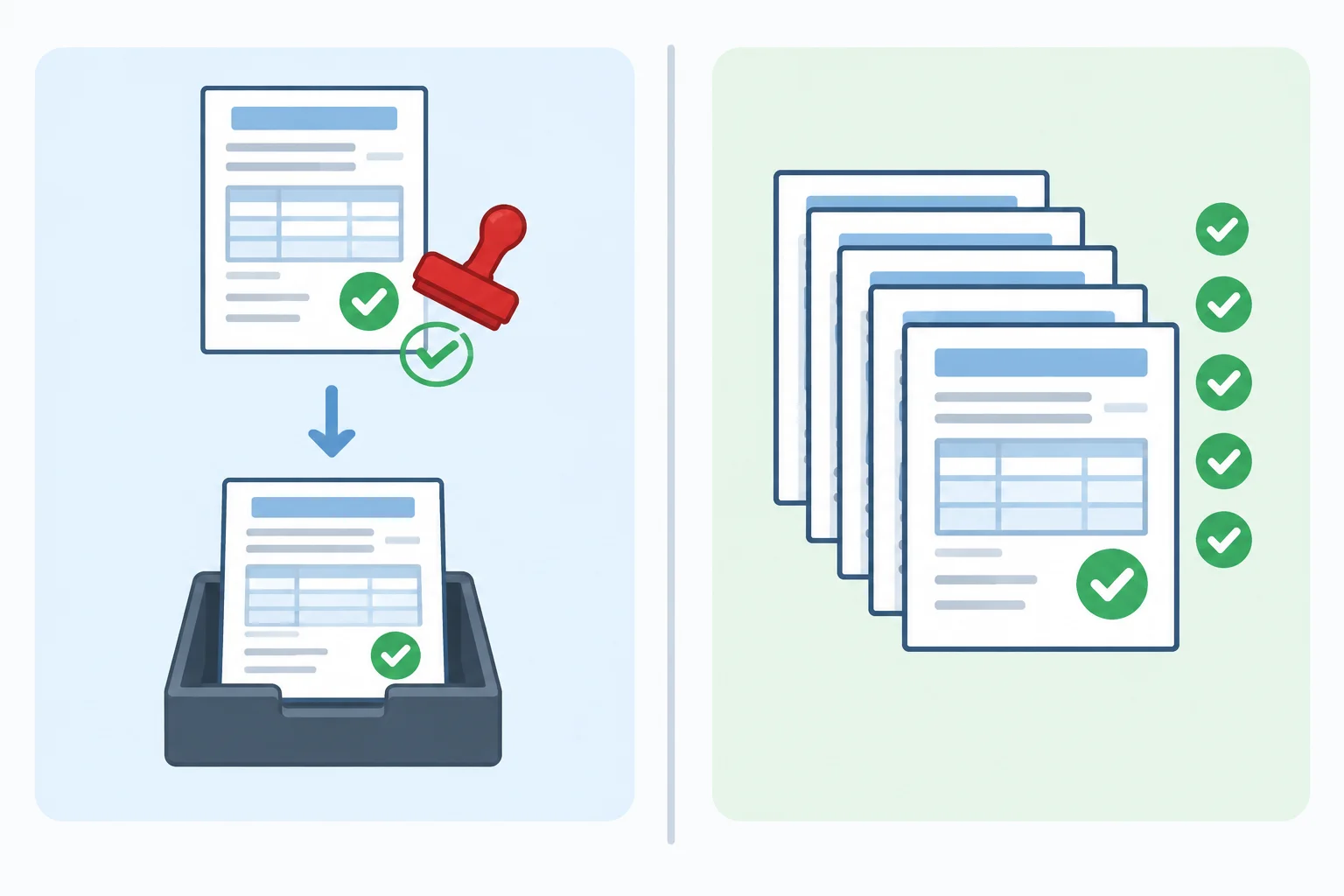
The arrows show the order. The last image shows the result: the learner receives a copy.
Tip
Use one sequence marker at the beginning of each step: First, Then, After that, Finally,. Start a completed example with Yesterday, so the reader can immediately see that it is not the usual routine.
Read the model from top to bottom. It begins with a purpose, gives the usual process in grouped steps, and then switches to one completed example.
Example
Purpose: This explains how a course registration form is processed at a study center.
Usual process:
First, the form is usually completed and sent to the assistant by the learner.
Then, the form is checked by the assistant.
After that, the form is approved by the manager.
Finally, a copy is printed and returned to the learner by the assistant.
Completed example:
Yesterday, one form was approved by the manager. Finally, one printed copy was returned to the learner by the assistant.
Tip
The routine uses present passive forms because it describes what usually happens. The completed example uses past passive forms because it reports what happened yesterday. Notice that the result names the approved form and the returned copy.
Put the usual passive steps in the correct order.
Use the written model and the process diagram from the previous screens. Write a short description with:
Your writing should make the routine and the completed example clearly different.
Write at least 250 characters (0/250).

Step 7 of 8
Listen for key passive details, write what you hear, and practise stress and pauses in a short process explanation.
In natural speech, is, are, was, and were can sound quiet. Listen for the whole passive pattern: the receiver + a form of be + a past participle.
Use the time word too:
The receiver and past participle help you hear what happened. The form of be and the time information show whether it is a routine or one completed occasion.

Hear the time information and main action clearly; forms such as is and was may be quieter.
Tip
First, find the receiver. Then, listen for the past participle, such as checked or approved. Finally, use usually or yesterday with is/was to understand the time.
Listen twice. Then choose the statement that matches the recording.
Usually, the form is checked by the assistant. Yesterday, the form was approved by the manager.
Which statement matches the recording?
Write exactly what you hear. Listen for the short forms is and was, as well as the receiver and the past participle.
Listen and write what you heard.
Listen and type the two sentences.
Say each line aloud twice:
Usually, / the form is checked.
Yesterday, / one printed copy was returned.
The slash shows a short pause between meaningful chunks. Do not pause between every word.
Tip
Make the bold time word and bold main action easy to hear. Keep is and was connected to the words around them, rather than saying every word with the same strength.
Say both lines aloud twice. Then write a short self-check: name the words you stressed and say where you paused.
Write at least 30 characters (0/30).

Step 8 of 8
Write, say, and self-check a short passive process explanation with a usual routine and a completed example.
Bring the whole skill together in one short explanation. Start with a purpose, show the usual process in order, and then use Yesterday, to introduce one completed occasion.
Use active wording when responsibility is important. Use passive wording when the receiver, action, or result is the focus.

The flow follows the routine from form completion to the returned copy.
Example
This describes course registration at a study center.
First, the learner usually completes the form and sends it to the assistant.
Then, the form is checked by the assistant.
After that, the form is approved by the manager.
Finally, a copy is printed and returned to the learner by the assistant.
Yesterday, one form was approved, and one printed copy was returned to the learner.
Before writing, make a quick plan. Keep the usual process and the completed example separate. Your explanation should make it easy for a reader or listener to follow what happens, who matters, and what result is reached.
Use this checklist after you draft your sentences and again after you say them aloud.
| Check | Ask yourself |
|---|---|
| Purpose | Did I say what process I am explaining? |
| Usual steps | Did I use usually and present passive forms where the receiver is the focus? |
| Completed example | Did I begin with Yesterday, and use past passive forms? |
| Agreement | Does each receiver match am, is, are, was, or were? |
| Verb form | Did I use a past participle, including sent? |
| Order and result | Do the sequence markers show the process clearly and lead to a result? |
| Focus | Did I use active wording where responsibility matters and passive wording where the action matters? |
| Speaking | Did I pause between steps and stress the main action and important time information? |
Tip
Read your finished explanation in meaningful chunks, not word by word:
First, | the form is checked. |
Yesterday, | one form was approved.
Let the sequence marker introduce the step. Make the main action and the time information easier to hear.
Write five or six connected sentences about the study center registration model or a familiar comparable process.
Include a brief purpose, the usual steps in order, a clear result, and one sentence beginning Yesterday, about a completed occasion. Use present passive forms for usual steps and past passive forms for yesterday. Use active wording where the person doing the action matters; otherwise, focus on the receiver when that makes the process clearer.
When your text is ready, read the same sentences aloud. Pause after each sequence marker, make the main actions and usually / yesterday easy to hear, and self-check with the previous screen before you submit.
Write at least 250 characters (0/250).
Summary
You can now create a short process explanation that a reader or listener can follow.
Congratulations! You completed: Explain a Process with the Passive
Thousands of online courses in video, ebooks and audiobooks.
To test your knowledge during online courses
Generated directly from your cell phone's photo gallery and sent to your email

Download our app via QR Code or the links below:.



Carry knowledge in your pocket.
Download the Cursa app.
There are hundreds of free courses available, with a free certificate of completion that is saved in your mobile image gallery.
Download the app to access the Course Completion Certificate for Free.


+ 10 million
students

Free and Valid
Certificate

60 thousand free
exercises

4.8/5 rating in
app stores

Free courses in
video and ebooks