 Programming Basics
Programming fundamentals are core concepts such as variables, data types, operators, control flow, functions, and basic problem-solving logic.

6

2

2

Build strong algorithm skills with a free online course: data structures, sorting, graphs and dynamic programming. Learn faster, code smarter, earn a certificate.
5

(11)

30h53m

22 exercises
Build core coding skills fast with this free online programming course—learn Python basics, problem-solving, and earn a certificate-ready foundation for tech roles.
5
(4)
6h34m
14 exercises
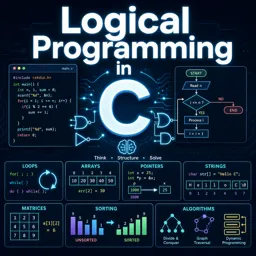
Build strong programming logic with a free online course in C basics—practice loops, functions, arrays and problem solving, and level up for entry tech roles.
4.5

(27)
6h56m
19 exercises
Exercises
Test your knowledge of error types, breakpoints, stack traces, assertions, logging, exceptions, and systematic debugging techniques.
Start exercisesTest your Python programming fundamentals with questions on syntax, variables, lists, loops, functions, strings, tuples, and operators.
Start exercisesTest your knowledge of basic algorithms, problem-solving techniques, time complexity, recursion, dynamic programming, and graph paths.
Start exercisesTest your knowledge of programming control structures, loops, conditionals, break, continue, for, while, and do-while statements.
Start exercisesTest your understanding of object-oriented programming basics, including classes, objects, encapsulation, inheritance, polymorphism, interfaces, and constructors.
Start exercisesTest your knowledge of algorithms, problem solving, debugging, sorting, loops, recursion, data structures, compilers, IDEs, and version control.
Start exercises
Variables and Data Types Explained: How Programs Store Information
A beginner-friendly guide to variables and data types: what they are, the main types, and how programs store and use information.

Core Concepts in Programming Logic: Variables, Control Structures, and More
Learn the core concepts of programming logic—variables, data types, control structures, and more—to build a solid foundation in coding.

Getting Started With Programming Logic: Step-By-Step Guide For Beginners
Learn the basics of programming logic with this beginner’s guide, covering concepts, examples, and tips to build strong coding skills.
Understanding The Foundations Of Programming Logic
Learn the essentials of programming logic, from variables and control structures to algorithm design, for a solid start in coding.

Unlocking The Essentials: What You Need To Know About Programming Basics
Learn the key concepts of programming basics, including syntax, data types, and debugging, to build a strong foundation for coding success.

Building Strong Foundations: Exploring the Basics of Programming Logic
Programming logic is key to software development. Master control structures, data handling, and Boolean logic to create efficient, reliable, and intelligent code.

Mastering Conditional Statements: The Key to Powerful Programming Logic
Conditional statements enable decision-making in code. Mastering if, else, and switch statements enhances programming logic, making applications more dynamic and responsive.

The Art of Debugging: Enhancing Programming Logic
Debugging enhances programming logic by identifying and fixing errors efficiently. Use structured techniques, tools, and reviews to write clean, reliable code.
Web Development

Programming Languages ( Python, Ruby, Java, C )
Office Productivity (Excel, Word and More)

Artificial Intelligence and Machine Learning

App Development
Databases
Software testing

Cyber Security
Cloud Computing and Web Servers
Robotics and Drones

Data Science and Business Intelligence
Backend development

Developer and IT Tools
Hardware, Operating Systems and IT Support
Computer Basics

Game development
Develop a strong foundation in computer science with free online courses designed for beginners, students, and professionals seeking practical digital skills. Study programming logic, algorithms, variables, data types, operators, control structures, functions, arrays, and problem-solving techniques. Each course is free, includes free certification, and features exercises that help reinforce theoretical knowledge through active learning and coding practice.
These learning resources introduce computational thinking and the structured methods used to transform problems into executable solutions. Explore algorithm design, pseudocode, flow control, conditional statements, loops, modular programming, debugging, and code analysis. The curriculum includes language-independent concepts as well as practical instruction using C and Python.
Exercises support knowledge retention and allow learners to apply syntax, logic, algorithm development, and debugging strategies. By progressing through lessons and assessments, students can identify errors, compare possible solutions, and improve code quality. Course completion also includes free certification, offering a convenient way to document your learning journey.
For additional introductory material, visit Programming Basics. This related collection can help you review foundational concepts, strengthen computational reasoning, and prepare for further studies in software development, web development, data science, automation, and object-oriented programming.
To access these free courses, lessons, exercises, and free certification, you must install the Cursa app on your mobile device. Use Download for Android through Google Play, or choose Download for iOS / iPhone through the App Store. Install the app, select a course, and begin studying at your own pace.
What are programming fundamentals?
Programming fundamentals are core concepts such as variables, data types, operators, control flow, functions, and basic problem-solving logic.
Is programming logic important for beginners?
Yes. Programming logic helps beginners break problems into clear, step-by-step solutions before writing code.
What is an algorithm in programming?
An algorithm is a finite sequence of instructions used to solve a problem or complete a task.
Should I learn pseudocode before a programming language?
Pseudocode is useful for learning logic because it lets you plan algorithms without worrying about language syntax.
What basic concepts are taught in a programming fundamentals course?
Courses typically cover variables, conditions, loops, arrays, functions, input/output, debugging, and algorithms.
Can I learn programming fundamentals with C or Python?
Yes. C is useful for understanding low-level logic, while Python offers beginner-friendly syntax for practicing core concepts.
What are data structures and why are they important?
Data structures organize data efficiently. Common examples include arrays, lists, stacks, queues, and dictionaries.

Complete any course and issue your certificate via the app — at no cost.

Download the app! to have access to more than 4,000 Online Courses + Certificate, all free!
Download the app! 100% free courses.


Carry knowledge in your pocket.
Download the Cursa app.
There are hundreds of free courses available, with a free certificate of completion that is saved in your mobile image gallery.
Download the app to access the Course Completion Certificate for Free.


+ 10 million
students

Free and Valid
Certificate

60 thousand free
exercises

4.8/5 rating in
app stores

Free courses in
video and ebooks
What are people saying about free online courses of Programming Fundamentals
Aihik Chatterjee
its a great learning platform.
CourseProgramming logic