
Step 1 of 7
Notice Two Different Times
Notice how an imagined earlier decision can connect to a different situation now.

Learning path · Level 8 · Tutorial 4
Connect earlier choices with life now, and continuing situations with past outcomes. Read short accounts and compare spoken alternatives with different time meanings. Complete an audio-choice task and a brief dictation, then use a model to explain one connection in speech and writing.

 Notice Two Different Times
Notice how an imagined earlier decision can connect to a different situation now. 2 min
 Build a Past-to-Present Connection
Connect an unreal earlier decision with its imagined effect now. 3 min
 Connect a Continuing Situation to the Past
Connect Sam’s continuing distance from the course venue with an imagined result yesterday, then check whether the same relationship fits a situation that changed only today. 3 min
 Keep Negatives and Time Relationships Clear
Use negative mixed conditionals carefully: select the negative clause that matches the imagined meaning, then check that the condition and result have a sensible time relationship. 3 min
 Hear the Time Contrast
Listen for the form after would, use time expressions to confirm the meaning, and transcribe a mixed conditional accurately. 3 min
 Ask How an Earlier Choice Affects Now
3 min
 Explain and Check One Connection
Write, check, revise, and say one short explanation that connects facts across time with a mixed conditional. 4 min
Step 1 of 7
Notice how an imagined earlier decision can connect to a different situation now.
Mixed conditionals connect an imagined condition and result that refer to different times.
Alex made an earlier decision last week. The lasting effect is part of the current situation now. First, keep the stated facts separate from the imagined alternative.
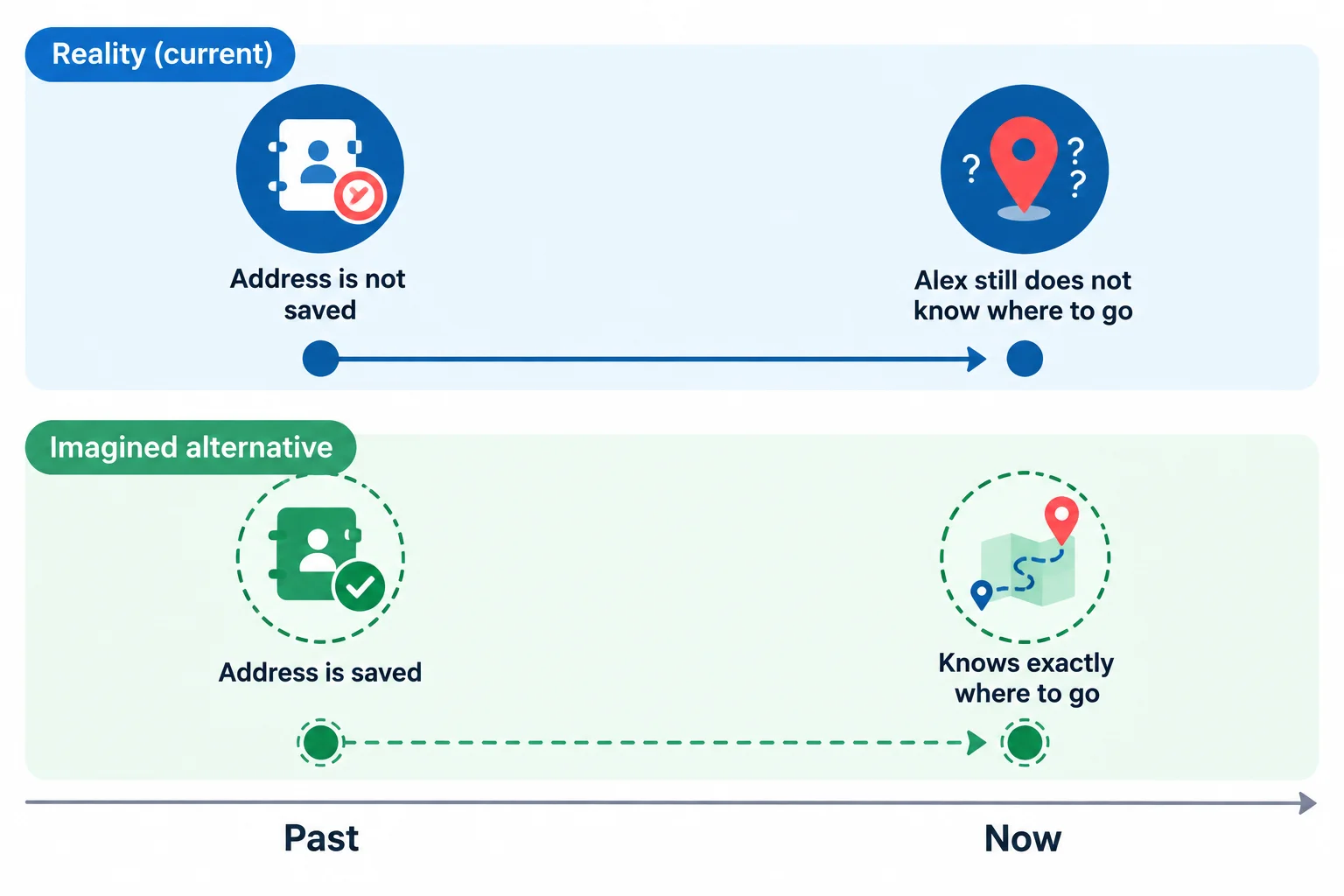
Solid marks show facts. Dashed marks show an imagined alternative.
The expressions earlier decision and current situation help you notice the two times.
A third conditional imagines a different past result. This mixed example changes an earlier decision but imagines a result now. Read the meaning first: What changed in the past? What would be different now?
Example
Fact account:
Alex did not save the course address last week. Alex still does not know where to go now.
Imagined alternative:
If Alex had saved the course address last week, Alex would know where to go now.
The if-clause is the imagined condition: an earlier decision. The other clause is the imagined result: a current situation.
Tip
When the if-clause comes first, use this punctuation: If [condition], [result].
Here, the comma separates the earlier imagined condition from its result now.
Match each statement to its role and time.
Tap an item and then its matching pair.

Step 2 of 7
Connect an unreal earlier decision with its imagined effect now.
An earlier decision can have a lasting effect on a current situation. Alex did not save the course address last week. Alex still does not know where to go now.
To imagine a different earlier decision, change the past condition—not the stated facts. The imagined consequence is knowledge now. This is a Past condition → Present result connection.
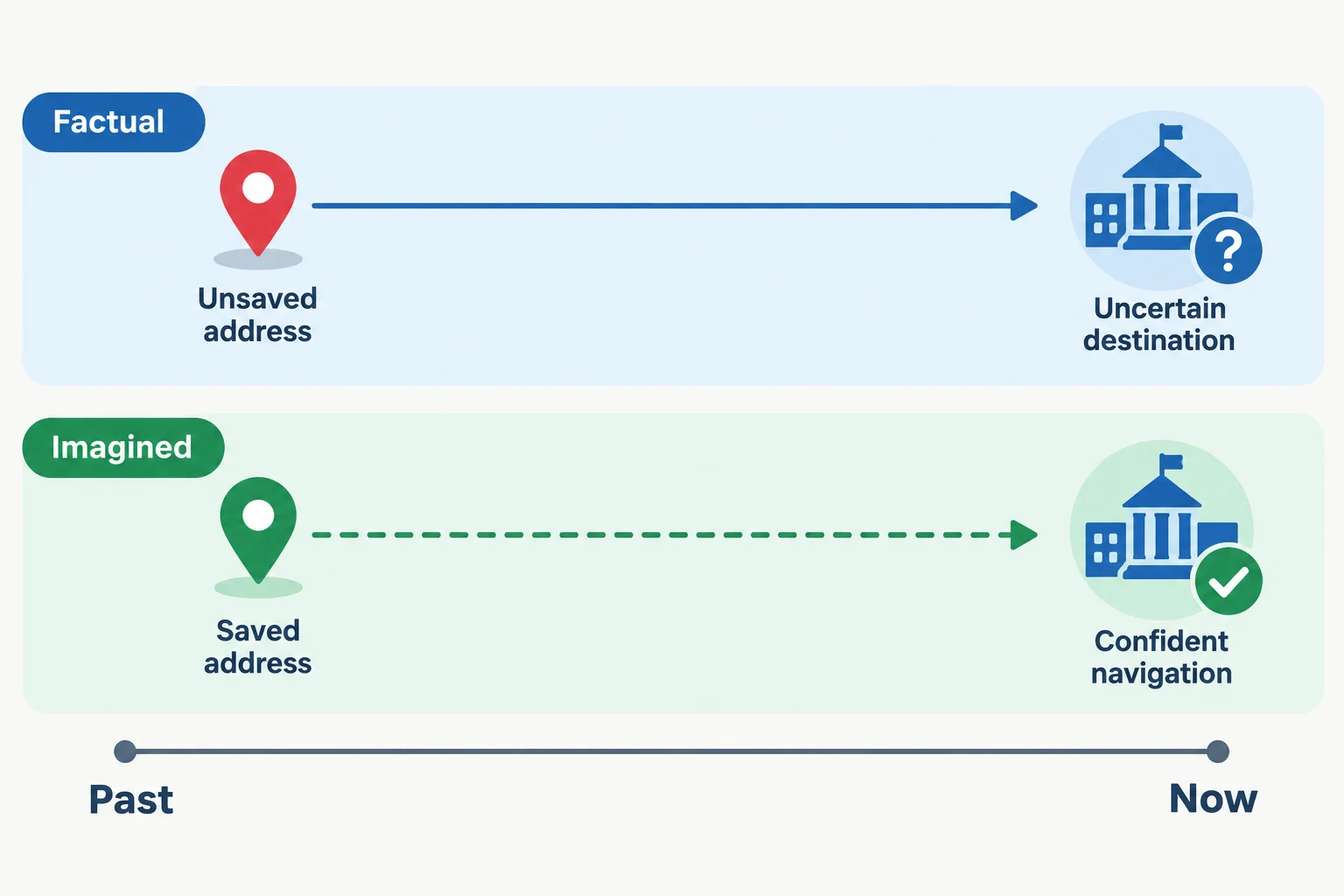
Solid marks show stated facts. Dashed marks show the imagined alternative and its present consequence.
Use this form for a Past condition → Present result:
if + past perfect, would + base form
The if-clause changes an earlier decision. The result clause describes the imagined current situation. Words such as now and still make the result time clear.
Read the clauses separately before combining them.
| Clause role | Time | Form | Alex's meaning |
|---|---|---|---|
| Condition | Past: last week | had + past participle | had saved the course address |
| Result | Present: now | would + base form | would know where to go |
Example
If Alex had saved the course address last week, Alex would know where to go now.
The earlier choice has a consequence in the current situation.
You can also put the result first:
Alex would know where to go now if Alex had saved the course address last week.
Use a comma after an opening if-clause. Do not use a comma before a final if-clause.
Build the affirmative mixed conditional from the blocks.
Your sentence
Available words
Complete the present result.
If Priya had saved the course map last week, she __ where to go now.

Step 3 of 7
Connect Sam’s continuing distance from the course venue with an imagined result yesterday, then check whether the same relationship fits a situation that changed only today.
A mixed conditional can connect a continuing situation with an earlier result.
Sam lives far from the course venue now. He lived far from it yesterday too, so he missed yesterday’s session because of the distance.
To imagine a different continuing situation and a different past outcome, use this pattern:
Continuing present condition → Past result
if + past simple, would have + past participle
The past simple in the if-clause does not describe one completed event yesterday. It expresses an unreal situation that would apply yesterday and still apply now.
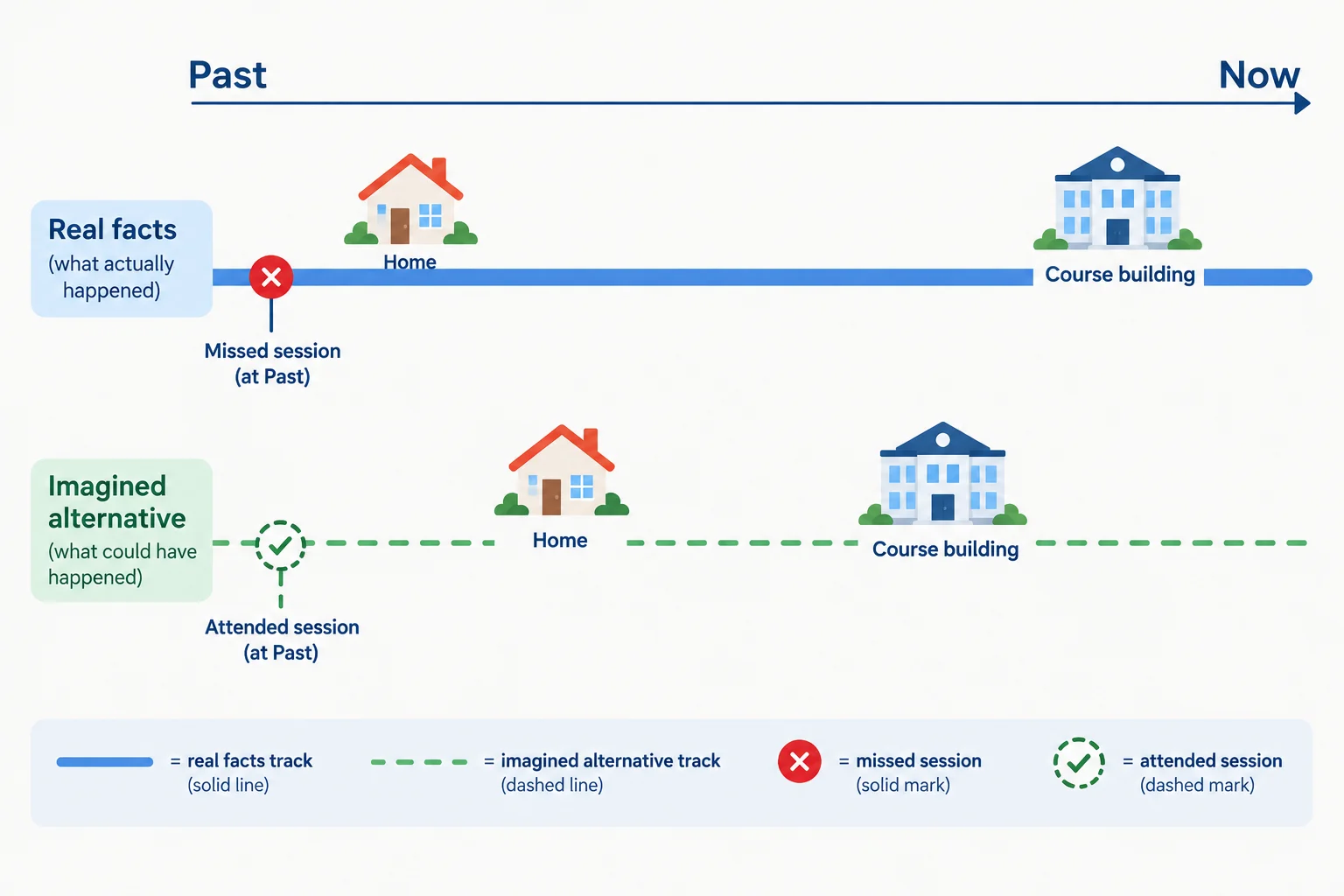
The imagined condition spans yesterday and now; the imagined result belongs at yesterday.
Use Sam’s facts to form an imagined alternative:
If Sam lived nearer to the course venue, he would have attended yesterday.
The condition is unreal: Sam does not live nearer. Its time scope is continuing: in the imagined alternative, it applies both yesterday and now. The result, would have attended, is an imagined outcome yesterday.
Use a comma after an opening if-clause:
If [condition], [result].
Example
Real facts: Sam lived far from the course venue yesterday, still lives far from it now, and missed yesterday’s session.
Imagined alternative: If Sam lived nearer to the course venue, he would have attended yesterday.
This does not mean that Sam moves nearer now and changes yesterday. It imagines a different ongoing situation—one that also applied yesterday.
Tip
Check the time scope, not whether the imagined condition is a real fact. Ask: “Would this imagined situation apply both at the time of the past result and now?”
If the situation began only today, it cannot explain a different result yesterday.
Priya works long hours now and worked long hours yesterday, so she missed yesterday’s workshop. Build the imagined alternative.
Arrange the blocks to form the mixed conditional.
Your sentence
Available words
Complete both parts.
Write at least 80 characters (0/80).

Step 4 of 7
Use negative mixed conditionals carefully: select the negative clause that matches the imagined meaning, then check that the condition and result have a sensible time relationship.
Start with the stated facts. Alex did not save the course address last week, and he still does not know where to go now.
A negative fact does not require negative grammar in both parts of an imagined alternative. First decide what you want to change: the earlier decision, the current situation, or both. Then keep the condition and result on their separate points in time.
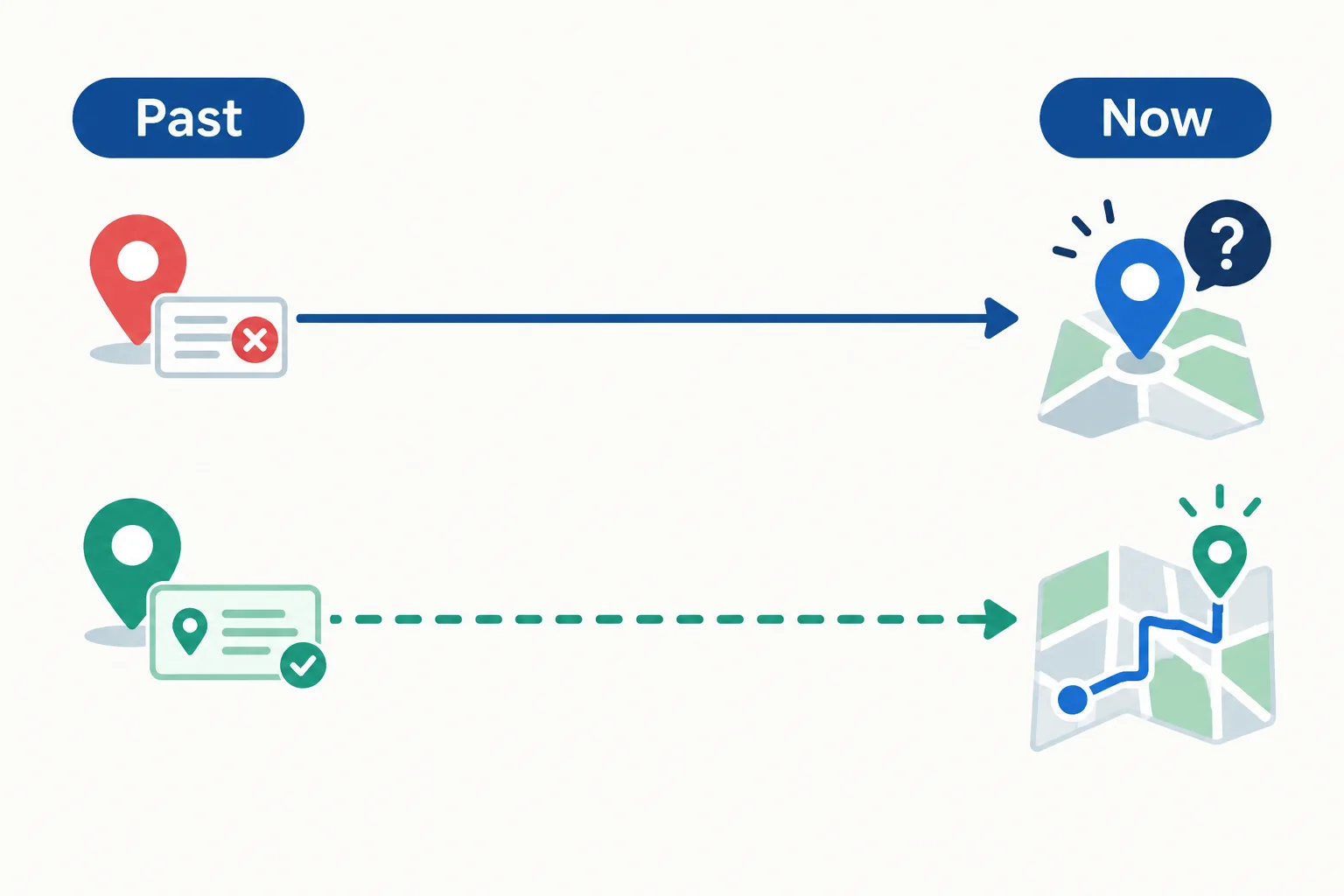
Keep stated facts on the solid track and imagined alternatives on the dashed track.
Use the usual mixed-conditional pattern first. Add a negative only to the clause whose imagined meaning needs to be negative.
The two patterns and their negative forms
| Pattern | Usual form | Negative choices |
|---|---|---|
| Past condition → Present result | if + past perfect, would + base form | had not + past participle; would not + base form |
| Continuing present condition → Past result | if + past simple, would have + past participle | did not + base form; would not have + past participle |
Example
Jordan saved the course address last week and knows where to go now.
If Jordan had not saved the course address last week, Jordan would not know where to go now.
Nora lives near the course venue now, lived near it yesterday, and attended yesterday's session.
If Nora did not live near the course venue, Nora would not have attended yesterday.
Use the facts to complete each imagined alternative. Focus on the negative form needed in the condition.
Jordan saved the course address last week and knows where to go now.
If Jordan ___ the course address last week, he would not know where to go now.
Nora lives near the course venue now, lived near it yesterday, and attended yesterday's session.
If Nora ___ near the course venue, she would not have attended yesterday.
Write three numbered lines.
Read your three lines aloud after writing them.
Write at least 220 characters (0/220).

Step 5 of 7
Listen for the form after would, use time expressions to confirm the meaning, and transcribe a mixed conditional accurately.
Mixed conditionals can sound similar, so listen for the result after would.
would knowwould have attendedUse the clause times to identify the pattern:
if + past perfect, would + base formif + past simple, would have + past participleTime expressions such as last week, now, still, and yesterday confirm what the verb forms tell you.
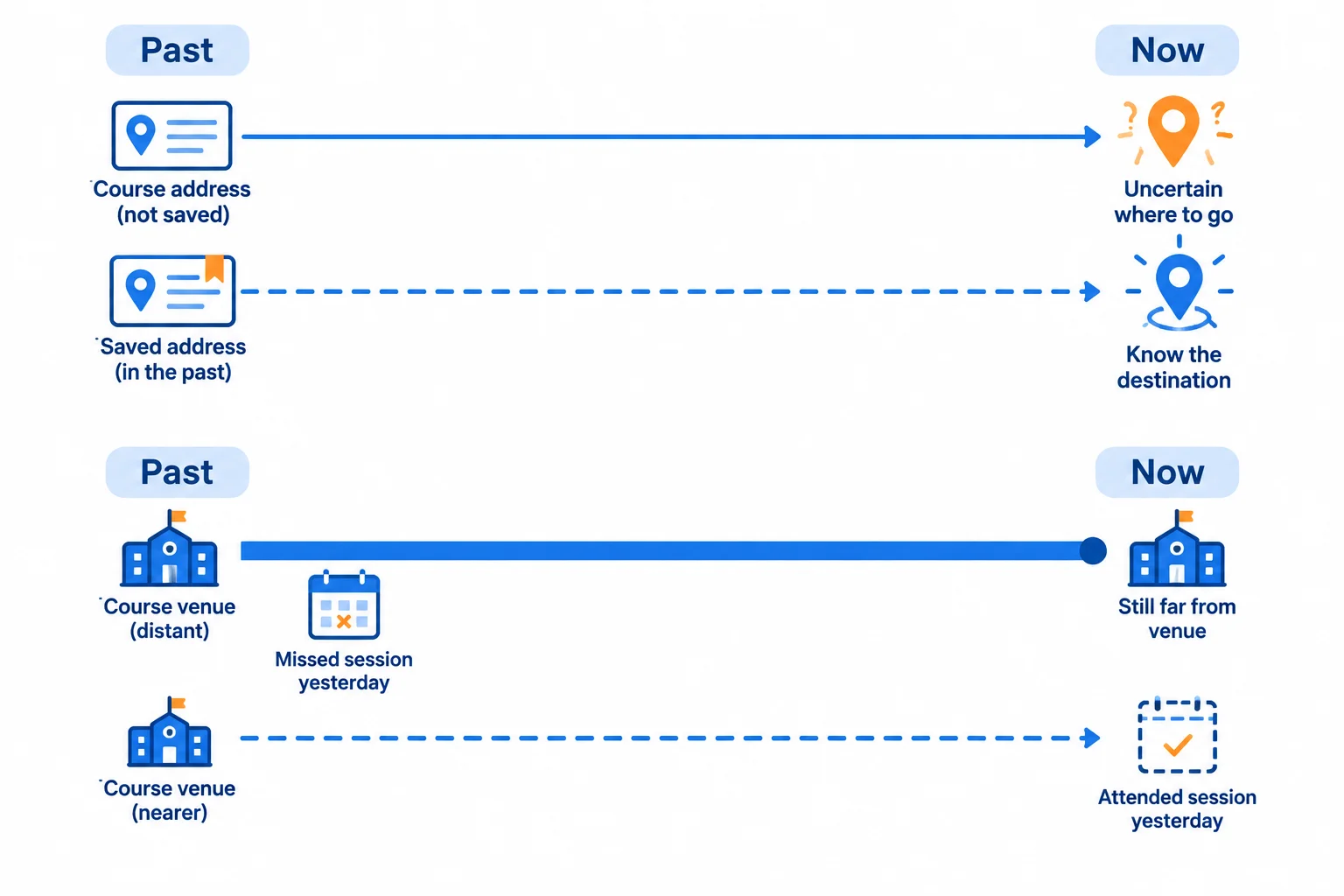
Read from left to right: Past → Now. Solid marks are stated facts; dashed marks are imagined alternatives. A band shows a situation that continues across both times.
Listen in clause-sized units. First hear the condition; then hear the result. The word after would is an important clue:
would know ends in a base form, so the result is now.would have attended includes have and a past participle, so the result was yesterday.Context should agree with the grammar. An earlier decision can have a lasting effect now. A continuing situation can explain a different outcome yesterday.
Listen to both mixed conditionals. Notice the result after would and the time expression at the end.
If Alex had saved the course address last week, he would know where to go now. If Sam lived nearer to the course venue, he would have attended yesterday.
If Alex had saved the course address last week, he would know where to go now. If Sam lived nearer to the course venue, he would have attended yesterday.
Tip
Practice the contrast in two chunks:
If Alex had saved the address **last week** / he would know where to go **now**.
The slash marks a short pause. Stress the time words, not every word. For the other pattern, make the contrast between now and yesterday easy to hear.
Listen and choose an option.
Listen to the spoken conditional. Which time relationship does it express?
If Alex had saved the course address last week, he would know where to go now.
Listen and write what you heard.
Write the complete mixed conditional you hear.

Step 6 of 7
A question can ask how an earlier decision affects life now. Put would before the subject in the result clause:
How would things be different now if ...?
The final if-clause gives the unreal earlier decision with past perfect. The relationship is Past condition → Present result:
There is no comma before a final if-clause in this question.
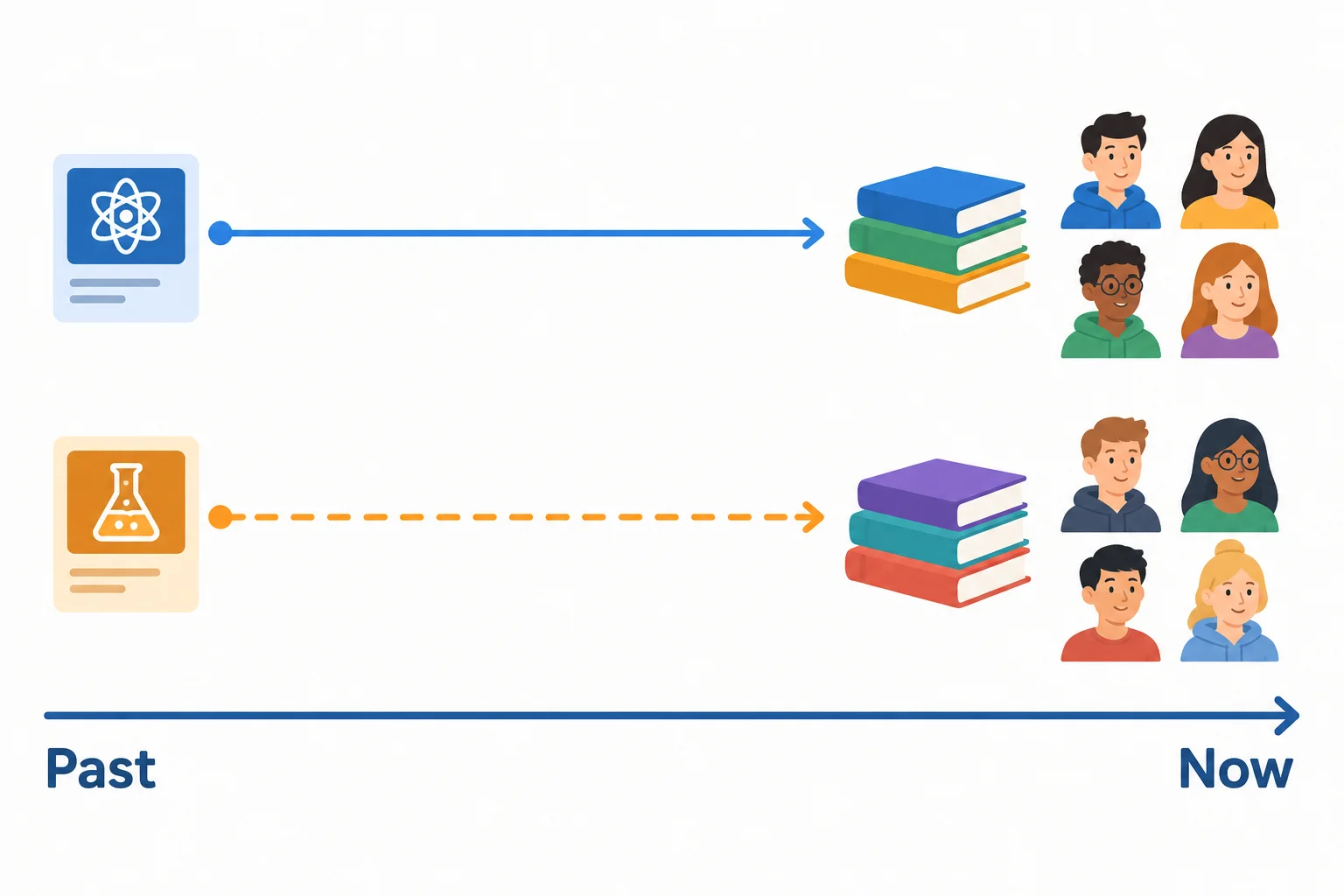
The solid track shows stated facts. The dashed track shows an imagined earlier choice and its possible result now.
Read the exchange. The question asks about the result now; the answer changes the earlier choice last week.
Question: How would things be different now if you had chosen another course last week?
Answer: If I had chosen another course last week, I would know different classmates now.
The answer begins with the past condition and ends with the present result. You can also put the result first: I would know different classmates now if I had chosen another course last week.
Listen to the model answer.
If I had chosen another course last week, I would know different classmates now.
Tip
Pronunciation cue: last week / now
Stress the two time signals. Pause briefly after the opening condition, then make the present consequence clear.
Arrange the blocks to form one question about a current effect.
Your sentence
Available words
Say the completed question aloud. Then answer it aloud with your own short Past condition → Present result sentence about choosing another course last week.
Type two things: your reply and one time word you stressed.
Write at least 35 characters (0/35).
Step 7 of 7
Write, check, revise, and say one short explanation that connects facts across time with a mixed conditional.
A clear mixed-conditional explanation has two tracks:
Choose the direction that fits the account:
if + past perfect, would + base formif + past simple, would have + past participleKeep the stated facts unchanged. Your imagined alternative should explain one possible connection between the two times.
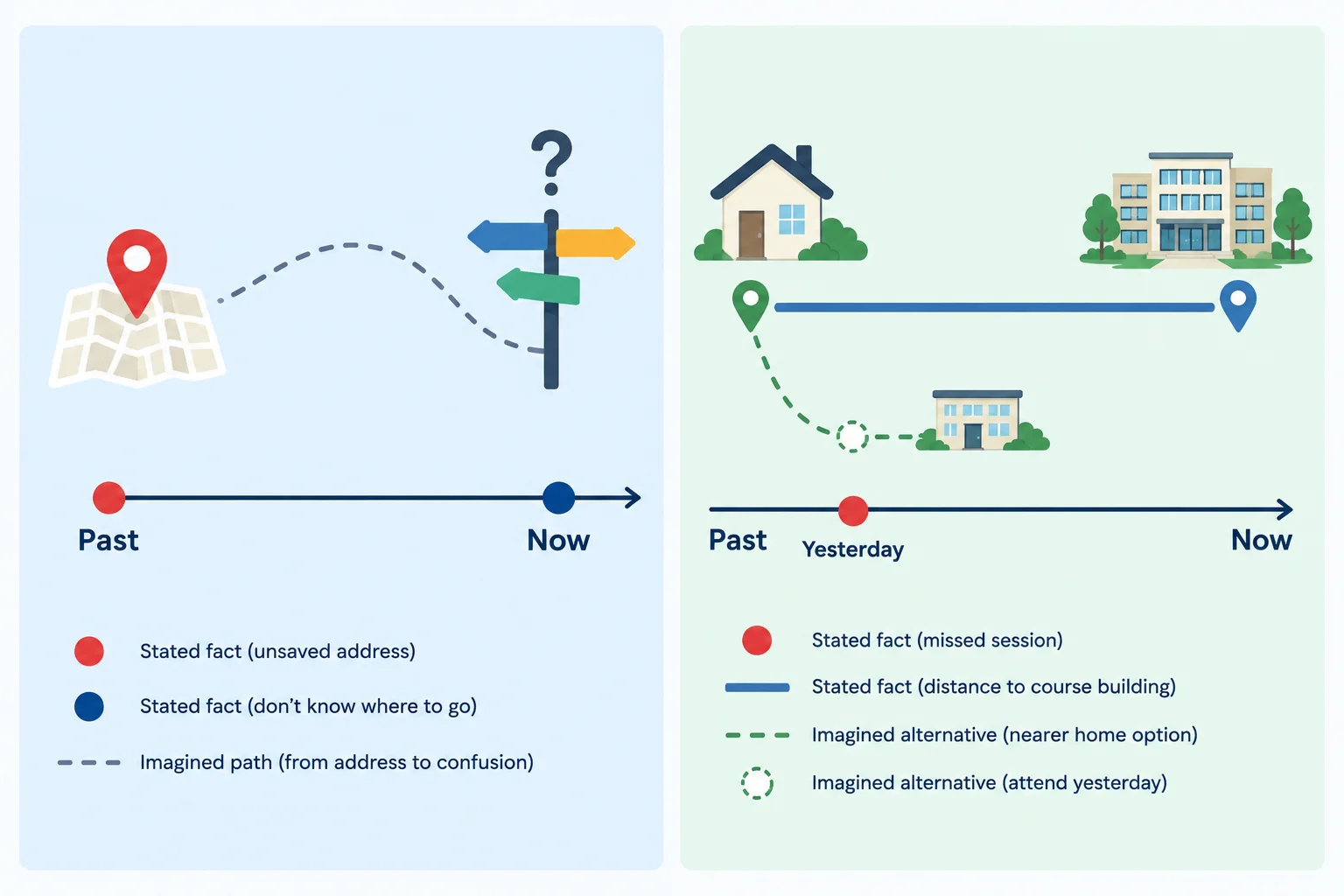
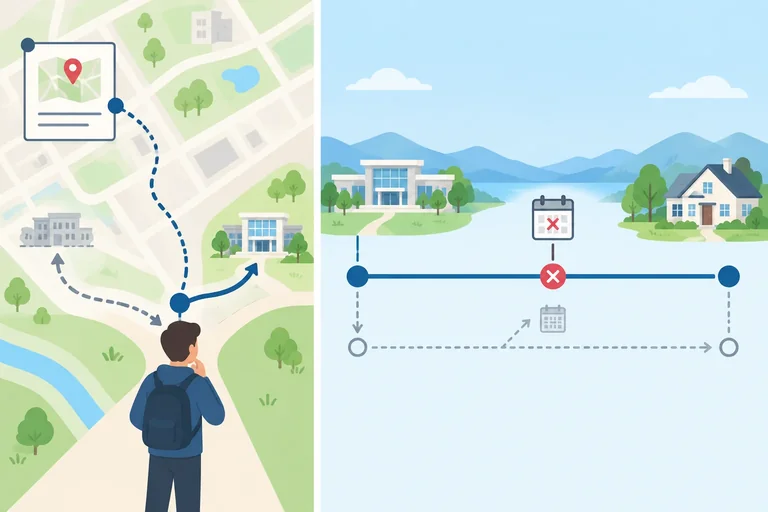
Read solid marks as facts and dashed marks as imagined alternatives. A continuing condition is shown as a band across Past and Now.
Tip
Pronunciation practice: make the time contrast easy to hear. For a past-to-present explanation, stress last week / now. For a continuing-present-to-past explanation, stress now / yesterday. Pause briefly at the slash.
Choose one account for your explanation.
Account A — Alex
Last week, Alex did not save the course address. Now, Alex still does not know where to go.
Account B — Sam
Sam lives far from the course venue now and lived far from it yesterday too. Because of the distance, Sam missed yesterday’s session.
On paper or in your notes, make a first draft of three or four sentences. State the relevant facts in at least two sentences, then add one clearly imagined mixed conditional. Do not present the imagined alternative as a real event.
Use these questions to revise your draft before you submit it.
| Question | What to check |
|---|---|
| Are the facts unchanged? | Keep the original time and situation. |
| What time is the condition? | Earlier choice, or a situation continuing through yesterday and now? |
| What time is the result? | Now, or yesterday? |
| Do the forms fit? | Match the form to the selected time direction. |
| Are time signals clear? | Use last week, now, still, or yesterday when useful. |
| Will it sound clear? | Stress the contrasting time words and pause between clauses. |
Example
Last week, Alex did not save the course address. Now, Alex still does not know where to go. If Alex had saved the address last week, Alex would know where to go now.
Summary
Now revise your draft using the checklist and sample. Then say your revised explanation aloud once. Stress the two contrasting time words and make a short pause between the condition and result.
Choose Account A or Account B from the previous screen. Write a revised explanation of three or four sentences: state the relevant facts and add one imagined mixed conditional connection. Keep the facts unchanged. After writing, say your response aloud with a clear time contrast.
Write at least 120 characters (0/120).
Congratulations! You completed: Connect Past and Present with Mixed Conditionals
Thousands of online courses in video, ebooks and audiobooks.
To test your knowledge during online courses
Generated directly from your cell phone's photo gallery and sent to your email

Download our app via QR Code or the links below:.



Carry knowledge in your pocket.
Download the Cursa app.
There are hundreds of free courses available, with a free certificate of completion that is saved in your mobile image gallery.
Download the app to access the Course Completion Certificate for Free.


+ 10 million
students

Free and Valid
Certificate

60 thousand free
exercises

4.8/5 rating in
app stores

Free courses in
video and ebooks