Step 1 of 9
Finished Time or a Connection to Now?
Choose the present perfect or past simple by deciding whether the speaker means a finished time or a connection to now.

Learning path · Level 5 · Tutorial 2
Choose the present perfect or past simple to make time clear. Explain what happened at a finished time and what continues now. Read and hear short accounts, then give a spoken and written update about your life, work, or study.
 Finished Time or a Connection to Now?
Choose the present perfect or past simple by deciding whether the speaker means a finished time or a connection to now. 2 min
 Move from Experience to Details
Move naturally from a present perfect experience question to past simple details about one finished occasion. 2 min
 Talk About Time That Is Still Open
Distinguish a summary up to now from a specific completed event within the same day or week. 3 min
 Show What Continues with For and Since
Use the present perfect with for and since to describe situations continuing now. 3 min
 Is the Situation Still True?
Use context to distinguish a duration continuing now from a finished period in the past, even when both sentences use for. 3 min
 Ask How Long
Ask How long questions about situations continuing now, then answer with for or since. 2 min
 Recognize British and American Usage
Compare common British English and American English choices for recent-result updates, while keeping finished-time rules clear. 2 min
 Hear and Say the Time Relationship
Listen for whether a situation continues now or belongs to a finished time, write a short update, and practise emphasizing key time information. 2 min
 Give a Clear Update
Bring together experience, finished details, progress up to now, and situations continuing now in one concise spoken and written update. 4 min
Step 1 of 9
Choose the present perfect or past simple by deciding whether the speaker means a finished time or a connection to now.
You already know both forms. Now use time meaning to choose between them.
Use the past simple when the speaker puts an event at a finished time:
Use the present perfect when an experience or result connects to NOW, without saying when the event happened:
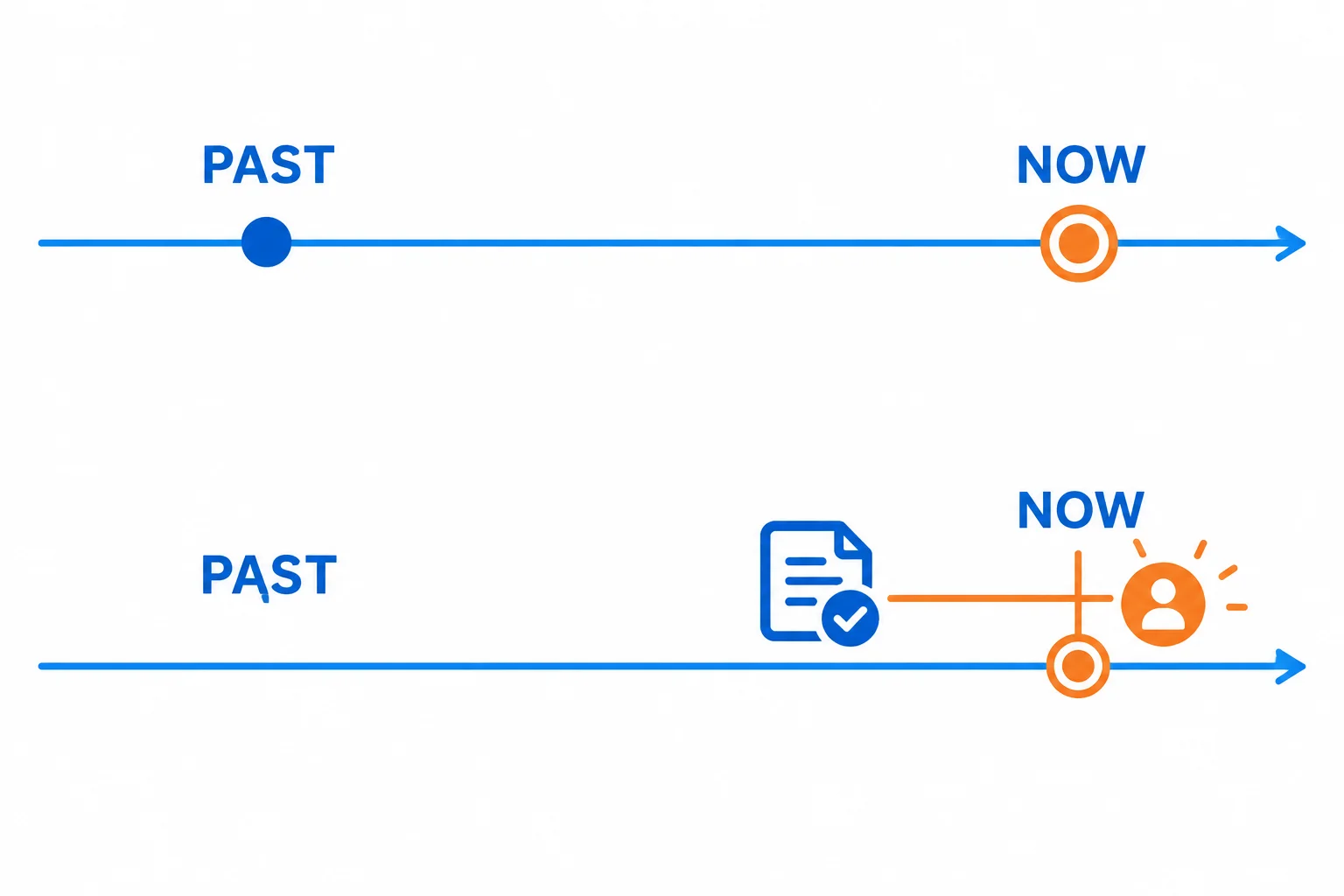
A finished-time event stays in the past. A present perfect statement links a past action, experience, or result to NOW.
Example
Finished time
Maya visited Lakeside last year.
The visit is placed at a completed point in the past.
Connection to now
Maya has visited Lakeside.
This tells us about Maya’s experience before now. The exact time is not the point.
Do not choose only because a sentence has no time expression.
Look at the surrounding context. A previous sentence can establish a finished time. Then the next sentence can continue that same past situation with the past simple, even without repeating the time phrase.
Example
Maya visited Lakeside last year. She took a boat tour there.
The second sentence does not say last year, but it describes another event from that finished trip.
Compare this:
Maya has visited Lakeside. It is an experience in her life before now.
Ask yourself: Is the speaker locating one finished occasion, or connecting an experience or result to now?
Tip
A time word is a useful clue, but the speaker’s meaning decides the tense. A finished past story uses the past simple; an experience or result important now can use the present perfect.
Maya is looking for her keys now because they are not with her. Choose the best update.
Complete the blank with one past simple verb.
Maya visited Lakeside last year. She ___ a boat tour there.
Write at least 1 characters (0/1).

Step 2 of 9
Move naturally from a present perfect experience question to past simple details about one finished occasion.
An experience question asks about life before now, without choosing one occasion. A detail question then focuses on one particular visit at a finished time.
Start with the present perfect experience question. After the answer, use the past simple to ask for the detail.

The conversation moves from “Has this happened before now?” to “When did that particular visit happen?”.
Example
Sam: Have you ever visited Lakeside?
Maya: Yes, I have.
Sam: When did you go?
Maya: I went last year.
The first question is about Maya’s experience before now. “When did you go?” selects one visit, so the follow-up question and answer use the past simple.
Listen for the change from an experience question to a question about one finished occasion.
Sam: Have you ever visited Lakeside? Maya: Yes, I have. Sam: When did you go? Maya: I went last year.
Sam: Have you ever visited Lakeside?
Maya: Yes, I have.
Sam: When did you go?
Maya: I went last year.
Use this flow:
The absence of an exact time in the first question is not the only reason for the present perfect. Its purpose is to ask about experience. The follow-up purpose is different: it asks about one finished occasion.
Tip
In a past simple question, use did + the base verb:
When did you go?
Do not use the past form after did.
Put the four lines in the order of a natural conversation.
After someone says they have visited a city, build the past simple follow-up question about that particular visit.
Your sentence
Available words

Step 3 of 9
Distinguish a summary up to now from a specific completed event within the same day or week.
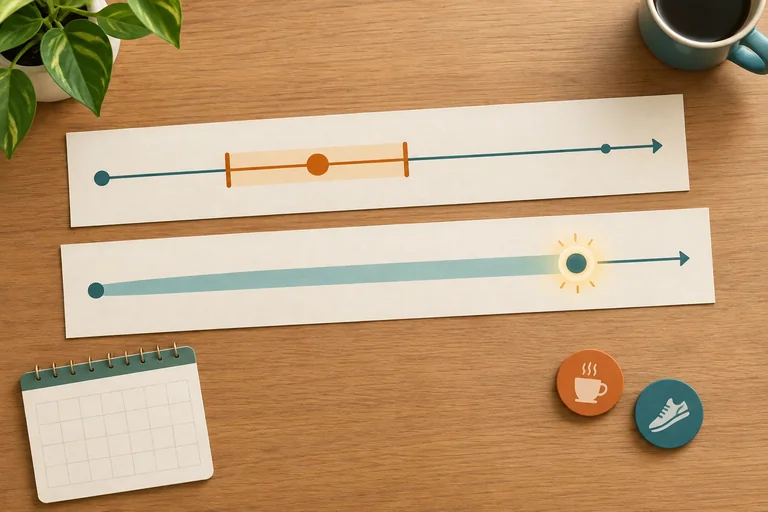
At 3:00 p.m., Maya can see today as a time still open: it began earlier, but it is not over. To give a total up to now, she uses the present perfect: “Maya has finished two tasks today.” This summarizes what is complete before now, without focusing on the exact times.
To identify one completed task, Maya gives a specific finished time and uses the past simple: “She finished the first task at nine.” She finished the second task at one. Both actions happened today, but the speaker’s viewpoint is different.
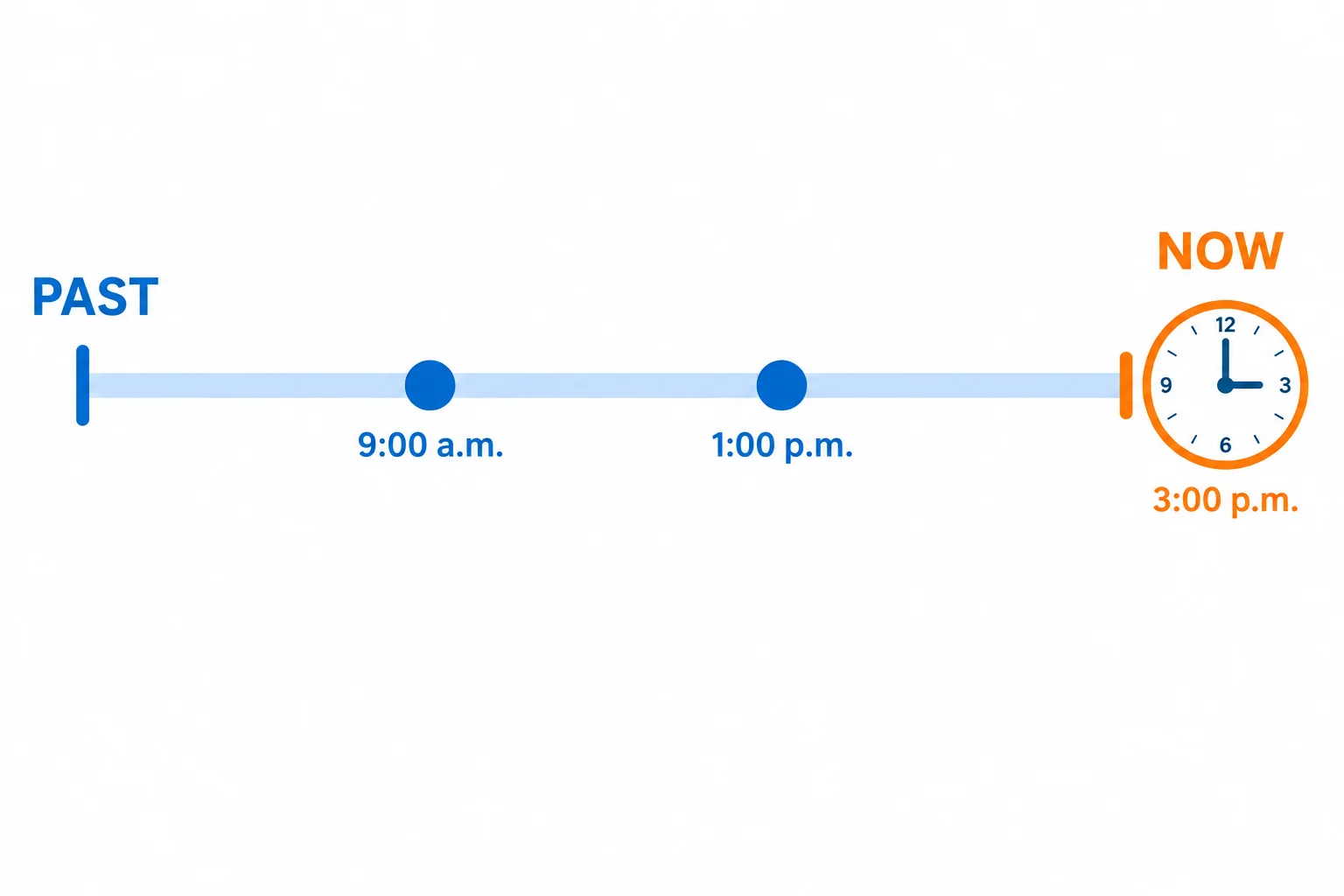
The bar shows today as a time still open at 3:00 p.m. The dots show completed events at 9:00 a.m. and 1:00 p.m.
The word today does not automatically require the present perfect. First, ask what the speaker means:
The same idea applies to this week when the speaker sees the week as still open.
Compare a summary up to now with one completed event inside the same period.
| Viewpoint | Sentence | Reason |
|---|---|---|
| Summary up to now | Maya has finished two tasks today. | Today is still open at 3:00 p.m. |
| Finished detail | She finished the first task at nine. | At nine is a finished time. |
| Summary up to now | Maya has sent three emails this week. | The week is still open. |
| Finished detail | She sent one email on Monday morning. | Monday morning is a finished time. |
Example
Sam: “How is your day going?”
Maya: “I’ve finished two tasks today.”
Sam: “What did you finish at one?”
Maya: “I finished the second task at one.”
Tip
Do not use a time word as an automatic rule. Decide whether you are reporting a total up to now or pointing to a particular completed event.
It is Thursday afternoon. Match each statement to its time meaning.
Tap an item and then its matching pair.
At 3:00 p.m., Maya gives a total for today. Then she gives the exact time of the first task. Choose the best complete update.
Step 4 of 9
Use the present perfect with for and since to describe situations continuing now.
A situation can begin in the past and be continuing now. Use the present perfect to show this connection:
Both situations started before now and are still true now.
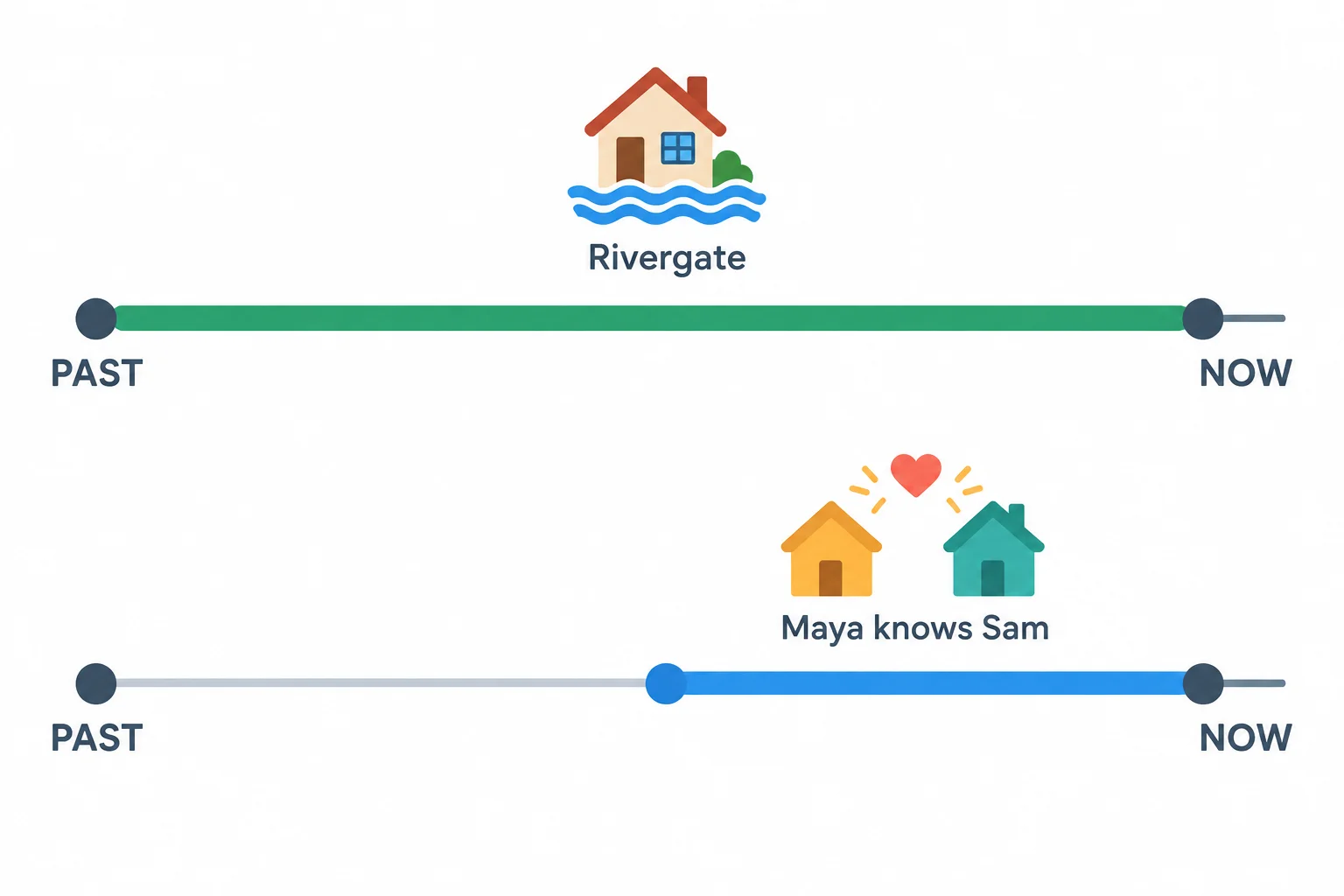
A bar that reaches NOW shows a situation continuing now.
Use for before a length of time. Use since before a starting point.
The pattern is:
subject + have/has + past participle + for/since + time expression
For the verb know, the past participle is know → known.
Both forms describe a situation continuing now.
| Word | Use it with | Example |
|---|---|---|
| for | a length of time | for three weeks |
| for | a length of time | for six months |
| since | a starting point | since Monday |
| since | a starting point | since last year |
Example
Maya says: “I've lived in Rivergate for two years. I've known Sam for a year.”
A learner can also say: “I've studied this course since Monday.” The course began on Monday and is continuing now.
Match each time expression to its meaning.
Tap an item and then its matching pair.
Complete Maya’s continuing update.
Context: Every situation below began before now and remains true now.

Maya has lived in Rivergate  two years.
She has  Sam  a year.
Her course has continued  Monday.
Step 5 of 9
Use context to distinguish a duration continuing now from a finished period in the past, even when both sentences use for.
The words for two years describe a length of time. They do not choose the verb form by themselves.
Ask one question: does the situation reach NOW?
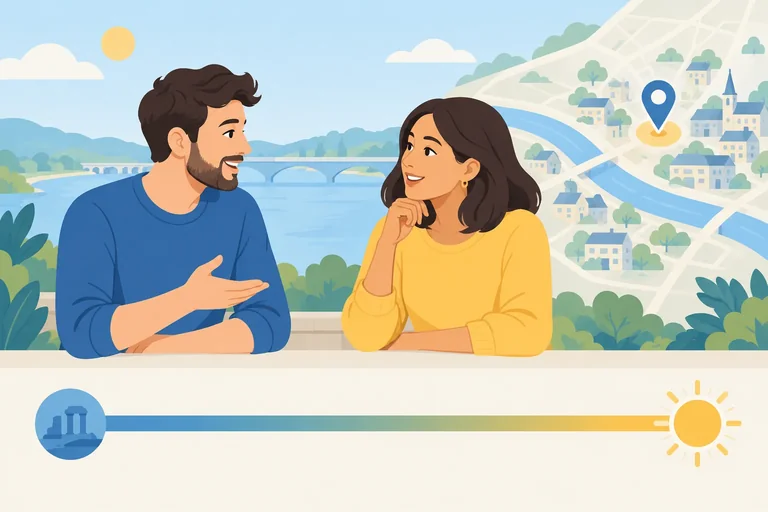
Look at the whole context: here can mean Maya’s current town, while there can mean a former home.
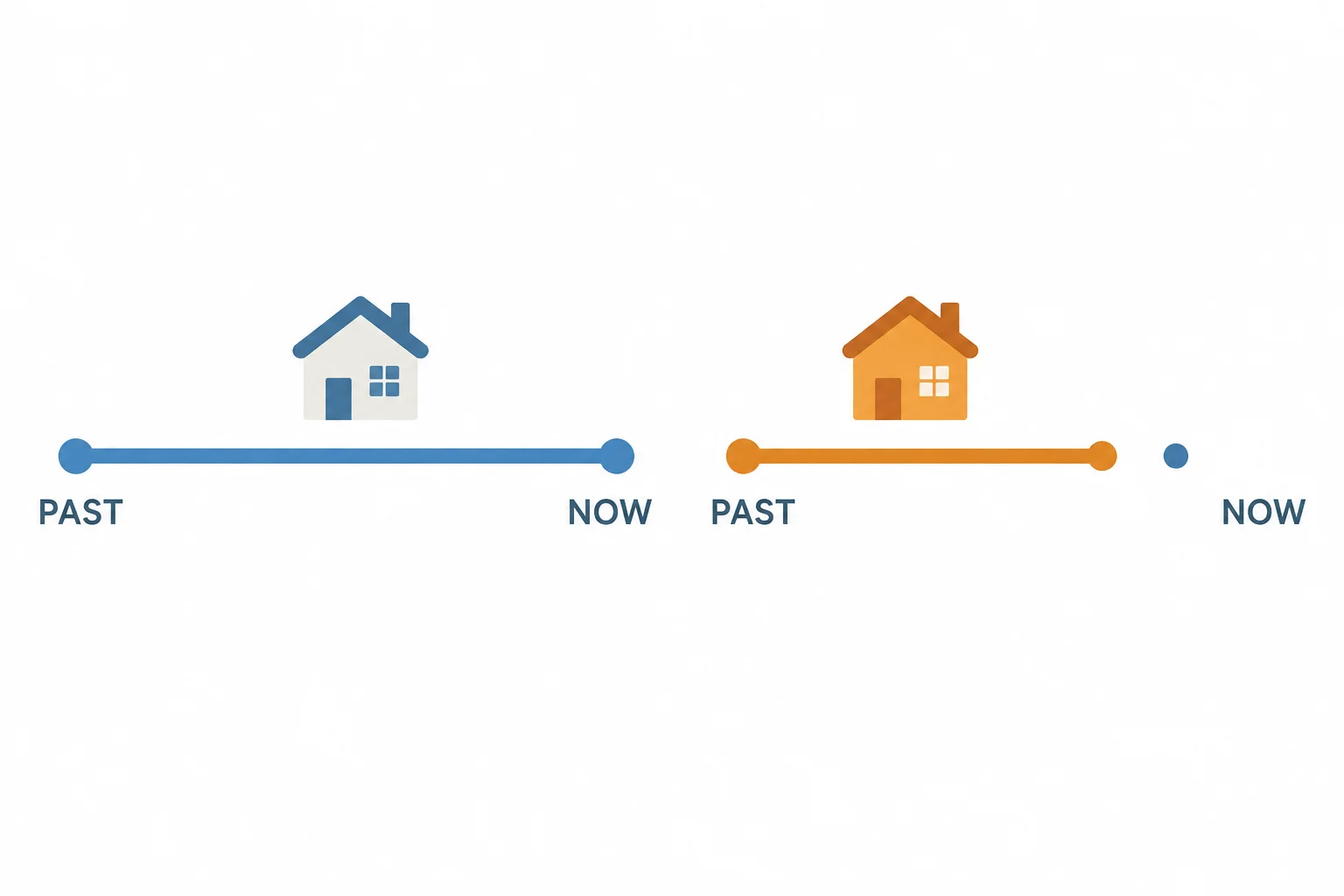
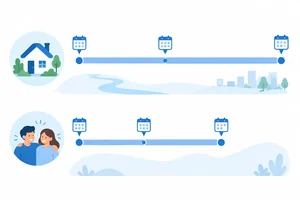
A bar reaching NOW shows a situation continuing now. A bar that ends in PAST shows a finished period.
Example
Maya says: “I've lived in Rivergate for two years. Before I moved here, I lived in Hillford for two years.”
The length is the same, but the time relationship is different. Rivergate is her current town; Hillford was her home before the move.
Use the time expressions and the surrounding sentence together. A finished time or a completed move can show that a duration is fully in the past.
| Sentence | Context clue | Meaning |
|---|---|---|
| I've lived in Rivergate for two years. | Rivergate is Maya’s current town. | The duration reaches NOW. |
| I lived in Hillford for two years. | It was before Maya moved. | The duration ended in PAST. |
Read the account, then match each detail to the timeline feature.
Maya is in Rivergate now. Her move there happened two years ago. Her Hillford home lasted two years before that move.
Match each detail with its timeline feature.
Tap an item and then its matching pair.
Maya is in Rivergate now. Her Hillford home ended before she moved.
Choose the verb forms that keep both time relationships clear.
Complete the update: “Maya _ in Rivergate for two years, but she _ in Hillford for two years before moving.”
Step 6 of 9
Ask How long questions about situations continuing now, then answer with for or since.
Use How long to ask about the duration of a situation that is continuing now.
Build the question like this:
How long + have/has + subject + past participle ...?
Use has with he, she, or Maya. Use have with I, you, we, or they.
This question is about a situation from the past that reaches NOW, not about a finished time.
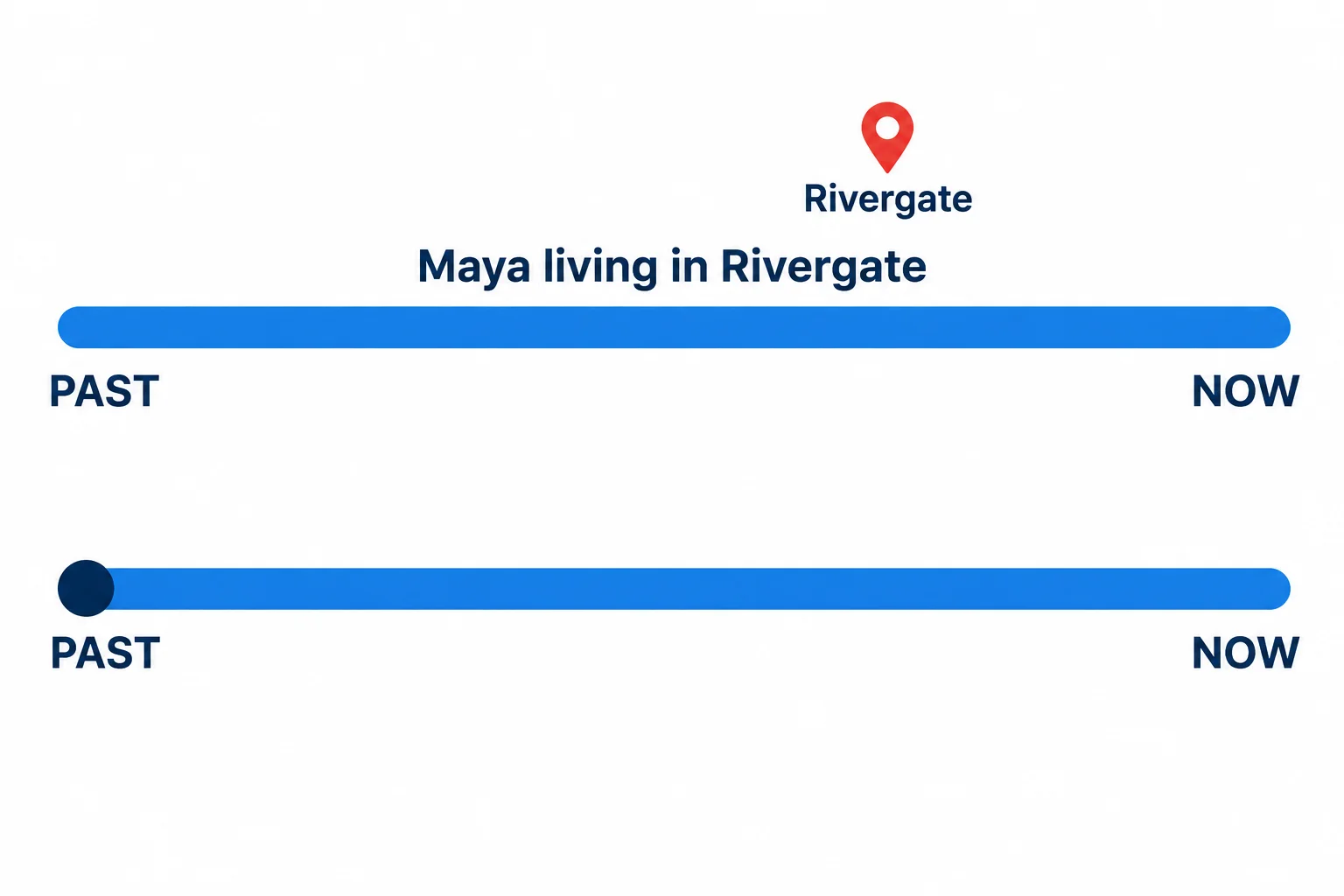
A bar that reaches NOW shows a situation continuing now. Ask about its duration with How long.
Example
How long has Maya lived in Rivergate?
She has lived there for two years.
You can also answer with a starting point:
How long has Maya known Sam?
She has known him since last year.
Arrange the words to make a question about a situation that is continuing now.
Your sentence
Available words
Match each question to its relevant answer.
Tap an item and then its matching pair.
Say and then write a short two-line exchange about a real or invented situation that is continuing now.
Make the subject, auxiliary, and past participle clear.
Write at least 30 characters (0/30).

Step 7 of 9
Compare common British English and American English choices for recent-result updates, while keeping finished-time rules clear.
You already know that just, already, and yet can connect a recent result or an expected action to now. British English and American English often choose different verb forms for the same meaning.
British English more often uses the present perfect. American English often uses the past simple. These are common preferences, not two different meanings.

The result is the same: a task is complete now. The wording can vary by regional preference.
These examples show common choices for the same situation. Speakers may also choose differently in real conversations.
| Situation | British English | American English |
|---|---|---|
| Recent result | I've just finished the report. | I just finished the report. |
| Completed early | Maya has already sent the message. | Maya already sent the message. |
| Expected action | Has Sam replied yet? | Did Sam reply yet? |
Use the variety label as a helpful clue, not as a strict rule. A British English speaker can understand the American English form, and an American English speaker can understand the British English form.
The important point is the time meaning: each pair reports a recent result or asks about an expected action. Just, already, and yet do not force only one tense in every variety.
Example
British English
Maya: “I've just finished my task.”
American English
Maya: “I just finished my task.”
Both updates mean that Maya’s task is complete now, and she completed it very recently.
Warning
A regional preference for recent results does not change the rule for a stated finished time. In both British English and American English, say: “Maya finished the task yesterday.”
Do not use the present perfect with yesterday here, because yesterday is a finished time.
Match each British English update with the American English update that has the equivalent meaning.
Tap an item and then its matching pair.

Step 8 of 9
Listen for whether a situation continues now or belongs to a finished time, write a short update, and practise emphasizing key time information.
When you listen, use both the verb form and the time context.
Do not depend only on one sound. Listen for the time information too: a duration reaching now, or a past period that ended.
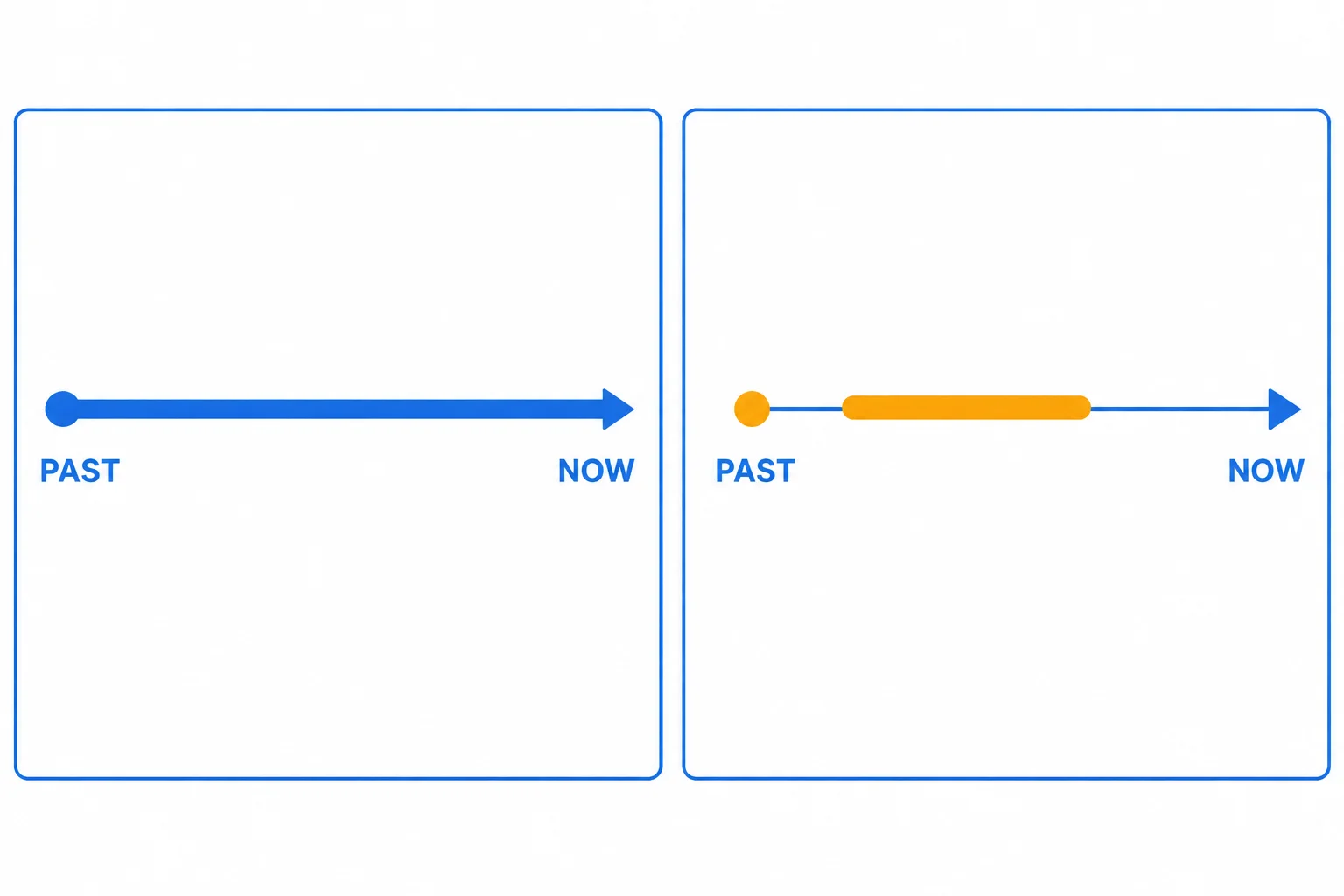
A bar that reaches NOW shows a situation continuing now. A completed period stays in the PAST.
Listen to Maya describe her current town and her former town.
I've lived in Rivergate for two years. I lived in Hillford for two years before I moved.
I've lived in Rivergate for two years. I lived in Hillford for two years before I moved.
Listen and choose an option.
What does the update mean?
I've known Sam for a year.
Listen and write what you heard.
Listen and type the short update exactly as you hear it.
Say the models aloud after the audio.
Keep for and since light. Give clear emphasis to the time information that tells your listener how long or from when:
Repeat each update twice. On the second try, make the bold time information especially clear.
I've lived in Rivergate for two years. I've worked here since Monday.
Tip
Clear emphasis helps a listener hear the time relationship quickly. You do not need to stress every word.

Step 9 of 9
Bring together experience, finished details, progress up to now, and situations continuing now in one concise spoken and written update.
A clear update can include different time relationships without becoming a long story. At 3:00 p.m. today, Maya can connect an experience, a particular finished event, a summary up to now, and a situation continuing now.
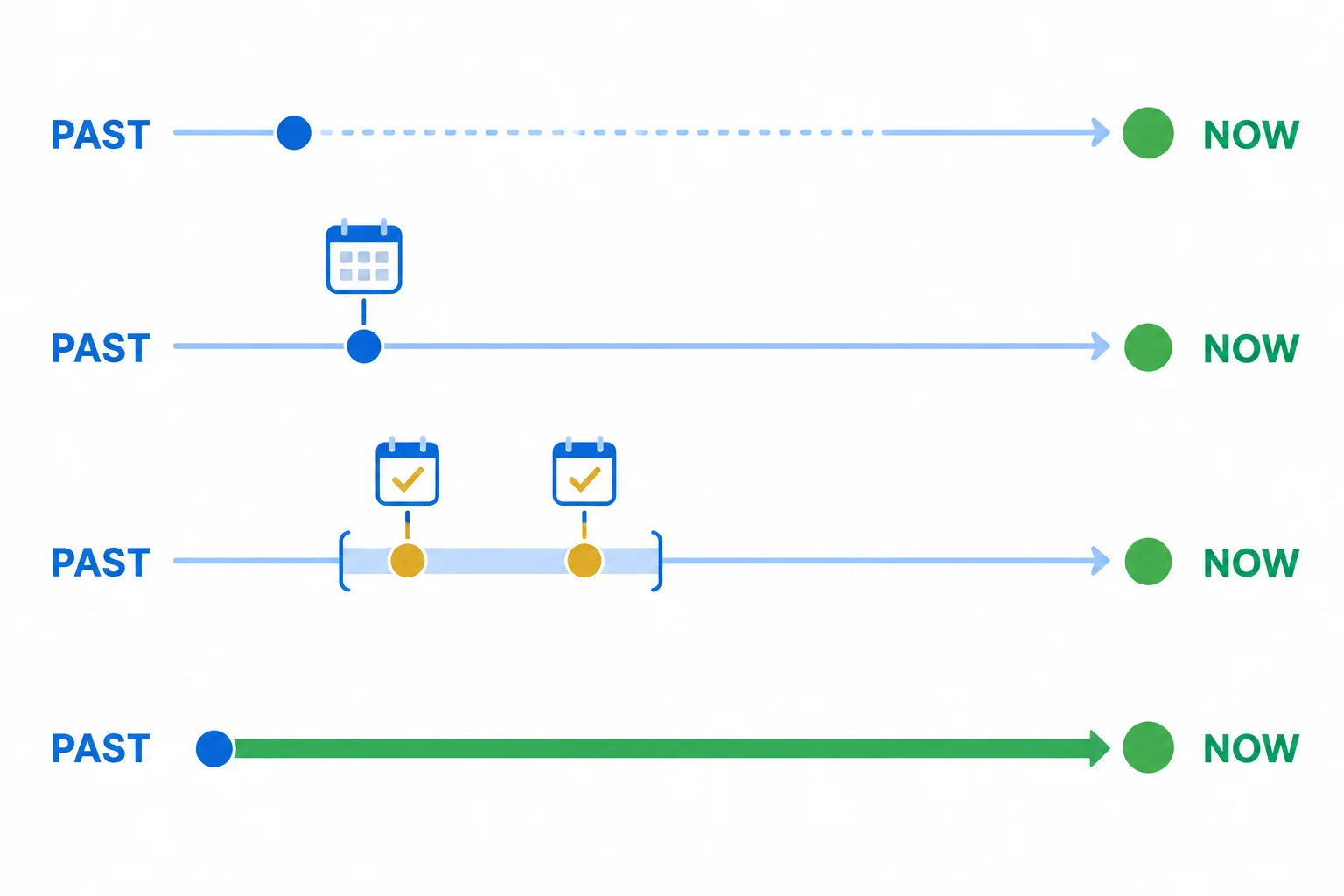
A dot shows a completed event; a bar shows a duration. The relationship to NOW helps you choose the verb form.
Example
Maya’s update at 3:00 p.m. today:
“I've visited Lakeside. I went there last year. I've finished two tasks today. I finished the first at nine and the second at one. I've lived in Rivergate for two years.”
Read Maya’s message. Then listen to her related spoken update. Notice how she moves from a general point to a particular detail.
Listen for the time relationships in Maya’s update.
Hi Sam. I've visited Lakeside, but I went there last year. I've finished two tasks today. I finished the first at nine and the second at one. I've lived in Rivergate for two years.
Match each sentence to its time relationship.
Tap an item and then its matching pair.
Tip
Before you speak or write, check the meaning you want. Time words help, but they do not choose the verb form by themselves.
Use this short check as you plan your update.
| What do you mean? | Ask yourself | Use |
|---|---|---|
| Experience | Am I not naming one finished occasion? | present perfect |
| Finished detail | Am I naming one completed occasion at a finished time? | past simple |
| Progress up to now | Am I giving a total in a time still open? | present perfect |
| Continuing situation | Is it still true now? | present perfect + for or since |
| Partner question | Am I asking about a duration continuing now? | How long + have/has + subject + past participle ...? |
Summary
Use Maya’s message and audio you have just read and heard. First, say aloud one finished event and one situation continuing now that you noticed.
Next, create a real or invented update. Say it aloud, then type your final version:
Use five sentences in total. Compare your work with the model and checklist, then revise at least one sentence if its time relationship is not clear. Type the revised final version.
Write at least 120 characters (0/120).
Congratulations! You completed: Choose the Present Perfect or Past Simple
Thousands of online courses in video, ebooks and audiobooks.
To test your knowledge during online courses
Generated directly from your cell phone's photo gallery and sent to your email

Download our app via QR Code or the links below:.



Carry knowledge in your pocket.
Download the Cursa app.
There are hundreds of free courses available, with a free certificate of completion that is saved in your mobile image gallery.
Download the app to access the Course Completion Certificate for Free.


+ 10 million
students

Free and Valid
Certificate

60 thousand free
exercises

4.8/5 rating in
app stores

Free courses in
video and ebooks