
Step 1 of 8
Separate Three Layers of Meaning
Separate explicit wording, assumed background, and cautious inference in a short exchange.

Learning path · Level 12 · Tutorial 2
Interpret indirect remarks, irony, and cultural allusions without treating a plausible inference as a fact. Read short exchanges and background notes, listen to alternative deliveries, choose the best-supported interpretation, and transcribe a brief exchange. Write an evidence-based interpretation with an alternative reading, then rehearse a response that checks the speaker's intent.

 Separate Three Layers of Meaning
Separate explicit wording, assumed background, and cautious inference in a short exchange. 2 min
 Follow the Implication
Infer indirect meaning from relevance and informativeness, then distinguish a cancellable implication from a contradiction. 3 min
 Examine the Background Assumption
Identify the background assumptions associated with again and stop + -ing, while keeping those assumptions separate from verified facts. 3 min
 Recognize Irony Without Assuming Hostility
Use circumstances to recognize possible verbal irony, while distinguishing shared frustration from unsupported claims of sarcastic criticism. 3 min
 Hear How Delivery Changes the Reading
Compare two deliveries of identical wording, identify audible cues without treating them as proof of intent, and keep transcription separate from interpretation. 3 min
 Use Background Knowledge to Decode an Allusion
Use a supplied cultural background note and the surrounding exchange to interpret Achilles' heel as a possible vulnerable point in a strong plan. 3 min
 Check Intent Without Accusing
Turn an uncertain implication into a focused, non-accusatory clarification that the other speaker can correct. 2 min
 Make and Check an Evidence-Based Interpretation
Integrate contextual, cultural, and delivery evidence into a cautious interpretation, then rehearse an intent check that protects the next practical action. 4 min
Step 1 of 8
Separate explicit wording, assumed background, and cautious inference in a short exchange.
A listener can understand more than a speaker explicitly says. Keep three layers separate:
The last two are not confirmed facts merely because a speaker has spoken. Describe them cautiously: “This may imply …” or “Alex appears to treat … as shared.”
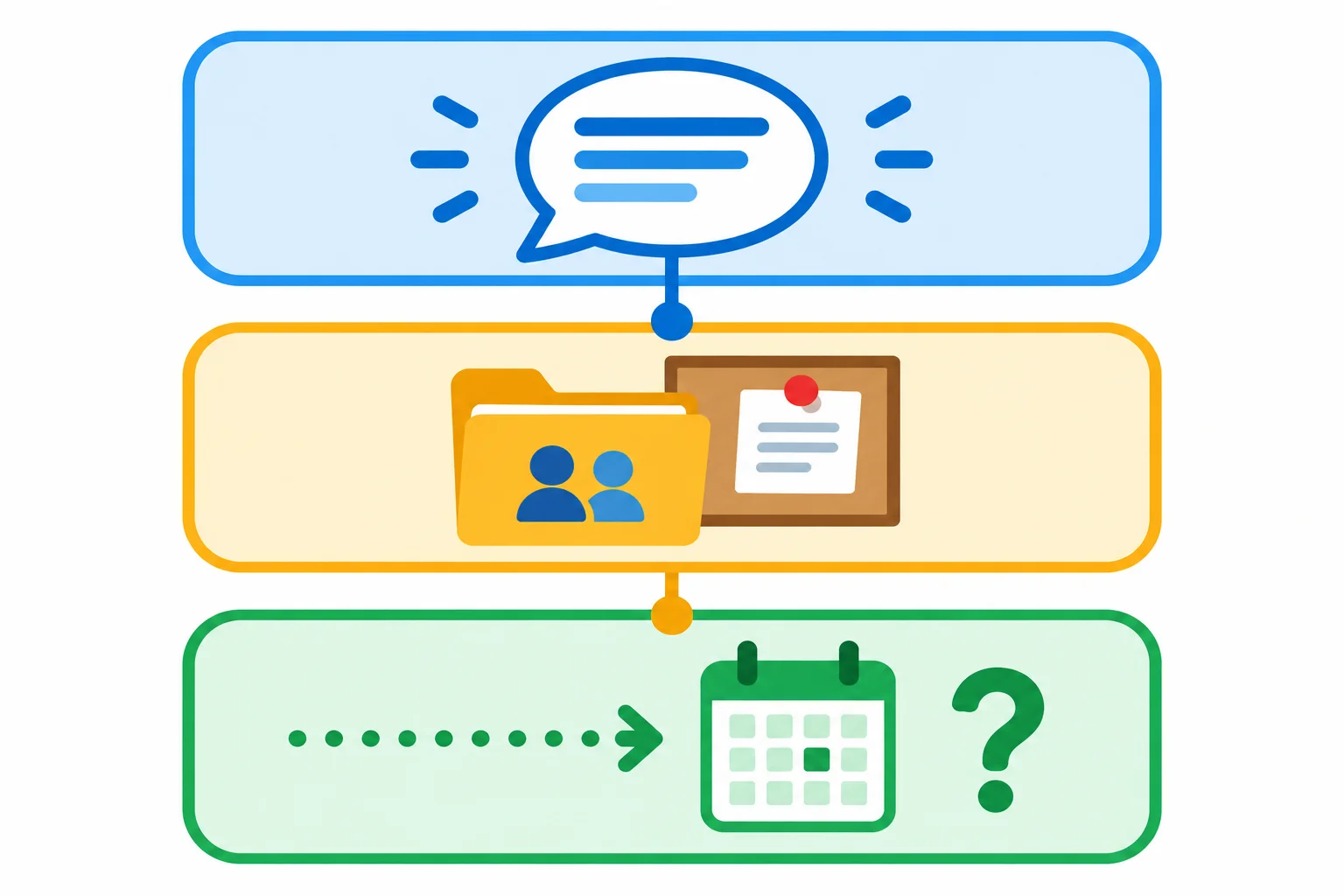
Read from the words outward: what is stated, what is treated as shared, and what may be inferred.
Example
Context: Maya and Alex are planning a community exhibition at Riverbank Arts Center. Bookings open on Friday.
Maya: Should we announce bookings on Friday?
Alex: The poster is not ready.
Alex explicitly states only that the poster is not ready. The rest requires careful interpretation.
A useful analysis keeps evidence and interpretation apart.
A Contextual cue is evidence in the exchange: Maya asks about an announcement on Friday, and Alex mentions the poster.
An Alternative reading is a different interpretation that still fits the available evidence. Here, Alex may be signaling a practical obstacle. Alternatively, Alex may simply be giving a status update, without opposing a Friday announcement.
Do not turn either reading into a claim about Alex’s intention.
One possible three-layer analysis
| Analysis label | Careful interpretation |
|---|---|
| Literal statement | The poster is not ready. |
| Background assumption | A poster exists or is expected for the announcement. |
| Likely implication | Announcing on Friday may be difficult or may need preparation first. |
Context: Riverbank Arts Center plans to use Room B, which has 40 places.
Maya: We have 45 artist applications.
Alex: Room B has 40 places.
Match each interpretation to its meaning layer.
Tap an item and then its matching pair.

Step 2 of 8
Infer indirect meaning from relevance and informativeness, then distinguish a cancellable implication from a contradiction.
An indirect reply can create a conversational implicature: a likely meaning inferred from how the reply relates to the immediate exchange. It is not additional literal content and not proof of the speaker’s intention.
Build an evidence chain:
A Contextual cue is observable evidence in the exchange. It supports an interpretation; it does not turn that interpretation into a fact.
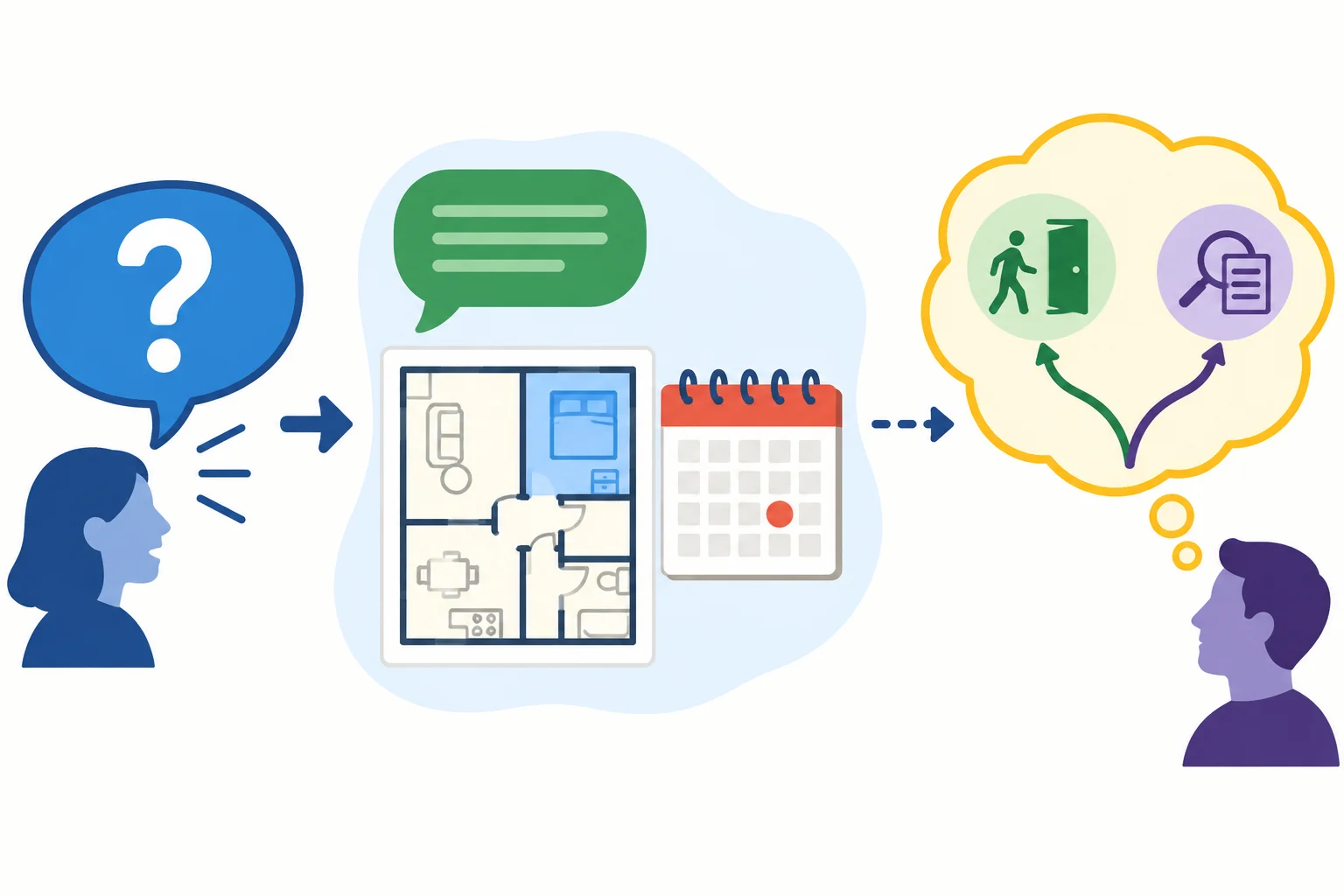
Start with the exchange, then use its relevance to form a tentative interpretation.
Tip
Phrase an inference as “may be suggesting” or “may be concerned about,” rather than claiming to know what the speaker means. A different context can support an Alternative reading.
Example
Context: Riverbank Arts Center is planning a community exhibition. Room B has 40 places, and bookings open on Friday.
Maya: Should I send the booking notice now?
Alex: We still have to confirm the 40 places.
Literal statement: Alex says that confirmation of the 40 places remains to be done.
Contextual cue: Maya has asked whether to send the notice now, and Alex mentions an unresolved detail that the notice would state.
Likely implication: Alex may be signaling that sending the notice should wait until the number is confirmed. This is a conversational implicature, not an explicit instruction to wait.
A likely implication is often cancellable. The speaker can reject the inferred message while leaving the Literal statement consistent. That differs from a continuation that denies the statement itself.
| Continuation | Effect | Why |
|---|---|---|
| Alex: We still have to confirm the 40 places, but send the notice now; we can update it if needed. | Cancels the waiting inference | The confirmation is still unfinished. |
| Alex: We still have to confirm the 40 places. Actually, they were confirmed yesterday. | Contradicts the statement | It denies that confirmation remains to be done. |
Informativeness also matters. A detail a speaker chooses to mention can make one concern relevant. But omission alone is not proof: if Alex mentions that the poster draft is ready but does not say “yes,” that does not by itself prove support for or reluctance about sending the notice. Use the whole exchange.
Context: Maya is preparing the Friday booking announcement for Room B.
Maya: Can we tell groups that Room B has 40 places?
Alex: The seating plan still needs approval.
What is the best-supported Likely implication?
Context: At Riverbank Arts Center, Maya is preparing the Friday booking notice for the community exhibition in Room B, which currently has 40 places.
Maya: Shall I publish the Friday booking notice saying Room B has 40 places?
Alex: The fire-safety review is scheduled for this afternoon.
Write three brief parts:
Write at least 120 characters (0/120).

Step 3 of 8
Identify the background assumptions associated with again and stop + -ing, while keeping those assumptions separate from verified facts.
A presupposition is a background assumption associated with a linguistic expression. It is different from a Literal statement: the literal statement is what the speaker affirms, denies, or asks.
The trigger again commonly presents a similar earlier event as already established. It does not make that earlier event a confirmed fact.
At Riverbank Arts Center, consider three forms about Room B:
Maya: "Bookings will open on Friday again."
Maya: "Bookings will not open on Friday again."
Maya: "Will bookings open on Friday again?"
The Literal statement changes from affirmation to denial to question. The Background assumption may remain: bookings opened on Friday on a comparable earlier occasion.

Changing a statement into a negative or a question can change its Literal statement while leaving a Background assumption available.
Compare the part that changes with the background that may persist.
| Form | Literal statement | Background assumption |
|---|---|---|
| Affirmative | A future Friday opening is stated | A comparable Friday opening happened earlier |
| Negative | A future Friday opening is denied | A comparable Friday opening happened earlier |
| Question | Information about a future Friday opening is requested | A comparable Friday opening happened earlier |
The trigger stop + -ing commonly presents an activity as having occurred previously.
Alex: "I stopped emailing artists after 6 p.m."
Literal statement: Alex says that the activity ceased.
Background assumption: Alex had previously emailed artists after 6 p.m.
The same background can remain in "I did not stop emailing artists after 6 p.m." and "Did I stop emailing artists after 6 p.m.?" The main claim changes; the presupposition often remains.
Unlike a conversational implicature, this background is cued by the expression itself. Still, it is not evidence independent of the speaker's wording.
The activity is treated as prior background in each form.
| Form | Literal statement | Background assumption |
|---|---|---|
| Affirmative | Alex says the emailing ceased | Alex had emailed artists after 6 p.m. |
| Negative | Alex denies that the emailing ceased | Alex had emailed artists after 6 p.m. |
| Question | The speaker asks whether the emailing ceased | Alex had emailed artists after 6 p.m. |
Example
Context: Maya has no reliable record of Alex emailing artists after 6 p.m.
Maya: "Did you stop emailing artists after 6 p.m.?"
Alex: "I never did that. I sent messages before 6."
Maya's question carries a Background assumption that Alex had done that activity. Alex directly corrects it. The question therefore does not prove that the activity occurred.
An Alternative reading is possible when context makes the assumed background unclear or when a speaker immediately revises it. Treat a presupposition as part of how the wording frames the exchange, not as a verified historical record.
Read both sets.
Set A
Maya: "Bookings will open on Friday again."
Maya: "Bookings will not open on Friday again."
Maya: "Will bookings open on Friday again?"
Set B
Alex: "I stopped emailing artists after 6 p.m."
Alex: "I did not stop emailing artists after 6 p.m."
Alex: "Did I stop emailing artists after 6 p.m.?"
Which analysis is best supported?

Step 4 of 8
Use circumstances to recognize possible verbal irony, while distinguishing shared frustration from unsupported claims of sarcastic criticism.
Verbal irony may arise when an apparent evaluation clashes with the circumstances or with the speaker’s likely stance. The words alone do not prove irony.
Context: Bookings open on Friday for a community exhibition with 40 places in Room B. The booking page repeatedly fails and accepts far too many requests.
Maya: "That’s a wonderfully orderly opening."
Literal statement: Maya calls the opening orderly.
Contextual cue: The booking process is visibly disorderly.
Likely implication: Maya may be drawing attention to the disorder or expressing frustration.
Alternative reading: Without more context, she could be exaggerating playfully rather than criticizing anyone.
Keep the layers separate: the clash is evidence for an interpretation, not proof of Maya’s private intention.
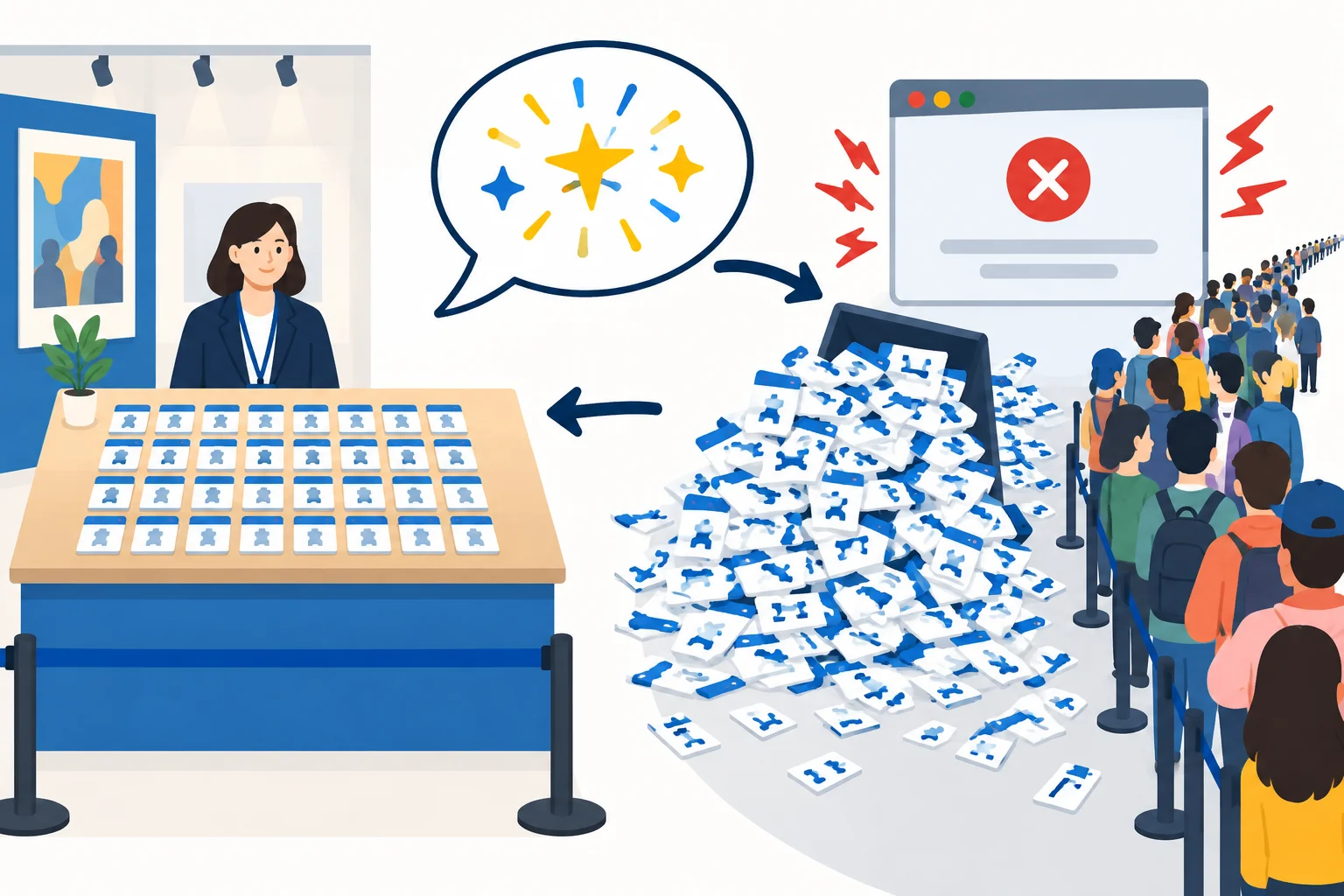
The contrast between an apparently positive remark and visible disorder is a contextual cue for possible verbal irony.
A positive word is not automatically ironic, and an ironic remark is not automatically hostile. Look at what the remark is responding to and who, if anyone, seems to be its target.
Sarcastic criticism is one possible use of irony: the speaker may use an apparently positive remark to imply criticism of a person, decision, or system. But irony can also communicate shared amusement or frustration about a problem that both speakers face.
An ironic interpretation is not always the exact word-for-word opposite. "A beautifully controlled launch" may suggest frustration with a failed process; it does not establish every stronger claim about the speaker’s attitude.
Example
Context: On Friday, 52 people receive booking confirmations for the 40 places in Room B.
Maya: "A beautifully controlled launch."
Literal statement: Maya describes the launch as controlled.
Contextual cue: More confirmations were issued than places available.
Likely implication: Maya may be highlighting a failure in the booking process.
Alternative reading: If Maya and Alex are laughing while fixing the issue together, the remark may express shared frustration rather than an attack on Alex.
The exchange supports possible implied criticism of the process. It does not contain explicit criticism such as "Alex, you handled this badly."
Compare the circumstances before deciding how far an interpretation can go.
| Remark | Contextual cue | Careful interpretation |
|---|---|---|
| "What a smooth opening." | The booking page has sent duplicate confirmations. | Possible frustration about the process; irony is plausible. |
| "A brilliant rescue." | Alex finds enough chairs after a last-minute change. | Sincere praise remains plausible; there is no clear mismatch. |
| "Perfect timing." | Alex arrives after the booking problem has delayed everyone. | It may be sarcastic criticism of Alex, or shared comic frustration; more evidence is needed. |
Context: On Friday, the booking page confirms 65 places for Room B, which has only 40 places. Maya says, "A brilliantly managed system." Alex has been trying to correct the page.
Which interpretation is best supported?
Context: Bookings open on Friday. In the first ten minutes, the site confirms 55 people for the 40 places in Room B. Alex says, "I warned the team that the limit was not working." Maya replies, "Well, that worked perfectly."
Choose the better-supported interpretation: (1) Maya is likely commenting on the failed booking process, or (2) Maya is definitely making sarcastic personal criticism of Alex.
Then write three short parts:
Write at least 180 characters (0/180).

Step 5 of 8
Compare two deliveries of identical wording, identify audible cues without treating them as proof of intent, and keep transcription separate from interpretation.
Context: At Riverbank Arts Center, Maya and Alex are preparing the community exhibition in Room B, which has 40 places. Bookings open on Friday. During testing, the booking page froze twice.
Maya: The booking page froze twice during testing.
Alex: That is a reliable system.
The words in Alex's reply stay the same in both recordings. Listen for what changes in the delivery before deciding what stance Alex may be taking.

The wording can remain identical while prominence, pauses, and pitch movement change what a listener notices.
Listen to the first delivery.
That is a reliable system.
Alex: That is a reliable system.
Now listen to the same wording again.
That is a reliable system.
Alex: That is a reliable system.
Keep the levels separate. A pause, pitch movement, or prominence is an audible Contextual cue. Calling a delivery ironic is an interpretation of that cue together with the situation.
The Literal statement in both recordings is that the system is reliable. In this context, neither recording is an explicit criticism. A listener may infer implied criticism, but that remains a Likely implication, not a confirmed fact.
The annotations below represent audible features; they do not reveal Alex's private intention.
| Delivery | Annotated listening extract | Cautious analysis |
|---|---|---|
| Delivery A | Alex: | That is a **reliable** system. | Contextual cue: a pause and marked prominence on “reliable.” Likely implication: Alex may be pointing out a mismatch between the claim and the freezes. |
| Delivery B | Alex: That is a reliable system. | Contextual cue: unexpectedly flat pitch and even prominence. Alternative reading: Alex may sound resigned or dry; the delivery alone does not prove sarcasm. |
Tip
Start with an observation: “Delivery A gives extra prominence to ‘reliable.’” Then qualify the inference: “This may make ironic criticism more plausible in the supplied context.” Do not turn a vocal cue into a fact about motive.
Listen and choose an option.
Context: Maya and Alex expect strong interest in the Riverbank Arts Center exhibition. Room B has 40 places, and bookings open on Friday.
Choose the best-supported description of Alex's delivery.
Forty places should be enough.
Listen and write what you heard.
Maya speaks first and Alex speaks second. Transcribe the two sentences exactly. You may include speaker labels.
Return to Delivery A and Delivery B from the first screen. In 70–120 words, write:
Maya: and Alex: labels.Keep the transcription separate from your interpretation. Do not state Alex's intent as a fact.

Step 6 of 8
Use a supplied cultural background note and the surrounding exchange to interpret Achilles' heel as a possible vulnerable point in a strong plan.
An allusion is a brief reference that evokes a story, figure, or cultural reference instead of explaining it fully.
Background note: In a commonly retold Greek story, Achilles is a formidable warrior whose heel is his vulnerable point. In present-day English, Achilles' heel figuratively identifies one vulnerable point in an otherwise strong person, plan, or position.
The expression does not transfer every detail of the story. Use the surrounding exchange to determine which feature matters now.
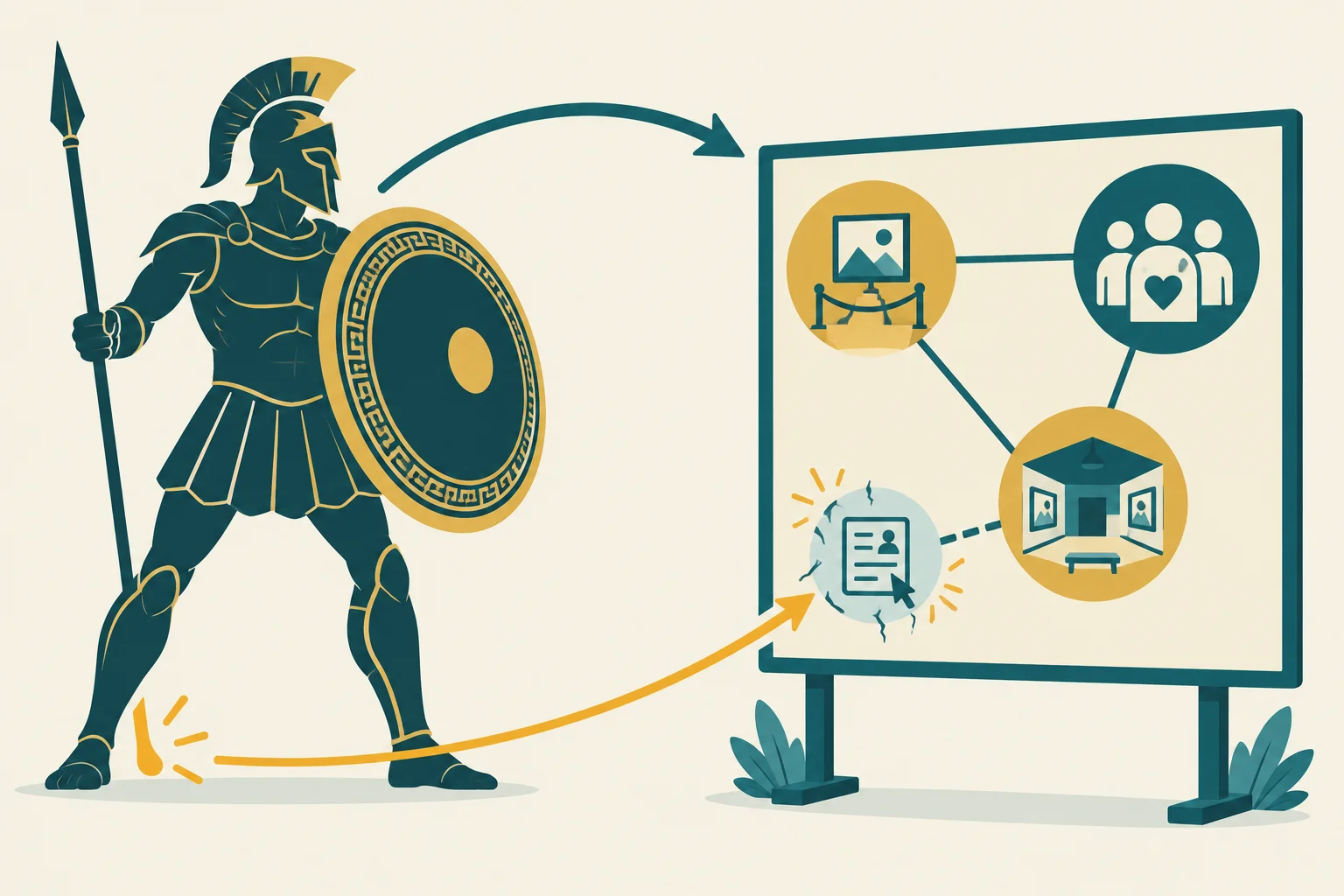
The allusion transfers the pattern of overall strength plus one weak point—not the whole story.
Tip
Do not assume that someone knows an allusion because of their name, nationality, or appearance. If the context does not establish a figurative meaning, a literal anatomical reading or simple uncertainty can be reasonable. A brief clarification is better than an assumption.
Example
Context: Riverbank Arts Center has artists, volunteers, and Room B with 40 places for the community exhibition. Bookings open on Friday, but the online registration page has not been tested.
Maya: The exhibition plan looks strong. Is there anything we should check before Friday?
Alex: The registration page is our Achilles' heel.
Literal statement: Alex calls the registration page “our Achilles' heel.”
Contextual cue: The exchange concerns preparation for Friday, and the registration page is untested.
Likely implication: The page is the plan's vulnerable point and deserves attention. This does not establish that it will fail.
Alternative reading: Alex may be raising the concern lightly rather than making severe implied criticism. The context makes a literal body-part reading unlikely here, but unfamiliarity with the expression would still be understandable.
Only the story features that help explain the current concern should be mapped.
| Story feature | Present situation | Relevant connection |
|---|---|---|
| Formidable warrior | Exhibition plan | The plan has several strengths |
| Vulnerable heel | Untested registration page | One part may create difficulty |
| Threat to the warrior | Bookings opening Friday | A practical pressure makes the weakness important |
Match each interpretation tool to its role.
Tap an item and then its matching pair.
Context: Riverbank Arts Center has secured Room B with 40 places, recruited volunteers, and prepared the exhibition displays. Bookings open on Friday. The online registration form has not yet been tested.
Maya: The exhibition plan is solid. What should we focus on before Friday?
Alex: The online registration form is our Achilles' heel.
Write 80–120 words. Map the relevant story features to this situation, paraphrase Alex's allusion in plain English, and identify one contextual cue that supports your reading. End by explaining why a listener should not be assumed to know the reference.
Write at least 250 characters (0/250).

Step 7 of 8
Turn an uncertain implication into a focused, non-accusatory clarification that the other speaker can correct.
An intent check separates three things:
Start with “You said …” rather than “You meant …” Then use wording such as “I wondered whether …” or “Am I reading that correctly?” This keeps a conversational implicature separate from a fact about the speaker’s motive.
A focused check asks about one uncertainty. It does not turn an implied criticism into an explicit criticism or assume hostility.
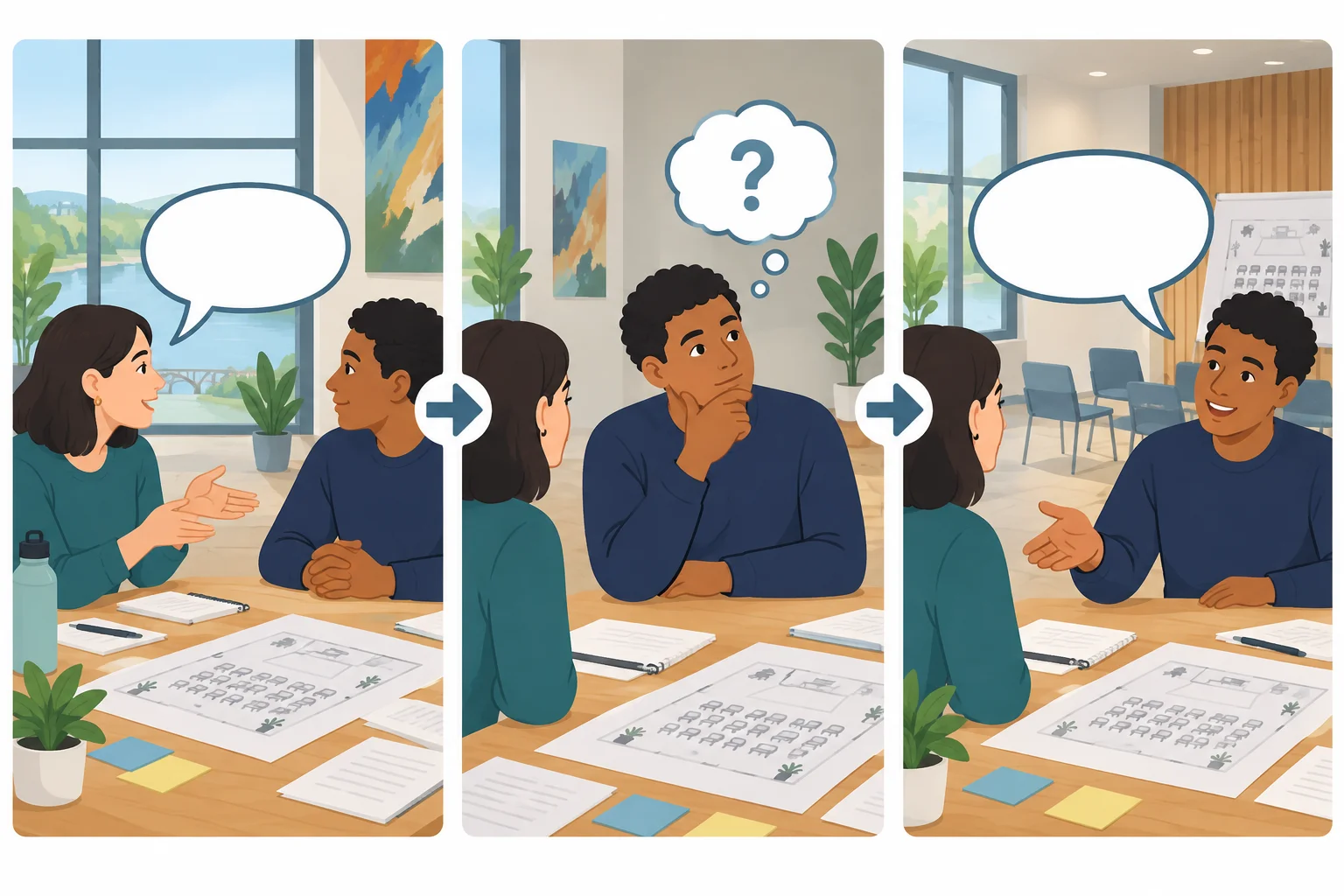
Keep the observation, the inference, and the question distinct: this gives the other speaker room to correct your reading.
Example
Context: Several community groups have asked about the exhibition. Room B has 40 places, and bookings open on Friday.
Maya: “Room B has 40 places.”
Alex: “That should be plenty.”
Contextual cue: The earlier inquiries make a capacity concern plausible.
Alternative reading: Alex may simply be expressing confidence that 40 places will be enough.
Maya can say: “You said ‘That should be plenty.’ I wondered whether you were concerned about capacity. Is that what you meant?”
This response identifies the remark, offers a tentative reading, and invites correction. It does not claim that Alex has made an explicit criticism.
Context: Alex has mentioned that the booking page still needs testing.
Maya: “We can publish it Friday morning.”
Alex: “That should be straightforward.”
Build Maya’s tactful intent check.
Your sentence
Available words
Context: Bookings open on Friday. The confirmed exhibitor list is scheduled to go online on Wednesday. Alex has not explained whether this timing causes a problem.
Maya: “The list will go online Wednesday.”
Alex: “A Wednesday release. Interesting.”
Write a two- or three-sentence intent check for Maya. Then say it aloud once in a calm, genuinely curious voice.
Before you submit, self-check:
Write Maya’s intent check. Include an observation, a tentative reading, and a question.
Write at least 120 characters (0/120).

Step 8 of 8
Integrate contextual, cultural, and delivery evidence into a cautious interpretation, then rehearse an intent check that protects the next practical action.
Context: Riverbank Arts Center is preparing a community exhibition in Room B, which has 40 places. Bookings open on Friday. At noon, Maya saw that the booking page displayed 40 places. The web team is checking the page.
Maya: The exhibition plan is strong: the artists, schedule, and volunteers are ready.
Alex: The booking page is our Achilles' heel. Did it show 12 places again this morning? Has it stopped changing?
Maya: I only checked it at noon. It showed 40 places then, and the web team is checking the page.
Background note: In a commonly retold Greek story, Achilles is a formidable warrior with one vulnerable heel. Achilles' heel conventionally refers to a vulnerable point in an otherwise strong person, plan, or position.

The exhibition arrangements and the current 40-place display are confirmed Context. The booking page may still be a vulnerable point, but that interpretation needs evidence.
Listen to Alex's later remark. Notice the exact wording, then consider how prominence and a pause may affect the relative plausibility of different readings.
A reliable system, just what we need on Friday.
Write an 80–110-word interpretation of the evidence packet. Use these labels in your paragraph: Literal statement, Background assumption, Likely implication, Contextual cue, and Alternative reading.
Identify the linguistic triggers again and stop + -ing. State which earlier events are only presupposed by Alex's wording and which details the Context independently confirms. Explain what Achilles' heel points to here. Cite at least two relevant cues from the Context, exchange, or delivery. Make your Alternative reading genuinely compatible with those same cues.
Then rehearse aloud a 20–30-second intent check for Alex. Target the uncertainty that matters for Friday's bookings without accusing Alex, Maya, or the web team.
Write at least 450 characters (0/450).
Compare your work with this model as one evidence-based reading, not as proof of Alex's private intention.
Example
Literal statement: Alex calls the booking page “our Achilles' heel” and asks whether it showed 12 places again and has stopped changing.
Background assumption: “again” presupposes an earlier 12-place display; “stop + -ing” presupposes earlier changing. Neither is confirmed.
Likely implication: The page may need checking before Friday because it is the plan's vulnerable point.
Contextual cue: The web team is checking it, and “reliable” receives marked prominence after a pause. The Context confirms a 40-place display at noon.
Alternative reading: Alex may be dryly flagging a practical risk, not criticizing Maya or the team.
Example
Possible intent check to rehearse aloud:
“Alex, you called the booking page our Achilles' heel, and later said, ‘A reliable system, just what we need on Friday.’ I wondered whether you are concerned that it could still change before bookings open. Are you asking us to arrange a stability check now, or were you only flagging a risk for the web team?”
Self-check before you finish:
Summary
Use this sequence whenever meaning is uncertain.
Congratulations! You completed: Interpret Implication, Irony, and Allusion
Thousands of online courses in video, ebooks and audiobooks.
To test your knowledge during online courses
Generated directly from your cell phone's photo gallery and sent to your email

Download our app via QR Code or the links below:.



Carry knowledge in your pocket.
Download the Cursa app.
There are hundreds of free courses available, with a free certificate of completion that is saved in your mobile image gallery.
Download the app to access the Course Completion Certificate for Free.


+ 10 million
students

Free and Valid
Certificate

60 thousand free
exercises

4.8/5 rating in
app stores

Free courses in
video and ebooks