
Step 1 of 10
Pass On a Message
Learn to distinguish direct speech from reported speech and use accurate say or tell patterns while clearly naming the original speaker.

Learning path · Level 8 · Tutorial 5
Pass on statements and questions while preserving the speaker's meaning. Read a message and listen to a related exchange, using audio-choice and brief dictation tasks to check details. Then give an oral report and write a guided account that clearly separates events, other people's messages, and an imagined alternative.

 Pass On a Message
Learn to distinguish direct speech from reported speech and use accurate say or tell patterns while clearly naming the original speaker. 2 min
 Look Back from the Reporting Time
Use common backshifts to report Maya's Tuesday statements from Leo's Wednesday viewpoint while preserving the original sequence of events. 3 min
 Report Earlier Activity and Future Plans
Report earlier activity, future plans, and ability from a later viewpoint while preserving the original meaning. 2 min
 Keep People, Time, and Place Clear
Track who spoke, who received a message, and where and when it is reported so that pronouns, possessives, and references remain clear. 2 min
 Decide What Needs to Change
Use the reporting context to decide whether to retain a form or use backshift, while keeping the original speaker and the degree of certainty clear. 2 min
 Report Yes-or-No Questions
Report yes-or-no questions with asked if or asked whether, using statement word order and context-appropriate verb forms. 2 min
 Report Information Questions
Keep information-question words, use statement word order, and distinguish them from yes-or-no reports. 2 min
 Read, Listen, and Check the Report
Read Maya’s message, listen to her later exchange with Leo, and check that your report keeps sources, questions, negatives, and timing accurate. 3 min
 Give a Clear Spoken Report
Plan and deliver a short spoken report as Leo to Noor, using source attribution, a clear event sequence, and purposeful pauses and stress. 2 min
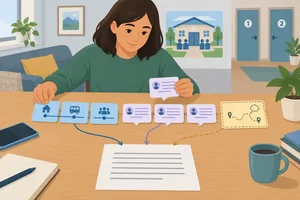 Write and Check the Complete Account
Write and revise a complete report that separates real events, Maya's messages and questions, and an imagined alternative. 5 min
Step 1 of 10
Learn to distinguish direct speech from reported speech and use accurate say or tell patterns while clearly naming the original speaker.
Direct speech presents the original speaker’s words. It uses quotation marks:
Maya said, "The workshop is in Room 4."
Reported speech passes on the meaning without quotation marks:
Maya said that the workshop is in Room 4.
In both forms, Maya is the original speaker. Naming her shows that this information comes from Maya, not from you.
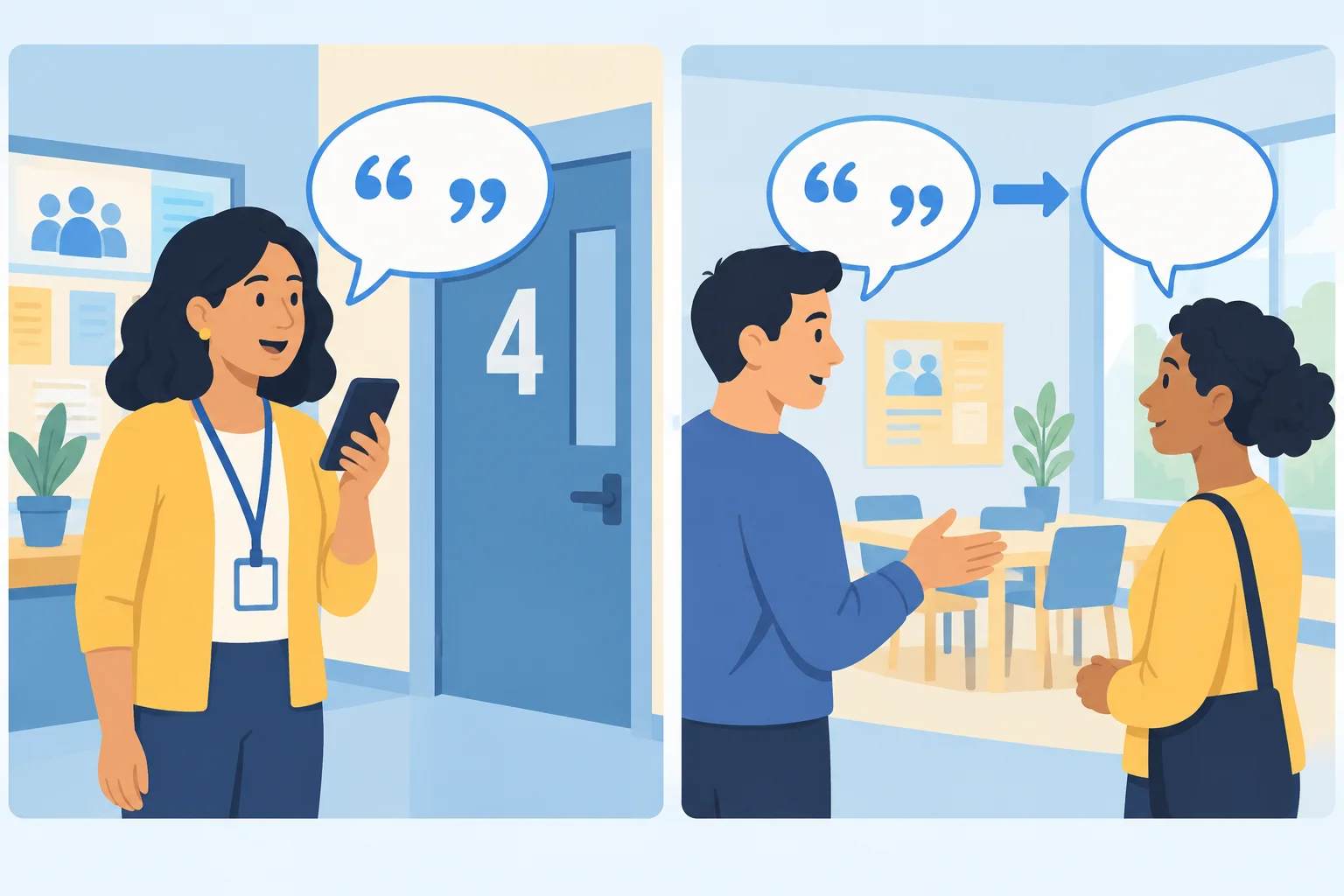
Direct speech gives Maya’s words. Reported speech carries Maya’s message forward while keeping Maya visible as the source.
A reporting verb introduces another person’s message. Choose the pattern by asking: am I passing on a statement, telling a person, or naming a question?
Use these patterns for messages in this step.
| Purpose | Pattern | Example |
|---|---|---|
| Pass on a statement | said + (that) + clause | Maya said (that) the workshop is in Room 4. |
| Name the listener | told + person + (that) + clause | Maya told Leo (that) the workshop is in Room 4. |
| Name a question | asked + person + a question | Maya asked Leo a question. |
Tip
Use said + (that) + clause when no person comes directly after the verb. Use told + person + (that) + clause when you name the listener.
Do not use told that ... without a person, and do not use said Leo that ....
Complete the reported statement:
Maya ___ that the workshop is in Room 4.
Match each direct-speech message to its faithful reported-speech version.
Tap an item and then its matching pair.
Step 2 of 10
Use common backshifts to report Maya's Tuesday statements from Leo's Wednesday viewpoint while preserving the original sequence of events.
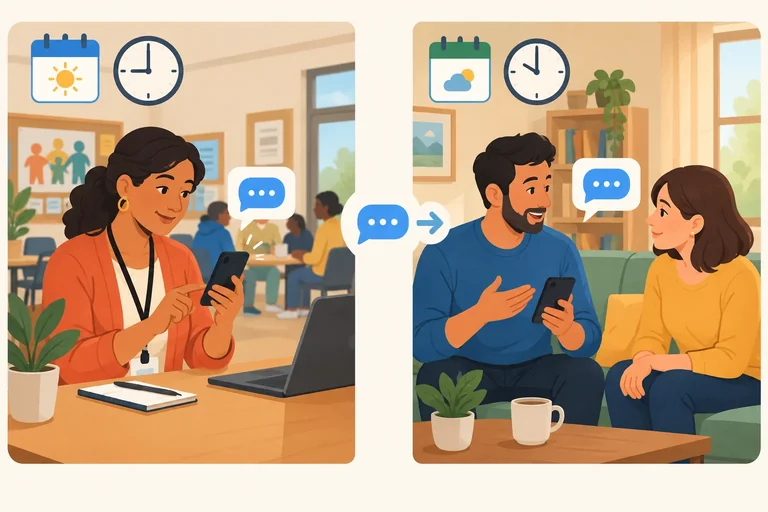
On Tuesday at 9:00 a.m., Maya sends Leo a message from the community center. On Wednesday at home, Leo reports it to Noor. Because he is looking back from a later reporting time, he can use a backshift: a tense change in the reported clause, often after a past reporting verb.
Direct speech: Maya said, "The workshop is in Room 4."
Reported speech on Wednesday: Maya said that the workshop was in Room 4.
The message still concerns one workshop. A backshift changes the viewpoint of the report; it does not create a second event.
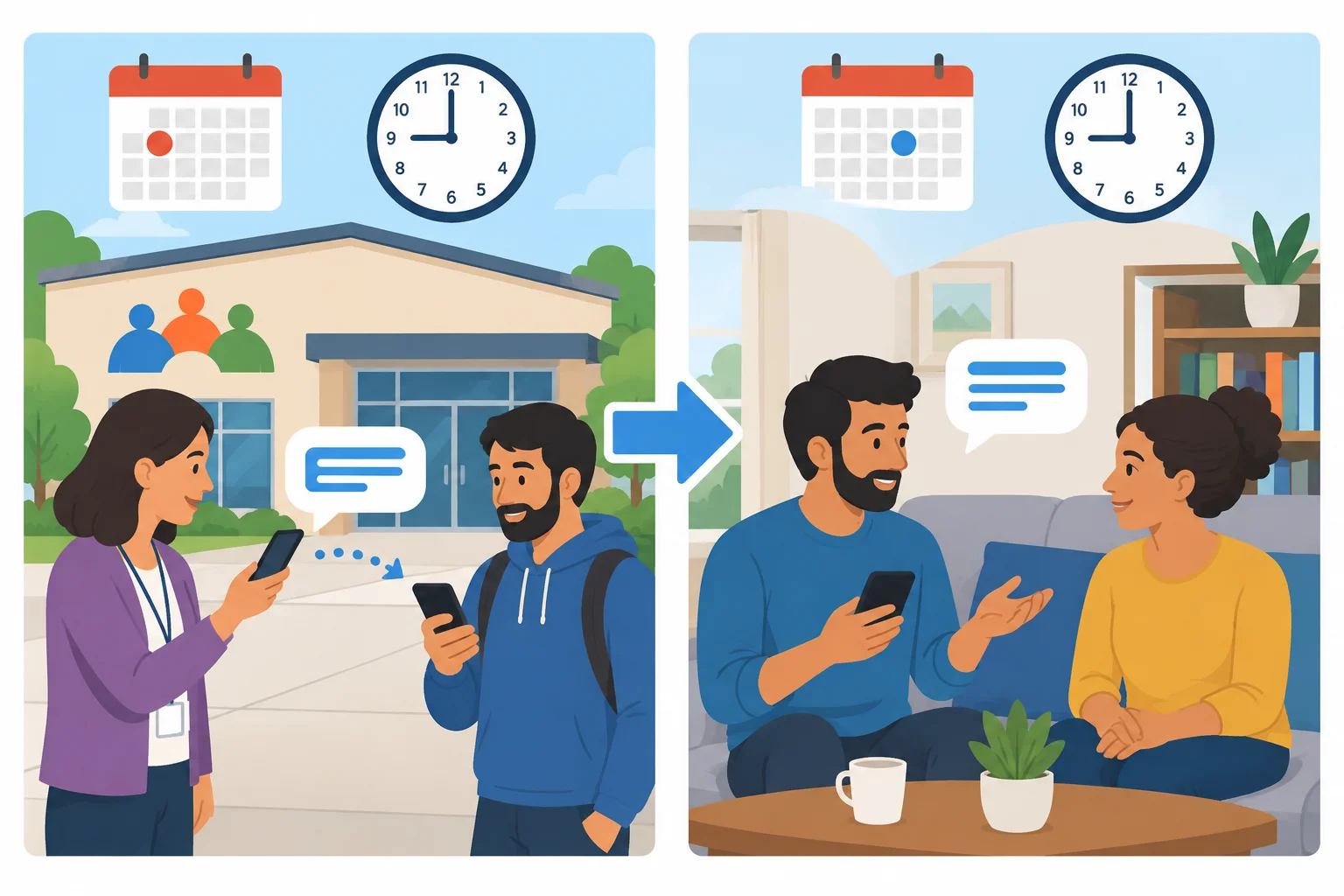
Leo reports later, so the reported verb can look back from Wednesday to Maya's Tuesday message.
Use these common backshifts when a later report calls for them. The verb form changes, but each event stays in its original place in the sequence.
These examples use Maya's Tuesday statements and Leo's Wednesday reporting viewpoint.
| Direct speech on Tuesday | Reported speech on Wednesday | Change |
|---|---|---|
| Maya said, "The workshop is in Room 4." | Maya said that the workshop was in Room 4. | present simple → past simple |
| Maya said, "The sign is pointing to Room 4." | Maya said that the sign was pointing to Room 4. | present continuous → past continuous |
| Maya said, "The handouts have been printed." | Maya said that the handouts had been printed. | present perfect → past perfect |
| Maya said, "The center staff checked the chairs before 9:00 a.m. on Tuesday." | Maya said that the center staff had checked the chairs before 9:00 a.m. on Tuesday. | past simple → past perfect |
Tip
The past perfect forms make an earlier action clear. They do not mean that the handouts were printed or the chairs were checked twice. The original sequence remains the same.
Leo is reporting to Noor on Wednesday. Maya said, "The sign is pointing to Room 4." Which is the accurate report?
Leo is reporting to Noor on Wednesday. Maya said, "The handouts have been printed." Which is the accurate report?
Leo is reporting to Noor on Wednesday. Complete the four reported statements below. Each one reports a different Tuesday statement. Keep names and explicit Tuesday references unchanged; choose the verb form that looks back from the reporting time.
Maya said, "The workshop is in Room 4 on Tuesday." Complete Leo's report: Maya said that the workshop ___ in Room 4 on Tuesday.
Maya said, "The sign is pointing to Room 4." Complete Leo's report: Maya said that the sign ___ to Room 4.
Maya said, "The handouts have been printed." Complete Leo's report: Maya said that the handouts ___.
Maya said, "The center staff checked the chairs before 9:00 a.m. on Tuesday." Complete Leo's report: Maya said that the center staff ___ the chairs before 9:00 a.m. on Tuesday.

Step 3 of 10
Report earlier activity, future plans, and ability from a later viewpoint while preserving the original meaning.
Backshift can show that an activity was already in progress before the reporting point. On Wednesday at home, Leo reports a Tuesday message to Noor.
Direct speech: Maya said, "I was printing the handouts before 9:00 a.m."
Reported speech: Leo told Noor that Maya had been printing the handouts before 9:00 a.m.
Had been printing keeps the meaning of an ongoing activity and places it before Leo’s later report. Use this shift when the earlier relationship matters; do not change a verb only because you are reporting it.

The Wednesday report looks back to the Tuesday activity before Maya’s 9:00 a.m. message.
With a later reporting viewpoint, will → would and can → could are common changes.
Use would for a plan that was future at the original time. Use could for an ability that was possible at that time. Neither form proves that the plan happened or that the ability was used.
Example
Future plan
Direct speech: Maya said, "I will send the notes on Wednesday."
Reported speech: Leo told Noor that Maya would send the notes on Wednesday.
Ability
Direct speech: Maya said, "Leo can use the printed handouts."
Reported speech: Leo told Noor that Leo could use the printed handouts.
Do not add another past layer to a verb that is already in a past perfect form. In a later report, past perfect simple and past perfect continuous normally remain unchanged.
Choose the form for its meaning: a completed result or an activity in progress.
Compare the form in the source with the form in the later report.
| Source verb form | Later report form | Meaning retained |
|---|---|---|
| had printed the handouts | had printed the handouts | completed before an earlier point |
| had been preparing the room | had been preparing the room | ongoing activity before an earlier point |
Tip
Check the timeline before choosing a form. Ask: Was this an ongoing activity, a completed action, a future plan, or an ability? A reporting change must preserve that meaning.
On Wednesday at home, Leo reports Tuesday details to Noor. Match each meaning with the verb phrase that best fits a later report.
Tap an item and then its matching pair.

Step 4 of 10
Track who spoke, who received a message, and where and when it is reported so that pronouns, possessives, and references remain clear.
A reported message needs a clear viewpoint. First identify the original speaker, the original listener, the reporter, and the new audience.
On Tuesday at 9:00 a.m., Maya sends Leo a message from the community center. Maya is the original speaker; Leo is the original listener. On Wednesday at home, Leo reports the message to Noor. Leo is now the reporter, and Noor is the audience.
Before changing a pronoun or a reference, ask: Who said it? Who heard it first? Who is reporting now? When and where is the report happening?
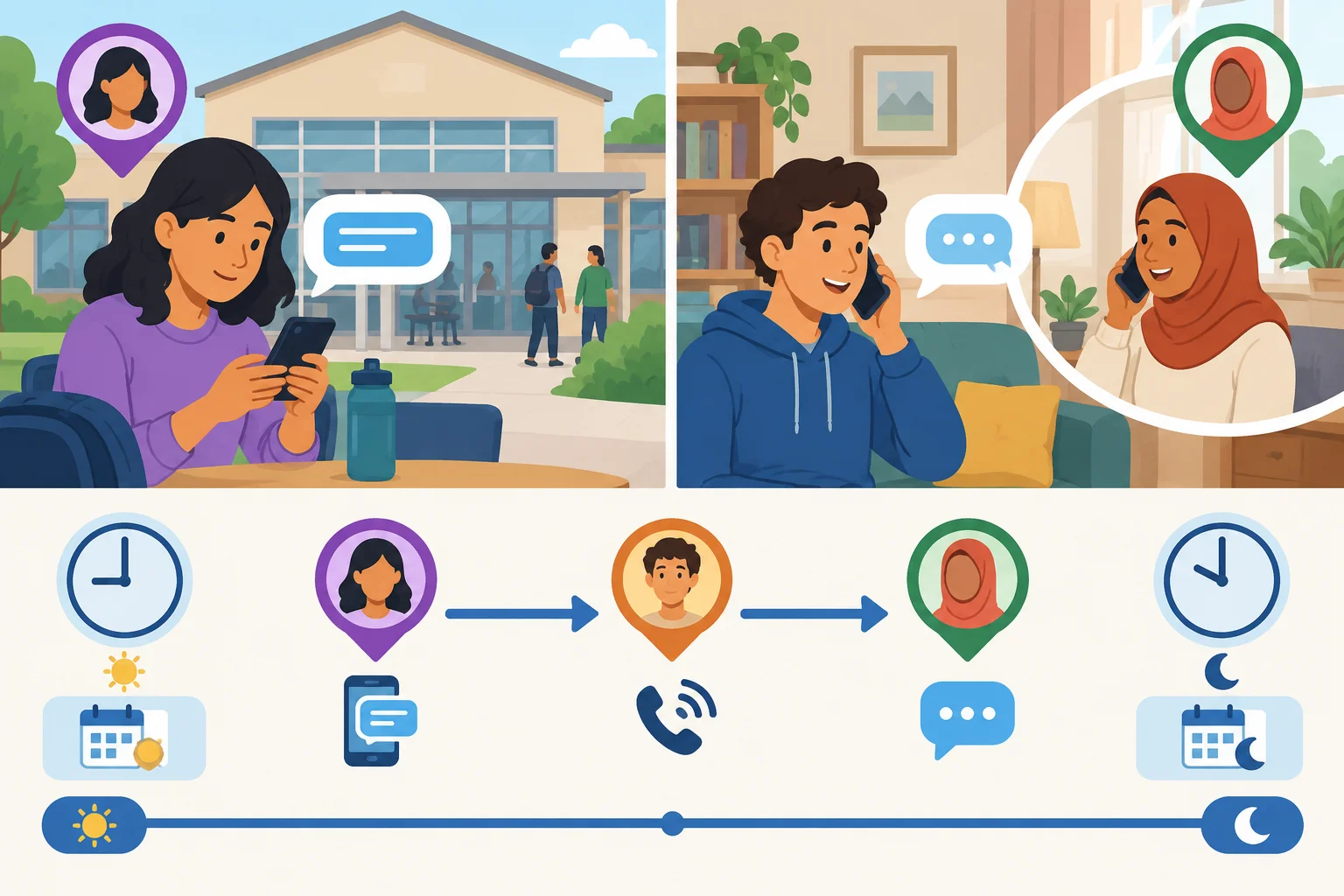
The people, time, and place of the report can change, even though Maya's message stays the same.
Pronouns and possessives do not have one automatic replacement. They follow the people in the new viewpoint. For example, Maya's I can become she when Leo reports to Noor; Maya's my can become her. In a message to Leo, you can become him.
For we and our, first decide exactly who is included. Then choose the form that fits Leo's report to Noor.
Time and place expressions change only if the original words would point to the wrong time or place for the new audience.
These changes fit Leo's report to Noor at home on Wednesday.
| In Maya's message | Who or what it means | In Leo's Wednesday report |
|---|---|---|
| I | Maya | she |
| my | Maya | her |
| you | Leo | him |
| today | Tuesday | that day |
| tomorrow | Wednesday | the next day |
| yesterday | Monday | the day before |
| here | the community center | there |
Example
Maya's Tuesday message says, “The workshop is in Room 4. I've printed the handouts here today.”
At home on Wednesday, Leo can say: Maya said that she had printed the handouts there that day.
Alternative reporting context: At 9:05 a.m. on Tuesday, Leo repeats the handout detail to a visitor at the community center. The day and place are still the same, so he can say: Leo said that Maya had printed the handouts here today.
Do not change here or today merely because you are using reported speech.
Maya's Tuesday message to Leo includes: “I've printed my handouts for you.” On Wednesday, Leo reports the message to Noor. Match each word to the person it identifies in Maya's original sentence.
Tap an item and then its matching pair.
Maya sent Leo this message from the community center on Tuesday at 9:00 a.m.: “I've printed the handouts here today.”
Build two reports in order. First, Leo tells Noor at home on Wednesday. Then, at 9:05 a.m. on Tuesday, Leo repeats the message to a visitor at the community center.
Your sentence
Available words

Step 5 of 10
Use the reporting context to decide whether to retain a form or use backshift, while keeping the original speaker and the degree of certainty clear.
A backshift often helps you report from a later viewpoint, but it is not mechanical. First ask: When am I reporting? Is the information still true or relevant? What do I know independently?
On Tuesday, Maya says, "The community center opens at 9:00 a.m." On Wednesday, Leo can still report: Maya said that the community center opens at 9:00 a.m. The present tense fits because the opening time is independently confirmed as a continuing fact.
He can also say: Maya said that the community center opened at 9:00 a.m. This backshift reports Maya's Tuesday statement from a later viewpoint. It does not automatically mean that the center no longer opens at 9:00 a.m.
Keep Maya visible as the original speaker. Her statement is not automatically Leo's own claim.
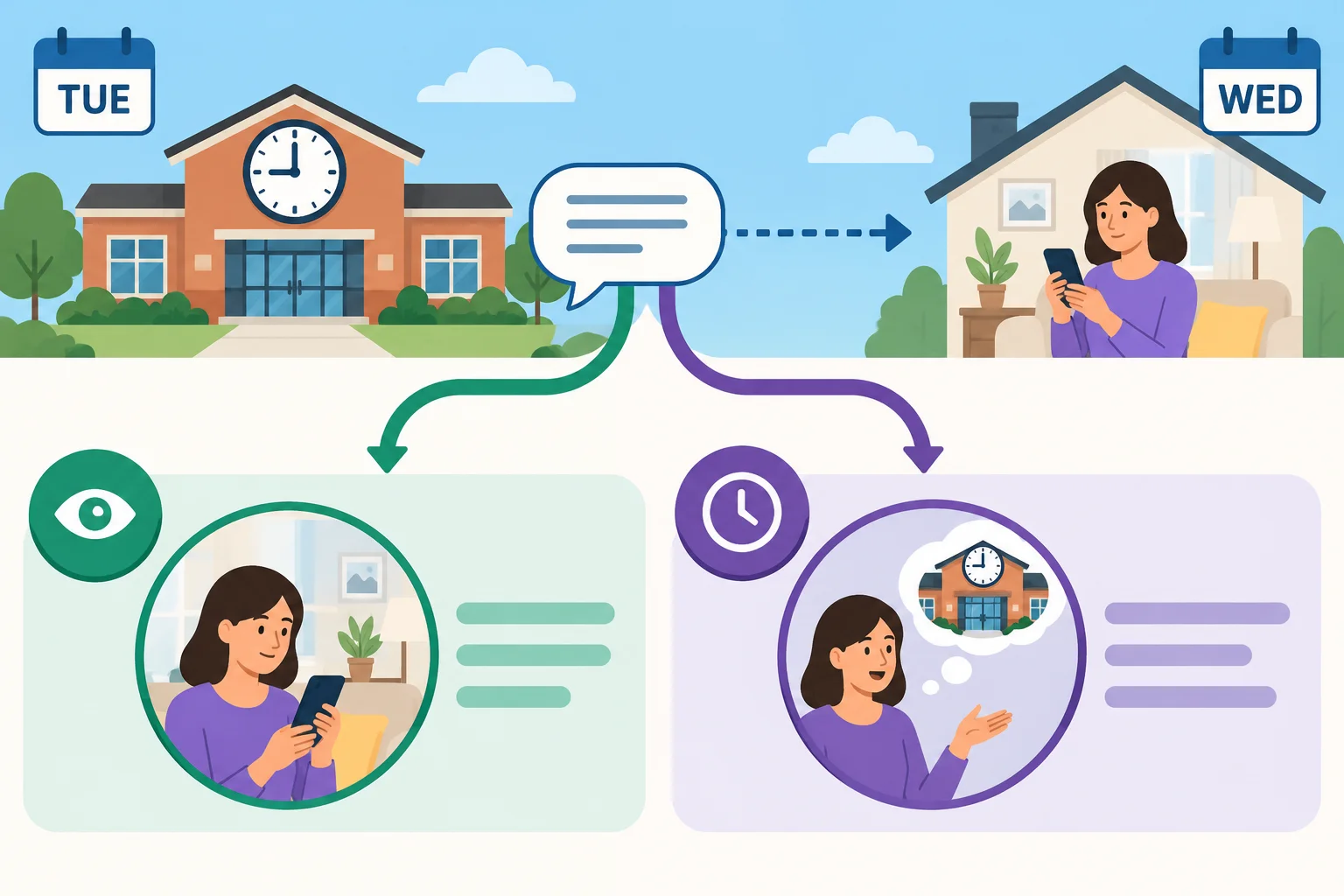
The reporting viewpoint can change, while the opening-time fact can remain true.
At 9:00 a.m. on Tuesday, Maya sends Leo a message from the community center: Maya wrote, "The workshop is in Room 4. I've printed the handouts."
If Leo repeats this message immediately at the community center, the workshop and the printed handouts are still current. He may keep forms that emphasize that relevance: Maya said that the workshop is in Room 4 and that she has printed the handouts.
On Wednesday at home, the workshop is already in the past. A later report can use backshift: Maya said that the workshop was in Room 4 and that she had printed the handouts.
Do not change a fixed name such as Room 4. Expressions such as here and today change only if they would point to the wrong place or time for the listener.
Use the actual reporting situation, not an automatic replacement rule.
| Original reference | Same time or place | Later or different place |
|---|---|---|
| here | can remain here | may become there |
| today | can remain today | may become that day |
| Room 4 | stays Room 4 | stays Room 4 |
It is Wednesday, and Leo is speaking at home. Maya's Tuesday message said, "I've printed the handouts." Leo has not independently checked the handouts. Which report is the most careful?
Compare reports of the same message.
On Tuesday, Maya said, "The community center opens at 9:00 a.m."
Context 1: It is Tuesday at 9:05 a.m. at the community center. Leo repeats the message to a participant.
Context 2: It is Wednesday at home. Leo reports to Noor, and the center's 9:00 a.m. opening time has been independently confirmed as still true.
Write one reported sentence with said for each context. Then add one sentence explaining one tense choice. Keep Maya clearly identified as the original speaker.
Write at least 80 characters (0/80).

Step 6 of 10
Report yes-or-no questions with asked if or asked whether, using statement word order and context-appropriate verb forms.
A yes-or-no question can become reported speech. Use the reporting verb asked, add if or whether, and follow it with a clause.
Pattern: asked + (person) + if/whether + clause
Direct speech uses question order:
Maya asked Leo, "Did you read my message?"
At home on Wednesday, Leo reports to Noor:
Maya asked me if I had read her message.
The report is an overall statement, so it ends with a full stop.
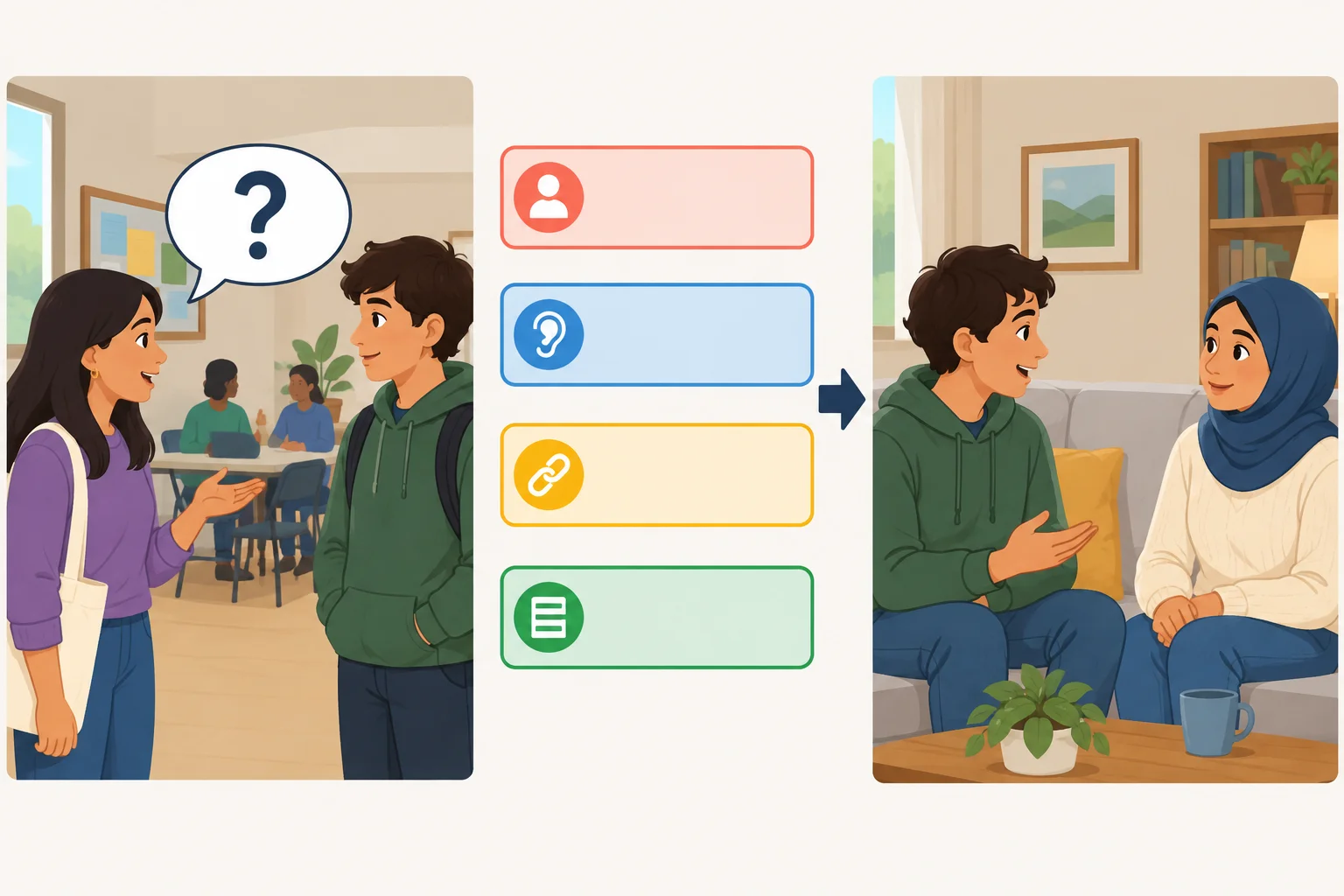
A reported question moves from the original speaker to a later listener. Its clause changes from question order to statement order.
Example
In Maya's direct question, you refers to Leo, so it becomes I when Leo reports his own action. Maya's my refers to Maya, so it becomes her.
Because Leo reports later, did read becomes had read. Either if or whether can introduce this yes-or-no question:
Maya asked me whether I had read her message.
Choose the connector freely when both forms fit; then make sure the clause after it has statement word order.
After if or whether, use normal statement word order: subject + verb.
With direct questions that use do, does, or did, do not keep that question-form word in the report. Show the tense in the reported verb phrase instead.
The same statement order applies after be and modal verbs. Use the backshift and reference choices that fit the reporting context.
Compare each direct question with a later report by Leo on Wednesday.
| Direct speech | Reported-clause pattern | Later report |
|---|---|---|
| Maya asked Leo, "Did you read my message?" | if/whether + I + had + participle | Maya asked me if I had read her message. |
| Practice question: "Are you in Room 4?" | if/whether + I + was | Maya asked whether I was in Room 4. |
| Practice question: "Can you come to Room 4 today?" | if/whether + I + could + base verb | Maya asked if I could come to Room 4 that day. |
Tip
Do not write question order such as if had I read ... or whether was I .... The connector is followed by a clause, not another direct question. A reported question inside a statement takes a full stop, not a question mark.
Leo is speaking to Noor at home on Wednesday. Choose the accurate report of Maya's Tuesday question: Maya asked Leo, "Did you read my message?"
Complete the three reports based on the form-practice questions from the previous screen. You may use if or whether in each report.
Maya asked me
She also asked
Finally, she asked 
Step 7 of 10
Keep information-question words, use statement word order, and distinguish them from yes-or-no reports.
On Tuesday at 10:25 a.m., Maya asked Leo, "Where did you go first?" Maya is the original speaker. When Leo reports her question at home on Wednesday, he must preserve what she wanted to know: the place.
This is an information question. In reported speech, keep its question word, such as what, where, when, why, or how. Do not add if or whether; those connectors belong to yes-or-no questions. The reporting verb is asked, but the rest becomes a clause inside a statement.
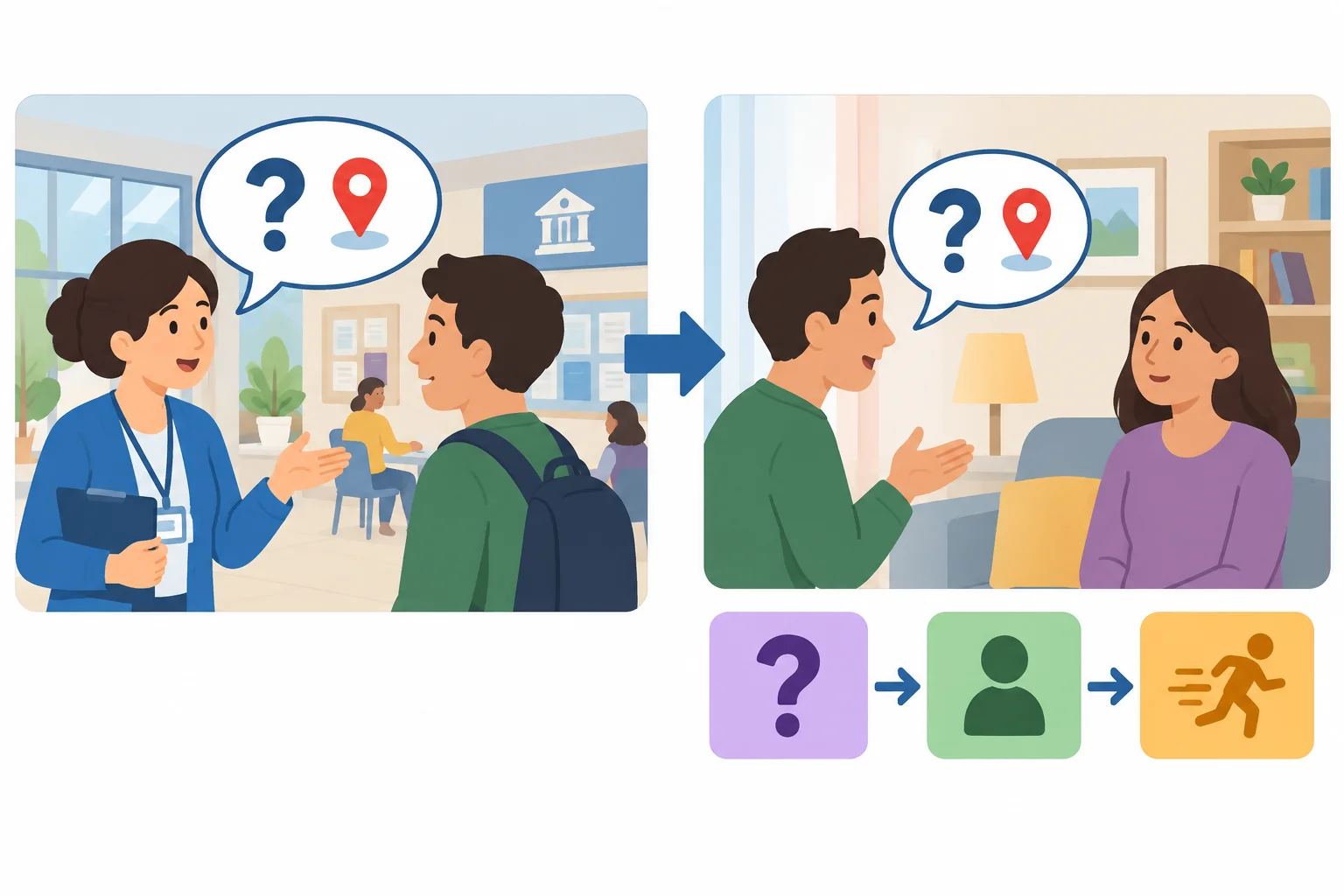
The question word travels into the reported clause, but the clause uses statement word order.
Example
Direct speech: Maya asked Leo, "Where did you go first?"
Reported speech: Maya asked Leo where he had gone first.
Later, Leo told Noor that Maya had asked him where he had gone first.
The later viewpoint can require backshift, but the meaning stays the same: Maya wanted to know Leo's first destination.
Choose the connector from the meaning of the original question. An information question already has a question word, so keep it. A yes-or-no question has no question word, so use if or whether.
In both types, use subject + verb. A complete statement containing a reported question ends with a full stop.
Use this check when you change a direct question into reported speech.
| Original question type | After asked | Reported-clause order |
|---|---|---|
| Information question | question word | subject + verb |
| Yes-or-no question | if / whether | subject + verb |
Example
Remove do, does, or did when it only forms the direct question: Where did he go? → where he had gone.
However, keep lexical do when it carries the action's meaning: What did you do? → what I had done. The question-form did disappears, but the action do remains.
True or false: This is correctly ordered reported speech.
Maya asked Leo where had he gone first.
Repair this draft while building Leo's report for Noor on Wednesday:
Maya asked Leo where had he gone first, and she asked if had he read her message.
Maya's direct questions were "Where did you go first?" and "Did you read my message?"
Your sentence
Available words

Step 8 of 10
Read Maya’s message, listen to her later exchange with Leo, and check that your report keeps sources, questions, negatives, and timing accurate.
Read the written message first. It is direct speech, so it shows Maya’s own words.
On Tuesday at 9:00 a.m., Maya sent Leo this message from the community center:
Maya wrote, "The workshop is in Room 4. I've printed the handouts."
When you make reported speech later, keep the source clear: Maya’s message—not Leo’s observation—gives the room and handout details.
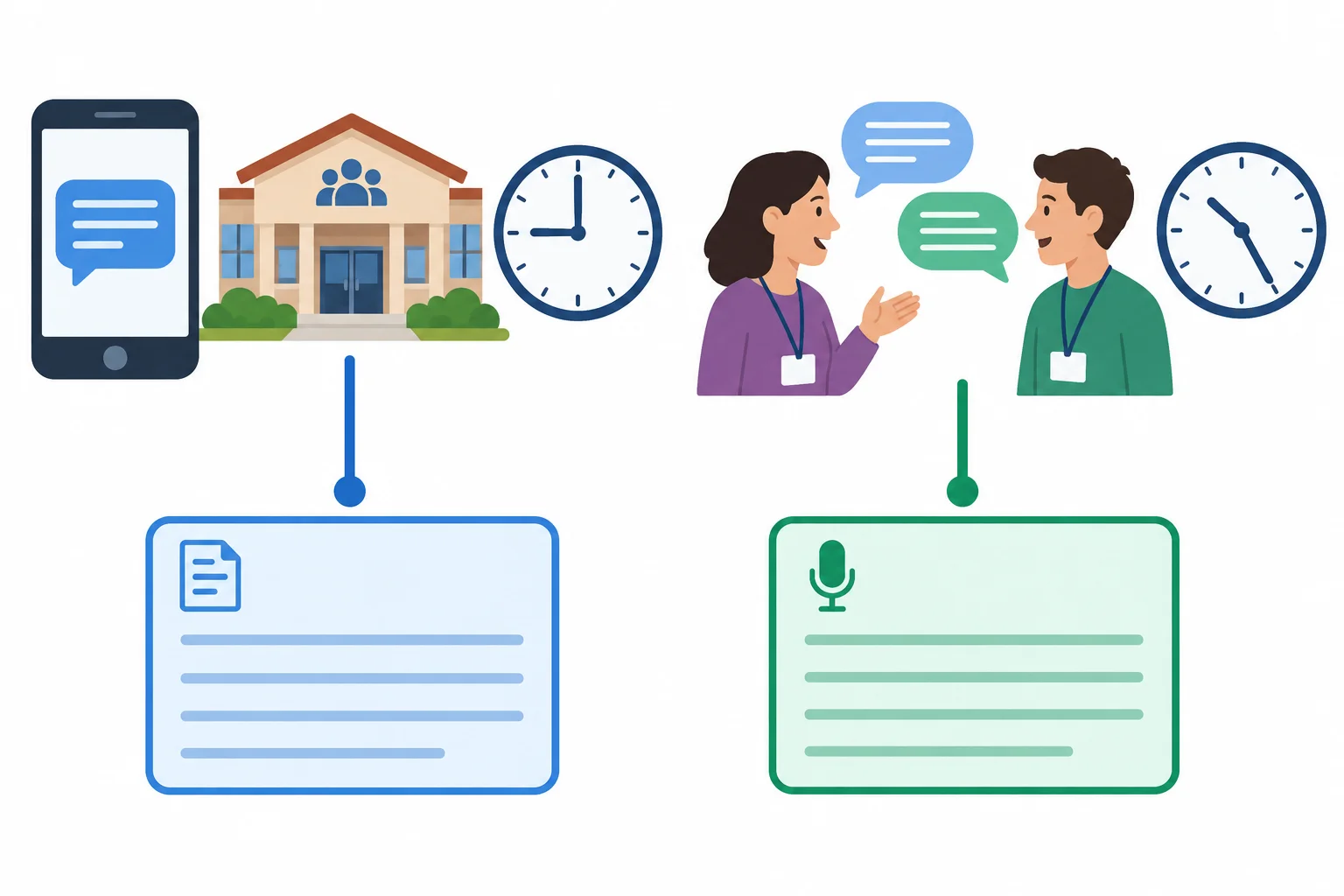
First identify the source; then check what that source actually says.
Now listen to the related exchange from Tuesday at 10:25 a.m. It is a second source, not a repetition of the written message. Listen for who asks the questions, what Leo had not done, and Maya’s later plan.
Listen to the exchange. You will use both sources on the next screen.
“Leo, did you read my message this morning?”
“No, I hadn’t checked it. I went to Room 2 first at 10:00 a.m.”
“I see. The workshop is in Room 4, and I printed the handouts earlier. Where did you go first?”
“To Room 2. I reached Room 4 at 10:20 a.m.”
“All right. I’ll send the notes on Wednesday.”
Listen and choose an option.
Listen again. Which report accurately combines Maya’s written message and the later exchange?
“Leo, did you read my message this morning?”
“No, I hadn’t checked it. I went to Room 2 first at 10:00 a.m.”
“I see. The workshop is in Room 4, and I printed the handouts earlier. Where did you go first?”
“To Room 2. I reached Room 4 at 10:20 a.m.”
“All right. I’ll send the notes on Wednesday.”
Listen and write what you heard.
Listen and type exactly what you hear. Use normal capitalization and punctuation.

Step 9 of 10
Plan and deliver a short spoken report as Leo to Noor, using source attribution, a clear event sequence, and purposeful pauses and stress.
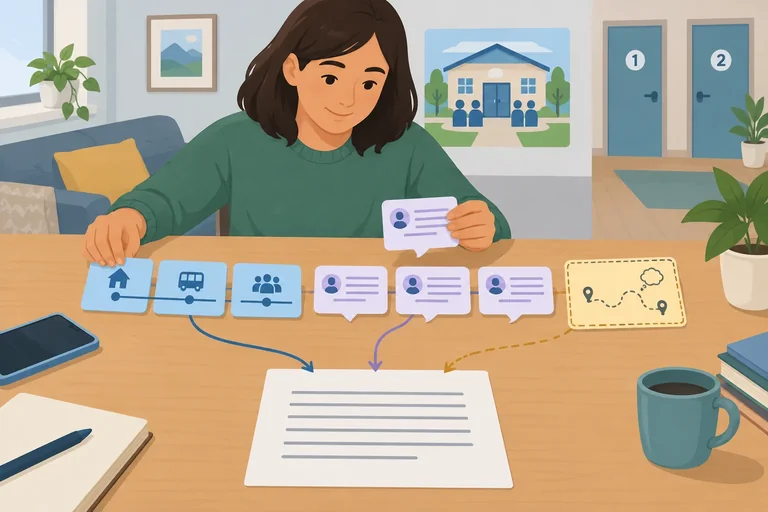
On Wednesday at home, speak as Leo to Noor. Your goal is not to repeat every original word. Give a short, reliable account in four beats:
Keep facts separate from Maya’s messages. From Wednesday, Tuesday can be the day before, and Maya’s plan for Wednesday can be that day.
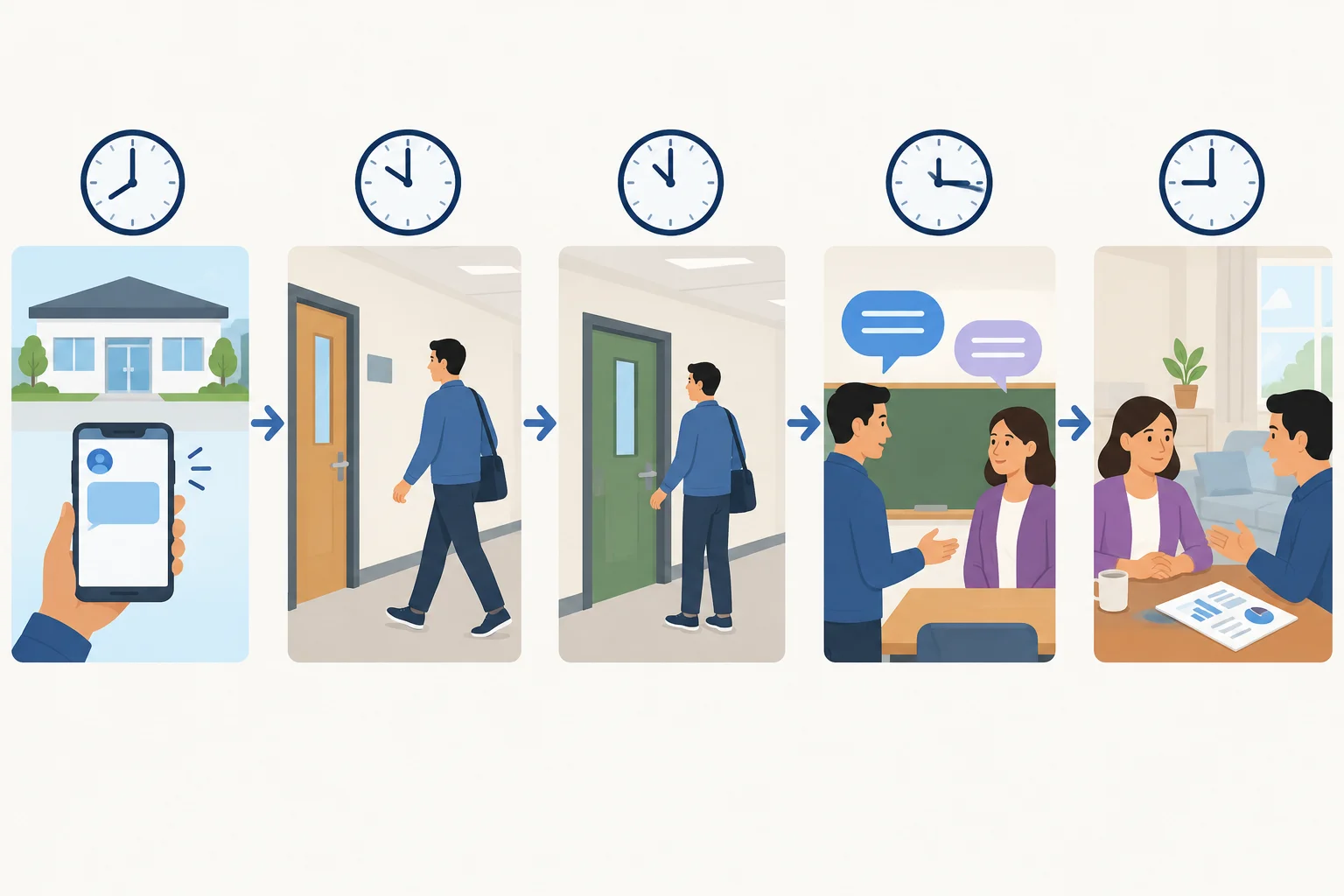
Use the timeline to keep events separate from Maya’s statements and questions.
Use this compact checklist while planning your spoken report.
| Part | Include |
|---|---|
| Source | Maya’s message and later exchange |
| Events | Message at 9:00 a.m.; Room 2 at 10:00 a.m.; Room 4 at 10:20 a.m. |
| Statements | Room 4, printed handouts, and notes planned for Wednesday |
| Questions | Whether Leo read the message and where he went first |
Listen to a model report. Notice how it follows the timeline without copying direct speech word for word.
The day before, Maya had sent me a message at 9:00 a.m. from the community center. She said that the workshop was in Room 4 and that she had printed the handouts. I had not checked her message, so I went to Room 2 at 10:00 a.m. and reached Room 4 at 10:20. At 10:25, Maya asked me if I had read her message and where I had gone first. She also told me that she would send the notes that day.
The day before, Maya had sent me a message at 9:00 a.m. from the community center. She said that the workshop was in Room 4 and that she had printed the handouts. I had not checked her message, so I went to Room 2 at 10:00 a.m. and reached Room 4 at 10:20. At 10:25, Maya asked me / if I had read her message and where I had gone first. She also told me / that she would send the notes that day.
Tip
A pause is optional. Use it after a reporting phrase when the following message is long: “Maya asked me / …”
Give contrastive stress to the original speaker and to a time contrast. This helps Noor hear who provided the information and when it happened. Keep the reporting viewpoint on Wednesday.
First, say a 40–60-second report aloud as Leo to Noor. Use the timeline and the model as support, but do not try to memorize it. Include at least one reported statement and one reported question. You do not need to record your voice.
Then write a brief self-check with three parts: identify the source, name one time-reference choice you used, and name one delivery feature you used.
Write at least 45 characters (0/45).
Step 10 of 10
Write and revise a complete report that separates real events, Maya's messages and questions, and an imagined alternative.
You are Leo, reporting to Noor at home on Wednesday. Keep these kinds of information separate:
A reported message is still Maya’s information. Name Maya so that Noor can distinguish her messages from your own factual account.
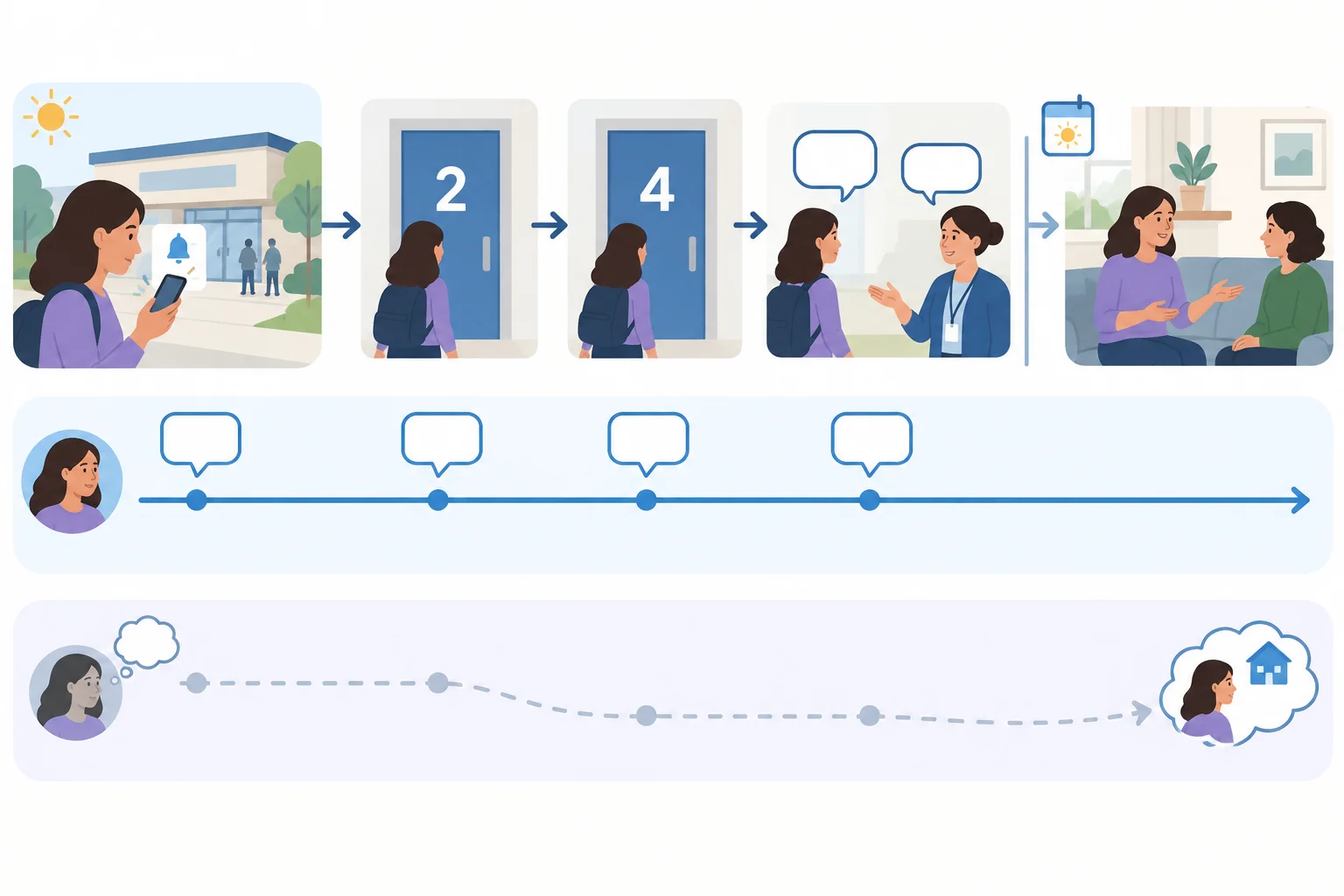
Use the solid timeline for facts, speech bubbles for Maya's messages, and the dashed route only for an alternative that did not happen.
Keep factual events separate from what Maya wrote, said, and asked.
| Time | Record |
|---|---|
| Tuesday, 9:00 a.m. | Maya sends Leo a message from the community center. |
| Tuesday, 10:00 a.m. | Leo has not checked the message and goes to Room 2. |
| Tuesday, 10:20 a.m. | Leo reaches Room 4. |
| Tuesday, 10:25 a.m. | Maya and Leo have a related exchange. |
| Wednesday, at home | Leo reports the events to Noor. |
| Wednesday | Maya plans to send the notes. |
Example
Written message — Tuesday, 9:00 a.m.
Maya wrote, "The workshop is in Room 4. I've printed the handouts."
Exchange — Tuesday, 10:25 a.m.
Maya asked Leo, "Did you read my message?"
Maya asked Leo, "Where did you go first?"
Maya said, "I'll send the notes tomorrow."
Write an account, not a list. From Leo’s Wednesday viewpoint, include:
Keep a consistent viewpoint: check who each pronoun means, when each reference points to, and whether a detail is a fact or Maya’s message.
Warning
Maya said tomorrow on Tuesday. When Leo reports on Wednesday, two context-supported references can still mean Wednesday:
Do not simply retain tomorrow in Leo’s Wednesday report: it would normally point to Thursday. Choose a reference that makes your viewpoint clear.
Summary
Example
Use this as a comparison model, not a script. A different order can be accurate if every source detail and reference remains clear.
On Tuesday, Maya sent me a message from the community center at 9:00 a.m. I did not check it, so I went to Room 2 at 10:00 a.m. and reached Room 4 at 10:20 a.m. Maya told me that the workshop was in Room 4. She also said that she had printed the handouts and would send the notes the next day. At 10:25 a.m. on Tuesday, she asked whether I had read her message and where I had gone first. If I had checked her message, I would have gone directly to Room 4 at 10:00 a.m.
Compare your draft with the original sources, not only with grammar patterns.
| Check | What must remain clear |
|---|---|
| Facts | Leo's route and arrival times are real events. |
| Attribution | Maya remains the original speaker. |
| Written message | Room 4 and the printed handouts match Maya's message. |
| Yes-or-no question | Use if/whether with statement word order. |
| Information question | Keep the question word with statement word order. |
| Future plan | The next day or that day can mean Wednesday in this context; tomorrow would usually suggest Thursday. |
| Alternative | The conditional is clearly outside the factual timeline. |
Write your final account as Leo speaking to Noor at home on Wednesday.
First draft it privately. Compare it with the model and source-check table on the previous screen, then revise before submitting.
Your account paragraph must be 90–120 words. Include two factual events, two attributed statements by Maya, one reported yes-or-no question, one reported information question, and one clearly marked imagined alternative using a familiar conditional.
After a blank line, add:
Review: followed by one correction you made or one reporting choice you verified.Ready: followed by one concise self-assessment beginning I can report...Write at least 500 characters (0/500).
Congratulations! You completed: Report What People Said and Asked
You completed this level!
Up next: B2: Effective Work Communication
 Give Work Updates with Modal and Perfect PassivesGive clear updates about what must happen and what has already been done. Read a short project update and listen to a team message, then choose the meaning you hear and complete a brief dictation. Practise hearing and saying passive verb phrases. Give an update aloud and write a guided status note, checking both against models.
Thousands of online courses in video, ebooks and audiobooks.
To test your knowledge during online courses
Generated directly from your cell phone's photo gallery and sent to your email

Download our app via QR Code or the links below:.



Carry knowledge in your pocket.
Download the Cursa app.
There are hundreds of free courses available, with a free certificate of completion that is saved in your mobile image gallery.
Download the app to access the Course Completion Certificate for Free.


+ 10 million
students

Free and Valid
Certificate

60 thousand free
exercises

4.8/5 rating in
app stores

Free courses in
video and ebooks