
Step 1 of 9
Choose the Evaluation and Commitment You Mean
Choose closely related wording that communicates the intended evaluation or position without creating an unsupported criticism, willingness, refusal, or prediction.

Learning path · Level 12 · Tutorial 1
Edit notices and messages so their wording expresses exactly what you intend. Read competing interpretations, listen to differently stressed versions, choose the supported meaning, and complete a short dictation of scope-bearing phrases. Write an unambiguous revision and explain it aloud. Also explore when a deliberate double meaning serves a clear purpose rather than confusing the reader.

 Choose the Evaluation and Commitment You Mean
Choose closely related wording that communicates the intended evaluation or position without creating an unsupported criticism, willingness, refusal, or prediction. 3 min
 Find Two Plausible Lexical Readings
Identify a word with two contextually plausible senses and state how added context resolves—or fails to resolve—the uncertainty. 2 min
 Trace Attachment and Grouping
Trace how modifier attachment and coordination grouping create competing readings, then make the intended grouping explicit. 3 min
 Control the Scope of Negation
Distinguish the scope of negation in quantified and necessity-bearing claims, then use explicit paraphrases to preserve the intended meaning. 3 min
 Place and Stress Only with Care
Use placement, context, and spoken focus to interpret restrictions with only, then replace an uncertain restriction with an explicit revision. 3 min
 Make Reference, Conditions, and Actions Explicit
Revise notices from an intent brief by making actors, actions, conditions, and missing details explicit. 3 min
 Make the Spoken Reading Support the Meaning
Use phrase boundaries and contrastive prominence to support an explicit meaning, then listen, transcribe, and rehearse scope-bearing wording. 2 min
 Decide When a Double Meaning Helps
Decide when a deliberate double meaning adds useful engagement and when explicit wording is necessary to prevent different actions. 2 min
 Finalize a Notice and Defend Your Choices
Produce a clear Riverside Skills Workshop notice from an ambiguous draft, test it against spoken clarification, and defend the revisions that control its interpretation. 3 min
Step 1 of 9
Choose closely related wording that communicates the intended evaluation or position without creating an unsupported criticism, willingness, refusal, or prediction.
Denotation is what an expression describes. Connotation is the evaluation or association it can carry.
At Riverside Skills Workshop, both economical supplies and cheap supplies may refer to low-cost items. But economical highlights efficient use of money or resources. Cheap highlights low price and can carry an unintended implication of lower quality.
Choose the word that preserves the stated facts without adding an evaluation you cannot support.

Economical foregrounds efficient use; cheap foregrounds low price and may invite a quality judgment.
Example
Original: “Maya chose cheap chairs.”
A reader may hear a criticism of the chairs’ quality.
Revision: “Maya chose economical chairs.”
This revision supports an efficiency-focused evaluation, but use it only if efficient use is the intended point. Do not treat either word as a neutral substitute in every context.
Stance words also control what a reader infers about commitment. They are not a fixed intensity ladder: someone can be reluctant and later agree, while someone opposed to a proposal may still take part in a required process.
Choose the expression that states the actual position—no stronger and no weaker.
Use the stated evidence, not an assumption about what happens next.
| Expression | What it supports | What it does not establish |
|---|---|---|
| reluctant to approve | Hesitation or reservations | A final refusal |
| unwilling to approve | No willingness to give approval | Opposition to the whole proposal |
| opposed to the proposal | An adverse position on the proposal | Whether the person will approve, block, or discuss it |
Example
Original: “Leo is reluctant to approve the schedule.”
Intended meaning: Leo has reservations now; later approval remains possible.
Revision: Keep reluctant to approve when that limited meaning is supported. Replacing it with unwilling to approve would add a lack of willingness; replacing it with opposed to the proposal would state an adverse position instead of hesitation.
Match each expression to the intention it communicates.
Tap an item and then its matching pair.
Write a short 3-line mapping for these Riverside Skills Workshop situations.
For each line, supply the most precise expression. Then choose situation 2 or 3 and explain how one nearby alternative would change or overstate the meaning.
Write at least 260 characters (0/260).

Step 2 of 9
Identify a word with two contextually plausible senses and state how added context resolves—or fails to resolve—the uncertainty.
Lexical ambiguity occurs when one word or phrase supports distinct meanings in the same sentence. Do not silently select one meaning: first check whether each reading is a plausible reading in the available context.
At Riverside Skills Workshop, speaker can mean a person who gives a talk or a piece of audio equipment. If the message provides no deciding detail, both readings remain available.

The surrounding context must determine which sense of speaker is intended.
Example
Original: “The speaker is in Room 3.”
Reading A: The person who will address the workshop is in Room 3.
Reading B: The audio device is in Room 3.
Both are plausible readings because the sentence gives no detail about a presentation or sound equipment. A useful editorial diagnosis names the ambiguous wording—speaker—and paraphrases each reading fully.
Match each added detail to the conclusion it supports.
Tap an item and then its matching pair.
Diagnose this notice before Maya sends it:
Original: “The speaker is ready in Room 3.”
Write an editorial diagnosis in 3 short parts:
Write at least 120 characters (0/120).

Step 3 of 9
Trace how modifier attachment and coordination grouping create competing readings, then make the intended grouping explicit.
A sentence can support more than one plausible reading because its parts can be grouped differently. This is structural ambiguity: the issue is not what a word means, but what a modifier attaches to.
In Maya thanked volunteers and presenters with badges, the phrase with badges may describe both groups or only the nearer group, presenters. Brackets make each grouping visible.

The same final phrase can attach to both coordinated groups or to the nearer group only.
Example
Original: Maya met the volunteers with the schedule.
Reading A: Maya had the schedule when she met the volunteers.
Grouping: [Maya met [the volunteers] [with the schedule]]
Reading B: Maya met the volunteers who had the schedule.
Grouping: [Maya met [the volunteers with the schedule]]
The words stay the same, but with the schedule has a different attachment. A reliable diagnosis gives both a grouping and a full paraphrase.
Example
Original: Maya thanked volunteers and presenters with badges.
Reading A: The volunteers and the presenters had badges.
Grouping: [[volunteers and presenters] with badges]
Reading B: The volunteers were thanked, and the presenters who had badges were thanked.
Grouping: [volunteers] and [presenters with badges]
Do not rely on a comma alone to perform disambiguation. State the intended relationship in a revision.
Tip
A grouping diagram is evidence for a reading, not a substitute for one. Always pair brackets with a complete paraphrase that says who or what the modifier describes.
Match each stated reading to its bracketed grouping.
Tap an item and then its matching pair.
Original: Maya thanked volunteers and presenters with badges.
Intended meaning: Maya thanked volunteers. She also thanked only presenters who had badges.
Build the Revision.
Your sentence
Available words

Step 4 of 9
Distinguish the scope of negation in quantified and necessity-bearing claims, then use explicit paraphrases to preserve the intended meaning.
Scope is the part of a message affected by an expression. Compare these claims about Riverside Skills Workshop:
So, none is compatible with not all, but it is much stronger. Do not assume that not all means “some did attend.” It leaves that question open.

“Not all attended” fits the middle and last patterns. “None attended” fits only the last pattern.
Example
Original: Not all 12 volunteers attended the briefing.
Intended meaning: At least 1 volunteer did not attend; the sentence does not state how many attended.
Revision: At least 1 of the 12 volunteers did not attend the briefing.
Original: None of the 12 volunteers attended the briefing.
Intended meaning: 0 volunteers attended.
Revision: No volunteer attended the briefing.
True or false: If 0 of the 12 volunteers attended, the statement “Not all 12 volunteers attended” can still be true.
Negation can also change what necessarily covers.
The first statement leaves the truth of P open. The second excludes it. An explicit paraphrase prevents an unintended implication that something is impossible when it is merely unconfirmed.

“Not necessarily true” leaves more than one outcome available; “necessarily not true” rules the claim out.
Example
Original: It is not necessarily true that the room is available.
Intended meaning: The room’s availability is not guaranteed; it may be unavailable.
Revision: The room may be unavailable.
Original: It is necessarily not true that the room is available.
Intended meaning: Given the relevant assumptions, the room cannot be available.
Revision: The room is unavailable under those assumptions.
A record says, “None of the 12 volunteers attended the briefing.” Which attendance pattern is compatible with that statement?
Complete the meaning-preserving paraphrase:
“It is not necessarily true that the schedule is final.”
“Whether the schedule is final remains ____.”
Complete the meaning-preserving paraphrase:
“It is necessarily not true that the schedule is final.”
“It is ____ that the schedule is final under the relevant assumptions.”

Step 5 of 9
Use placement, context, and spoken focus to interpret restrictions with only, then replace an uncertain restriction with an explicit revision.
Original: Maya only emailed Leo.
The sentence can support more than one plausible reading. In one context, it restricts Maya’s action: emailing was the only contact action she took. In another, it restricts the recipient: Leo was the only person she emailed.
Only excludes relevant alternatives, but the context determines which alternatives matter. It does not automatically make a claim about every other possible action, person, or event.

The relevant alternatives may concern the actor, the action, or the recipient.
Placement gives a useful clue, but it is not a mechanical guarantee. The mid-position form is especially dependent on context and spoken focus.
Compare the likely restriction in each version. The final column prevents an unintended implication: a restriction in one area does not settle every other area.
| Wording | Likely restriction | Not established |
|---|---|---|
| Only Maya emailed Leo. | Actor: nobody else emailed Leo. | Whether Maya used another contact method |
| Maya only emailed Leo. | Usually action: emailing was her sole contact action. | A recipient reading may still arise in context |
| Maya emailed only Leo. | Recipient: no one else received her email. | Whether Maya also called Leo |
Tip
Original: Maya only emailed Leo.
Intended meaning: Leo was Maya’s sole email recipient.
Revision: Maya emailed Leo and no one else.
When an instruction or commitment cannot depend on inference, use an explicit paraphrase. It states the intended restriction instead of asking readers to recover it from placement or stress.
The written words are identical in both recordings. Use the stated context and the contrastive prominence you hear.
Listen and choose an option.
Context 1: The Riverside Skills Workshop team is deciding whether Maya will email, call, or meet Leo. Listen to the message. Which restriction is best supported?
Maya only emailed Leo.
Listen and choose an option.
Context 2: Maya has emailed several people. The question is who received her message. Listen to the message. Which restriction is best supported?
Maya only emailed Leo.
For a consequential report, make the excluded actions explicit rather than relying on only. Build the revision from the established contact record.
The record establishes that Maya sent an email to Leo. It also establishes that she used neither a phone call nor a meeting. Assemble an unambiguous revision.
Your sentence
Available words

Step 6 of 9
Revise notices from an intent brief by making actors, actions, conditions, and missing details explicit.
Disambiguation begins with the intended meaning, not an editor’s guess. Before revising, identify the facts the message must preserve:
Then name uncertain referents, keep modifiers near their intended targets, and separate conditions when they govern different actions. Do not turn may into must, remove a stated event, add a deadline, or invent a reason that the brief does not supply.

Build the revision from the supplied facts, not from the reading that first seems likely.
Example
An earlier line in a Riverside Skills Workshop note identifies the registration volunteers.
Original: Maya told Leo that they must confirm their attendance after the briefing.
Reading A: Maya told Leo that Maya and Leo must confirm their attendance after the briefing.
Reading B: After the briefing, Maya told Leo that the registration volunteers must confirm their attendance.
Intended meaning: Reading B. The reporting event happened after the briefing. The registration volunteers—not Maya and Leo—have the confirmation duty.
Revision: After the briefing, Maya told Leo that the registration volunteers must confirm their attendance.
The revision preserves the reporting event through indirect speech. It replaces the competing referent they and attaches after the briefing to Maya’s act of telling Leo, rather than to the volunteers’ confirmation duty.
Check whether each fact from the intent brief still appears in the revision.
| Fact to preserve | Explicit wording in the revision | Editorial effect |
|---|---|---|
| Reporting event | Maya told Leo that ... | Keeps the stated event without claiming exact words |
| Time of report | After the briefing | Attaches the time to telling |
| Actor | the registration volunteers | Removes the uncertain referent |
| Required action | must confirm their attendance | States the duty directly |
| Unstated detail | No deadline added | Avoids inventing a requirement |
Arrange the blocks to express this intended meaning clearly: Leo has permission to send the revised schedule to the volunteers, but only when Maya approves it.
Your sentence
Available words
Revise the notice from the supplied intent brief. Write 3 short labeled parts.
Original: “Send the updated schedule to the volunteers with Maya if it changes.”
Intended meaning:
Write at least 140 characters (0/140).

Step 7 of 9
Use phrase boundaries and contrastive prominence to support an explicit meaning, then listen, transcribe, and rehearse scope-bearing wording.
Clear wording comes first; spoken delivery can then support the intended scope. A phrase boundary can separate a condition from the action it governs:
Before the session | Leo will check the room.
The boundary helps listeners group the condition with the action that follows. But a pause is supporting evidence, not proof of grammatical structure: speakers may pause to breathe, plan, or add emphasis. Check the wording and context before deciding on a plausible reading.
Keep scope-bearing words audible. Even when another word receives contrastive prominence, words such as only, not all, and not necessarily must remain clear.
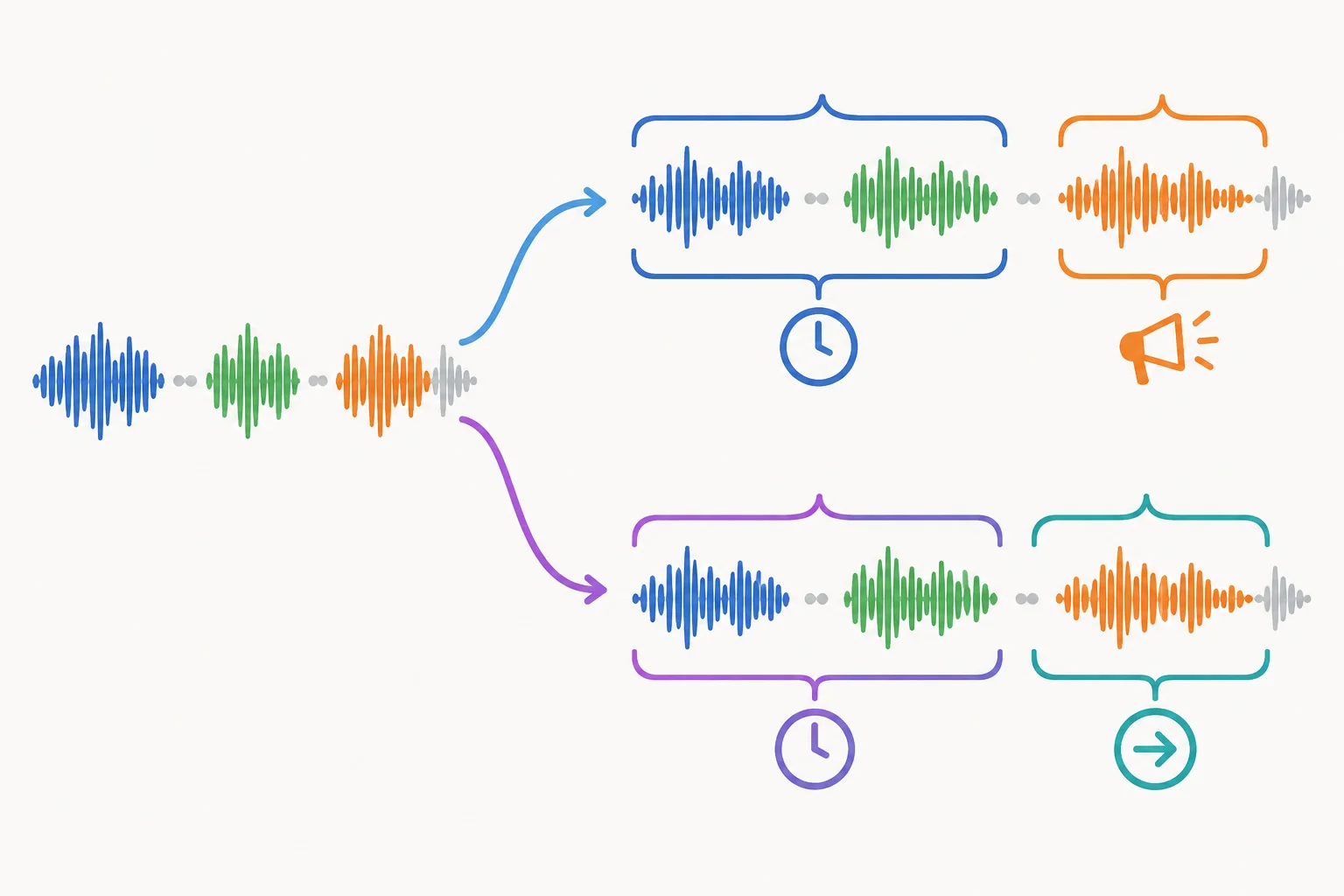
A boundary can make one grouping easier to hear, but the words and context still establish the meaning.
Tip
In annotated rehearsal, capitals mark contrastive prominence and | marks a phrase boundary. These marks are not ordinary spelling or punctuation. A polished notice should state its meaning explicitly instead of relying on a pause to repair ambiguous wording.
Maya told Leo after the briefing to confirm the registration volunteers' attendance.
Maya told Leo after the briefing to confirm the registration volunteers' attendance.
Both recordings use exactly the same words. Which pairing of recording and full paraphrase is best supported by the boundary placement?
Listen and write what you heard.
Listen and type the complete sentence with normal capitalization and punctuation.
Read this explicit revision aloud twice:
The 4 setup volunteers must attend the briefing. The 8 other volunteers may attend but are not required to attend.
On the second reading, make the obligation and permission audible without overperforming them. Then write an annotated rehearsal version using capitals for any contrastive prominence and | for any phrase boundary. Add 1 sentence reporting whether your delivery preserves the intended scope.
Write at least 100 characters (0/100).

Step 8 of 9
Decide when a deliberate double meaning adds useful engagement and when explicit wording is necessary to prevent different actions.
Retain a deliberate double meaning when it is low-stakes, its readings are recoverable for the intended audience, and both readings support a clear purpose such as a playful headline.
Clarify or replace it when readers may take different actions, misunderstand a commitment, or miss a necessary meaning. A playful line may remain, but the practical instruction beside it must be explicit.
Ask three questions: Can readers recover both readings? Does the double meaning serve a purpose? Could it change what someone does?

Use wordplay for engagement when the audience can recover it; make consequential actions explicit.
Choose the editorial response that matches the likely effect of the wording.
| Editorial choice | Use it when | What to do |
|---|---|---|
| Retain | Both readings are recoverable and harmless | Keep the wordplay; state logistics separately. |
| Clarify | The appealing wording can stay, but action needs precision | Add a direct instruction beside it. |
| Replace | Different readings could produce different actions | Use one explicit expression instead. |
A Riverside Skills Workshop promotion says: “Make some noise for the workshop!” Below it, the notice says: “The percussion session begins at 19:00 in Hall B.” What is the best editorial decision?
Compare these 2 Riverside Skills Workshop messages.
1. Promotional headline: “Turn up for clearer sound.”
Context: it promotes an audio demonstration. A separate line states: “Join the audio demonstration at 18:00 in Studio 2.”
2. Entry instruction: “Check bags at the desk before entering.”
Intent brief: every visitor must hand all bags to a staff member at the desk for storage before entering.
For each message, identify the wording with the double meaning and decide whether to retain, clarify, or replace it. Justify both decisions using recoverability, purpose, and likely action. Write an explicit Revision for message 2.
Write at least 280 characters (0/280).

Step 9 of 9
Produce a clear Riverside Skills Workshop notice from an ambiguous draft, test it against spoken clarification, and defend the revisions that control its interpretation.
Use these facts—not an editor’s guess—to finalize the Riverside Skills Workshop notice.
Optional playful heading: Count Us In? It can appear separately from the practical instructions.
Keep the attendance rule separate from the confirmation duty.

The attendance groups differ, but the confirmation path begins with all 12 volunteers.
Original
“The 4 setup volunteers must attend the briefing, and the 8 other volunteers may attend; they must confirm availability to Leo by 17:00 on 14 June 2027. Maya will send the final notice.”
The coordinated description of 2 groups comes before they. The pronoun can therefore support more than 1 plausible reading. The draft also omits the deadline’s venue local time and does not state Maya’s exclusive authority.
Original: “The 4 setup volunteers must attend the briefing, and the 8 other volunteers may attend; they must confirm availability to Leo ...”
Reading A: they refers to the 8 other volunteers. The unintended implication is that the 4 setup volunteers do not need to confirm.
Reading B: they refers collectively to the 2 groups just named. All 12 volunteers must confirm.
Intended meaning: Reading B.
Revision: Name all 12 volunteers as the people who must confirm. Keep the attendance statements separate so permission to attend does not appear to limit the confirmation duty.
Use the check to ensure that each change removes a specific risk without changing the supplied commitments.
| Wording to inspect | Risk or missing fact | Targeted revision |
|---|---|---|
| “they must confirm” | The duty may apply only to the 8 other volunteers. | Name all 12 volunteers as the people who must confirm. |
| Attendance and confirmation in one sentence | Optional attendance may appear to govern confirmation. | Use separate sentences for attendance and confirmation. |
| “by 17:00 on 14 June 2027” | The deadline lacks its time context. | Add “venue local time.” |
| “Maya will send” | A likely sender is stated, but exclusive authority is not. | State that Maya is the only person authorized to send the final notice. |
Before finalizing, verify 4 points:
A spoken delivery can support these distinctions, but it cannot add a fact the written notice omits. Retain a harmless double meaning only when it remains separate from the required action.
Listen and choose an option.
Listen to Maya’s short clarification. Which editorial conclusion is fully supported?
To be clear, all 12 volunteers must confirm their availability to Leo by 17:00 on 14 June 2027, venue local time. The 4 setup volunteers must attend the briefing. The 8 other volunteers may attend, but are not required to attend. Maya alone is authorized to send the final notice.
Use the written intent brief, the Original, and Maya’s spoken clarification. Your polished notice must be ordinary written English: do not use grouping brackets, stress capitals, or | boundary marks.
You may retain Count Us In? only as a separate playful heading, never as a substitute for a practical instruction.
Complete all parts.
Reading A: State one plausible reading of they in the Original.
Reading B: State the other plausible reading.
Revision: Write a 50–70-word final notice. Preserve every fixed fact about attendance, confirmation, the deadline, and Maya’s exclusive authority.
Then read your Revision aloud. Use supportive prominence and phrase boundaries, and explain aloud 1 edit: name the reading it removes and the meaning it preserves.
Finally, add a brief written self-check: confirm the 4 attendance facts, then decide whether Count Us In? may remain as a separate heading and justify your decision by its effect on practical action.
Write at least 420 characters (0/420).
Congratulations! You completed: Control Meaning and Ambiguity
Thousands of online courses in video, ebooks and audiobooks.
To test your knowledge during online courses
Generated directly from your cell phone's photo gallery and sent to your email

Download our app via QR Code or the links below:.



Carry knowledge in your pocket.
Download the Cursa app.
There are hundreds of free courses available, with a free certificate of completion that is saved in your mobile image gallery.
Download the app to access the Course Completion Certificate for Free.


+ 10 million
students

Free and Valid
Certificate

60 thousand free
exercises

4.8/5 rating in
app stores

Free courses in
video and ebooks