
Step 1 of 7
Separate Variety, Register, and Individual Style
Distinguish shared variety patterns, situation-based register choices, and personal style without treating unfamiliar English as incorrect.

Learning path · Level 12 · Tutorial 3
Understand unfamiliar English usage in short scheduling and everyday exchanges. Read contextualized dialogues, listen to selected variety features, choose the intended meaning, and complete a short dictation. Write an accurate restatement and rehearse a practical clarification aloud. Focus on understanding and intelligibility, not on copying an accent or replacing a speaker's variety.

 Separate Variety, Register, and Individual Style
Distinguish shared variety patterns, situation-based register choices, and personal style without treating unfamiliar English as incorrect. 3 min
 Recognize Habitual Meaning
Interpret habitual be as a recurring pattern while withholding unsupported conclusions about the current occasion. 4 min
 Confirm an Earlier Appointment
Interpret prepone in a workshop scheduling exchange, distinguish an earlier proposal from a confirmed appointment, and ask a focused confirmation question. 3 min
 Hear Pronunciation Differences Without Labeling Speakers
Recognize selected rhotic and non-rhotic realizations while preserving word recognition and avoiding unsupported conclusions about speaker identity. 3 min
 Listen for Meaning, Then Check the Detail
Use meaning-first listening, targeted replay, and dictation to understand an unfamiliar-variety scheduling exchange without inventing details or silently rewriting the speaker’s wording. 3 min
 Restate Accurately and Clarify Respectfully
Preserve a speaker’s meaning while using clear, respectful wording to restate and clarify a scheduling message. 3 min
 Apply a Meaning-First Approach
Integrate reading, listening, restatement, and respectful clarification in a final community workshop scheduling exchange. 4 min
Step 1 of 7
Distinguish shared variety patterns, situation-based register choices, and personal style without treating unfamiliar English as incorrect.
When English differs from what you expect, first ask what kind of difference you are noticing. A variety involves shared patterns of grammar, vocabulary, or pronunciation. A register is language chosen for a situation, such as a formal email or a casual conversation. Individual style is one speaker’s personal tendency, such as using very brief messages or a favorite closing.
These dimensions can overlap. A person can use a shared variety pattern while choosing a formal register and still have a distinctive individual style. No single spoken variety is a universal norm.

Use the evidence available: shared pattern, situation, or one speaker’s repeated preference. More than one dimension may apply.
The source of a difference is not always visible from one sentence. Look for evidence across speakers, situations, or repeated choices.
| Dimension | Main evidence | What it does not prove |
|---|---|---|
| Variety | A shared, systematic pattern in a speech community | That every member uses it identically |
| Register | A choice suited to a situation, audience, or purpose | A speaker’s permanent way of speaking |
| Individual style | A personal tendency repeated by one speaker | A pattern shared by a whole community |
| Regional usage | An association with a region | A rule followed by every person in that region |
A speech community shares linguistic practices, but its members do not speak identically. Likewise, regional usage signals an association, not a guarantee about any individual.
Focus on intelligibility: Was the intended message understood? Familiarity with your own usual English is not the measure of correctness. If the wording is unfamiliar but the evidence is limited, do not turn uncertainty into a judgment about the speaker.
Tip
Treat an unfamiliar form as a cue to investigate context—not as proof of an error or proof of a speaker’s background.
Match each description to the best interpretation.
Tap an item and then its matching pair.

Step 2 of 7
Interpret habitual be as a recurring pattern while withholding unsupported conclusions about the current occasion.
In African American English (AAE), habitual be can mark a recurring situation. It signals a pattern, not simply an alternative form for every use of am, is, or are.
For example, “Jordan be free Tuesday afternoons” communicates a usual availability pattern. It does not, by itself, say whether Jordan is free at the moment of speaking.
Habitual be is associated with AAE, but it is not used by every AAE speaker in every situation.
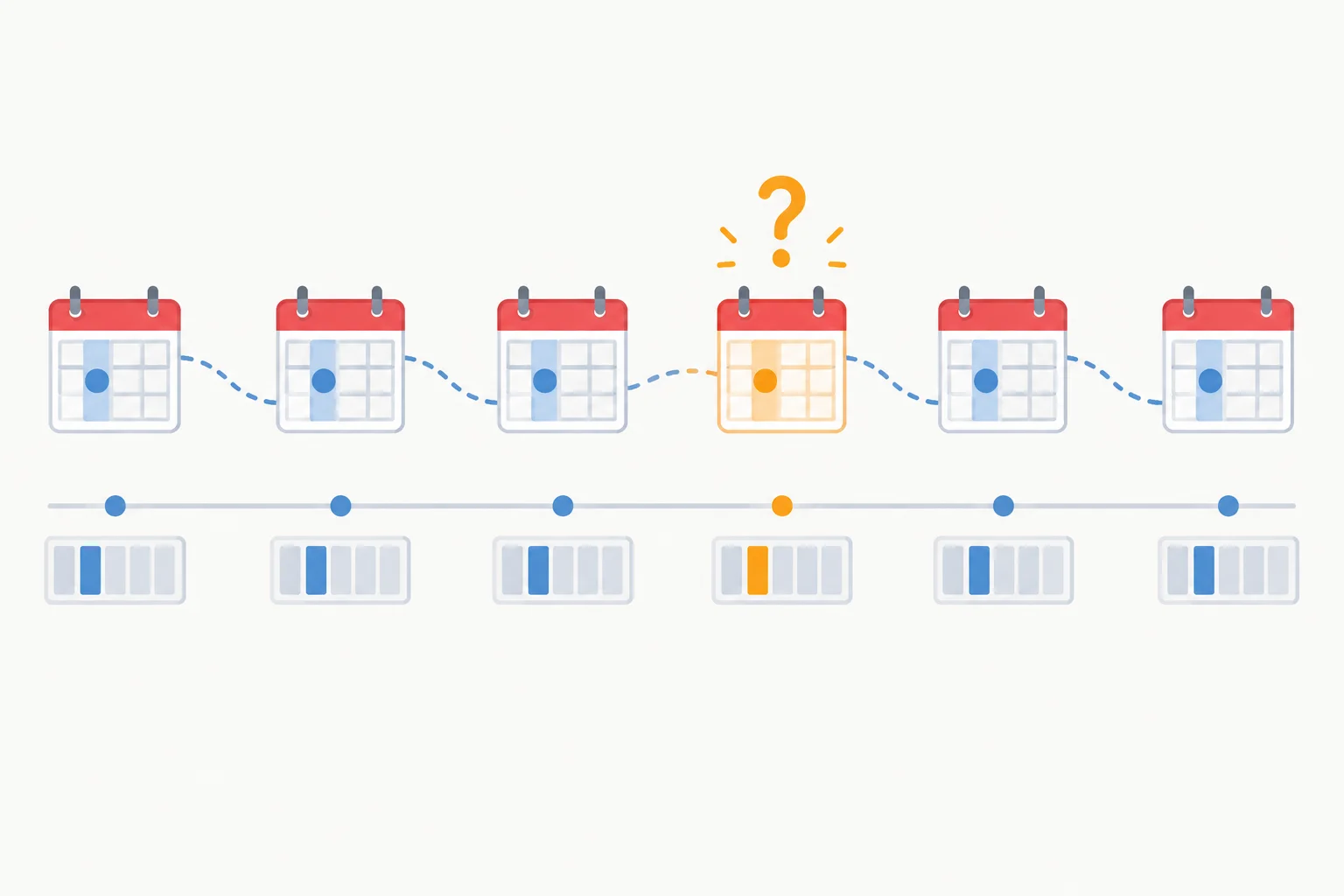
Repeated Tuesday afternoons represent habitual meaning. A particular date still needs its own evidence.
Read the exchange in context:
Alex: We are planning the community workshop for Tuesday 18 September at 3:00 p.m. Do you usually have time Tuesday afternoons?
Jordan: I be free Tuesday afternoons.
Jordan’s wording establishes a recurring availability pattern. The word usually and the time expression Tuesday afternoons help identify that pattern.
However, a pattern is not an exceptionless rule. The exchange does not yet establish whether Jordan can attend on Tuesday 18 September.
Example
Original wording
Jordan: “I be free Tuesday afternoons.”
Meaning
Jordan has recurring Tuesday-afternoon availability.
Not established by this wording alone
Whether Jordan is free right now, or whether Jordan can attend on one particular Tuesday.
A recurring situation and a current event may coincide, but habitual meaning alone neither confirms nor denies the current event.
True or false: If Jordan says, “I be free Tuesday afternoons,” Jordan cannot be free at the moment of speaking.
Read this exchange. Which interpretation is supported?
Alex: Could you assist with the community workshop on Tuesday 18 September at 3:00 p.m.?
Jordan: I be free Tuesday afternoons, though I need to look at my calendar.

Step 3 of 7
Interpret prepone in a workshop scheduling exchange, distinguish an earlier proposal from a confirmed appointment, and ask a focused confirmation question.
A word can be unfamiliar because it is regional usage, not because it is defective. In some Indian English contexts, prepone means to move an event to an earlier time or date.
Use the scheduling context to interpret it. Here, the workshop already has an arrangement; Jordan raises a possible earlier arrangement. This association with some Indian English contexts does not mean that every speaker in those contexts uses the word.
Example
Original wording
Alex: The community workshop is scheduled for Tuesday 18 September at 3:00 p.m.
Jordan: Could we prepone it to 2:00 p.m.?
Alex: I need to check before I confirm it.
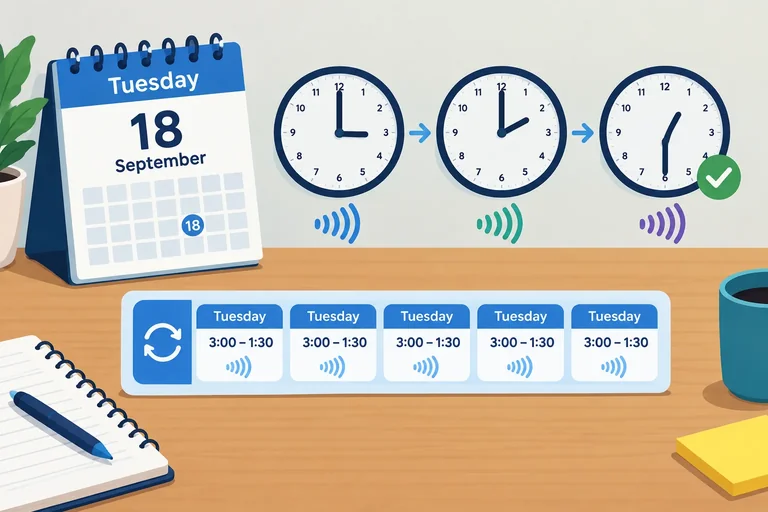
The original arrangement is Tuesday 18 September at 3:00 p.m. Jordan proposes an earlier time: Tuesday 18 September at 2:00 p.m. The diagram’s direction is 3:00 p.m. → 2:00 p.m.
The question form “Could we …?” signals a proposal. It does not itself confirm that the workshop has changed.
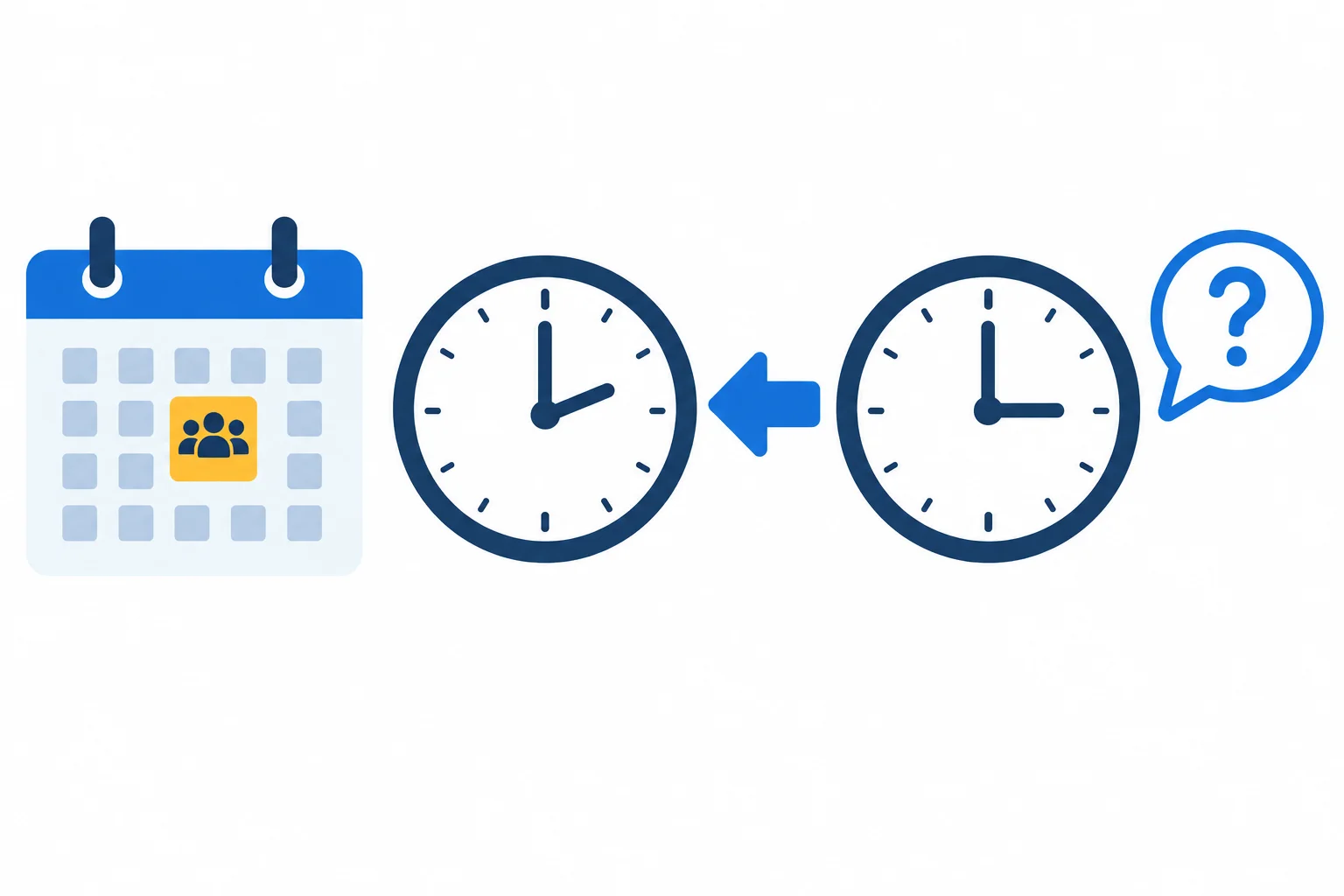
Schedule meaning: Tuesday 18 September, 3:00 p.m. → 2:00 p.m.; the move is proposed, not yet confirmed.
A practical clarification checks the consequence, rather than questioning the legitimacy of the expression.
Clarification
“Can you confirm that the workshop on Tuesday 18 September is moving from 3:00 p.m. to 2:00 p.m.?”
This wording checks the date, the direction of the change, and whether the proposal is agreed. You may use more familiar wording yourself while accurately understanding the regional usage.
Keep the possible interpretations separate.
| Possible interpretation | Fits the exchange? | Reason |
|---|---|---|
| Move the event earlier | Yes | 3:00 p.m. → 2:00 p.m. |
| Move the event later | No | 2:00 p.m. is earlier than 3:00 p.m. |
| Make the event shorter | No | No duration changes |
| Make an unspecified change | No | A specific earlier time is given |
Complete the meaning: In the exchange, prepone describes moving the workshop to an __ time.
For the Alex–Jordan exchange, select the response that accurately records the original arrangement and proposal, then checks whether the change is agreed.

Step 4 of 7
Recognize selected rhotic and non-rhotic realizations while preserving word recognition and avoiding unsupported conclusions about speaker identity.
Rhotic and non-rhotic describe selected pronunciation patterns, not better or worse English.
In selected rhotic pronunciations, an r after a vowel is heard in words such as work and start. In selected non-rhotic pronunciations, that r is not heard when it comes before a consonant or a pause.
The written word and intended message remain the same. Non-rhotic does not mean that every r is absent: position matters.
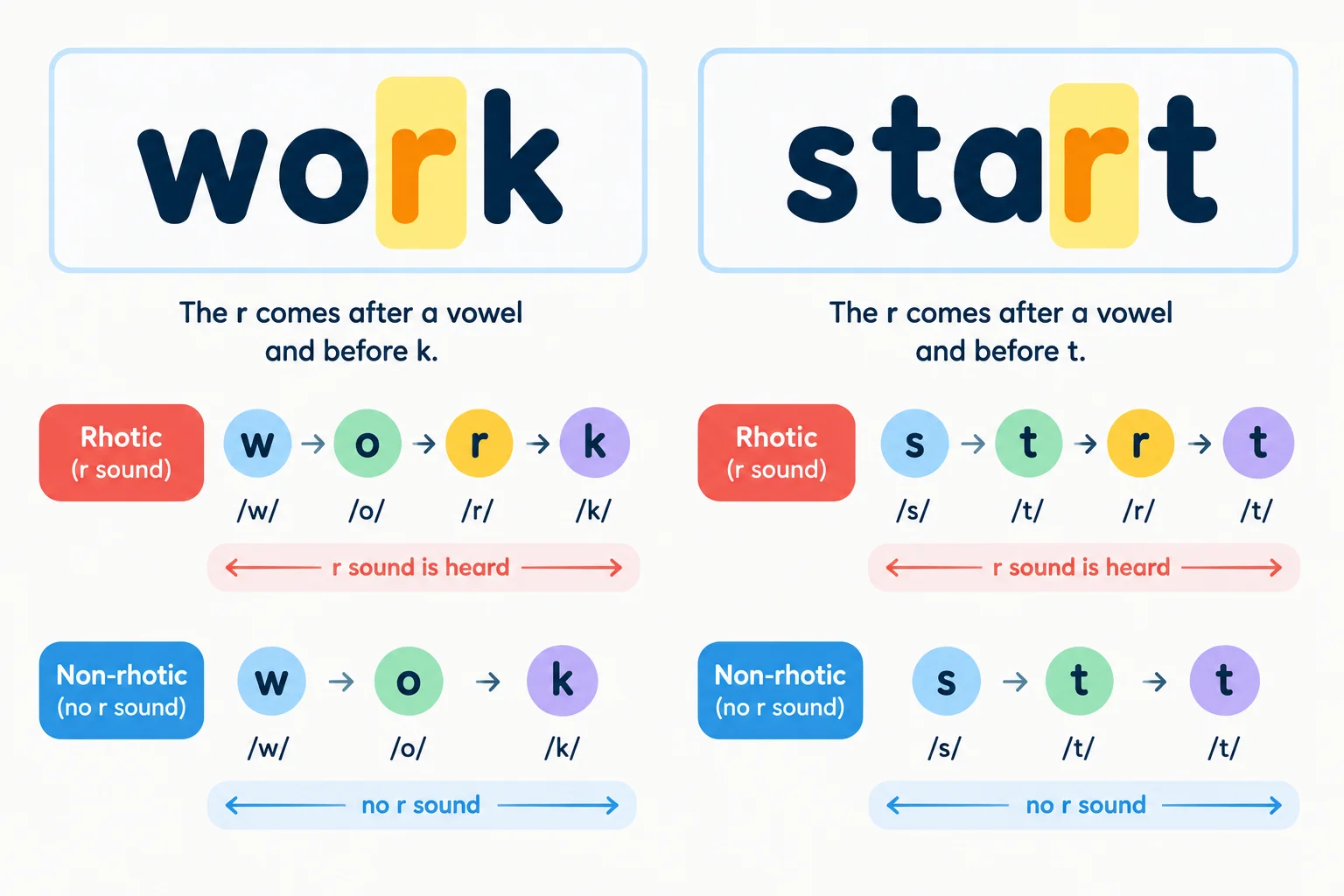
In both anchor words, the relevant r follows a vowel and comes before a consonant. This position makes the comparison reliable.
Now compare two recordings of the same workshop message. Focus first on recognizing the message; then notice whether the post-vowel r in start is heard before the t of time.
A pronunciation feature can occur across multiple speech communities, and speakers vary across situations. One feature is not enough evidence for a speaker’s nationality, ethnicity, or complete linguistic background.
The community workshop's start time is 3:00 p.m.
The community workshop's start time is 3:00 p.m.
Tip
Treat pronunciation as evidence about this recording, not as a shortcut to identity. Your aim is intelligibility: recognize the word and message, then describe only what the sound supports.
Listen again to Sample A and Sample B on the previous screen. Which conclusion is supported by the recordings?

Step 5 of 7
Use meaning-first listening, targeted replay, and dictation to understand an unfamiliar-variety scheduling exchange without inventing details or silently rewriting the speaker’s wording.
When a recording uses an unfamiliar variety, begin with meaning rather than with a word-by-word comparison to your usual pronunciation.
On a first listen, identify the situation, the intended action, and any practical detail that still needs checking. Then replay with one focused question. This prevents one uncertain sound from obscuring the whole message.
The aim is intelligibility: successful understanding. An unfamiliar feature is not evidence that the speaker has said something defective.

First establish the situation and action; then use a focused replay to check one uncertainty.
Tip
Context can narrow the possibilities, but it cannot supply information that was not spoken. Do not invent a time, a confirmation, or attendance on a particular date simply because it would make the exchange easier to understand.
Stressed content words often anchor an action or a time. Surrounding grammar tells you how those anchors relate. A phrase such as “Tuesday afternoons” can describe a recurring pattern, while another phrase identifies one particular date.
Listen first for the broad situation. On replay, ask one precise question: Is the speaker describing a recurring availability pattern, a current event, or an arrangement that still needs confirmation?
Listen once for the main distinction. Then read the transcript and notice how recurring availability differs from confirmation for one date.
Jordan: Alex be free Tuesday afternoons, but we still need to confirm the workshop for Tuesday 18 September.
Jordan: Alex be free Tuesday afternoons, but we still need to confirm the workshop for Tuesday 18 September.
Tip
The stressed phrases help you locate the recurring pattern and the specific date. The grammar around habitual be identifies availability as a pattern; it does not settle whether Alex will attend on this particular Tuesday.
Listen and choose an option.
Listen for the practical meaning. Which record is supported by the recording?
Jordan: Can we prepone the community workshop on Tuesday 18 September from 3:00 p.m. to 2:00 p.m.? I can confirm after I check.
Listen and write what you heard.
Replay the sentence and type the Original wording exactly as you hear it.

Step 6 of 7
Preserve a speaker’s meaning while using clear, respectful wording to restate and clarify a scheduling message.
Accommodation means adjusting your own communication so that meaning is easier to share. It does not mean asking another speaker to abandon their variety, and it does not require you to imitate an accent.
When you respond, make the practical details easy to hear: the action, the date, the time, and whether a plan is only proposed or already confirmed. This supports intelligibility while respecting the original wording.

Keep the speaker's meaning intact, then make the relevant practical detail explicit in your own wording.
Tip
Before you restate or clarify, check three things: What pattern or event is being described? What change is proposed? What still needs confirmation?
Example
Original wording
Jordan: “Alex be available Tuesday afternoons.”
Restatement
Alex is usually available on Tuesday afternoons.
Clarification
Does that include this Tuesday?
The restatement preserves the habitual meaning: it describes a recurring pattern. It does not claim that Alex is available at this exact moment or on every Tuesday without exception.
A faithful restatement can use more broadly familiar wording, but it must keep the source's meaning and certainty.
| Original wording | Meaning to preserve | Possible restatement |
|---|---|---|
| Alex be available Tuesday afternoons. | A recurring availability pattern; not a claim about this occasion. | Alex is usually available Tuesday afternoons. |
| Could we prepone the community workshop on Tuesday 18 September from 3:00 p.m. to 2:00 p.m.? | A suggested move to an earlier time; it is not yet confirmed. | Jordan proposes moving the workshop earlier, from 3:00 p.m. to 2:00 p.m. |
Build a respectful question that checks whether the proposed earlier time has been confirmed.
Your sentence
Available words
Read the message, then write a restatement in different wording.
Original wording
Jordan: “Alex be available Tuesday afternoons. Could we prepone the community workshop on Tuesday 18 September from 3:00 p.m. to 2:00 p.m.?”
Your restatement must keep both the recurring availability pattern and the fact that the time change is a proposal, not a confirmation.
Tip
Say the clarification you built on the previous screen aloud in your own voice. Use manageable pacing and make the key action, date, and time audible. Aim for intelligibility; do not imitate another person's accent.
Write 2–3 sentences. First, restate Jordan’s message in your own wording while preserving the recurring pattern and the proposed status of the schedule change. Then report whether, after saying your clarification aloud, the key action and time were clear.
Write at least 120 characters (0/120).
Step 7 of 7
Integrate reading, listening, restatement, and respectful clarification in a final community workshop scheduling exchange.
Read the chronology before interpreting any one feature.
Original wording
Alex: The community workshop was initially scheduled for Tuesday 18 September at 3:00 p.m. We proposed moving it from 3:00 p.m. to 2:00 p.m., but that was not confirmed.
Jordan: I be free Tuesday afternoons, but I need to check whether I can attend on Tuesday 18 September.
The next screen contains Jordan’s later follow-up. Keep two questions separate: What time is proposed or confirmed for the workshop? Is Jordan’s attendance on this particular date established? A recurring availability pattern does not settle attendance on one occasion.

The proposed change from 3:00 p.m. to 2:00 p.m. and a recurring Tuesday-afternoon pattern are different kinds of evidence.
Both recordings are Jordan’s later follow-up, before Alex gives a final confirmation. Listen first for the proposed action, time, and attendance status. Then notice the relevant r in start and work. The two samples use the same words; do not use either pronunciation to assign an identity to Jordan.
Listen to the follow-up once for its practical meaning.
Could we prepone the community workshop to 1:30 p.m.? I start work then, and I still need to check whether I can attend on Tuesday 18 September.
Listen to the same follow-up again.
Could we prepone the community workshop to 1:30 p.m.? I start work then, and I still need to check whether I can attend on Tuesday 18 September.
Based on the recordings, which account is supported?
Alex now replies after Jordan’s later proposal:
Original wording
Alex: Yes. The community workshop is confirmed for Tuesday 18 September at 1:30 p.m.
This is the final appointment status. Jordan’s habitual meaning still describes a recurring Tuesday-afternoon pattern, and Jordan has still said that attendance on this date needs checking. Confirming the workshop does not automatically confirm Jordan’s attendance.
Tip
Use this meaning-first sequence whenever a form or sound is unfamiliar:
Summary
Write two labeled parts.
Restatement: In 40–60 words, faithfully restate the full scheduling outcome and Jordan’s availability information. Preserve the difference between the confirmed workshop time and Jordan’s unresolved attendance. Do not label the original wording as defective.
Self-check: Add one brief sentence saying how your response preserved fidelity, interpretive caution, respectful wording, and intelligibility.
Then rehearse aloud for 20–30 seconds: say a brief version of your restatement, followed by Clarification: and one focused question asking whether Jordan can attend on Tuesday 18 September. Use clear wording and manageable pacing; do not imitate either sample’s pronunciation.
Write at least 280 characters (0/280).
Congratulations! You completed: Understand Unfamiliar Varieties of English
30 XP
Thousands of online courses in video, ebooks and audiobooks.
To test your knowledge during online courses
Generated directly from your cell phone's photo gallery and sent to your email

Download our app via QR Code or the links below:.



Carry knowledge in your pocket.
Download the Cursa app.
There are hundreds of free courses available, with a free certificate of completion that is saved in your mobile image gallery.
Download the app to access the Course Completion Certificate for Free.


+ 10 million
students

Free and Valid
Certificate

60 thousand free
exercises

4.8/5 rating in
app stores

Free courses in
video and ebooks