 HVAC Training


It teaches the principles, equipment, installation, maintenance, and repair of cooling and climate-control systems.

9

1

2


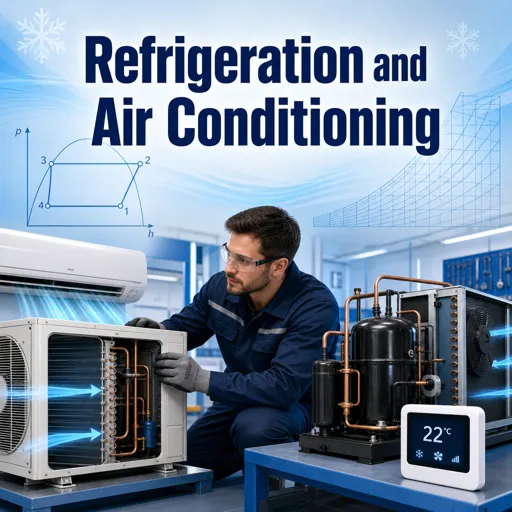
Build job-ready HVAC skills with this free refrigeration and air conditioning course—learn cycles, COP/EER, refrigerants and ratings, plus practice questions.
5

(4)

9h11m

6 exercises
Build in-demand HVAC skills with a free air conditioning course—learn installation best practices, troubleshooting, charging and airflow to work smarter, faster.
4.7

(6)
10h15m
14 exercises
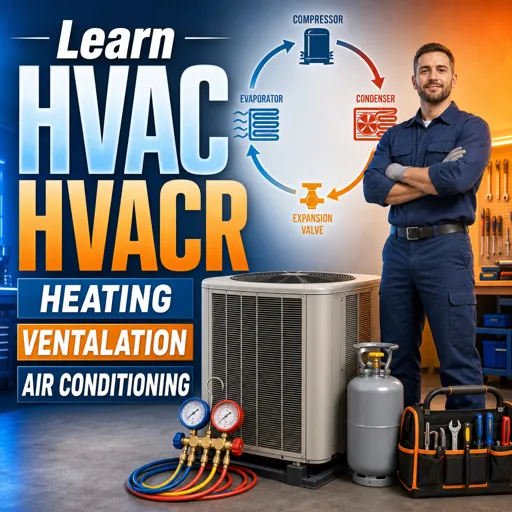
Build job-ready HVACR skills fast with this free online course—learn refrigeration cycles, gauges, superheat/subcooling, and diagnostics for real systems.
4.3
(7)
34h21m
43 exercises
Free CourseRefrigeration and air-conditioning
5
(1)
17h58m
30 exercises
Free CourseFundamentals of HVAC
5
(2)
58m
6 exercises
Free CourseHVAC training
5
(3)
4h01m
8 exercises
Free CourseRefrigeration and Air Conditioning Technician
4.8
(4)
1h18m
Free CourseIntroduction to market HVAC and Refrigeration
4.7
(3)
1h04m
6 exercises
Exercises
Test your knowledge of nitrogen pressure testing, deep-vacuum procedures, micron gauges, dehydration, and leak detection.
Start exercisesTest your knowledge of air conditioning system efficiency, refrigerants, maintenance, indoor air quality, and AC component functions.
Start exercisesTest your knowledge of HVAC control systems, including thermostats, sensors, dampers, zoning, VAV/CAV systems, and airflow control.
Start exercisesTest your knowledge of refrigeration and air conditioning heat transfer, including evaporators, condensers, compressors, refrigerants, and airflow.
Start exercisesTest your knowledge of refrigeration and air conditioning system components, including compressors, condensers, evaporators, expansion valves, and thermostats.
Start exercisesTest your knowledge of thermodynamics in refrigeration and air conditioning, including refrigerant cycles, compressors, evaporators, condensers, and COP.
Start exercises
Common Problems in Refrigeration Systems and How to Fix Them
Refrigeration issues like poor cooling, leaks, and noise often stem from dirty coils, faulty seals, and blocked drains. Cleaning and part checks can resolve most.

Essential Tools and Equipment for Air Conditioning Technicians
Starting a career as an air conditioning technician requires not only a solid foundation of knowledge and skills but also the right tools and equipment. Proper training courses will cover the use of these essential items, ensuring that technicians are well-prepared for any job. Here is a detailed look at the essential tools and equipment every air conditioning technician should have.
Develop practical and theoretical knowledge with free online courses designed for students, aspiring technicians, maintenance professionals, and anyone interested in climate-control technology. The learning content introduces HVAC and HVACR systems through educational topics such as thermodynamics, heat transfer, the vapor-compression refrigeration cycle, indoor air quality, ventilation, humidity control, refrigerants, and energy efficiency.
Study the operation of compressors, condensers, evaporators, expansion devices, ducts, fans, thermostats, electrical controls, and heat pumps. Lessons also address system installation, preventive maintenance, fault diagnosis, pressure and temperature measurement, load calculations, component inspection, and safe servicing procedures. Exercises help reinforce technical concepts, support knowledge retention, and encourage learners to apply diagnostic reasoning to realistic equipment scenarios.
All courses are free and offer structured lessons, learning exercises, and free certification. Learners can study at their own pace, review important procedures, and strengthen competencies relevant to residential, commercial, and industrial cooling systems. The selection supports introductory education as well as continued technical development.
To access the courses, install the Cursa app on your mobile device. Android users can select Download for Android through Google Play. Apple users can select Download for iOS / iPhone through the App Store. After installation, choose a course and begin studying refrigeration principles, air-conditioning technology, equipment servicing, and HVAC troubleshooting for free.
What is refrigeration and air conditioning training?
It teaches the principles, equipment, installation, maintenance, and repair of cooling and climate-control systems.
Can beginners learn HVAC and refrigeration online?
Yes. Beginner courses cover the refrigeration cycle, basic HVAC components, tools, safety, and common system operation.
What is the refrigeration cycle?
It is the process in which refrigerant absorbs heat at the evaporator and releases it at the condenser through compression and expansion.
What skills are needed for an air conditioning technician?
Technicians need to understand electrical basics, refrigerant handling, diagnostics, system installation, airflow, and safe work practices.
What tools are used in HVAC and refrigeration work?
Common tools include manifold gauges, vacuum pumps, multimeters, thermometers, leak detectors, recovery machines, and charging scales.
Do HVAC courses teach air conditioner installation?
Yes. Many courses explain system sizing, component connections, piping, electrical wiring, evacuation, charging, and startup checks.
Why is HVAC safety training important?
Safety training helps prevent electrical injury, refrigerant exposure, burns, pressure-related accidents, and improper handling of equipment.

Complete any course and issue your certificate via the app — at no cost.

Download the app! to have access to more than 4,000 Online Courses + Certificate, all free!
Download the app! 100% free courses.


Carry knowledge in your pocket.
Download the Cursa app.
There are hundreds of free courses available, with a free certificate of completion that is saved in your mobile image gallery.
Download the app to access the Course Completion Certificate for Free.


+ 10 million
students

Free and Valid
Certificate

60 thousand free
exercises

4.8/5 rating in
app stores

Free courses in
video and ebooks
What are people saying about free online courses of Refrigeration and air conditioning
Jean
I would recommend Ekeeda to anyone who wants to learn andbgrow as a person. Now after completing the courses I can boldly say I stand a better chance.
CourseRefrigeration and Air conditioning
Jean
This is a good app to learn and to grow as a person, after completing the cours I can that I stand a better chance to find a job. I recommend this pla
CourseRefrigeration and Air conditioning
Martin Márk Herr
This has been interesting and informative. I liked the use of real examples as this helped me understand the different components.
CourseFundamentals of HVAC
Samuel Epale
I'm very happy to have discovered this content. I want to learn HVAC and I'm giving myself every chance to succeed, Thank you for everything you do.
CourseHVAC training
Nick Brooks
I actually already had the HVAC School app, so already familiar. However I am self taught with HVAC already replacing the Capacitor and the Contactor.
CourseAir Conditioning Training