
Step 1 of 8
Say What Is Happening Now
Use the present continuous to describe familiar actions happening now.

Learning path · Level 3 · Tutorial 1
Say what you and other people are doing now. Ask questions and say what is not happening. Read and listen to short messages. Choose between an everyday routine and an action now, then say and write your own short update.

 Say What Is Happening Now
Use the present continuous to describe familiar actions happening now. 3 min
 Make the -ing Form
Write four common -ing forms correctly in short present continuous sentences about actions now. 2 min
 Say What Is Not Happening
Correct mistaken descriptions of actions happening now with I'm not, isn't, and aren't. 2 min
 Ask About an Action Now
Ask and answer simple questions about actions happening now. 3 min
 Every Day or Now?
Choose the present simple for routines and the present continuous for actions happening now. 3 min
 Read and Listen to Short Updates
Use short messages to find people, actions, negative clues, and the difference between a routine and an action happening now. 3 min
 Hear and Say the -ing Ending
Hear, write, and say the -ing ending clearly in short present continuous sentences. 2 min
 Share Your Update
Bring together reading, listening, questions, and writing to share a short update about actions happening now. 4 min
Step 1 of 8
Use the present continuous to describe familiar actions happening now.
Look at the actions in the picture. They are happening now. English calls this form the present continuous.
Pattern: am/is/are + action word ending in -ing
Anchor example: I am waiting.
Use now or at the moment to show that an action is current.

Sam is waiting for a bus. Lina is taking a photo. Noor is making lunch.
Choose am, is, or are for the person. Then use an action word ending in -ing.
In everyday speech and messages, short forms are common. The arrow shows the full form and the short form.
Use these forms for actions happening now.
| Person | Full form → short form | Example |
|---|---|---|
| I | I am → I'm | I'm waiting. |
| Sam (he) | he is → he's | He's waiting for a bus now. |
| Lina (she) | she is → she's | She's taking a photo. |
| Noor (she) | she is → she's | She's making lunch at the moment. |
| two friends (they) | they are → they're | They're sitting. |
Listen for the short forms and the action words.
I'm waiting for a bus now. She's taking a photo. She's making lunch at the moment. They're sitting.
I'm waiting for a bus now. She's taking a photo. She's making lunch at the moment. They're sitting.
Put the pieces in order to describe Lina's action.
Your sentence
Available words
Build two short updates: one about yourself now and one about a group at the moment.
Your sentence
Available words

Step 2 of 8
Write four common -ing forms correctly in short present continuous sentences about actions now.
You already know the present continuous for actions now. Now focus on the spelling of the action word before you use it after am, is, or are.

These actions are happening now.
For these three action words, look at the letters before you add the -ing ending.
| Action word | Change | -ing form |
|---|---|---|
| wait | add -ing | wait → waiting |
| make | remove e, add -ing | make → making |
| take | remove e, add -ing | take → taking |
For this word, write two t letters before the -ing ending: sit → sitting. Learn this spelling as an example; you do not need a spelling rule for every action word yet.

Two friends are sitting at the moment.
Example
Two friends are sitting at the moment.
Tip
After am, is, or are, use the action word with its -ing ending. Keep the spelling you learned: waiting, making, taking, or sitting.
Match each action word to its -ing form.
Tap an item and then its matching pair.
Sam is __ for a bus now.
Noor is __ lunch at the moment.
Lina is __ a photo now.
Two friends are __ at the moment.

Step 3 of 8
Correct mistaken descriptions of actions happening now with I'm not, isn't, and aren't.
Use the present continuous to say an action is not happening now.
Put not after am, is, or are. Keep the action word ending in -ing.
Full form → short form
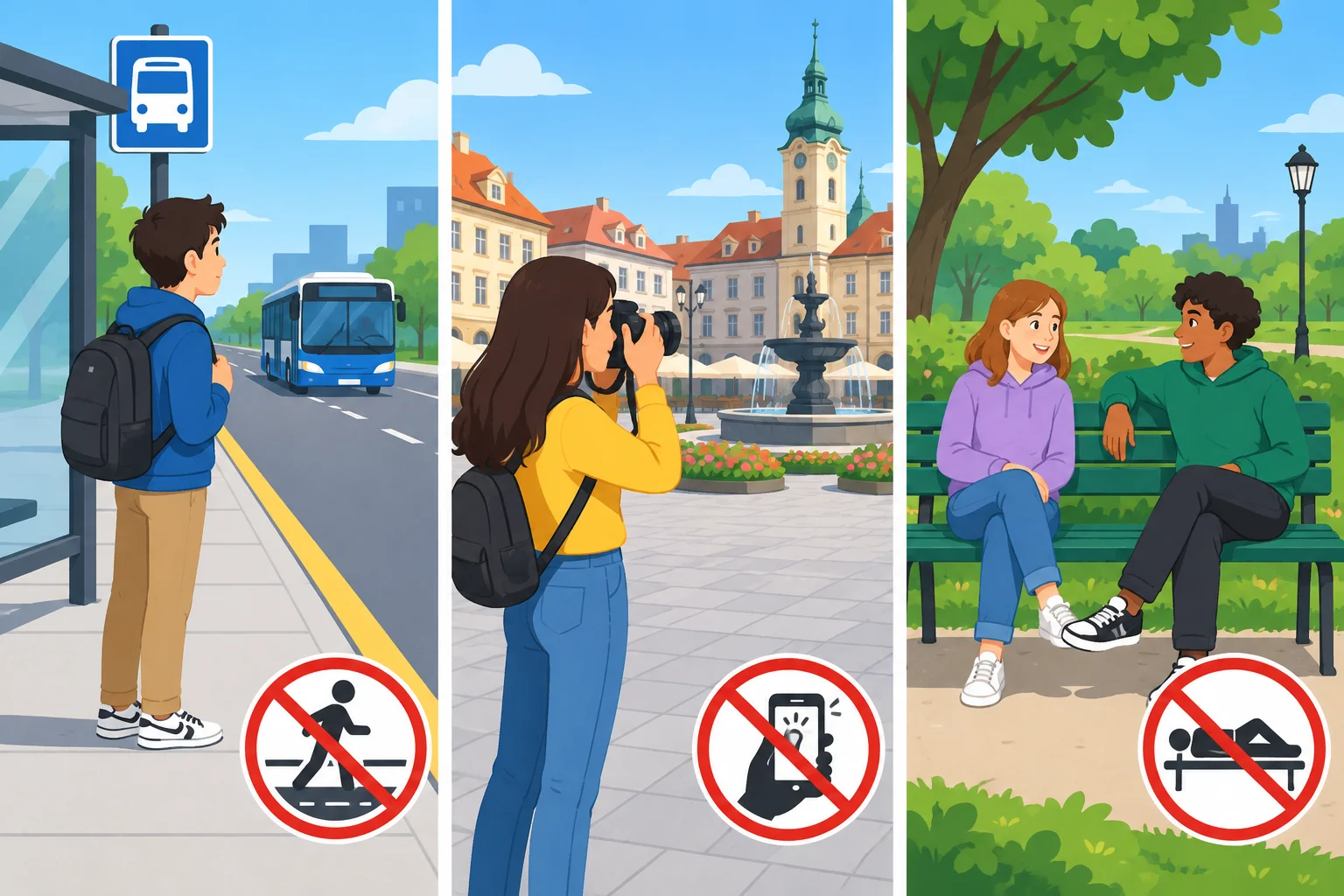
Look at what is really happening before you say what is not happening.
To correct a wrong description, use two short sentences:
Use I'm not, isn't, or aren't. The action word stays the same: waiting, taking, making, or sitting.
Example
Sam isn't taking a photo. He is → he's waiting for a bus.
Noor isn't sitting. She is → she's making lunch.
Two friends aren't waiting for a bus. They are → they're sitting.
Tip
Do not remove -ing in a negative sentence.
Correct: She isn't taking a photo.
The word not changes the meaning; taking stays an -ing form.

Check the action in the picture.
Look at the picture. Lina is waiting for a bus.
Use the picture on the previous screen. Someone says, “Lina is waiting for a bus.” Build a two-sentence correction.
Your sentence
Available words

Step 4 of 8
Ask and answer simple questions about actions happening now.
To ask a yes/no question about an action now, put am, is, or are before the person.
Sam is waiting for a bus. → Is Sam waiting for a bus?
Two friends are sitting. → Are two friends sitting?
For a short answer, use the person who answers. When a question says you, the speaker answering says I.
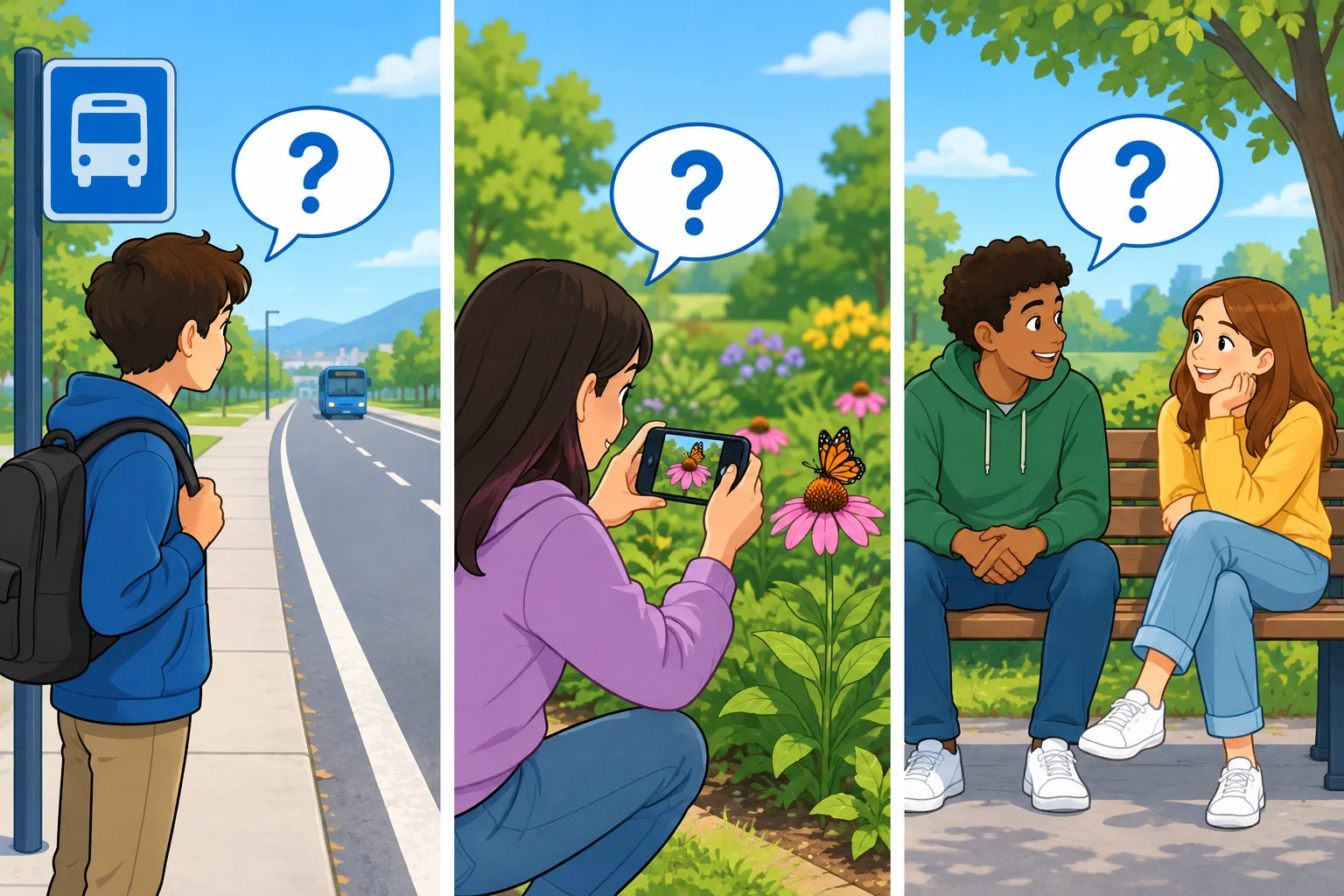
Ask about the person and action by putting am, is, or are first.
A question and answer usually keep the same person. But you changes to I when the listener answers about themself.
| Person in the question | Question | Affirmative answer | Negative answer |
|---|---|---|---|
| you | Are you waiting for a bus? | Yes, I am. | No, I'm not. |
| she | Is she taking a photo? | Yes, she is. | No, she isn't. |
| they | Are they sitting? | Yes, they are. | No, they aren't. |
Use What when you want information about the action.
What are you doing?
What is she doing?
What is he doing?
In a personal answer, change you to I.
What are you doing? → I'm waiting for a bus.
Listen to the exchange. Then say each question and answer aloud.
Are you waiting for a bus?
Yes, I am.
What are you doing?
I'm waiting for a bus.
Is Lina making lunch?
No, she isn't. She's taking a photo.
Are you waiting for a bus?
Yes, I am.
What are you doing?
I'm waiting for a bus.
Is Lina making lunch?
No, she isn't. She's taking a photo.
Tip
At the start of a yes/no question, make am, is, or are clear. Keep the action word ending in -ing.
Build a yes/no question about Sam and the bus.
Your sentence
Available words
Build a what question for another person.
Your sentence
Available words
Match each question to its suitable answer.
Tap an item and then its matching pair.

Step 5 of 8
Choose the present simple for routines and the present continuous for actions happening now.
First, look at the meaning. Use the present simple for a routine that happens again and again. Use the present continuous for an action happening now.
Choose the form that matches the time meaning.
| Meaning | Time clue | Pattern | Model |
|---|---|---|---|
| Routine | every day | action word | I walk every day. |
| Action now | now; at the moment | am/is/are + action word ending in -ing | I am → I'm taking the bus now. |

The left picture shows a regular routine. The right picture shows one action happening now.
Example
I walk every day. I'm taking the bus now.
The action can be similar, but the time meaning changes the sentence form.
Which sentence tells what Sam is doing at the moment?

Use the time meaning and the picture to choose each verb form.
Left picture: I ___ to work every day.
Right picture: I ___ the bus now.

Step 6 of 8
Use short messages to find people, actions, negative clues, and the difference between a routine and an action happening now.
A short update gives you clues. Find the person first. Then find the action ending in -ing. Notice not, isn't, and aren't: they show an action that is not happening.
Read the whole update for time clues too: every day is a routine; now and at the moment show what is happening now.

Look for the person, the action, and whether the action is happening or not.
Example
Noor makes lunch every day. At the moment, she's making lunch. Two friends aren't sitting. They're waiting for a bus.
Read this update:
“Sam walks every day. At the moment, he isn't taking a photo. He's waiting for a bus.”
True or false? Sam is taking a photo now.
Read the update, then match each person to the action happening now.
“Sam walks every day. At the moment, he's waiting for a bus. Lina isn't waiting. She's taking a photo.”
Tap an item and then its matching pair.
Listen to Noor's short update. Then choose the picture that matches what she is doing at the moment.
Hi, I'm Noor. I walk every day, but at the moment, I'm making lunch.
Choose the picture that matches the audio.

Step 7 of 8
Hear, write, and say the -ing ending clearly in short present continuous sentences.
The words waiting, making, and sitting all have an -ing ending. Listen for the final sound. It is like the final sound in sing. Do not add a separate hard g sound after it.
Say the words slowly, then at normal speed.
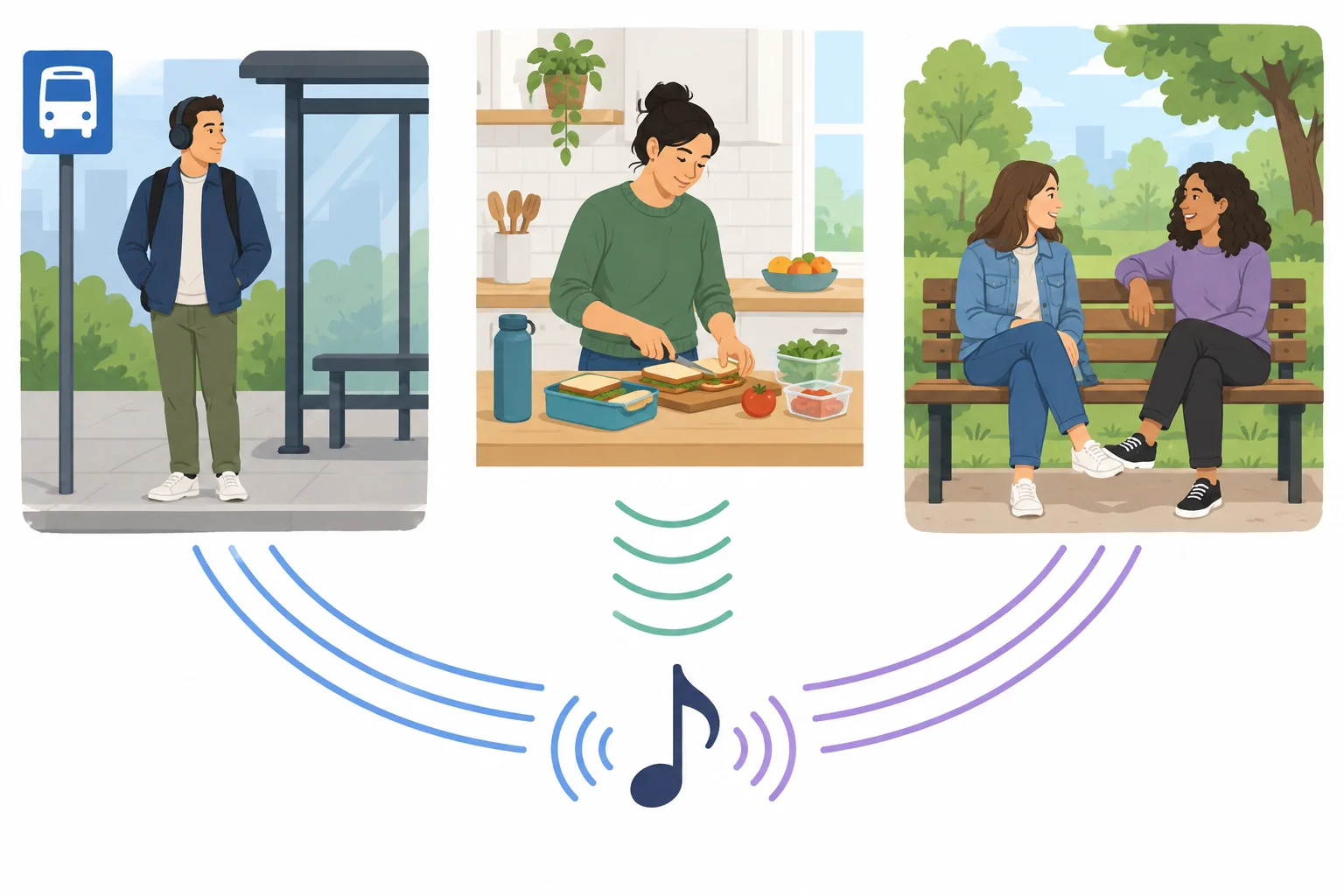
Listen for the same final sound at the end of each action word.
Listen. Then repeat each word.
waiting, making, sitting.
waiting, making, sitting.
Tip
Think of sing. The end of waiting, making, and sitting has that same final sound.
Now carry the clear -ing ending into a whole sentence. Listen and repeat each sentence aloud. Keep the last sound clear, but do not add an extra hard g sound.

Look at the actions as you repeat the sentence models.
Listen and repeat.
He's waiting for a bus. She's making lunch. They're sitting.
He's waiting for a bus. She's making lunch. They're sitting.
Listen and write what you heard.
Listen and write the sentence.
Look at Picture A and Picture B. Say one full sentence about each picture aloud. Then replay the audio model and compare your -ing endings with it.

Picture A and Picture B: describe both actions aloud.
Replay after you say your two sentences.
He's waiting for a bus. They're sitting.
Which -ing ending needed another try after you compared your speech with the audio model? Write one action word.
Write at least 3 characters (0/3).

Step 8 of 8
Bring together reading, listening, questions, and writing to share a short update about actions happening now.
Read this incoming message.
“Hi! I walk every day, but I'm taking the bus now. Are you waiting for a bus?”
The message gives a routine with every day and an action now. Reply with a current-action sentence, or ask a short question about what is happening now.

Use every day for a routine and now for an action happening at this time.
Listen to the short update. Do not read a transcript; listen for the action happening at the moment.
Noor's making lunch at the moment.
Which picture matches the audio?
Build a question you can send to ask about an action now.
Your sentence
Available words
Use this pictured role-play if you cannot write about your real situation now.

Choose the real situation around you, or imagine that you are part of this scene.
Write your three-sentence update.
Use actions happening now. If you use the picture, you may imagine that you are in the scene. Then say all three sentences aloud, with a clear -ing ending.
Write at least 35 characters (0/35).
Summary
Check your update before you finish.
Congratulations! You completed: Talk About What Is Happening Now
30 XP
Thousands of online courses in video, ebooks and audiobooks.
To test your knowledge during online courses
Generated directly from your cell phone's photo gallery and sent to your email

Download our app via QR Code or the links below:.



Carry knowledge in your pocket.
Download the Cursa app.
There are hundreds of free courses available, with a free certificate of completion that is saved in your mobile image gallery.
Download the app to access the Course Completion Certificate for Free.


+ 10 million
students

Free and Valid
Certificate

60 thousand free
exercises

4.8/5 rating in
app stores

Free courses in
video and ebooks