
Step 1 of 10
Define the Two Audiences
Identify what the planning group and local residents need from the same evidence, while preserving the proposal’s essential meaning.

Learning path · Level 12 · Tutorial 5
Complete a compact project about proposed evening access to a community learning centre. Use two short texts and two short recordings presented in the tutorial. Choose supported audio interpretations and complete a brief dictation before reconciling the sources. Write a 160–200-word position for a planning group, adapt it into an 80–100-word public message, and give a 60–90-second briefing with responses to two challenging question prompts. Self-check both versions and revise a misleading or unclear choice.

 Define the Two Audiences
Identify what the planning group and local residents need from the same evidence, while preserving the proposal’s essential meaning. 2 min
 Check Whether the Written Claims Are Comparable
Read two written sources about Riverside Learning Centre and compare their claims without treating different evidence as a direct conflict. 3 min
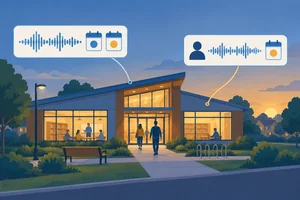 Capture the Spoken Qualifications
Listen to two spoken sources about proposed evening access at Riverside Learning Centre. Capture precise qualifications, distinguish personal experience from general evidence, and preserve the wording that limits a staffing claim. 3 min
 Record What Can and Cannot Be Reconciled
Classify what the four sources can reconcile, what they cannot compare directly, and what remains genuinely unsettled. 3 min
 Build Bridges into Specialist Language
Make specialist wording accessible through precise definitions and action clauses without adding unsupported facts or responsibility. 3 min
 Write an Evidence-Limited Position
Create a decision-facing position that uses the four sources selectively, attributes key claims, and recommends a cautious next step without concealing uncertainty. 5 min
 Adapt the Position for Local Residents
Adapt a completed Planning-group position into a clear, evidence-faithful message for local residents. 4 min
 Brief the Mixed Audience and Handle Challenges
Deliver a concise evidence-limited briefing for planning-group members and local residents, then handle two challenges without overstating what the sources establish. 4 min
 Test Fidelity and Likely Audience Impact
Test the fidelity, clarity, and likely impact of your planning, public, and spoken versions before making a final revision. 3 min
 Revise and Complete the Mediation Project
Make and justify a consequential revision, then verify that both written versions and the spoken briefing remain evidence-faithful. 3 min
Step 1 of 10
Identify what the planning group and local residents need from the same evidence, while preserving the proposal’s essential meaning.
Audience mediation means rebuilding access to the same evidence for different people. You may change the order, level of detail, and wording, but you must not change the essential meaning, certainty, or factual commitments.
In this project, Riverside Learning Centre is considering a six-week trial of evening access on Tuesdays and Thursdays, 18:00–20:00. It is a proposal: it has not been approved.
The planning group needs material that supports a decision. Local residents need to understand what is proposed, what remains uncertain, and what it could mean for access.

Adapt the route to meaning, not the evidential basis.
Tip
A useful test is: Would a careful reader of either version reach the same conclusion about what is proposed and how certain it is? If not, adaptation may have become distortion.
Build an audience profile before you write. It identifies what each audience already knows, what matters to them, the question they are likely to ask, and what they need to do next.
The same case will move through five stages:
At every stage, keep a clear boundary between source information, your judgement, and any recommendation you make.
Use these profiles to decide what to select and explain.
| Audience | Expertise and priority | Likely question | Needed outcome |
|---|---|---|---|
| Planning group | Decision-focused; needs evidence limits and implications | Should we approve the proposal? | A defensible basis for a decision |
| Local residents | Access-focused; may not know planning language | What could change for me, and is it certain? | A clear practical understanding |
Match each label to the need or commitment it represents.
Tap an item and then its matching pair.

Step 2 of 10
Read two written sources about Riverside Learning Centre and compare their claims without treating different evidence as a direct conflict.
Planning note
Riverside Learning Centre is considering, but has not approved, a six-week trial of evening access on Tuesdays and Thursdays, 18:00–20:00. In a survey of current daytime users, 72 of 120 (60%) said they would use evening access if the trial went ahead. The note treats this expressed interest as support for testing the proposal, while recognising that a survey records intentions rather than visits. It also states that staffing for both proposed evenings is confirmed as of 1 June 2027. On this basis, the Planning note supports taking the proposal forward for a time-limited trial.
Review note
The Review note examines a separate four-week evening-access pilot conducted last year. During that earlier pilot, 18 of 60 (30%) registered participants attended at least once. The note cautions against predicting use from expressed interest: attendance records show behaviour, whereas a survey records what respondents say they may do. It does not report on the current daytime-user survey, and its participants, period, and arrangement differ from the proposed six-week trial at Riverside Learning Centre. The note therefore does not claim that 30% will attend the proposal now under consideration. It asks readers to treat the earlier result as context, not as a direct forecast.
Keep each denominator attached to its meaning. A percentage without its population, period, and measurement can create a misleading comparison.
| Source | Figure | Population | Time frame | What the figure measures |
|---|---|---|---|---|
| Planning note | 72 of 120 (60%) | Current daytime users | Current survey | Said they would use evening access |
| Review note | 18 of 60 (30%) | Registered participants | Four-week pilot last year | Attended at least once |
Before calling two sources inconsistent, apply the same comparison basis to each claim:
Different percentages create an apparent contradiction only when they make incompatible claims about the same thing under comparable conditions. Here, the notes provide non-comparable evidence: one records current users’ intentions for a proposed trial; the other records previous participants’ behaviour in an earlier pilot.
Both figures can be accurate. The earlier attendance result gives context, but it neither disproves the current interest result nor establishes what attendance will be in the proposed trial.

Compare population, period, and measure before treating two percentages as competing evidence.
Using the Planning note and Review note, explain why the figure 18 of 60 (30%) neither disproves the 72 of 120 (60%) interest result nor predicts attendance in the proposed trial. Identify the relevant differences in population, time frame, and measurement.
Write at least 250 characters (0/250).

Step 3 of 10
Listen to two spoken sources about proposed evening access at Riverside Learning Centre. Capture precise qualifications, distinguish personal experience from general evidence, and preserve the wording that limits a staffing claim.
Spoken sources often contain limits that are easy to lose in a summary. Listen for what is confirmed, what is not confirmed, and what the speaker explicitly refuses to claim. A negation can change the evidence record completely: lack of confirmation is not the same as impossibility.
Listen to the first source recording. Focus on the staffing status on each proposed evening.
Here is a short update on the proposed six-week trial of evening access at Riverside Learning Centre, on Tuesdays and Thursdays from 18:00 to 20:00. As of 1 June 2027, Tuesday staffing is confirmed. Thursday staffing is not confirmed. That does not mean Thursday cover will be impossible, but I cannot say that it is in place. The proposal has not been approved, and this update does not decide whether it should be.
Listen and choose an option.
Which entry most accurately records the Coordinator update?
Here is a short update on the proposed six-week trial of evening access at Riverside Learning Centre, on Tuesdays and Thursdays from 18:00 to 20:00. As of 1 June 2027, Tuesday staffing is confirmed. Thursday staffing is not confirmed. That does not mean Thursday cover will be impossible, but I cannot say that it is in place. The proposal has not been approved, and this update does not decide whether it should be.
Listen to the second source recording. Notice the difference between one person’s access need and a claim about local residents generally.
I support the proposed six-week trial because evening access could help people who cannot use the centre in the daytime. For me, though, Tuesday is not an option: I have a regular commitment then. I would need Thursday access if the trial is to make a difference to me. I am describing my own situation, not claiming that everyone has the same timetable. I also understand that the proposal has not yet been approved.
Listen and choose an option.
Which interpretation is supported by the Resident comment?
I support the proposed six-week trial because evening access could help people who cannot use the centre in the daytime. For me, though, Tuesday is not an option: I have a regular commitment then. I would need Thursday access if the trial is to make a difference to me. I am describing my own situation, not claiming that everyone has the same timetable. I also understand that the proposal has not yet been approved.
Listen and write what you heard.
Type the sentence exactly as you hear it.
The diagram separates a staffing statement from one resident’s personal access constraint.
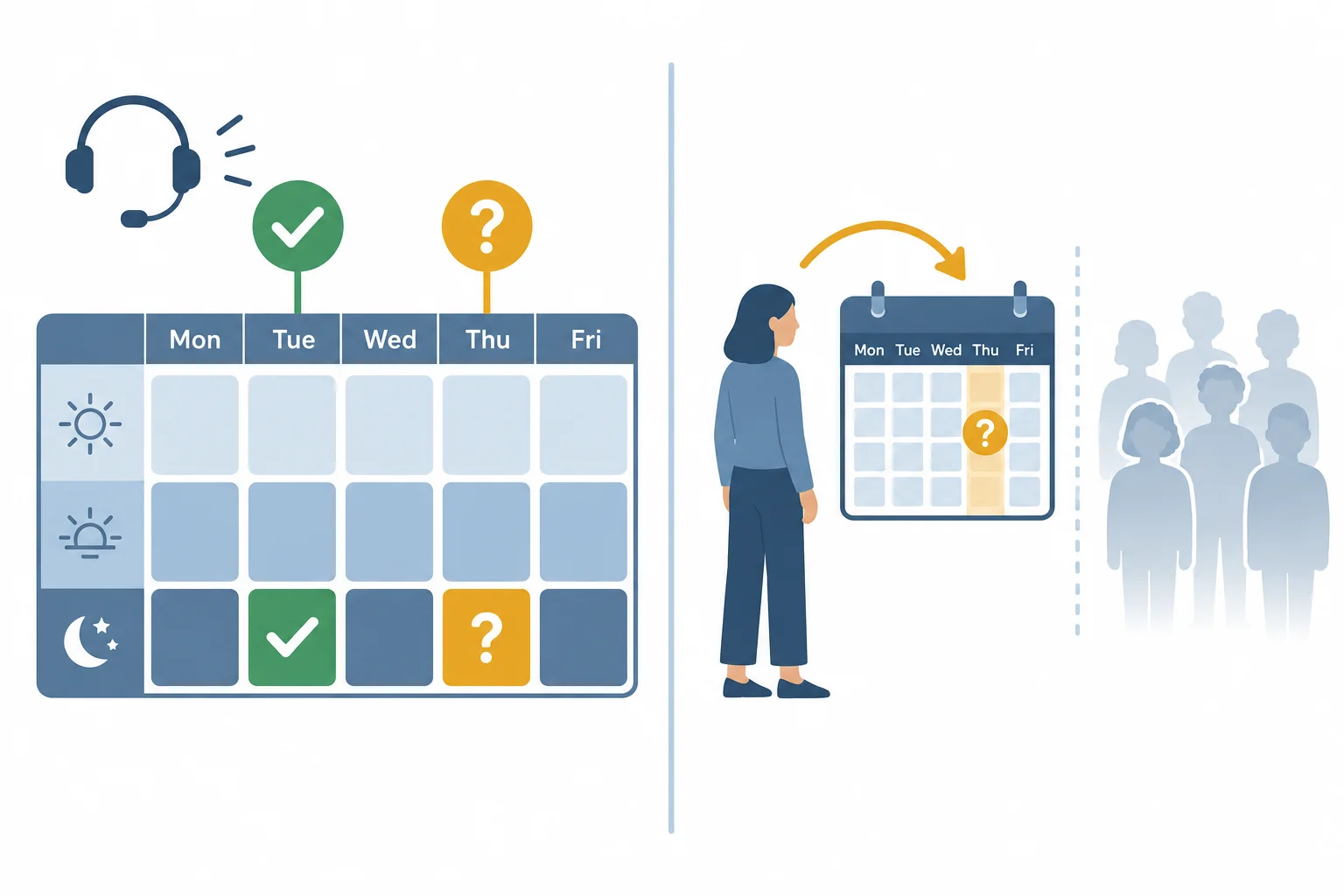
Record the scope of each spoken claim before comparing it with other evidence.
Coordinator update — transcript
Here is a short update on the proposed six-week trial of evening access at Riverside Learning Centre, on Tuesdays and Thursdays from 18:00 to 20:00. As of 1 June 2027, Tuesday staffing is confirmed. Thursday staffing is not confirmed. That does not mean Thursday cover will be impossible, but I cannot say that it is in place. The proposal has not been approved, and this update does not decide whether it should be.
Resident comment — transcript
I support the proposed six-week trial because evening access could help people who cannot use the centre in the daytime. For me, though, Tuesday is not an option: I have a regular commitment then. I would need Thursday access if the trial is to make a difference to me. I am describing my own situation, not claiming that everyone has the same timetable. I also understand that the proposal has not yet been approved.
Tip
When you use these recordings later, keep their limits attached to the claim. The Coordinator update gives a staffing status, not a final decision. The Resident comment gives one person’s experience, not a measure of local demand.

Step 4 of 10
Classify what the four sources can reconcile, what they cannot compare directly, and what remains genuinely unsettled.
A conflict record does not try to make every source agree. First compare the claims: are they about the same proposition, time, population, and scope?
A recording is not automatically stronger than a written note simply because it is audio. Compare what each source actually claims and retain uncertainty where the case materials provide no resolution.
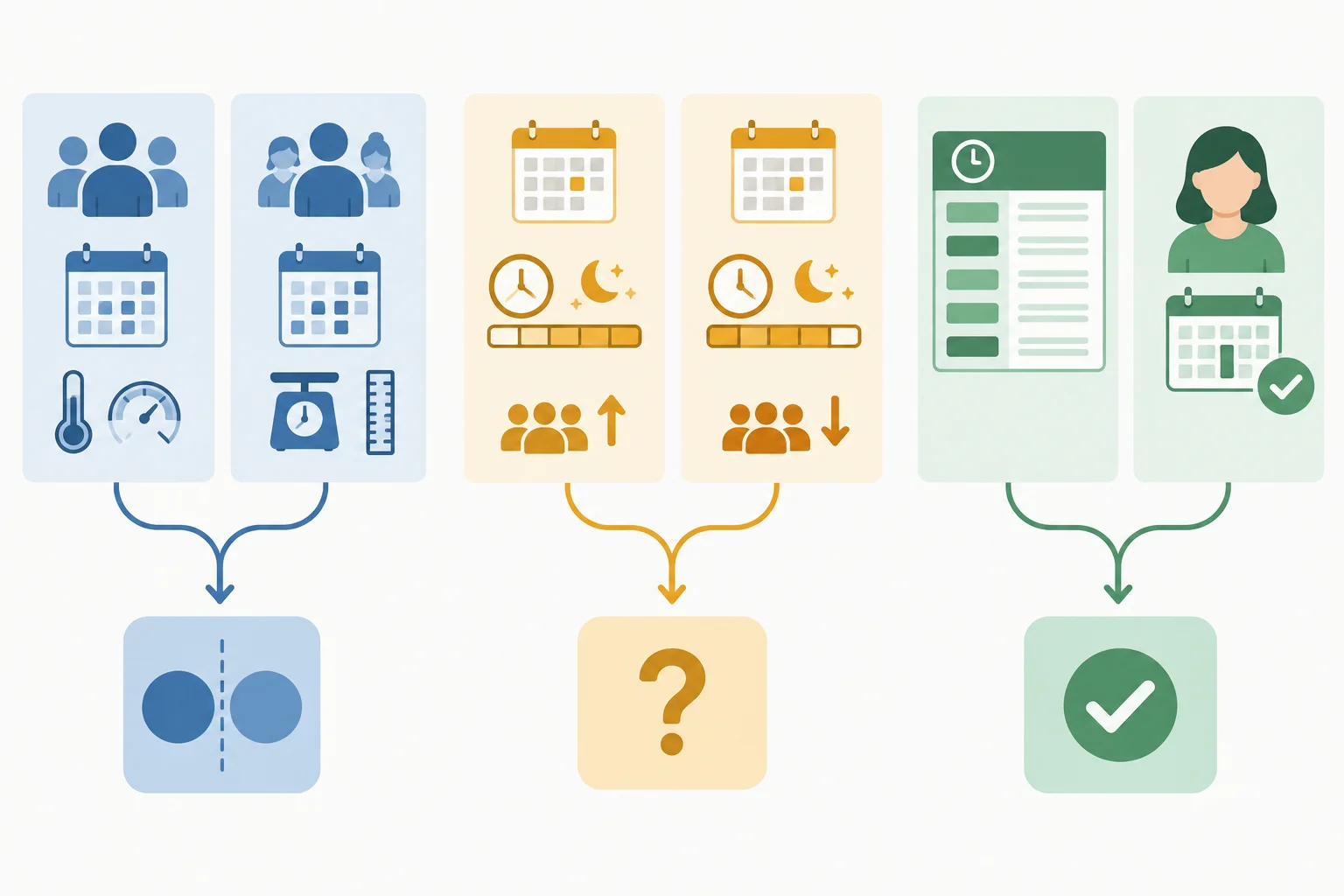
Different evidence bases may be non-comparable; incompatible claims about the same proposal and date remain contested; a practical constraint can coexist with support.
Use one status for each issue. The record preserves both the evidence and its limit.
| Issue | Source claims | Comparison basis | Status | Reason |
|---|---|---|---|---|
| Likely demand | Planning note: 72 of 120 (60%) current daytime users expressed interest. Review note: 18 of 60 (30%) participants attended a pilot last year. | Different population, period, and measure | Not directly comparable | Expressed interest and recorded attendance do not directly compete. |
| Staffing on 1 June 2027 | Planning note: staffing for both evenings is confirmed. Coordinator update: Tuesday is confirmed; Thursday is not confirmed. | Same proposal and same date | Contested | The claims about Thursday staffing are incompatible; no supplied source resolves them. |
| Practical access | The proposal is Tuesdays and Thursdays, 18:00–20:00. Resident comment supports evening access but needs Thursday access. | A proposed schedule and one person's constraint | Reconciled | The claims can coexist; one comment does not show how common the need is. |
There is limited common ground: the Planning note and the Resident comment both point to a possible value in evening access. That does not establish unanimous support, sufficient demand, or confirmed Thursday staffing.
A defensible position can therefore retain residual uncertainty. It may recommend checking Thursday staffing before any approval, but it must not describe that check as already completed.
Match each comparison with its correct status and reason.
Tap an item and then its matching pair.
Create a short conflict-resolution record for the planning group in 110–160 words. Use these headings exactly: Issue | Source claims | Comparison basis | Status | Reason.
Include the demand comparison, the staffing accounts, and the resident’s access constraint. Classify each issue, justify its status, and end by identifying one verification need. Do not claim that the staffing conflict has been settled.
Write at least 500 characters (0/500).

Step 5 of 10
Make specialist wording accessible through precise definitions and action clauses without adding unsupported facts or responsibility.
An assumption bridge supplies the small piece of context that a non-specialist reader needs in order to understand a claim. It does not fill an evidence gap with an assumption.
For example, if you use staffing rota, add a brief definition: the schedule showing who is due to work. This helps local residents understand why staffing matters without claiming that a rota has been checked or completed.
Keep the source limit visible. The staffing accounts concern the same proposal and date, 1 June 2027, but remain an unresolved discrepancy. A bridge can clarify that point; it cannot resolve it.
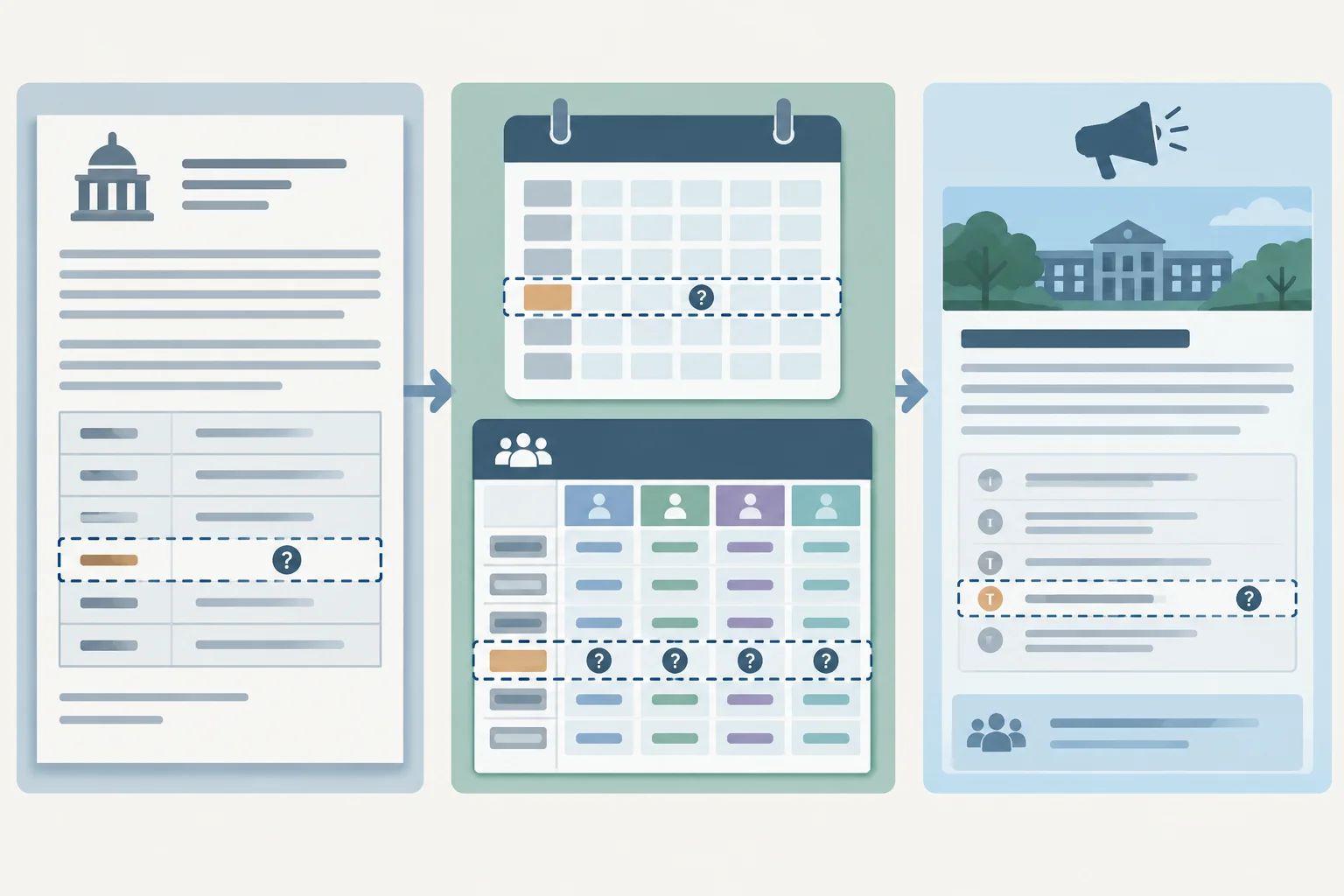
The bridge makes a technical label understandable while keeping the Thursday staffing uncertainty visible.
Example
An appositive definition places a short explanation beside a specialist label:
the staffing rota, the schedule showing who is due to work,
The commas show that the middle words explain the label rather than identify a different rota. Use this compact structure when the definition is necessary for the audience to follow the point.
Use namely when you will give the exact, complete specification of what you have just named. It is not a loose substitute for for example.
A nominalisation can also make an action harder to see. Compare confirmation of Thursday staffing with an action clause such as check whether Thursday staffing can be confirmed.
The action clause is clearer, but it must not invent an actor. If no source says who will check, arrange, or approve something, do not name a manager, the centre, or another organisation as if that responsibility were established.
Example
Exact specification
The proposed trial has two evenings, namely Tuesdays and Thursdays, from 18:00–20:00.
Here, namely introduces the whole set of proposed evenings.
Cautious action
Before approval, check whether Thursday staffing can be confirmed.
This is a recommendation, not a report that anyone has already completed a check. It makes the action clear without assigning it to an unsupported person or organisation.
Tip
Do not turn an uncertain source claim into certainty while simplifying it. The Coordinator update says that Thursday staffing is not confirmed; it does not establish that staffing is impossible, or that a particular person will solve the issue.
Build one accurate explanatory sentence.
Your sentence
Available words
Rewrite this cautious recommendation as one clear action sentence:
Cautious recommendation: Because Thursday staffing is not confirmed, confirmation should occur before approval.
Preserve the uncertainty. Do not name a person or organisation that the sources do not identify.
Write at least 45 characters (0/45).

Step 6 of 10
Create a decision-facing position that uses the four sources selectively, attributes key claims, and recommends a cautious next step without concealing uncertainty.
A Planning-group position is not a source-by-source report. It helps the planning group decide whether to approve the proposed six-week trial while showing where the evidence ends.
Build it in three voices:
Use all four sources because each has a decision-relevant role. Select one useful point from each; do not give four equal summaries. The position must retain the unresolved discrepancy about Thursday staffing and the difference between expressed interest and past attendance.

Keep evidence, judgement, and recommendation visibly separate: attribution shows what a source says; a recommendation shows what you propose.
Tip
A proportionate recommendation does not pretend that the sources prove more than they do. You may recommend approval only after a specified verification, or recommend deferring the decision until that verification is available. Both can be defensible if you explain the evidence and preserve residual uncertainty.
Use this compact plan. These are approximate allocations; the complete position must remain 160–200 words.
The ranges total 160–195 words, leaving room to adjust emphasis while staying within the final limit.
A useful chain is: claim → limit → judgement → recommendation.
The Planning note’s survey can support a possible benefit, while the Review note limits any prediction from that interest: its earlier attendance figure concerns a different population, period, and measure. Treat these as non-comparable evidence, not as a numerical contest.
The Resident comment can illustrate a practical consequence of the proposed timetable, but it is one person’s account. For staffing, retain the unresolved discrepancy: the Planning note says both evenings are confirmed as of 1 June 2027; the Coordinator update says Tuesday is confirmed but Thursday is not. No supplied source establishes which account is correct.
Tip
Use reporting verbs precisely: reports and states for source content; cautions against for the Review note’s warning; I recommend or the planning group should consider for your own action. A verification step is proposed only when you explicitly present it as a recommendation.
Which editorial decision would create the most defensible final recommendation for the planning group?
Write your Planning-group position in 160–200 words. Do not count the label in the word total.
Address the planning group’s decision on the unapproved proposal for a six-week trial of evening access at Riverside Learning Centre. Draw selectively on all four supplied sources: Planning note, Review note, Coordinator update, and Resident comment.
Attribute pivotal claims. Distinguish expressed interest from recorded attendance, including why the figures are not directly comparable. Address the staffing conflict as unresolved; do not invent a resolution. Use the Resident comment as one person’s access constraint, not evidence of representative demand.
End with a recommendation whose strength matches the evidence. If you propose a condition or verification, label it as your recommendation rather than an existing arrangement. Use the planning-material schedule: Tuesdays and Thursdays, 18:00–20:00.

Step 7 of 10
Adapt a completed Planning-group position into a clear, evidence-faithful message for local residents.
A public message is not a shortened Planning-group position. It rebuilds access to the same meaning for local residents: lead with what could affect them, use familiar wording, and explain only the detail needed to interpret the proposal.
Use selection, ordering, explanation, and register to adapt. Do not change the recommendation, turn uncertainty into certainty, or present a proposal as an arrangement already in place.
A cross-audience fidelity check asks: can each essential public claim be traced back to the same source record and position? Different wording is acceptable; different evidential meaning is not.

Adapt the route into the message, while keeping its essential meanings connected.
Use this grid to check whether a public version still carries the decision-relevant meaning of the Planning-group position.
| Essential meaning | Planning-group wording | Public-message wording | Must remain true |
|---|---|---|---|
| Proposal status | The trial is proposed. | The group is considering a trial. | It is not approved. |
| Timing | Tuesdays and Thursdays, 18:00–20:00. | Tuesdays and Thursdays, 6–8 p.m. | The schedule is unchanged. |
| Demand evidence | Interest and prior attendance have different bases. | The earlier pilot does not predict current use directly. | The evidence is non-comparable. |
| Staffing | The accounts create an unresolved discrepancy. | Thursday staffing needs checking. | The uncertainty is audible. |
| Action | Verify staffing before a decision. | Check staffing before deciding. | This is a recommendation. |
Example
This 92-word model makes the proposal practical without claiming that it has been approved. It models one cautious, conditional recommendation; retain the underlying position you developed earlier if yours differs.
“The planning group is considering a six-week trial of evening access at Riverside Learning Centre on Tuesdays and Thursdays, 6–8 p.m. The Planning note says 72 of 120 daytime users surveyed would use it. A previous pilot had attendance from 18 of 60 registered participants, but that was a different group and period. One resident needs Thursday access. Staffing accounts for Thursday differ, so the group should check this before deciding. No evening access has been approved. If approved, the trial could give local residents another time to use the centre.”
Tip
Notice the assumption bridge in “a different group and period”. It gives residents the background needed to understand why two figures are not a direct forecast, without reproducing the whole comparison record.
Keep the unresolved discrepancy visible when it could affect access. “Staffing accounts for Thursday differ” is more faithful than either “Thursday staffing is guaranteed” or “Thursday access will not happen.”
Which sentence could appear in a faithful Public message?
Write your Public message for local residents.
Check that your message does not turn a recommendation into an existing arrangement or treat the two demand figures as directly comparable.
Write at least 520 characters (0/520).

Step 8 of 10
Deliver a concise evidence-limited briefing for planning-group members and local residents, then handle two challenges without overstating what the sources establish.
A mixed meeting needs one Spoken briefing (60–90 seconds), not two separate speeches. The planning group needs a recommendation and its limits; local residents need to hear what access could look like and what is still uncertain.
Use this spoken route:
Mention source titles where attribution matters. A resident’s Thursday need can illustrate a practical consequence, but one comment does not establish representative demand.

Make the limitation part of the main route of your briefing, not an afterthought.
Tip
Make the caveat audible. Slow down immediately before it, pause once, and give the limiting word clear stress:
“The Planning note reports that both evenings were confirmed; the Coordinator update confirms Tuesday, not Thursday.”
A pause and contrastive stress help listeners retain the unresolved discrepancy. They do not make the claim more certain.
A difficult question may contain a valid concern while drawing a conclusion the sources do not justify. Do not evade the supported part. Acknowledge it, name the evidential boundary, then return to a proportionate conclusion.
For staffing, the boundary is an unresolved discrepancy: the written and recorded accounts concern the same proposal and date, 1 June 2027, but conflict. Neither medium automatically outranks the other.
For demand, the boundary is non-comparable evidence: 72 of 120 current daytime users expressed interest, whereas 18 of 60 registered participants attended a separate four-week pilot last year. The figures can inform a decision, but neither directly cancels the other.
Use these two moves in each reply: recognise the part supported by evidence, then say what the evidence cannot establish.
| Challenge | Supported point to acknowledge | Boundary to state | Safe next move |
|---|---|---|---|
| “Can you confirm that staffing is secure?” | There are staffing claims about the proposed evenings. | The sources leave Thursday staffing contested. | Avoid confirmation; connect your recommendation to resolving the discrepancy. |
| “Does 18 of 60 disprove the survey interest?” | The earlier pilot recorded actual attendance. | Its population, period, and measure differ from the survey. | Treat it as a caution against prediction, not a direct rebuttal. |
Tip
Avoid two shortcuts: “the recording must be right because it is newer-sounding” and “30% proves there is no demand”. The sources supplied do not support either claim. In a spoken reply, a short sentence such as “That is not established by these sources” can protect the residual uncertainty.
Practise locally with a timer. First deliver your Spoken briefing in 60–90 seconds. Then pause and answer each challenge aloud as if a different person had asked it.
Keep only three prompts in front of you: proposal and recommendation / selected evidence / limitation. Do not read a full script. Speak clearly enough for both planning-group members and local residents to follow.
There is no upload and no automated pronunciation assessment. Judge intelligibility yourself: can a listener hear your recommendation, the reason for it, and the qualification that prevents overstatement?
Complete the final rehearsal aloud.
Then write a 70–140-word rehearsal record. Include your estimated briefing time, one caveat you made audible, and the evidential boundary you maintained in each reply. Focus on intelligibility and audible qualifications, not on copying a particular accent.
Write at least 240 characters (0/240).

Step 9 of 10
Test the fidelity, clarity, and likely impact of your planning, public, and spoken versions before making a final revision.
Before you revise anything, audit the whole project against the source record—not against how persuasive it sounds. Check the Planning-group position, Public message, Spoken briefing, and both replies.
A faithful project keeps the proposal unapproved: a six-week trial on Tuesdays and Thursdays, 18:00–20:00. It also preserves two limits: the demand figures are non-comparable evidence, and the staffing accounts create an unresolved discrepancy.
Use the six-part check below to find meaning risks before you look for style improvements.
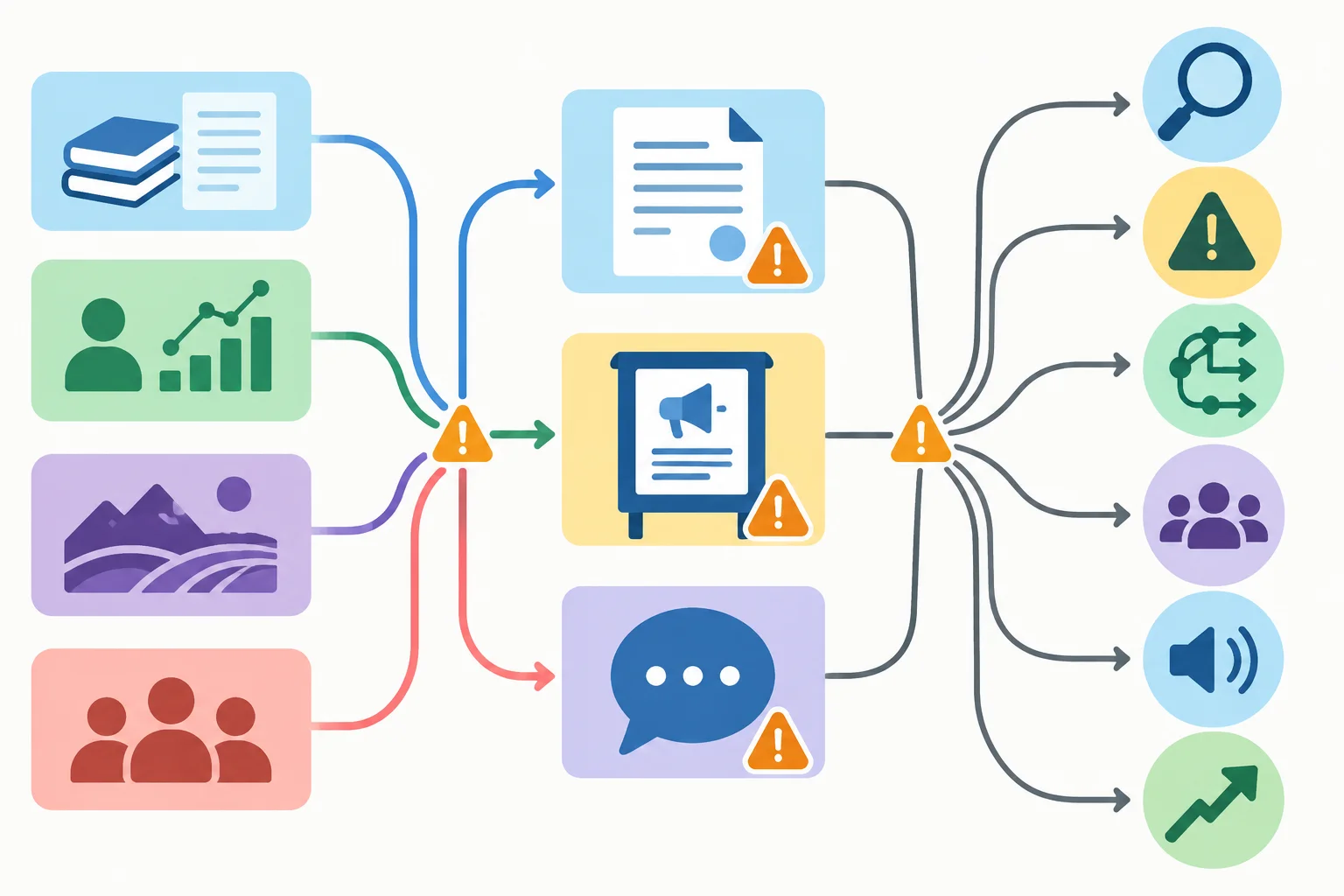
Different formats may change access to the message, but they must not change what the evidence establishes.
Use this structured self-check. A red flag is not automatically a failure; it is a choice that needs testing against the source record and audience needs.
| Dimension | What to test | Warning sign |
|---|---|---|
| Accuracy | Facts, figures, dates, attribution, and proposal status | A claim changes a source detail |
| Interpretive caution | Limits, scope, and residual uncertainty | A possibility sounds certain |
| Coherence | Clear link from evidence to judgement and recommendation | The conclusion seems to come from nowhere |
| Register | Formality and explanation suited to each audience | Specialist wording blocks local residents |
| Pronunciation | Intelligibility, phrasing, stress, and pauses | A caveat is rushed or inaudible |
| Audience impact | What each audience could reasonably infer | Compression creates a misleading conclusion |
Test plausible interpretations, not only your intended meaning. Ask: “What might a planning-group reader or local resident conclude after hearing only this version?”
Compression can create consequential distortion:
These are more important than cosmetic matters such as varying a repeated word. Prioritise the choice that could alter a decision, conceal uncertainty, or prevent an audience from understanding what access is actually proposed.
Tip
For the spoken briefing, listen for meaning at the boundaries of a sentence. Make the limitation audible, rather than attaching it as a fast final clause.
For example, pause before a qualification; give contrastive stress to the uncertain point; and check that a listener can distinguish a recommendation from an existing arrangement. Practise aloud locally, then decide whether a delivery choice could make certainty sound stronger than the evidence permits.
Audit your complete project now. Write brief findings for all six dimensions, then identify one likely unintended interpretation and one consequential choice to revise later. Do not rewrite the choice in this activity.
Write at least 450 characters (0/450).

Step 10 of 10
Make and justify a consequential revision, then verify that both written versions and the spoken briefing remain evidence-faithful.
A consequential revision fixes a choice that could change what either audience believes or does. Record the chain, not just the new wording:
Do not remove a caveat merely to make a message shorter. A repair is successful only if it still distinguishes an unapproved proposal from an arrangement, and preserves any unresolved discrepancy.

A revision should make its effect on interpretation visible.
This illustrative record repairs an implication of approval and guaranteed staffing. Your own revision may address a different consequential choice.
| Original choice | Likely interpretation | Revision | Reason |
|---|---|---|---|
| “Riverside Learning Centre will open 6–8 p.m. on Tuesdays and Thursdays.” | Access has been approved and staffing is settled. | “Recommend a six-week trial on Tuesdays and Thursdays, subject to resolving the Thursday staffing discrepancy.” | It marks this as a recommendation, retains the trial status, and does not guarantee Thursday access. |
After changing one version, recheck the other version and your spoken script. Adaptation may change order, vocabulary, and level of detail, but it must not change the evidential basis.
Use British spelling in your written work. Keep the planning material’s time as 18:00–20:00 and the public-facing time as 6–8 p.m. If your repair affects spoken wording, repeat the affected passage aloud. Make the caveat audible: pause before it and give the limiting words clear stress.
Check the essential meanings below in both written outputs. A shorter public message need not repeat every figure, but it must not imply a stronger conclusion than the Planning-group position supports.
| Check | Planning-group position | Public message | Spoken briefing |
|---|---|---|---|
| Proposal status | Labels a recommendation or unapproved proposal | Does not announce confirmed access | States what is proposed, not settled |
| Schedule | Six-week trial; Tuesdays and Thursdays, 18:00–20:00 | Six-week trial; Tuesdays and Thursdays, 6–8 p.m. | Uses a clear equivalent time |
| Staffing | Retains the unresolved discrepancy | Does not promise both evenings | Says what is confirmed and what remains uncertain |
| Demand evidence | Does not treat the figures as directly competing | Avoids claiming representative demand | Explains the limit if challenged |
| Recommendation | Separates your judgement from source claims | Makes practical meaning clear | States the recommendation and its condition |
Tip
Before you finish, count each written output yourself: Planning-group position: 160–200 words. Public message: 80–100 words. Time your full Spoken briefing: 60–90 seconds, then practise both replies. Timing and word counts are checks you perform; they do not establish whether a claim is supported.
| What adaptation may change | What it must not change |
|---|---|
| Selection, order, definitions, examples, register, and phrasing | The evidential basis, the proposal’s unapproved status, or unresolved disagreement |
Complete your final revision record. Choose one consequential wording or delivery choice from your project.
Use these headings exactly:
Original choice | Likely interpretation | Revision | Reason
Then add:
Write at least 420 characters (0/420).
Congratulations! You completed: Mediate Conflicting Sources for Different Audiences
25 XP
You completed the path
Congratulations! You went through every tutorial in this path.
Thousands of online courses in video, ebooks and audiobooks.
To test your knowledge during online courses
Generated directly from your cell phone's photo gallery and sent to your email

Download our app via QR Code or the links below:.



Carry knowledge in your pocket.
Download the Cursa app.
There are hundreds of free courses available, with a free certificate of completion that is saved in your mobile image gallery.
Download the app to access the Course Completion Certificate for Free.


+ 10 million
students

Free and Valid
Certificate

60 thousand free
exercises

4.8/5 rating in
app stores

Free courses in
video and ebooks