Step 1 of 8
Show Activity Up to Now
Build affirmative present perfect continuous statements for workshop preparation that began earlier and continues up to now.

Learning path · Level 8 · Tutorial 1
Give a clear update on what you have completed and what you have been doing. Compare short written and spoken progress reports, choose the meaning you hear, and complete a brief dictation. Use a model to guide your own spoken and written update about preparing an activity or completing a study task.

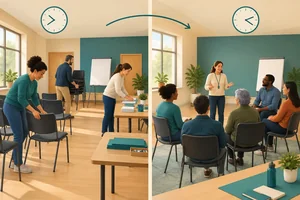
 Show Activity Up to Now
Build affirmative present perfect continuous statements for workshop preparation that began earlier and continues up to now. 2 min
 Make Negatives and Questions
Use accurate present perfect continuous negatives, yes-or-no questions, and short answers in workshop preparation updates. 2 min
 Explain Recent Activity
Interpret present perfect continuous updates about recently stopped activity by using present evidence and context. 2 min
 Separate Results from Activity
Choose present perfect simple or continuous forms according to whether a progress update emphasizes a completed result, a quantity, or activity over time. 3 min
 Choose Naturally with Different Verbs
Choose naturally between present perfect simple and continuous forms for continuing situations, and use simple forms with common state verbs. 2 min
 Read a Progress Report
Read a short community-workshop progress report and distinguish confirmed completed results, activity over time, remaining work, and claims the report does not establish. 2 min
 Hear and Stress the Key Information
Listen for key information in progress updates, write a short perfect-form sentence, and practice making results and time information prominent. 3 min
 Give Your Own Progress Update
Create and self-check a concise written and spoken progress update using present perfect simple and present perfect continuous forms. 4 min
Step 1 of 8
Build affirmative present perfect continuous statements for workshop preparation that began earlier and continues up to now.
Today is Thursday. Maya began workshop preparation on Monday, and the preparation continues up to now.
Preparation is the work you do to get an activity ready. Progress notes often use three labels: Completed results, Activity and duration, and Remaining work. This step focuses on Activity and duration.
The present perfect continuous looks back from now and highlights work over a period. Maya does not need to be preparing at this exact minute.
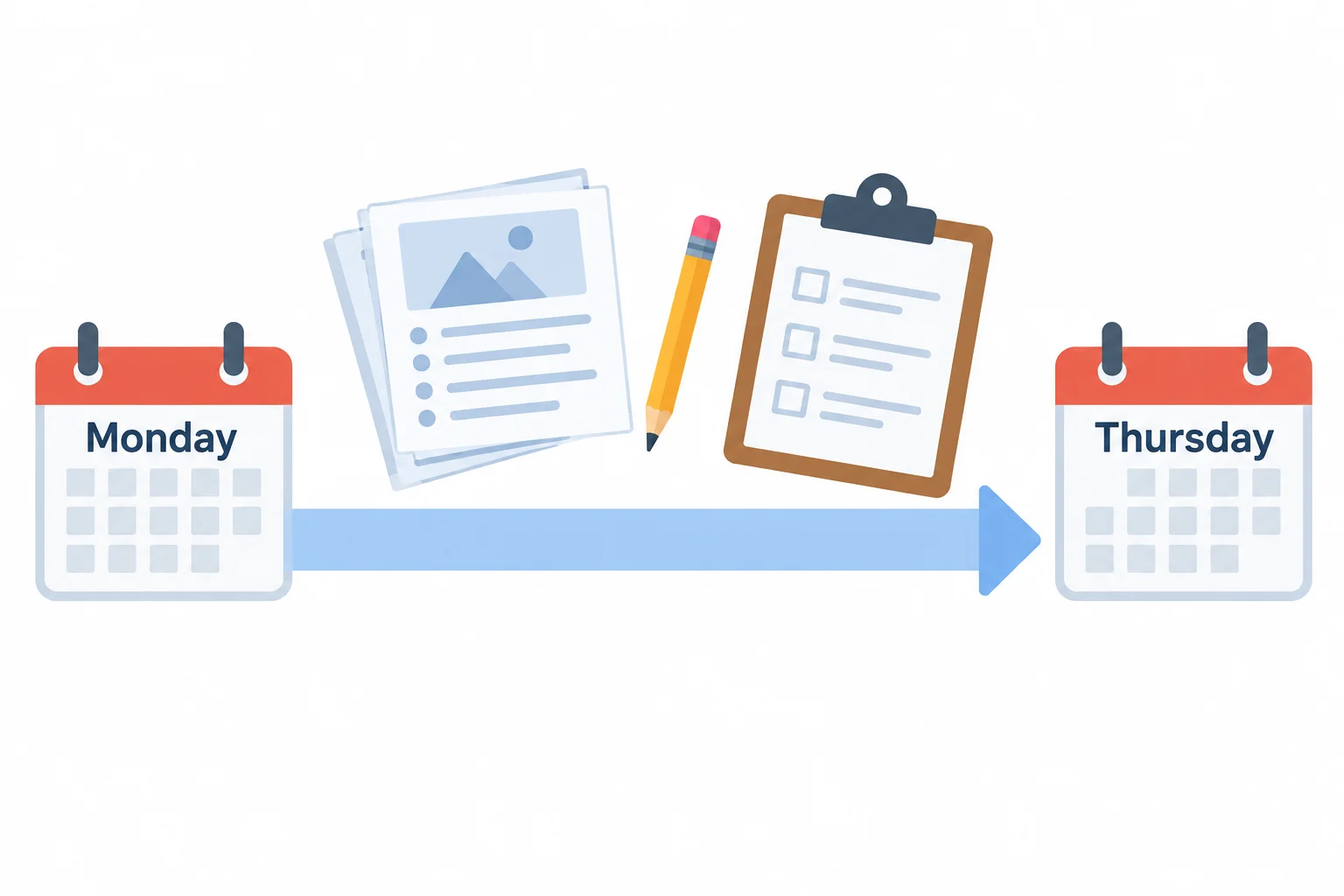
The shaded band represents preparation over a period ending at now.
Use the affirmative present perfect continuous pattern:
subject + have/has + been + verb-ing
Choose have with I, you, we, and they. Choose has with he, she, it, or one person’s name.
The reference point is now. The form draws attention to the activity over time.
Example
Activity and duration
Maya: “I've been preparing the workshop since Monday.”
Leo: “I've been revising the schedule since Tuesday.”
Both activities started before Thursday and connect to now.
Use for with a duration, or length of time. Use since with a starting point.
Both expressions can show an activity that began earlier and reaches now.
Choose the time expression that matches the information you want to give.
| Focus | Form | Progress update |
|---|---|---|
| Duration | for + a length of time | We've been organizing materials for two hours. |
| Starting point | since + a starting point | Leo has been revising the schedule since Tuesday. |
Tip
A duration phrase tells us the length of the activity. A starting-point phrase tells us when it began.
Build one accurate progress update. Put the starting-point expression with Maya’s activity and the duration expression with our activity.
Your sentence
Available words

Step 2 of 8
Use accurate present perfect continuous negatives, yes-or-no questions, and short answers in workshop preparation updates.
Use a negative when you want to say that an activity has not been happening during the period up to now.
Negative pattern: subject + haven't/hasn't + been + verb-ing
Put haven't or hasn't before been. Use haven't with I, you, we, and they. Use hasn't with he, she, it, or one person’s name.
Example: Leo hasn't been revising the schedule.

A negative starts with the subject. A yes-or-no question starts with have or has.
For a yes-or-no question, put Have or Has before the subject.
Question pattern: Have/Has + subject + been + verb-ing?
Do not add do. Keep been + verb-ing after the subject.
Short answers use have or has without repeating the full activity:
Maya: “Has Leo been revising the schedule?”
Leo: “Yes, I have.”
A negative gives information: “Leo hasn't been revising the schedule.” A question asks whether the activity has been happening. To revise means to improve an existing piece of writing, such as a schedule or a draft.
Build a negative update about Maya’s workshop preparation.
Your sentence
Available words
Build a yes-or-no question about Leo and the schedule.
Your sentence
Available words
Complete the affirmative short reply about Maya’s preparation: “Yes, Maya ___.”
Step 3 of 8
Interpret present perfect continuous updates about recently stopped activity by using present evidence and context.
The present perfect continuous can describe activity that stopped very recently but has an effect now.
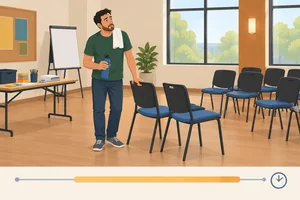
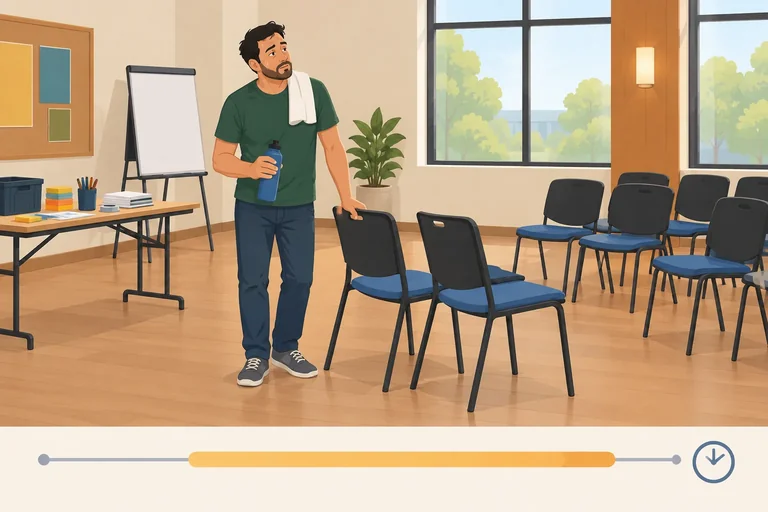
Leo says, “I’m tired because I’ve been moving chairs for twenty minutes.” His tiredness is the present effect. He may have stopped moving chairs shortly before he speaks.
The form alone does not tell us whether he is moving a chair at this exact moment. It also does not confirm that the whole chair-moving task is complete. Use the situation and the evidence around the sentence.
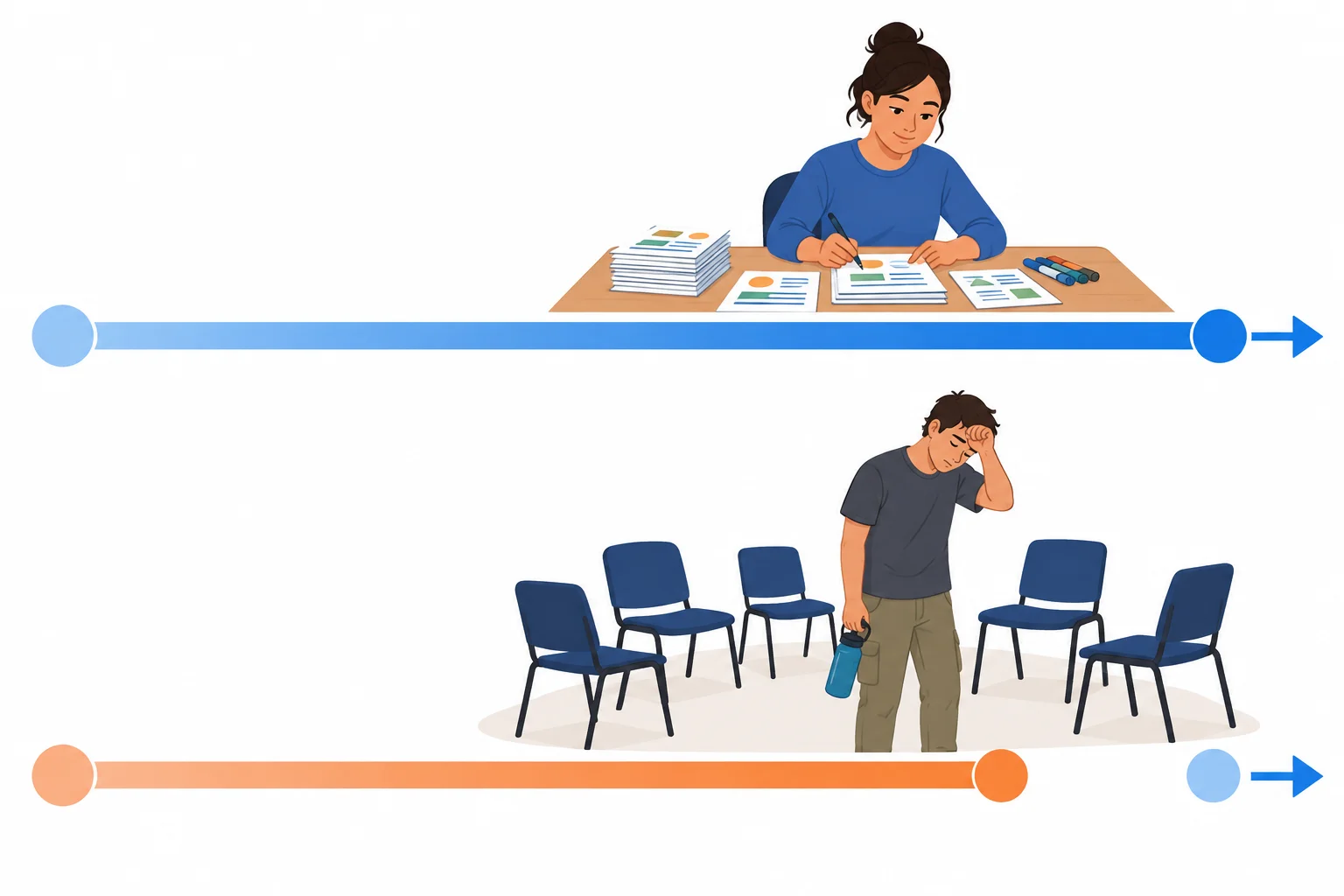
Maya’s preparation reaches now. Leo’s chair-moving ended shortly before now and explains his tiredness.
Example
Activity and duration — continuing now
Maya is at her desk. “I’ve been preparing the workshop since Monday.”
Activity and duration — recently stopped
Leo steps away from the chairs. “I’m tired because I’ve been moving chairs for twenty minutes.”
Maya’s scene supports an activity that continues now. Leo’s tiredness and pause support a recent-action reading. Neither sentence, by itself, confirms that every part of the task is finished.
Choose True or False.
Leo says, “I’m tired because I’ve been moving chairs for twenty minutes.” This sentence alone proves that he is still moving chairs at this exact moment.
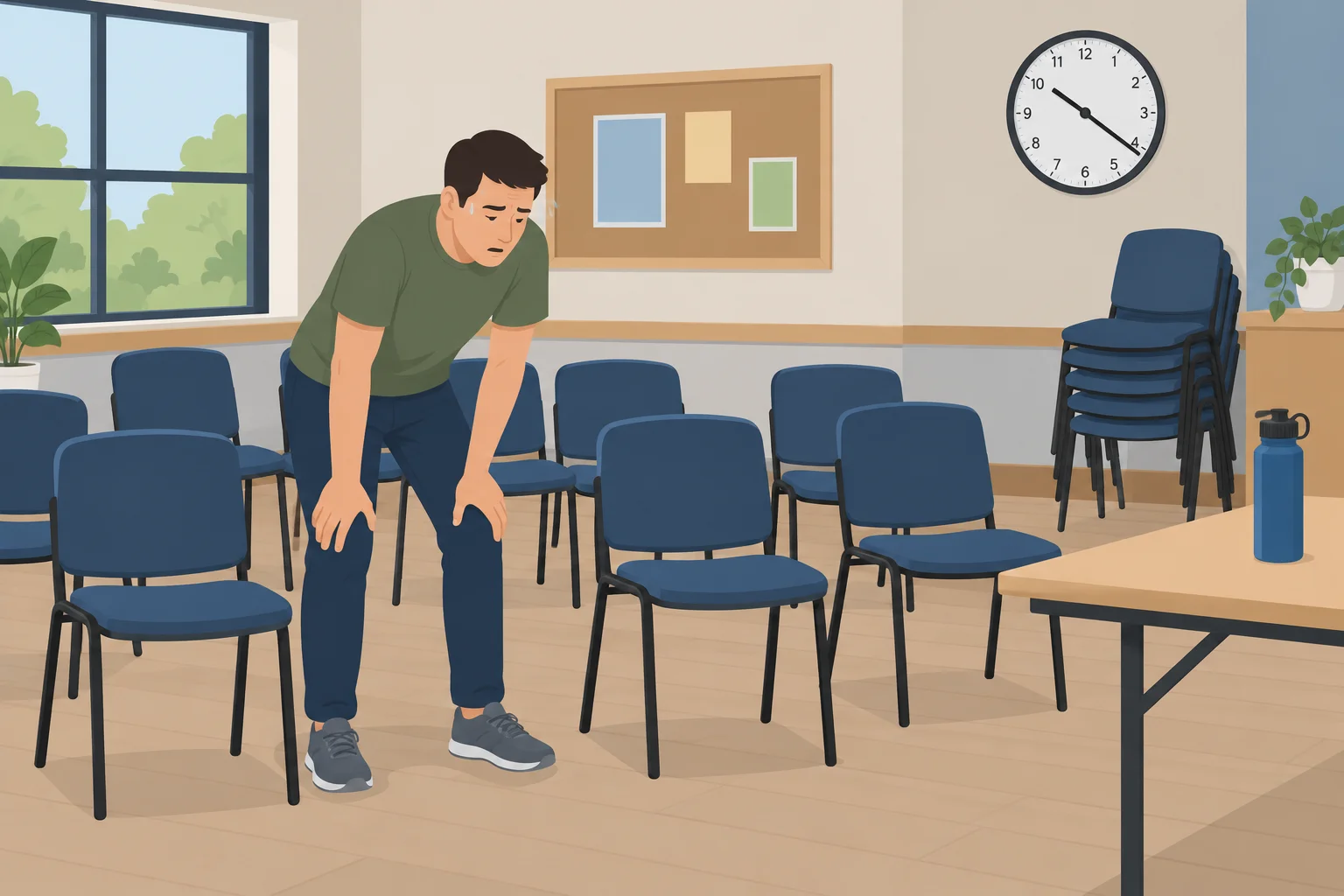
Look for what the room shows—and what it does not confirm.
Look at the scene. Leo says, “I’ve been moving chairs for twenty minutes.” Which conclusion is best supported?

Step 4 of 8
Choose present perfect simple or continuous forms according to whether a progress update emphasizes a completed result, a quantity, or activity over time.
A progress update can highlight either a result or the work leading to it.
Use the present perfect simple—subject + have/has + past participle—for a confirmed result or completed quantity.
Use the present perfect continuous—subject + have/has + been + verb-ing—for activity, effort, or time spent.
Completed results: Maya has completed 3 of 5 activity sheets.
Activity and duration: Leo has been revising the schedule since Tuesday.
Remaining work: 2 activity sheets remain.
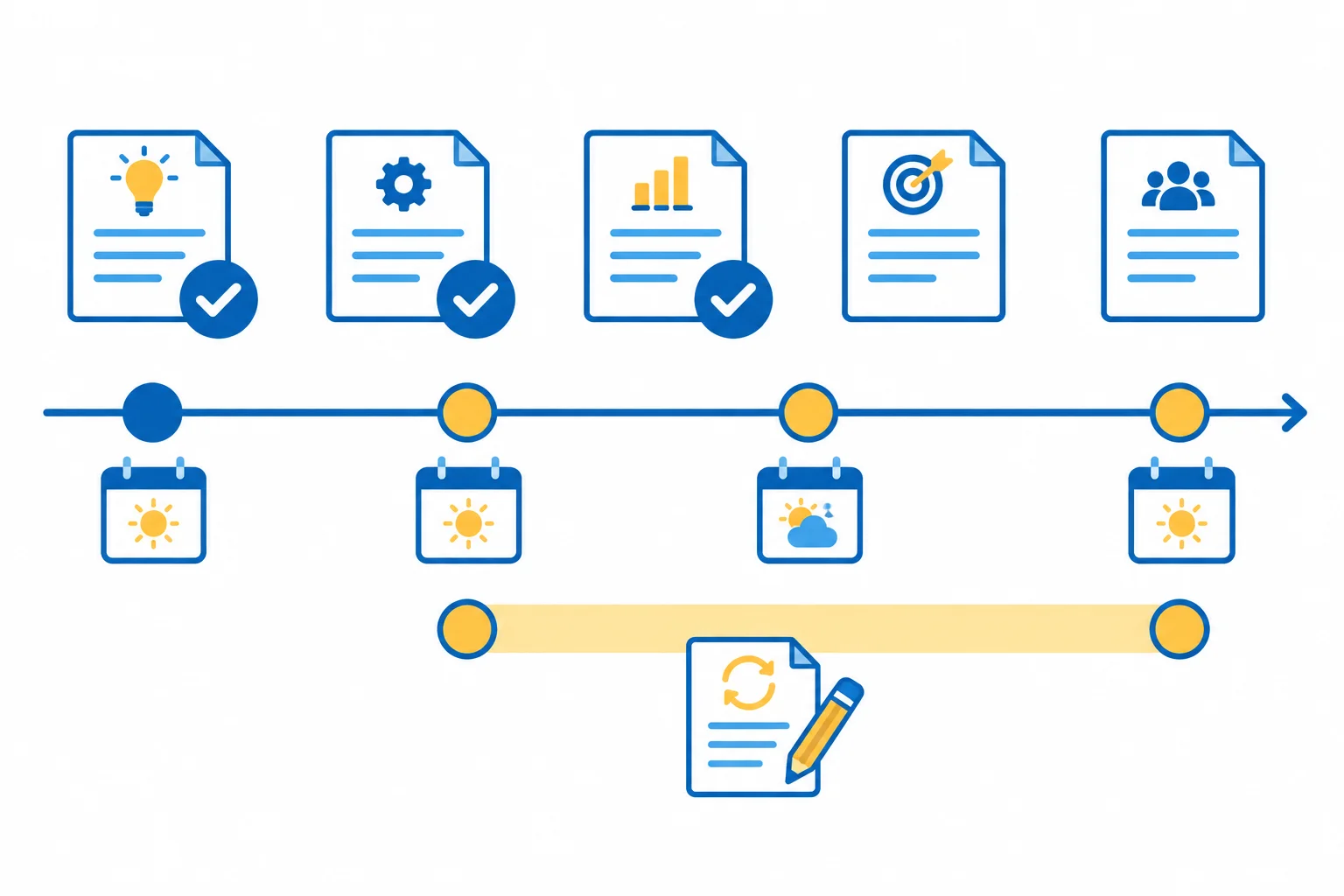
The check marks show Completed results. The shaded band shows Activity and duration. The two unmarked sheets show Remaining work.
Choose the form from the message you want to give. A time expression does not automatically require the continuous form: a sentence can include a duration and still emphasize a finished result.
| Main focus | Useful form | Example update |
|---|---|---|
| Confirmed result or quantity | Present perfect simple | Maya has completed 3 of 5 activity sheets. |
| Activity, effort, or duration | Present perfect continuous | Leo has been revising the schedule since Tuesday. |
| Time needed for a completed result | Present perfect simple can fit | Maya has completed the draft in two hours. |
Match each progress note to its intended focus.
Tap an item and then its matching pair.
Complete the update with the form that makes the result the main point.
Maya __ three activity sheets in two hours.
Complete the update with the form that emphasizes activity and duration.
Leo __ the schedule since Tuesday.
Build one question about a completed quantity, then one question about the length of an activity.
Build the question about Maya's completed quantity.
Your sentence
Available words
Build the question about Leo's activity duration.
Your sentence
Available words
Step 5 of 8
Choose naturally between present perfect simple and continuous forms for continuing situations, and use simple forms with common state verbs.
You already know the main contrast: the present perfect simple can emphasize a result, while the present perfect continuous can emphasize activity and duration. But do not use a mechanical “finished or unfinished” rule.
Some continuing activities allow both forms. The reference point is still now; the speaker chooses the focus.
I've worked here for a year. presents an ongoing fact.I've been working here for a year. highlights the activity during that period.Neither sentence says that the job has ended.
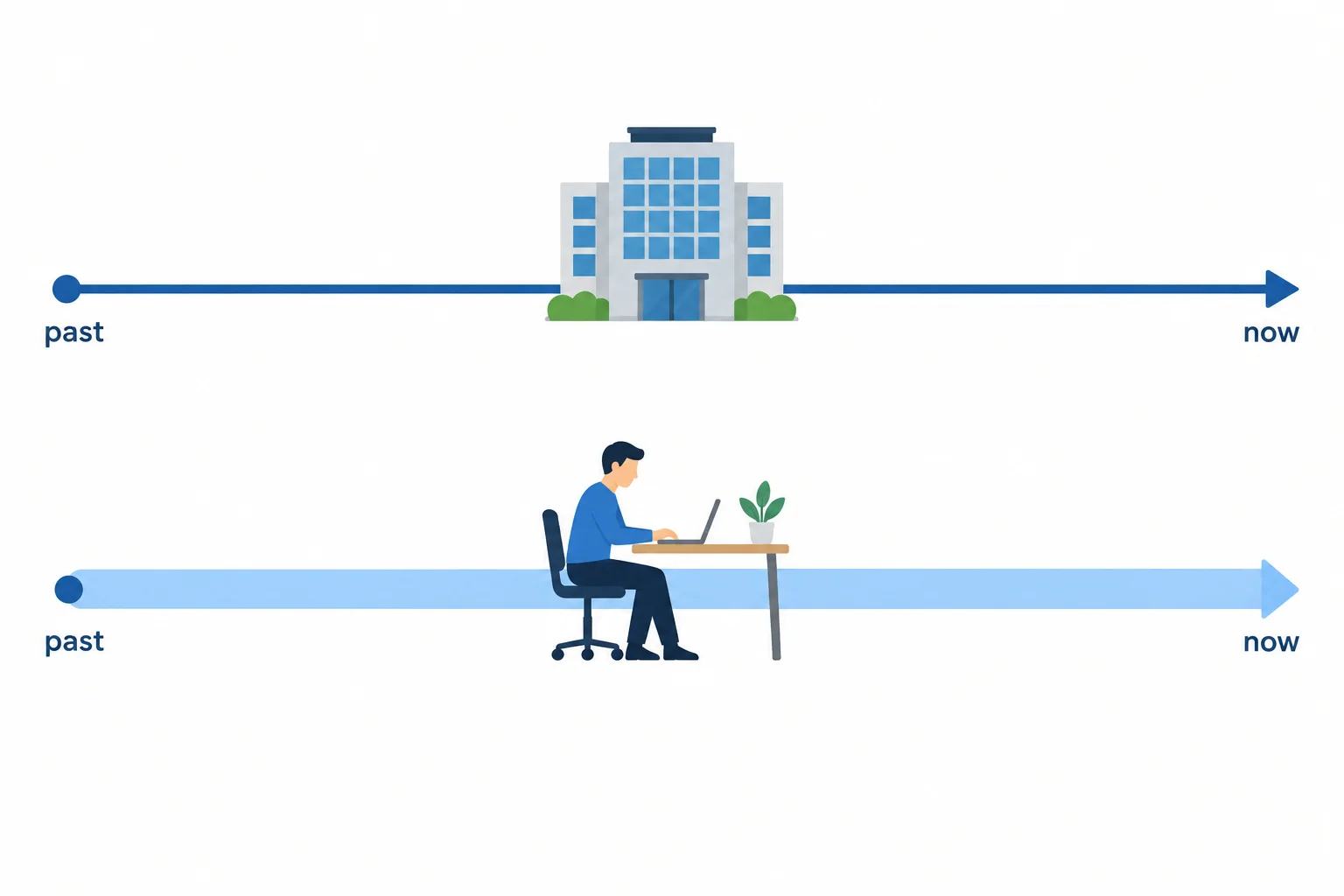
Both timelines reach now. The speaker can emphasize either the ongoing fact or the activity over the period.
Both forms can be correct for a continuing activity; the focus changes.
| Form | Main focus | Meaning now |
|---|---|---|
| I've worked here for a year. | Ongoing fact | My job continues now. |
| I've been working here for a year. | Activity over time | The work activity has continued up to now. |
Use the present perfect simple with common state verbs: verbs that usually describe a condition, possession, knowledge, or belief rather than an activity.
For ordinary meanings, use this pattern even with for or since:
subject + have/has + past participle
Examples:
I have known Maya since Monday.Leo has owned the projector for two years.Maya has believed in the workshop plan since Monday.These states continue up to now, but the simple form does not mean they are finished.
With the ordinary state meanings below, choose the present perfect simple—not the continuous.
| Verb | Natural form | Not normally used for this meaning |
|---|---|---|
| know | I have known Maya since Monday. | I have been knowing Maya since Monday. |
| own | Leo has owned the projector for two years. | Leo has been owning the projector for two years. |
| believe | We have believed in the plan since Monday. | We have been believing in the plan since Monday. |
Which pair is natural when the speaker still has the same job after one year, but wants to change the focus?
Write a short tense check.
I've been knowing Maya since Monday.Leo has been owning the projector for two years.We've been believing in the plan since Monday.Write at least 120 characters (0/120).
Step 6 of 8
Read a short community-workshop progress report and distinguish confirmed completed results, activity over time, remaining work, and claims the report does not establish.
A progress report is easier to read when you sort details into three labels:
Do not decide from one verb phrase alone. Read the surrounding details. A report can say that someone has completed a draft and has been revising it: the first version exists, but it can still be changing.
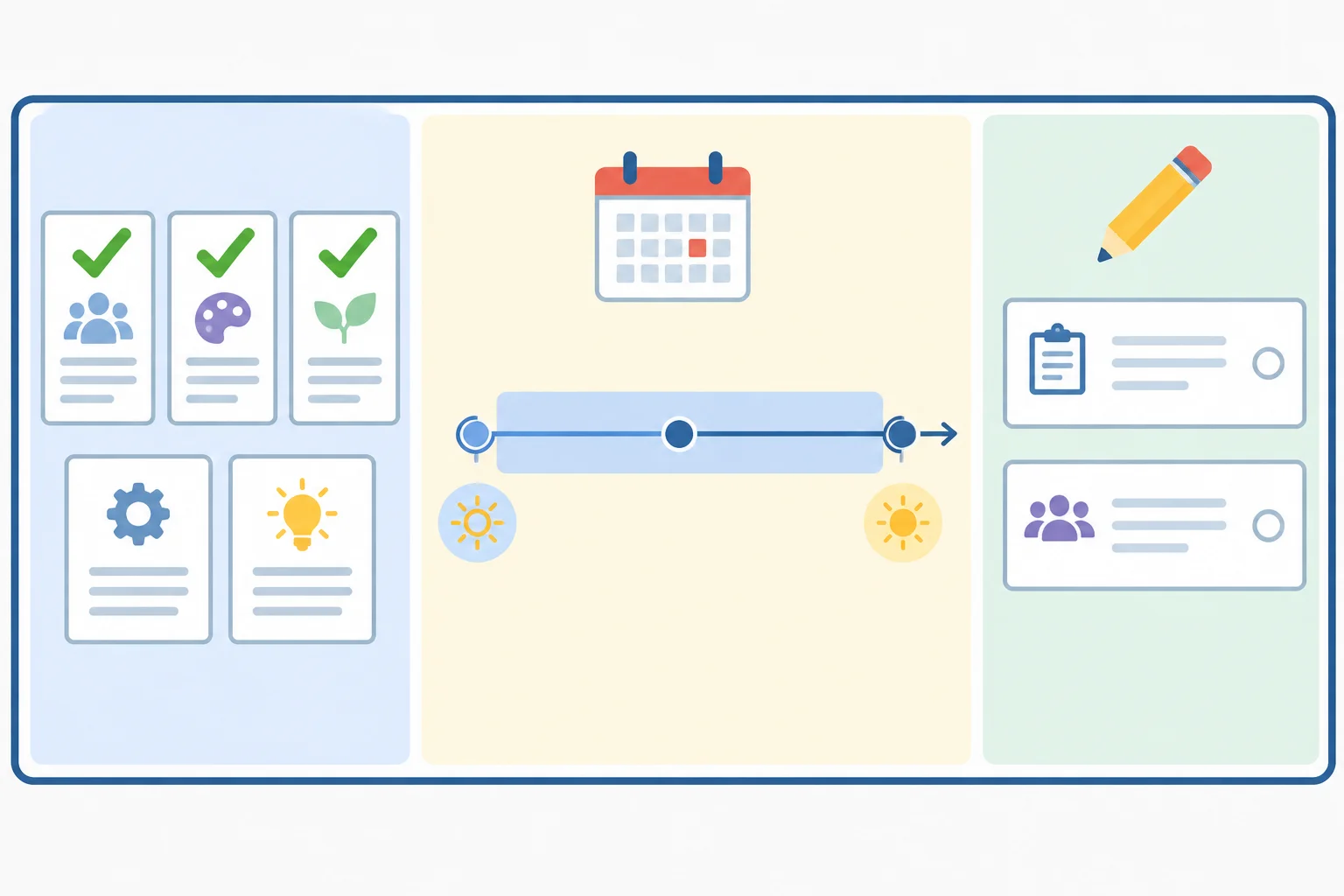
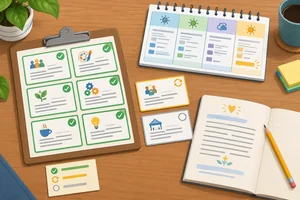
Check marks show confirmed results; a shaded timeline band shows activity over time; unmarked cards show remaining work.
Tip
A draft is a version of a text that may still need changes. Completing a draft does not mean that every part of the work is final.
Example
Thursday workshop preparation
Completed results
Activity and duration
Remaining work
Use the report’s exact information. Do not turn an activity into a confirmed result unless the report says it is complete.
| Label | Report detail | What is confirmed |
|---|---|---|
| Completed results | 3 of 5 activity sheets | A completed quantity |
| Completed results | a draft of the welcome note | A first version exists |
| Activity and duration | revising the schedule since Tuesday | Activity over a period, not a finished schedule |
| Remaining work | 2 activity sheets remain | The full set is not complete |
Maya has completed a draft, and she has been revising that draft. These ideas do not conflict: completing names a result, while revising describes continuing work on that result.
The report confirms that Leo has finished revising the schedule.
The report supports both that a welcome-note draft exists and that Maya has continued work on it.
Classify each statement from the workshop report or a claim about it.
Tap an item and then its matching pair.

Step 7 of 8
Listen for key information in progress updates, write a short perfect-form sentence, and practice making results and time information prominent.
In natural progress updates, have, has, and been are often quick and quiet. Listen for the whole message instead of trying to hear every small word separately.
In these examples, Maya's means Maya has, and Leo's means Leo has. Make the result, quantity, or time information more noticeable than the auxiliary words.
When you write after listening, use the correct standard form: Maya has completed... or Leo has been revising...
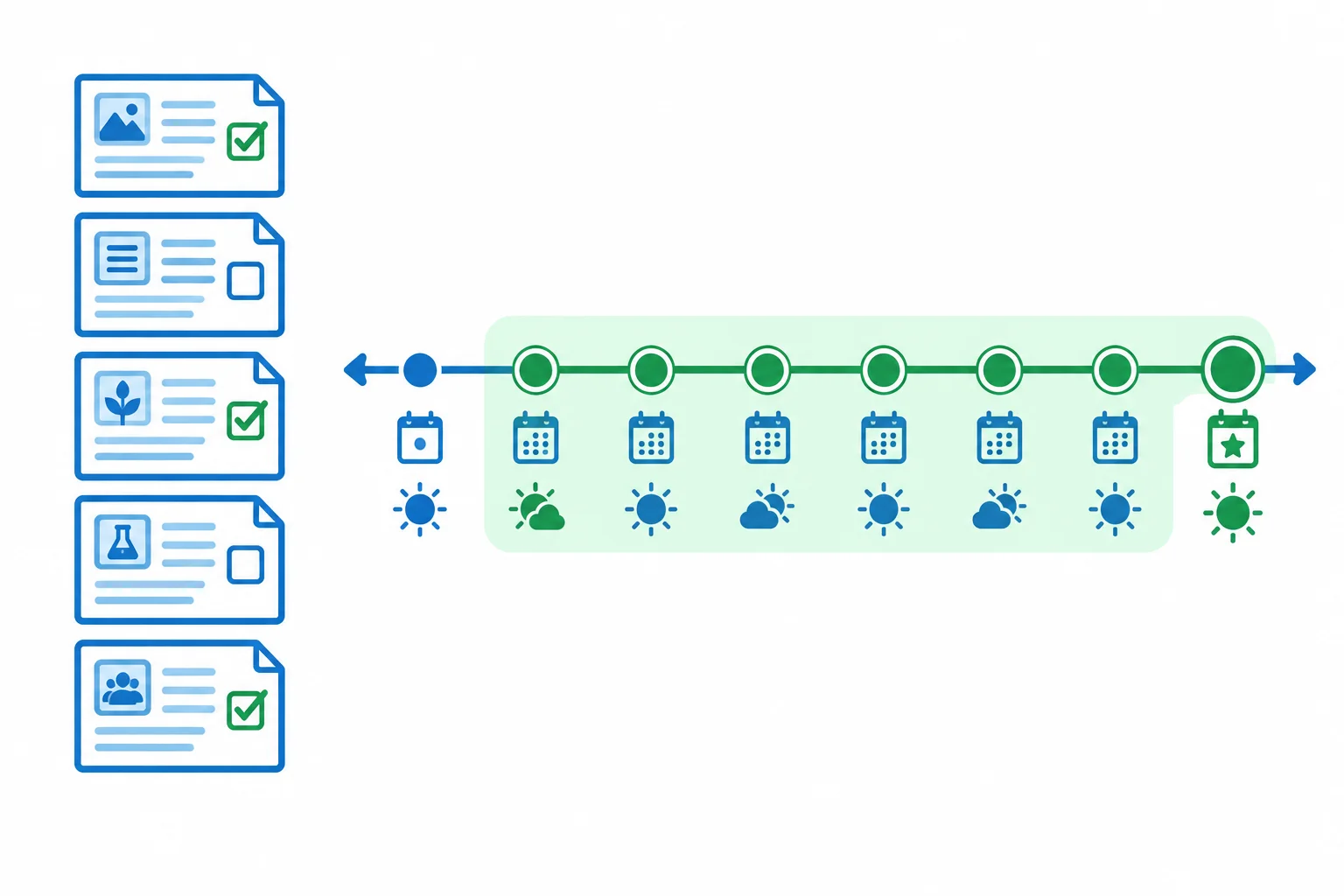
A completed quantity and a continuing activity can carry the key information in a spoken update.
Listen, then read: Maya's completed three activity sheets. Leo's been revising the schedule since Tuesday.
Maya's completed three activity sheets. Leo's been revising the schedule since Tuesday.
Listen and choose an option.
What does this update emphasize?
Leo's been revising the schedule since Tuesday.
Listen and choose an option.
What does this update communicate?
Leo's tired because he's been moving chairs for twenty minutes.
Listen and write what you heard.
Listen and type the sentence in standard written English.
Listen and repeat the model aloud: Maya's completed three activity sheets, and I've been revising the schedule since Tuesday.
Maya's completed three activity sheets, and I've been revising the schedule since Tuesday.
Tip
Self-check after speaking:
Speak your own two-part progress update aloud. Include one completed result and one activity with a duration or starting point. You can use workshop preparation or a study task.
Then type the update you said and name the amount or time phrase you stressed.
Write at least 45 characters (0/45).

Step 8 of 8
Create and self-check a concise written and spoken progress update using present perfect simple and present perfect continuous forms.
A useful progress update does three jobs: it names a confirmed result, shows activity over time, and says what is still remaining. Choose the tense for the meaning you want to emphasize—not only for whether the whole task is finished.
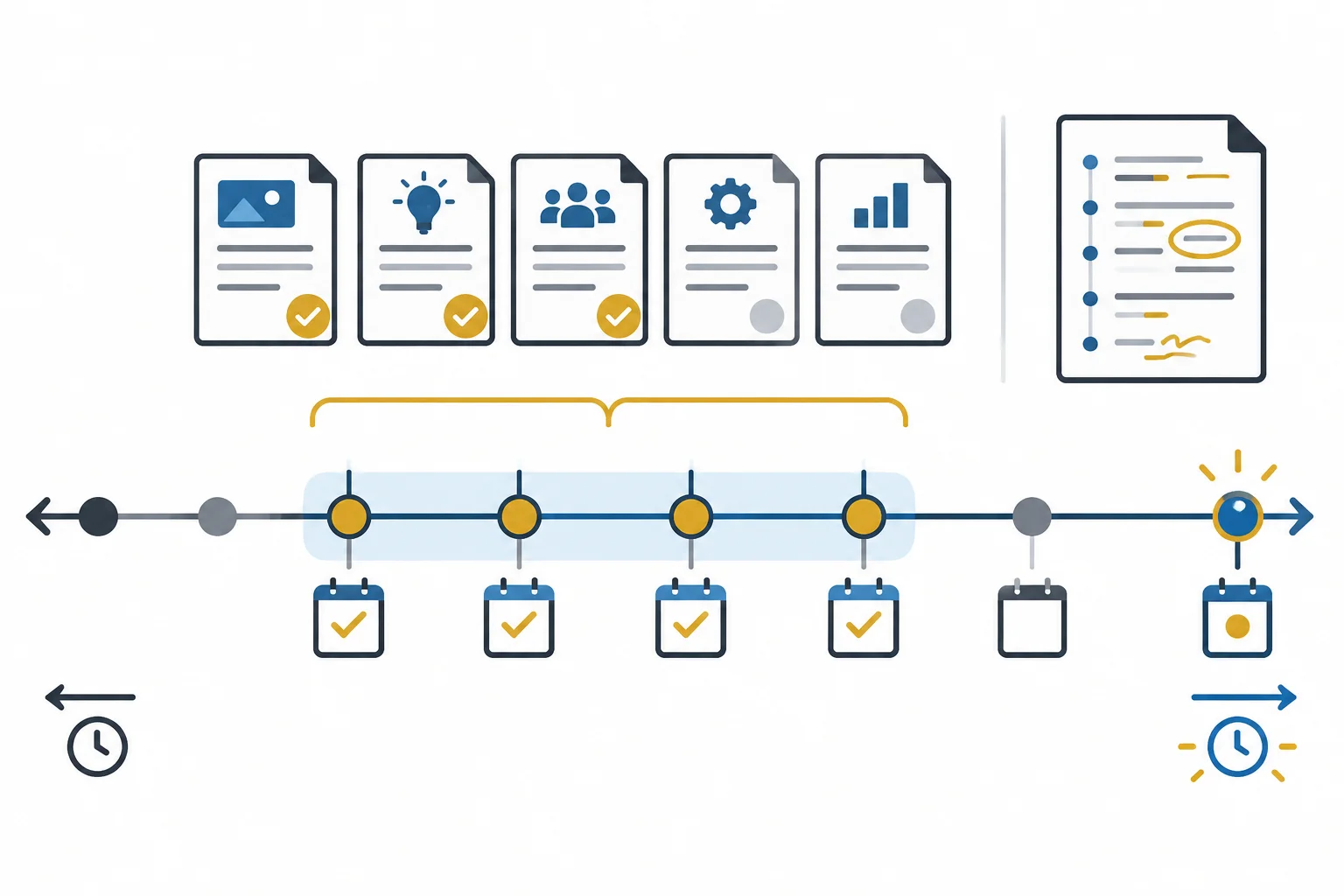
Use three labels in your notes: Completed results, Activity and duration, and Remaining work.
Example
Maya’s Thursday update
“I’ve completed three of the five activity sheets. I’ve been preparing workshop materials since Monday. I’ve also been checking the room plan for two hours. The preparation is moving forward, but two activity sheets remain. I haven’t been revising the schedule today. Has Leo been revising it since Tuesday?”
Say it aloud with extra focus on three activity sheets, two hours, and two activity sheets. Keep the auxiliary words less prominent.
Use this checklist after you draft your message.
| Meaning | Best choice | Form check |
|---|---|---|
| Confirmed result or amount | Present perfect simple | subject + have/has + past participle |
| Activity, duration, or recent effort | Present perfect continuous | subject + have/has + been + verb-ing |
| State continuing to now | Present perfect simple | Know, own, and believe normally use simple forms |
| Work not finished | A clear remaining statement | Say what still needs work |
Source A: Written progress card — Thursday
Completed results
Activity and duration
Remaining work
Read for the function of each line, not only for the verb form.
Listen for one completed quantity and one activity with a duration.
I've completed three activity sheets. I've been preparing the workshop materials for two hours. Two activity sheets remain.
Which summary correctly identifies a completed result in Source A and an activity with duration in Source B?
| Include | Check |
|---|---|
| Completed result or quantity | Use present perfect simple when the result is the focus. |
| Activity with time | Use present perfect continuous with for or since when duration is the focus. |
| Remaining work | Make clear what is still left to do. |
| One extra form | Add a suitable negative or follow-up question. |
| Spoken delivery | Stress the important amount and time expression. |
Write a 50–70-word update about workshop preparation or your own study task. Include:
Then say a 30–45-second version aloud. You may add a short opening or closing sentence when speaking. Compare both versions with Maya’s model and the checklist. In your response, write your update, then add Check: and report one correction you made or one confirmed strength. No recording is needed.
Write at least 280 characters (0/280).
Congratulations! You completed: Describe Progress with the Present Perfect Continuous
Thousands of online courses in video, ebooks and audiobooks.
To test your knowledge during online courses
Generated directly from your cell phone's photo gallery and sent to your email

Download our app via QR Code or the links below:.



Carry knowledge in your pocket.
Download the Cursa app.
There are hundreds of free courses available, with a free certificate of completion that is saved in your mobile image gallery.
Download the app to access the Course Completion Certificate for Free.


+ 10 million
students

Free and Valid
Certificate

60 thousand free
exercises

4.8/5 rating in
app stores

Free courses in
video and ebooks