Step 1 of 9
Look Back from a Past Moment
Use a timeline to identify the past moment an account looks back from and distinguish it from an earlier event.

Learning path · Level 8 · Tutorial 2
Explain what had happened, or had been happening, before another past event. Read and hear short accounts of a delayed activity, reconstruct their timelines, and complete audio-choice and dictation tasks. Then use a model to explain the cause of a problem in a short spoken and written account.
 Look Back from a Past Moment
Use a timeline to identify the past moment an account looks back from and distinguish it from an earlier event. 2 min
 Build Past Perfect Simple Statements
Build affirmative past perfect simple statements to show actions completed before a past reference point. 2 min
 Ask What Had Happened
Ask and answer about earlier events, and use negatives to explain what had not happened by a past reference point. 2 min
 Describe Activity Before a Past Moment
Describe earlier activity, duration, and effects with the past perfect continuous. 3 min
 Choose Completion, Activity, or State
Choose past perfect simple or continuous forms to emphasize completion, activity, duration, and states before a past reference point. 3 min
 Connect the Events Without Overusing Had
Use time signals and tense changes to connect earlier causes with the main sequence of the delayed workshop. 3 min
 Hear What Had Happened
Listen for past reference points, contractions, negative meaning, and earlier activity in the delayed workshop account. 3 min
 Explain the Delay Aloud
Use clear pauses, stress, and accurate past perfect forms to give a short spoken explanation of the delayed workshop. 2 min
 Put the Whole Account Together
Write and read aloud a clear account of the delayed workshop, separating earlier causes from the main past sequence. 3 min
Step 1 of 9
Use a timeline to identify the past moment an account looks back from and distinguish it from an earlier event.
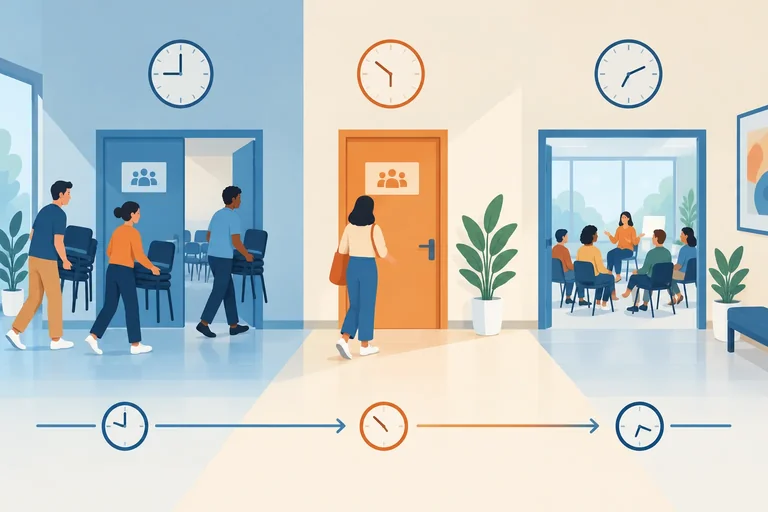
When you tell a past account, you do not always look from now. You can look back from one moment in the past. That moment is the past reference point.
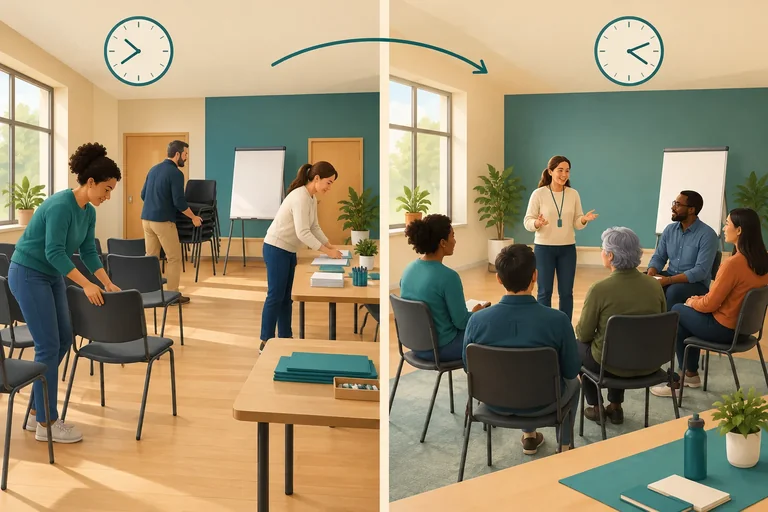
At 10:00, Leo reached Room A. From that past reference point, we can look back to an earlier event: Maya’s team had finished moving 20 chairs by 09:45.
The past perfect helps show that an event or situation was earlier than the past reference point.
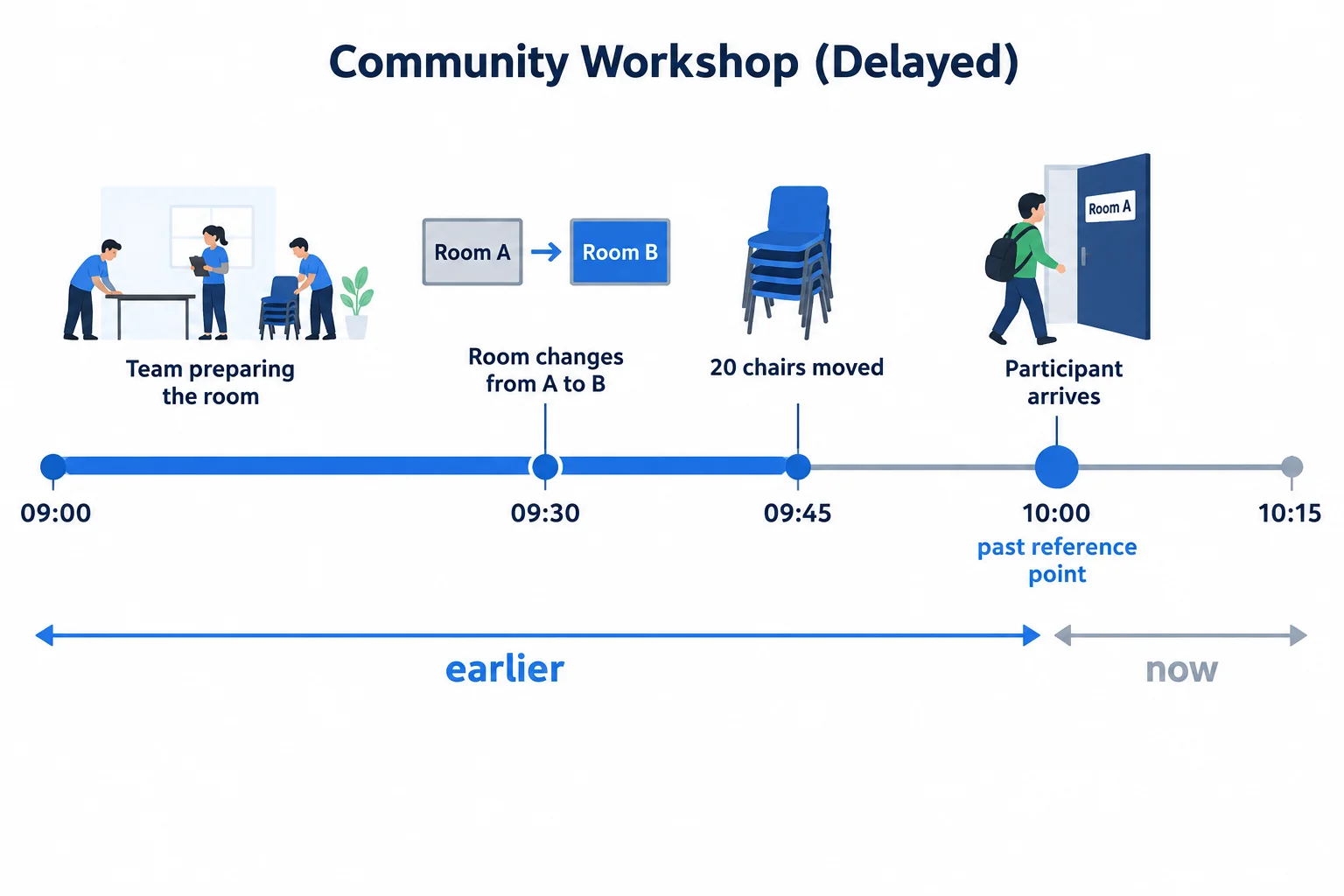
Read from the 10:00 dot. The activity and events to its left happened earlier.
The order of events in a sentence can differ from their real time order. First find the past reference point; then place the other event before or after it on a timeline.
Example
When Leo reached Room A at 10:00, Maya’s team had moved 20 chairs by 09:45.
The sentence mentions Leo’s arrival first, but the team’s work happened first. Leo’s arrival at 10:00 is the past reference point.
Tip
Ask yourself: “What past moment is this account looking back from?” Do not choose the first event you read automatically.
Read the account, then choose the timeline that shows the past reference point and the earlier event correctly.
“When Leo reached Room A at 10:00, Maya’s team had moved 20 chairs by 09:45.”

Step 2 of 9
Build affirmative past perfect simple statements to show actions completed before a past reference point.
You can look back from a past reference point and name an action that was already complete.
At 10:00, Leo reached Room A. The room had changed from Room A to Room B at 09:30. The change happened earlier; Leo’s arrival is the past reference point.
Use the past perfect simple to make that earlier completion clear.
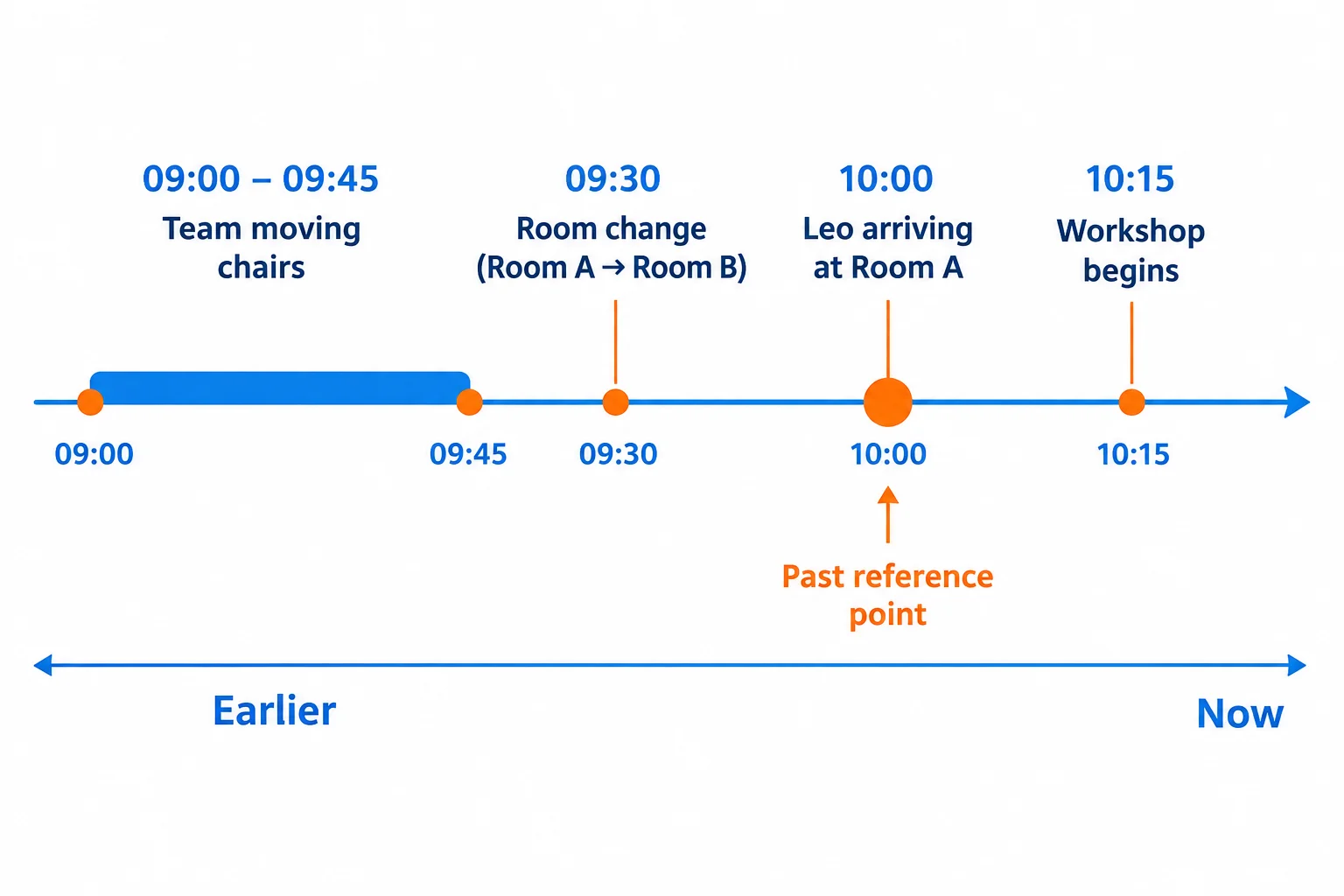
The room change is earlier than the past reference point: Leo’s arrival at 10:00.
Past perfect simple pattern
subject + had + past participle
had stays the same with every subject. After had, use a past participle, not a past simple form. For example, the past simple is began, but the past participle is begun.
Compare the verb forms before building a past perfect simple statement.
| Base verb | Past simple | Past participle | Past perfect simple |
|---|---|---|---|
| leave | left | left | Leo had left Room A. |
| begin | began | begun | Maya had begun the workshop. |
| move | moved | moved | Maya’s team had moved 20 chairs. |
Build one statement about the completed action before Leo arrived.
Your sentence
Available words
At 10:20, complete the three past perfect simple statements. Type the three verb phrases in order, separated by semicolons.
Maya’s team _ moving 20 chairs. Leo _ Room A. Maya ___ the workshop.
Use these base verbs: finish, leave, begin.
Step 3 of 9
Ask and answer about earlier events, and use negatives to explain what had not happened by a past reference point.
At a past reference point, you can ask what happened earlier—or explain what had not happened yet.
Use subject + had not + past participle for a negative:
At 10:00, Maya’s message had not included Room B.
In conversation, had not usually becomes hadn’t. To make a question, move had before the subject. Do not use did with the past perfect.
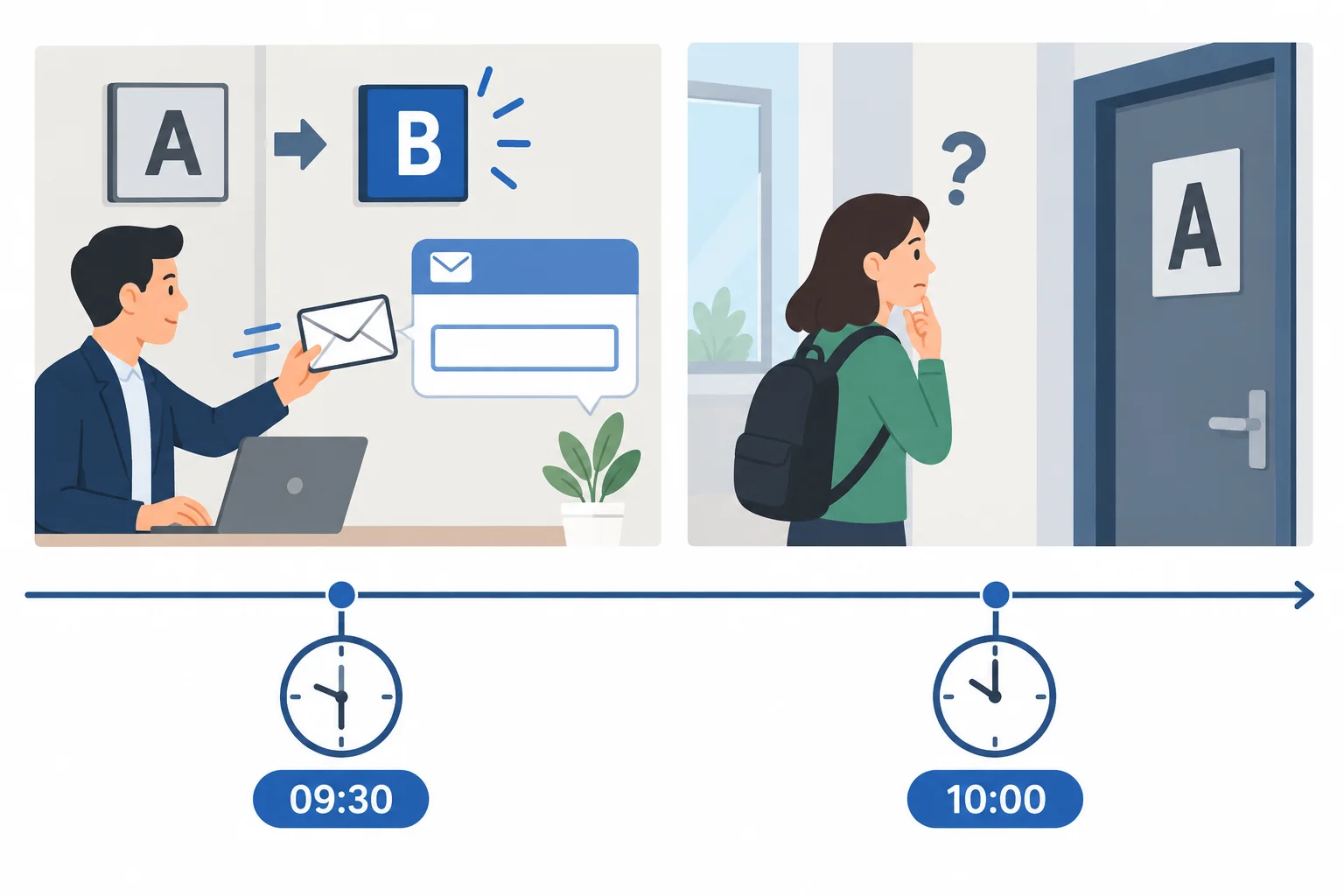
The missing room detail happened before the past reference point: Leo’s arrival at 10:00.
Use these full forms when you write grammar patterns.
| Purpose | Pattern | Workshop example |
|---|---|---|
| Negative | subject + had not + past participle | Maya had not included Room B. |
| Yes-or-no question | Had + subject + past participle? | Had Maya included Room B? |
| Information question | question word + had + subject + past participle? | What had Maya’s message omitted? |
| Short answer | Yes, subject + had. / No, subject + had not. | No, it had not. |
Example
Leo: Had your message included the new room number?
Maya: No, it hadn’t. I hadn’t added Room B.
Leo: What had the message omitted?
Maya: The new room number.
The short answer uses hadn’t; it does not repeat the main verb.
Tip
Say Had Maya included ...?, not Did Maya had included ...?
In a past perfect question or negative, had already carries the tense. The main verb stays as a past participle.
Build an information question that asks about the missing detail in Maya’s message.
Your sentence
Available words
Build a yes-or-no question about this fact: Maya’s message did not include the new room number.
Your sentence
Available words
At 10:00, Leo was still in Room A. Change this statement into a negative: “Leo had found Room B by 10:00.” Write the past perfect verb phrase.
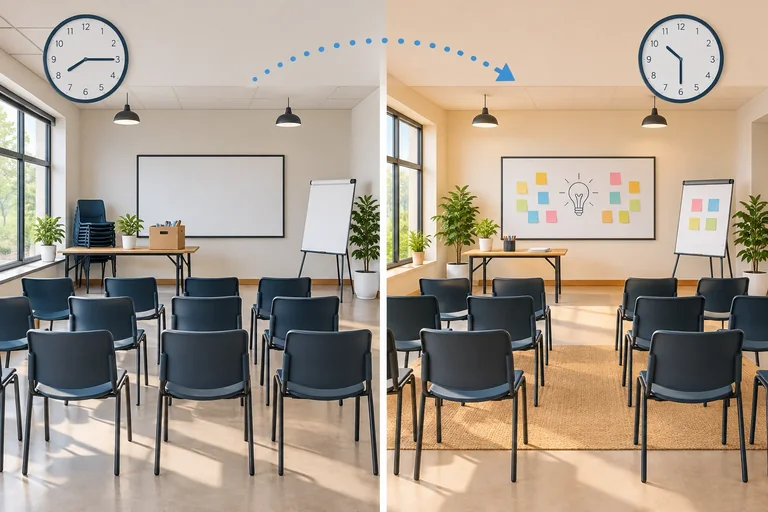
Maya’s team finished moving 20 chairs at 09:45. At 10:00, answer: “Had Maya’s team moved 20 chairs?”
Step 4 of 9
Describe earlier activity, duration, and effects with the past perfect continuous.
A past perfect continuous verb phrase looks back from a past reference point to an earlier activity.
Pattern: subject + had been + -ing form
At 09:30, Maya's team had been preparing the room since 09:00.
The activity started earlier and continued up to the past reference point. As with other forms using had, the auxiliary is the same for every subject.
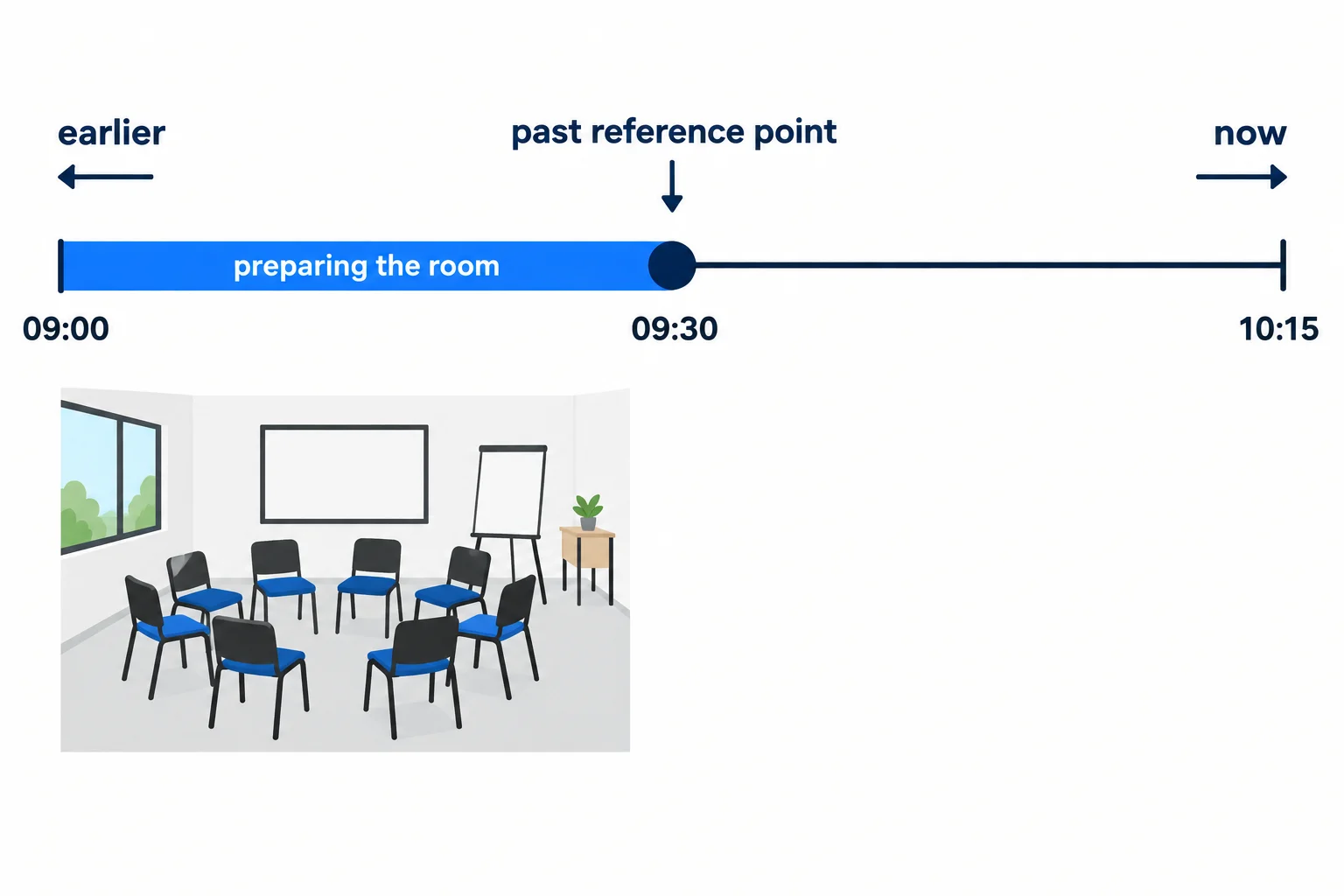
The bar shows an activity that began before the past reference point and continued up to it.
Example
Use for to give a length of time and since to give a starting point.
Make negatives and questions by changing the position of had. Keep been + -ing form after it.
Short answers use had or hadn't. Do not repeat been in a short answer.
Use these patterns when you ask about an activity before a past reference point.
| Purpose | Pattern | Workshop example |
|---|---|---|
| Affirmative | subject + had been + -ing form | They had been preparing the room. |
| Negative | subject + had not been + -ing form | They had not been preparing Room B. |
| Question | Had + subject + been + -ing form? | Had they been preparing? |
| Short answer | Yes, subject + had. / No, subject + hadn't. | Yes, they had. / No, they hadn't. |
Example
Maya: “Had the team been preparing Room B at 09:30?”
Leo: “No, they hadn't. They'd been preparing Room A since 09:00.”
The past perfect continuous can also explain a result at a past reference point.
At 09:45, the team finished moving 20 chairs. They had been moving chairs for 15 minutes.
The activity may have just stopped at the reference point. The form by itself does not tell us whether an activity continued after that point; use the surrounding context.
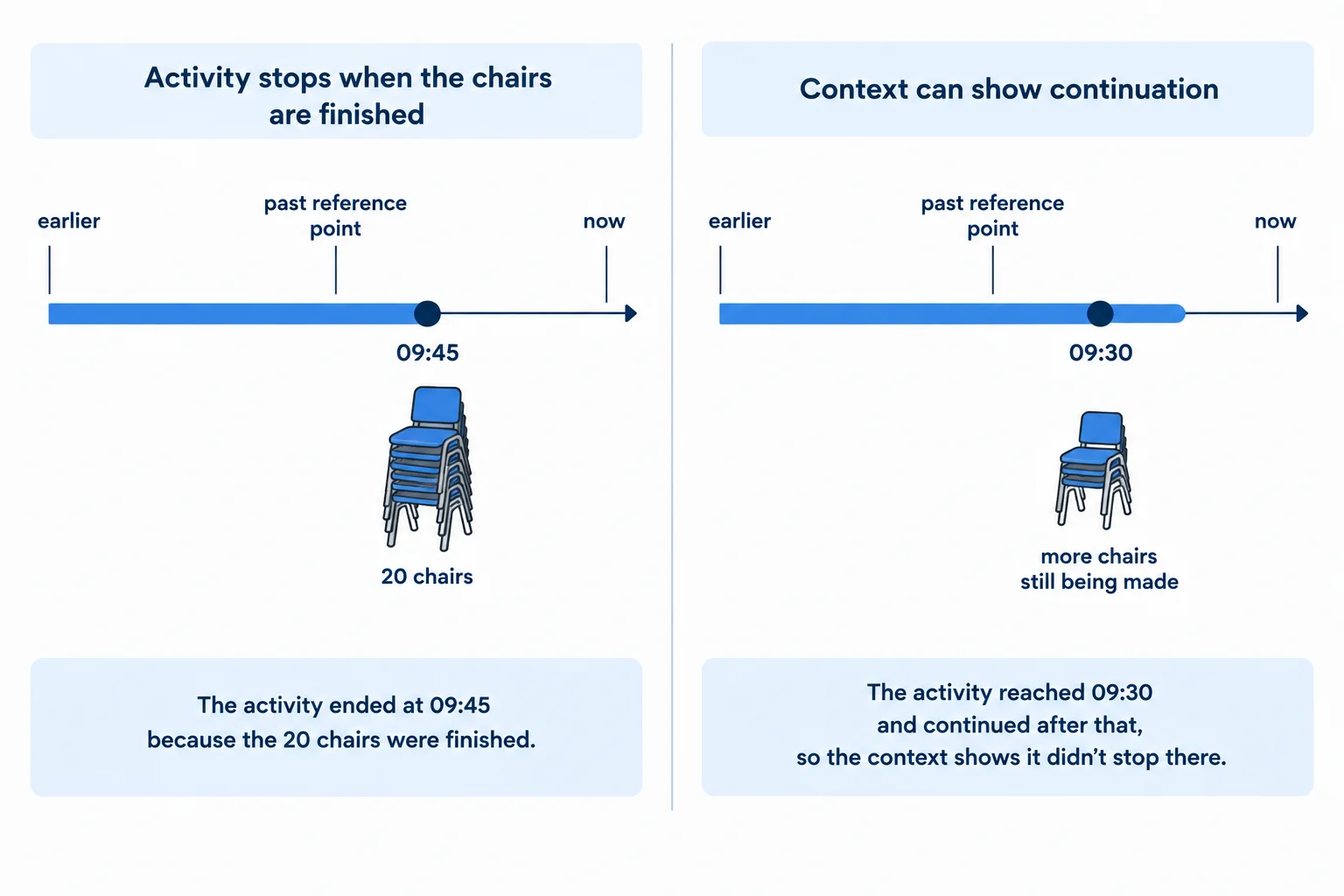
A past perfect continuous form reaches back to the activity before the reference point. Context tells you what happened afterward.
Complete each missing verb phrase.
At 09:30, Maya's team ____ the room since 09:00.
At 09:45, Maya's team ____ chairs for 15 minutes before they finished moving 20 chairs.
Match each account to its timeline description.
Tap an item and then its matching pair.

Step 5 of 9
Choose past perfect simple or continuous forms to emphasize completion, activity, duration, and states before a past reference point.
Both forms look back from a past reference point, but they highlight different information.
Use the past perfect simple when the important idea is an earlier completed result or amount. Use the past perfect continuous when the important idea is an earlier activity or its duration.
At 09:45, Maya’s team had moved 20 chairs. The completed amount matters.
At 09:45, Maya’s team had been moving chairs. The activity matters. This form alone does not say whether the activity was complete.
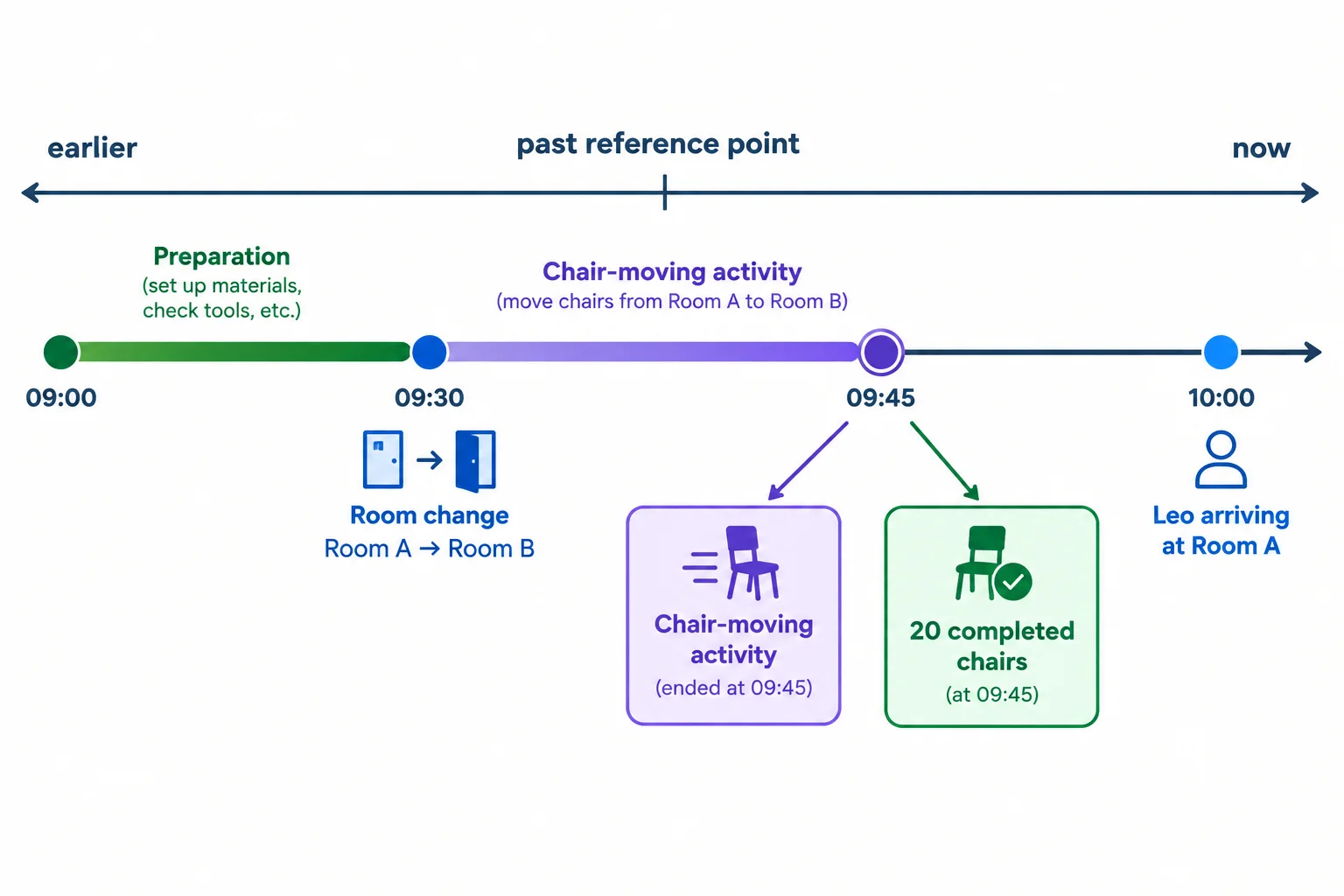
The same earlier period can be described through its completed result or through the activity itself.
Choose the form according to the meaning you want to emphasize.
| Form | Pattern | Main focus | Workshop example |
|---|---|---|---|
| Past perfect simple | subject + had + past participle | Completed result or amount | Maya’s team had moved 20 chairs. |
| Past perfect continuous | subject + had been + -ing form | Activity or duration | Maya’s team had been moving chairs. |
| Past perfect simple with a state | subject + had + past participle | Earlier state | Maya had known about the change. |
A duration phrase does not automatically require the continuous form. State verbs such as know normally use the simple form.
At 09:45, Maya had known about the room change for 15 minutes. Her knowledge began at 09:30 and continued to that past reference point.
With an action verb, both forms can sometimes be possible, but the emphasis changes:
The event order stays the same. Your choice tells the listener what matters most.
Example
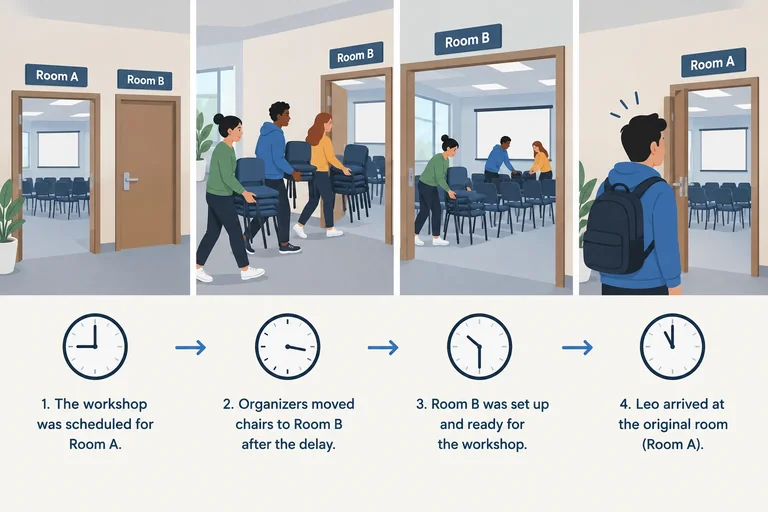
Leo arrived at Room A at 10:00. Maya’s team had prepared the room, but Maya’s message had omitted the new room number.
The first past perfect simple form presents a result. The second presents an earlier completed cause of Leo’s problem. If you say Maya’s team had been preparing the room, you draw attention to the work in progress before that past moment instead.
At 10:00, Maya had known about the room change since 09:30. Select the best sentence.
Match each intended meaning to the best past perfect form.
Tap an item and then its matching pair.
Step 6 of 9
Use time signals and tense changes to connect earlier causes with the main sequence of the delayed workshop.
A past account can look back from one later moment. That moment is the past reference point.
Use by the time to connect an earlier situation to that point:
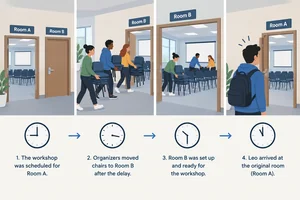
By the time Leo reached Room A at 10:00, Maya’s team had already moved 20 chairs to Room B.
The past simple event, Leo reached Room A, gives the reference point. The past perfect simple action happened earlier. Already goes between had and the past participle to emphasize that the action was complete.
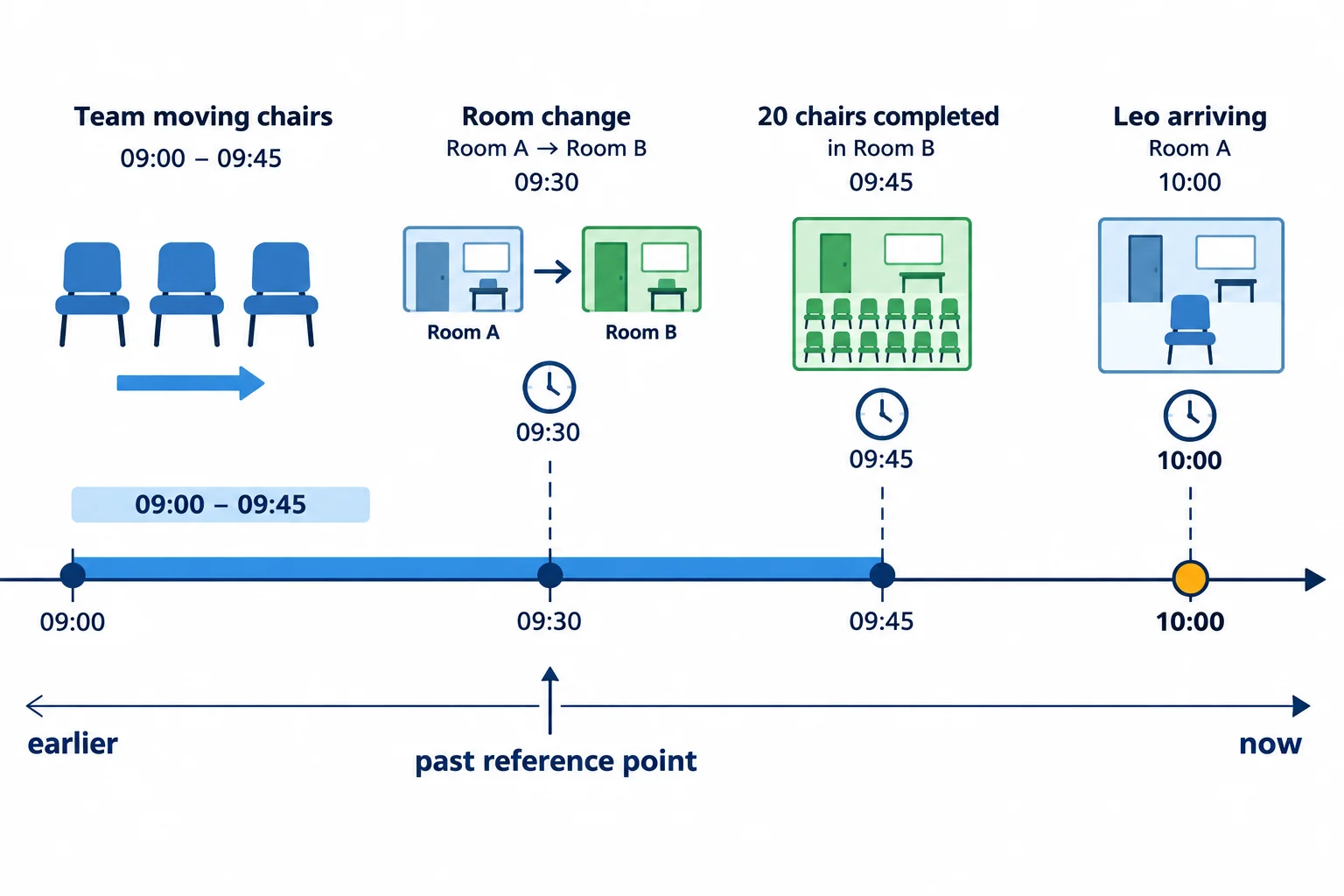
The events to the left of 10:00 are earlier; 10:00 is the past reference point in the example sentence.
A clear delay explanation gives background first, then returns to the main past sequence. Choose a signal that makes the relationship clear; do not add had to every earlier action.
Use the signal that best shows how two events connect.
| Signal or choice | Purpose | Example |
|---|---|---|
| by the time | Links earlier background to a later past reference point | By the time Leo arrived, the team had finished. |
| already | Emphasizes earlier completion | They had already moved 20 chairs. |
| before that | Directs attention to earlier background | Before that, the room had changed. |
| before | Can make order clear without past perfect | The team moved chairs before Leo arrived. |
| then / a clock time | Continues the main past sequence | Then Leo found Room B at 10:10. |
Example
By the time Leo reached Room A at 10:00, Maya’s team had already moved 20 chairs to Room B. Before that, the room had changed at 09:30. Maya had known about the change since 09:30, but her message omitted the new room number. Leo looked in Room A, then found Room B at 10:10. The workshop began at 10:15.
The unexpected change interrupted the original plan. The missing room number was the cause of Leo’s delay. After the earlier background, looked, found, and began return to the past simple main sequence.
Arrange the workshop events from earliest to latest.
Use the workshop timeline from this step. In one response:
Keep the times, rooms, 20 chairs, and the missing room number consistent.
Write at least 250 characters (0/250).

Step 7 of 9
Listen for past reference points, contractions, negative meaning, and earlier activity in the delayed workshop account.
When you listen to a past account, first find the past reference point. Then listen for the earlier verb phrase.
In this workshop account, 09:30 is the past reference point: the room changed then. The team’s preparation began earlier, at 09:00.
In these past accounts, a contraction can contain had:
The word after the auxiliary helps you hear the form: a past participle follows had; been + -ing form follows had been.
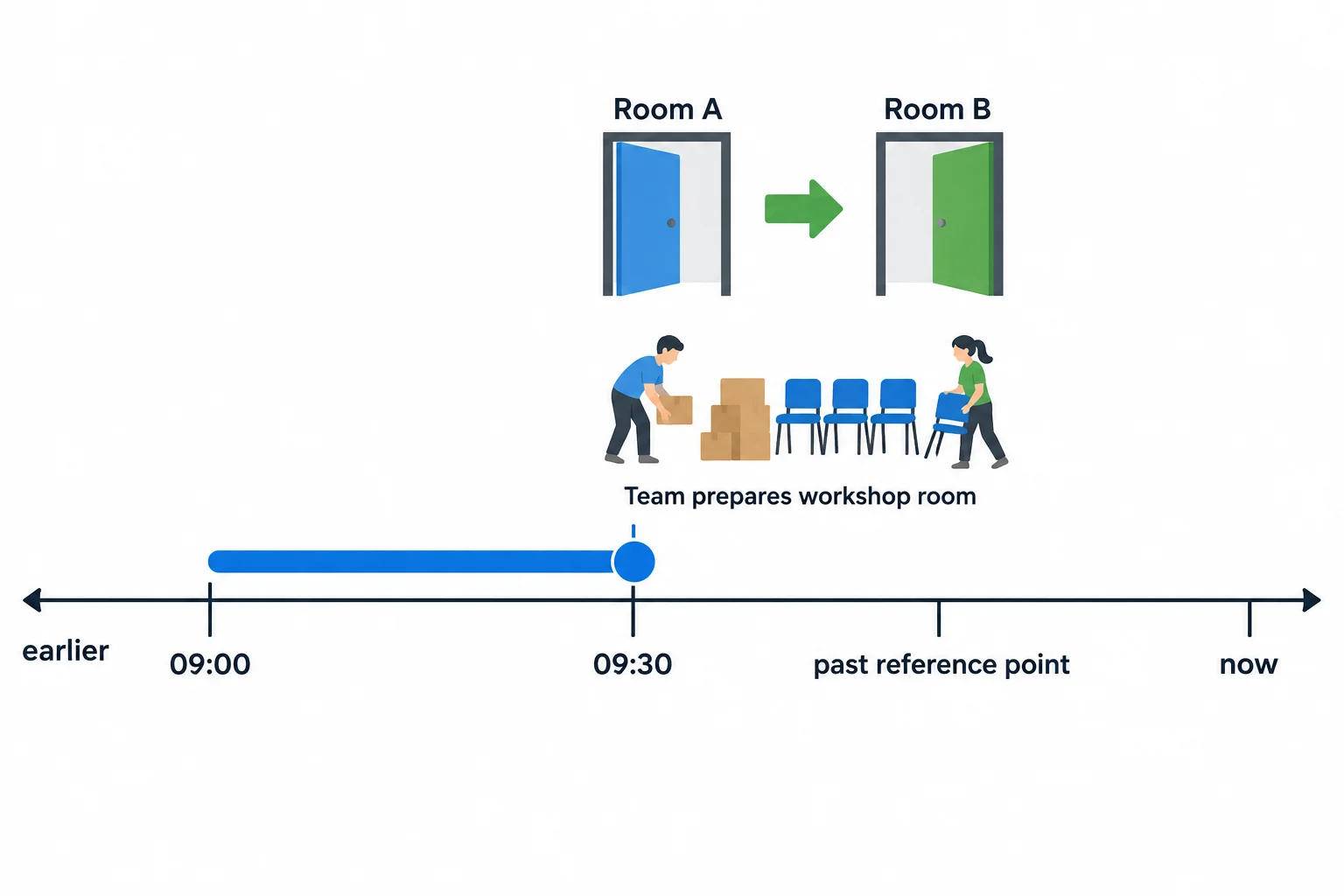
The bar shows earlier activity. The dot at 09:30 is the past reference point.
Do not listen only for the main verb. The auxiliary changes the meaning:
Keep the auxiliary when you write what you hear. It tells the listener whether an action happened, did not happen, or was in progress.
Listen for the missing detail and the past reference point.
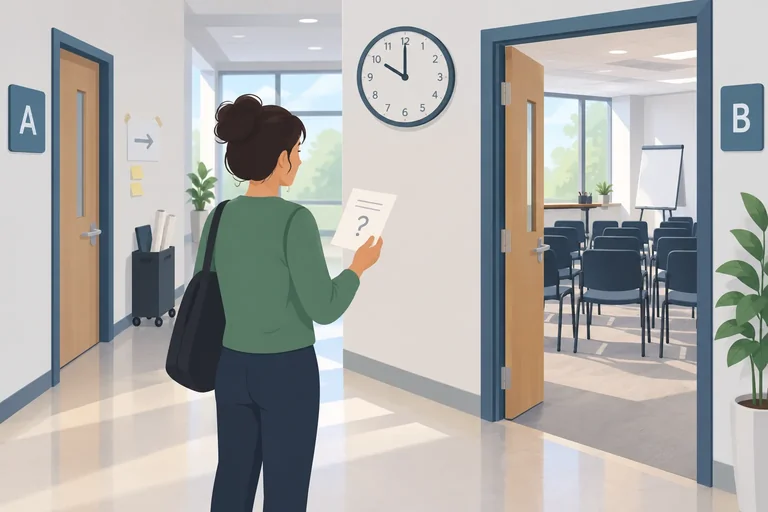
At 10:00, Leo could not find the workshop because Maya's message hadn't included the new room number.
At 10:00, Leo could not find the workshop because Maya's message hadn't included the new room number.
Tip
In connected speech, had been may be quiet. Listen especially for the activity or duration: “They had been preparing / for 30 minutes.”
When you repeat an account, pause briefly after the past reference point. It makes the time order easier to follow.
Listen and choose an option.
Listen to the stated sequence. Which spoken account matches it?
The room changed at 09:30. The team finished moving 20 chairs at 09:45. Leo reached Room A at 10:00.
Listen carefully. The recording gives the activity’s starting time and its past reference point.
At 09:30, the room changed from Room A to Room B. Maya's team had been preparing the room since 09:00.
Choose the timeline that matches the recording.
Listen and write what you heard.
Type exactly what you hear.
Listen and write what you heard.
Type exactly what you hear.
Step 8 of 9
Use clear pauses, stress, and accurate past perfect forms to give a short spoken explanation of the delayed workshop.
When you explain a delay aloud, guide your listener through three clear time units:
A brief pause between units helps the listener follow each change in time. You do not need to put every fact into one long sentence.
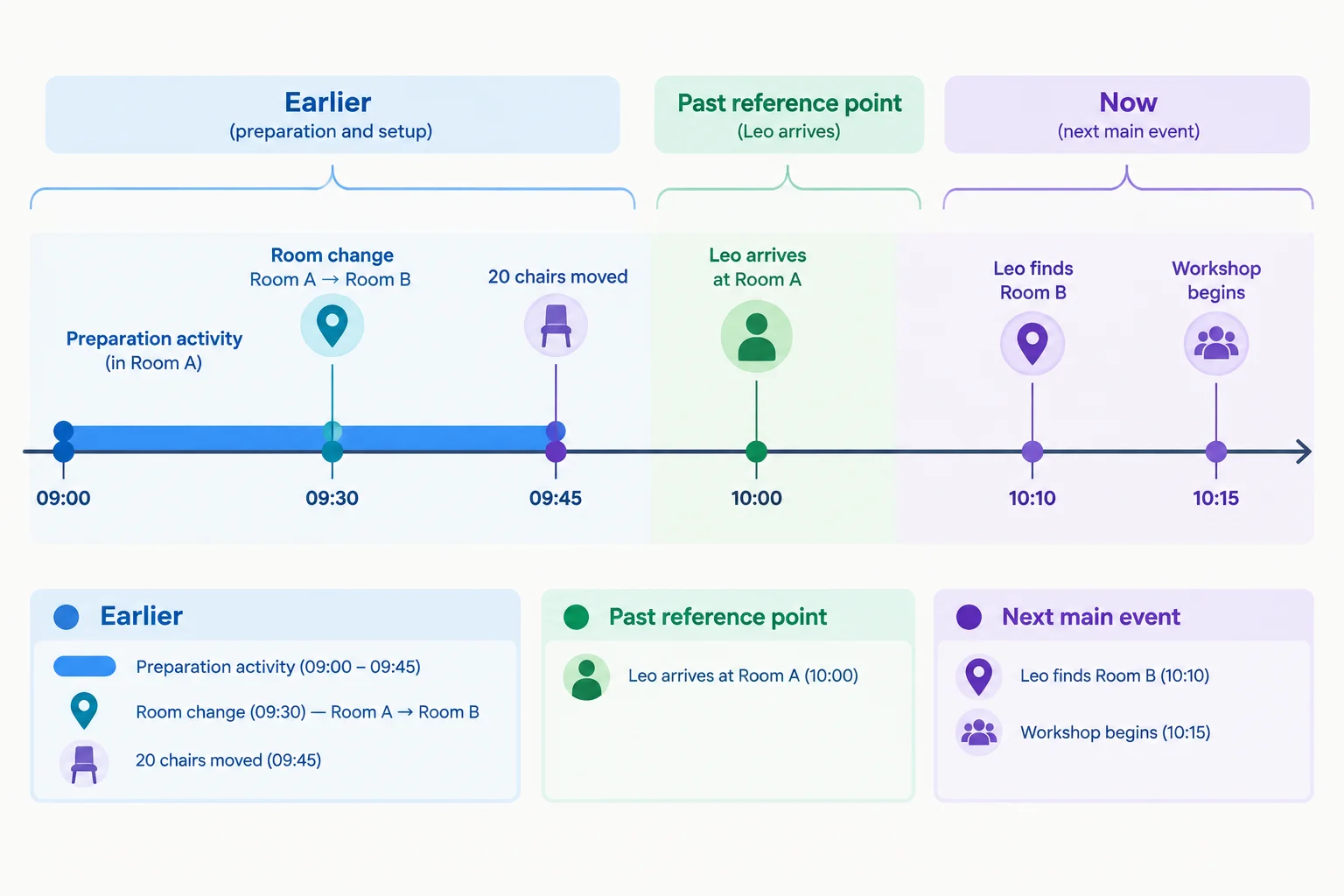
Start at the past reference point, look back to the earlier cause, then move forward to the next event.
Listen for the past situation, the earlier cause, and the next event.
At 10:00, Leo arrived at Room A for the workshop. However, Maya's message hadn't included the new room number. Maya had known about the change since 09:30. Her team had moved 20 chairs by 09:45 and had been preparing for the workshop since 09:00. Leo found Room B at 10:10, and the workshop began at 10:15.
Listen once for the event order. Then use the pronunciation model below. A slash marks a brief pause; bold words carry useful stress. The contraction hadn't keeps the negative meaning clear, even when it is spoken quickly.
Example
At 10:00, Leo arrived at Room A for the workshop. / However, Maya's message hadn't included the new room number. / Maya had known about the change since 09:30. / Her team had moved 20 chairs by 09:45 / and had been preparing for the workshop since 09:00. / Leo found Room B at 10:10, / and the workshop began at 10:15.
Tip
Pause when you move from the past situation to an earlier cause, and again when you return to the next event. Stress the detail that makes the delay understandable: a missing detail, a completed amount, or a duration.
Speak aloud for 30–40 seconds from these fact notes. Make your own account rather than repeating the model.
Include an earlier completed event and an earlier activity. Pause between your time units and stress one detail that explains the delay. Speak aloud to yourself; do not record or upload anything.
Tip
Before writing, check yourself:
After speaking, write one key sentence from your account. It must include both an earlier completed event and an earlier activity. Then add a brief reflection: identify one place where you paused and one detail you stressed.
Write at least 100 characters (0/100).

Step 9 of 9
Write and read aloud a clear account of the delayed workshop, separating earlier causes from the main past sequence.
At 10:00, Leo reached Room A. That arrival is the past reference point. To explain the later start, move backward for changes, completed results, and preparation; then return to the past simple for what Leo did next.
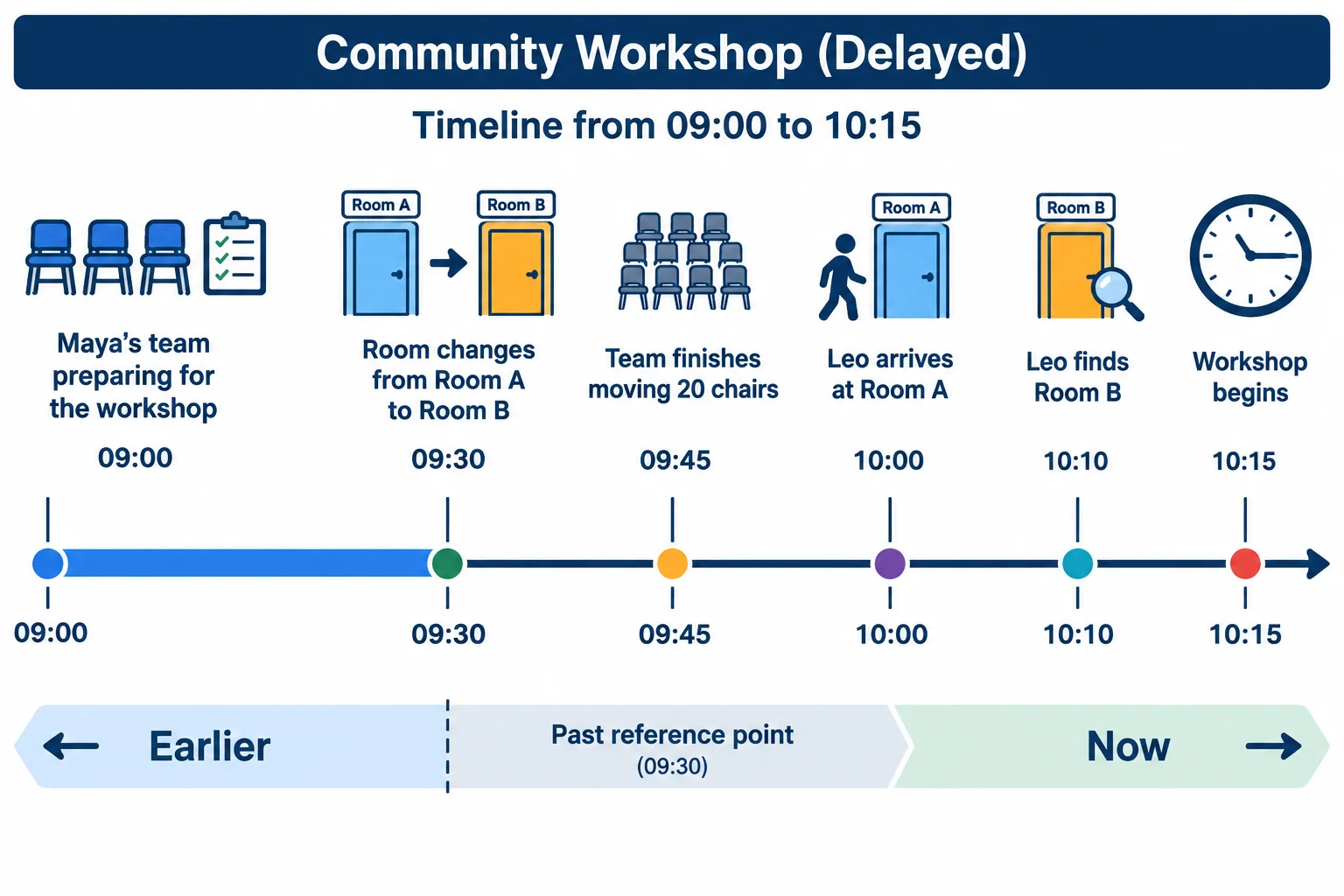
Bars show earlier activity; dots show completed events. The 10:00 arrival is the past reference point.
A coherent account starts with the past reference point, looks back to earlier causes, and returns to the main sequence. This model is 64 words.
Example
At 10:00, Leo arrived at Room A for the workshop. The room had changed to Room B at 09:30, and Maya had known about the change since then. Her message had omitted the new room number. Her team had moved 20 chairs by 09:45 and had been preparing for the workshop since 09:00. Leo found Room B at 10:10, so the workshop began at 10:15.
Tip
Use the model’s organization, not its exact sentences. State the real cause of the delay, but do not invent traffic, a cancellation, or another problem.
Draft your account in 60–80 words. Compare it with the model, then revise it with this checklist. Finally, read it aloud once. Pause briefly when you move between earlier causes and the main sequence, and stress the detail that explains the delay.
Summary
Submit your final 60–80-word account. Before submitting, compare it with the model and checklist on the earlier screens, revise it, and read it aloud once. Include 10:00 as a past reference point, at least one past perfect simple form, one past perfect continuous form, and past simple main events. Explain the delay using only the established facts.
Write at least 250 characters (0/250).
Congratulations! You completed: Explain Earlier Events with the Past Perfect
25 XP
Thousands of online courses in video, ebooks and audiobooks.
To test your knowledge during online courses
Generated directly from your cell phone's photo gallery and sent to your email

Download our app via QR Code or the links below:.



Carry knowledge in your pocket.
Download the Cursa app.
There are hundreds of free courses available, with a free certificate of completion that is saved in your mobile image gallery.
Download the app to access the Course Completion Certificate for Free.


+ 10 million
students

Free and Valid
Certificate

60 thousand free
exercises

4.8/5 rating in
app stores

Free courses in
video and ebooks