
Step 1 of 9
Words for Your Day
Recognize, read, and say the main action phrases for a typical day.

Learning path · Level 2 · Tutorial 1
Talk about your day. Say what you do and when you do it. Use always, sometimes, and never. Read and listen to short texts about other people's days. Say and write simple sentences about your day.

 Words for Your Day
Recognize, read, and say the main action phrases for a typical day. 3 min
 Say What You Do
Build short routine statements with I, you, we, and they. 3 min
 Talk About His or Her Day
Use he and she with familiar daily actions to talk about Mia's and Leo's routines. 3 min
 Hear the Ends of the Words
Hear the different endings in works, goes, and watches, then repeat them in short routine statements. 3 min
 Say the Time
Read and say simple digital times. Learn the difference between seven a.m. and seven p.m. 3 min
 Say When You Do It
Use at to connect familiar routine actions to clock times. 2 min
 Always, Sometimes, or Never
Use always, sometimes, and never to describe how often you do routine actions. 3 min
 Read and Listen to a Day
Read Mia's day, listen to Leo's day, and write a sentence you hear. 3 min
 Tell Someone About Your Day
Write and say four simple sentences about your own typical day. Use familiar actions, times, and frequency words. 4 min
Step 1 of 9
Recognize, read, and say the main action phrases for a typical day.
Learn these action phrases for a typical day:
Look at the pictures. Read each phrase aloud.

The pictures show the action phrases from get up to sleep.
Tip
Notice these differences:
work is also an action word. Go to work means travel to work.
Listen and repeat each phrase. Say the words clearly after the model.
Get up. Eat. Go to school. Go to work. Study. Watch TV. Sleep.
Get up. Eat. Go to school. Go to work. Study. Watch TV. Sleep.
Tip
Say the phrases again without reading. Use the pictures in your mind to help you remember each action.
Choose the picture for go to school.
Choose the picture for sleep.
Listen and choose an option.
Listen. Say the phrase aloud. Then choose the action you hear.
Watch TV.

Step 2 of 9
Build short routine statements with I, you, we, and they.
Use simple present sentences to talk about routines—things you do regularly.
Put the person first, then the action phrase:
After I, you, we, and they, use the same action form.
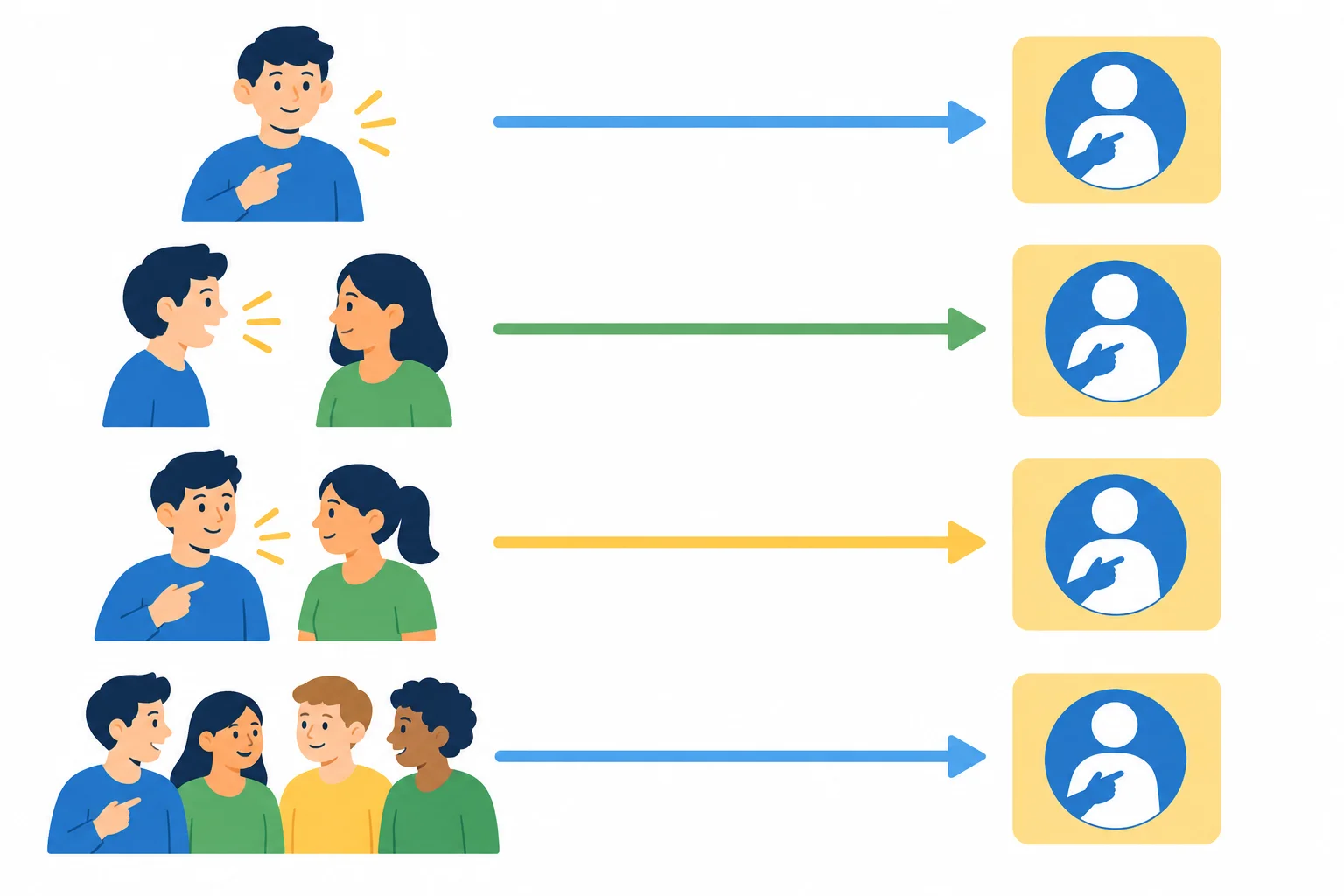
With I, you, we, and they, the action word does not change.
Add every day when you want to make a repeated routine clear. Put it at the end.
I go to school every day.
We watch TV every day.
They go to work every day.
Build the sentence in this order: person, action, then the repeated-day idea.
Tip
Use the action directly after the person.
Say: I study.
Do not add am, is, or are before the action in these routine sentences.
Example
Person + action phrase + every day
You eat every day.
We sleep every day.
Arrange the words to make one routine statement.
Your sentence
Available words
Complete the routine statement.
I __ TV every day.

Step 3 of 9
Use he and she with familiar daily actions to talk about Mia's and Leo's routines.
You know sentences such as I work. Now talk about one other person.
With he or she, change the action word:
She works.He goes to work.
Use these forms to talk about Mia and Leo.
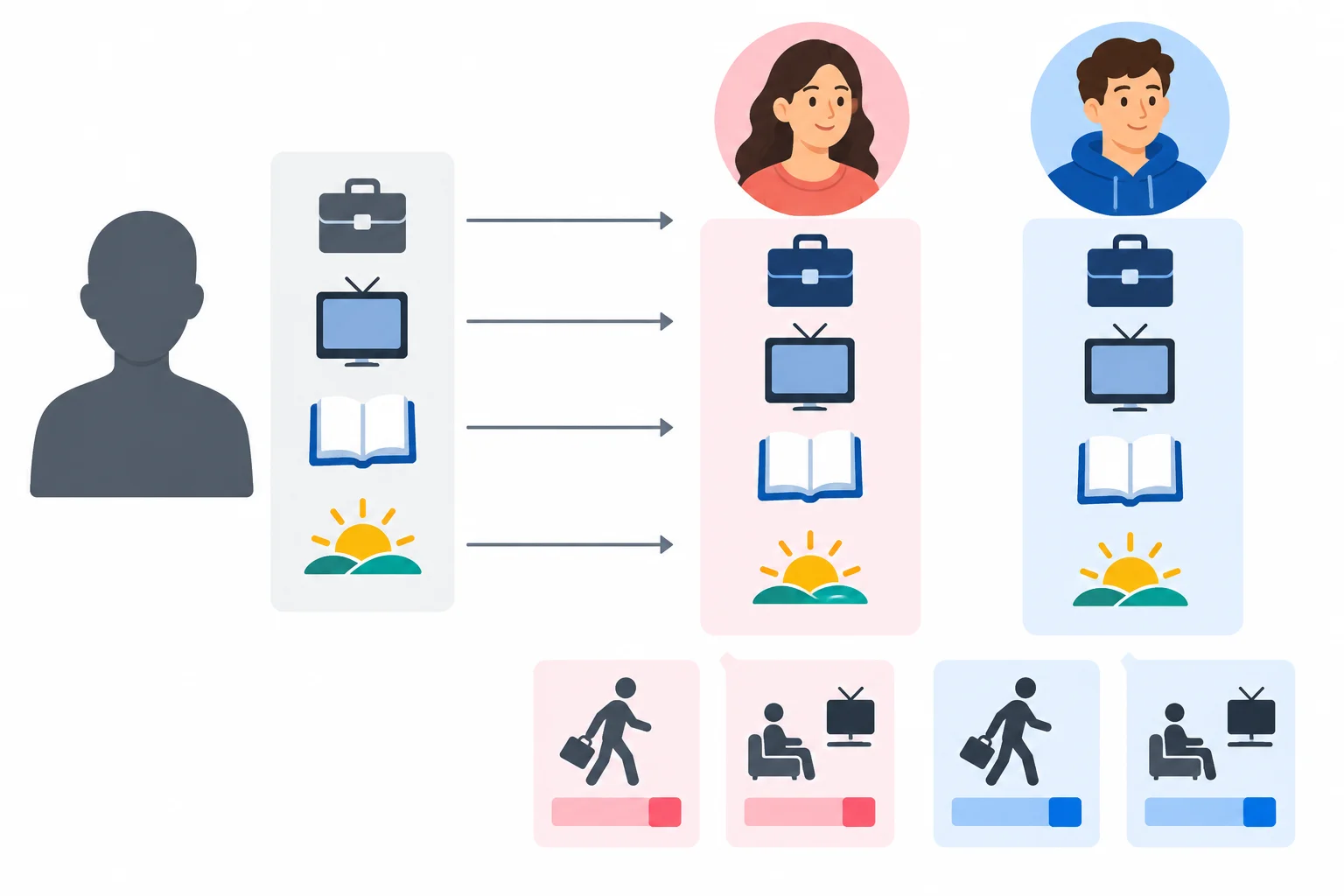
When the action is about Mia or Leo, the action word has a different form.
Learn these familiar action forms. Notice the change from an I sentence to a sentence about Mia or Leo.
| With I | With Mia or Leo |
|---|---|
| I work. | Leo works. |
| I eat. | Mia eats. |
| I sleep. | Leo sleeps. |
| I go to school. | Mia goes to school. |
| I watch TV. | Mia watches TV. |
| I study. | Mia studies. |
| I get up. | Mia gets up. |
Tip
Use the complete familiar forms: goes, watches, and studies. In get up, only get changes: gets up.
Complete the sentence.
Mia ___ TV.
Complete the sentence.
Leo ___ to work every day.
Change this sentence to talk about Mia: I get up.
Complete: Mia ___ up.
Then say the completed sentence aloud.

Step 4 of 9
Hear the different endings in works, goes, and watches, then repeat them in short routine statements.
Listen to the whole word. A dot is one syllable, or one beat.
Keep works and goes smooth and short. Do not add a new syllable to them.
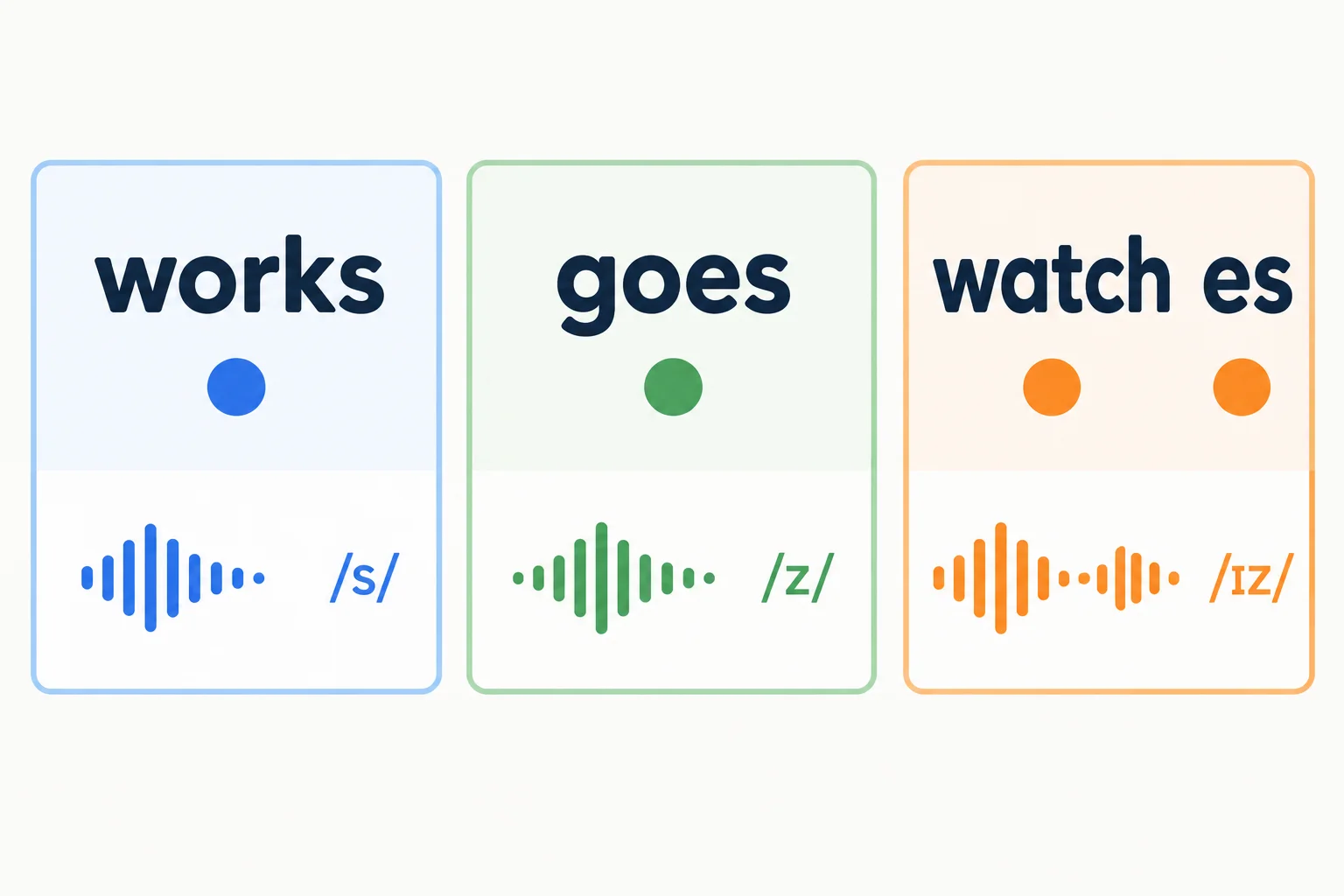
One dot = one syllable (one beat).
Listen and repeat each word. Play the audio again and compare your voice with the model.
Works. Goes. Watches.
Tip
Say watches in two beats: “watch — es.” Say works and goes in one smooth beat each.
Listen and choose an option.
Listen to the three sentences. Choose the ending patterns in order. Then replay the audio and say each sentence aloud.
He works. She goes to school. She watches TV.

Step 5 of 9
Read and say simple digital times. Learn the difference between seven a.m. and seven p.m.
Digital times use a colon. In this step, read :00, :15, and :30.
Say the hour first. Then say fifteen or thirty.
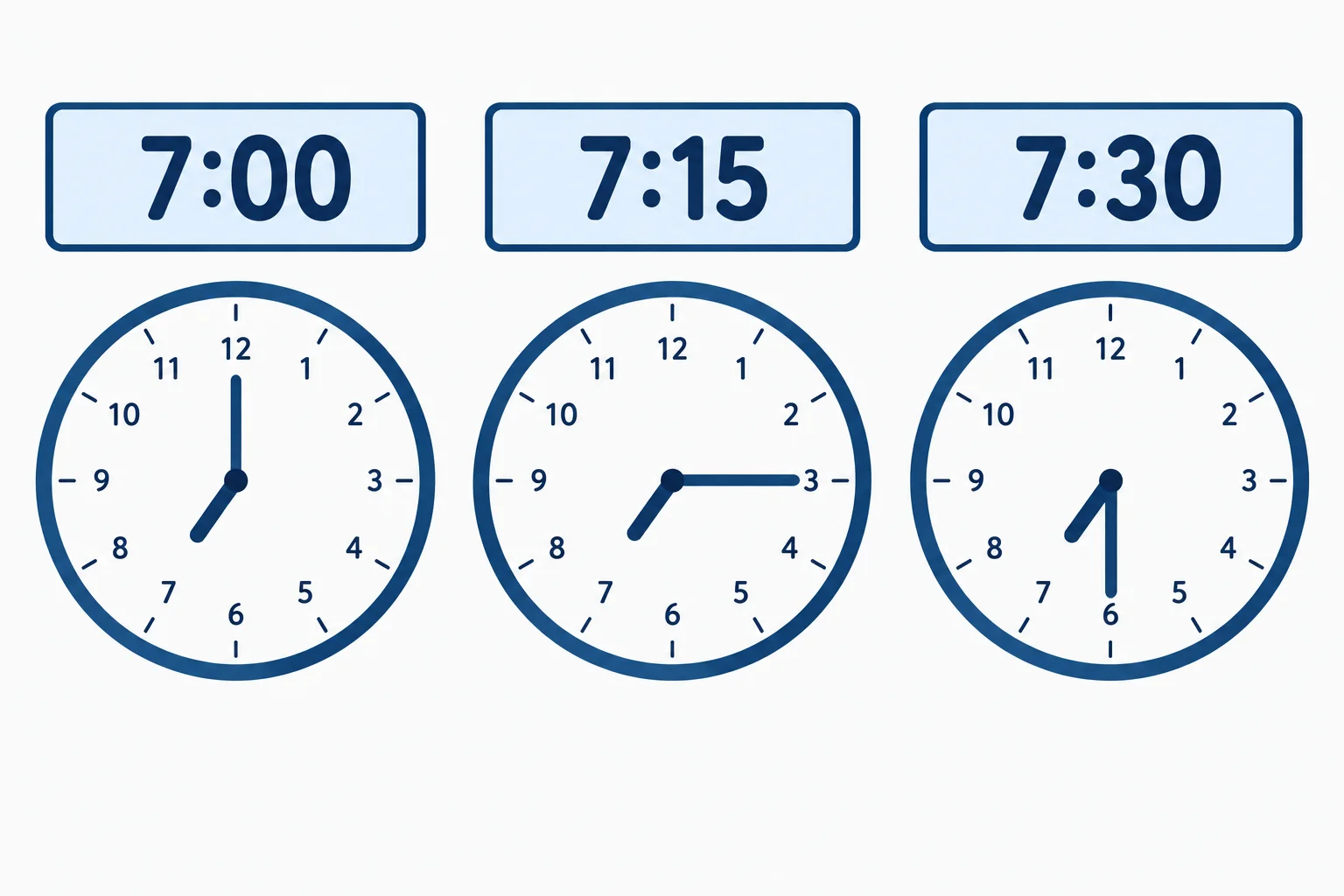
Read the hour, then say fifteen or thirty when you see :15 or :30.
Read each display aloud.
| Digital display | Say it |
|---|---|
| 7:00 | Seven o'clock. |
| 7:15 | Seven fifteen. |
| 7:30 | Seven thirty. |
Look at the same hour in two parts of the day:
When you need to make this difference clear, say seven a.m. or seven p.m.
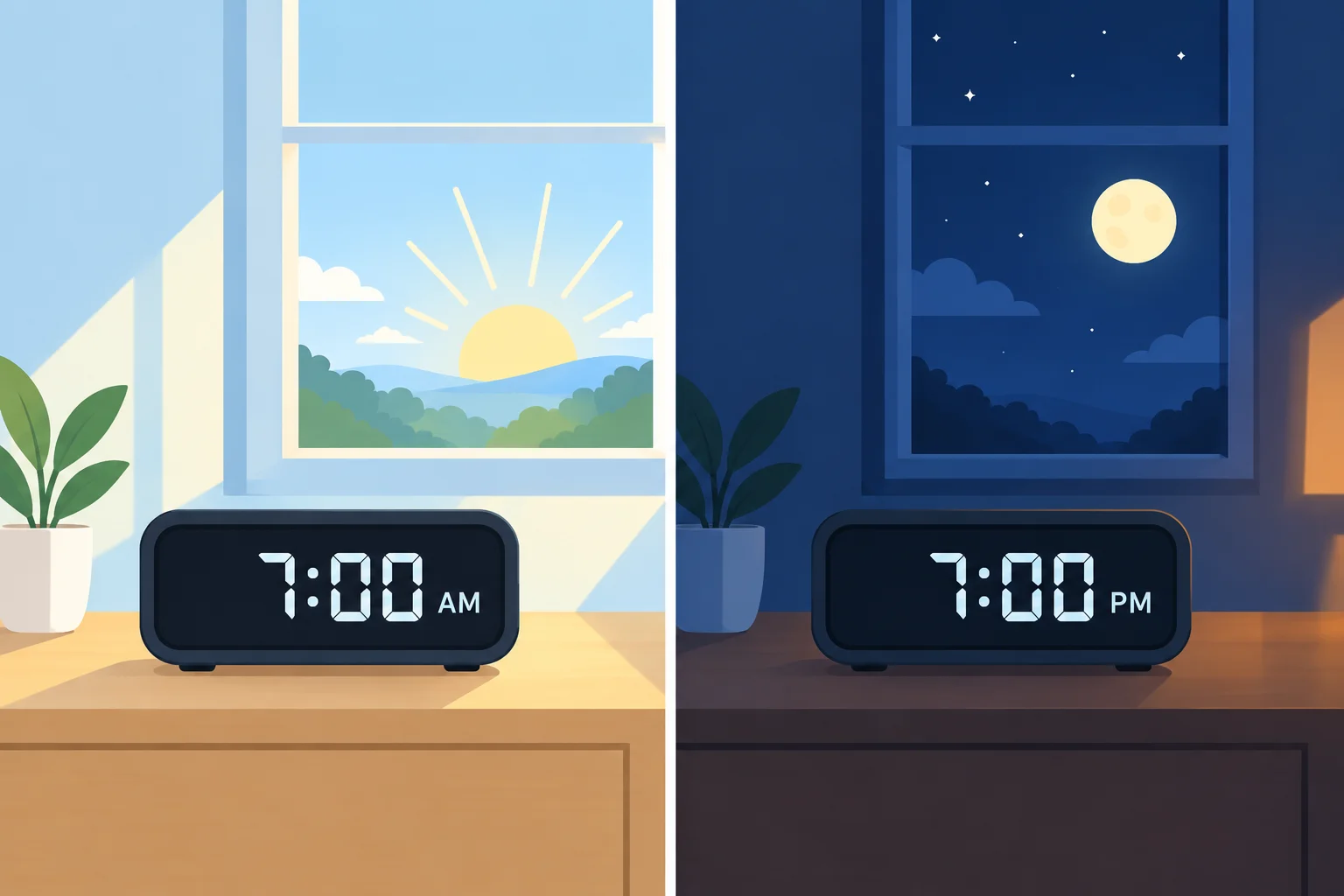
The hour is the same; 7:00 a.m. is morning and 7:00 p.m. is evening.
Listen and repeat.
Seven a.m. Seven p.m.
Seven a.m. Seven p.m.
Listen and choose an option.
Listen. Which digital display do you hear?
Seven thirty.
Match each digital display to the way you say it.
Tap an item and then its matching pair.

Step 6 of 9
Use at to connect familiar routine actions to clock times.
Use at before a clock time to say when an action happens.
Person + action + at + time
Put the time at the end of the sentence. You already know the action forms for I, he, and she.
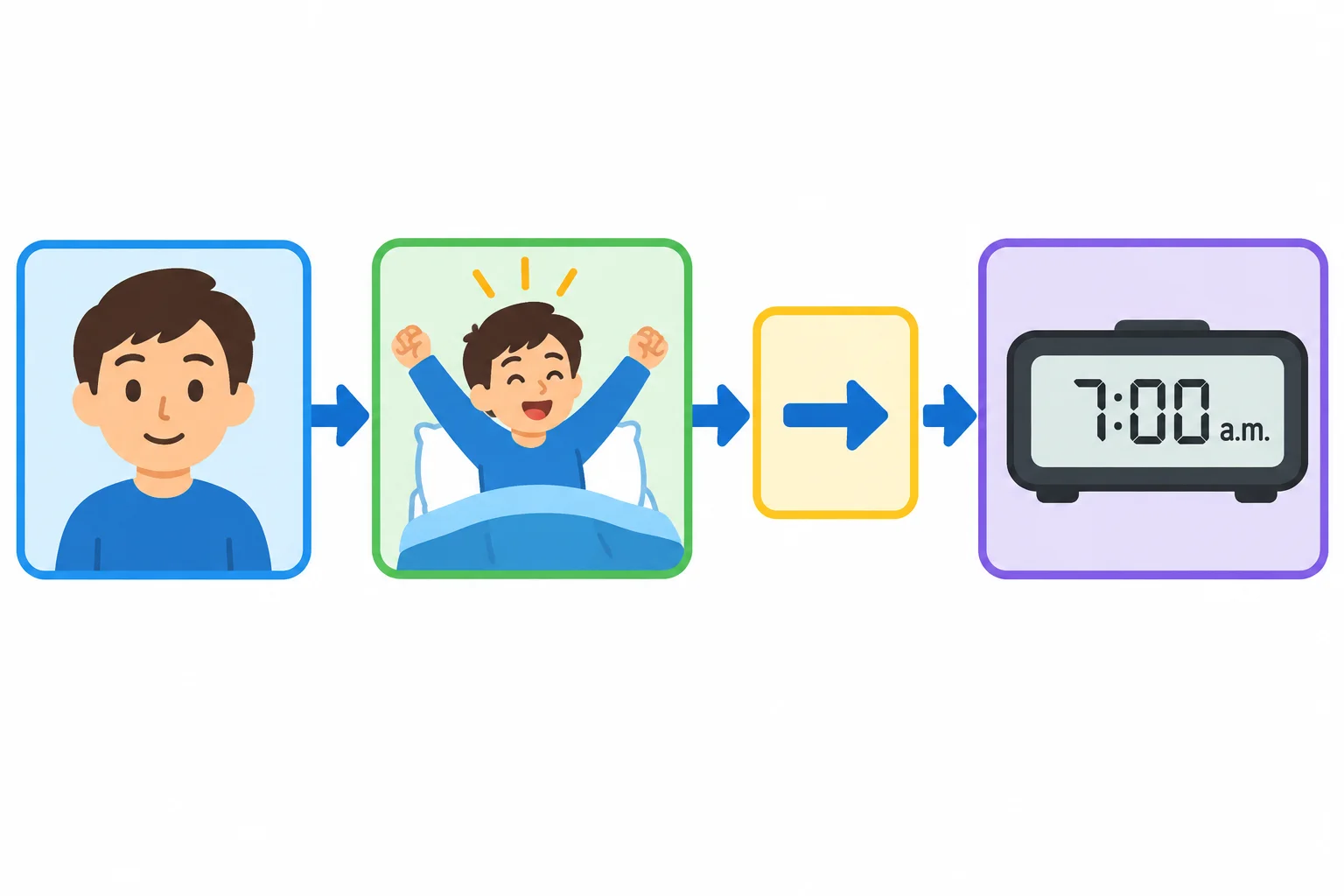
The connector at links an action to its clock time.
Example
I get up at 7:00 a.m.
She studies at 7:30 p.m.
He goes to work at 8:00 a.m.
Use a.m. or p.m. when the part of the day needs to be clear.
When the context is clear, you can use a shorter time phrase: at seven.
A schedule gives you an action and a time. Change each schedule line into a complete sentence.
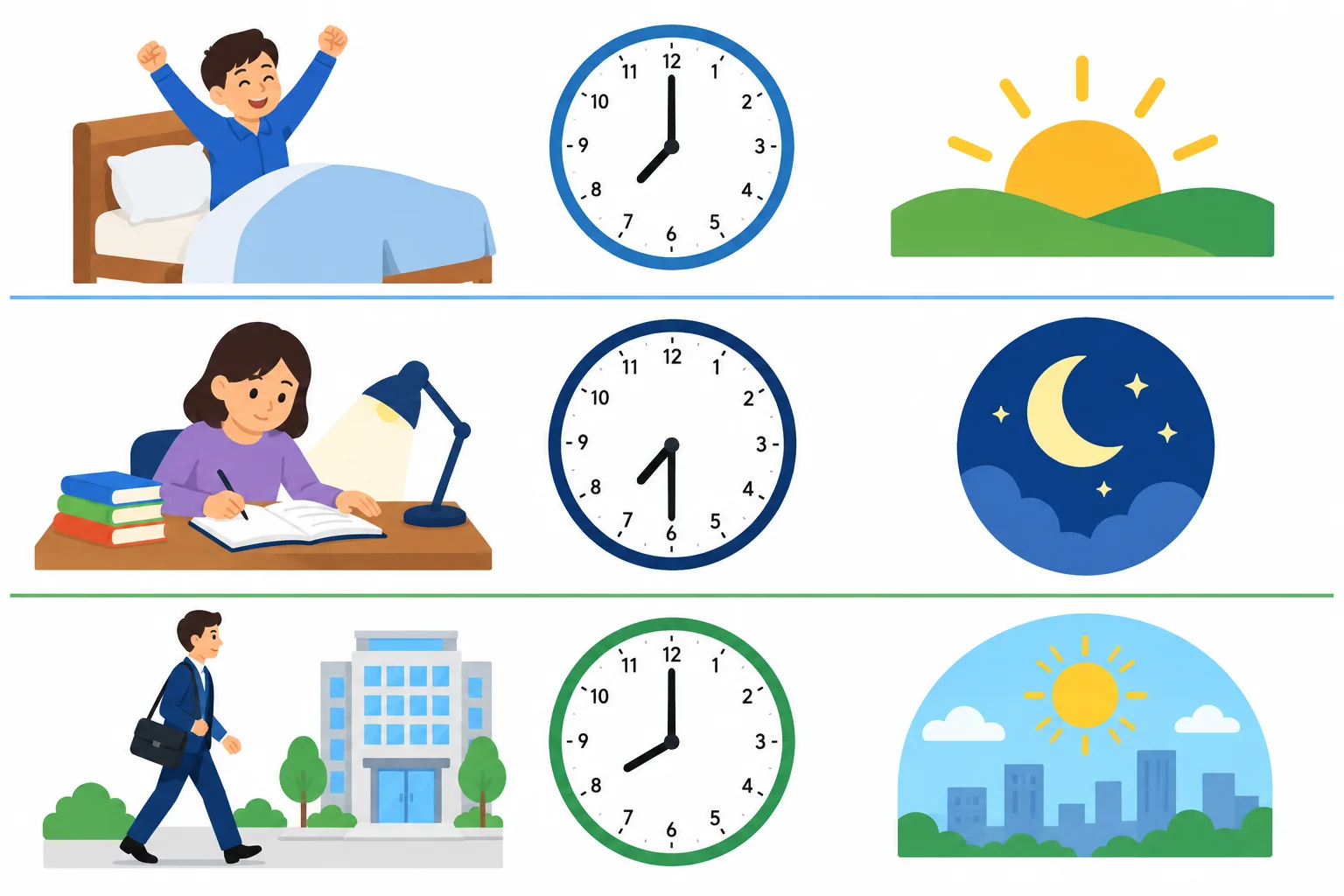
Use the action and time in each schedule row to make a sentence.
Use this schedule for the next activities.
| Person | Action | Time |
|---|---|---|
| You | get up | 7:00 a.m. |
| Mia | study | 7:30 p.m. |
| Leo | go to work | 8:00 a.m. |
Build a complete sentence about Leo.
Action: go to work
Time: 8:00 a.m.
Your sentence
Available words
Look back at the schedule. Write three sentences: one about you, one about Mia, and one about Leo.
Use at before every time. Use I for your sentence and the correct he or she action form for Mia and Leo.
Write at least 60 characters (0/60).
Step 7 of 9
Use always, sometimes, and never to describe how often you do routine actions.
Use always, sometimes, and never to say how often an action is part of your routine.
“Sometimes” does not mean one fixed number of days. It only means not every time.
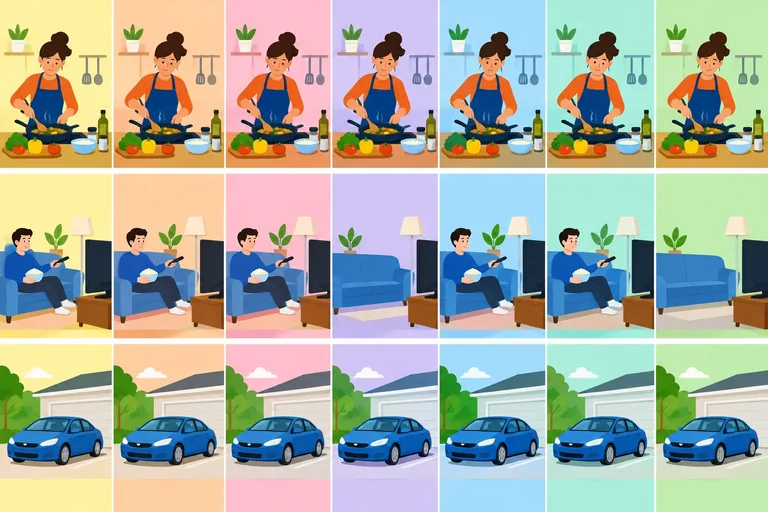
The rows show every time, some days but not all, and no days.
Put the frequency word after the person and before the action word.
If you add a time, put the time phrase at the end.
person + frequency word + action + at + time
Read the pattern in each sentence.
| Pattern | Sentence |
|---|---|
| Person + frequency + action | I always cook. |
| Person + frequency + action | Leo sometimes drives. |
| Person + frequency + action | Mia sometimes watches TV. |
| Person + frequency + action + time | I always study at 7:30 p.m. |
Tip
Never already means zero times. Use the same pattern: person + never + action. Do not add another negative word.
Match each frequency word to its routine pattern.
Tap an item and then its matching pair.
Build the routine sentence.
Your sentence
Available words
Final check: Write three short matches and one true sentence about your routine.
Then write one true routine sentence. Use one frequency word in the correct place. Add at and a time if useful.
Write at least 45 characters (0/45).

Step 8 of 9
Read Mia's day, listen to Leo's day, and write a sentence you hear.
Read Mia's short day. Find action words, times, and a word that tells how often something happens.
Mia gets up at 7:00 a.m. She goes to school at 8:15 a.m. She studies at 7:30 p.m. She sometimes watches TV.

Use Mia's written text, not the picture, to find the times.
Match each action from Mia's day with its detail.
Tap an item and then its matching pair.
Listen to Leo's short day. Listen for one detail at a time. The person and the ending of the action word help you follow his routine.
Listen and choose an option.
Listen to Leo's day. Which action does Leo sometimes do?
Leo gets up at seven a.m. He goes to work at eight a.m. He sometimes watches TV.
Listen and choose an option.
Listen to Leo's day again. What time does Leo go to work?
Leo gets up at seven a.m. He goes to work at eight a.m. He sometimes watches TV.
Listen and write what you heard.
Listen and type the complete sentence. You may replay the audio.

Step 9 of 9
Write and say four simple sentences about your own typical day. Use familiar actions, times, and frequency words.
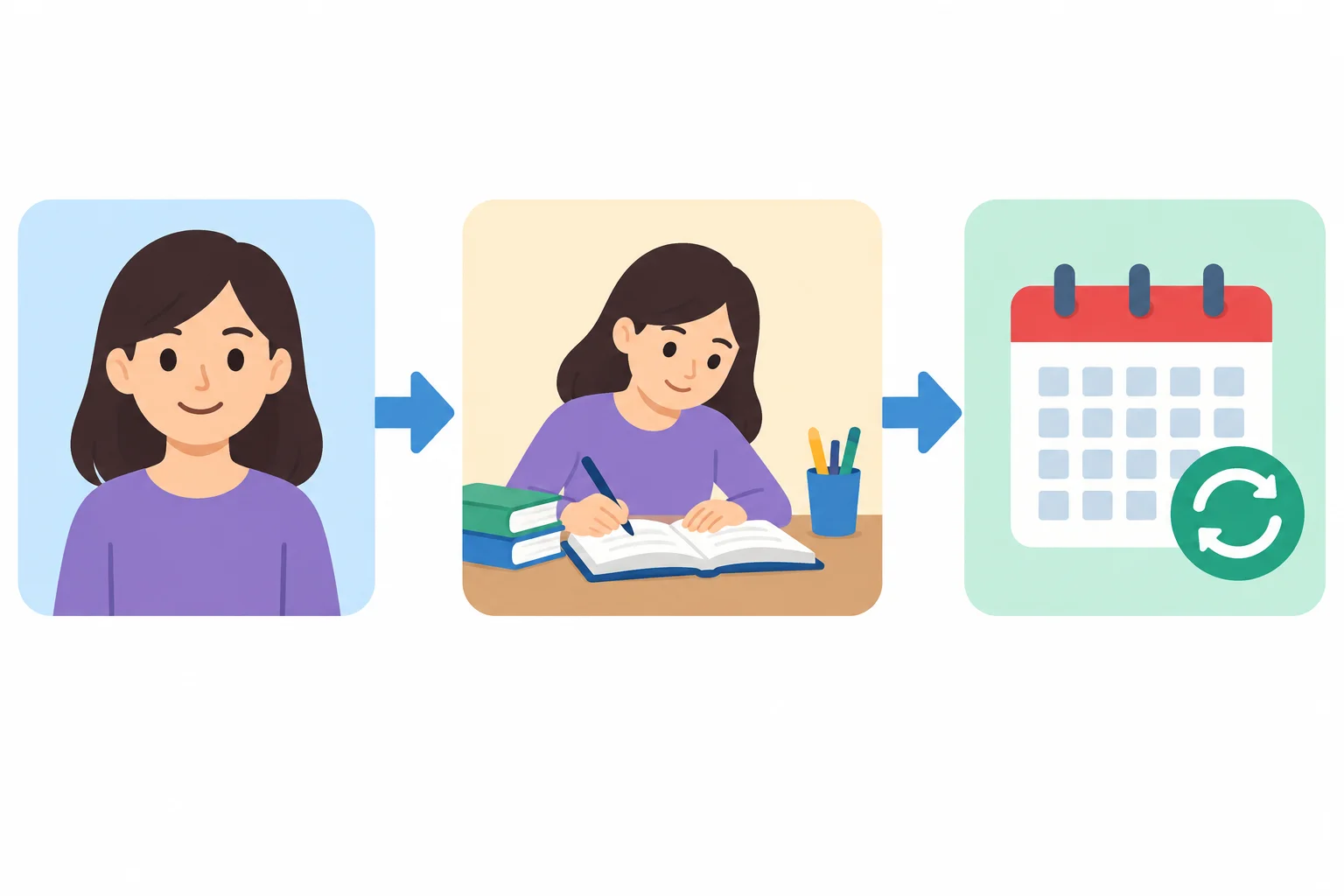
Use this four-sentence model as a guide. The sentences are about one person’s routine, so choose actions and times that are true for your own day.

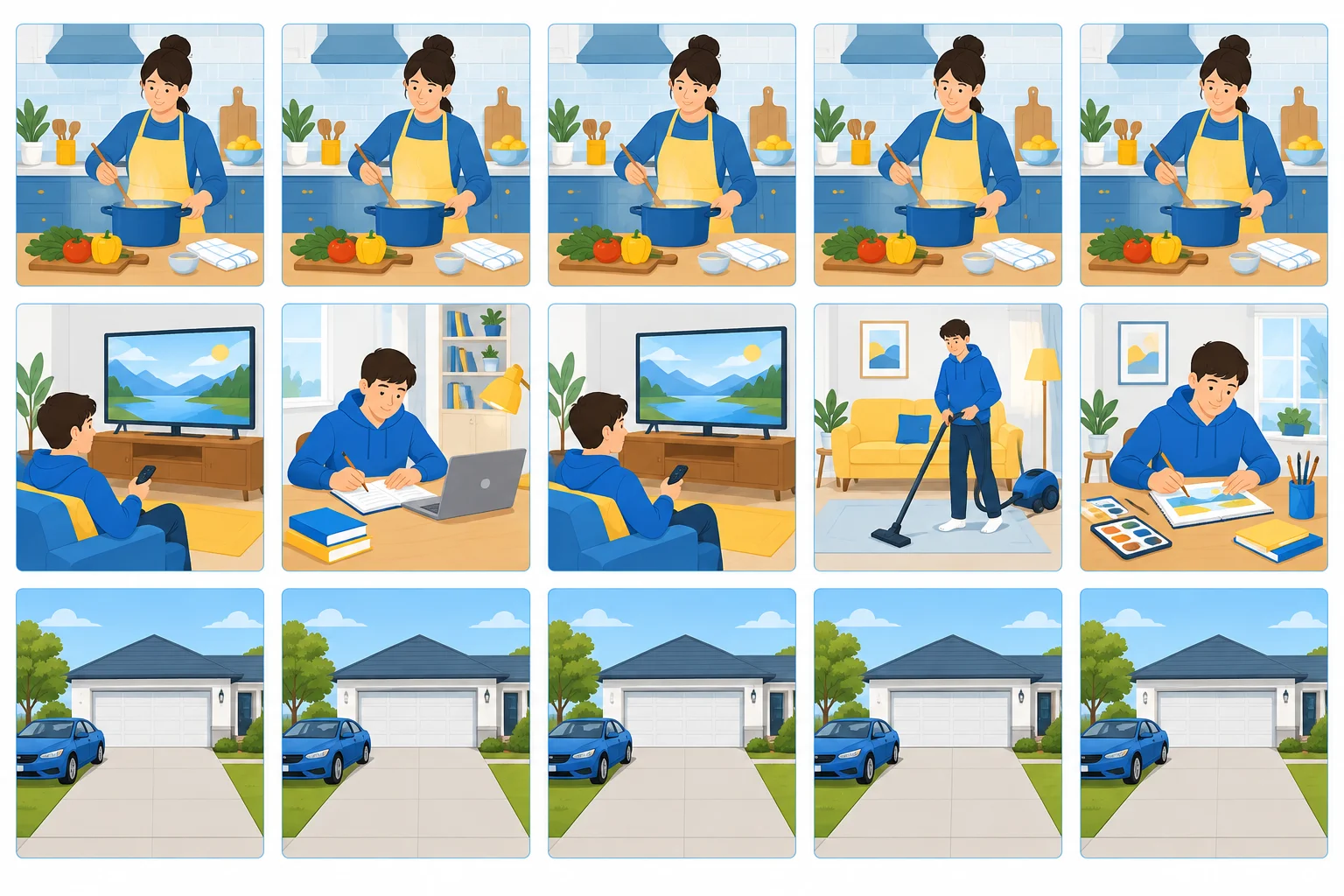
Use the pictures to follow the order of a simple day.
Example
I get up at 7:00 a.m. I go to school at 8:15 a.m. I always study at 7:30 p.m. I sometimes watch TV.
Listen. Then say the four model sentences aloud.
I get up at seven a.m. I go to school at eight fifteen a.m. I always study at seven thirty p.m. I sometimes watch TV.
I get up at seven a.m. I go to school at eight fifteen a.m. I always study at seven thirty p.m. I sometimes watch TV.
Plan four sentences about a typical day. Begin every sentence with I. Choose familiar actions that are true for you. You can use different actions from the model.
Check your sentences before you write them.
| What to check | Your sentence needs |
|---|---|
| Person | Start with I. |
| Frequency word | Put always, sometimes, or never after I. |
| Action | Use a familiar action phrase. |
| Time | Put at before a clock time. |
| Meaning | Make the sentence true for your typical day. |
Tip
You need at least two sentences with at plus a clock time. Use at least two different frequency words: always, sometimes, or never.
Write exactly four meaningful sentences about your typical day, one sentence per line.
Then add these three self-check lines: Meaning: yes/no, Word order: yes/no, and Pronunciation: yes/no.
Write at least 100 characters (0/100).
Summary
You can now describe a daily routine in simple English.
Congratulations! You completed: Talk About Your Day
Thousands of online courses in video, ebooks and audiobooks.
To test your knowledge during online courses
Generated directly from your cell phone's photo gallery and sent to your email

Download our app via QR Code or the links below:.



Carry knowledge in your pocket.
Download the Cursa app.
There are hundreds of free courses available, with a free certificate of completion that is saved in your mobile image gallery.
Download the app to access the Course Completion Certificate for Free.


+ 10 million
students

Free and Valid
Certificate

60 thousand free
exercises

4.8/5 rating in
app stores

Free courses in
video and ebooks