 Thermodynamics
 Electromagnetism
 Modern Physics
 Quantum Physics
 Astrophysics
 Nuclear Physics
 Radioactivity
 General Relativity
 Statistical Physics
 Particle Physics
 Photovoltaics
 Computational Physics
 Statistical Thermodynamics
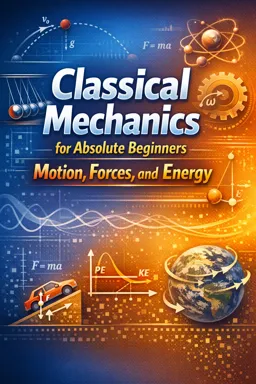
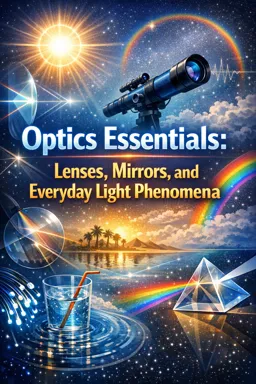
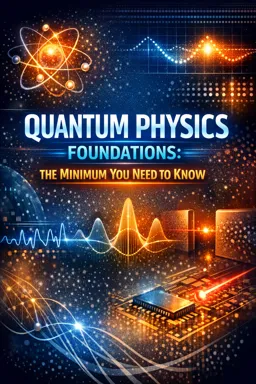
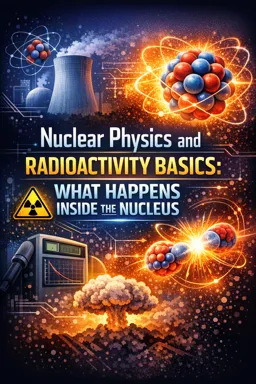


Beginner physics courses cover motion, forces, energy, electricity, magnetism, waves, and basic problem-solving.

22

2

5


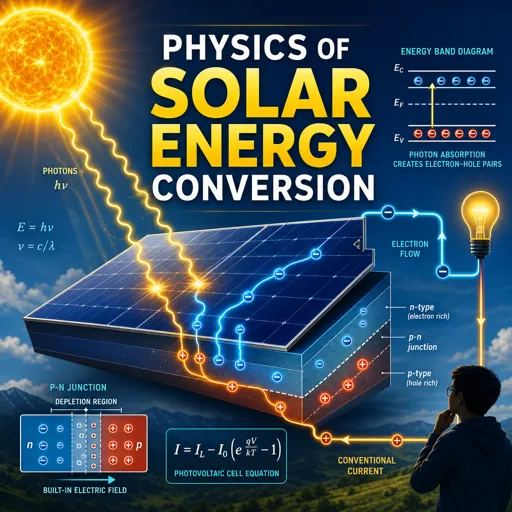
Build a solid solar-cell foundation with this free physics course on band diagrams, junctions, and efficiency—ideal for renewable-energy studies.
5

(4)

4h59m

16 exercises
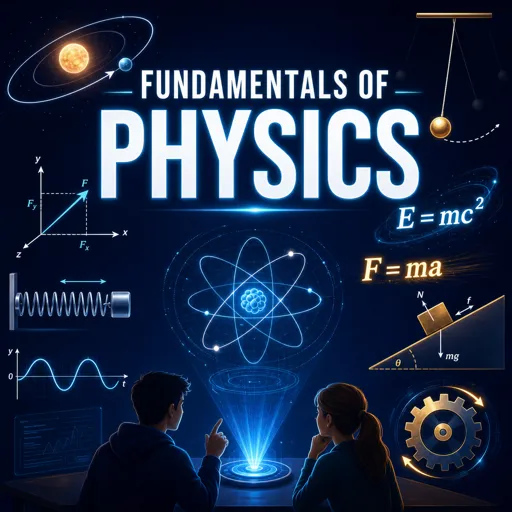
Build real problem-solving skills in physics with this free online course—master motion, energy, waves and relativity, and earn a certificate of completion.
5
(45)
28h44m
23 exercises
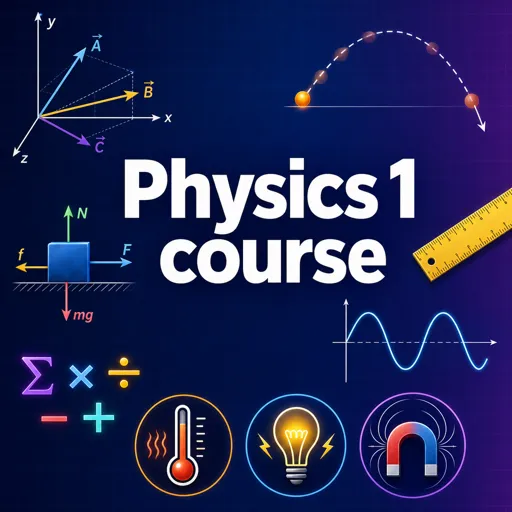
Build strong physics skills fast with a free online course: motion, vectors, units, conversions, and core laws—ideal for exams and study confidence.
4.8
(6)
4h10m
19 exercises
Free CourseRelativity Course: Special and General Relativity, Tensors, Black Holes, Gravitational Waves and Cosmology
5
(3)
19h01m
39 exercises
Free CourseIntroduction to Thermodynamics
5
(1)
1h48m
9 exercises
Free CourseNuclear and Radiochemistry
5
(1)
31h56m
31 exercises
Free CoursePhysics for beginners
5
(1)
1h57m
2 exercises
Free CourseThermodynamics and Statistical Physics
5
(1)
14h53m
23 exercises
Free CourseAstrophysics and Cosmology Course
5
(1)
1h24m
5 exercises
Free CourseQuantum Physics
5
(1)
24m
4 exercises
Free CourseFundamentals of Physics II
4.7

(24)
29h48m
24 exercises
Free CourseQuantum physics
4.2
(37)
28h18m
38 exercises
Free CourseParticle Physics
4
(3)
34h07m
22 exercises
Free CourseComputational Physics in Python
3.7
(3)
35h45m
26 exercises
Free CourseStatistical Mechanics
New
35h54m
26 exercises
Free CourseThermal Physics
New
1h40m
4 exercises
Free CourseNuclear Physics and Radioactivity
New
1h24m
4 exercises
Free CourseGeneral Relativity of Einstein
New
30h22m
8 exercises
Free CourseCollege Physics 1
New
16h39m
25 exercises
Free CourseModern Physics
New
11h56m
6 exercises
Exercises
Test your knowledge of numerical differentiation, integration, ODE solvers, stability, convergence, and computational modeling.
Start exercisesTest your introductory astrophysics knowledge on stars, galaxies, black holes, planets, eclipses, redshift, and the Big Bang.
Start exercisesTest your general relativity knowledge: Einstein, spacetime curvature, gravity, time dilation, light bending, black holes and gravitational waves.
Start exercisesTest your thermodynamics knowledge with questions on the laws of thermodynamics, entropy, energy, heat, work, and thermodynamic systems.
Start exercisesTest your particle physics knowledge with questions on the Standard Model, Higgs boson, antimatter, fundamental forces, fermions and quantum phenomena.
Start exercisesTest your introduction to optics knowledge with questions on refraction, lenses, mirrors, light wavelengths, rainbows, optical fibers, and the eye.
Start exercises
The States of Matter Explained: Solid, Liquid, Gas, and Plasma
Learn what really separates solids, liquids, gases, and plasma, how phase changes work, and why temperature and pressure control the outcome.

Thermodynamics in Action: How Energy, Entropy, and Efficiency Shape Real Systems
Understand thermodynamics through energy, entropy, and efficiency, and learn how these principles shape engines, systems, and real-world physics.

Classical Mechanics Made Intuitive: From Free-Body Diagrams to Energy Methods
Learn classical mechanics intuitively with free-body diagrams, Newton’s laws, energy, and momentum methods for faster problem solving.

Exploring the Standard Model: The Framework of Particle Physics
The Standard Model explains fundamental particles and forces, shaping modern physics while leaving mysteries like dark matter and gravity unsolved.

Quarks and Leptons: The Cornerstones of Particle Physics
Discover how quarks and leptons form the foundation of matter, shaping the universe through fundamental forces and particle interactions.

Understanding Particle Physics: The Building Blocks of Matter
Explore particle physics, the Standard Model, and how accelerators reveal the building blocks of matter while shaping future discoveries.

Unveiling the Giants: Particle Accelerators and the Hunt for Fundamental Forces
Discover how particle accelerators unravel the mysteries of matter, forces, and the universe, from the Higgs boson to dark matter exploration.

An Introduction to Modern Physics: Concepts and Impact
Explore modern physics concepts—relativity, quantum mechanics, and more—and discover their impact on science, technology, and society.
Build a stronger understanding of matter, energy, motion, forces, space and time through free online courses designed for beginners, university students, educators and independent learners. Study essential educational concepts such as classical mechanics, electromagnetism, waves, optics, thermodynamics, quantum theory, relativity and computational modeling. Every course is free, includes free certification and features exercises that help reinforce theories, formulas, problem-solving methods and scientific reasoning.
Start with introductory lessons or advance toward specialized areas of theoretical, experimental and applied science. The available learning paths support academic revision, exam preparation, professional development and personal enrichment.
Expand your curriculum with focused content covering microscopic phenomena, energy systems, spacetime and contemporary scientific models.
Course lessons and exercises can help learners interpret physical laws, manipulate equations, analyze data, understand units and dimensions, construct mathematical models and connect abstract principles with observable phenomena. Topics range from velocity, acceleration, momentum and electric charge to entropy, atomic structure, particles, gravitation, cosmology and solar energy conversion. Flexible online study makes it possible to review content at your own pace while building a structured foundation for advanced science and engineering subjects.
To access the courses, exercises and free certification, install the Cursa app on your mobile device. Android users can get it from Google Play using Download for Android. iPhone users can install it from the App Store using Download for iOS / iPhone. Choose a course, follow the instructional modules and begin learning for free.
What are the best online physics courses for beginners?
Beginner physics courses cover motion, forces, energy, electricity, magnetism, waves, and basic problem-solving.
Can I learn quantum physics online?
Yes. Online quantum physics courses introduce wave-particle duality, uncertainty, atoms, quantum states, and applications.
What topics are covered in a college physics course?
College physics commonly includes mechanics, thermodynamics, electromagnetism, optics, waves, and introductory modern physics.
What is the difference between classical physics and modern physics?
Classical physics describes everyday-scale motion and forces, while modern physics includes relativity, quantum mechanics, and atomic phenomena.
Are there online courses on thermodynamics and statistical mechanics?
Yes. These courses explore heat, work, entropy, temperature, engines, probability, and the behavior of many-particle systems.
Can I study astrophysics, black holes, and cosmology online?
Yes. Physics courses can explain stars, galaxies, black holes, gravitational waves, spacetime, and the evolution of the universe.
What can I learn in an electromagnetism course?
You can learn electric charge, electric and magnetic fields, circuits, magnets, electromagnetic waves, and practical technologies.

Complete any course and issue your certificate via the app — at no cost.

Download the app! to have access to more than 4,000 Online Courses + Certificate, all free!
Download the app! 100% free courses.


Carry knowledge in your pocket.
Download the Cursa app.
There are hundreds of free courses available, with a free certificate of completion that is saved in your mobile image gallery.
Download the app to access the Course Completion Certificate for Free.


+ 10 million
students

Free and Valid
Certificate

60 thousand free
exercises

4.8/5 rating in
app stores

Free courses in
video and ebooks
What are people saying about free online courses of Physics
Leopold Kossack
I loved it. I learned so much about Physics.
CourseCollege Physics 1
Leopold Kossack
Can you pleeeaaassseee put College Physics 2 in here as well?!?
CourseCollege Physics 1
Leopold Kossack
My first Physics course ever and I’m still doing many. I loved it and many things I had to know for my new Physics courses I learned here like Forces.
CoursePhysics for beginners