Step 1 of 9
Find Places on a Map
Learn the place labels and map features used throughout this tutorial.

Learning path · Level 4 · Tutorial 5
Ask how to get to a place and understand a short answer. Follow a route on a simple map shown on screen. Give clear directions aloud and write a short message to help someone find a place.
 Find Places on a Map
Learn the place labels and map features used throughout this tutorial. 2 min
 Ask How to Get There
Ask politely how to reach a place and understand a short answer about travel time. 2 min
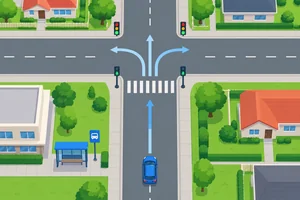 Give Short Instructions
Choose short movement instructions from the traveler’s point of view and form a negative instruction with Don’t. 3 min
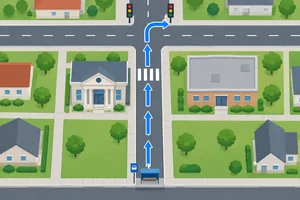 Explain Where to Go and Turn
Use movement phrases and landmarks to make short directions more precise. 3 min
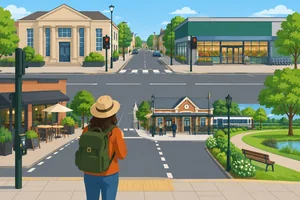 Say Where the Place Is
Describe positions on the map and say which side a traveler should look on. 2 min
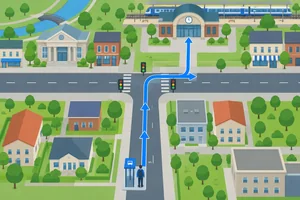 Read and Follow a Route
Follow a written directions message from the bus stop to the station and check each movement on the map. 2 min
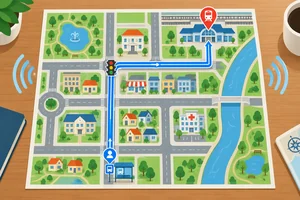 Listen and Say Directions Clearly
Follow short spoken directions on the town map, then practise saying familiar instructions with clear pauses and direction words. 3 min
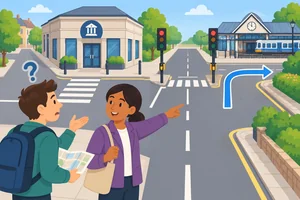 Check What You Heard
Ask for repetition, check an important route detail, and listen for a correction. 2 min
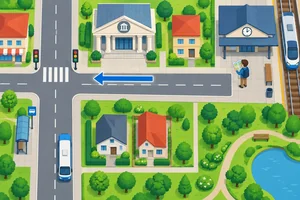 Help a Visitor Find the Bus Stop
Complete a directions exchange and create a clear return-route message from the station to the bus stop. 4 min
Step 1 of 9
Learn the place labels and map features used throughout this tutorial.
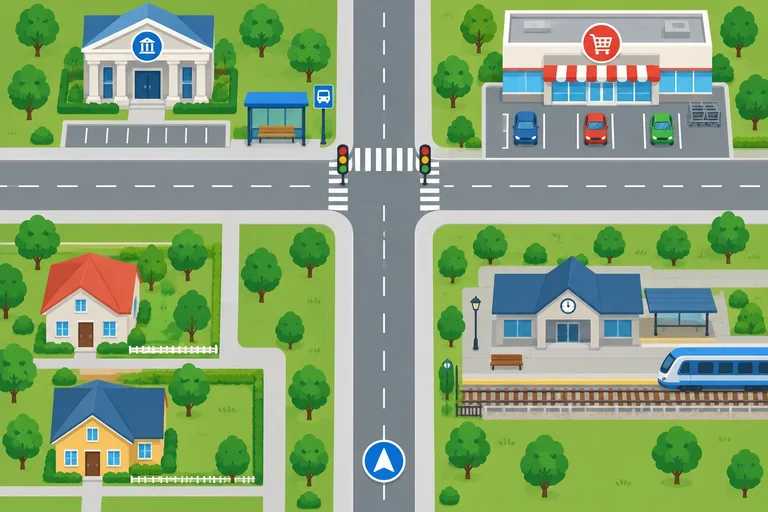
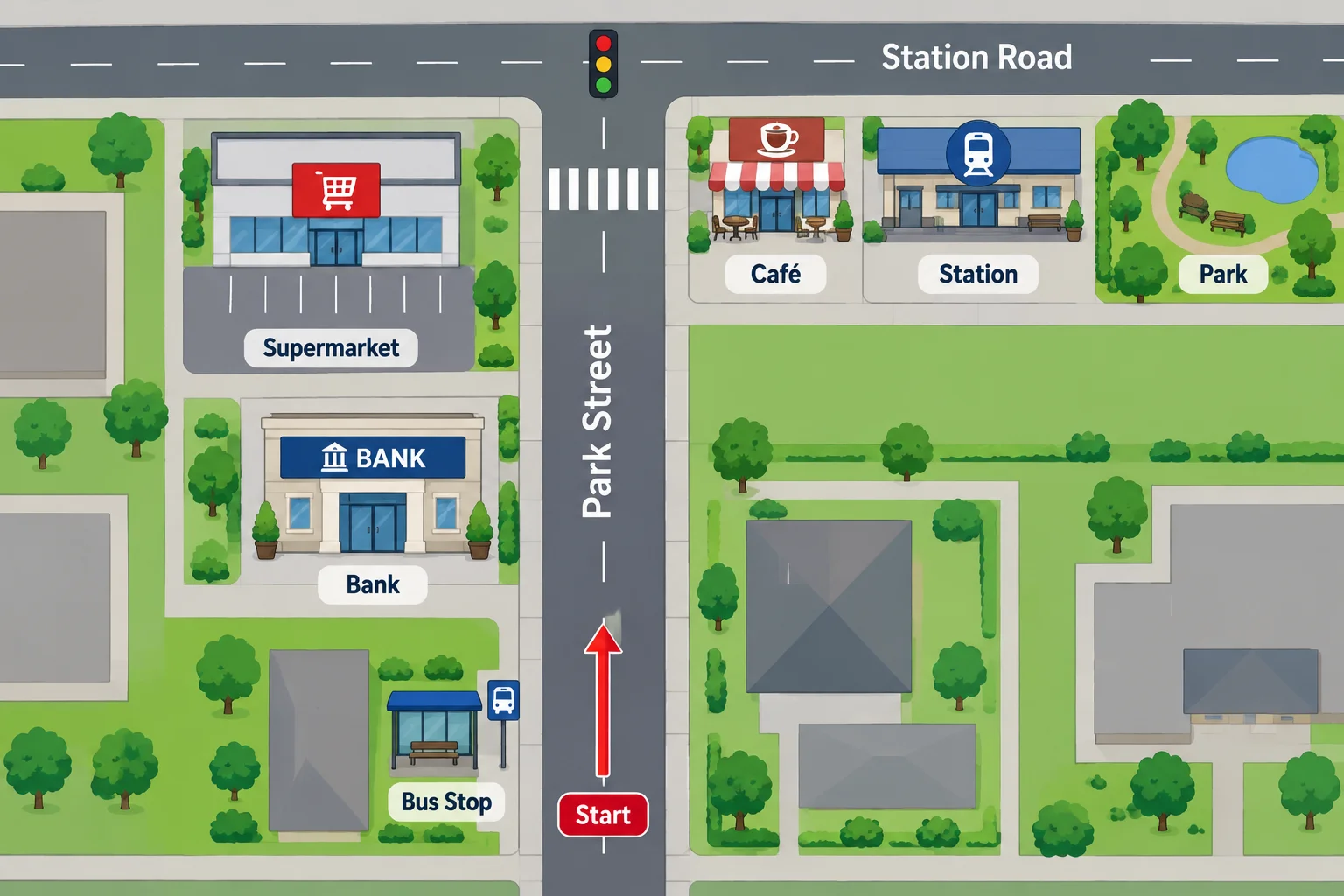
A map can show places with small pictures and labels. In this tutorial, we use one town map.
Look for these places: the bank, the supermarket, the bus stop, and the station. Look for the traffic lights too.
A corner is where streets meet. The map has Park Street and Station Road. Start shows where the traveler begins. The arrow shows the direction the traveler is facing.
Here, Start is at the bus stop. The arrow points up the map.
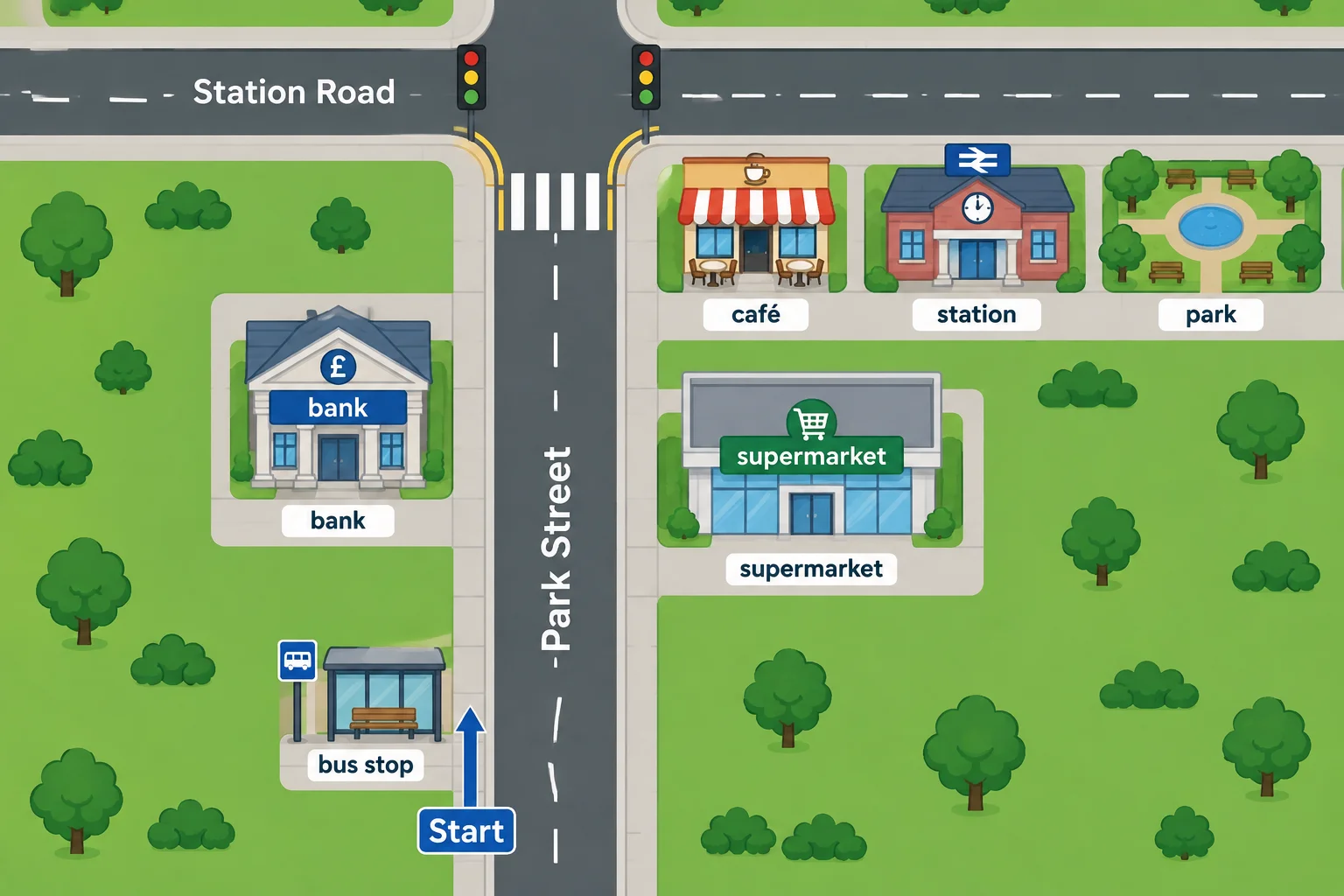
Find the place labels, the traffic lights, the corner, and the Start arrow.
Match each map word to its picture clue.
Tap an item and then its matching pair.
Choose the map that matches the shared town map.
Step 2 of 9
Ask politely how to reach a place and understand a short answer about travel time.
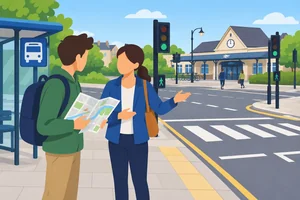
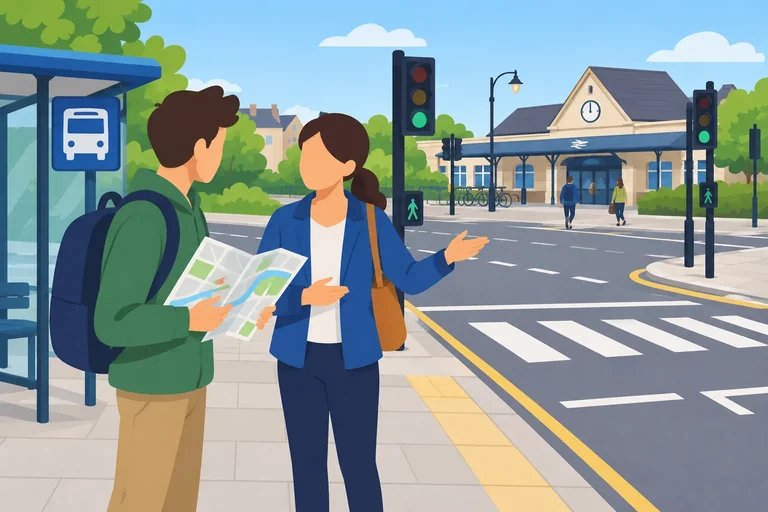
Use Excuse me. to get someone's attention politely. Then ask: How do I get to the station?
Keep the question words and change the destination:
The station is one possible destination. Use the same question frame for different places.
Example
Asking for a route
Visitor: Excuse me. How do I get to the station?
Local: The station is on Station Road.
Asking about time
Visitor: Is it far?
Local: It's five minutes on foot.
Listen to the two short exchanges.
Visitor: Excuse me. How do I get to the station? Local: The station is on Station Road. Visitor: Is it far? Local: It's five minutes on foot.
Put the words in order to ask politely about the supermarket.
Your sentence
Available words
Ask Is it far? when you want to know about the distance or travel time.
A short answer can give a time and a travel method. On foot means walking. By bus means travelling on a bus.
Read these two short answers.
| Time | Method | Short answer |
|---|---|---|
| five minutes | on foot | It's five minutes on foot. |
| ten minutes | by bus | It's ten minutes by bus. |
Listen for the time and the travel method. You will use this answer in the next activity.
It's ten minutes by bus.
Write two short lines.
Your first line needs Excuse me. Your second line needs both the time and the travel method.
Write at least 35 characters (0/35).
Step 3 of 9
Choose short movement instructions from the traveler’s point of view and form a negative instruction with Don’t.
Directions often begin with an action word. Do not use you.
Go straight ahead.
Turn left.
Turn right.
Read left and right from the traveler’s point of view. First, look at the arrow that shows which way the traveler is facing.
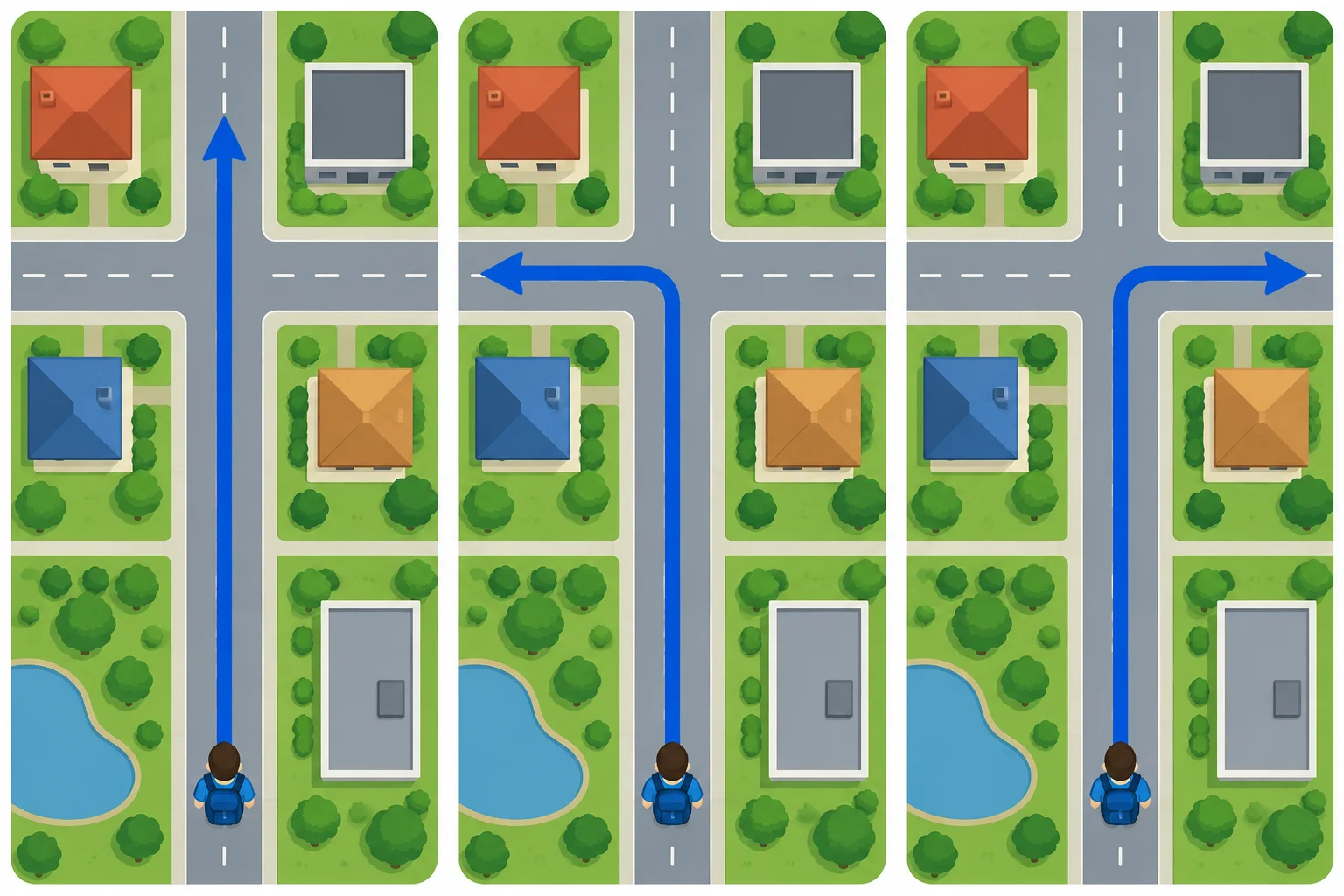
The same screen side can mean different things if the traveler faces a different way. Start by checking the traveler’s arrow.
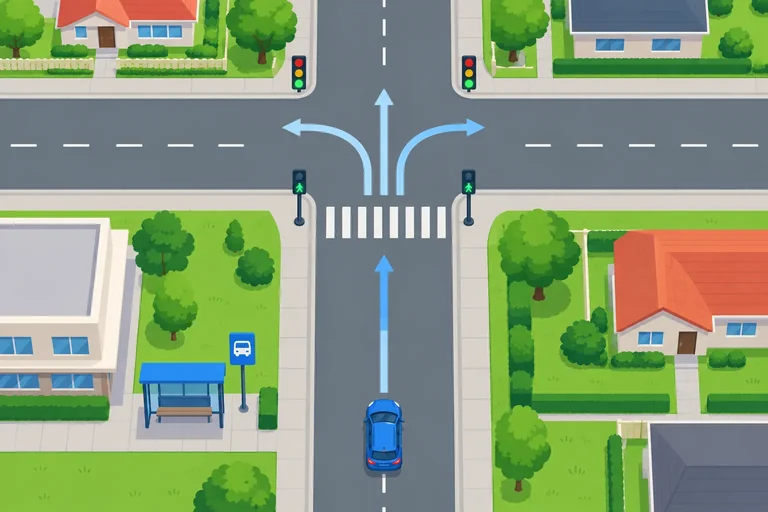
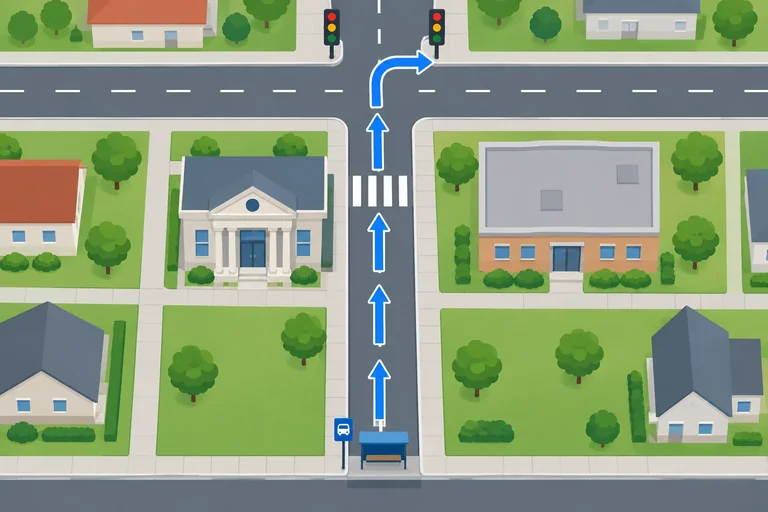
A turn changes the direction of the traveler’s arrow. Go straight ahead keeps the same direction. Turn left and Turn right change it.
To say that an action is not correct here, use Don’t + an action.
Don’t cross the road here.
Watch how the arrow changes direction at a turn.
The traveler begins facing up. After the left turn, the traveler faces left.
Example
Local: Go straight ahead. Turn right.
Short instructions are clear and direct.
The traveler starts facing up. Match each instruction to the correct arrow movement.
Tap an item and then its matching pair.
Build one negative instruction.
Your sentence
Available words
Step 4 of 9
Use movement phrases and landmarks to make short directions more precise.
Landmarks make directions clearer.
Use these phrases with the short instructions you already know.
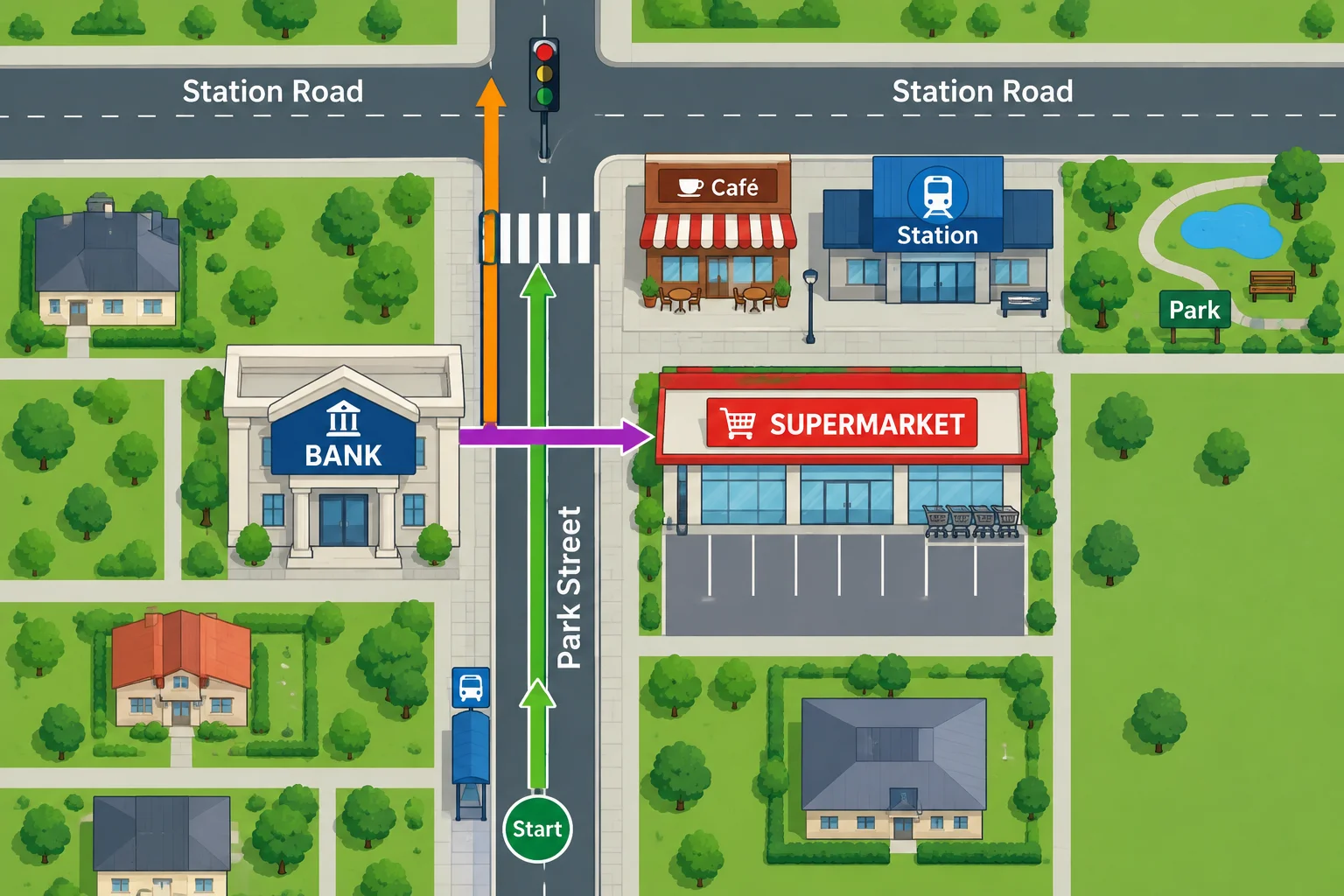
The arrows show movement along a street, across a road, and past a landmark.
Use at to name the exact point where a turn happens.
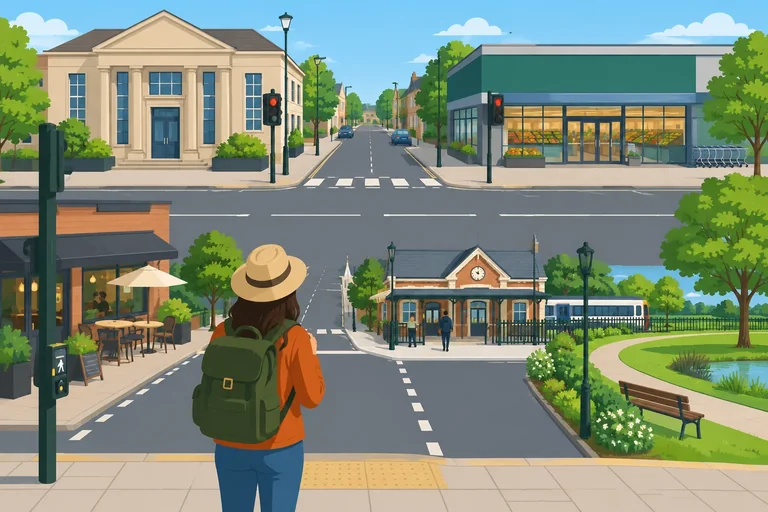
Turn left at the traffic lights.
The traffic lights are the turning point. You can also say at the corner when the corner tells the traveler where to turn.
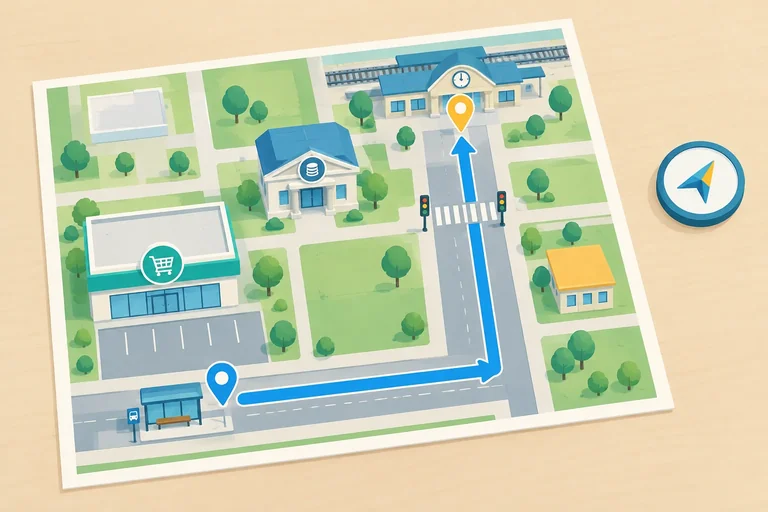
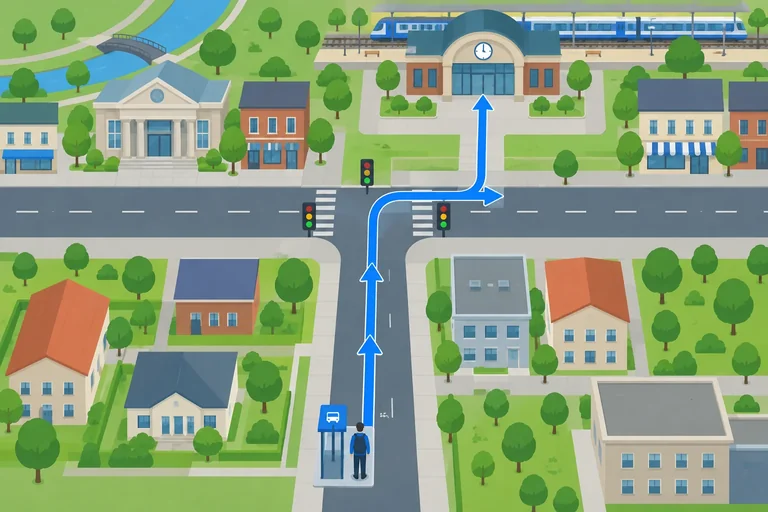
On the shared map, a traveler walking up Park Street from the bus stop turns right at the traffic lights to go along Station Road. Left and right depend on the traveler’s direction.
Example
Directions
Go straight ahead along Park Street. Go past the bank. Turn right at the traffic lights.
Each sentence is short, but the landmark tells the traveler exactly where to make the turn.
Warning
These are map-language examples. In a real street, cross only where it is safe and follow local signs, signals, and traffic.
Match each direction phrase to its meaning.
Tap an item and then its matching pair.
Complete the instruction.
You are walking up Park Street. Continue beyond the bank. At the junction, turn right at the _.
Step 5 of 9
Describe positions on the map and say which side a traveler should look on.
Use location words to describe where a place is on the map.
These words describe a place. They do not tell the traveler to move.
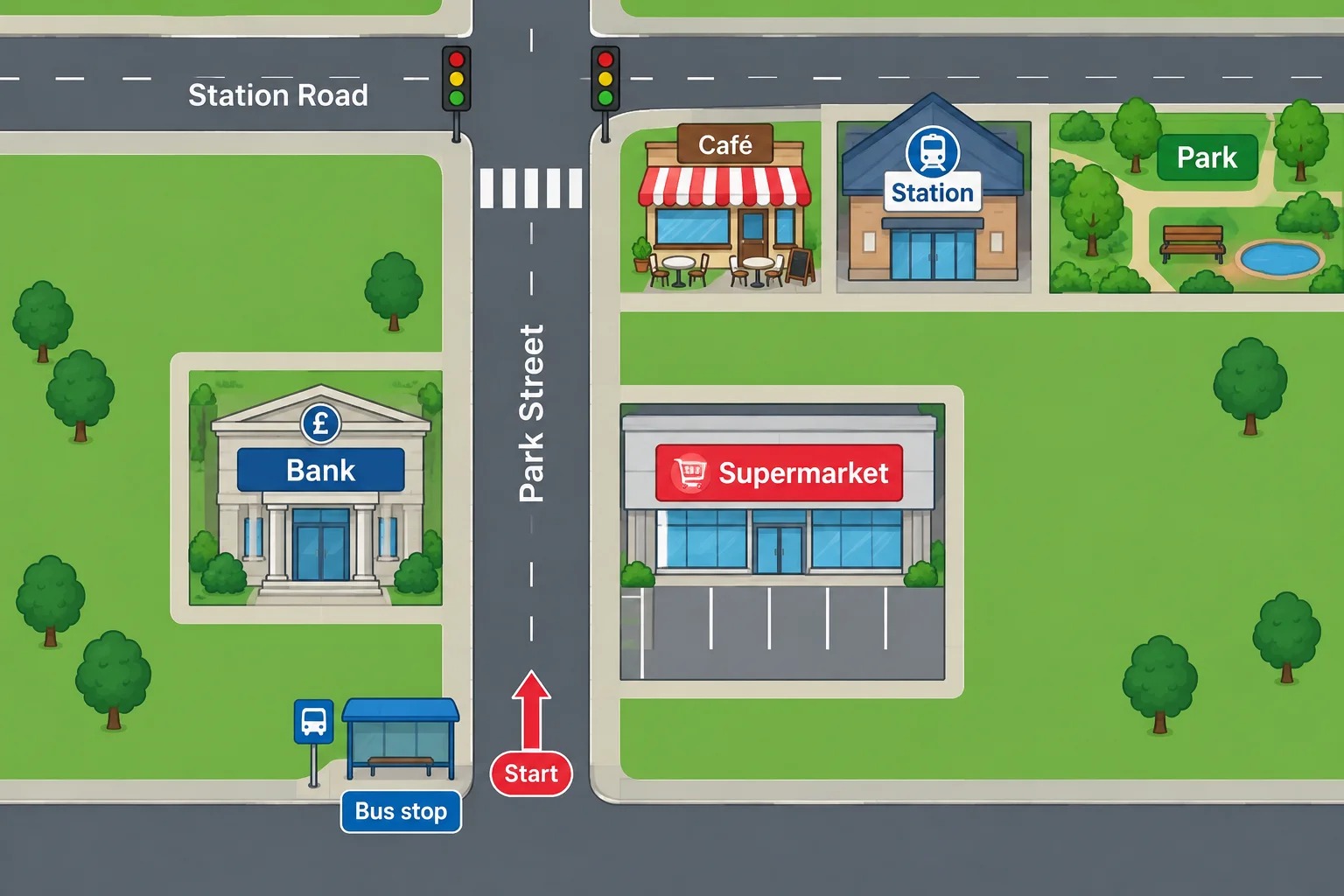
The supermarket is opposite the bank. The station is between the café and the park. The café is near the station.
Finish directions with the side where the traveler can find the place.
Turn left. is an action: the traveler changes direction.
It’s on your left. is a location: the place is on that side as the traveler continues.
Always use the traveler’s current direction—not the left or right side of the screen.
Compare an instruction with a final location description.
| Words | What they tell the traveler | Example |
|---|---|---|
| Turn left. | An action to do. | Turn left at the traffic lights. |
| It’s on your left. | Where to look. | The bank is on your left. |
| It’s on your right. | Where to look. | The supermarket is on your right. |
Example
Visitor: Excuse me. How do I get to the station?
Local: Go straight ahead. Turn right at the traffic lights. It’s on your right.
Match each unfinished description to the correct word or side.
Tap an item and then its matching pair.
Step 6 of 9
Follow a written directions message from the bus stop to the station and check each movement on the map.
A route is the path you follow on a map. Start at Start, then read one sentence and move one step at a time.
The arrow shows the traveler is facing up Park Street. Left and right are the traveler’s left and right, not the map’s fixed sides. After a turn, the traveler faces a new direction.
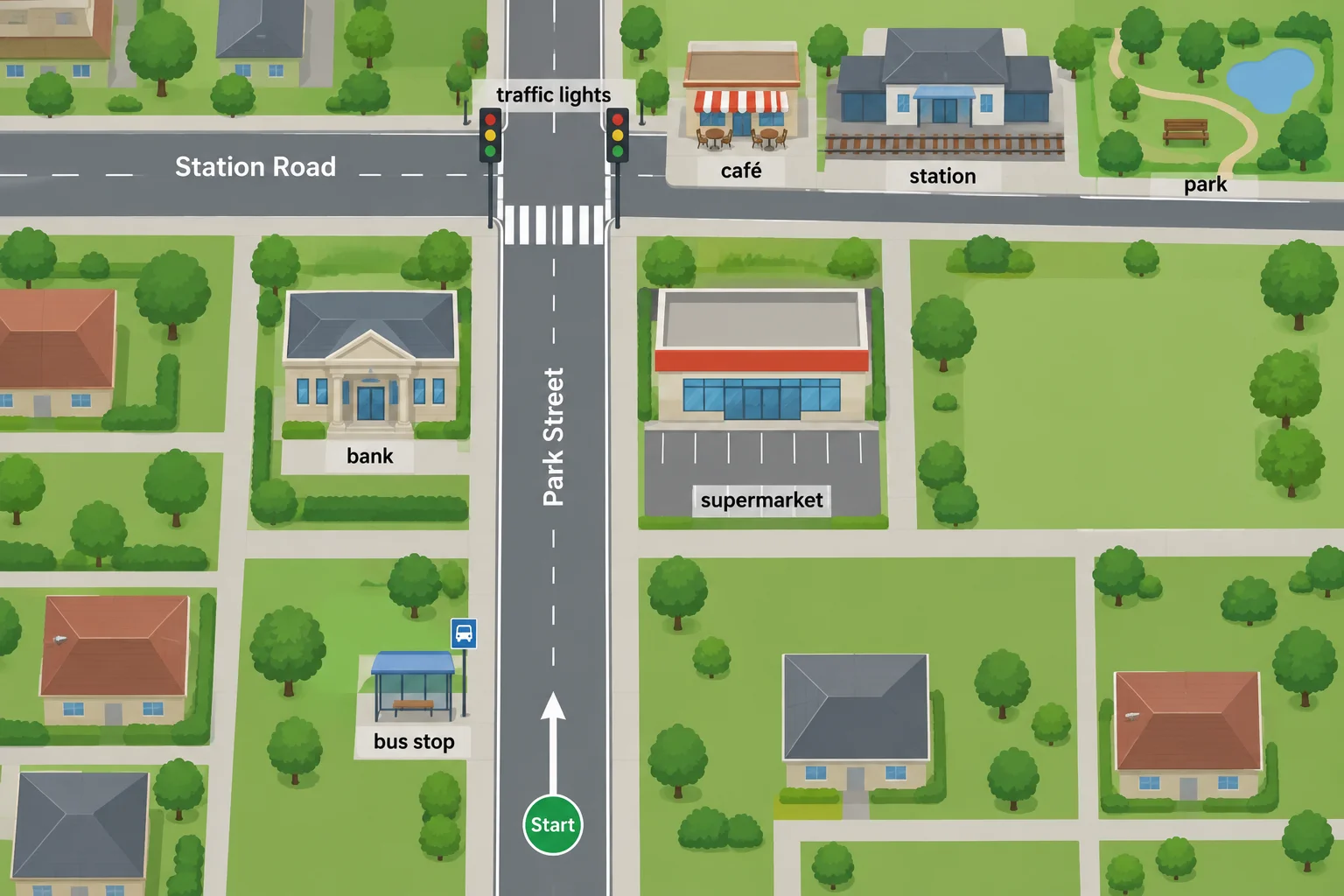
Find the Start arrow first. The map is not to scale.
Tip
The journey from the bus stop to the station takes five minutes on foot. Use the landmarks to check that you are still on the correct route.
Read the message in order. First, locate the start. Next, follow each movement sentence. When you turn, change the direction you are facing. Finally, use the last sentence to check which side the destination is on.
Example
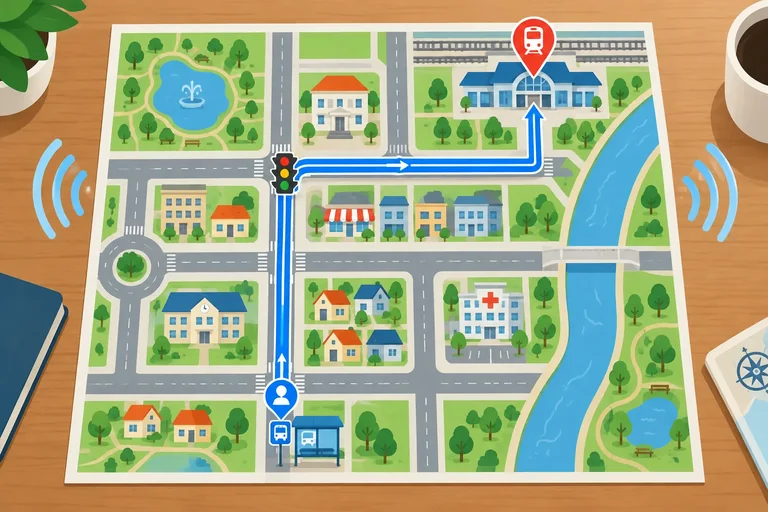
Start at the bus stop. Go straight ahead along Park Street. Go past the bank. Turn right at the traffic lights. The station is on your right. It’s five minutes on foot.
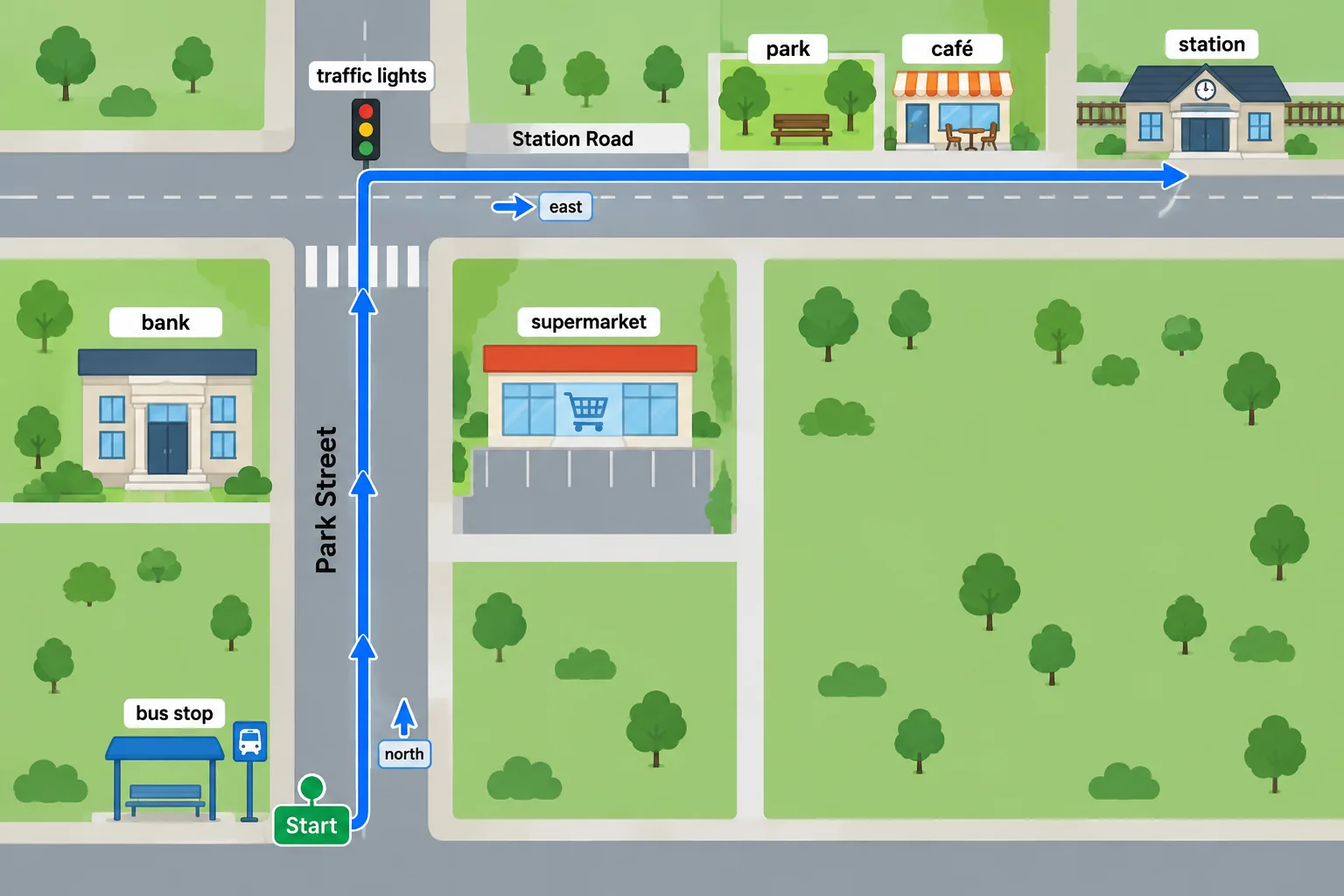
The traveler faces up before the turn and right across the map after the turn.
Starting at the bus stop and facing up Park Street, put these instructions in the order of the route.
Choose the map route that matches the model directions message.
Step 7 of 9
Follow short spoken directions on the town map, then practise saying familiar instructions with clear pauses and direction words.
When you listen to directions, do not try to catch every word. First, find Start and the facing arrow. Then listen for three useful clues:
Follow the route with your finger as you listen.
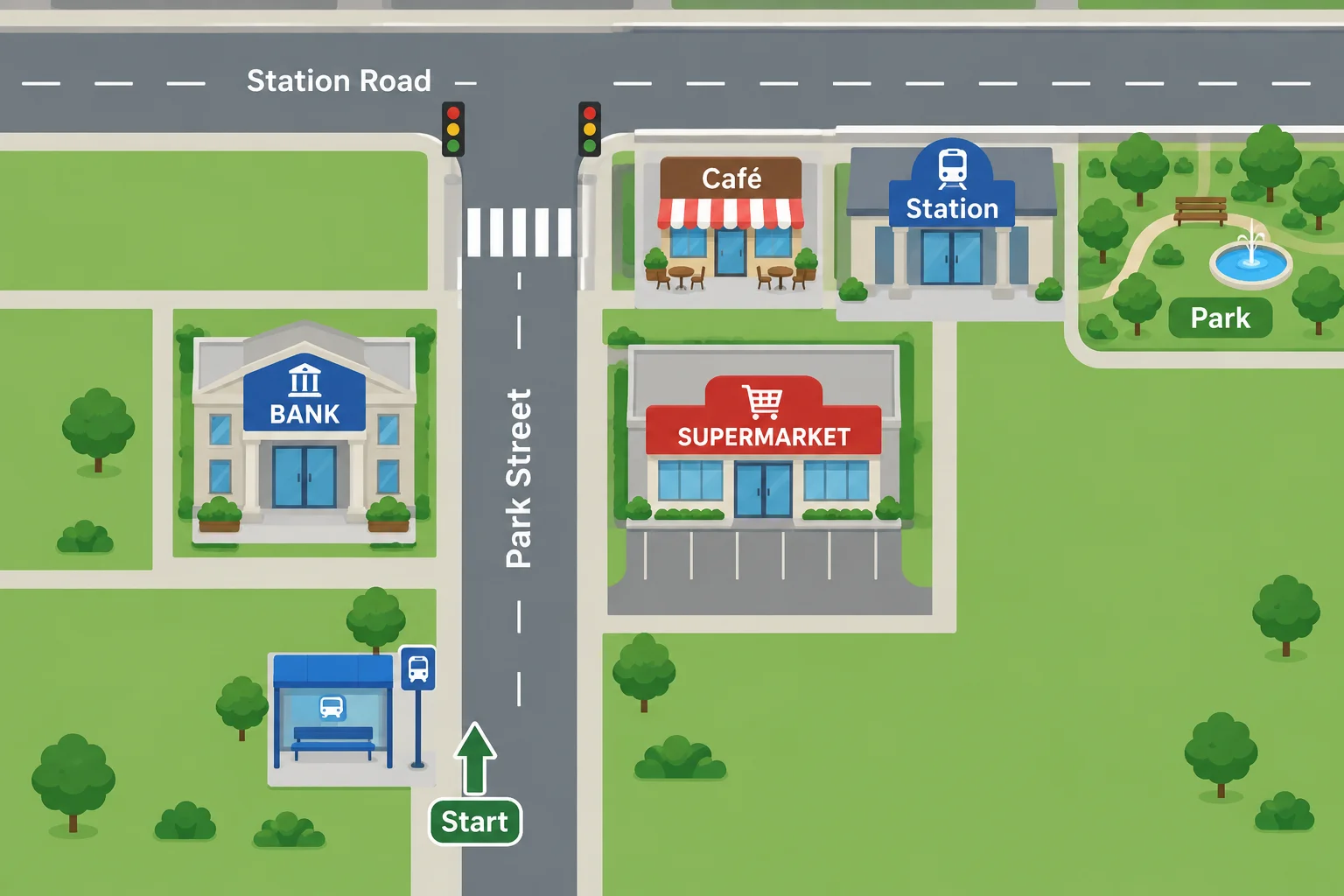
The Start arrow shows the traveller is facing up Park Street.
Tip
Keep your finger or eyes on the map. Move only when you hear an action or a landmark.
Listen once without reading a transcript. Follow the route on the map in your mind.
Start at the bus stop. Go straight ahead. Turn right at the traffic lights. Go past the café. The station is on your right.
Choose the route that matches the audio.
Say directions in short pieces. Make the important direction word a little stronger, and pause between instructions.
Turn left. / Go straight ahead. / Turn right.
A pause gives the listener time to follow each part of the route.
Listen, then repeat with the same short pauses.
Turn left. Go straight ahead. Turn right.
Tip
Do not rush left, right, or straight. Clear direction words help a listener choose the correct way.
Listen and write what you heard.
Listen and write the instruction.
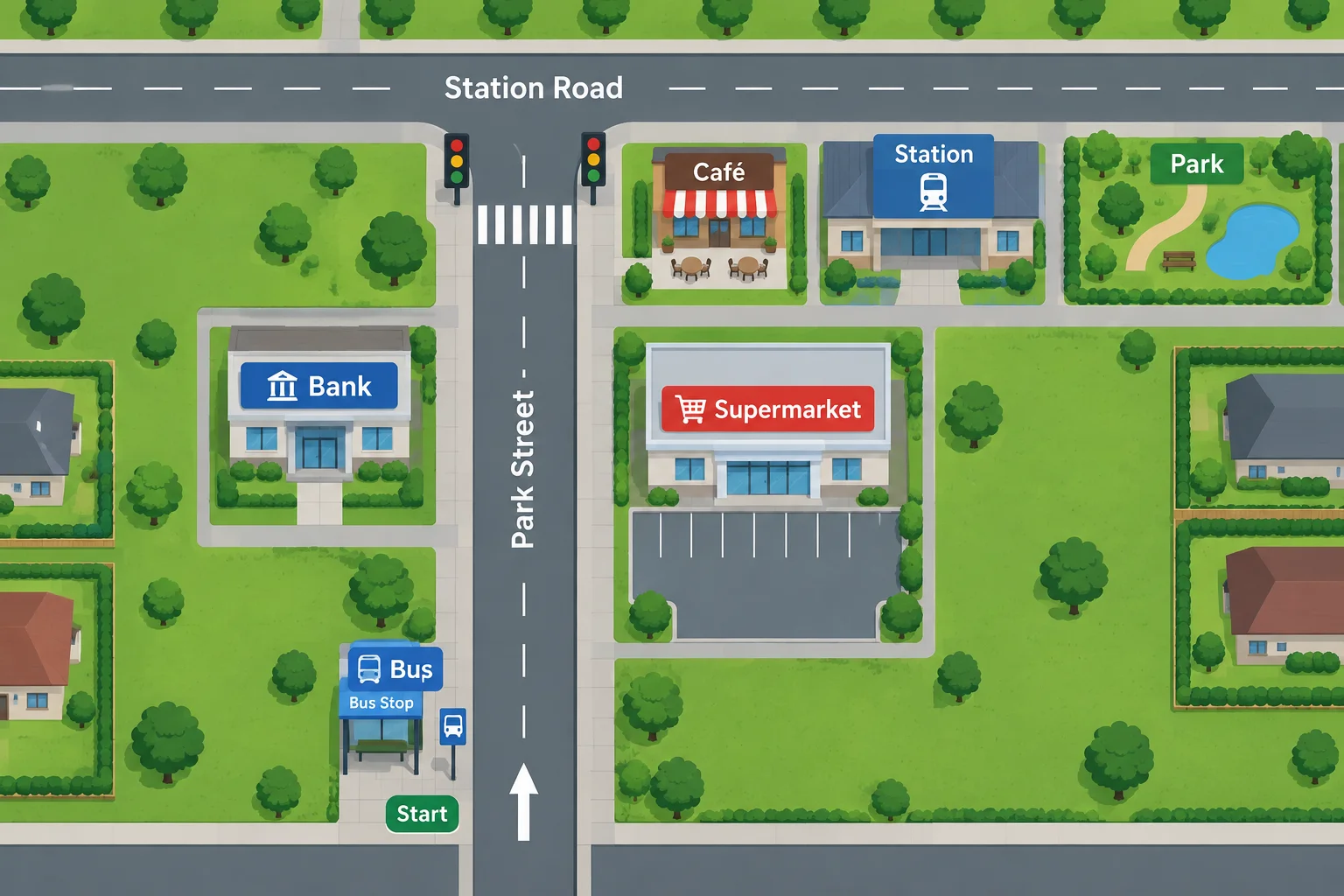
Use the map to plan directions from the bus stop to the station.
First, look at the map and say directions from the bus stop to the station aloud. Pause between each sentence. Next, say these practice lines aloud: “Turn left. / Turn right. / Go straight ahead.”
Then write one self-check sentence: Did you pause between instructions, and which direction words did you say clearly?
Write at least 25 characters (0/25).
Step 8 of 9
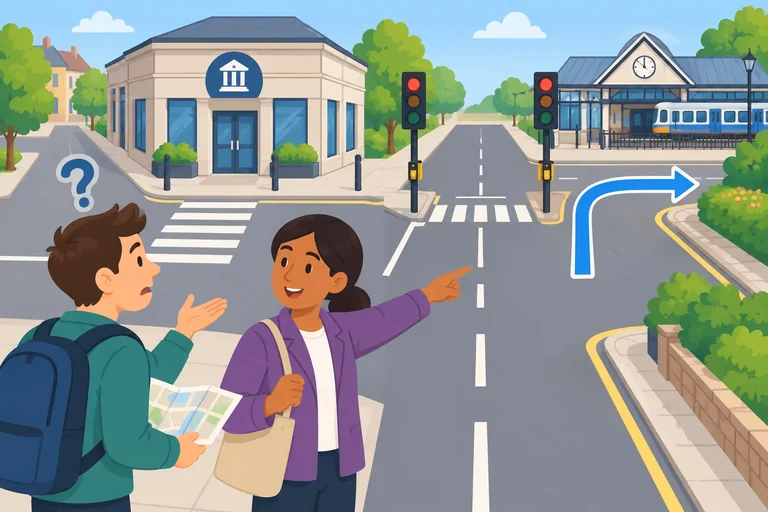
Ask for repetition, check an important route detail, and listen for a correction.
When one word is unclear, stop and check it. Repeat the detail you think you heard as a short question: Left at the bank?
The Local can confirm it or correct it. On this map, the bank is a landmark on Park Street; the turn to Station Road is at the traffic lights.
If you need to hear the instruction again, say: Could you say that again, please? After the help, say: Thank you.
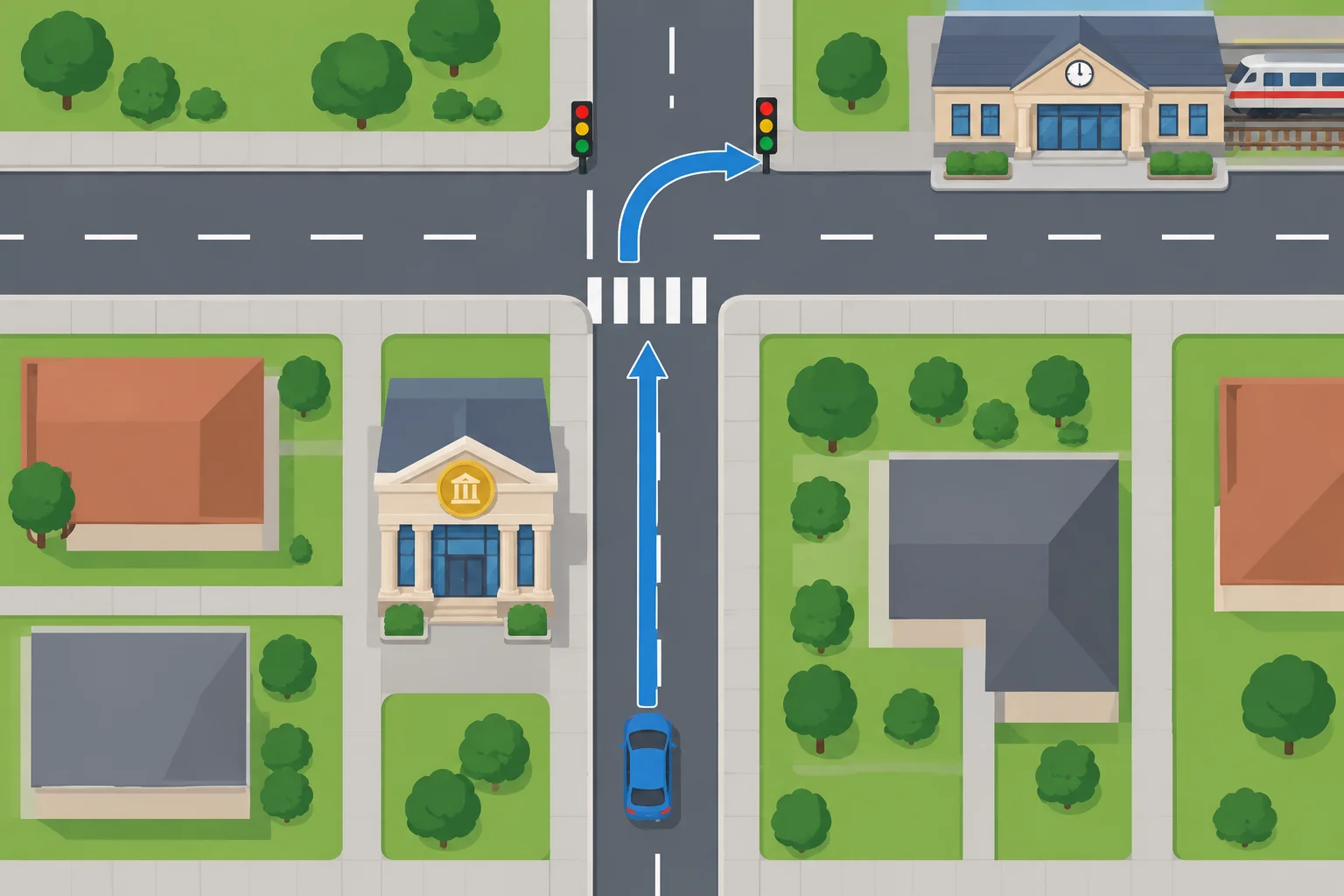
Use the landmark and the turning point carefully: the bank is on the route, but the turn is at the traffic lights.
Example
Visitor: Left at the bank?
Local: No. Turn right at the traffic lights.
Visitor: Could you say that again, please?
Local: Turn right at the traffic lights.
Visitor: Thank you.
Build the polite request.
Your sentence
Available words
Put the exchange in the correct order.
Listen and choose an option.
Listen. Which corrected instruction do you hear?
No. Turn right at the traffic lights.
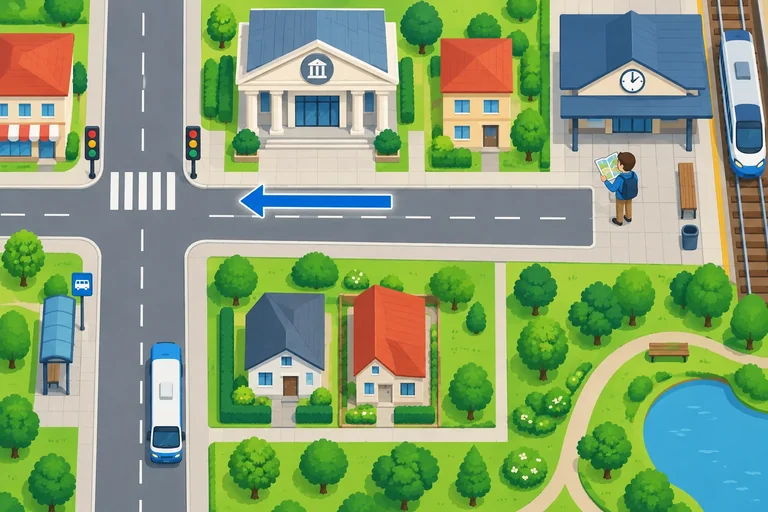
Step 9 of 9
Complete a directions exchange and create a clear return-route message from the station to the bus stop.
You are helping a Visitor travel from the station to the bus stop. Start at Start and follow the arrow, not the fixed sides of the screen. Each time the traveler turns, imagine the arrow turning too.
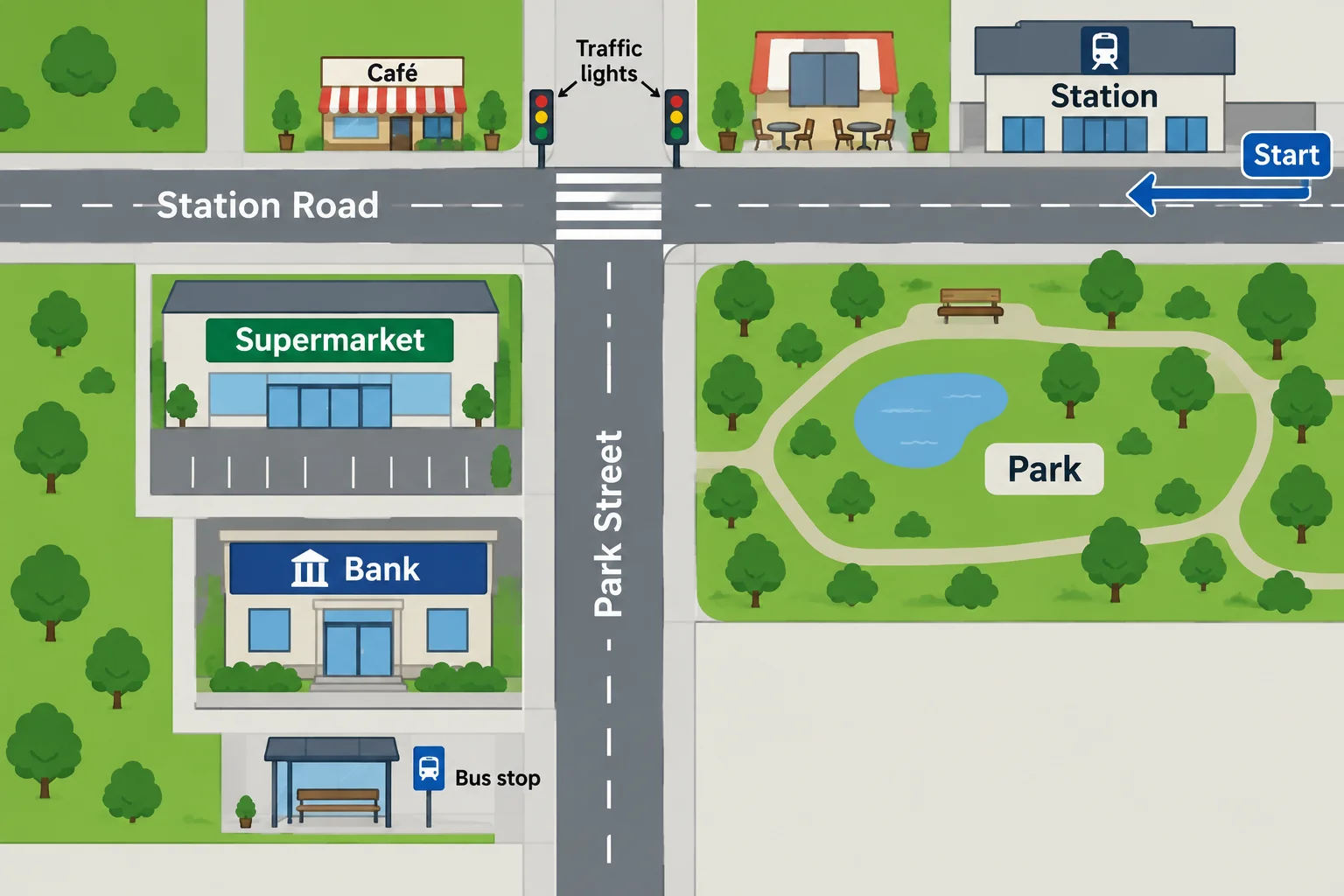
Use the arrow to follow the traveler’s changing direction. The map is not to scale.
Tip
After the crossing and turn, check the traveler’s new direction before deciding which side is left or right.
Listen and choose an option.
Listen to the Visitor. What does the Visitor want to know?
Excuse me. How do I get to the bus stop? Is it far?
Use the map to check a detail before continuing. A checking question can show that you are listening carefully. The bank is a landmark on the route, but it is not the point where the traveler turns.
Example
Visitor: Excuse me. How do I get to the bus stop? Is it far?
Local: Go straight ahead along Station Road. Cross the road at the traffic lights. Turn left after the crossing. Go past the bank. It’s on your right. It’s five minutes on foot.
Visitor: Left at the bank?
Local: No. Turn left after the crossing at the traffic lights.
Visitor: Could you say that again, please?
Local: Turn left after the crossing at the traffic lights.
Visitor: Thank you.
Tip
Say the Local’s last instruction aloud. Pause after the sentence and make left clear.
Summary
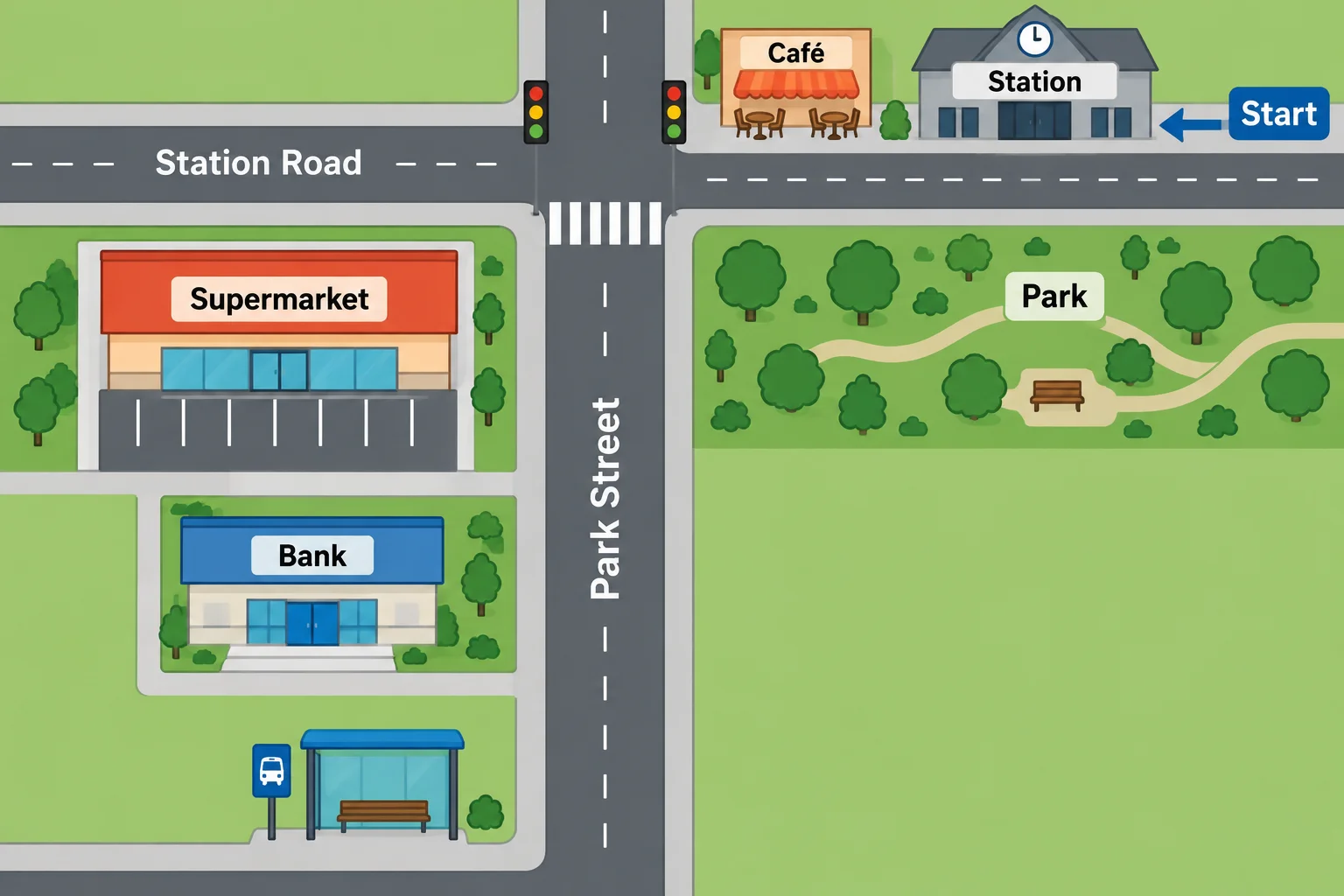
Plan and check the route directly on this map before you write.
Write four to six short sentences to take the Visitor from the station to the bus stop. Use the map to check every movement, landmark, and final side. Include the travel-time answer.
Then say your message aloud with pauses and clear straight, left, and right. Also say “Left at the bank?” once as a checking question. After you respond, compare your wording and route with the reference answer.
Write at least 100 characters (0/100).
Congratulations! You completed: Ask for and Give Directions
30 XP
You completed this level!
Up next: B1: Experience and Advice
 Share Experiences and Recent NewsAsk about experiences and share recent news with the present perfect. Read and listen to short conversations, say your own answers aloud, and write a short update about something you have done.
Thousands of online courses in video, ebooks and audiobooks.
To test your knowledge during online courses
Generated directly from your cell phone's photo gallery and sent to your email

Download our app via QR Code or the links below:.



Carry knowledge in your pocket.
Download the Cursa app.
There are hundreds of free courses available, with a free certificate of completion that is saved in your mobile image gallery.
Download the app to access the Course Completion Certificate for Free.


+ 10 million
students

Free and Valid
Certificate

60 thousand free
exercises

4.8/5 rating in
app stores

Free courses in
video and ebooks