
Step 1 of 9
Find the Point That Needs Emphasis
Identify the one detail that a workshop-update listener needs corrected, contrasted, or prioritized.

Learning path · Level 10 · Tutorial 1
Make the main point of a short work or study update unmistakable. Read and hear contrasting versions, practise clefts, fronting, and inversion, then write and say a focused update without making every sentence sound unusually emphatic.

 Find the Point That Needs Emphasis
Identify the one detail that a workshop-update listener needs corrected, contrasted, or prioritized. 2 min
 Correct a Misunderstanding with an It-Cleft
Use an it-cleft to correct a mistaken cause or time while preserving the facts of a workshop update. 3 min
 State a Priority with a What-Cleft
State the workshop team’s priority with precise vocabulary and a focused what-cleft. 2 min
 Front a Contrast Without Inverting
Move an object to the front for a clear contrast while keeping normal statement word order. 2 min
 Invert After Negative Openings
Use subject–auxiliary inversion after negative or restrictive openings while preserving tense, aspect, modality, and main-verb form. 3 min
 Place Inversion After the Whole Only-Clause
Learn where subject–auxiliary inversion belongs after an opening only-clause and how this differs from only restricting the subject. 3 min
 Make the Intended Contrast Audible
Use stress and thought groups to make the intended contrast in a workshop update easy to hear. 3 min
 Choose Emphasis That Fits the Message
Select emphasis that serves the listener, and keep supporting details clear and ordinary. 2 min
 Final Task: A Focused Team Update
Write, revise, and say a concise team update that corrects a misunderstanding and makes the immediate priority clear without over-emphasizing every detail. 5 min
Step 1 of 9
Identify the one detail that a workshop-update listener needs corrected, contrasted, or prioritized.
Focus is the detail that corrects a misunderstanding, creates a contrast, or identifies what matters next. Shared information is information both speakers already accept.
In this workshop update, the delay is shared information. If a listener blames the budget, the cause—not the whole story—needs focus.

The spotlight represents focus: one detail is brought forward while shared information stays in the background.
An ordinary update and a marked version can report the same facts. The difference is where they direct the listener’s attention.
Use marked wording when the listener needs a correction or a clear contrast. Read the examples for their meaning; you will learn how to construct these patterns in later steps.
Example
Listener’s misunderstanding: “The budget caused the delay.”
Ordinary update: The timing caused the delay.
Focused update: It was the timing that caused the delay.
The event has not changed. The focused update directs attention to the cause that corrects the listener.
Example
Listener’s misunderstanding: “The team noticed the error before Tuesday.”
Ordinary update: We noticed the error after checking the list on Tuesday.
Focused update: It was after checking the list on Tuesday that we noticed the error.
Here, the timing of the discovery is the focus; the workshop and the error are shared information.
Tip
Do not make every sentence unusually emphatic. First ask: What does this listener misunderstand, contrast, or need to prioritize? That answer identifies the detail for focus.
Match each listener misunderstanding to the detail that should receive focus in a reply.
Tap an item and then its matching pair.

Step 2 of 9
Use an it-cleft to correct a mistaken cause or time while preserving the facts of a workshop update.
The workshop was delayed because two sessions overlapped. The team checked the session list on Tuesday and then noticed the error. If a listener blames the budget, the detail that needs focus is the timing; the event itself is shared information.
An it-cleft puts that focus in a prominent position without changing the facts.
Pattern:
It + is/was + focus + that + remaining clause
For a correction about the past delay, use was:
It was the timing that caused the delay.
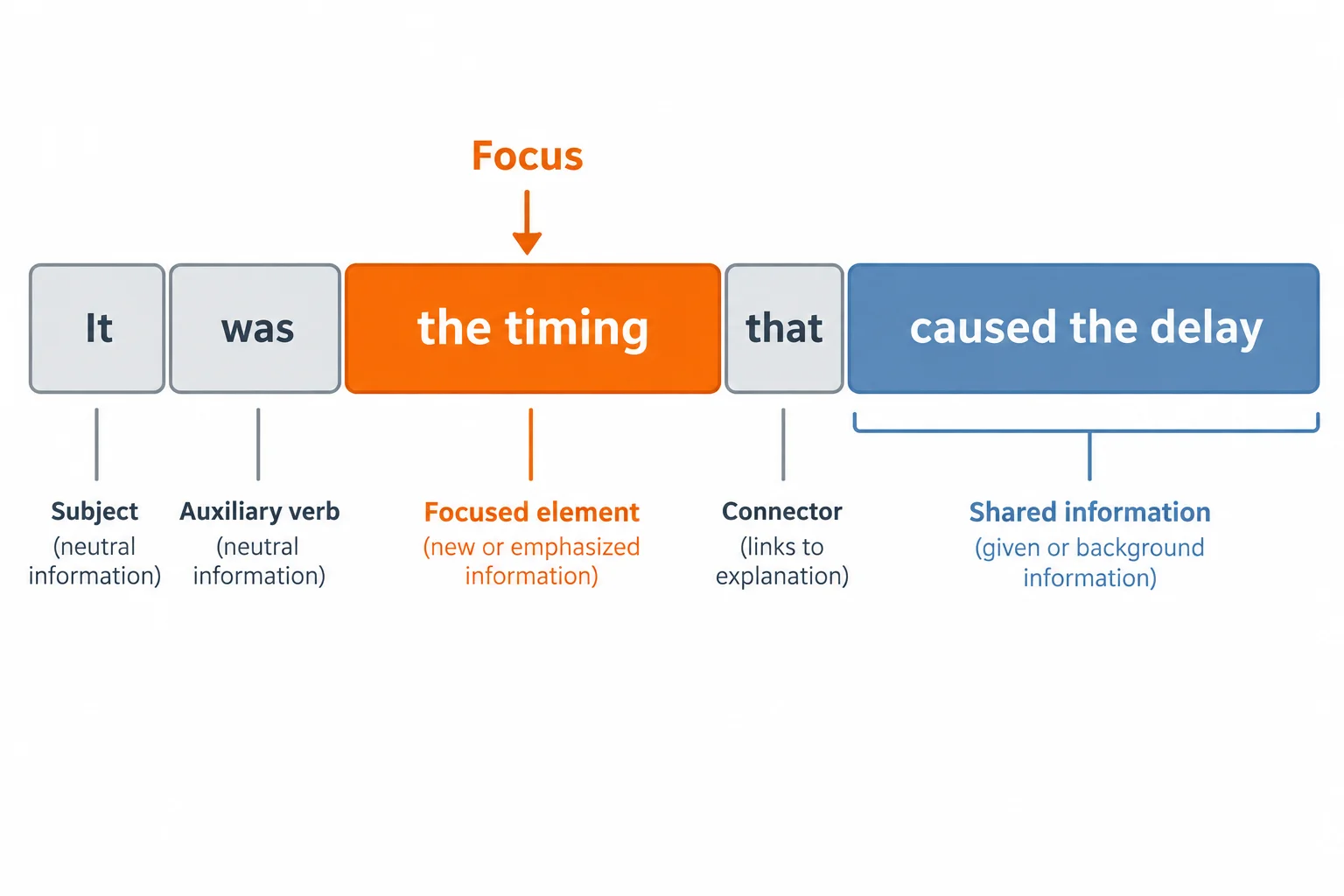
The selected focus goes between is/was and that. The remaining clause carries shared information about the event.
Example
Misunderstanding: “The budget caused the delay.”
Correction: “It was the timing that caused the delay.”
The it-cleft highlights the timing, not the already established delay.
You can also focus when an event happened. Keep a necessary preposition with the focused time phrase.
Original event: The team noticed the error after checking the list on Tuesday.
Time correction: It was on Tuesday that the team noticed the error after checking the list.
The focus changes, but the event, participants, and time reference remain accurate. The clause after that still identifies the same event.
Tip
When you build an it-cleft, check two things:
Do not remove details that make the event identifiable. For a time focus, retain the complete phrase, such as on Tuesday.
A colleague says, “The budget caused the delay.” Build a correction that focuses the actual cause.
Your sentence
Available words
A colleague says the team noticed the error on Monday. Write the correction. Start with It:
It __

Step 3 of 9
State the workshop team’s priority with precise vocabulary and a focused what-cleft.
A what-cleft puts a need or an action first, then places the information the listener should retain after is. This makes a priority easy to hear and remember.
Use What we need is + focused noun phrase:
What we need is a clearer schedule.
Use What we need to do is + base verb:
What we need to do is revise the schedule.
The first pattern focuses the needed thing. The second focuses the next action. In both patterns, the words after is carry the focus.
An it-cleft often corrects one disputed detail; a what-cleft can present the priority the listener should retain.

In a what-cleft, the specification after “is” is the focus: either the needed item or the action to take.
Example
Focus on the needed item
What we need is a clearer schedule.
Focus on the next action
What we need to do is revise the schedule.
Both sentences concern the same situation, but they guide the listener toward a different takeaway.
Use priority-setting vocabulary precisely. These expressions have different jobs in an update: one names the issue requiring attention, one names the next step, and one identifies the cause beneath the visible issue.
Use these labels so that an update does not treat every fact as equally important.
| Expression | What it identifies | Workshop case |
|---|---|---|
| the main concern | The issue requiring attention | The workshop delay |
| the immediate priority | What should happen next | A clearer schedule |
| the underlying problem | The cause beneath the visible issue | Two sessions overlapped |
Match each workshop fact with its role in the update.
Tap an item and then its matching pair.
Write a short focused response to the workshop update.
Use ordinary punctuation and capitalization.
Write at least 120 characters (0/120).

Step 4 of 9
Move an object to the front for a clear contrast while keeping normal statement word order.
Fronting moves an object to the beginning of a statement when that object is the contrast or a shared topic you want to return to.
In the workshop update, a listener may ask which part of the situation you can clarify. The object can come first so that it receives focus:
That part I can explain.
The rest of the statement keeps ordinary statement order: subject, then verb phrase.
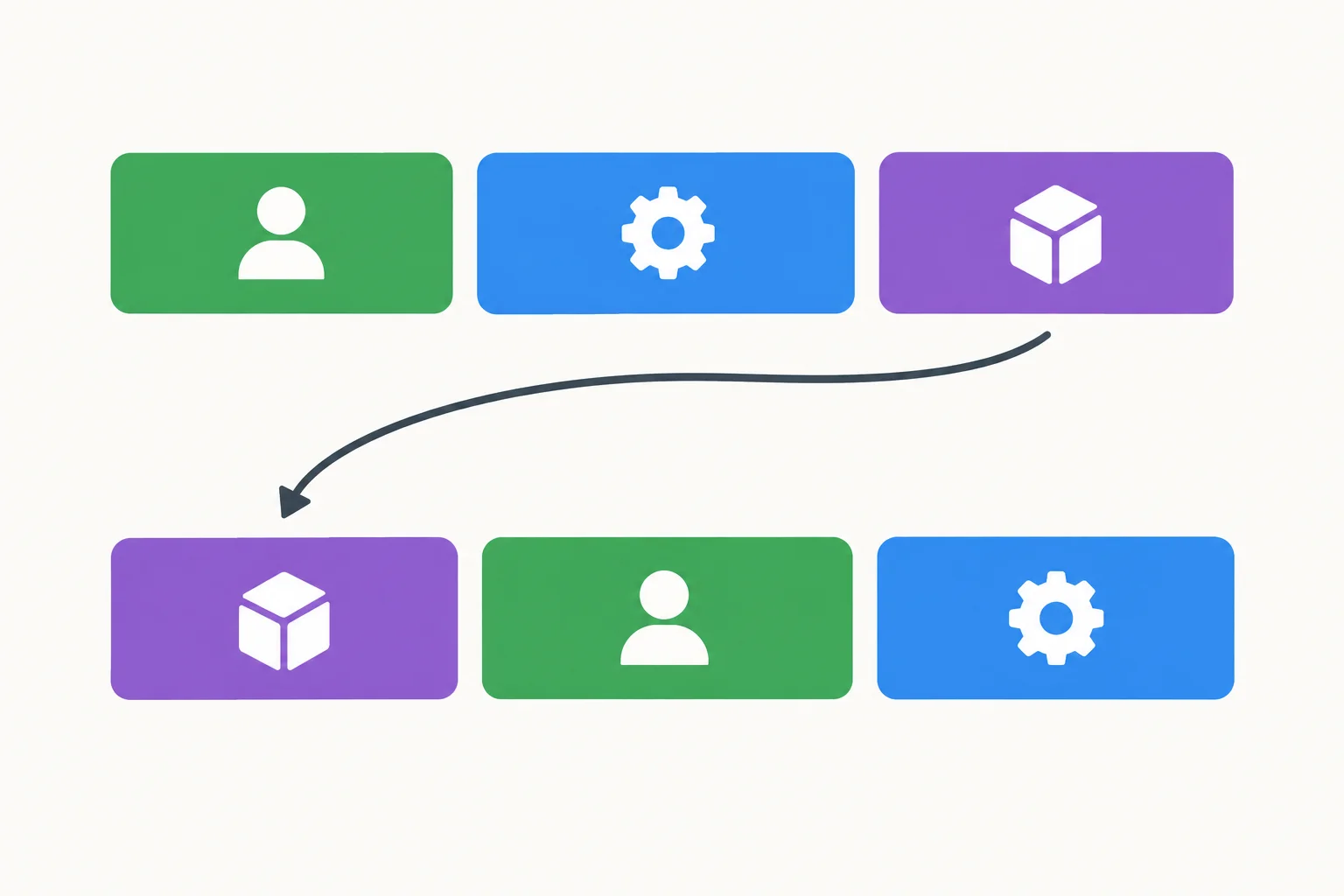
Fronting highlights the object; it does not make the statement question-like.
Use this pattern:
object + subject + verb phrase
The fronted object still has its original role. Do not add a second object pronoun after the verb.
Use fronting when the listener already has a reason to notice that object. Without context, ordinary statement order is usually clearer.
Example
Neutral: I can explain that part.
Fronted: That part I can explain.
The object, That part, is now the focus. I can explain stays in normal statement order.
Not: That part I can explain it. The fronted object already fills the object role.
Tip
A fronted object does not require question-like order. Keep the subject before the modal or auxiliary in the remaining clause.
Correct: That part I can explain.
Not: That part can I explain.
Is this a correct fronted statement?
That part can I explain.
The listener asks which document the coordinator can approve: the list or the revised schedule. Build the fronted version of this neutral statement:
The coordinator can approve the revised schedule.
Your sentence
Available words

Step 5 of 9
Use subject–auxiliary inversion after negative or restrictive openings while preserving tense, aspect, modality, and main-verb form.
Openings such as never, rarely, and under no circumstances carry a negative or restrictive meaning. At the start of an emphatic statement, they can trigger subject–auxiliary inversion.
Unlike object fronting, this changes the order of the clause:
opening + auxiliary + subject + main verb
The opening establishes the strong limit or contrast. The auxiliary moves in front of the subject.
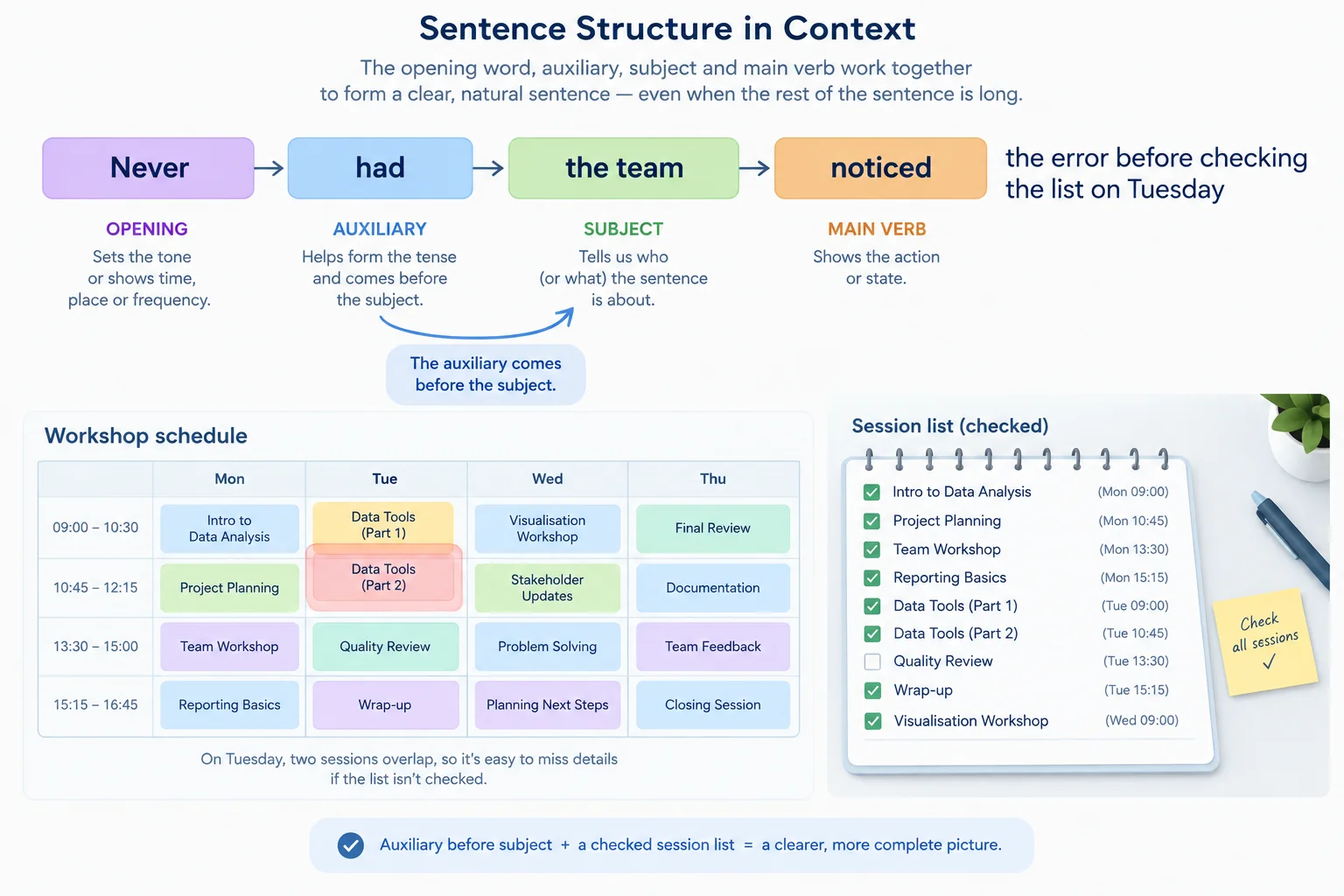
In subject–auxiliary inversion, the auxiliary comes before the subject after the opening.
When the clause already contains an auxiliary or a modal, move that word before the subject. Do not select a new auxiliary.
With more than one auxiliary, move only the first auxiliary. The rest of the verb phrase stays after the subject. This preserves the original tense, aspect, and modality.
These fragments show what moves into the auxiliary position after a negative or restrictive opening.
| Original verb phrase | After inversion | Key point |
|---|---|---|
| has noticed | has the team noticed | First auxiliary moves |
| can approve | can anyone approve | Modal moves |
| will have been revised | will the schedule have been revised | Only will moves |
Example
Ordinary order: The team had never noticed the error before checking the list on Tuesday.
Inverted order: Never had the team noticed the error before checking the list on Tuesday.
The past perfect auxiliary carries the earlier-time meaning, so it moves before the subject.
A simple present or simple past clause has no auxiliary available for inversion. Supply do-support instead:
After do, does, or did, use the base form of the main verb.
Example
Ordinary: The sessions rarely overlap.
Inverted: Rarely do the sessions overlap.
Ordinary: The list rarely shows a conflict.
Inverted: Rarely does the list show a conflict.
Ordinary: We never noticed the error before Tuesday.
Inverted: Never did we notice the error before Tuesday.
Warning
The opening already supplies the negative or restrictive meaning. Do not add not automatically. Also, after do-support, do not use a past or third-person main-verb form: Never did we noticed is incorrect.
Complete each emphatic statement. Use the auxiliary that preserves the original tense, aspect, or modality.
Rarely  we receive such detailed feedback on the schedule.
Never  we notice the error before Tuesday.
Never  the team noticed the error before checking the list on Tuesday.
Under no circumstances  anyone except the coordinator approve the revised schedule.
Step 6 of 9
Learn where subject–auxiliary inversion belongs after an opening only-clause and how this differs from only restricting the subject.
An opening only after or only when clause restricts the circumstances of the main event. Treat that opening as one complete unit.
The time clause keeps ordinary statement order. Subject–auxiliary inversion begins in the main clause, after the whole opening:
opening + auxiliary + subject + main verb
This structure highlights when the team noticed the problem, not a new event.
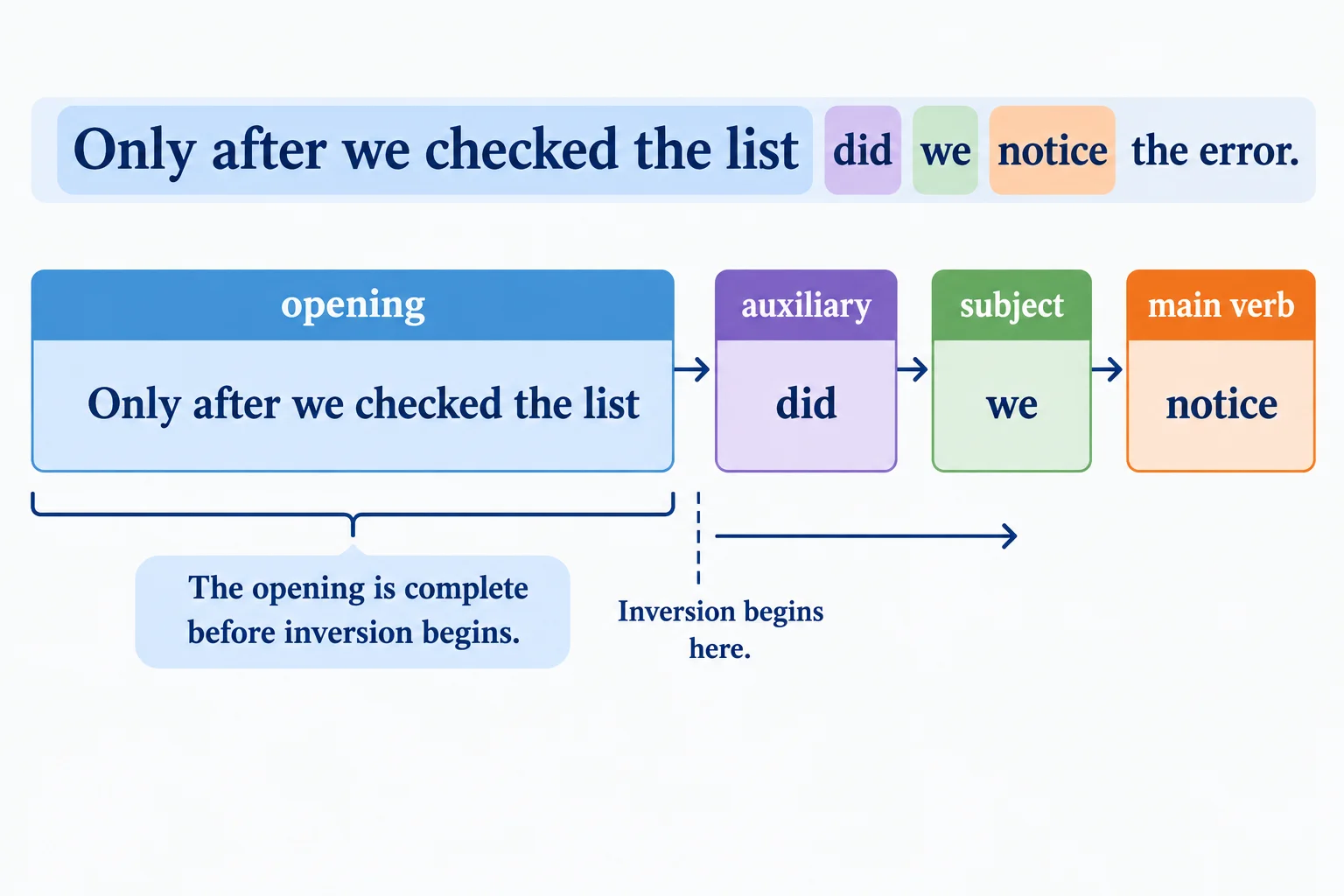
The opening has ordinary order; inversion starts in the main clause.
Example
Only after we checked the list did we notice the error.
Inside the opening, the order is we checked. After the opening, did moves before we, and the main verb stays in its base form: notice.
The team checked the list on Tuesday, so the sentence makes that restricted timing especially important.
Compare the position of only before deciding whether to invert.
When only introduces an opening circumstance, inversion follows the opening clause. But when only restricts the subject, use ordinary statement order. In that case, the subject comes before its modal or auxiliary.
The word only itself does not automatically cause inversion. Its grammatical role and position determine the structure.
Both sentences are emphatic, but they organize emphasis differently.
| What only restricts | Word order | Workshop example |
|---|---|---|
| Circumstances of noticing | Opening, then auxiliary + subject + main verb | Only after we checked the list did we notice the error. |
| The person with authority | Subject + modal + main verb | Only the coordinator can approve it. |
Choose the option that correctly completes the first statement and identifies what only restricts in the second.
Only after we checked the list ___ the error.
Only the coordinator can approve the revised schedule. Here, only restricts the ___.

Step 7 of 9
Use stress and thought groups to make the intended contrast in a workshop update easy to hear.
Stress helps a listener locate the focus: the detail being corrected or contrasted. Shared information is usually lighter, so it does not compete with the main point.
In pronunciation guides, capitals show the strongest stress and / shows an optional thought-group boundary. Do not use capitals or / in ordinary written sentences.
These two versions report the same fact, but they guide attention differently:
In the first version, the speaker corrects the cause. In the second, the speaker contrasts the result with another possible outcome. Stress does not automatically belong on the final word.
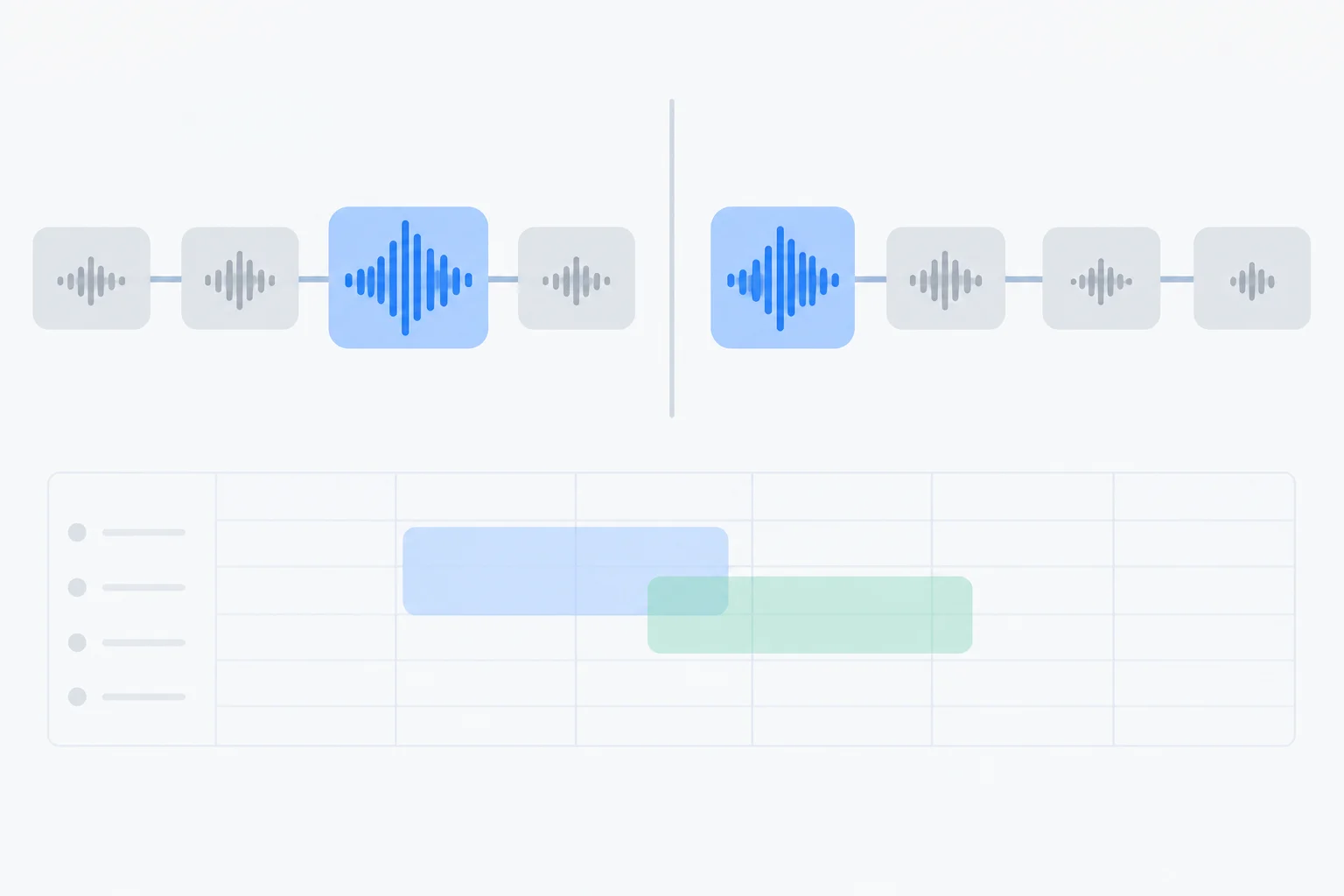
One strong beat can shift the listener's attention while the surrounding shared information stays lighter.
Listen to the two versions. Then listen to the fronted statement and notice the small spoken boundary after the fronted information.
It was the timing that caused the delay. The delay was caused by the timing. That part I can explain.
It was the TIMING / that caused the delay.
The DELAY / was caused by the timing.
That part / I can explain.
Listen and choose an option.
Listen to the update. Which detail does the speaker present as the team's immediate priority?
What we need is a clearer schedule.
Listen and write what you heard.
A colleague says that the budget caused the workshop delay. Listen and write the correction you hear.
Return to the two versions on the first screen and say each one aloud twice.
Then identify the strongest stressed word and the focus of each version. Use ordinary capitalization in your response.
After saying both versions aloud, record how the focus changed.
Write at least 25 characters (0/25).

Step 8 of 9
Select emphasis that serves the listener, and keep supporting details clear and ordinary.
Emphasis is useful when the listener needs help locating one important point: a correction, a contrast, a priority, or a special restriction. If a sentence merely supplies shared information, ordinary word order is usually clearer.
Think of focus as a limited resource. In a short update, one or two marked sentences can guide attention. If every sentence sounds specially emphatic, the listener has to decide which point actually matters most.
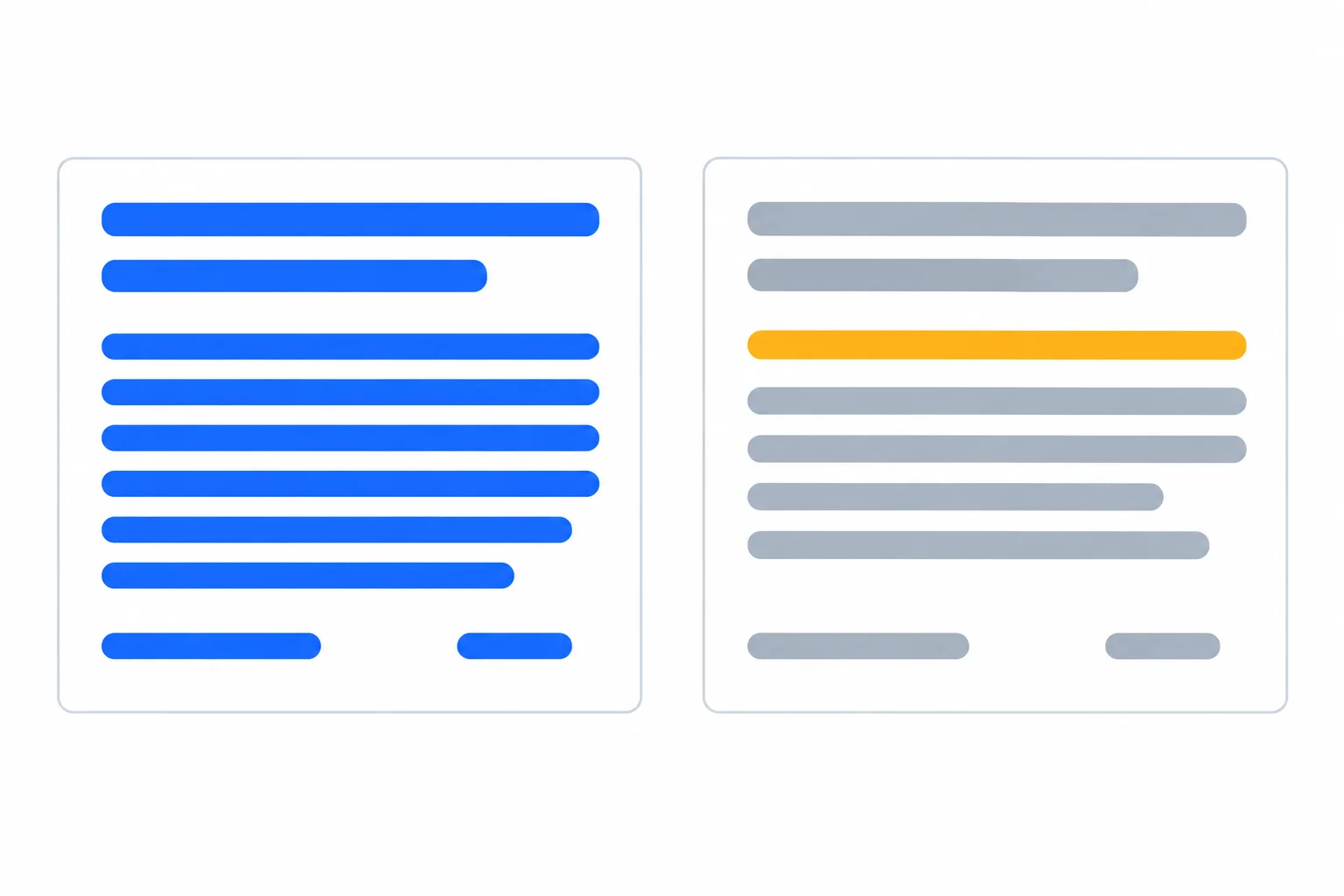
A focused update lets one important point stand out while the surrounding shared information stays visually quiet.
Choose the structure from the listener's need, not because a marked structure sounds more advanced. Clefts are often natural when you are correcting a misunderstanding or stating a priority. Fronting needs an accessible contrast. Subject–auxiliary inversion can be effective, but its formal or forceful effect is not needed for routine supporting details.
Use ordinary order unless the listener needs a particular contrast or restriction to stand out.
| Listener's need | Useful wording | Reason |
|---|---|---|
| Add a shared detail | We checked the list on Tuesday. | No special contrast is needed. |
| Correct the cause | It was the timing that caused the delay. | The it-cleft makes the disputed cause the focus. |
| State the next priority | What we need is a clearer schedule. | The what-cleft presents the priority clearly. |
| Return to a known topic | That part I can explain. | Fronting works because that part is already accessible. |
| Give a formal restrictive sequence | Only after we checked the list did we notice the error. | Inversion gives the sequence rhetorical force. |
| Restrict the subject | Only the coordinator can approve the revised schedule. | Only modifies the subject; normal word order remains. |
During a short status call, the department head says, “The budget caused the delay.” You have been asked to make the correction about the cause unmistakable in your first sentence. Which reply uses the appropriate marked corrective structure?
A project sponsor wrongly believes that the budget delayed the workshop and needs a concise written update. Revise this overemphatic draft in 3–4 sentences:
“It was the timing that caused the delay. It was Tuesday that we noticed the error. What we need is a clearer schedule. Only after we checked the list did we notice the error. Only the coordinator can approve the revised schedule.”
Preserve all the facts. Retain an it-cleft to make the correction about timing—not budget—the main focus. Return the discovery detail, the immediate priority, and the approval fact to ordinary statement order unless emphasis genuinely helps.
Write at least 120 characters (0/120).

Step 9 of 9
Write, revise, and say a concise team update that corrects a misunderstanding and makes the immediate priority clear without over-emphasizing every detail.
A colleague has the wrong explanation for the workshop delay. Your update must correct that point, give the essential sequence, and make the next priority clear.
Case facts:
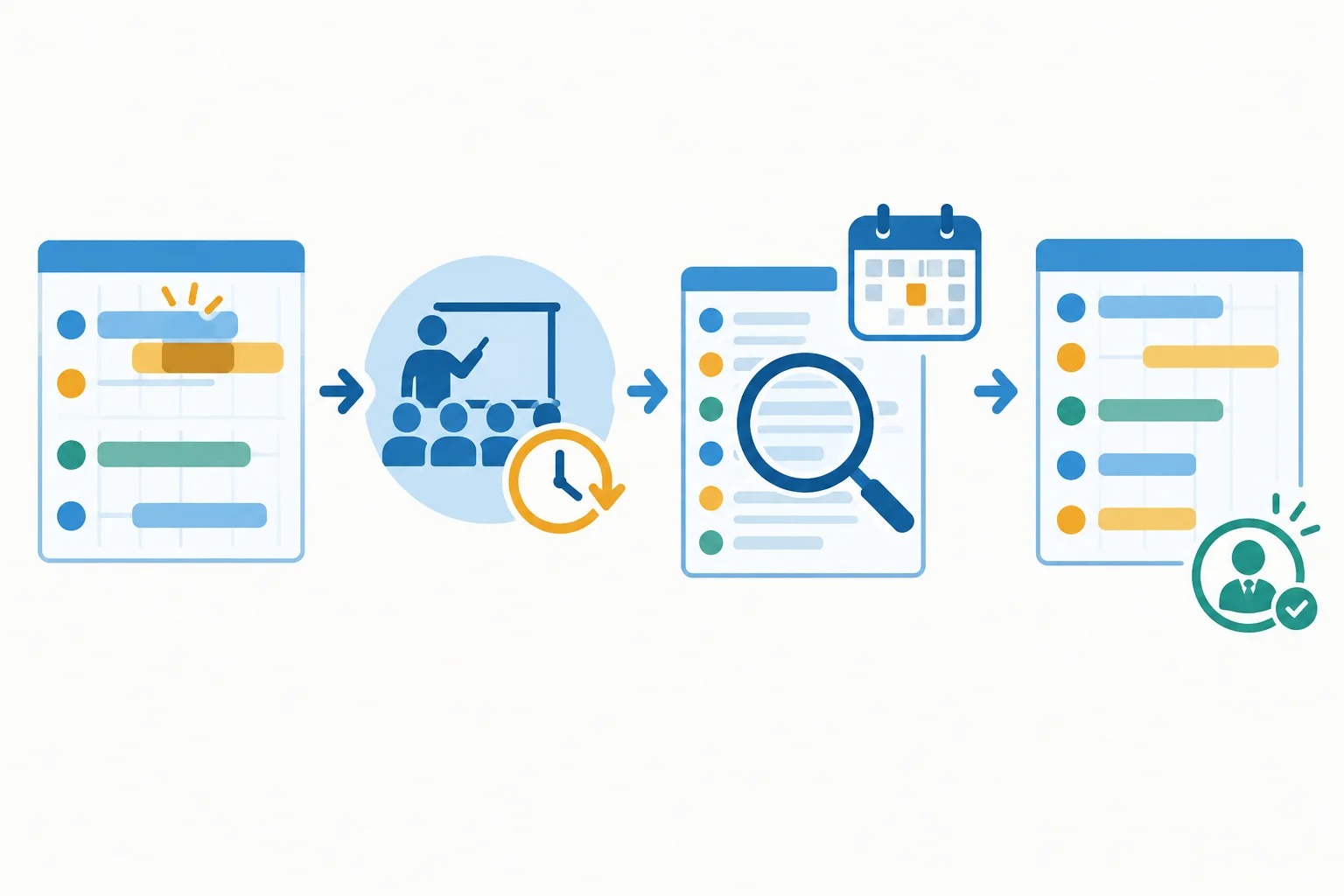
Keep this sequence accurate. Use emphasis only for the point your colleague needs corrected.
Listen to the colleague's assumption before drafting your reply.
So the workshop was delayed because the budget was too small, right?
So the workshop was delayed because the budget was too small, right?
Draft a reply to the colleague in 60–80 words. Correct the budget assumption with an it-cleft, include the event sequence, and state the immediate priority. Use no more than one additional marked structure if it genuinely helps the listener. Keep supporting details in ordinary sentence order.
Write your 60–80-word update.
A strong update does not need to make every sentence emphatic. This model uses one it-cleft for the correction; the other facts stay direct and concise. Different successful updates may use a different second marked structure when the listener needs it.
Example
It was the timing that caused the delay, not the budget. Two sessions overlapped, and the workshop was delayed as a result. We noticed the error only after checking the list on Tuesday. The underlying problem was the overlap between the two sessions. The main concern is the delay, and the immediate priority is a clearer schedule. Only the coordinator can approve the revised schedule.
Use this checklist to revise your own draft. Do not copy the model automatically: preserve the facts and choose the focus that answers the colleague's misunderstanding.
| Check | Question to ask |
|---|---|
| Facts | Did I include the overlap, Tuesday discovery, priority, and coordinator approval accurately? |
| Focus | Does my it-cleft clearly correct the budget assumption? |
| Form | Is each marked structure complete and grammatical? |
| Density | Do ordinary sentences carry the supporting details? |
| Register | Is the update concise and suitable for a colleague? |
| Delivery | Will I give the correction the strongest stress and group the message naturally? |
Revise your draft using the model and checklist. Then say the revised update aloud at a natural pace. Give the corrected contrast the strongest stress; do not make every sentence equally forceful.
In your response, write the final 60–80-word update. After it, add two short lines:
Key contrast: ...
Marked structure(s): ...
Enter your revised update, then identify the contrast and the structure or structures you chose. Read the update aloud before submitting.
Congratulations! You completed: Emphasize Key Points with Clefts and Inversion
Thousands of online courses in video, ebooks and audiobooks.
To test your knowledge during online courses
Generated directly from your cell phone's photo gallery and sent to your email

Download our app via QR Code or the links below:.



Carry knowledge in your pocket.
Download the Cursa app.
There are hundreds of free courses available, with a free certificate of completion that is saved in your mobile image gallery.
Download the app to access the Course Completion Certificate for Free.


+ 10 million
students

Free and Valid
Certificate

60 thousand free
exercises

4.8/5 rating in
app stores

Free courses in
video and ebooks