
Step 1 of 8
Connect Goals, Objectives, and KPIs
Distinguish a business goal, a marketing objective, a KPI, and a marketing activity.

Learning path · Level 1 · Tutorial 4
Turn a business goal into a measurable marketing objective, choose relevant KPIs, and calculate basic performance measures from small text-based examples.

 Connect Goals, Objectives, and KPIs
Distinguish a business goal, a marketing objective, a KPI, and a marketing activity. 2 min
 Write a Measurable Marketing Objective
3 min
 Choose KPIs That Match the Objective
Choose a primary KPI that directly measures a marketing objective, then use supporting measures for context rather than mistaking activity for results. 2 min
 Calculate Conversion Rate
3 min
 Calculate Customer Acquisition Cost
Calculate customer acquisition cost from a clearly stated acquisition-cost scope and a matching count of new customers. 3 min
 Calculate Return on Ad Spend
Calculate revenue-based return on ad spend (ROAS) and state the limit of what it can show. 3 min
 Check Whether the Data Support the KPI
2 min
 Apply the KPIs and Summarize the Result
Integrate Maple Stationery’s objective and KPI results into a concise, evidence-bounded assessment. 4 min
Step 1 of 8
Distinguish a business goal, a marketing objective, a KPI, and a marketing activity.
A business goal gives the broad commercial direction. An objective states the intended measurable marketing outcome. A key performance indicator (KPI) is the measure used to evaluate progress toward that objective.
A marketing activity is work the team performs—such as publishing an email or launching an ad. It may help, but completing the work does not itself prove that the outcome happened.

Think in a chain: business direction → measurable outcome → measure of progress.
Example
For Maple Stationery, the roles connect like this:
The activity can support the objective, but it is not evidence that new customers increased. The KPI supplies that evidence. In the next step, you will make the objective more specific with a target and time frame.
Tip
A useful quick check:
A KPI is not automatically useful just because it is easy to count. Its value comes from how well it evaluates the objective.
Match each statement to its role.
Tap an item and then its matching pair.

Step 2 of 8
A marketing objective turns a broad direction into a result you can check. For this case, a complete objective has four parts:
A target is a planning assumption for this case. It is not a forecast, a guarantee, or a universal standard.
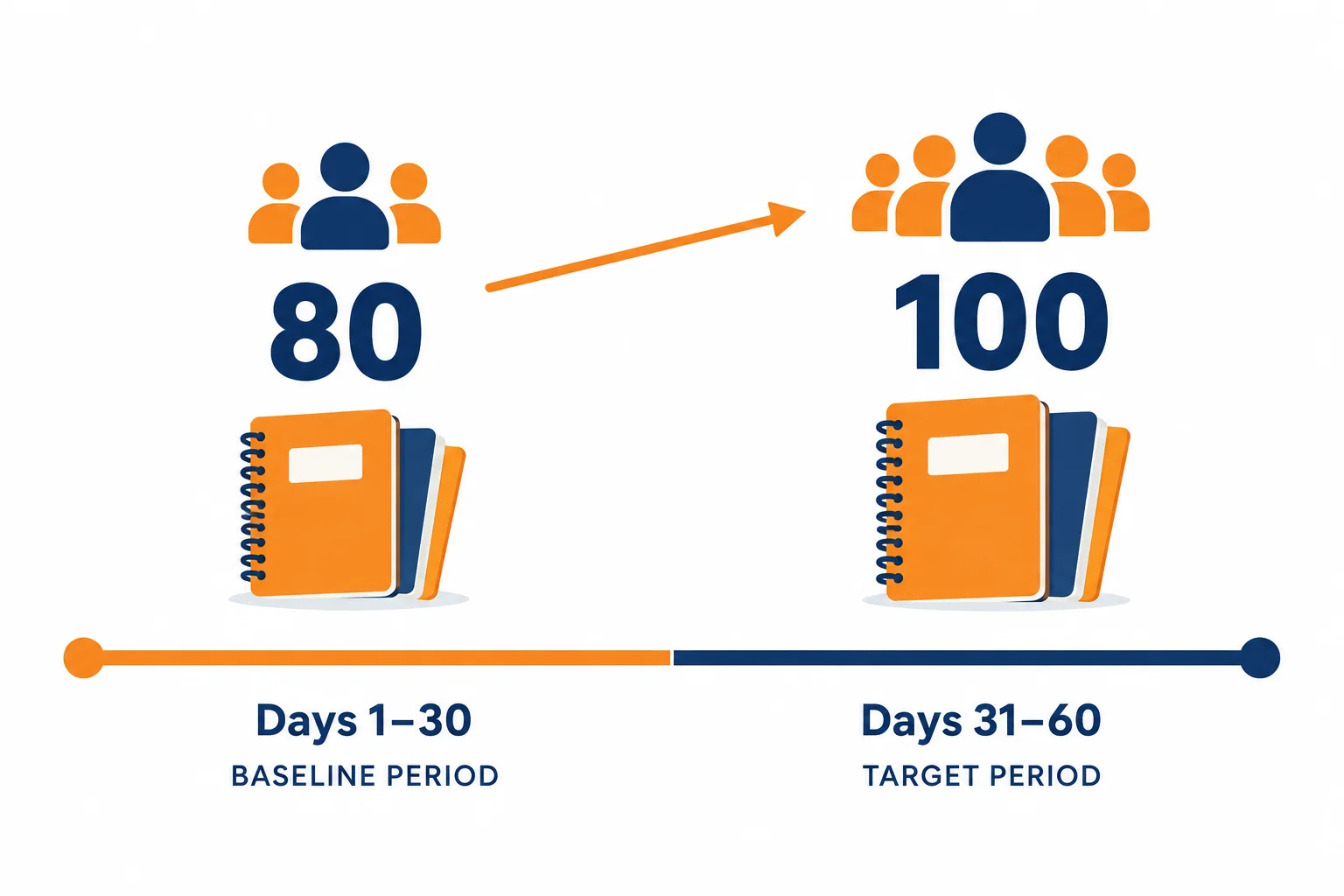
The baseline is the observed starting point; the target is the intended result for the next period.
Example
For Maple Stationery, the baseline period is the previous 30 complete days. It recorded 80 new customers. The target period is the next 30 days, with an illustrative target of 100 new customers.
A clear objective is:
“Increase new customers from 80 in the previous 30 complete days to 100 in the next 30 days.”
This names a distinct first-time buyer as the outcome. It does not claim that the target will certainly happen.
Sometimes the starting value is unavailable. Do not invent one or treat missing data as zero.
Instead, acknowledge the gap and say how it will be established. For example, state that the baseline new-customer count for the previous 30 complete days is not yet established and will be determined from the retailer’s customer records before the target period is evaluated.
The target can still be stated, but the missing baseline limits what can be compared until that record is available.
Tip
Use the same definition on both sides of an objective. Here, new customers means distinct first-time buyers—not website sessions or completed purchase sessions.
Which statement correctly describes Maple Stationery’s target of 100 new customers for the next 30 days?
Write two short sentences for Maple Stationery.
Write at least 180 characters (0/180).

Step 3 of 8
Choose a primary KPI that directly measures a marketing objective, then use supporting measures for context rather than mistaking activity for results.
A key performance indicator (KPI) is a measure used to evaluate progress. Start with the objective, then choose one primary KPI that directly records its intended outcome.
For Maple Stationery, the objective is to reach 100 new customers in the next 30 days. The primary KPI is therefore new customers. It answers the central question: “Did the intended outcome happen?”
Supporting measures add context. They can help explain progress, but they do not replace the primary KPI.

Choose the measure that directly records the outcome before adding measures that help interpret it.
Tip
Use the funnel stages you already know as context, not as a substitute for the objective. For a new-customer outcome, new customers is a conversion-stage outcome measure. website sessions and sessions with a completed purchase can help explain what happened before or during conversion.
By contrast, posts published records marketing work. It may be useful for managing a content routine, especially near awareness, but it cannot show by itself whether first-time buyers increased.
Supporting measures answer narrower diagnostic questions. They are useful when their definition, population, and period match the question being asked. The next steps will calculate these measures; for now, focus on the question each one answers.
Three supporting measures for Maple Stationery
| Measure | Question it answers | Role |
|---|---|---|
| website sessions | How many website visits occurred? | Traffic context |
| sessions with a completed purchase | How many visits included a completed purchase? | Purchase-behavior context |
| Conversion rate | What share of website sessions contained a completed purchase? | Conversion context |
| Customer acquisition cost (CAC) | What were the stated acquisition costs per new customer? | Cost context |
| Return on ad spend (ROAS) | How much ad-attributed revenue was reported per dollar of ad spend? | Advertising-revenue context |
Maple Stationery’s objective is to reach 100 new customers in the next 30 days. Which should be its primary KPI?
Maple Stationery wants the next 30 complete days to end with 100 distinct first-time buyers. Its team is also proud that it published 24 posts during the period.
Name the primary KPI you would use, then explain in one or two sentences why the post count is insufficient on its own.
Write at least 100 characters (0/100).

Step 4 of 8
A conversion is a desired action defined in advance. For Maple Stationery, the defined conversion is a website session containing a completed purchase.
In the baseline period (the previous 30 complete days), there were 4,000 website sessions across the whole site and 160 sessions with a completed purchase. The qualifying sessions are part of the full set of website sessions.
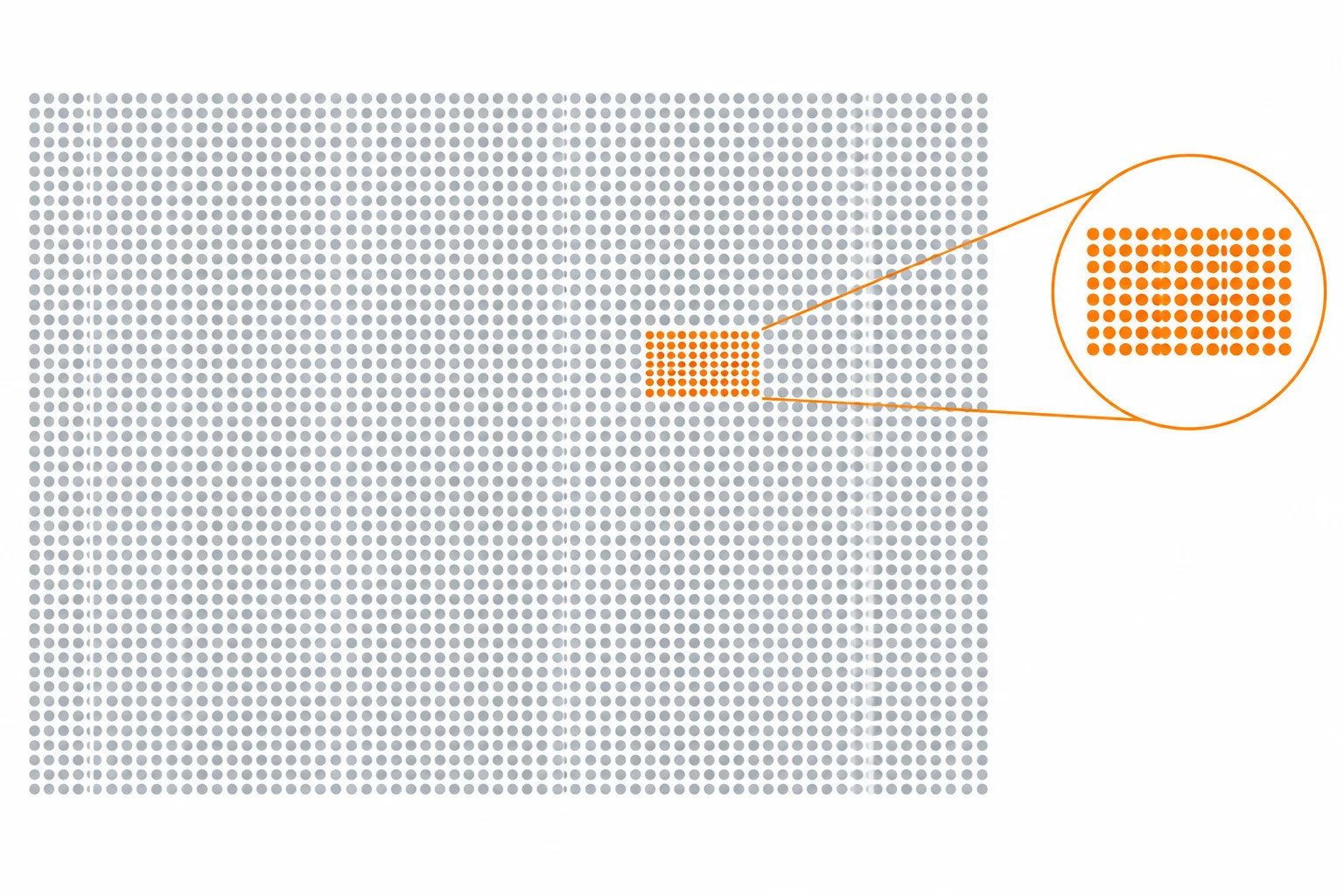
The numerator is the qualifying subset; the denominator is the full population of website sessions from the same period.
Use this case formula:
Conversion rate (%) = (sessions with a completed purchase / website sessions) × 100
This is the purchase-session conversion rate because the conversion is a completed purchase within a session. Both counts must cover the same population and reporting period. Do not pair all-site purchase sessions with traffic from only one channel.
Example
Baseline calculation:
(160 sessions with a completed purchase / 4,000 website sessions) × 100 = 4.0%
Read 4.0% as: 4.0 qualifying sessions per 100 website sessions. It is not the percentage of new customers.
Tip
Keep the labels separate. A purchase session is a qualifying website visit. An order is a transaction count. A new customer is a distinct first-time buyer. One category cannot silently replace another in this formula.
For example, Maple Stationery's 80 new customers are not the numerator for the purchase-session conversion rate.
Match each Maple Stationery count label to what it describes.
Tap an item and then its matching pair.
For the baseline period, Maple Stationery recorded 4,000 website sessions across all channels and 160 sessions with a completed purchase. Which statement is correct?

Step 5 of 8
Calculate customer acquisition cost from a clearly stated acquisition-cost scope and a matching count of new customers.
Customer acquisition cost (CAC) expresses the stated acquisition cost per new customer. It answers: “How much did the defined acquisition effort cost for each distinct first-time buyer?”
For this case:
CAC = acquisition costs / new customers
Use costs and new customers from the same reporting period and the same declared acquisition scope. Maple Stationery’s baseline period is the previous 30 complete days.

CAC combines the stated acquisition costs once, then divides that total by new customers from the matching period.
Maple Stationery’s stated baseline acquisition-cost scope includes advertising, acquisition-related labor, and acquisition-related software. Ad spend is already one component of the total—do not add it again after using the total.
Baseline-period acquisition costs for Maple Stationery
| Component | Amount | Treatment in CAC |
|---|---|---|
| Ad spend | $1,200 | Included once |
| Acquisition-related labor | $800 | Included once |
| Acquisition-related software | $400 | Included once |
| Total acquisition costs | $2,400 | Use as the numerator |
Example
Maple Stationery had 80 new customers in the same baseline period.
CAC = acquisition costs / new customers
CAC = $2,400 / 80
CAC = $30.00 per new customer
This means Maple spent $30.00 in its stated acquisition-cost scope for each new customer during the baseline period.
CAC is not automatically the same as ad spend per new customer: that narrower measure uses only advertising cost. It is also not cost per purchase: a purchase session and a distinct new customer are different counts.
A lower CAC means lower stated acquisition cost per new customer. By itself, it does not establish profitability.
Which calculation uses Maple Stationery’s stated baseline CAC scope correctly?
In Maple Stationery’s baseline period, acquisition costs were $1,200 ad spend, $800 acquisition-related labor, and $400 acquisition-related software. The period had 80 new customers and 160 sessions with a completed purchase.
Write the CAC calculation. Identify which costs and customer count you used, give the result in dollars per new customer, and state what the result means.
Write at least 80 characters (0/80).
Step 6 of 8
Calculate revenue-based return on ad spend (ROAS) and state the limit of what it can show.
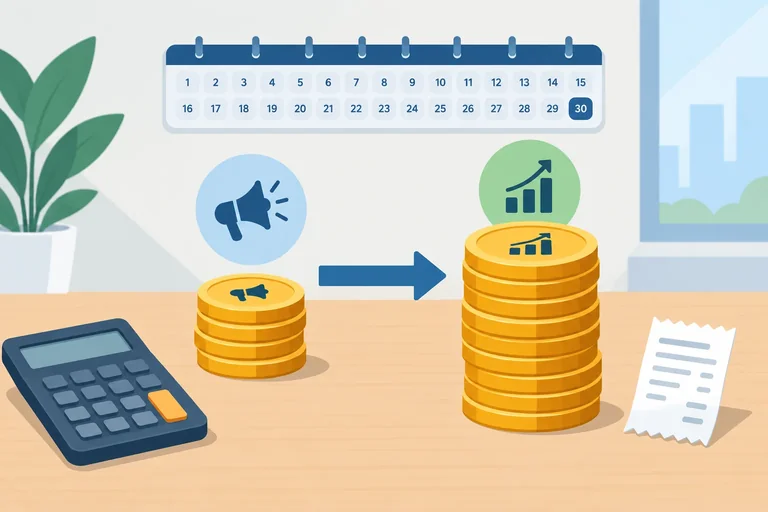
Return on ad spend (ROAS) compares revenue attributed to advertising with advertising spend for the same defined scope and reporting period.
Use the supplied ad-attributed revenue, not total store revenue. In this case, attribution is a supplied reporting assignment; it does not prove that advertising caused every purchase.
Formula:
ROAS = ad-attributed revenue / ad spend
Report ROAS as a revenue-to-ad-spend multiple, such as 4.0x—not as a percentage or as profit. For Maple Stationery’s baseline period (the previous 30 complete days), the supplied inputs are $4,800 ad-attributed revenue and $1,200 ad spend.
Do not divide by the full $2,400 acquisition-cost total. That total includes acquisition-related labor and software as well as ad spend; ROAS uses ad spend only.

ROAS compares ad-attributed revenue with ad spend from a matching scope and reporting period.
Which expression correctly sets up Maple Stationery’s baseline ROAS calculation?
A ROAS multiple describes reported ad-attributed revenue for each dollar of advertising spend. For example, a Separate example with a ROAS of 2.5x means the report assigns $2.50 in revenue to advertising for every $1 of ad spend in that defined scope and period.
The multiple is useful only with its definition. Match the revenue assignment, advertising-spend scope, and reporting period before comparing results.
Warning
ROAS is a revenue measure, not a profit measure. The formula does not deduct product costs, fulfillment, payment fees, acquisition-related labor, software, other marketing costs, or other business expenses.
A ROAS above 1.0x means reported ad-attributed revenue is greater than ad spend. It does not, by itself, establish profitability. No universal “good ROAS” threshold is provided: meaningful evaluation depends on costs and the defined reporting scope.
Write a concise baseline-period assessment for Maple Stationery. Use $4,800 ad-attributed revenue and $1,200 ad spend.
Write at least 180 characters (0/180).

Step 7 of 8
Before calculating or comparing a key performance indicator (KPI), perform a quick boundary check:
A formula can be correct while its result is unsupported because its inputs do not belong together.
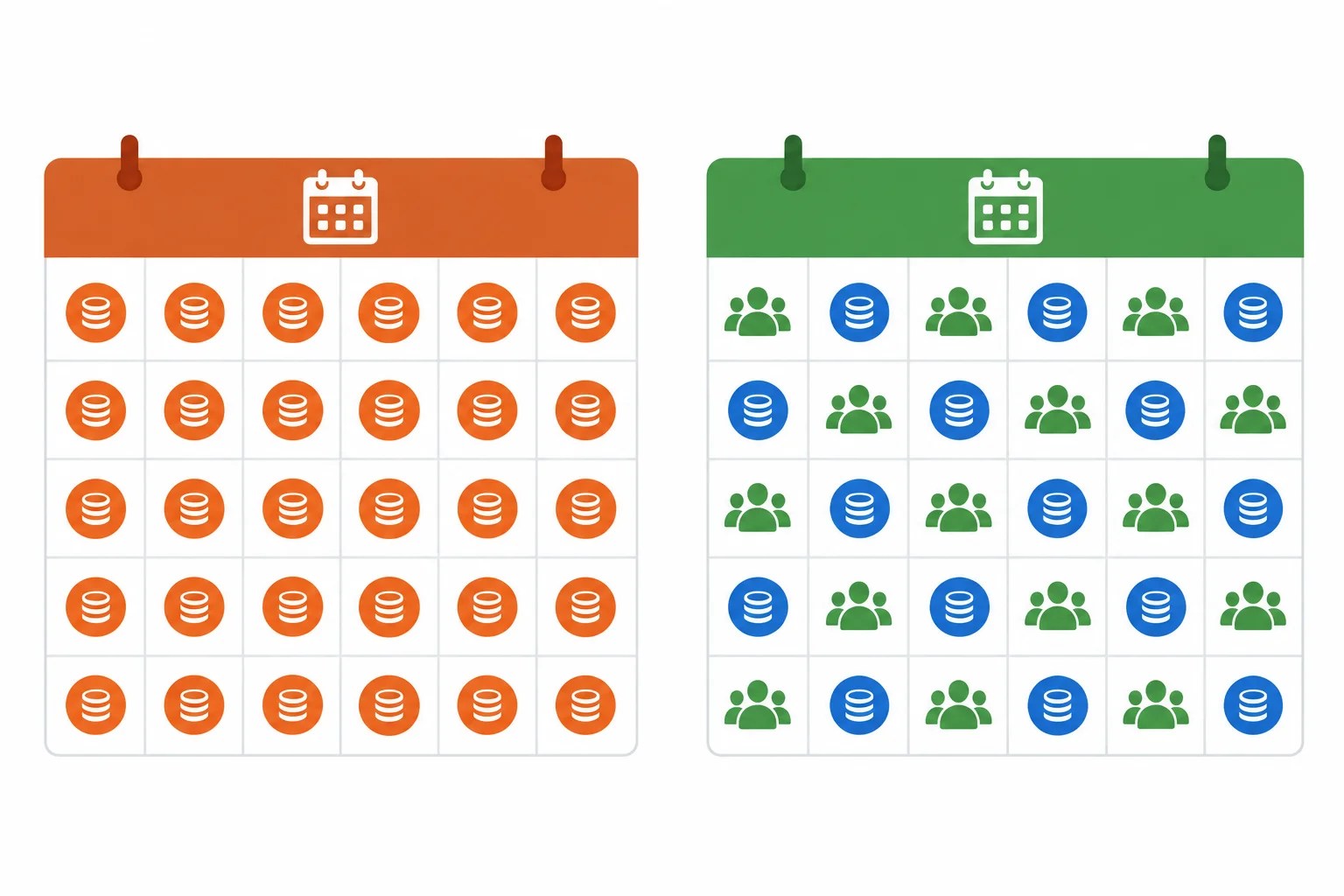
Costs, customers, and revenue must use compatible reporting windows. Do not pair costs from one 30-day period with customers or revenue from a different one.
A missing value is not a zero. If a required input is missing, the KPI cannot be supported. A zero denominator is also not a zero result: it makes a ratio undefined. In contrast, a genuine zero numerator can produce a valid zero result when the denominator is positive.
Every row is a Separate example, not Maple Stationery data.
| Situation | What it means | Responsible response |
|---|---|---|
| Separate example: Ad spend is supplied, but ad-attributed revenue is missing. | A required ROAS input is missing; it is not $0. | Do not calculate ROAS. Request ad-attributed revenue for the defined period and scope. |
| Separate example: Acquisition costs are $2,400 and new customers are 0. | CAC would divide by zero. | Report CAC as undefined for this period; do not report $0.00. |
| Separate example: 0 sessions with a completed purchase out of 4,000 website sessions. | The numerator is genuinely zero and the denominator is positive. | The purchase-session conversion rate is validly 0.0%. |
| Separate example: Whole-site purchase sessions are paired with email-only website sessions. | The numerator and denominator use different populations. | Do not calculate the rate until both measures use the same population. |
Warning
Do not “fix” a gap by substituting a nearby number. New customers are not automatically a substitute for sessions with a completed purchase, and total acquisition costs are not the denominator for ROAS.
Separate example: A retailer reports $1,100 ad spend for April. It also reports $4,200 ad-attributed revenue, but that revenue is explicitly for March. What is the most supported conclusion?
Review both cases below.
Case A — Maple Stationery purchase-session conversion rate
During the target period, the whole site recorded 5,000 website sessions and 200 sessions with a completed purchase.
Case B — Separate example: CAC
A retailer reports $3,000 in acquisition costs for April, using its declared acquisition-cost scope. It reports 75 new customers for March.
For each case, write calculable or unsupported. Then name the exact input or measurement boundary that supports the calculation or must be clarified. Focus on whether the data support the KPI, not on doing the arithmetic.
Write at least 100 characters (0/100).

Step 8 of 8
Integrate Maple Stationery’s objective and KPI results into a concise, evidence-bounded assessment.
Bring the measures into one decision view. Maple Stationery’s objective was: Increase new customers from 80 in the baseline period (the previous 30 complete days) to 100 in the target period (the next 30 days).
The primary key performance indicator (KPI) is new customers. The target-period result of 100 new customers meets the stated planning target. Supporting measures add context: purchase-session conversion rate describes qualifying website sessions, customer acquisition cost (CAC) describes the stated acquisition cost per new customer, and return on ad spend (ROAS) describes ad-attributed revenue relative to ad spend.
Compare the periods using explicit metric definitions and units.
| Metric | Baseline period | Target period | Comparison |
|---|---|---|---|
| new customers (primary KPI) | 80 | 100 | Target met; +20 new customers |
| purchase-session conversion rate | 4.0% | 4.0% | Unchanged |
| CAC (stated acquisition costs per new customer) | $30.00 per new customer | $27.00 per new customer | Lower by $3.00 per new customer |
| ROAS (ad-attributed revenue / ad spend) | 4.0x | 3.0x | Lower by 1.0x |
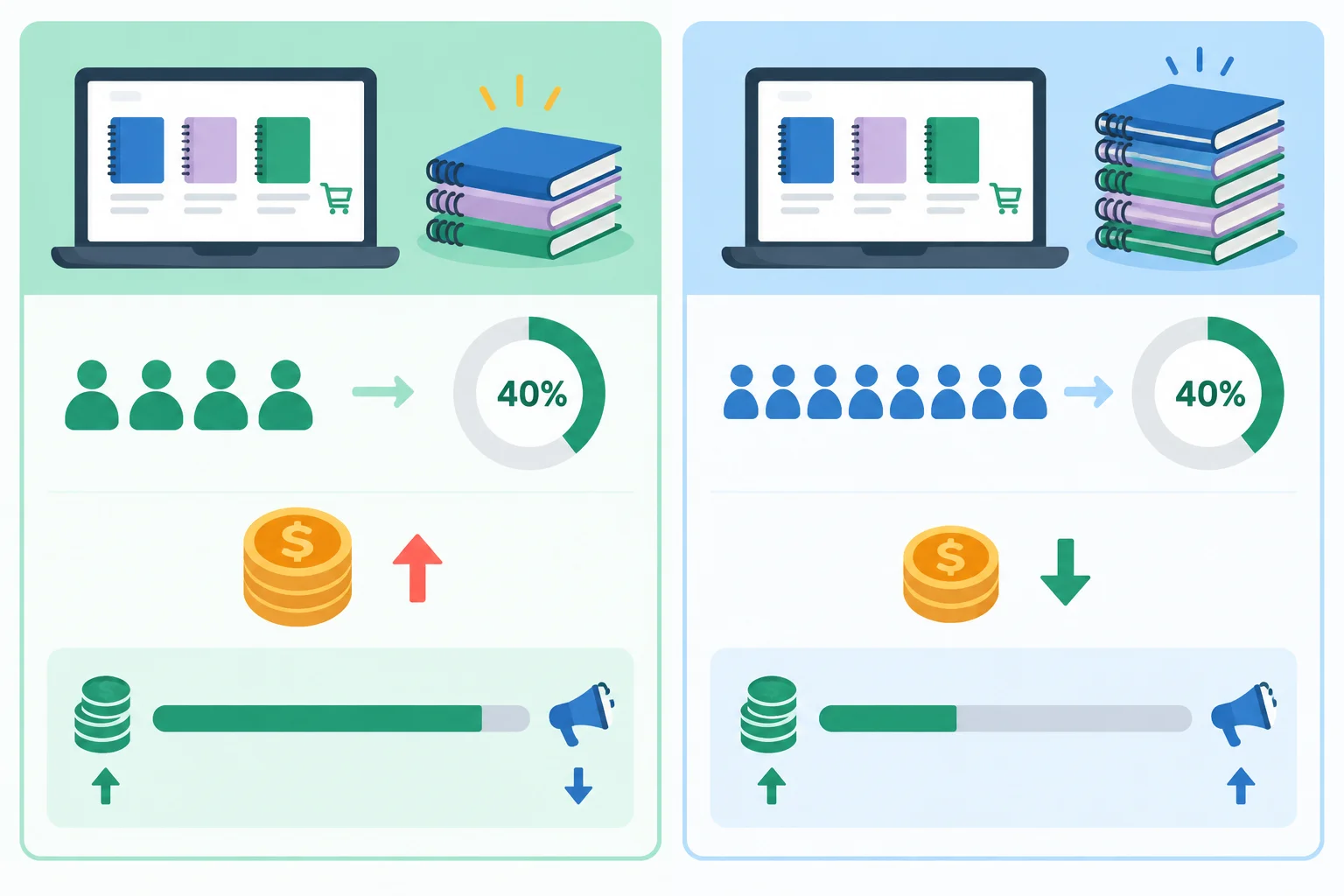
The objective can be met even when supporting measures do not all move in the same direction.
Target period: 200 sessions with a completed purchase came from 5,000 website sessions. The purchase-session conversion rate is __.
Target-period acquisition costs total $2,700, and Maple Stationery gained 100 new customers. CAC is __.
Target-period ad-attributed revenue is $4,500 and ad spend is $1,500. ROAS is __.
Write a concise evidence-bounded assessment using this data.
Baseline period: 4,000 website sessions; 160 sessions with a completed purchase; 80 new customers; $2,400 acquisition costs; $1,200 ad spend; $4,800 ad-attributed revenue.
Target period: 5,000 website sessions; 200 sessions with a completed purchase; 100 new customers; $2,700 acquisition costs; $1,500 ad spend; $4,500 ad-attributed revenue.
In 5–7 sentences: state the objective and primary KPI; calculate the three target-period KPIs with units; compare each with baseline; and conclude what the data establish. Include one limitation about profitability.
Write at least 350 characters (0/350).
Summary
Congratulations! You completed: Set Marketing Objectives and Calculate Core KPIs
Thousands of online courses in video, ebooks and audiobooks.
To test your knowledge during online courses
Generated directly from your cell phone's photo gallery and sent to your email

Download our app via QR Code or the links below:.



Carry knowledge in your pocket.
Download the Cursa app.
There are hundreds of free courses available, with a free certificate of completion that is saved in your mobile image gallery.
Download the app to access the Course Completion Certificate for Free.


+ 10 million
students

Free and Valid
Certificate

60 thousand free
exercises

4.8/5 rating in
app stores

Free courses in
video and ebooks