Step 1 of 7
Group Queries by the Answer Needed
Group the TrailSip query shortlist by the reader task and expected answer before assigning any queries to pages.

Learning path · Level 3 · Tutorial 2
Turn a keyword shortlist into a clear page map for a hypothetical site, assigning distinct page purposes and useful internal links without creating unnecessary competing pages.
 Group Queries by the Answer Needed
Group the TrailSip query shortlist by the reader task and expected answer before assigning any queries to pages. 2 min
 Define the Topic and Page Purpose
Turn a query group into a concise primary topic, supporting-query list, and reader-focused page purpose. 2 min
 Assign Groups to Pages
Create a provisional page map by matching TrailSip query groups to suitable Existing pages or a genuine Proposed content gap. 3 min
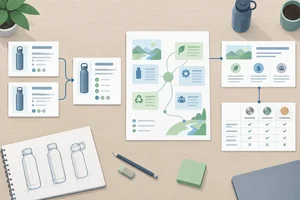 Resolve Unnecessary Page Overlap
Evaluate overlapping TrailSip page plans by comparing reader tasks, expected answers, and page scope. 2 min
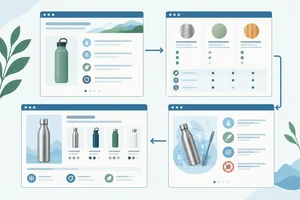 Plan Useful Paths Between Pages
Select directed internal links that connect related TrailSip pages and support a clear reader benefit. 2 min
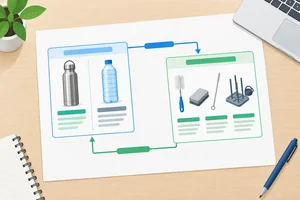 Write Descriptive Anchor Text
Write natural, descriptive anchor text and record it with a destination page and reader benefit. 2 min
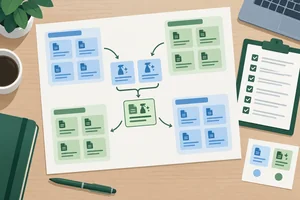 Complete and Check Your Page-and-Link Map
Finalize a coherent written page map and internal-link plan for TrailSip, then check coverage, page-purpose distinctions, overlap, and reader-focused link routes. 3 min
Step 1 of 7
Group the TrailSip query shortlist by the reader task and expected answer before assigning any queries to pages.
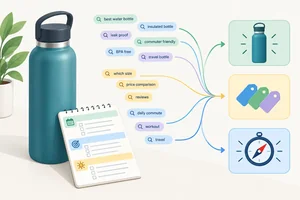
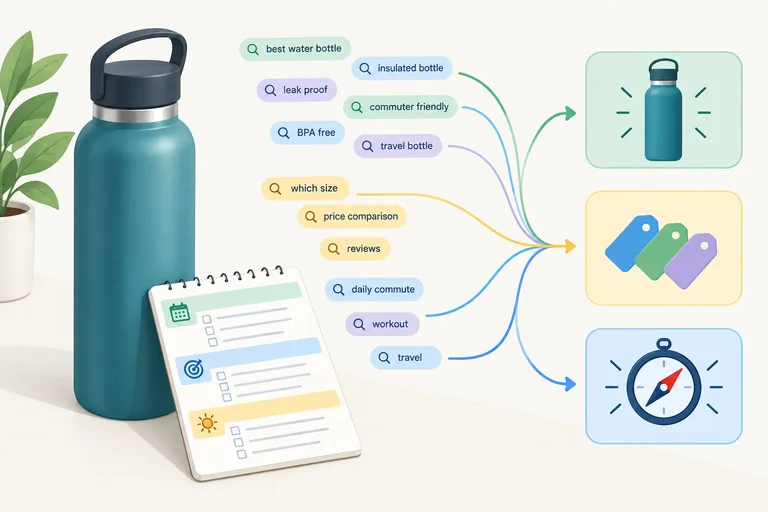
A query group brings together searches that could be satisfied by substantially the same answer and page experience. Group by the reader’s task—not by repeated words.
For TrailSip, how to choose a reusable water bottle and clean reusable water bottle both mention a reusable water bottle, but they require different answers: one helps a commuter decide; the other gives cleaning steps. Keep them separate.
Different wording can express one need. stainless steel vs plastic water bottles and steel or plastic reusable bottle both call for a comparison. Intent categories are a useful starting point, but they are not detailed enough by themselves to form groups: two informational searches can still need very different answers.
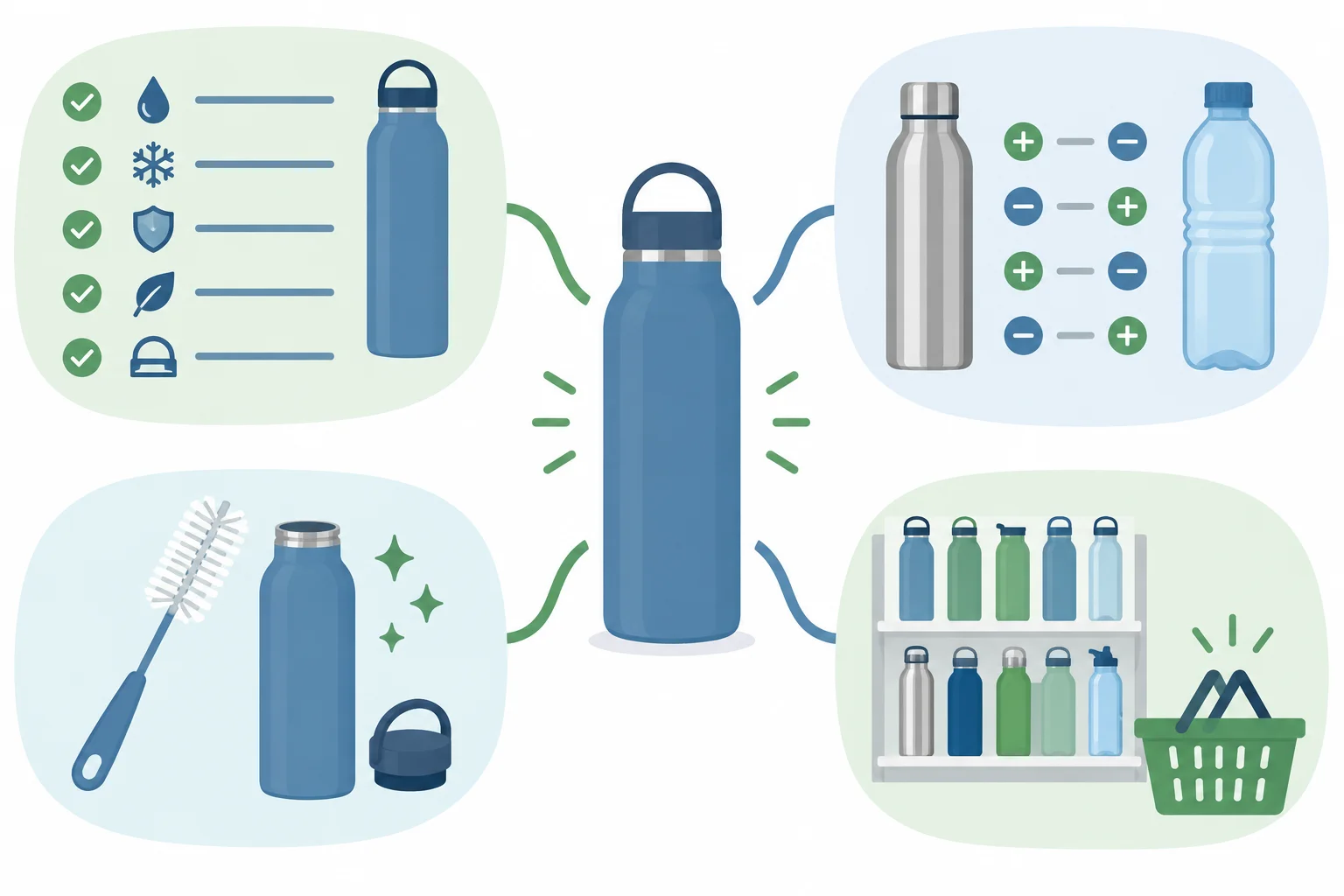
The same product can lead to distinct answer experiences. Use the reader’s next task to decide whether queries belong together.
Use the fixed TrailSip shortlist and the supplied fictional observations below. You do not need to repeat keyword research. Ask: “Could one useful answer satisfy both searches?”
Scenario evidence helps identify the expected answer format. It is evidence for a planning decision, not a promise about rankings or actual search results.
Each pair below can be handled by one substantially shared answer. The pairs should remain separate from one another because their reader tasks and expected experiences differ.
| Queries | Scenario evidence | Answer needed |
|---|---|---|
| how to choose a reusable water bottle; reusable water bottle guide | Scenario evidence: results emphasize capacity, lids, portability, and selection advice. | Choosing guidance |
| stainless steel vs plastic water bottles; steel or plastic reusable bottle | Scenario evidence: results emphasize material trade-offs and side-by-side comparisons. | Material comparison |
| how to clean a water bottle; clean reusable water bottle | Scenario evidence: results emphasize cleaning methods and care steps. | Cleaning instructions |
| buy stainless steel water bottles; stainless steel water bottles for sale | Scenario evidence: results emphasize retail listings, products, and shopping choices. | Products to buy |
Tip
Do not create a separate group for every wording variation. But do not combine searches merely because they share words such as “reusable,” “water,” or “bottle.” A shared answer and page experience—not vocabulary alone—is the test.
Match each TrailSip query pair to the shared answer it needs.
Tap an item and then its matching pair.
Step 2 of 7
Turn a query group into a concise primary topic, supporting-query list, and reader-focused page purpose.
A query group is your input. Turn it into a short planning record with three fields:
These fields describe useful content coverage. They are not instructions to repeat every query word-for-word.
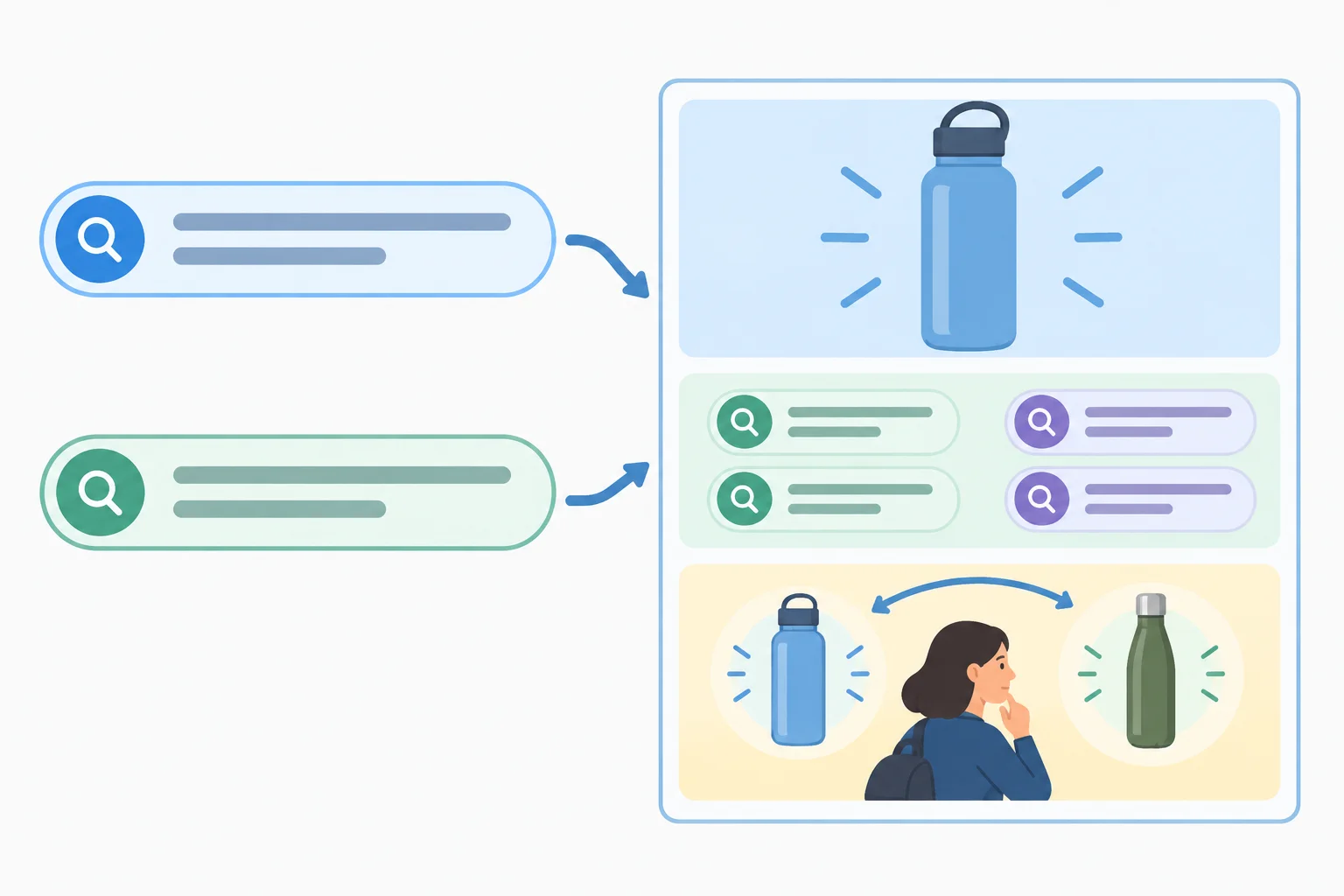
One query group becomes a focused planning record, rather than several separate pages for each wording variation.
Scenario evidence: TrailSip's shortlist includes two queries about comparing bottle materials. They can share one planning record because the reader needs substantially the same comparison answer.
This record keeps the central subject broad while preserving the actual search phrases as supporting queries.
| Field | Planning entry |
|---|---|
| Primary topic | reusable bottle materials |
| Supporting queries | stainless steel vs plastic water bottles; steel or plastic reusable bottle |
| Page purpose | Help commuters compare reusable bottle materials so they can choose a bottle that fits their needs. |
Example
The primary topic is not a list of every phrase. Likewise, the page purpose is not a ranking target. Its focus is the reader's task: comparing materials in order to make a choice. That focus helps define what belongs in the answer and what does not.
Complete the sentence: A page purpose explains the reader's __ and the outcome they want.
Create a three-line planning record for this TrailSip query group:
how to choose a reusable water bottlereusable water bottle guide
Write:
Keep the topic broad, preserve the queries as search phrases, and make the purpose specific to the reader task.
Write at least 120 characters (0/120).
Step 3 of 7
Create a provisional page map by matching TrailSip query groups to suitable Existing pages or a genuine Proposed content gap.
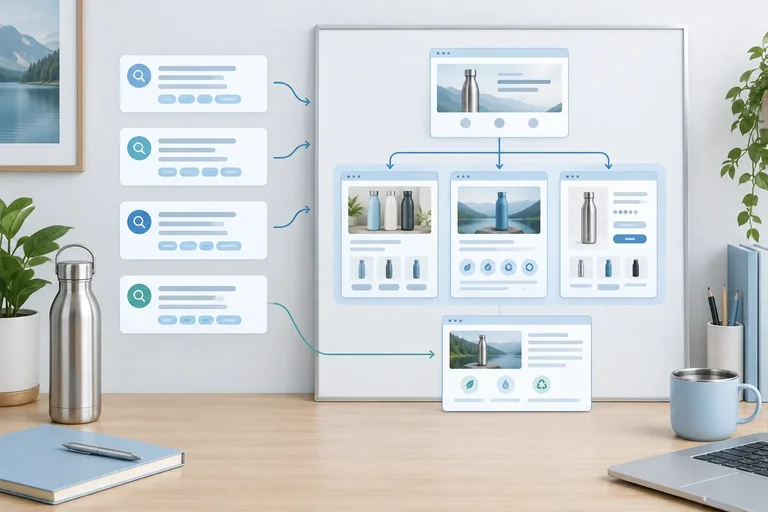
A keyword-to-page map gives each query group one planned destination page. Start with what the reader needs and the answer the page must provide—not with how often a word repeats.
First, check the existing page inventory. If an existing page’s current role and page purpose fit the query group, use it. Propose a page only when the inventory has no suitable destination.
One page can support several query variations. For example, a cleaning query group does not need a separate page for every way a reader asks about cleaning.
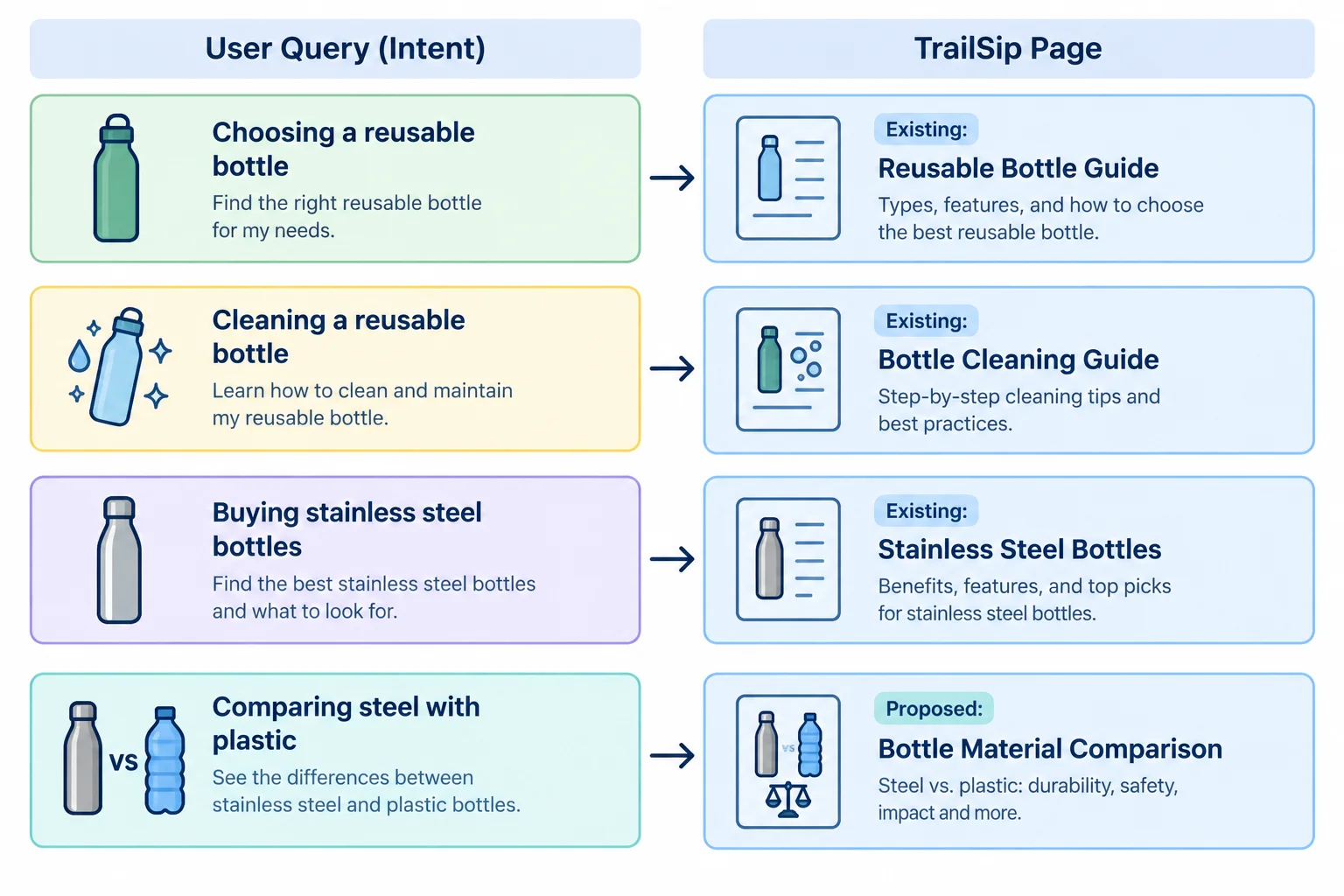
The comparison group needs a distinct comparison answer, while the other groups fit current page roles.
Scenario evidence: TrailSip’s current inventory describes what each page does today. Use these roles rather than guessing from a page label alone.
| Page | Current role |
|---|---|
| Reusable Bottle Guide | Broad selection guide |
| Bottle Cleaning Guide | Cleaning instructions |
| Stainless Steel Bottles | Product category |
The map below assigns every shortlist query to a clear destination. The cleaning group fits Bottle Cleaning Guide, so proposing Reusable Bottle Cleaning would be unnecessary. In contrast, the inventory has no page focused on comparing materials, so Bottle Material Comparison is a genuine content gap.
A provisional page map for TrailSip
| Page | Status | Page purpose | Primary topic | Supporting queries |
|---|---|---|---|---|
| Reusable Bottle Guide | Existing | Help commuters choose a reusable water bottle so they can select an option that fits their routine. | choosing reusable bottles | how to choose a reusable water bottle; reusable water bottle guide |
| Bottle Cleaning Guide | Existing | Help bottle owners clean a reusable water bottle so they can keep it ready for regular use. | cleaning reusable bottles | how to clean a water bottle; clean reusable water bottle |
| Stainless Steel Bottles | Existing | Help shoppers buy stainless steel water bottles so they can compare available bottle options and choose one to purchase. | stainless steel bottle shopping | buy stainless steel water bottles; stainless steel water bottles for sale |
| Bottle Material Comparison | Proposed | Help commuters compare steel and plastic reusable bottles so they can choose a suitable bottle material. | steel versus plastic bottle materials | stainless steel vs plastic water bottles; steel or plastic reusable bottle |
Match each TrailSip query group to its planned destination and status.
Tap an item and then its matching pair.
Step 4 of 7
Evaluate overlapping TrailSip page plans by comparing reader tasks, expected answers, and page scope.
Page overlap is not about repeated words alone. It occurs when two planned pages would help the same reader complete essentially the same task with substantially the same answer.
Ask two questions for each pair:
If one coherent page can answer both query groups well, combine the proposals in the plan. If the reader needs a different task, a deeper answer, or a different page experience, keep the pages separate.
At this stage, combining revises the content plan. It does not mean deleting a live page or prescribing redirects.
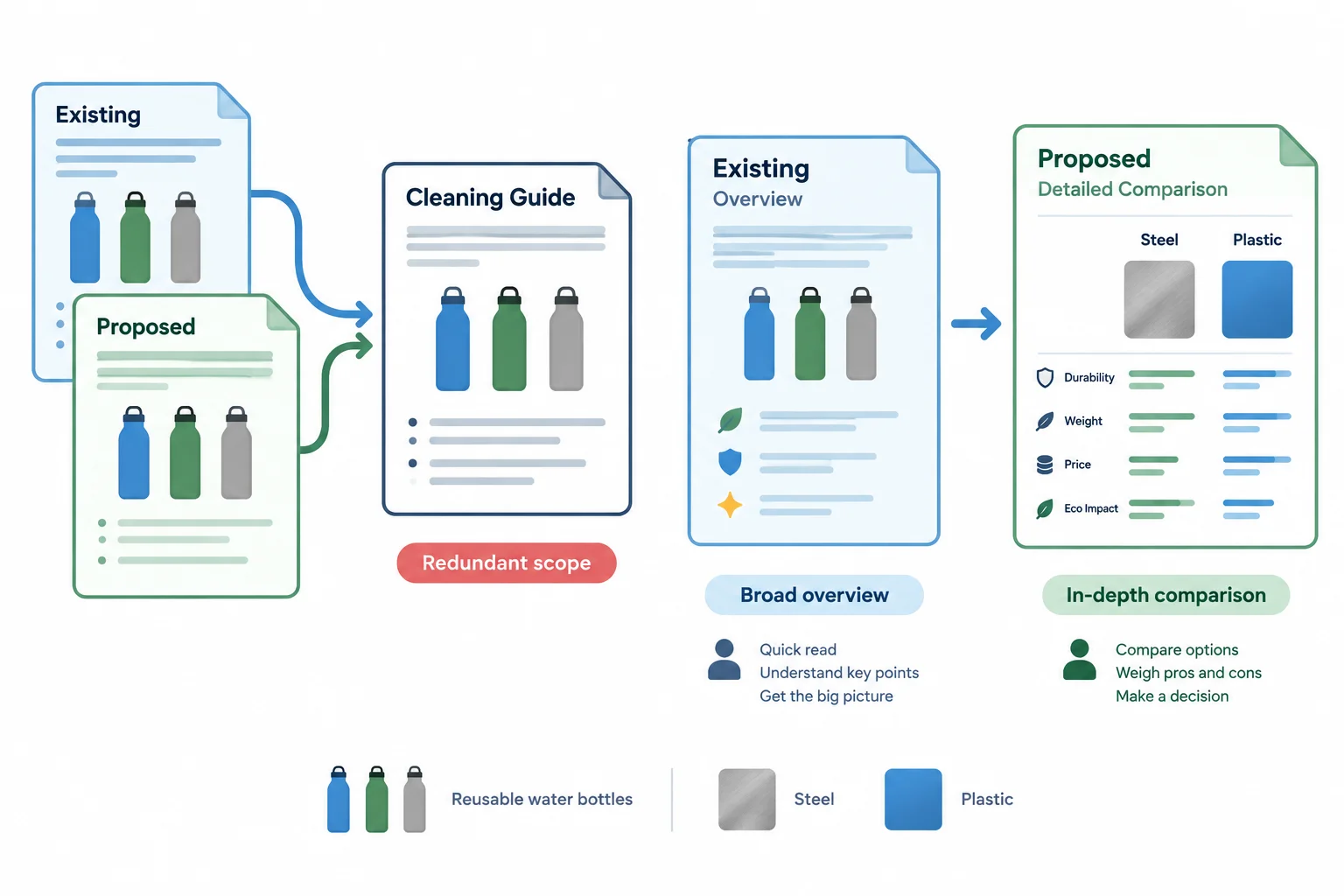
Overlap depends on the expected answer and page scope. A broad overview can coexist with a deeper supporting comparison.
Tip
Shared vocabulary is only a clue to investigate. It does not, by itself, prove harmful competition or a ranking problem.
Scenario evidence — TrailSip's provisional page map includes one intentional duplicate candidate. Compare the reader task and expected answer before deciding whether that candidate belongs in the final plan.
A proposed page may repeat supporting queries temporarily while you test its scope. That is a planning signal to evaluate, not a reason to create another page automatically.
| Page | Status | Page purpose | Primary topic | Supporting queries |
|---|---|---|---|---|
| Reusable Bottle Guide | Existing | Help commuters choose a reusable water bottle so they can select one for everyday travel. | choosing a reusable water bottle | how to choose a reusable water bottle; reusable water bottle guide |
| Bottle Cleaning Guide | Existing | Help bottle owners clean a reusable water bottle so they can keep it ready for regular use. | cleaning a reusable water bottle | how to clean a water bottle; clean reusable water bottle |
| Stainless Steel Bottles | Existing | Help shoppers browse stainless steel reusable bottles so they can choose a product to buy. | buying stainless steel reusable bottles | buy stainless steel water bottles; stainless steel water bottles for sale |
| Bottle Material Comparison | Proposed | Help commuters compare steel and plastic reusable bottles so they can choose a material for daily use. | steel versus plastic reusable bottles | stainless steel vs plastic water bottles; steel or plastic reusable bottle |
| Reusable Bottle Cleaning | Proposed | Help bottle owners clean a reusable water bottle so they can keep it ready for regular use. | cleaning a reusable water bottle | how to clean a water bottle; clean reusable water bottle |
What is the strongest reason to keep a broad reusable-bottle guide and a detailed steel-versus-plastic comparison as separate planned pages?
Scenario evidence: Bottle Cleaning Guide is Existing and helps bottle owners clean a reusable water bottle for regular use. Reusable Bottle Cleaning is Proposed and would provide the same cleaning task and answer the same two cleaning queries.
Reusable Bottle Guide is Existing and provides a broad bottle-selection overview. Bottle Material Comparison is Proposed and would provide a detailed steel-versus-plastic comparison.
In 3–5 sentences, decide what to do with the two cleaning-page plans and whether to keep the overview and comparison as separate pages. Justify both decisions through the expected answer and page scope—not shared keywords alone.
Write at least 180 characters (0/180).
Step 5 of 7
Select directed internal links that connect related TrailSip pages and support a clear reader benefit.
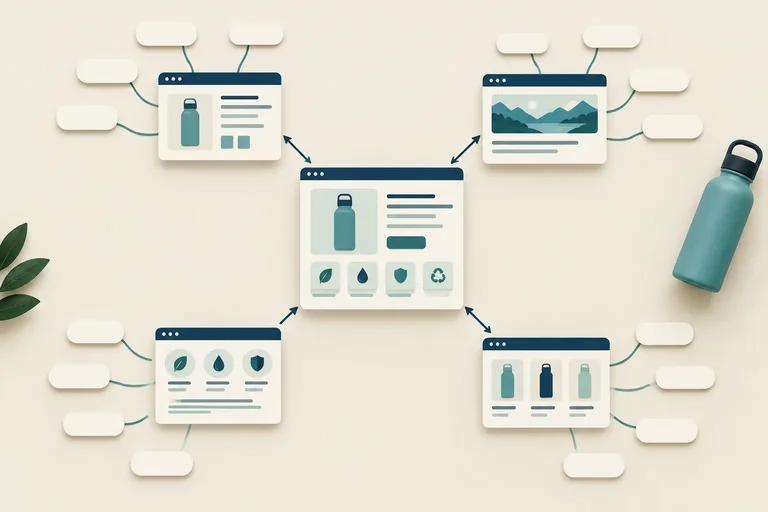
An internal link connects one page to another page on the same site. Plan it as a directed route: Source page → Destination page.
A useful route answers a likely next question or enables a next action. It helps readers navigate; it can also help search engines discover pages and understand how pages relate. It does not guarantee rankings.
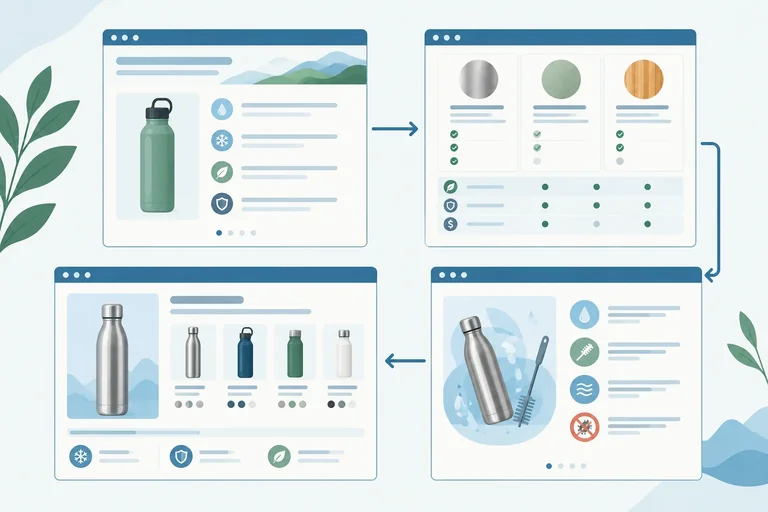
Scenario evidence: TrailSip’s page map includes three Existing pages—Reusable Bottle Guide, Stainless Steel Bottles, and Bottle Cleaning Guide—and one Proposed supporting page, Bottle Material Comparison.
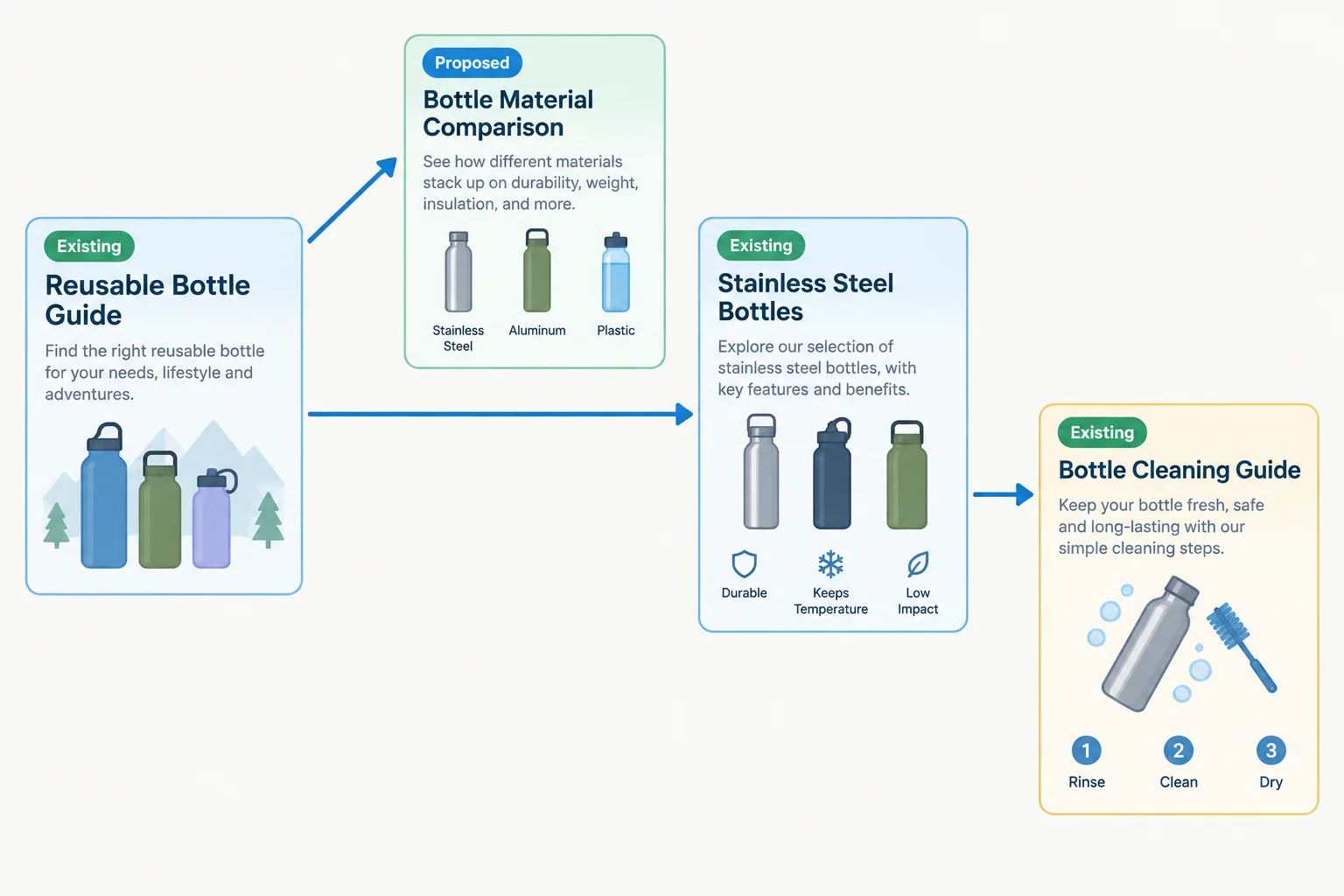
Arrows show a reader’s possible path from an overview to a more specific answer or action.
Example
Start with the reader on the source page: after getting this answer, what would they reasonably need next?
A reverse route needs its own reader benefit. For example, do not add Bottle Cleaning Guide → Stainless Steel Bottles merely because the first route exists. Add it only when the cleaning-page reader has a genuine reason to browse that category.
Tip
A diagram is a relevance check, not a link quota. Look for a likely reader need that has no helpful route. Not every page should link to every other page.
Match each source page to the most useful destination and reader benefit.
Tap an item and then its matching pair.
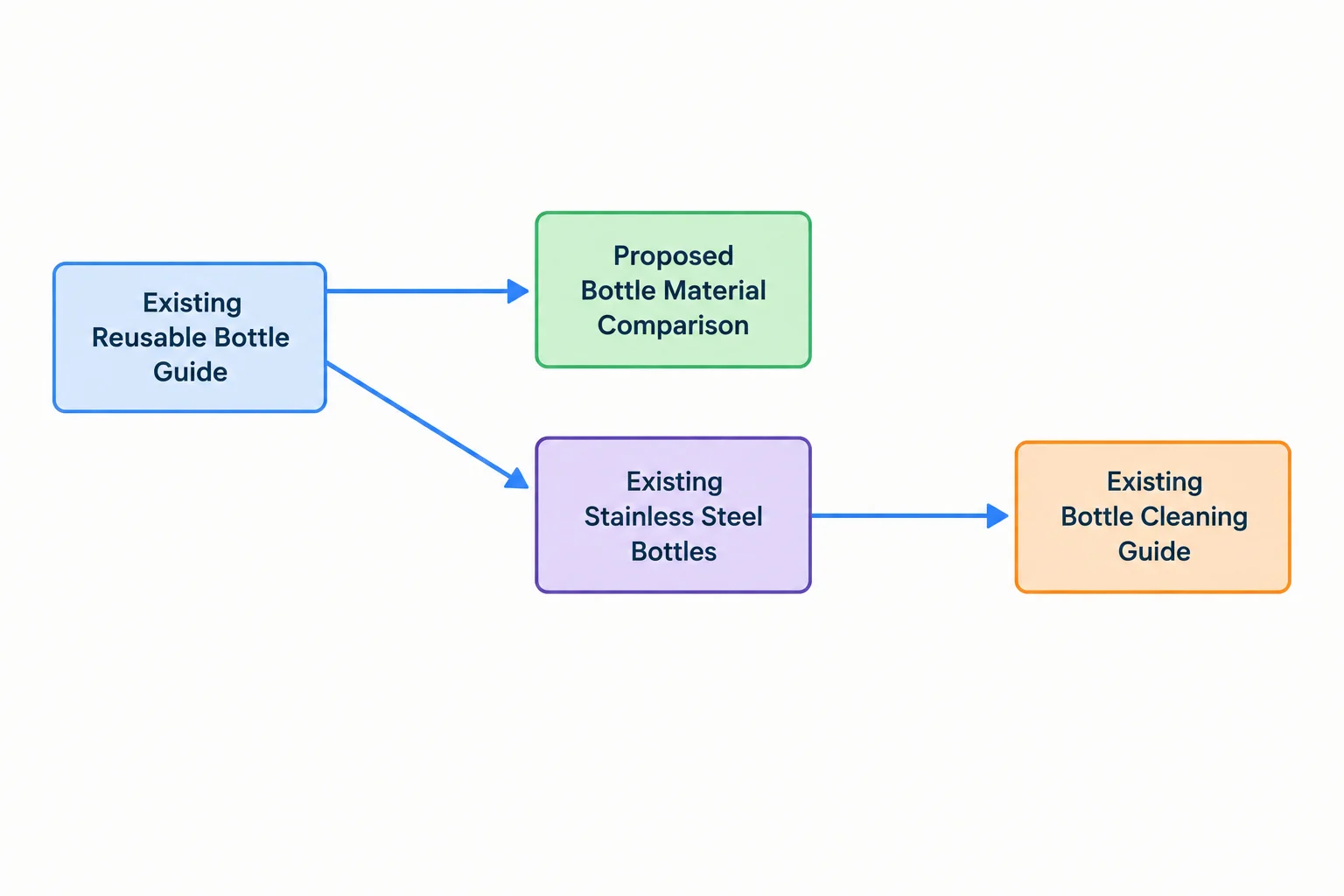
This diagram shows only the routes currently planned.
A reader on Bottle Material Comparison has concluded that steel fits their needs. Which missing route should be added to support the clearest next action?
Step 6 of 7
Write natural, descriptive anchor text and record it with a destination page and reader benefit.
An internal link has visible, clickable wording called anchor text. It should tell readers what they will find after selecting it.
Write the anchor for the destination and the sentence around it—not as a repeated target query. For example, a guide sentence can naturally link readers to a material comparison with wording that describes the comparison.
“Click here” gives almost no destination information. A phrase that promises shopping when the destination is a guide is also misleading.
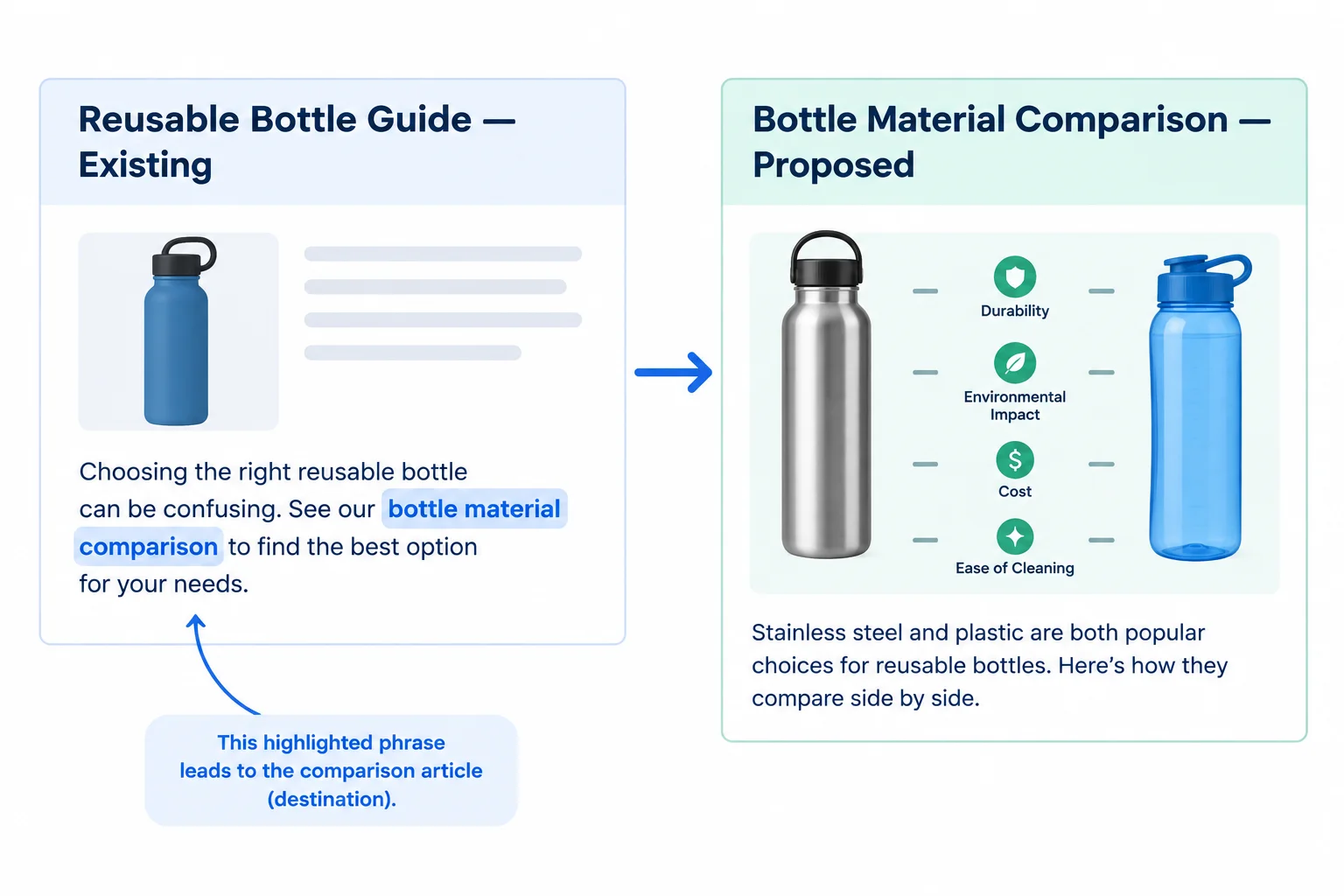
A useful anchor text prepares the reader for the destination: Reusable Bottle Guide → Bottle Material Comparison.
A written link plan keeps the route and its reader value together. Read each row from the Source page to the Destination page. The anchor text is lowercase because it appears naturally in the source-page sentence.
Each anchor is descriptive without copying a target query word for word.
| Source page | Destination page | Anchor text | Reader benefit |
|---|---|---|---|
| Reusable Bottle Guide | Bottle Material Comparison | compare steel and plastic bottles | Helps a reader evaluate material differences before choosing a bottle. |
| Bottle Material Comparison | Bottle Cleaning Guide | how to clean a reusable bottle | Helps a reader move from a material decision to practical care instructions. |
Example
Target query: stainless steel vs plastic water bottles
Natural source-page sentence: “Before deciding, readers can compare steel and plastic bottles.”
The anchor describes the destination without forcing the full query into the sentence. Choose links because they answer a likely next question—not to reach a fixed link count or to repeat exact-match wording.
Complete two link-plan records in your document or spreadsheet. For each context, replace the bracketed anchor with natural lowercase anchor text, then provide the Destination page and Reader benefit.
Context: “Material can affect a bottle’s weight, durability, and everyday care. [learn more] before making your choice.”
Context: “Whatever material you choose, regular care helps keep a reusable bottle ready to use. [buy stainless steel bottles] for the next step.”
Use this format:
Write at least 120 characters (0/120).
Step 7 of 7
Finalize a coherent written page map and internal-link plan for TrailSip, then check coverage, page-purpose distinctions, overlap, and reader-focused link routes.
You have completed the mapping workflow. Now audit the plan as a reader pathway, not as a list of repeated words.
Check five things:
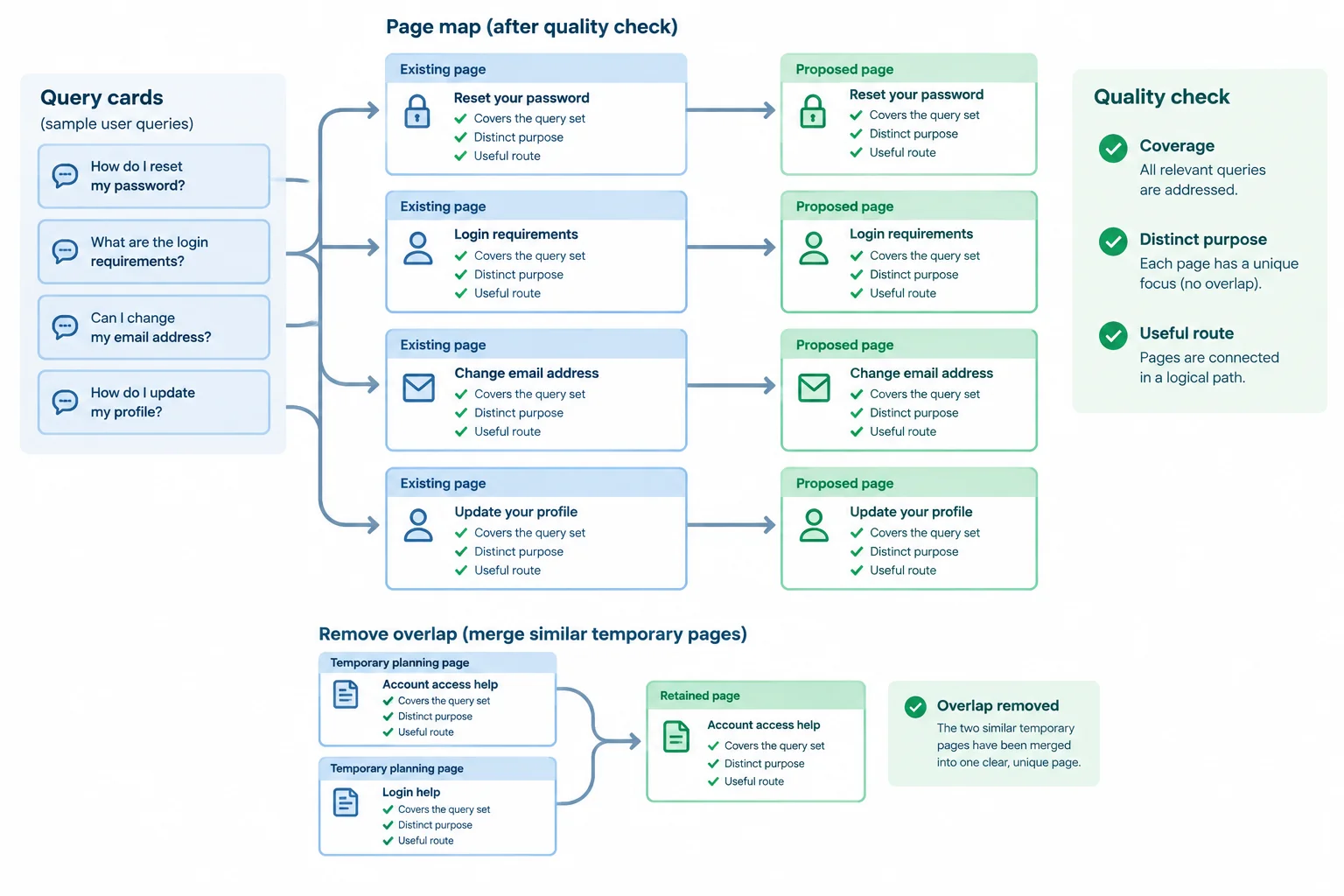
A finished map checks coverage, distinct page purposes, and useful directed routes.
Tip
This map is a planning handoff for later page-element drafting. It is not a published website, a technical implementation plan, or a promise of search rankings.
Scenario evidence: TrailSip is a fictional retailer of reusable water bottles for everyday commuters. Its candidate-page inventory is shown below. The roles describe what each page currently does or is intended to do; page labels are planning labels, not search titles or URLs.
Use this fixed query shortlist exactly as written: how to choose a reusable water bottle; reusable water bottle guide; stainless steel vs plastic water bottles; steel or plastic reusable bottle; how to clean a water bottle; clean reusable water bottle; buy stainless steel water bottles; stainless steel water bottles for sale.
Tip
There are five candidate pages but only four retained page records to produce. Review the two cleaning candidates through their page purposes. In your final map, every query must appear once, each retained purpose must use the required Help...so they can... pattern, and the link plan must contain exactly four links. Four is an exercise constraint, not an SEO rule.
| Candidate page | Status | Current or intended role |
|---|---|---|
| Reusable Bottle Guide | Existing | Broad selection guide |
| Bottle Cleaning Guide | Existing | Cleaning instructions |
| Stainless Steel Bottles | Existing | Product category |
| Bottle Material Comparison | Proposed | Compare steel and plastic bottles |
| Reusable Bottle Cleaning | Proposed | Cleaning instructions |
Create the compact page map in your document or spreadsheet. Use exactly these headers: Page | Status | Page purpose | Primary topic | Supporting queries.
Produce four retained records. Assign all eight supplied queries exactly once under Supporting queries. Use only Existing or Proposed for Status. Write each Page purpose as: Help [reader] [complete a task] so they can [reach an outcome].
Use the Scenario evidence on the previous screen to decide which candidate pages remain in the map.
Write at least 450 characters (0/450).
In your document or spreadsheet, write a four-row link plan using exactly these headers: Source page | Destination page | Anchor text | Reader benefit.
Use only retained pages. Read each route as Source page → Destination page. Make every anchor text lowercase, descriptive of its destination, and natural in the source-page context. State the reader benefit for each route.
Write at least 350 characters (0/350).
In one or two sentences, explain whether the extra cleaning-page proposal should be combined with another page or kept separate. Justify your decision by comparing the reader task and expected answer, not by counting repeated words.
Write at least 80 characters (0/80).
Compare your work with this coherent reference. Your wording may differ, but it should preserve the same query coverage, distinct tasks, appropriate statuses, and reader outcomes.
| Page | Status | Page purpose | Primary topic | Supporting queries |
|---|---|---|---|---|
| Reusable Bottle Guide | Existing | Help commuters choose a reusable water bottle so they can select one that fits their routine. | Choosing a reusable water bottle | how to choose a reusable water bottle; reusable water bottle guide |
| Bottle Material Comparison | Proposed | Help commuters compare stainless steel and plastic reusable bottles so they can choose a material that fits their needs. | Comparing reusable bottle materials | stainless steel vs plastic water bottles; steel or plastic reusable bottle |
| Bottle Cleaning Guide | Existing | Help commuters clean a reusable water bottle so they can keep it ready for regular use. | Cleaning a reusable water bottle | how to clean a water bottle; clean reusable water bottle |
| Stainless Steel Bottles | Existing | Help commuters browse stainless steel reusable water bottles so they can choose a bottle to buy. | Shopping for stainless steel reusable bottles | buy stainless steel water bottles; stainless steel water bottles for sale |
| Source page | Destination page | Anchor text | Reader benefit |
|---|---|---|---|
| Reusable Bottle Guide | Bottle Material Comparison | compare stainless steel and plastic bottles | Helps a reader who needs material-specific guidance before choosing. |
| Reusable Bottle Guide | Bottle Cleaning Guide | learn how to clean a reusable water bottle | Helps a reader consider ongoing care after choosing a bottle. |
| Bottle Material Comparison | Stainless Steel Bottles | browse stainless steel bottles | Helps a reader move from a material decision to relevant products. |
| Stainless Steel Bottles | Bottle Cleaning Guide | care for your reusable bottle | Helps a prospective or new owner find practical cleaning instructions. |
| Check | Result |
|---|---|
| Query coverage | All eight queries appear once. |
| Purpose distinction | Choosing, comparing, cleaning, and shopping are separate reader tasks. |
| Overlap decision | Reusable Bottle Cleaning combines into Bottle Cleaning Guide because both answer the same cleaning task. |
| Link relevance | Each route supports a likely next need with descriptive anchor text. |
| Handoff scope | The map guides later drafting; it does not publish pages or guarantee rankings. |
| Principle | Apply it by |
|---|---|
| One clear destination | Assign related wording to the page that provides the expected answer. |
| Distinct page purpose | Separate pages only when their reader tasks or experiences differ meaningfully. |
| Useful internal link | Connect a source page to a destination that helps with the reader's next likely need. |
| Accurate anchor text | Describe the destination naturally instead of forcing a target query. |
Congratulations! You completed: Map Keywords to Pages and Internal Links
Thousands of online courses in video, ebooks and audiobooks.
To test your knowledge during online courses
Generated directly from your cell phone's photo gallery and sent to your email

Download our app via QR Code or the links below:.


Carry knowledge in your pocket.
Download the Cursa app.
There are hundreds of free courses available, with a free certificate of completion that is saved in your mobile image gallery.
Download the app to access the Course Completion Certificate for Free.

+ 10 million
students

Free and Valid
Certificate

60 thousand free
exercises

4.8/5 rating in
app stores

Free courses in
video and ebooks