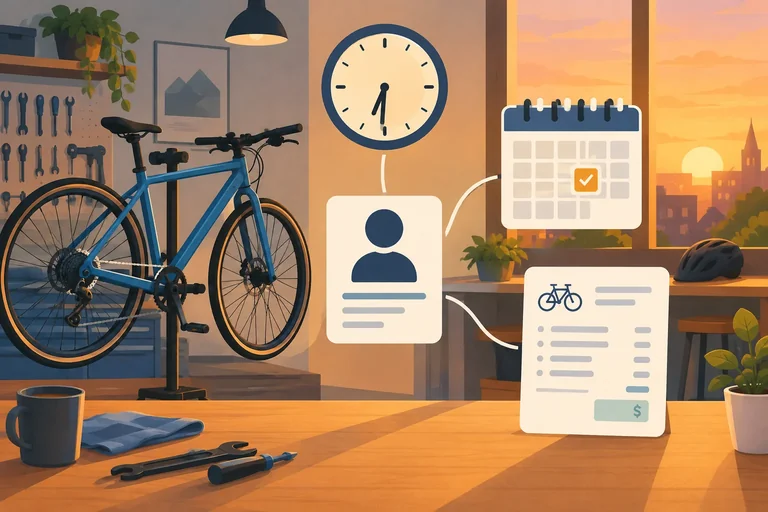
Step 1 of 8
Understand what a useful persona does
Learn how a persona keeps customer understanding useful, focused, and grounded in a practical situation.

Learning path · Level 1 · Tutorial 2
Develop a focused customer persona and a matching value proposition from a short business case or accessible audience evidence, making uncertainty explicit.
 Understand what a useful persona does
Learn how a persona keeps customer understanding useful, focused, and grounded in a practical situation. 1 min
 Extract useful audience evidence
Identify goals, needs, buying context, and barriers in supplied audience material while keeping business capabilities separate from customer evidence. 3 min
 Separate evidence from inference
Learn to distinguish what the Fictional case evidence reports from reasonable interpretations and unsupported assumptions. 2 min
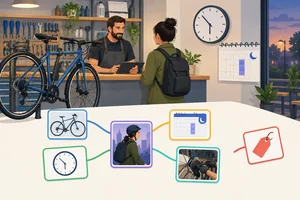 Choose a focused customer pattern
Select a provisional audience focus and priority need while preserving conflicting evidence. 2 min
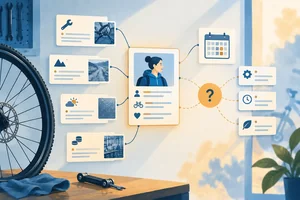 Build the evidence-informed persona
Create a concise, traceable working persona from the LoopFix Fictional case evidence while making uncertainty visible. 3 min
 Connect the persona to a value proposition
Connect the working persona’s priority need to confirmed LoopFix capabilities in a specific, supportable value proposition. 3 min
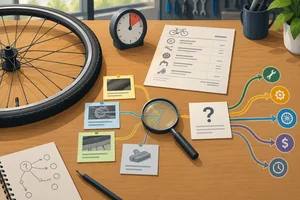 Choose the next question to investigate
Identify a consequential uncertainty, ask about it without leading the respondent, and define evidence that could revise the current working model. 2 min
 Finish and check your working brief
Complete a concise, traceable working brief for LoopFix using the supplied fictional case evidence. 3 min
Step 1 of 8
Learn how a persona keeps customer understanding useful, focused, and grounded in a practical situation.
A persona is a concise, evidence-informed decision aid. It describes a group through a shared need and buying context—the situation that affects a choice.
It is not a portrait of every possible customer. Its job is practical: help a marketer decide what problem to address, what information to provide, or which service option may matter.
A useful persona asks: What is this group trying to do, and what makes that decision harder?

Details that explain a service decision are more useful than details that merely describe a person.
Useful details help explain a decision. For a repair service, a scheduling constraint, a desired outcome, or a concern about repair costs may help a marketer decide what information or service option to emphasize.
Decorative details do not do that on their own. A name, age, favorite color, or social-media habit may make a profile feel vivid, but it is not useful unless it helps explain a relevant choice—and it should not be invented without support.
In this tutorial, you will use Fictional case evidence: fully supplied practice material, not research findings about real customers. You will create a short persona, a matching value proposition, and an explicit research gap.
Example
A persona is deliberately focused. It represents a group with a relevant shared situation; it does not try to describe every bicycle rider or average together people with different priorities.
Later, you will examine what the supplied case actually reports and keep uncertainty visible. For now, use this test: Could this detail help explain a practical service choice? If not, it probably does not belong in the persona.
A bicycle repair service is deciding whether appointment availability should be emphasized. Which profile would best help explain that service decision?

Step 2 of 8
Identify goals, needs, buying context, and barriers in supplied audience material while keeping business capabilities separate from customer evidence.
This activity uses Fictional case evidence: simulated practice material, not research findings about real customers or reviews of LoopFix. Audience evidence can come from conversation notes, public reviews, or supplied case observations. It tells you what a source reports.
Keep it separate from an Offer fact, which describes a confirmed business capability rather than customer demand.
The complete supplied evidence pack
| Source | Supplied summary |
|---|---|
| Commuter conversation about shop hours | Summary: A commuter cannot reach repair shops before closing. |
| Commuter conversation about daily bicycle use and costs | Summary: A commuter depends on a bicycle daily and worries about unknown repair costs. |
| Leisure rider conversation about quotes | Summary: A leisure rider prioritizes the lowest quote. |
| Public review excerpt about repair services | Summary: A review praises evening appointments. |
| Public review excerpt about repair services | Summary: A review reports unexpected added charges. |
Extract details that can help explain a service choice, but preserve the meaning of the source.
A source may support only one of these details. Do not force every source into every category, and do not fill gaps with a motive, biography, or personal characteristic that was never reported.
Example
Source report (summary): A commuter cannot reach repair shops before closing. Source: commuter conversation about shop hours.
Useful note: Buying context — access to repair shops is limited before closing. This note stays close to the reported situation. It does not invent a job title, a reason for the schedule, or a preferred repair service.
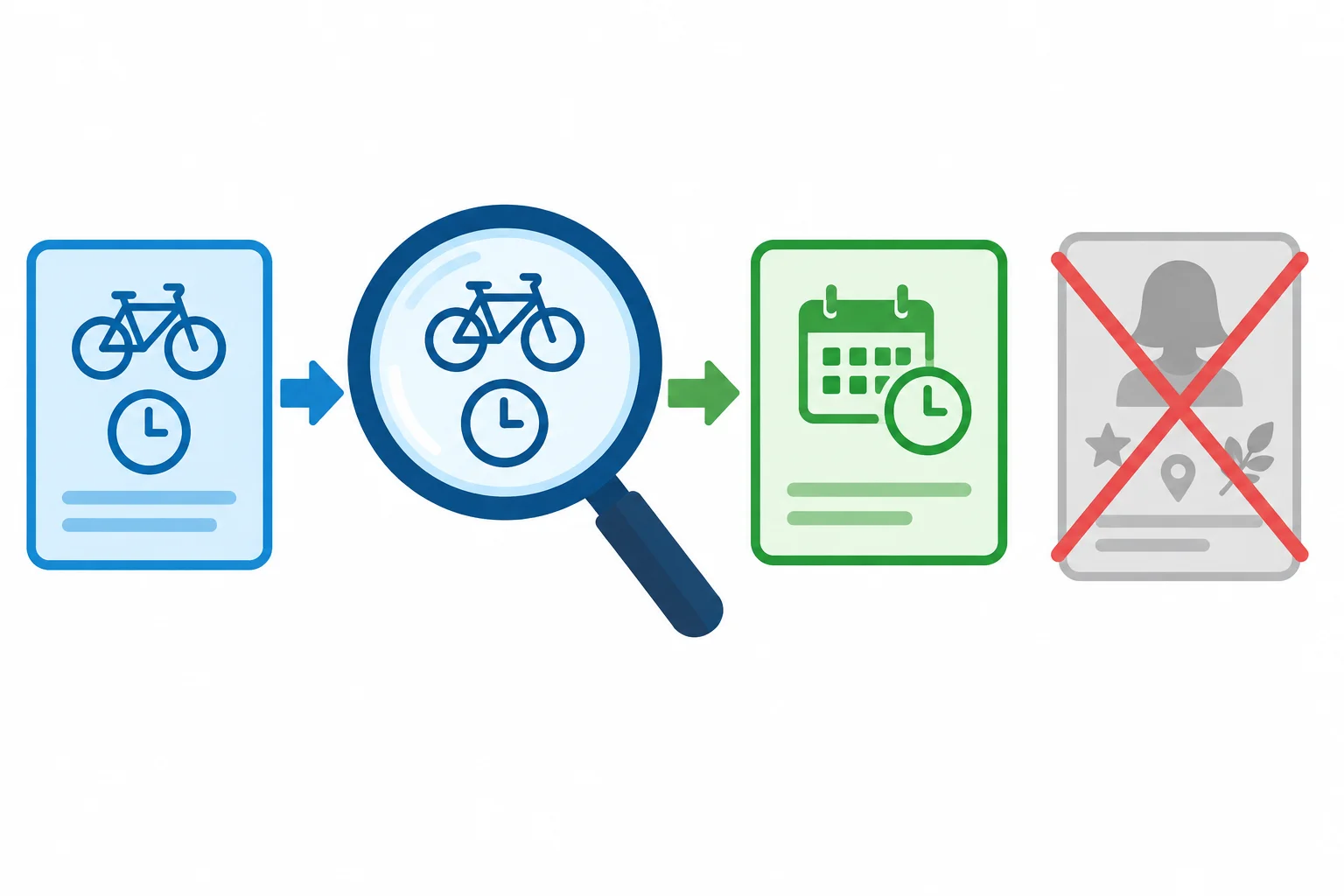
Turn a reported situation into a concise note without changing its meaning or adding an invented backstory.
Write notes that answer: What outcome is described? What requirement or difficulty is reported? What situation surrounds the choice?
For example, a reported concern about unknown repair costs can be recorded as a cost-related barrier. A statement that someone depends on a bicycle daily describes an important situation, but it does not tell you every reason they choose a repair service.
Record the source beside each note, such as: Source: commuter conversation about daily bicycle use and costs.
Confirmed Offer fact for LoopFix:
These facts may later be compared with audience evidence. They do not prove that riders want them, prefer them, or will choose LoopFix.
Tip
If you later collect real audience material, get permission for conversations. For public excerpts, remove names and sensitive details. You do not need an account, a paid tool, or external research for this case activity: use the supplied Fictional case evidence.
Match each supplied statement to the customer detail it supports. Keep the business capability separate from audience evidence.
Tap an item and then its matching pair.

Step 3 of 8
Learn to distinguish what the Fictional case evidence reports from reasonable interpretations and unsupported assumptions.
Evidence is not all equally certain. Use these three labels:
Keep the label close to the claim. This makes a working model useful without making it sound more certain than the evidence allows.
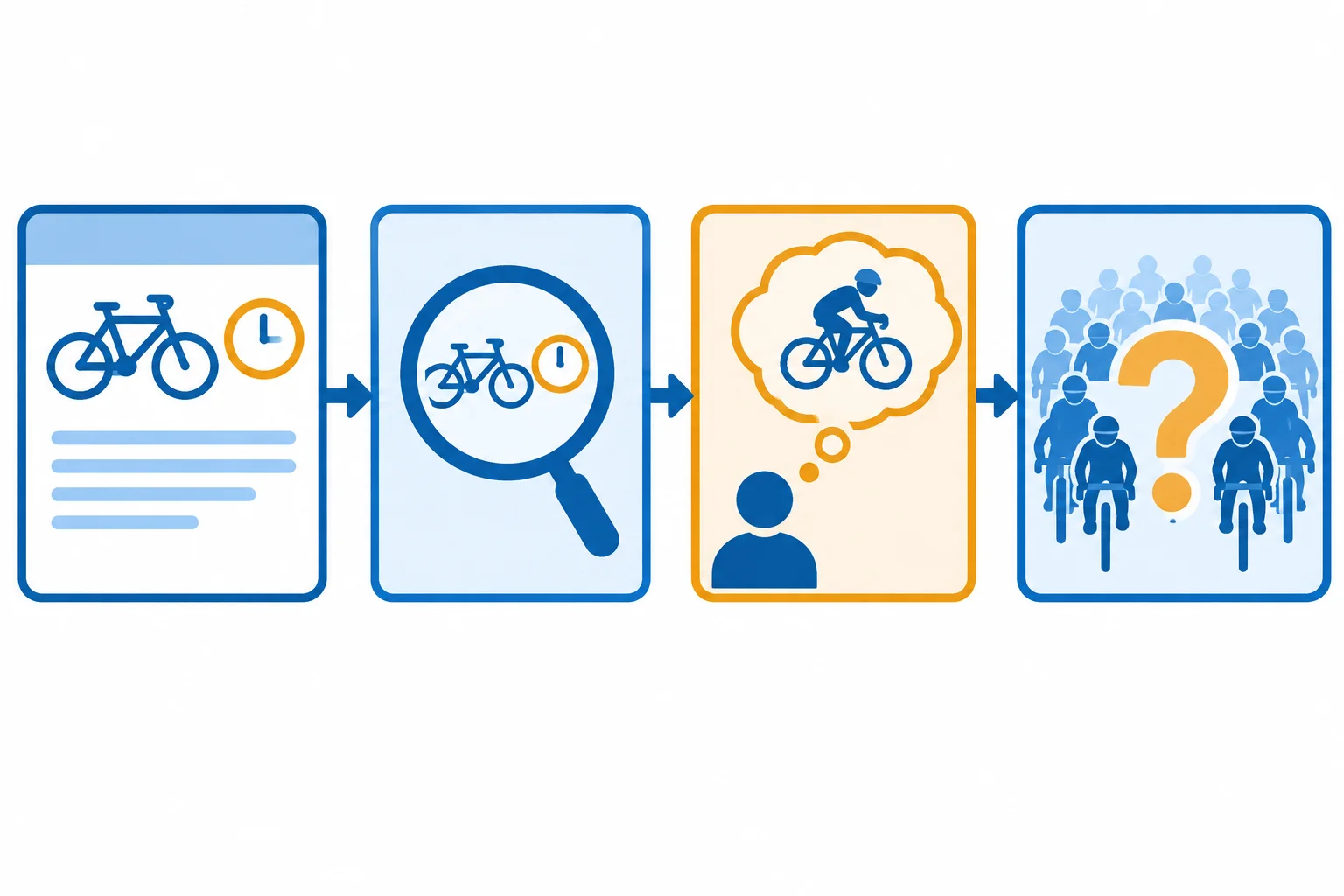
Move from what a source reports to an Interpretation carefully; do not turn a limited signal into a universal claim.
Example
Consider the scheduling signal in the Fictional case evidence:
Observation: A commuter cannot reach repair shops before closing.
Source: commuter conversation about shop hours
Interpretation: Evening access may matter to some commuters with similar schedules.
Source: commuter conversation about shop hours
Assumption: Evening appointments are the most important factor for every local cyclist.
The Interpretation is useful because it stays cautious. The Assumption adds both “most important” and “every,” neither of which the source establishes.
Use a limitation whenever the evidence is small or selective:
Appropriate limitation: These conversation summaries and review excerpts reveal possible needs and concerns, but they cannot show how common those priorities are among all local cyclists.
Missing evidence is not evidence that a need is absent. If no source mentions a concern, do not conclude that no rider has it. Keep one person’s experience connected to its source rather than treating it as a rule for everyone.
Read each claim and its reason carefully. A claim may be useful even when it is not an Observation—as long as its status is clear.
| Claim | Why its status matters |
|---|---|
| A review author reports unexpected added charges. | It records a reported experience, not independently verified pricing practice. |
| Cost clarity may influence some repair decisions. | It connects an observed concern to a plausible decision factor. |
| No cyclist cares about repair cost unless a source says so. | It incorrectly treats missing evidence as proof. |
Tip
An Offer fact is different from all three evidence-status labels: it is a confirmed capability of LoopFix, not evidence about customer demand. LoopFix provides online booking, weekday evening appointments from 5:00–8:00 p.m., and an itemized estimate approved before repairs.
A capability can be relevant to an Interpretation, but it does not prove that customers value it or that it is better than another service.
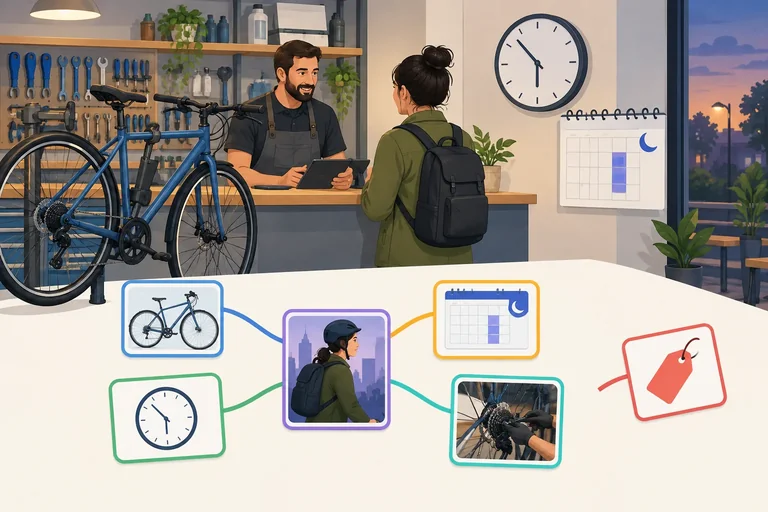
Match each claim with its correct evidence-status label.
Tap an item and then its matching pair.
Step 4 of 8
Select a provisional audience focus and priority need while preserving conflicting evidence.
A pattern groups related signals so you can inspect a possible shared situation. It does not prove that the signals describe one person or the whole market.
For the Fictional case evidence, keep source links attached:
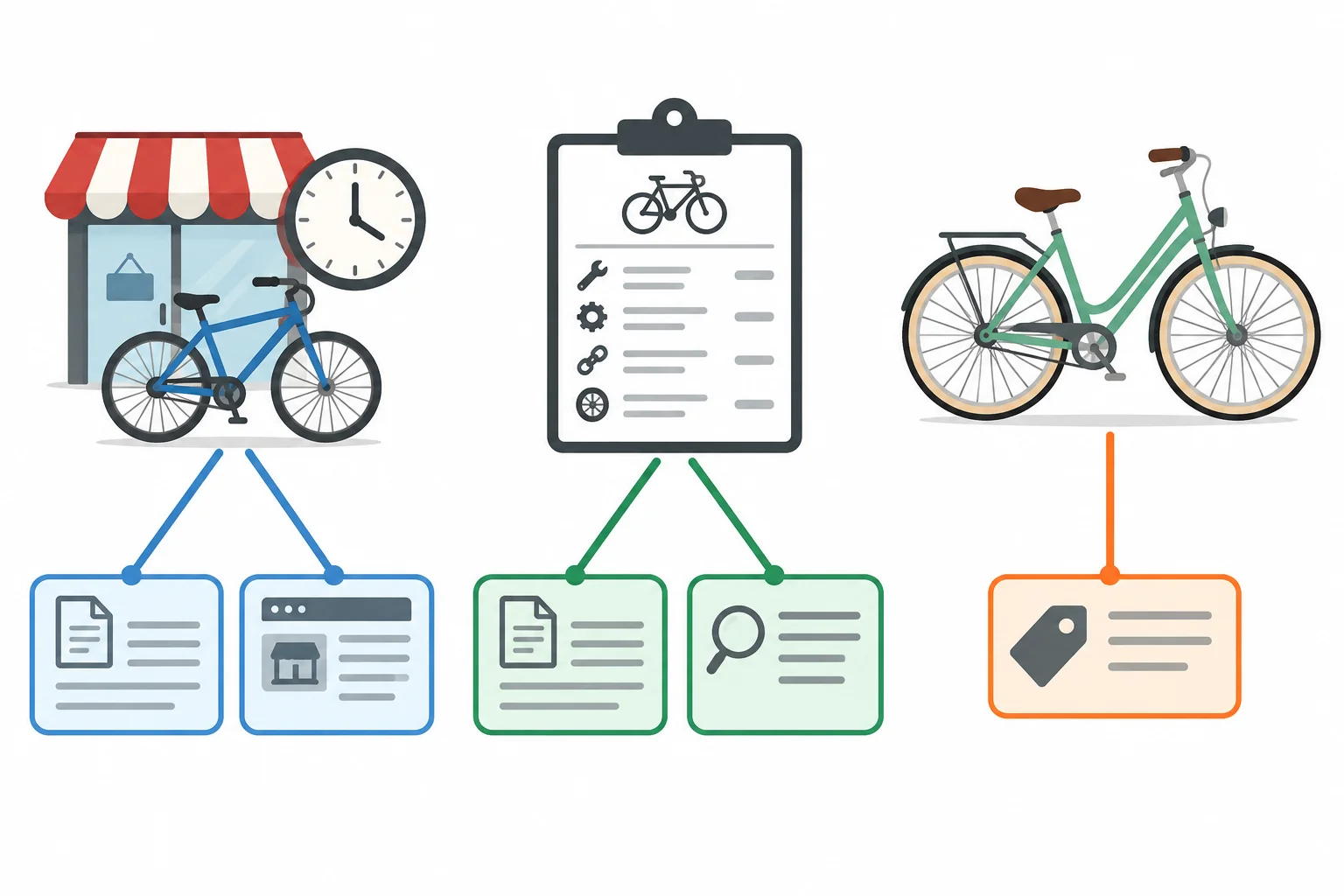
Group related evidence, but leave conflicting or unrelated signals visible as their own cluster.
Choose a focus because it is useful for a decision, not because it averages every rider into one profile.
A reasonable provisional focus is the shared situation behind the scheduling cluster: a bicycle commuter whose available time does not match typical shop hours. Its possible priority need is access to a repair appointment that fits that constraint.
This has an evidence basis in the commuter conversation. The evening-review signal adds a related reported experience, but neither source shows that every commuter values evening access most.
The lowest-quote signal belongs to a leisure rider. Do not convert that one observation into a claim that commuters—or all local riders—mainly choose on price.
Use offer facts to test whether a pattern is relevant to what LoopFix can actually provide. Offer relevance is not proof of customer demand.
| Candidate pattern | Audience evidence | Relevant LoopFix capability |
|---|---|---|
| Scheduling access | Observation: commuter cannot reach shops before closing. Source: commuter conversation about shop hours. | Offer fact: weekday evening appointments from 5:00–8:00 p.m. |
| Cost clarity | Observation: commuter worries about unknown repair costs. Source: commuter conversation about repair costs. | Offer fact: an itemized estimate approved before repairs. |
| Lowest-price preference | Observation: leisure rider prioritizes the lowest quote. Source: leisure rider conversation about quotes. | No LoopFix price claim is confirmed. |
Tip
Decision criteria are factors a customer may use to compare choices. “Appointment availability outside normal shop hours” is an Interpretation based on the scheduling observation; it is not a direct statement from every commuter. “Lowest quote” is directly reported only for the leisure rider.
Which provisional focus and priority need are best supported by the Fictional case evidence and a confirmed LoopFix capability?
Write 2–4 sentences. Choose a commuter-focused priority need, support it with two relevant case sources, and explain why the leisure rider’s lowest-price preference should remain separate instead of being generalized to this persona. Use Source: ... for each source reference.
Write at least 180 characters (0/180).

Step 5 of 8
Create a concise, traceable working persona from the LoopFix Fictional case evidence while making uncertainty visible.
A persona is a working decision aid, not a fictional biography. Use the shared-situation label Schedule-constrained bicycle commuter—not a name, age, salary, or portrait.
Build it with these fields:
Buying context: the situation around the choiceGoal: desired outcomePriority need: requirement that matters most in this working modelBarrier: what makes the choice harderDecision criteria: likely comparison factorsEvidence links: traceable sourcesAssumptions and unknowns: what the case does not establishKeep details only when they could guide a marketing decision.
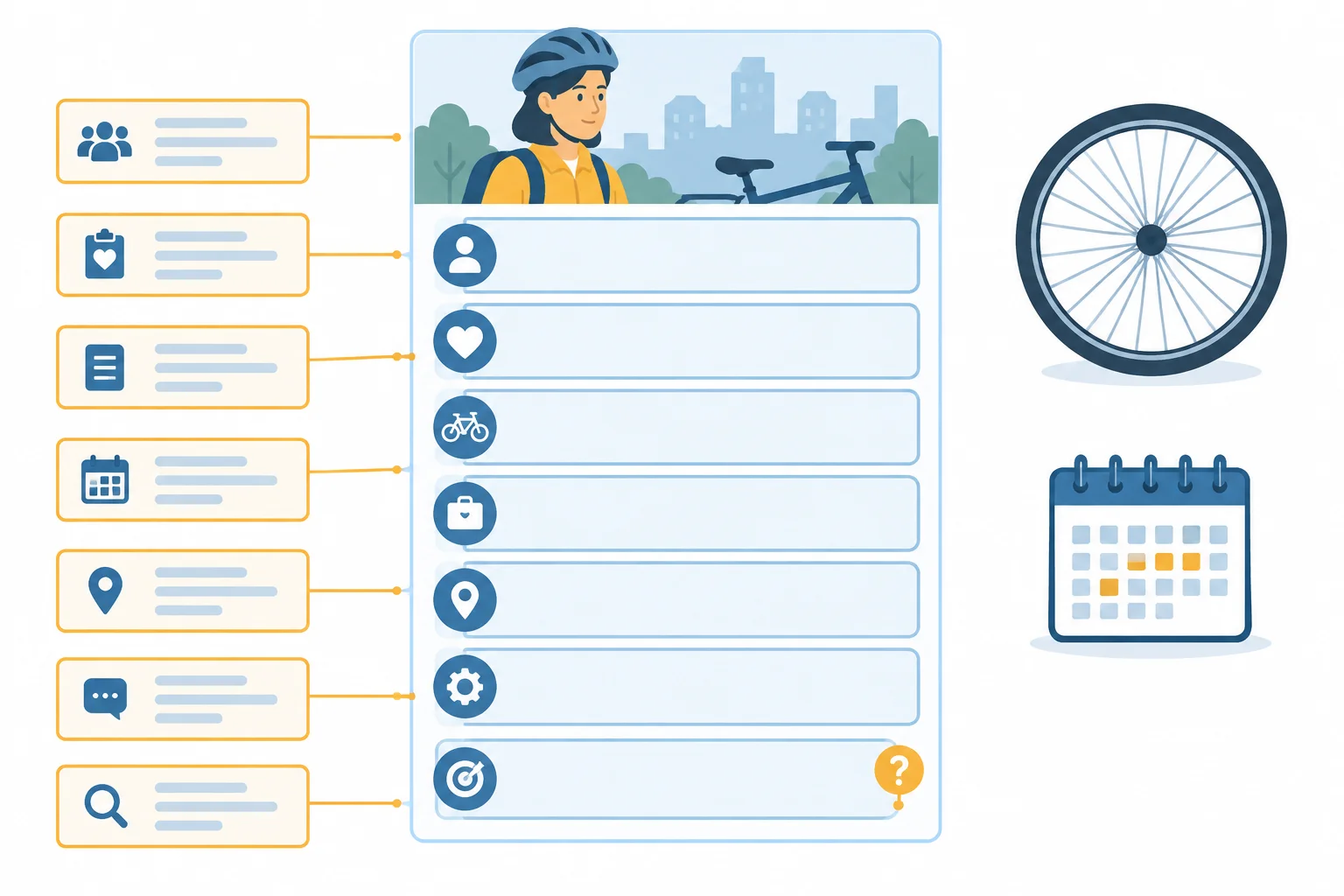
A useful persona separates supported claims from uncertainty instead of filling gaps with a biography.
Tip
Use evidence-status labels precisely:
Observation records what a source reported.Interpretation is a reasonable meaning drawn from one or more observations.Assumption is not established by the available case.A field may be concise, but its important claim needs either a Source: reference or an explicit uncertainty label. A persona can change when later evidence contradicts it.
Example
Persona
Schedule-constrained bicycle commuter
Buying context
Observation: A commuter cannot reach repair shops before closing. Source: commuter conversation about shop hours.
Goal
Interpretation: Keep a bicycle available for daily transport. Source: commuter conversation about daily bicycle use and repair costs.
Priority need
Interpretation: Repair access that fits a weekday schedule. Source: commuter conversation about shop hours.
Barrier
Observation: Existing shop hours prevent this commuter from reaching a repair shop. Source: commuter conversation about shop hours.
Decision criteria
Interpretation: Appointment availability and clarity about repair costs may affect comparison of repair options. Source: commuter conversation about shop hours; Source: commuter conversation about daily bicycle use and repair costs.
Evidence links
Source: public review about evening appointments. Source: public review about unexpected added charges.
Assumptions and unknowns
Assumption: Scheduling access and cost clarity matter together for the same audience pattern.
Unknown: How this persona ranks schedule, cost clarity, and price when selecting a repair service. Source: leisure rider conversation about quotes.
Notice the limits in this example. The case contains related commuter signals, but it does not prove that every schedule-constrained commuter depends on a bicycle daily or ranks the same criteria first. The leisure rider's preference for the lowest quote remains a separate, potentially conflicting pattern—not a detail to erase.
Draft a working persona for Schedule-constrained bicycle commuter from the Fictional case evidence.
Use every required field: Buying context, Goal, Priority need, Barrier, Decision criteria, Evidence links, and Assumptions and unknowns.
Attach Source: [source description] to key claims. Explicitly label at least one Interpretation and one Assumption or unknown. Keep the leisure rider's lowest-quote preference from becoming an unsupported claim about this persona.
Write at least 600 characters (0/600).

Step 6 of 8
Connect the working persona’s priority need to confirmed LoopFix capabilities in a specific, supportable value proposition.
Start with the audience need, not with a feature list. In the Fictional case evidence:
Observation: One commuter cannot reach repair shops before closing. Source: commuter conversation about shop hours.
Offer fact: LoopFix offers online booking.
Offer fact: LoopFix offers weekday evening appointments from 5:00–8:00 p.m.
Interpretation: An appointment option outside typical shop hours may address this commuter’s access barrier. It does not prove that every commuter will choose LoopFix.
A value proposition makes this need-to-offer connection clear: it names an audience, the priority need, the offer’s benefit, and a specific reason to choose it.
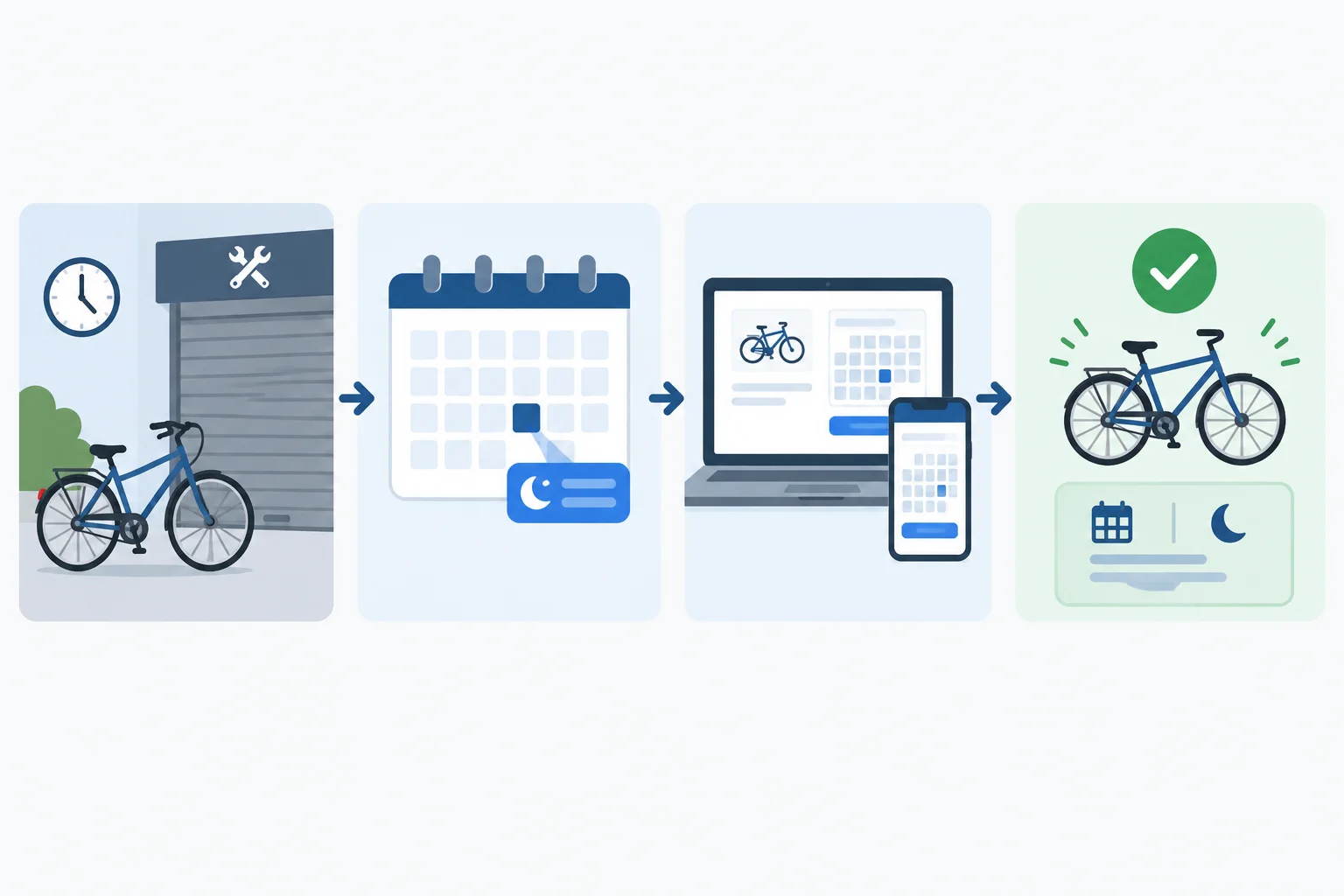
Link the reported situation to the priority need, then use confirmed capabilities as the reason to choose the offer.
Tip
Use only capabilities that are confirmed. LoopFix’s evening hours can support an appointment-access benefit, but they do not support claims such as “fastest repairs,” “lowest price,” “best service,” or a guaranteed outcome.
Use this shared structure:
For [audience] who need [priority need], [offer] provides [benefit] through [specific, supportable reason to choose it].
This is a strategic statement, not a slogan, headline, or full advertisement. Its job is to make the proposed audience fit and the supporting offer facts easy to inspect.
You do not need to include every LoopFix capability. Include the capabilities that directly support the selected priority need.
Example
Value proposition
For Schedule-constrained bicycle commuters who need an appointment option they can attend after typical shop hours, LoopFix provides that option through online booking and weekday evening appointments from 5:00–8:00 p.m.
The audience and need connect to the earlier observation. Source: commuter conversation about shop hours.
The reason to choose is supportable because it uses confirmed capabilities:
Offer fact: Online booking.
Offer fact: Weekday evening appointments from 5:00–8:00 p.m.
The statement proposes a relevant benefit; it does not claim that customers prefer it, that repairs are faster, or that the service is better than alternatives.
Arrange the parts into one logically aligned value proposition.
Your sentence
Available words
Draft one value proposition for the Schedule-constrained bicycle commuter persona.
Use the shared structure. Connect the need for an appointment option outside typical shop hours to confirmed LoopFix capabilities. Use online booking, weekday evening appointments from 5:00–8:00 p.m., or both as the reason to choose.
Do not promise speed, savings, superior quality, or customer preference.
Write at least 80 characters (0/80).
Step 7 of 8
Identify a consequential uncertainty, ask about it without leading the respondent, and define evidence that could revise the current working model.
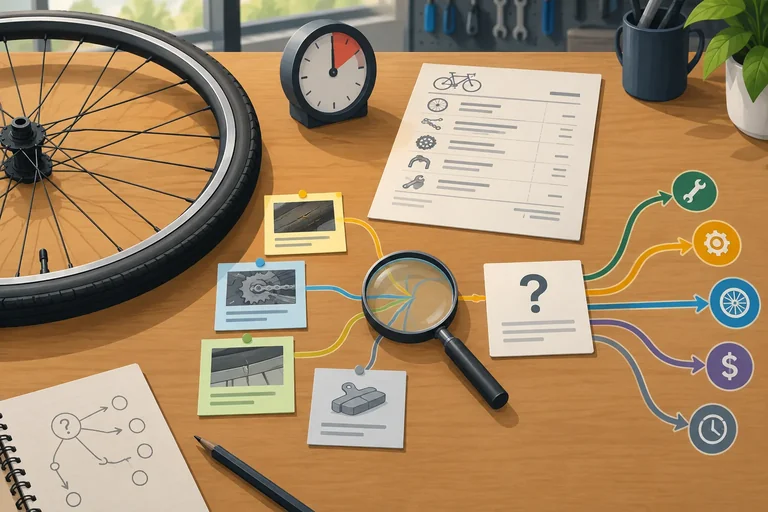
A useful research gap is an uncertainty that could change the working persona or value proposition—not an interesting personal detail with no decision impact.
In the Fictional case evidence, scheduling access and cost clarity are plausible priorities, but their influence on repair-service choice is still unknown. The case includes a commuter who cannot reach repair shops before closing (Source: commuter conversation about shop hours), a commuter worried about unknown repair costs (Source: commuter conversation about unknown repair costs), a review praising evening appointments (Source: public review praising evening appointments), and a review reporting unexpected added charges (Source: public review reporting unexpected added charges).
These signals justify a question; they do not prove which factor matters most or how common it is. One useful question is whether scheduling access and cost clarity influence choice relative to other factors.
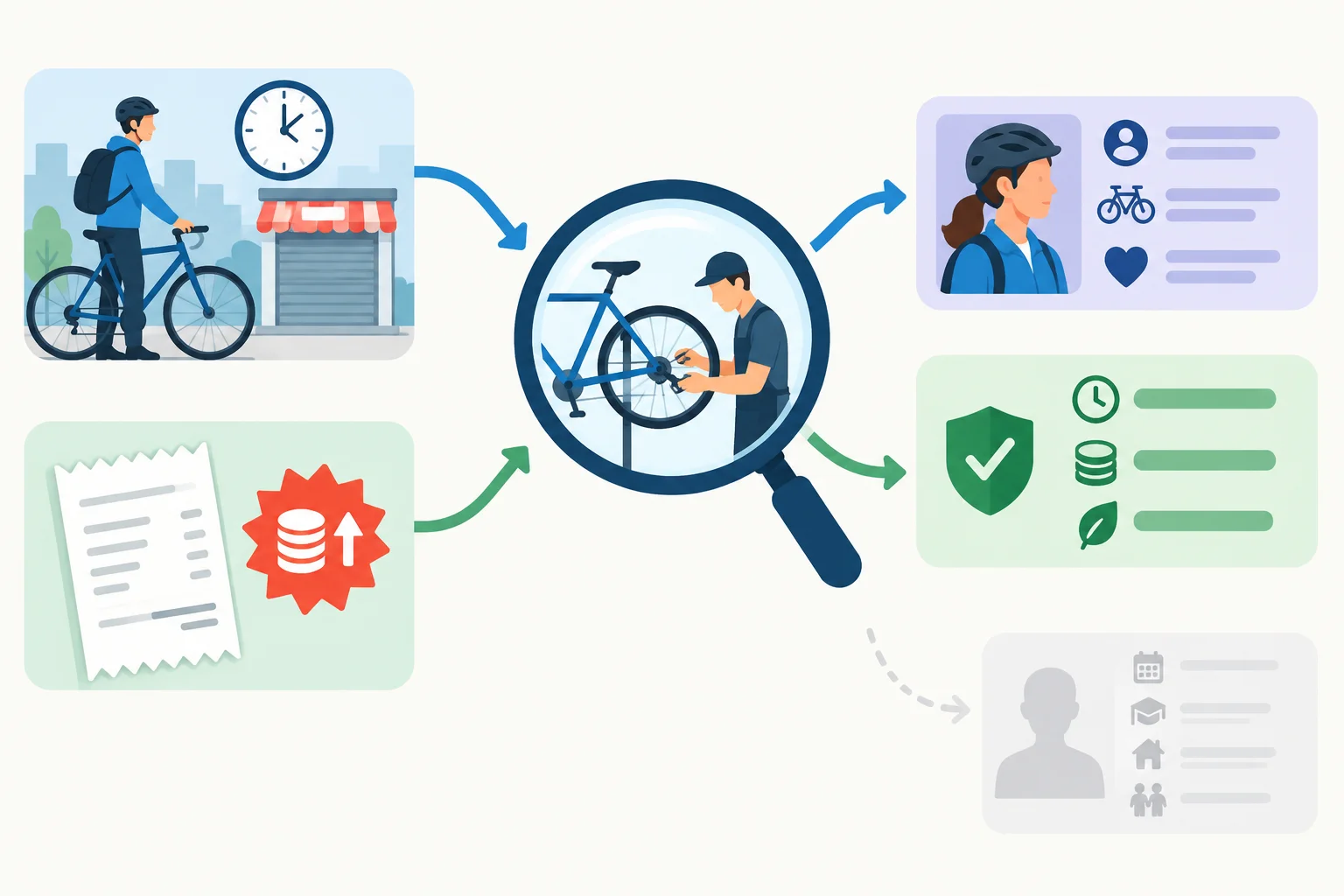
Treat related case signals as reasons to investigate a question, not as proof that every rider chooses on those factors.
Ask about a real, recent choice before naming LoopFix or suggesting an answer. A neutral question leaves room for appointment timing, expected costs, location, trust, the lowest quote, or another factor. A leading question steers someone toward the conclusion you hope to support.
Short, permission-based conversations can reveal reported motives and trade-offs. Relevant public reviews can add reported experiences, but they cannot establish how common a view is across the market.
Example
Neutral: “Thinking about your most recent bicycle repair decision, what factors mattered when you chose a service?”
This invites the person to describe their own criteria.
Leading: “Would you choose LoopFix because evening appointments and approved estimates solve common rider problems?”
This supplies the proposed answer, names the business, and assumes that the features solve the person’s problem.
Tip
Ask permission before a conversation, avoid collecting names or sensitive details, and focus on the recent repair choice. A single answer can strengthen, narrow, or contradict the working model; it cannot validate it for the whole market.
Turn the gap into a small plan. The plan should state what you need to learn, why it could matter, what evidence would help, how you can gather it, and what finding would change the current working model.
| Field | Working plan |
|---|---|
| Unanswered question | In a recent bicycle repair choice, how did scheduling access and expected-cost clarity compare with other factors? |
| Why it matters | The answer could confirm, narrow, or revise the persona's priority need and the value proposition. |
| Evidence to seek | Reported accounts of recent choices and trade-offs; relevant public review experiences. |
| Method | Hold short, permission-based conversations about a recent repair decision. Treat public reviews as reported experiences, not market prevalence. |
| What could change | If other factors consistently matter more, revise the priority need and avoid centering the proposition on scheduling or cost clarity. |
Review this proposed question:
“Would you choose LoopFix because its evening appointments and approved estimates solve common rider problems?”
Write six short labeled lines:
Write at least 180 characters (0/180).

Step 8 of 8
Complete a concise, traceable working brief for LoopFix using the supplied fictional case evidence.
Use this Fictional case evidence as your complete input. It contains simulated conversation summaries and simulated public review excerpts about local bicycle repair services. It is practice material, not research findings about real customers or reviews of LoopFix.
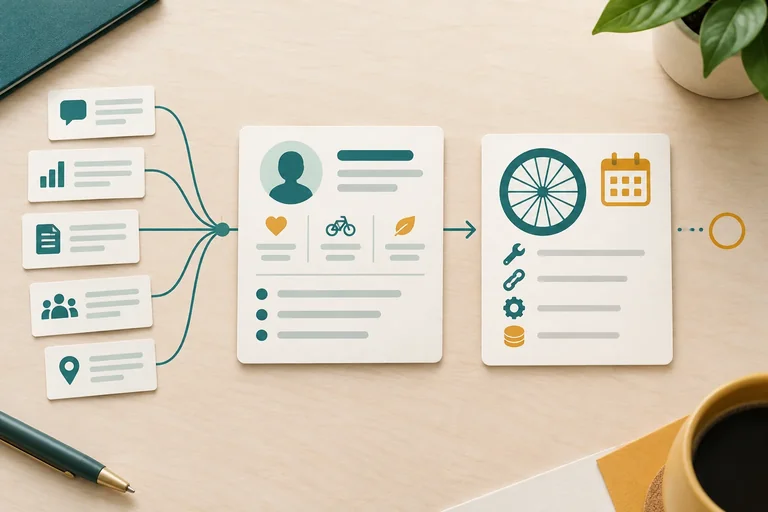
Keep the chain visible: a source supports a claim in the persona; confirmed LoopFix capabilities support the value proposition; an unresolved issue becomes the next research action.
Confirmed Offer fact items for LoopFix: online booking; weekday evening appointments from 5:00–8:00 p.m.; and an itemized estimate approved before repairs.
Each source below is an Observation: it records what the conversation participant or review author reported. Do not turn one report into a claim about all riders.
| Source | Reported signal | Useful evidence link |
|---|---|---|
| Commuter conversation about shop hours | Cannot reach repair shops before closing | Source: commuter conversation about shop hours |
| Commuter conversation about daily bicycle use and repair costs | Depends on a bicycle daily and worries about unknown repair costs | Source: commuter conversation about daily bicycle use and repair costs |
| Leisure rider conversation about quotes | Prioritizes the lowest quote | Source: leisure rider conversation about quotes |
| Public review excerpt about appointments | Praises evening appointments | Source: public review excerpt about evening appointments |
| Public review excerpt about charges | Reports unexpected added charges | Source: public review excerpt about unexpected added charges |
A compact brief should let a reader trace each major choice backward to evidence and forward to a practical action. The dashed final link signals uncertainty: it is a question to investigate, not a fact.
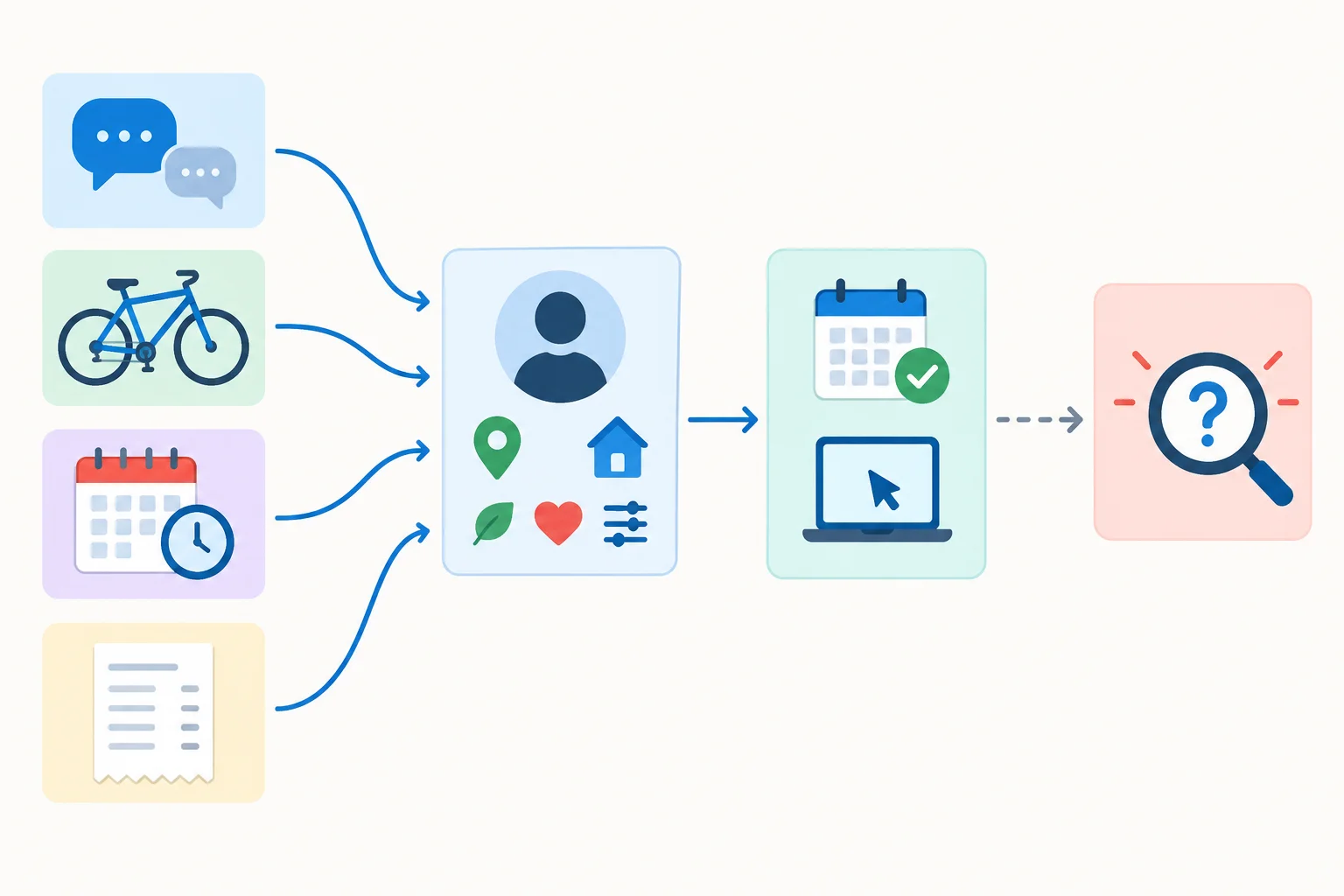
Evidence → persona need → supportable offer alignment → unanswered question.
Before you write, use this review rule: retain a claim only when it is either an Observation with a source, an Interpretation clearly labeled and linked to a source, an Assumption clearly labeled as untested, or an Offer fact confirmed for LoopFix.
The working persona label is Schedule-constrained bicycle commuter. It describes a shared buying situation, not a biography. Keep the leisure rider’s lowest-quote preference visible as potentially conflicting evidence rather than forcing it into this persona.
Use this checklist to inspect your three parts. A brief can be concise; traceability matters more than length.
| Part | Include | Check |
|---|---|---|
| Persona | Buying context, Goal, Priority need, Barrier, Decision criteria, Evidence links, Assumptions and unknowns | Use Source: references; label inferred criteria as Interpretation and gaps as Assumption or unknown. |
| Value proposition | Audience, priority need, offer, benefit, reason to choose | Use only confirmed Offer fact items. Do not claim lowest price, fast turnaround, superior quality, or uniqueness. |
| Next evidence to seek | Unanswered question, Why it matters, Evidence to seek, Method, What could change | Choose a question that could strengthen, narrow, or contradict the working model. |
| Whole brief | One focused audience context | Do not treat this small case as proof of what all riders want. |
Tip
Use this structure exactly for the proposition:
For [audience] who need [priority need], [offer] provides [benefit] through [specific, supportable reason to choose it].
A suitable research method is a short, permission-based conversation about a recent repair choice. Ask neutrally about what affected the choice and trade-offs. Do not ask people to agree that evening access or cost clarity matters.
Write the persona using the working label Schedule-constrained bicycle commuter. Include all of these field labels: Buying context, Goal, Priority need, Barrier, Decision criteria, Evidence links, and Assumptions and unknowns.
Attach relevant references in the format Source: [source description]. Mark direct reports as Observation, inferred criteria as Interpretation, and untested claims as Assumption.
Write at least 220 characters (0/220).
Write one value proposition using the required sentence structure. It must address the persona’s priority need and use only confirmed LoopFix Offer fact capabilities. Avoid any promise about price, turnaround time, service quality, or being better than competitors.
Write at least 100 characters (0/100).
Write a proportionate follow-up plan with these field labels: Unanswered question, Why it matters, Evidence to seek, Method, and What could change.
Choose one uncertainty that could alter the persona or value proposition. Use a neutral, permission-based method suited to a small follow-up.
Write at least 180 characters (0/180).
Before finishing, revise any weak link:
Source: reference?This is a provisional working model, not a final statement about every customer. It provides an evidence-aware starting point for the next tutorial, where you will examine customer journeys.
You assembled a focused, evidence-informed brief that connects audience evidence, a persona, a supportable value proposition, and a next research action.
Congratulations! You completed: Build an Evidence-Informed Persona and Value Proposition
Thousands of online courses in video, ebooks and audiobooks.
To test your knowledge during online courses
Generated directly from your cell phone's photo gallery and sent to your email

Download our app via QR Code or the links below:.


Carry knowledge in your pocket.
Download the Cursa app.
There are hundreds of free courses available, with a free certificate of completion that is saved in your mobile image gallery.
Download the app to access the Course Completion Certificate for Free.

+ 10 million
students

Free and Valid
Certificate

60 thousand free
exercises

4.8/5 rating in
app stores

Free courses in
video and ebooks