Step 1 of 8
Build the strategic decision spine
Connect FocusFlow's fictional audience evidence, positioning decision, and planning target into a traceable strategic statement.

Learning path · Level 10 · Tutorial 1
Draft the strategic core of an integrated marketing plan for a real or hypothetical business. Connect audience evidence and objectives to coordinated channel roles, explaining what to include, defer, or exclude without building a website or launching campaigns.

 Build the strategic decision spine
Connect FocusFlow's fictional audience evidence, positioning decision, and planning target into a traceable strategic statement. 3 min
 Prioritize the journey gaps
Identify customer uncertainties and missing transitions that deserve priority in FocusFlow’s 90-day strategic core. 3 min
 Assign complementary channel contributions
Assign distinct and deliberately shared roles to all six planning areas in the FocusFlow customer journey. 4 min
 Choose what to include, defer, or exclude
Choose explicit 90-day statuses for all six planning areas, with reasons that preserve coverage of FocusFlow's priority journey needs. 3 min
 Specify the cross-channel handoffs
Connect selected FocusFlow touchpoints through intent-matched, permission-appropriate next steps. 3 min
 Align the offer and shared assets
Keep FocusFlow's offer facts and shared assets coherent while allowing each selected touchpoint to serve its own customer context. 3 min
 Find and repair integration failures
Diagnose breaks in a strategic core and repair the connected decisions, handoffs, and shared assets. 3 min
 Complete your integrated strategic core
Assemble, review, and repair a coherent integrated strategic core for the FocusFlow fictional case. 4 min
Step 1 of 8
Connect FocusFlow's fictional audience evidence, positioning decision, and planning target into a traceable strategic statement.
An integrated plan does not begin as six separate channel plans. It begins with a connected set of decisions: what the case evidence supports, how you choose to position the offer, what planning target matters, and what customer result must happen before the business result.
Use this traceability chain:
Evidence -> Positioning -> Objective -> Journey need -> Channel contribution -> Intended outcome
The arrows show planning links, not proof of causation. Evidence can make a positioning choice reasonable; it cannot prove that the plan will reach its target. Channel contributions and handoffs will be specified later.
For now, build a defensible spine: every proposed action should eventually trace back to an input, a decision, and an intended outcome.
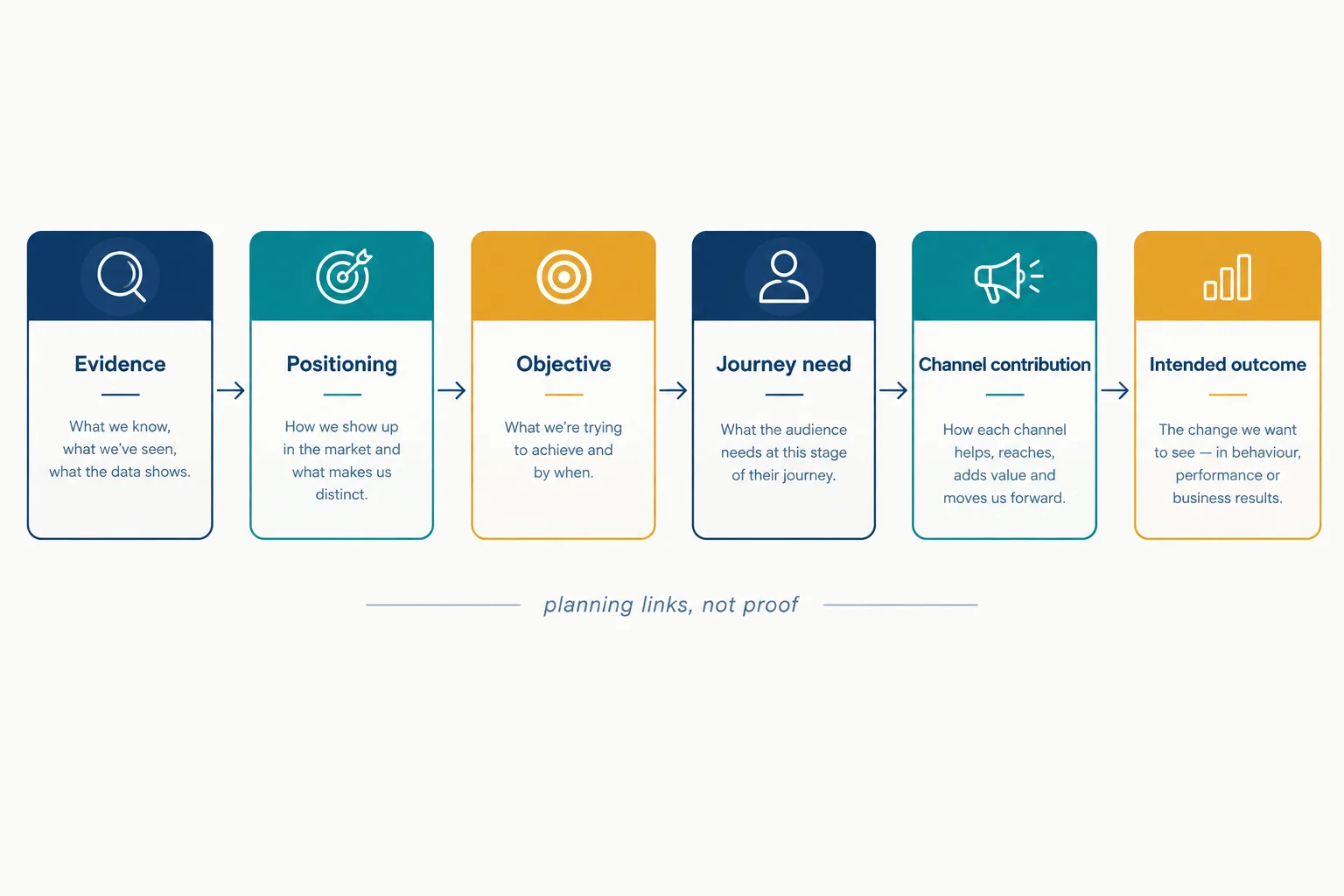
Traceability makes the strategic core testable: each later choice should have a clear upstream reason.
Treat the following as a bounded planning brief. It provides enough information to write a strategic core, but it does not provide channel-performance evidence, a forecast, or proof that a tactic will succeed.
Evidence — Fictional case evidence: Of 12 customer interviews, 8 mentioned searching for planning templates and 7 wanted to see a realistic client week before buying. These groups may overlap.
Decision: Position FocusFlow's Weekly Planner Pack as a practical resource that lets independent consultants judge its fit through a realistic client week before purchase.
Objective: 100 purchases in the next 90 days, compared with 80 purchases in the previous 90 days. This is a planning target, not a forecast.
Assumption: Making the realistic week easy to inspect will help some qualified visitors evaluate fit. This is plausible, but the interviews do not prove it will create any particular number of purchases.
The offer remains fixed across the plan. These are established case facts, not positioning claims or experimental promises.
| Element | Established case fact |
|---|---|
| Product | Weekly Planner Pack |
| Price | $29 |
| Payment | One-time payment |
| Access | Instant download |
| Subscription | No subscription |
| Preview | Available without an email address |
Match each case input to the strategic implication it best supports.
Tap an item and then its matching pair.
Which statement is an unsupported leap rather than an established case fact or a defensible Decision?
Write a short strategic statement for FocusFlow in 4–6 sentences.
Include:
Keep the fixed offer accurate: the Weekly Planner Pack costs $29, is a one-time payment with instant download, and has no subscription.
Write at least 350 characters (0/350).
Step 2 of 8
Identify customer uncertainties and missing transitions that deserve priority in FocusFlow’s 90-day strategic core.
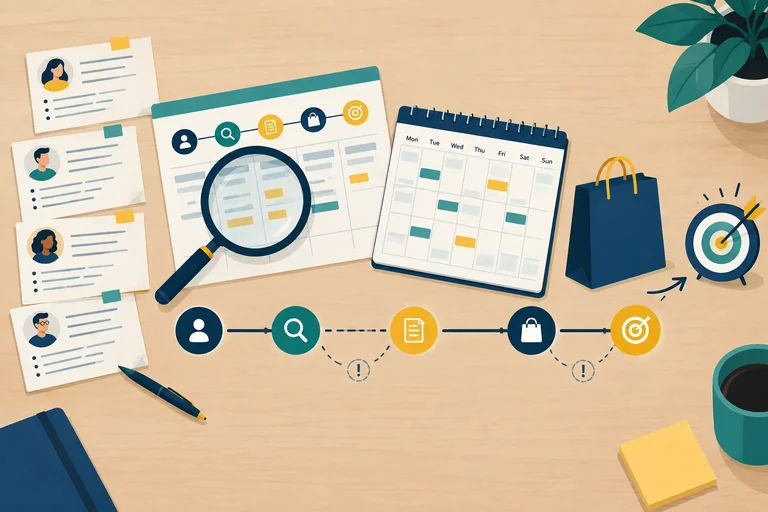
A priority journey need is a customer uncertainty or obstacle worth addressing first because it is relevant to the objective and has meaningful support. It is not a channel choice.
Evidence — Fictional case evidence: Of 12 customer interviews, 8 mentioned searching for planning templates. Seven wanted to see a realistic client week before buying. The groups may overlap.
Objective: 100 purchases in the next 90 days, compared with 80 purchases in the previous 90 days. This is a planning target, not a forecast.
Use the decision spine from Step 1: Evidence -> Positioning -> Objective -> Journey need -> Channel contribution -> Intended outcome. Arrows show planning links, not proof of causation.
A strong Decision can prioritize a purchase-relevant uncertainty while preserving other evidence-backed needs for the plan. Interview comments support relevance; they do not prove that resolving a need will produce 100 purchases.
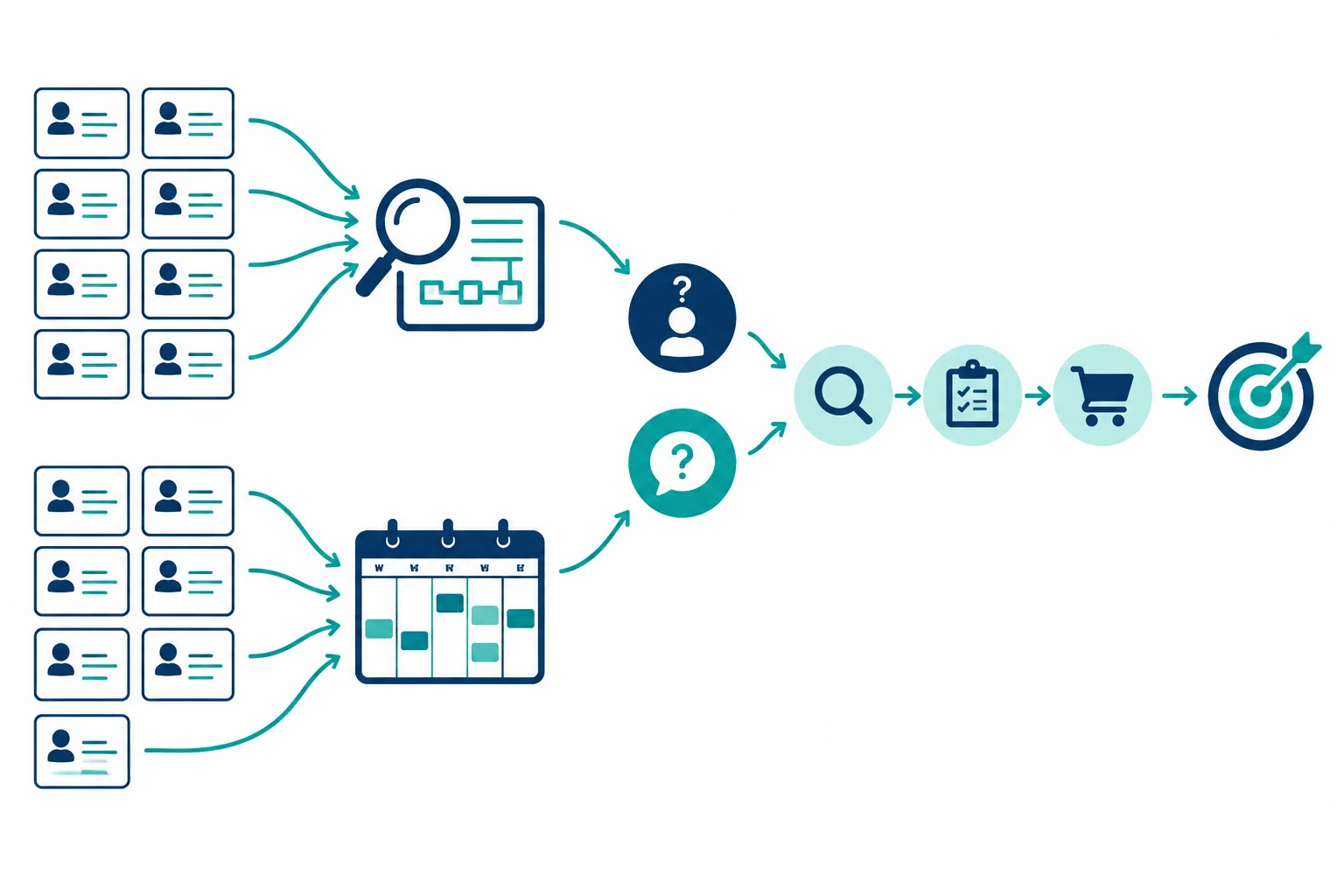
The interview findings identify needs to consider. They do not establish which path every consultant takes or guarantee an outcome.
A journey map is a planning hypothesis, not a fixed route. A consultant may arrive through a search, a recommendation, or a permission-based email; the plan should not assume one sequence for everyone.
Name the gap at the customer level:
Do not write “use social media” or “get more traffic” as a journey need. Those are possible responses, not the uncertainty to solve. Treat an unverified gap as an Assumption until the available map or evidence supports it.
Example
Existing map observation: A visitor can examine the Worked-week example on the ungated Preview page and can view the Product page.
Assumption: If the draft map does not show a relevant next action after the Preview page, there may be a missing transition from evaluation toward the Product page. This is not evidence that the transition is currently absent or ineffective.
Contrast: A missing touchpoint would mean that no place let a visitor inspect a realistic client week. FocusFlow already provides the Worked-week example on its Preview page, so do not describe that particular proof point as absent.
The remaining question is which customer uncertainty deserves priority for the 90-day planning target—not which channel should be selected.
Which planning note describes a potential missing transition rather than a missing touchpoint?
Choose one priority journey gap for FocusFlow’s 90-day strategic core. Describe the customer uncertainty or obstacle, identify the relevant Fictional case evidence, and explain why addressing it matters to the planning target of 100 purchases in the next 90 days.
Keep the response focused on the need, not a channel, tactic, or claim that more traffic will solve it. If you infer that a touchpoint or transition is missing, label that inference as an Assumption.
Write at least 180 characters (0/180).

Step 3 of 8
Assign distinct and deliberately shared roles to all six planning areas in the FocusFlow customer journey.
An integrated plan assigns a job within one customer journey; it does not start with six disconnected campaign ideas.
For each proposed activity, state this link:
Planning area → channel contribution → priority journey need → intended next action
A contribution is useful when it resolves a different uncertainty, reaches a different relevant context, or carries the customer through a different transition. Multiple areas may support the same destination, but they should not merely repeat the same promise and action.
Decision: Treat Content as a shared input: it creates material that several touchpoints can use. Treat Conversion as a cross-touchpoint function: it makes evaluation, purchase, and post-purchase movement clear wherever a customer arrives.
Fictional case evidence: Of 12 customer interviews, 8 mentioned searching for planning templates and 7 wanted to see a realistic client week before buying. These groups may overlap. The objective remains a planning target of 100 purchases in the next 90 days, versus 80 in the previous 90 days; it is not a forecast.
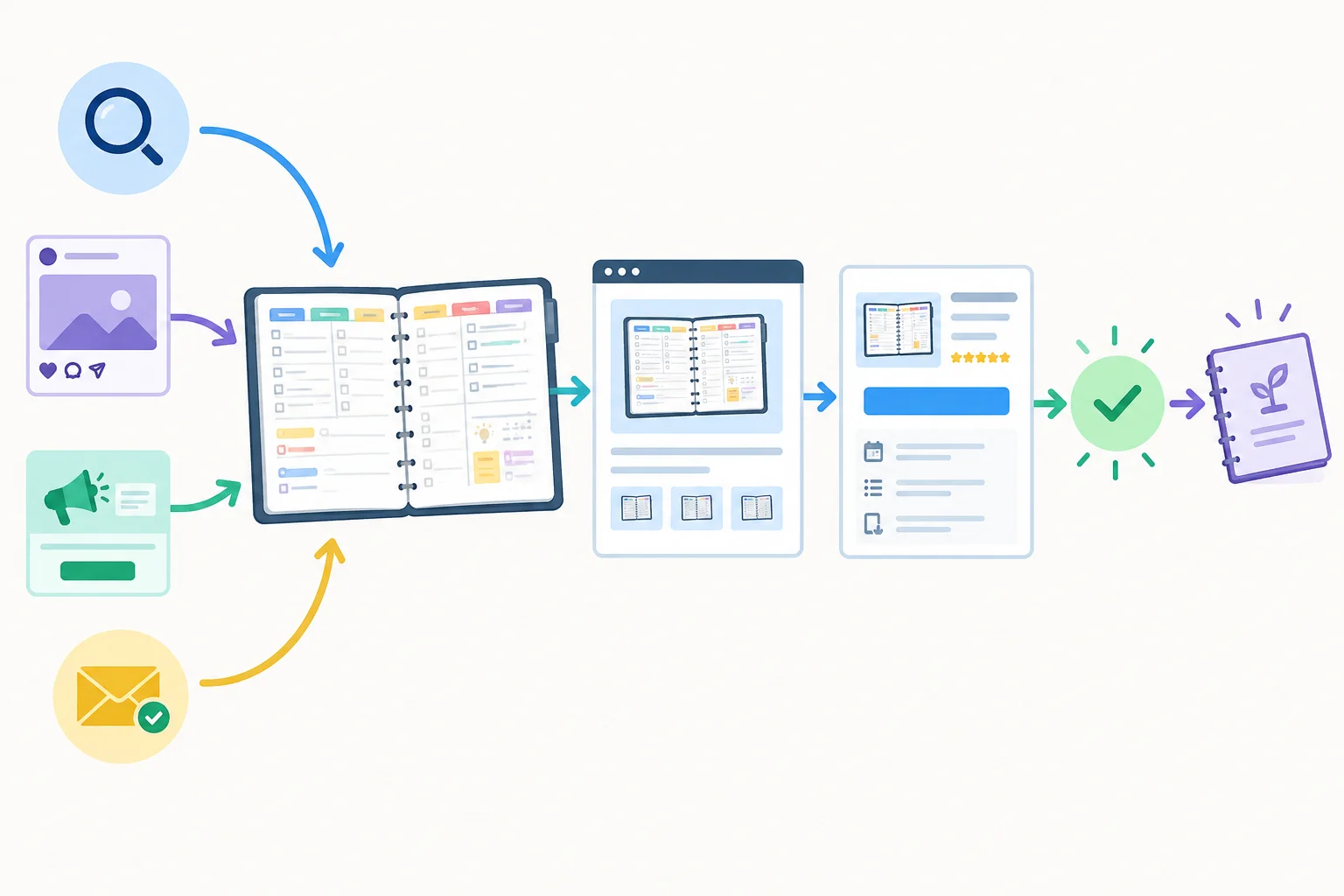
One shared asset can support several routes. Content supplies the asset; conversion makes the evaluation-to-purchase route clear across those routes.
Example
Useful reinforcement does not mean identical activity. Search can meet active template-seeking intent, while organic social can make a realistic client-week scenario feel relevant before someone chooses to evaluate it. Both may lead to the Preview page, but their contributions differ.
Duplicated activity repeats the same generic promise, audience context, and next action without resolving another uncertainty. For example, creating a second, identical Worked-week example solely for one channel adds production but no new customer value; that channel can reuse the shared asset with context-specific framing.
Assumption: Paid media could reach relevant prospects beyond owned touchpoints. No channel-level performance evidence is supplied, so this is a planning proposition—not proof that it will produce purchases.
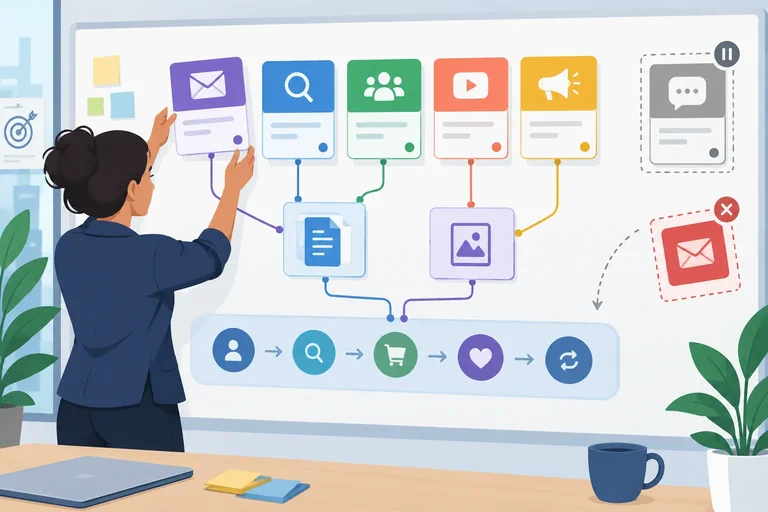
This is a role map, not a final portfolio decision. Each contribution has a primary job that can be checked against a priority journey need and a relevant next action.
| Planning area | Primary channel contribution | Priority journey need | Intended next action | Planning basis |
|---|---|---|---|---|
| Content | Create the Worked-week example once | Can this fit a realistic client week? | Examine the Preview page | Decision |
| SEO | Meet active planning-template search intent | Where can I find a suitable template? | Open the Preview page | Decision informed by Fictional case evidence |
| Organic social | Make the client-week scenario relatable before evaluation | Is this relevant to my consulting work? | Explore the Preview page | Decision |
| Paid media | Reach relevant prospects beyond owned touchpoints | Where can I assess this offer? | Visit the Preview page | Assumption |
| Re-engage eligible permission-based subscribers | Is this worth evaluating now? | Visit the Preview page | Evidence: existing permission-based list; Decision | |
| Conversion | Keep movement from evaluation to purchase clear | What happens if I decide to buy? | Continue to the Product page and purchase | Decision |
Match each candidate activity to its primary planning area. One candidate is duplicated activity rather than a distinct contribution.
Tap an item and then its matching pair.
Step 4 of 8
Choose explicit 90-day statuses for all six planning areas, with reasons that preserve coverage of FocusFlow's priority journey needs.
A channel portfolio is a set of decisions for the current 90-day plan—not a list of channels that are universally good or bad.
Decision: Give every planning area one status:
A status is not a performance prediction. It makes the strategic core testable for coherence: the selected areas must still support discovery, evaluation, purchase, and appropriate post-purchase guidance.
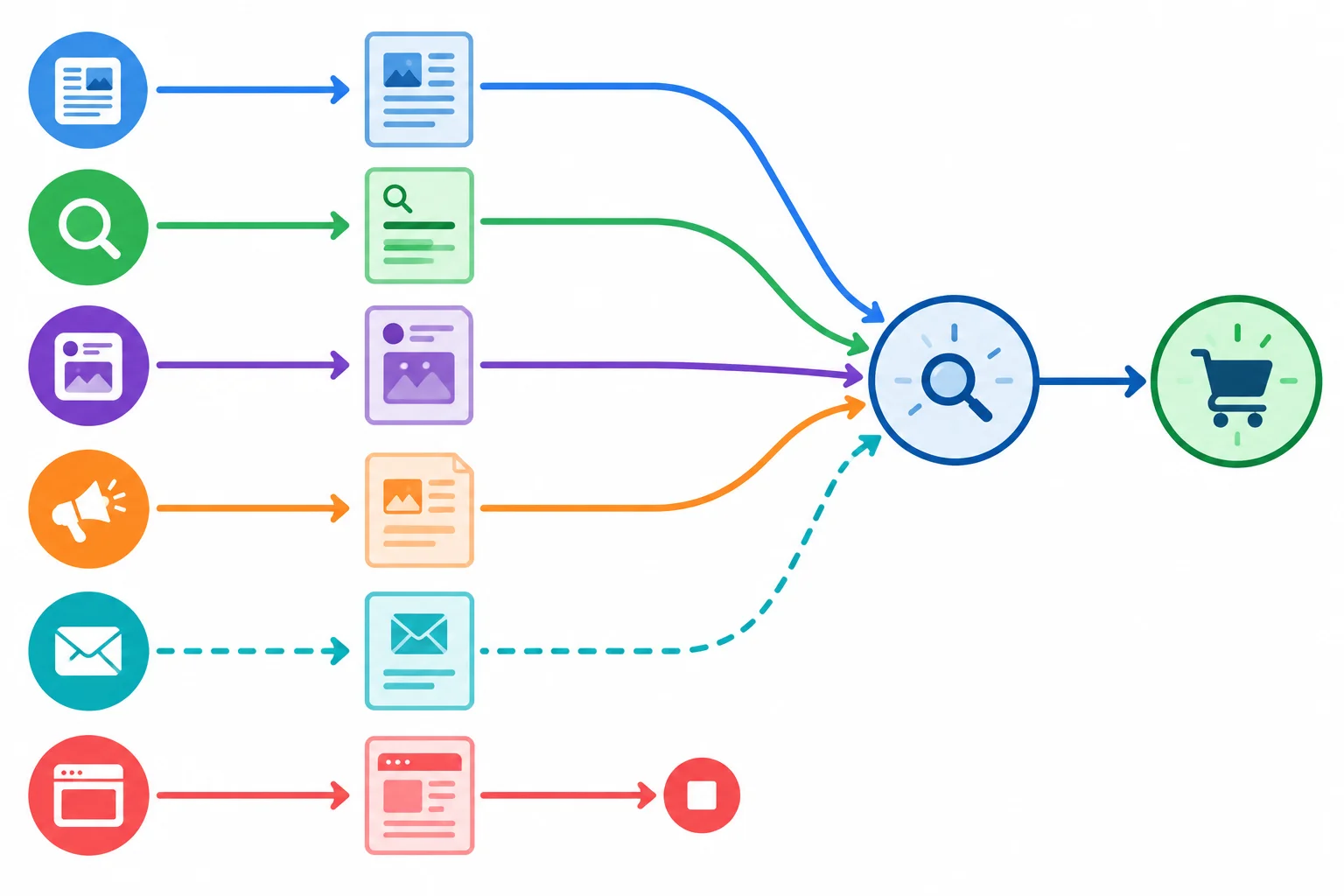
Included areas carry a defined contribution. A deferred or excluded area changes what the remaining areas must cover.
The following is one defensible portfolio for FocusFlow. It supports the planning target of 100 purchases in the next 90 days, compared with 80 purchases in the previous 90 days. The target is a planning target, not a forecast.
Fictional case evidence: 8 of 12 interviews mentioned searching for planning templates; 7 wanted to see a realistic client week before buying. The groups may overlap. No channel-level performance evidence is supplied.
The table shows Decisions, not proof that any channel will cause purchases.
Each status applies only to the current 90-day plan.
| Planning area | Status | Traceable rationale and implication |
|---|---|---|
| Content | Include | Decision: create the Worked-week example for evaluation. |
| SEO | Include | Fictional case evidence: 8 of 12 mentioned template searches; route relevant searchers to the Preview page. |
| Organic social | Defer | Assumption: adapted examples may be useful. Prerequisite: a reusable adaptation with a direct route to the Preview page. |
| Paid media | Exclude | Decision: no role in this 90-day plan. Coverage consequence: discovery relies on SEO, while the existing list is reached through Email. |
| Include | Evidence: an existing permission-based list. Send eligible subscribers to the Preview page within their permission scope. | |
| Conversion | Include | Decision: the ungated Preview page, Product page, and Getting-started guide support evaluation, purchase, and use. |
Which statement is the most usable Decision to defer Organic social in FocusFlow’s current 90-day portfolio?
Complete a compact six-row portfolio for FocusFlow. Write one line for each area:
Content | status | rationale
SEO | status | rationale
Organic social | status | rationale
Paid media | status | rationale
Email | status | rationale
Conversion | status | rationale
Use only Include, Defer, or Exclude, and scope every decision to the current 90-day plan. Label supported case inputs as Evidence, an unverified proposition as Assumption, and your selected response as Decision.
For every Defer, add Prerequisite: followed by the condition required before reconsidering it. For every Exclude, add Coverage consequence: explaining which remaining area or asset must cover the affected journey need. Keep the $29 one-time-payment, instant-download, no-subscription offer unchanged.
Write at least 500 characters (0/500).

Step 5 of 8
Connect selected FocusFlow touchpoints through intent-matched, permission-appropriate next steps.
Decision: A handoff is a deliberate connection between touchpoints. It does not merely name a channel; it states what a person should do next, where that action leads, what helps them act, and whether permission is required.
Write every handoff in this format:
Origin | Intended next action | Destination | Supporting asset | Permission condition
Use the exact shared asset names: Worked-week example, Preview page, Product page, and Getting-started guide. Use Not applicable when an action does not require marketing permission.
Fictional case evidence: of 12 customer interviews, 7 people wanted to see a realistic client week before buying. This supports a planning response; it does not prove a purchase result.
Read the flow from left to right: an origin creates an expectation; the intended action expresses customer intent; the destination must enable that action. The asset supplies the promised evidence, and the permission condition prevents consent from being assumed.
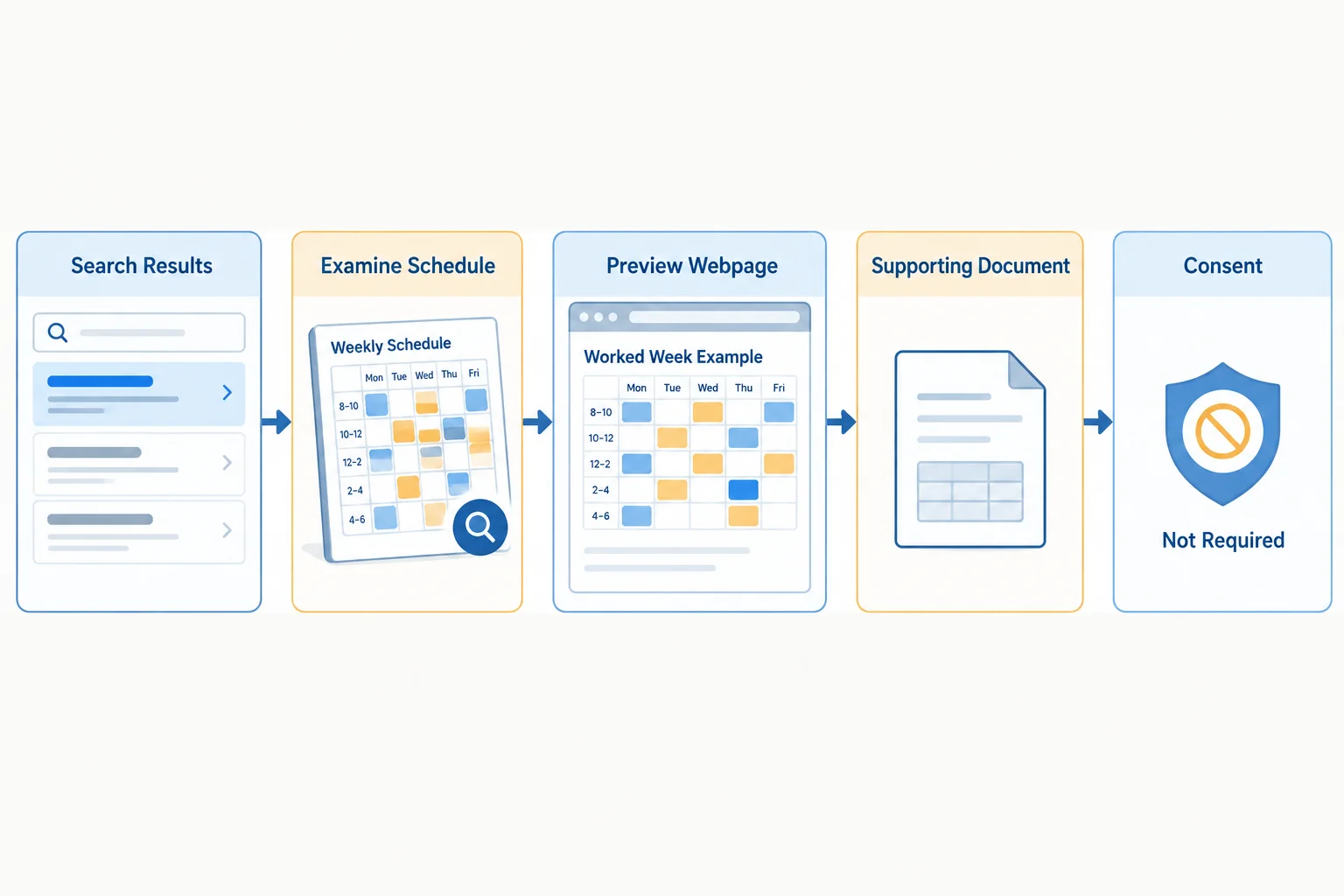
A handoff preserves the visitor's intent instead of sending them to an unrelated next step.
Test a handoff by following its promise. If an origin invites independent consultants to inspect a realistic client week, its destination must allow that inspection. Sending them first to an email sign-up changes the requested action and creates an avoidable barrier.
A dead end occurs when there is no relevant next action. An unfulfilled destination occurs when the destination cannot deliver what the origin promised. A handoff can also be incoherent when its asset is absent from the destination.
Decision: the ungated Preview page contains the Worked-week example. A person may view it without supplying an email address. Email may reach the existing permission-based list, but visiting a preview or product page does not create consent.
At a purchase handoff, the Product page must retain the fixed offer: $29, one-time payment, instant download, and no subscription.
Example
A coherent evaluation handoff is:
Organic social post | Examine a realistic client week | Preview page | Worked-week example | Not applicable
The destination fulfills the invitation, and the asset makes the promised client-week evidence available.
A later, distinct path can support use after purchase:
Purchase confirmation | Start using the pack | Getting-started guide | Getting-started guide | Not applicable
Do not replace the preview path with an email opt-in. Someone who declines marketing consent still needs a route to the ungated preview.
Complete the missing handoff component.
Organic social post | Examine a realistic client week | Preview page | Worked-week example | __
Draft two connected handoffs for FocusFlow using the required format:
Origin | Intended next action | Destination | Supporting asset | Permission condition
Start with a non-email discovery touchpoint that promises a realistic client week. Your second handoff must begin at the destination selected in your first handoff and support the next relevant action for a visitor ready to evaluate or buy.
Then add one sentence explaining how each destination fulfills the prior promise and how a person who declines marketing consent can still continue to the ungated preview.
Write at least 220 characters (0/220).

Step 6 of 8
Keep FocusFlow's offer facts and shared assets coherent while allowing each selected touchpoint to serve its own customer context.
A shared offer core prevents a plan from becoming a set of conflicting channel messages. Stable facts are shared offer invariants: every touchpoint must preserve them even when its framing, format, and call to action differ.
Evidence — Fictional case evidence: 7 of 12 customer interviews mentioned wanting to see a realistic client week before buying. This supports making evaluation visible; it does not prove that any channel will produce purchases.
Decision — Keep the offer facts below unchanged wherever they are stated or relied upon.
Assumption — Showing a realistic week may help evaluation. Treat that as a planning proposition, not as a promised business result.
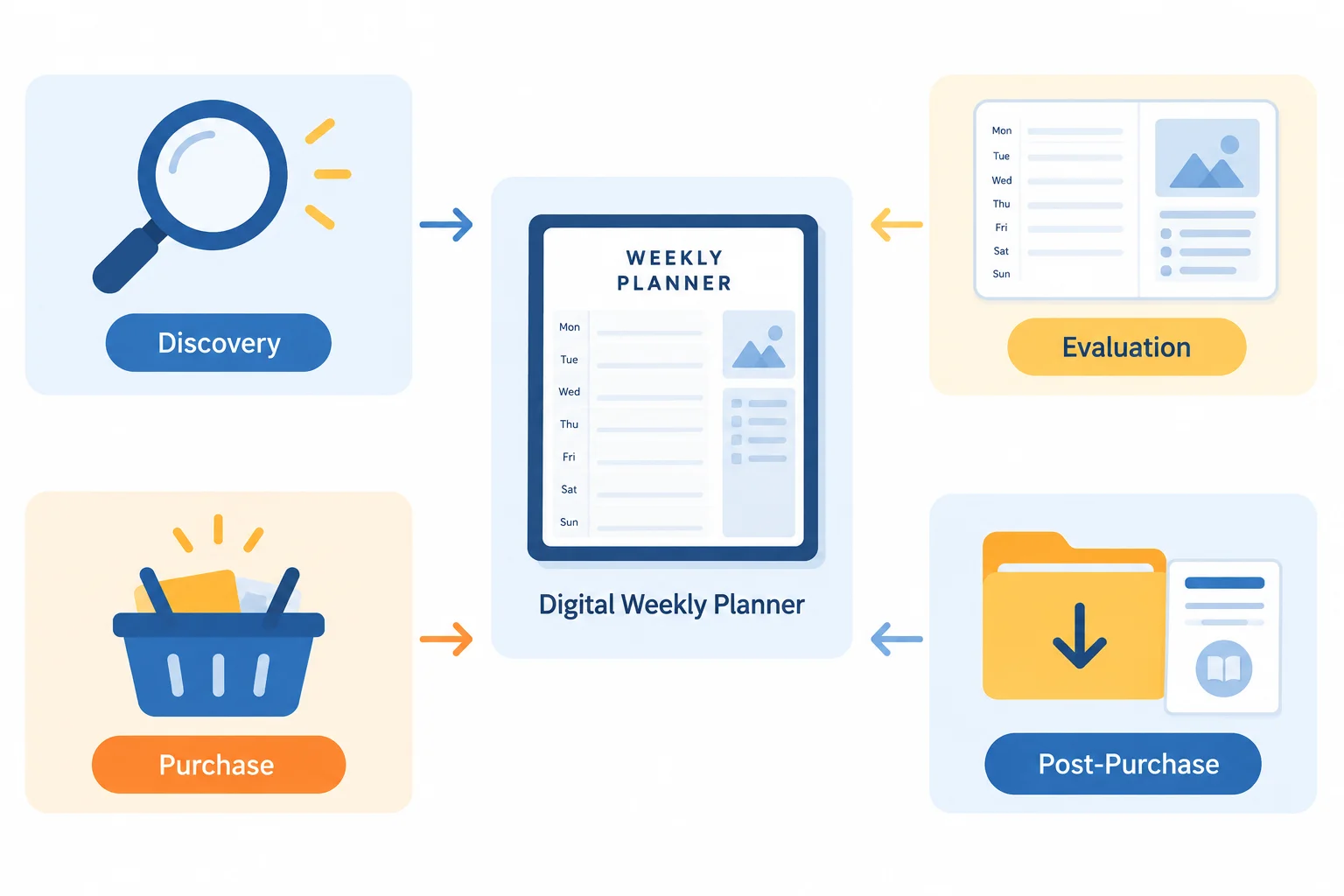
The channel context can change at each stage, but the central offer facts must remain aligned.
Use these fixed case facts as the offer source of truth.
| Invariant | Approved fact | Guardrail |
|---|---|---|
| Product | Weekly Planner Pack for independent consultants | Do not imply unsupported outcomes or features. |
| Price | $29 | Do not show a different price. |
| Payment model | One-time payment | Do not call it recurring or a subscription. |
| Access | Instant download | Do not imply a trial or delayed delivery. |
| Preview access | Preview available without an email address | Keep the Preview page ungated. |
Purposeful reuse does not mean pasting identical copy everywhere. Reuse the same asset or promise where it solves the same customer uncertainty, then adapt the framing to the originating context and intended next action.
The Worked-week example depicts a consultant's realistic client week and appears on the ungated Preview page. It can support discovery and evaluation without requiring a visitor to join the email list. The Product page handles the purchase decision, while the Getting-started guide supports the customer after instant download.
Each route uses a shared asset while preserving the offer core.
| Journey context | Possible framing | Intended next action | Supporting asset |
|---|---|---|---|
| Search discovery | Check whether this planning approach fits a client week. | Open the preview | Worked-week example on the Preview page |
| Organic social | See one realistic planning moment. | Explore the full example | Preview page |
| Permission-based email | Revisit the example when evaluating fit. | Review or buy | Preview page or Product page |
| Conversion | Confirm the offer before paying. | Purchase and download | Product page |
| Post-purchase | Begin using the purchased pack. | Open first-use guidance | Getting-started guide |
A message or asset is dependent when it repeats an offer fact, makes a promise about access, or sends a customer to a destination that must fulfill that promise. When a detail is corrected, trace outward from that detail.
Decision — Update direct claims and any mechanics that rely on the corrected detail. Do not rewrite every touchpoint by default. A social post that only links to the ungated preview, for example, is not dependent on payment-model wording.
This is a coherence check: an attractive channel-specific message is still a problem if its promise conflicts with the shared offer core.
Example — A draft mistakenly describes the $29 pack as a subscription. Correct the payment-model claim to one-time payment and review only touchpoints that state or rely on that claim.
| Touchpoint | Relationship to payment model | Action |
|---|---|---|
| Product page | Direct offer statement | Check it; edit only if it contains the error. |
| Promotional email | Direct offer statement | Correct the wording before sending. |
| Paid-media ad | Direct offer statement | Correct the claim and destination message. |
| Preview page | May only describe ungated preview access | No payment-model edit unless it makes that claim. |
| Worked-week example | Evaluation asset, not a payment claim | Keep the asset; no payment-model edit. |
| Getting-started guide | Post-purchase guidance | Review only if it states billing or access conditions. |
A scheduled LinkedIn post says, “See a realistic consultant client week before buying,” and links to the ungated Preview page. A promotional email and a paid-media draft both say, “Begin your $29 subscription,” and link to the Product page. The Product page correctly states the actual offer.
Classify the LinkedIn message and the email/paid-media message as legitimate adaptation or offer contradiction. Then identify every listed touchpoint that needs a change after the payment-model error is corrected, and explain why the others do or do not need one.
Write at least 120 characters (0/120).

Step 7 of 8
Diagnose breaks in a strategic core and repair the connected decisions, handoffs, and shared assets.
An integration failure is a conflict between decisions in a strategic core. Review a draft with five checks:
Trace each problem backward to the decision or dependency that produced it. Then repair the connected plan: a channel status, handoff, shared asset, and dependent message may all need to change. Planning links support a reasoned choice; they do not prove that the 100-purchase planning target will be achieved.
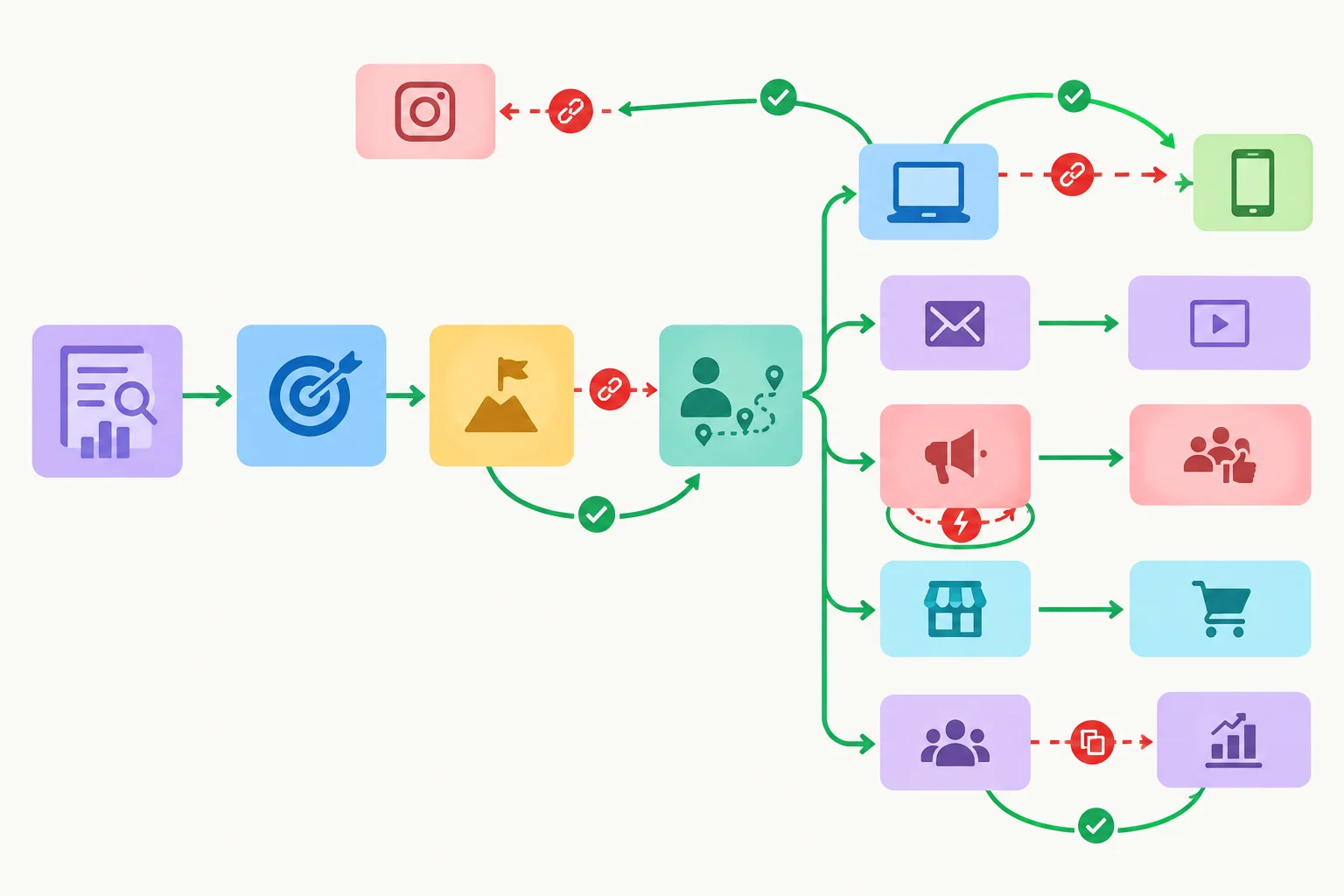
Inspect links among evidence, decisions, touchpoints, handoffs, and shared assets—not channels in isolation.
Tip
A local edit can create a new failure elsewhere. For example, changing a social call to action is not enough if the destination still requires an email address before showing a preview promised as ungated. The repair must update both the handoff and the destination experience.
Example
Fictional case evidence: Of 12 customer interviews, 8 mentioned searching for planning templates and 7 wanted to see a realistic client week before buying.
A flawed draft for FocusFlow contains these choices:
Organic social | View a realistic client week | Email signup form | Worked-week example | Not applicableThe draft does not merely have weak copy. It leaves a search-related journey need uncovered, sends a promised view to a sign-up barrier, contradicts the fixed offer, and duplicates a shared asset.
Each correction changes a connected part of the strategic core. The objective remains a planning target of 100 purchases in the next 90 days, compared with 80 purchases in the previous 90 days; these repairs do not turn it into a forecast.
| Failure source | Connected repair | Consequence |
|---|---|---|
| SEO is Exclude | Set SEO to Include; route relevant search intent to Preview page | Covers template-search discovery |
| Social handoff ends at sign-up | Route social to Preview page with the Worked-week example | Fulfills the promised next action |
| Email promises a trial | Use the fixed offer terms or invite a preview | Aligns email and Product page |
| Separate asset versions | Reuse one Worked-week example with channel-specific framing | Removes duplicated production |
Which handoff best repairs an organic social post that promises an ungated realistic client-week view?
Diagnose this deliberately inconsistent FocusFlow mini-plan.
Fictional case evidence: Of 12 customer interviews, 8 mentioned searching for planning templates and 7 wanted to see a realistic client week before buying.
Positioning: A Weekly Planner Pack for independent consultants who want to plan a realistic client week.
Objective: Planning target: 100 purchases in the next 90 days; baseline: 80 purchases in the previous 90 days.
Organic social | View the ungated Worked-week example | Email signup form | Worked-week example | Not applicableIdentify at least two underlying integration failures. Propose connected repairs, then explain how one repair changes at least one other touchpoint, shared asset, handoff, or portfolio decision.
Write at least 350 characters (0/350).

Step 8 of 8
Assemble, review, and repair a coherent integrated strategic core for the FocusFlow fictional case.
A completed strategic core is a short, connected set of decisions—not six separate channel plans. Assemble your earlier work so a reader can follow one planning line:
Evidence -> Positioning -> Objective -> Journey need -> Channel contribution -> Intended outcome
For FocusFlow, label the interview findings as Fictional case evidence, label chosen responses as Decision, and label anything not supported by the supplied inputs as Assumption. The arrows show planning links, not proof that an activity will cause a result.
Keep the objective precise: Decision: 100 purchases in the next 90 days. This is a planning target, not a forecast; the baseline is 80 purchases in the previous 90 days.
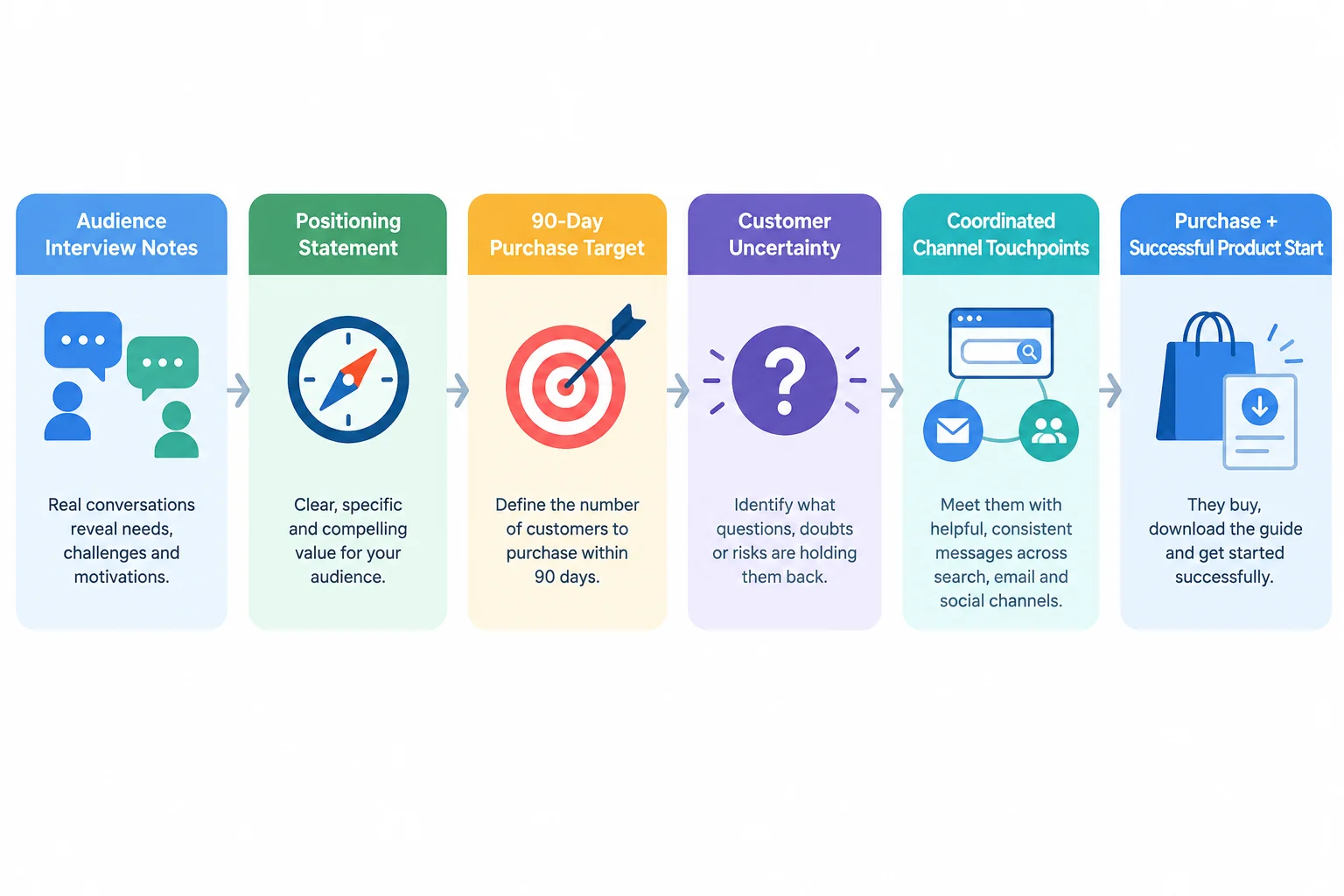
Use the flow to check that each later choice has a visible link back to evidence and forward to an intended outcome.
Summary
Before finalizing, make sure your draft contains these linked sections.
Record one status for every planning area. Status is scoped to this 90-day plan only: it does not claim that a channel always works or never works. A Defer decision needs a readiness requirement; an Exclude decision needs a scope-based reason. Your rationale should show how remaining activities still cover the priority journey needs.
| Planning area | Status for current 90-day plan | Rationale to record | Coverage or dependency to check |
|---|---|---|---|
| Content | Include, Defer, or Exclude | Need, evidence, or readiness link | Shared asset or journey need |
| SEO | Include, Defer, or Exclude | Need, evidence, or readiness link | Search-to-destination path |
| Organic social | Include, Defer, or Exclude | Need, evidence, or readiness link | Discovery-to-next-action path |
| Paid media | Include, Defer, or Exclude | Need, evidence, or readiness link | Readiness requirement if deferred |
| Include, Defer, or Exclude | Need, evidence, or readiness link | Permission condition | |
| Conversion | Include, Defer, or Exclude | Need, evidence, or readiness link | Promise and destination match |
Run four final checks.
Traceability: Can each included contribution be linked to a priority journey need and intended outcome? Do not treat the interview findings as proof that 100 purchases will occur.
Journey coverage: Can a searcher or social visitor reach the promised evaluation experience? Are there at least two purposeful handoffs rather than dead ends?
Promise consistency: Wherever the offer appears, it remains $29, one-time payment, instant download, and no subscription. The Worked-week example is on the ungated Preview page; no email address is required for that preview.
Explicit uncertainty: Mark claims that go beyond the inputs as Assumption. Repair a mismatch across channels, or flag it clearly if it remains unresolved.
Tip
This strategic core decides what should work together and why. It does not yet assign owners, sequence work, build a budget scenario, set measurement decision rules, or package a stakeholder pitch. Those are the next planning tasks.
Write a compact final strategic core for FocusFlow in your notes. Use labeled sections and include all of the following:
Origin | Intended next action | Destination | Supporting asset | Permission condition.Do not propose a website build, campaign launch, or automatic consent.
Write at least 700 characters (0/700).
Congratulations! You completed: Connect Channels in an Integrated Marketing Plan
Thousands of online courses in video, ebooks and audiobooks.
To test your knowledge during online courses
Generated directly from your cell phone's photo gallery and sent to your email

Download our app via QR Code or the links below:.


Carry knowledge in your pocket.
Download the Cursa app.
There are hundreds of free courses available, with a free certificate of completion that is saved in your mobile image gallery.
Download the app to access the Course Completion Certificate for Free.

+ 10 million
students

Free and Valid
Certificate

60 thousand free
exercises

4.8/5 rating in
app stores

Free courses in
video and ebooks