
Step 1 of 8
Choose a professional problem worth addressing
Identify a specific professional audience problem that is useful to address on LinkedIn.

Learning path · Level 4 · Tutorial 3
Draft a LinkedIn post and interaction plan that demonstrate useful professional knowledge and invite relevant business conversations. Practice through written examples without posting publicly or contacting strangers.

 Choose a professional problem worth addressing
Identify a specific professional audience problem that is useful to address on LinkedIn. 2 min
 Match the voice to the author
Choose a personal profile or organization Page based on ownership, permission, and a voice that does not overstate authority. 2 min
 Support an insight without overstating it
Use fictional practice data to make a useful professional observation without turning a small review into a causal claim or guaranteed result. 2 min
 Draft a post that earns discussion
Create a concise, evidence-supported LinkedIn post that invites a relevant professional discussion. 3 min
 Contribute a substantive comment
Practice adding a specific, relevant contribution to a simulated LinkedIn discussion without redirecting it into promotion. 2 min
 Follow up with context and permission
Practice a low-pressure follow-up that responds to context, offers useful help, and respects permission and boundaries. 2 min
 Recognize relevant business interest
Interpret LinkedIn response signals by the evidence they contain, distinguishing visibility and polite engagement from relevant professional discussion and explicit interest. 2 min
 Complete your credibility-building draft
Finalize a credible LinkedIn post and a written interaction plan for a simulated professional conversation. 3 min
Step 1 of 8
Identify a specific professional audience problem that is useful to address on LinkedIn.
LinkedIn relevance starts with a professional situation, not a broadly appealing topic. Define three things:
In this tutorial, the reader is fixed: marketing managers at small B2B software companies. Their work problem is unclear ownership of content approval. A useful contribution helps that reader think through a task they recognize.

A relevant LinkedIn topic sits at the intersection of a reader's role, a specific task, and their work context.
Tip
Business relevance is not a sales pitch. Begin by being useful to the right people: name a problem they can recognize and offer a focused angle worth considering.
Maya Chen, content operations lead at Harborline Studio, is preparing written practice examples about approval ownership. The setting gives the examples a shared professional context, but no account, public post, or contact with strangers is required.
Keep the topic narrow enough that a marketing manager can immediately recognize the task. The goal is to help with a real work problem—not to make a general announcement about Harborline Studio.
Example
Broad topic: “Why content marketing matters”
This could apply to almost anyone, but it does not identify a decision or task.
Professional problem: “Clarifying who gives final approval on a content brief”
This points to a concrete workflow issue for the defined audience. It can lead to a useful discussion without promising a service or outcome.
Which topic is most professionally relevant for the fixed audience and work problem?
Choose the most professionally relevant topic below. Then state the audience and work problem in one sentence.
A. How marketing managers at small B2B software companies can clarify final approval ownership for content briefs
B. General productivity tips for every kind of team
C. Why content is important
D. A general Harborline Studio update
Write the topic letter, followed by your one-sentence audience-and-problem statement.
Write at least 35 characters (0/35).

Step 2 of 8
Choose a personal profile or organization Page based on ownership, permission, and a voice that does not overstate authority.
On LinkedIn, the publisher signals who is speaking.
A personal profile represents an identifiable professional. Maya Chen can use I to share a firsthand observation or lesson from her work.
An organization Page represents Harborline Studio through an authorized author. It can use we to describe a shared practice or an organizational finding.
For marketing managers at small B2B software companies, either publisher can address unclear ownership of content approval. Choose based on who owns the experience and has permission to speak—not on an assumed reach advantage.

The voice changes with the publisher: an individual can speak from personal experience; an authorized organization can describe shared practice.
Keep the underlying situation truthful when you change publishers. A different voice does not give Maya or Harborline Studio extra authority.
If Maya refers to the internal review from her personal profile, she should identify it as Fictional practice data from Harborline Studio rather than present it as her personal research. An organization Page may describe the same organizational evidence using we, when Maya is authorized to do so.
Use the voice that matches the situation.
| Situation | Appropriate publisher | Voice boundary |
|---|---|---|
| Maya shares a lesson from supporting approval discussions | Personal profile | Use I; describe her own observation, not a company-wide promise. |
| Harborline shares an authorized finding from its internal review | Organization Page | Use we; identify the review as organizational evidence. |
| Harborline explains a shared approval practice | Organization Page | Use we only when the practice is authorized to be described. |
Match each publishing situation to the most appropriate author and voice.
Tap an item and then its matching pair.
Scenario: Maya has permission to publish from her personal profile about what she observed while supporting marketing managers. She does not have permission to speak for Harborline Studio’s full review or make commitments for the organization.
Write the publisher choice and a 25–40 word opening for marketing managers at small B2B software companies facing unclear ownership of content approval. Use a voice that fits Maya’s authority.
Write at least 25 characters (0/25).

Step 3 of 8
Use fictional practice data to make a useful professional observation without turning a small review into a causal claim or guaranteed result.
A credible insight can start with a small, clearly described review. It does not need a dramatic claim.
Fictional practice data: Harborline Studio reviewed 10 content briefs. Six lacked a named final approver; five of those missed their planned approval date. Four named a final approver; one of those missed its planned approval date.
This supports a bounded observation: in this review, missed dates appeared more often among briefs without a named final approver. It does not prove that naming an approver caused deadlines to be met.
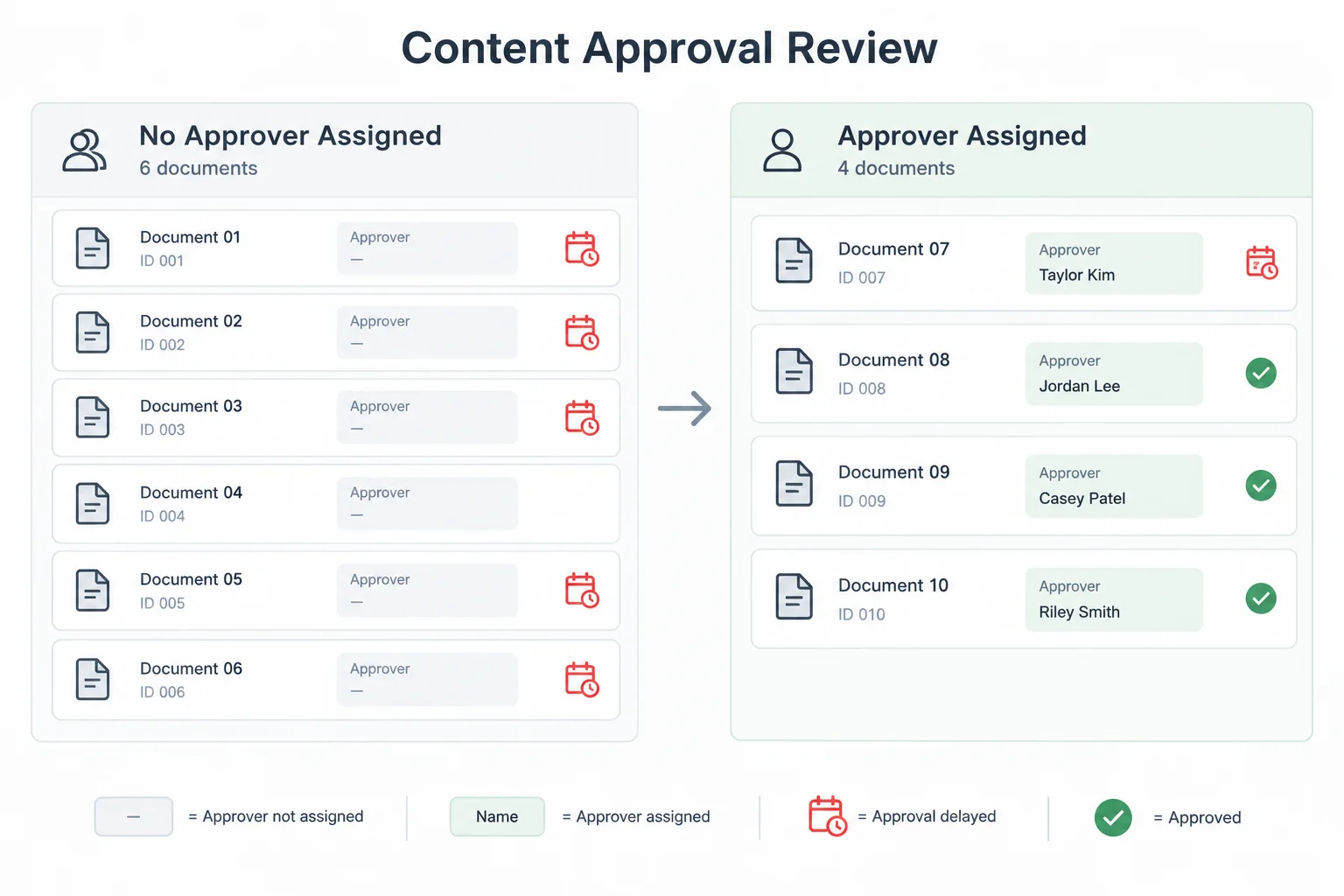
Fictional practice data: a descriptive pattern from 10 reviewed briefs, not a controlled comparison.
Tip
Name the source and scope of the evidence, then state the limitation that matters. Here, the source is Harborline Studio’s internal review, the scope is 10 content briefs, and no controlled comparison was conducted.
For an external fact, give traceable attribution. If you cannot identify a source a reader could check, do not present the claim as evidence.
Keep three statements separate: what the review observed, what you recommend, and what the review cannot establish. A recommendation may be useful even when it is not a proven outcome.
These examples use only authorized, nonconfidential fictional details. Do not replace evidence with invented statistics, unnamed client testimonials, or promised outcomes.
| Statement type | Evidence-aware wording | What it does |
|---|---|---|
| Supported observation | In Harborline Studio’s fictional internal review of 10 briefs, five of six briefs without a named final approver missed their planned approval date; one of four briefs with a named final approver did so. | Reports the source and counts. |
| Practical recommendation | Consider naming a final approver when a brief is created, then review whether this reduces approval ambiguity in your own workflow. | Offers an action without promising a result. |
| Unsupported causal claim | Naming a final approver prevents missed approval dates. | Claims a cause the review did not test. |
| Unsupported promise | Use this process and approvals will always be on time. | Promises an outcome no evidence can guarantee. |
Example
Maya can describe an observation from the organizational review with permission. Whether she writes as a personal profile or an organization Page, the facts, source, and limitation stay the same; changing voice never turns an observation into proof.
True or false: Because five of six briefs without a named final approver missed their planned approval date while one of four briefs with a named final approver did so, naming a final approver caused briefs to meet their approval dates.
Rewrite this overstated claim: “Naming a final approver guarantees on-time approval.”
Write 2–3 sentences. First, identify why the claim is unsupported and state a bounded observation using this Fictional practice data: Harborline Studio reviewed 10 content briefs; 6 lacked a named final approver and 5 of those missed their planned approval date; 4 named a final approver and 1 of those missed its planned approval date; no controlled comparison was conducted. Then give one practical recommendation without promising a result.
Write at least 180 characters (0/180).

Step 4 of 8
Create a concise, evidence-supported LinkedIn post that invites a relevant professional discussion.
A discussion-worthy post gives a specific professional reader a reason to keep reading, then a reason to respond. For this audience, use four short paragraphs:
This sequence is not an algorithm trick. It makes the reasoning easy to scan and keeps one useful idea in focus.
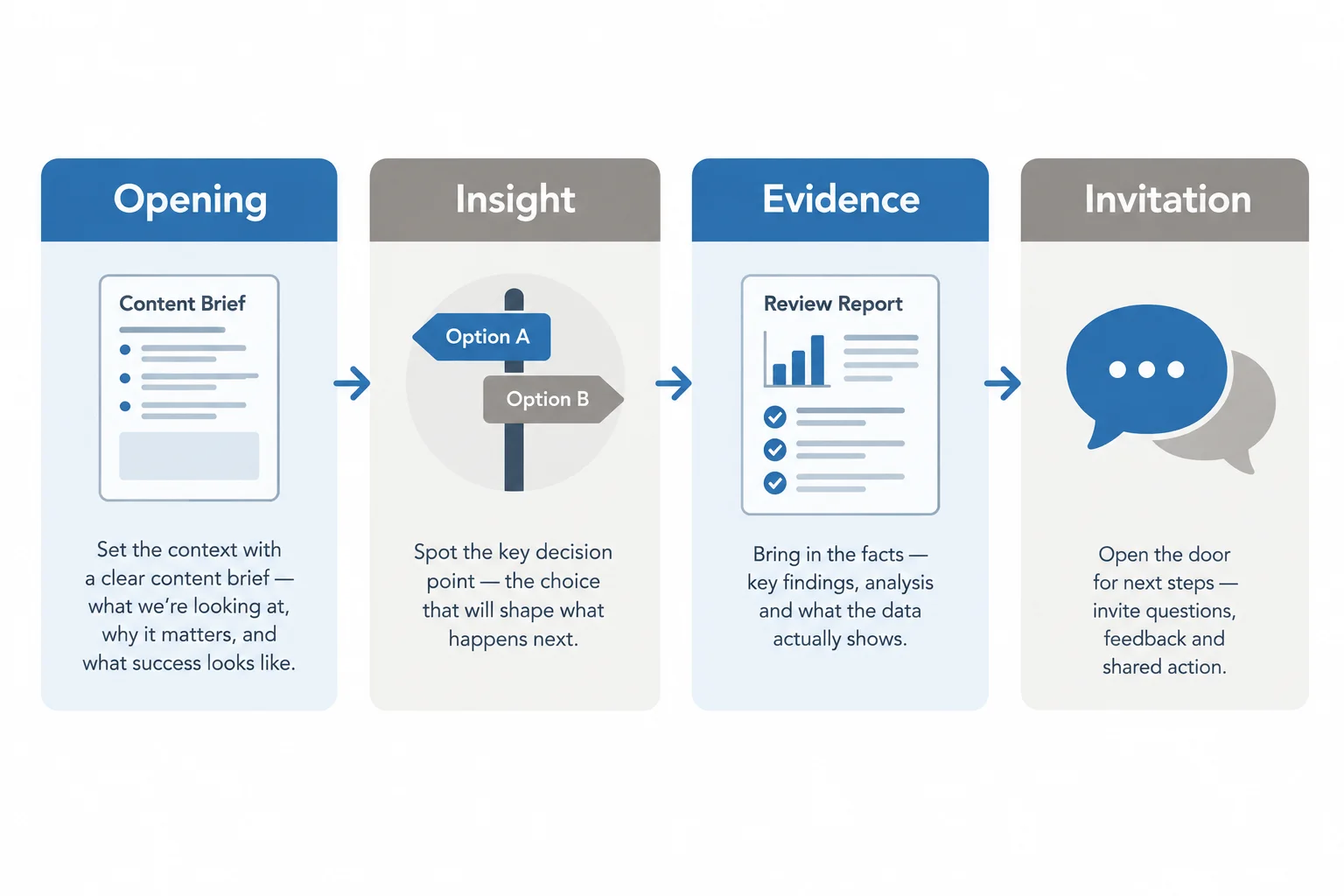
Opening → Insight → Evidence → Invitation
Evidence should support the insight, not turn it into a promise. Identify the organizational source, give the relevant counts, and state the limitation: this review was not a controlled comparison.
A credible invitation stays on the same problem. It asks peers how they handle final approval. It does not ask for forced agreement, chase reactions, or jump to a sales request. The labels below explain the draft structure; they do not belong in the finished post.
Example
Approval delays often look like a calendar problem, but unclear ownership can be part of the issue.
For marketing managers at small B2B software companies, I recommend naming one final approver in every content brief before review begins. It gives feedback a clear decision point.
At Harborline Studio, an internal review of 10 content briefs found that 6 lacked a named final approver, and 5 of those missed their planned approval date. Of the 4 briefs with a named final approver, 1 missed its planned approval date. Fictional practice data: this is a small internal review, not a controlled comparison, so it does not prove cause and effect.
How does your team make the final approval decision clear?
Put the four post sections into the taught order.
Post
Draft a 100–140-word LinkedIn post for marketing managers at small B2B software companies about unclear ownership of content approval. Write as Maya Chen on either a personal profile or an authorized organization Page. Use the voice consistently: Maya’s personal observations use “I”; authorized organizational statements use “we.”
Use short plain-text paragraphs that follow Opening → Insight → Evidence → Invitation. Include one practical recommendation and label the case evidence “Fictional practice data.” State that Harborline Studio’s internal review covered 10 content briefs: 6 lacked a named final approver and 5 of those missed their planned approval date; 4 named a final approver and 1 of those missed its planned approval date. Make clear that no controlled comparison was conducted. End with a focused question about final approval, without promising results or requesting a sale.
Write at least 500 characters (0/500).

Step 5 of 8
Practice adding a specific, relevant contribution to a simulated LinkedIn discussion without redirecting it into promotion.
A substantive comment stays connected to a specific point in the original post. It does more than praise: it adds a relevant example, practical nuance, clarifying question, or respectful disagreement.
For Harborline Studio, Maya Chen can contribute without making a sales pitch. She should be clear about whether she is sharing direct experience or offering a suggestion, and she should not disclose client details. The aim is to help marketing managers at small B2B software companies think more clearly about unclear ownership of content approval.

A useful comment responds to the existing discussion before adding one relevant contribution.
Example
Simulated conversation
Peer post: “Approval delays are rarely just a calendar problem. If no one has the final decision, feedback can keep circulating. What signals tell you that a brief needs clearer ownership?”
Maya Chen: “I have found that assigning an approver is more useful when the brief also states what that person can decide. Otherwise, the title simply becomes another review step. For marketing managers, is the decision boundary visible before feedback begins?”
This 39-word comment names the point it is extending, identifies Maya’s experience, adds a practical condition, and asks a focused question.
Two common replies add little professional value:
Neither needs to be hostile to be weak. A comment can be brief and still useful when it stays on the topic and contributes a concrete thought.
Example
Simulated conversation
“Great insight! Everyone needs to see this.”
This praise could appear under almost any post. It does not engage with approval ownership, add a relevant example, or move the discussion forward.
Example
Simulated conversation
“We solve approval problems for software teams. Download our checklist here: [link].”
This redirects a peer’s discussion to a promotion. It offers no response to the point the peer raised and gives readers little reason to trust the commenter’s expertise.
Simulated conversation
A comment says, “Great insight—so true!” Another says, “We solve this problem. Download our checklist here: [link].”
Why do these comments add little value to the discussion?
Simulated conversation
A peer writes: “At our small B2B software company, content approval often stalls because product and legal both comment, but neither owns the final decision. We are considering a named approver in every brief. What has made this work—or fail—in your team?”
As Maya Chen, write two clearly separated parts:
Write at least 180 characters (0/180).

Step 6 of 8
Practice a low-pressure follow-up that responds to context, offers useful help, and respects permission and boundaries.
A follow-up is a response to an actual exchange—not a trigger to pitch. Read what the person asked, disclosed, or declined, then choose the smallest useful next step.
Maya Chen can answer a relevant question in the same public discussion, offer a concise clarification, or ask whether more discussion would help. A reaction or public comment alone does not grant permission to move someone into a private sales conversation.
If there is no reply, or the person declines, stop. Do not send repeated or automated outreach.
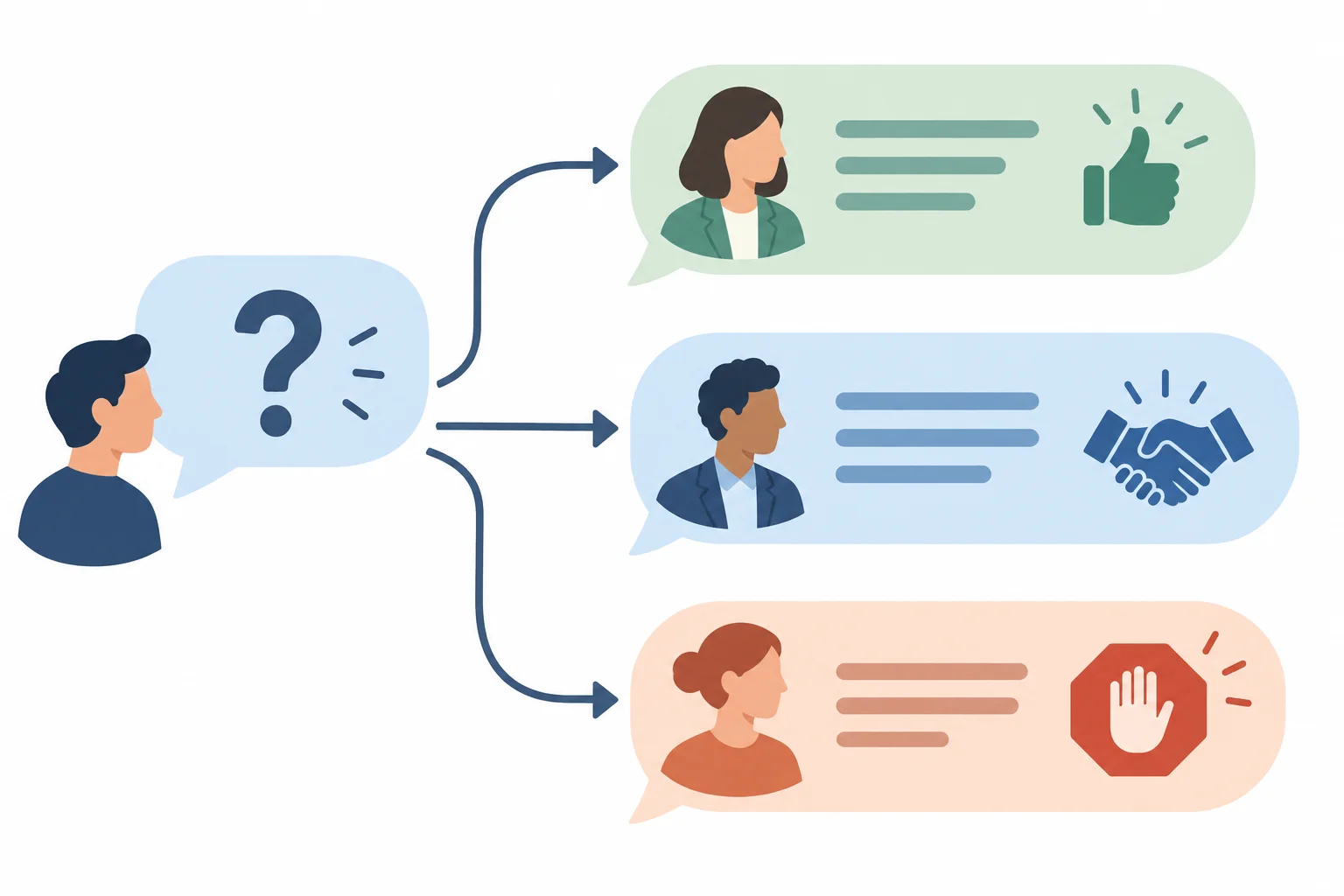
The response determines the next action: keep useful answers public when possible, seek agreement before changing channels, and respect boundaries.
Keep the next action proportionate. A clear question can receive a clear public answer. If someone signals interest in exploring a topic, ask whether a further conversation would be useful rather than assuming they want one.
Whether Maya is writing from her personal profile or as an authorized organization Page author, she should not imply a purchase, promise an outcome, or reveal confidential client details.
Use the response itself to decide what happens next.
| What the person does | Appropriate action |
|---|---|
| Asks a specific question | Answer it publicly if the answer is suitable there |
| Signals openness to discuss | Ask whether further conversation would help; agree on an appropriate available channel |
| Declines or does not reply | Acknowledge a decline if needed, then stop outreach |
Example
Simulated conversation
Maya’s comment: “One pattern I have seen in content operations is that a review date alone does not settle accountability. When one person is named as final approver, contributors can resolve feedback before the deadline. How do you record that ownership when several teams review a brief?”
Reply: “We use a checklist, but final approval becomes unclear when product and legal both comment. What does the handoff look like?”
Maya’s public follow-up: “Thanks for explaining that context. A simple option is to record one final approver beside the checklist and treat product and legal as required reviewers. Would a short example of the handoff be useful here?”
Match each reply from a Simulated conversation to the most proportionate next action.
Tap an item and then its matching pair.
Simulated conversation
Maya commented: “I’ve found that unclear final approval can make a content calendar look settled when it is not. For marketing managers working across product and legal reviews, naming one final approver may make the decision path easier to see. Where does approval ownership become least clear on your team?”
A marketing manager replied: “We have several reviewers, but no one owns the last decision. I would be interested in a simple way to document that handoff.”
Write a 30–50-word follow-up from Maya. Acknowledge the reply, offer one useful clarification, and ask permission before proposing any further conversation. Do not assume purchase intent or move the conversation to a private channel without agreement.

Step 7 of 8
Interpret LinkedIn response signals by the evidence they contain, distinguishing visibility and polite engagement from relevant professional discussion and explicit interest.
A signal is useful only for what it directly shows. For Maya Chen’s LinkedIn post about unclear approval ownership, an impression shows that the post appeared in front of someone. A reaction or brief praise shows limited attention. Neither one, by itself, demonstrates a business need, a buying decision, or a result.
Classify each signal by the strongest evidence in it—not by what you hope happens next. Look for increasing specificity: professional fit, a recognizable work problem, and an explicit willingness to explore a next step.

Signal strength rises with the evidence available: viewing, light response, professional exchange, then an explicit next-step request.
Use the category that the wording supports. A thoughtful question can be valuable even when it does not express commercial interest. Likewise, an explicit request can justify a proportionate response while leaving many important details unknown.
Choose a next action that matches the quality of the signal, while keeping uncertainty explicit.
| Category | Minimum evidence | What it supports | Appropriate stance |
|---|---|---|---|
| Exposure | An impression or view count | The post was seen | Do not infer interest |
| Light engagement | A reaction or generic praise | Limited attention | Acknowledge if appropriate |
| Relevant conversation | Professional fit, a work problem, or useful exchange | A worthwhile discussion | Continue helpfully |
| Qualified expression of interest | Relevant fit, stated need, and an explicit request or willingness to explore | A possible business-related next step | Respond proportionately and with permission |
Tip
Even a qualified expression of interest is not a sale, a guaranteed opportunity, or proof that the post caused future demand. Scope, authority, timing, budget, and fit may still be unknown.
Match each supplied count or Simulated conversation to the strongest supported response category.
Tap an item and then its matching pair.
In this written simulation, classify each item using exactly one category: Exposure, Light engagement, Relevant conversation, or Qualified expression of interest.
Write a separate classification for items 1–4. Then identify which response warrants a business-related next step, name one proportionate next action in this simulation, and state one thing that remains unknown.
Write at least 220 characters (0/220).

Step 8 of 8
Finalize a credible LinkedIn post and a written interaction plan for a simulated professional conversation.
A credible LinkedIn contribution works as one connected system. For Harborline Studio, the reader is marketing managers at small B2B software companies, and the problem is unclear ownership of content approval.
Choose an author who can speak truthfully: Maya’s personal profile can use her firsthand observation in an I voice while naming the organizational review; an authorized organization Page can use we for Harborline Studio’s shared practice. In either case, keep the claim limited to what the review can support.
Your invitation should extend the same practical topic into discussion. The comment and follow-up should then respond to what a person actually says—not to a hoped-for sale or reaction total.

A coherent draft keeps the audience, author authority, evidence, invitation, and next action aligned.
Use the response signal to choose a proportionate action. A signal can guide attention without proving demand, a sale, or a future outcome.
| Response category | What it indicates | Proportionate next action |
|---|---|---|
| Exposure | A person may have seen the post | Do not infer demand or begin outreach |
| Light engagement | A reaction or brief praise | Acknowledge only when useful; do not treat it as demand |
| Relevant conversation | Audience fit, a work problem, or a substantive exchange | Reply to the actual point with a concise, useful contribution |
| Qualified expression of interest | Relevant fit, stated need, and an explicit request or willingness to explore | Respond in context and ask whether a further conversation through an appropriate available channel would help |
Summary
Before finalizing, check all four entries:
Short plain-text paragraphs help the reader follow the reasoning. The finished post does not need draft-section labels.
Simulated conversation
“A marketing manager at a small B2B software company comments: ‘We keep losing time because product and legal both assume someone else gives final content approval. How did you define the final approver?’”
Which response category best fits this comment?
Complete the four entries separately. This is a written practice exercise only: do not post publicly or contact anyone.
Choose either Maya Chen’s personal profile or the authorized Harborline Studio organization Page. For a personal profile, use I for Maya’s own observation and identify the review as organizational evidence. For an organization Page, use we for authorized organizational statements.
Fictional practice data: An organizational internal review covered 10 content briefs. Six lacked a named final approver, and 5 of those missed their planned approval date. Four named a final approver, and 1 of those missed its planned approval date. No controlled comparison was conducted.
Simulated conversation: “I manage marketing at a small B2B software company. We are defining a clearer final-approval role this quarter. Would you be open to a short conversation about how Harborline Studio frames that responsibility?”
Before submitting, check word counts, use short plain-text paragraphs, label the evidence “Fictional practice data,” protect confidentiality, and avoid claims of guaranteed results.
Post
Revise or write a 100–140 word post for the defined audience. Use the chosen author voice, one useful insight, the supplied Fictional practice data with its limitation, and a focused invitation to discuss approval ownership. Do not use a hashtag block or promise results.
Write at least 500 characters (0/500).
Comment
Write a 35–60 word substantive public comment responding to the simulated conversation. Address the person’s stated approval-ownership issue with a useful, relevant contribution. Do not turn the comment into a sales pitch.
Write at least 175 characters (0/175).
Follow-up
Write a 30–50 word low-pressure follow-up that could be used only after mutual agreement to continue the conversation through an appropriate available channel. Refer to the actual exchange, offer a proportionate next step, and leave room for the other person to decline.
Write at least 150 characters (0/150).
Response rationale
Identify the response category for the simulated conversation. State the evidence for your classification, the respectful next action, and the stopping boundary if the person declines or does not respond. Keep the rationale separate from your post, comment, and follow-up.
Write at least 180 characters (0/180).
Congratulations! You completed: Build Professional Credibility on LinkedIn
25 XP
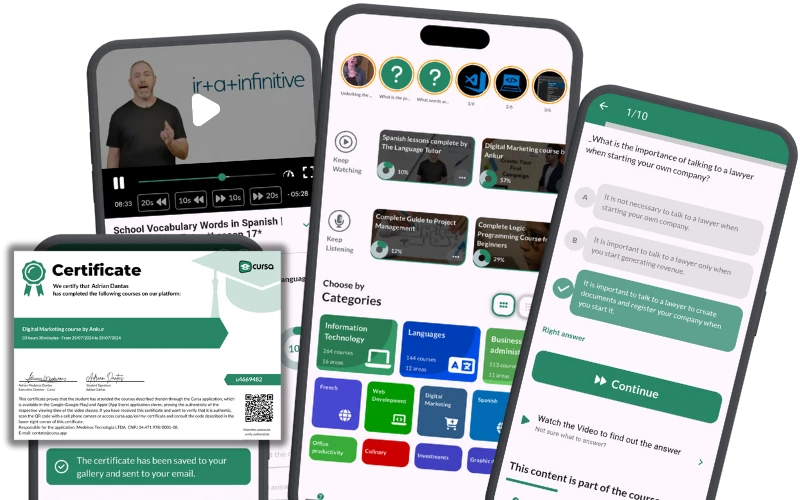
Thousands of online courses in video, ebooks and audiobooks.
To test your knowledge during online courses
Generated directly from your cell phone's photo gallery and sent to your email

Download our app via QR Code or the links below:.


Carry knowledge in your pocket.
Download the Cursa app.
There are hundreds of free courses available, with a free certificate of completion that is saved in your mobile image gallery.
Download the app to access the Course Completion Certificate for Free.

+ 10 million
students

Free and Valid
Certificate

60 thousand free
exercises

4.8/5 rating in
app stores

Free courses in
video and ebooks