
Step 1 of 7
Define the Complete User Outcome
Define a bounded task from its incoming request to a usable deliverable or explicit escalation outcome.

Learning path · Level 10 · Tutorial 1
Turn a real, low-risk user problem into a compact solution specification. Connect requirements, authorized sources, component responsibilities, human checkpoints, and acceptance criteria while making important design tradeoffs explicit.
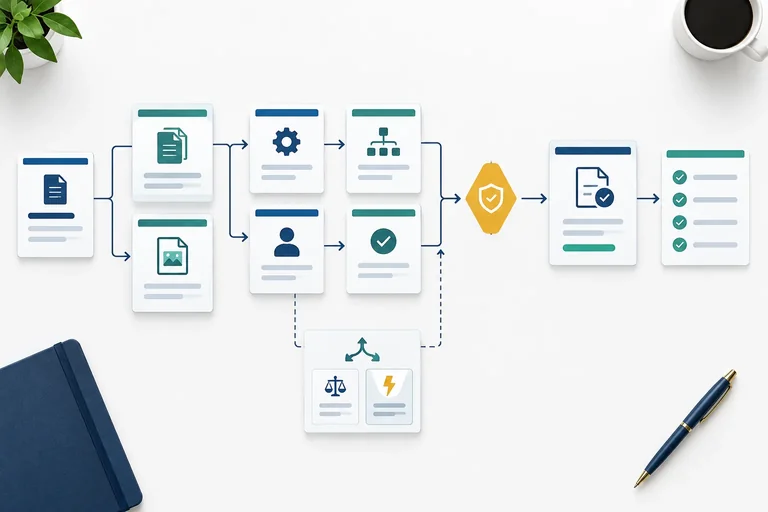
 Define the Complete User Outcome
Define a bounded task from its incoming request to a usable deliverable or explicit escalation outcome. 2 min
 Connect Requirements to Authorized Sources and Rules
Map observable requirements to authorized factual sources or operating rules, and make unsupported coverage explicit. 3 min
 Assign Responsibilities and Human Checkpoints
Assign AI, deterministic, and human responsibilities across a complete workflow, including authorized-source lookup, review, and escalation routes. 3 min
 Build the Requirement-to-Evidence Chain
Link each requirement to its authorized basis, workflow responsibility, human checkpoint, observable condition, and planned evidence. 3 min
 Resolve a Conflict and Record the Tradeoff
3 min
 Set Whole-Solution Acceptance Criteria
Finalize observable acceptance criteria that combine baseline-linked value, mandatory quality and safety gates, exception accounting, and honest limits on planned evidence. 4 min
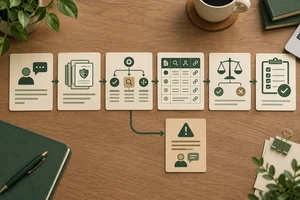 Finalize and Check Your Solution Specification
Complete and consistency-check a compact end-to-end solution specification before later assembly work. 3 min
Step 1 of 7
Define a bounded task from its incoming request to a usable deliverable or explicit escalation outcome.
An end-to-end specification starts with a real request and finishes with something the intended user can use. A helpful assistant draft is only an intermediate result: it is not the finished outcome if it has not reached the required usable state.
For this tutorial, use the Cedar Arts Center case. The Front-desk coordinator needs either a reply that is ready for staff to send or a clear escalation note. The specification must allow both outcomes rather than pretending every inquiry can receive a supported answer.
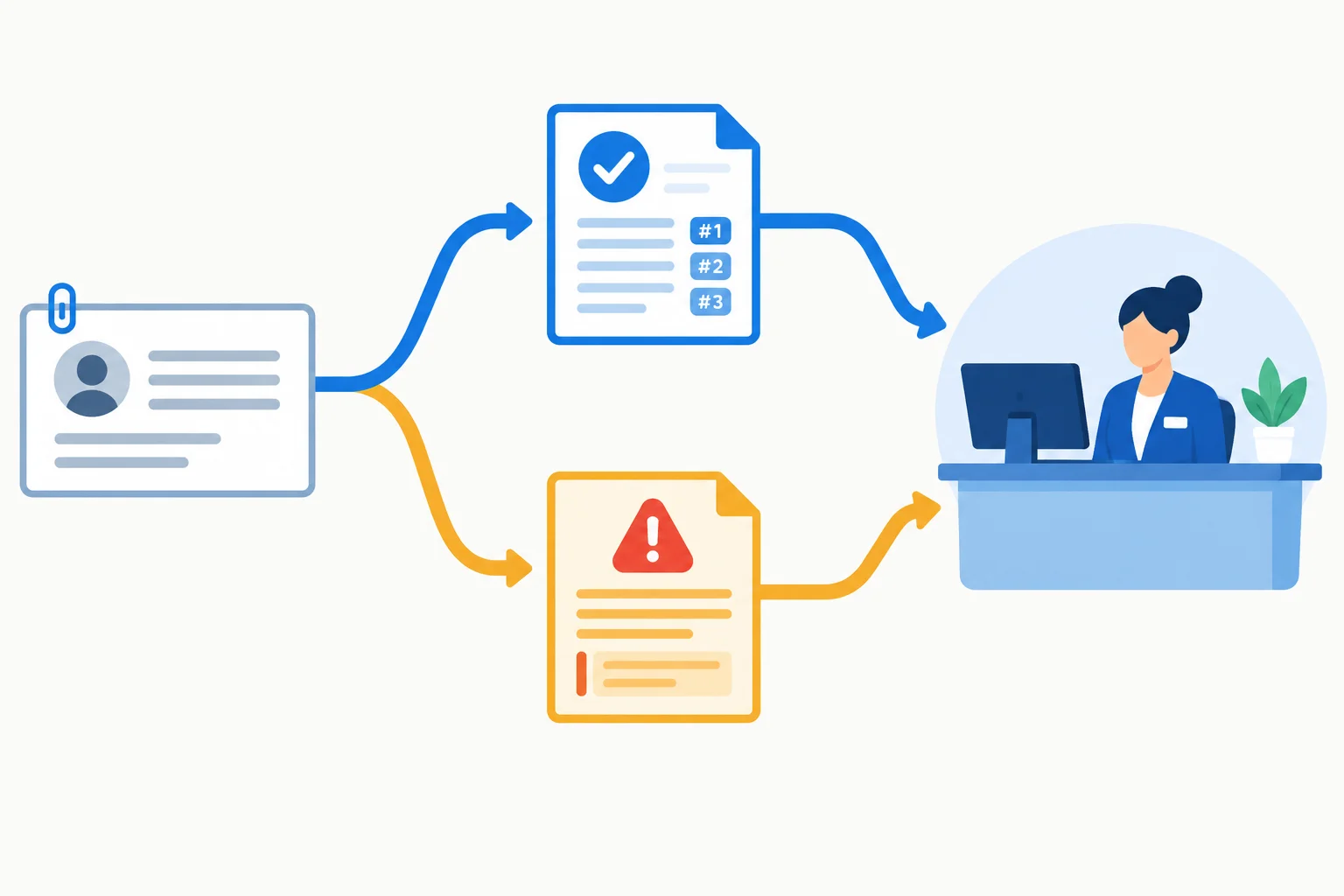
A complete task has two permitted end states: a usable reply or a safe escalation.
Use four headings to make the boundary testable. They prevent a vague statement such as “use AI to answer workshop questions.”
This is a task contract, not a tool choice or an implementation plan. You can draft it for a real low-risk task, or use the fully text-based Cedar case; no paid tool or working system is needed.
A compact boundary for the Cedar Arts Center inquiry task.
| Scope heading | Cedar Arts Center definition |
|---|---|
| Starting input | An anonymized public workshop inquiry |
| Intended user | Front-desk coordinator |
| Final deliverable | A staff-approved reply with internal source references, ready for staff to send; or an escalation note when a supported reply cannot be produced |
| Exclusions | Booking changes, live availability, payments, and automatic sending |
Warning
The phrase “ready for staff to send” matters. It describes the usable endpoint. An assistant-generated draft alone does not meet this final-deliverable definition, even when its wording looks polished.
Using the Cedar Arts Center case, write a compact task contract with these exact headings: Starting input, Intended user, Final deliverable, and Exclusions.
Then add one sentence distinguishing an assistant draft from the actual final deliverable. Your final-deliverable field must include both the supported-reply outcome and the escalation outcome.
Write at least 300 characters (0/300).

Step 2 of 7
Map observable requirements to authorized factual sources or operating rules, and make unsupported coverage explicit.
A requirement describes an observable outcome or constraint for the bounded task—not a capability label.
Compare:
For each requirement, ask: what authoritative basis allows this outcome? The basis may be an authorized factual source, an operating rule, or an established baseline or threshold. If no basis exists, the specification must limit the outcome rather than let the system guess.
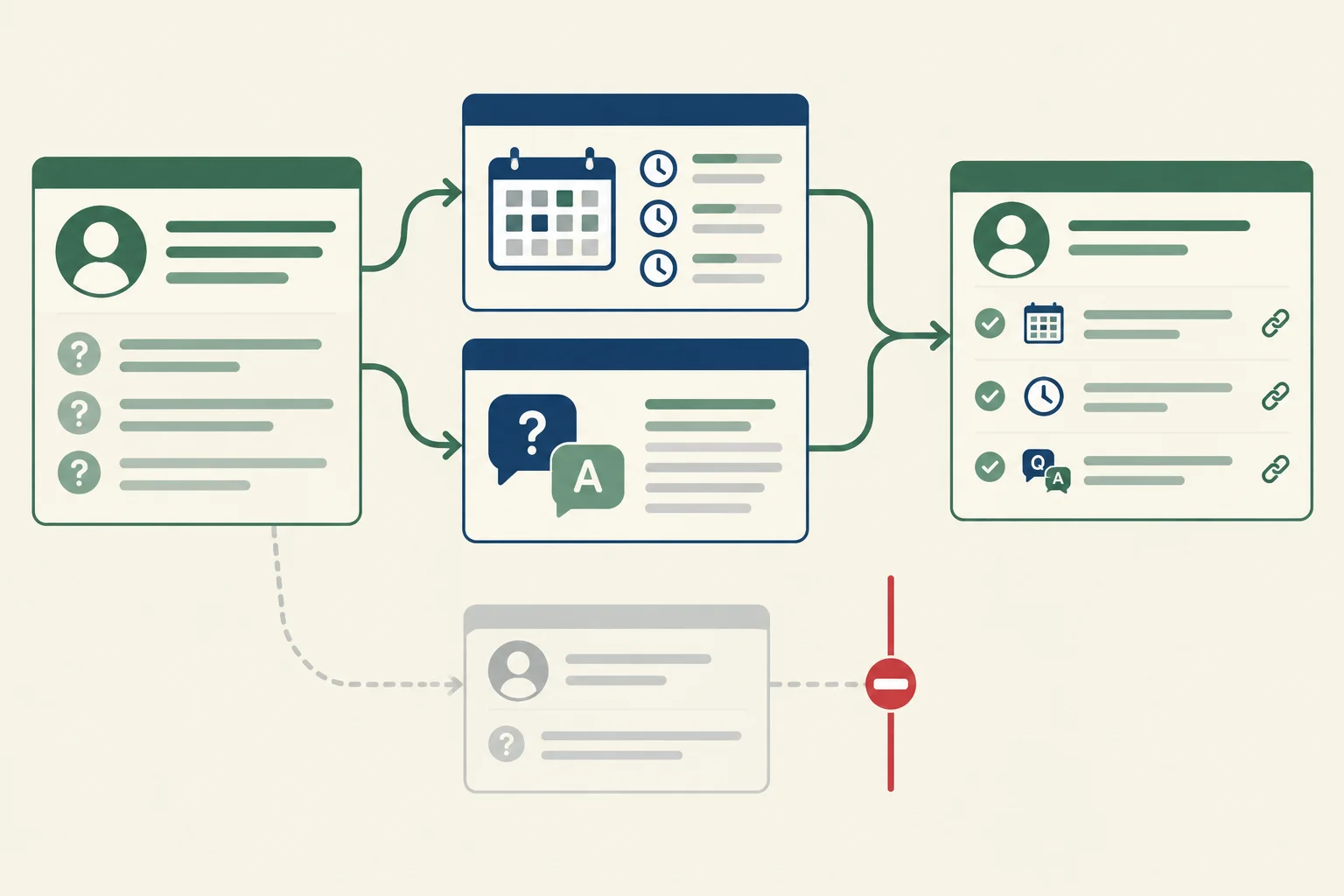
A usable reply can contain only claims that trace to an authorized source or rule.
This compact source pack is the complete factual basis for the worked case. Its version matters: a claim may be correct in general but unsupported by the authorized material available for this task.
Operating rules also provide a basis for constraints. They are not factual sources, but they determine what the completed outcome is allowed to be.
Each row links an observable requirement to the source or rule that justifies it. The final traceability chain will add responsibilities and planned evidence later.
| Requirement | Authorized source or rule | Supported facts or constraint |
|---|---|---|
| Workshop details with source reference | Workshop Schedule, version 2026-07-01 | Paper Collage: 2026-07-18, 14:00–15:30, Room B |
| Materials statement with source reference | Visitor FAQ, version 2026-07-01 | Materials are included |
| Reviewer approval before ready to send | Operating rule | Every reply is approved before becoming ready to send |
| Safe unsupported-request outcome | Operating rule | Unresolved source gaps or conflicts produce an escalation note, not an invented answer |
Coverage is specific, not transferable. The Workshop Schedule supports the listed event details; it does not establish unrelated facts. The Visitor FAQ supports the materials statement; it does not establish venue access, booking status, or live availability.
A gap is therefore a specification constraint. If an inquiry asks for a fact outside the authorized coverage, the permitted outcome is an escalation note—not a plausible completion.
Example
Inquiry detail: “Is parking available?”
Neither the Workshop Schedule nor the Visitor FAQ supports a parking claim. The specification must not treat silence as permission to infer an answer. Record the gap and use the escalation outcome.
The same principle applies if authorized sources conflict: do not select the more convenient statement by guess. Treat the factual claim as unresolved until it can be handled by the designated process.
Warning
Do not confuse a source being authorized with it covering every possible question. Authorization, version, and relevance must all support the specific claim.
Match each requirement or requested detail to its strongest available authorized basis. One item has no factual support in the source pack.
Tap an item and then its matching pair.
Step 3 of 7
Assign AI, deterministic, and human responsibilities across a complete workflow, including authorized-source lookup, review, and escalation routes.
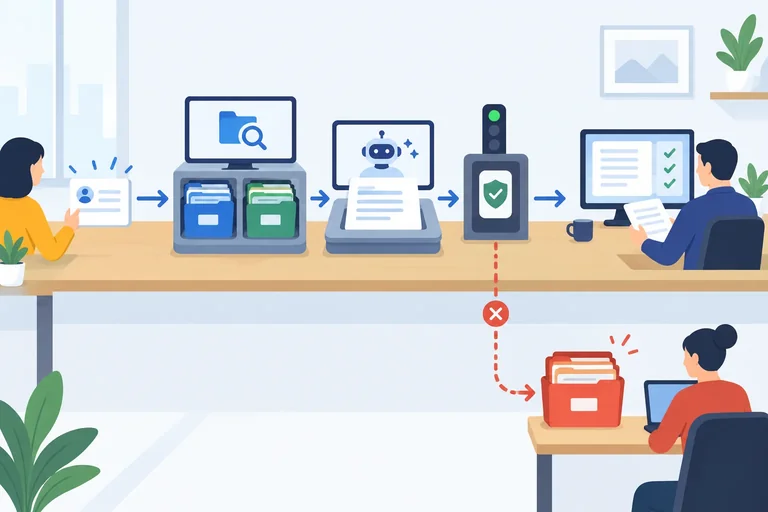
A responsibility flow assigns work and judgment without selecting tools or settings. For Cedar Arts Center, an AI component can interpret an anonymized inquiry and draft wording. A Deterministic operation can obtain the relevant entries and internal references from the authorized source pack, then flag an absent or conflicting support record. A Human decision checks whether each actionable claim is actually supported and decides the permitted outcome.
The source-lookup stage comes before drafting. It supplies facts from Workshop Schedule and Visitor FAQ, both versioned 2026-07-01, or produces a gap/conflict signal. A source reference being present is useful routing information, but it is not proof that the claim is true, complete, or applicable.
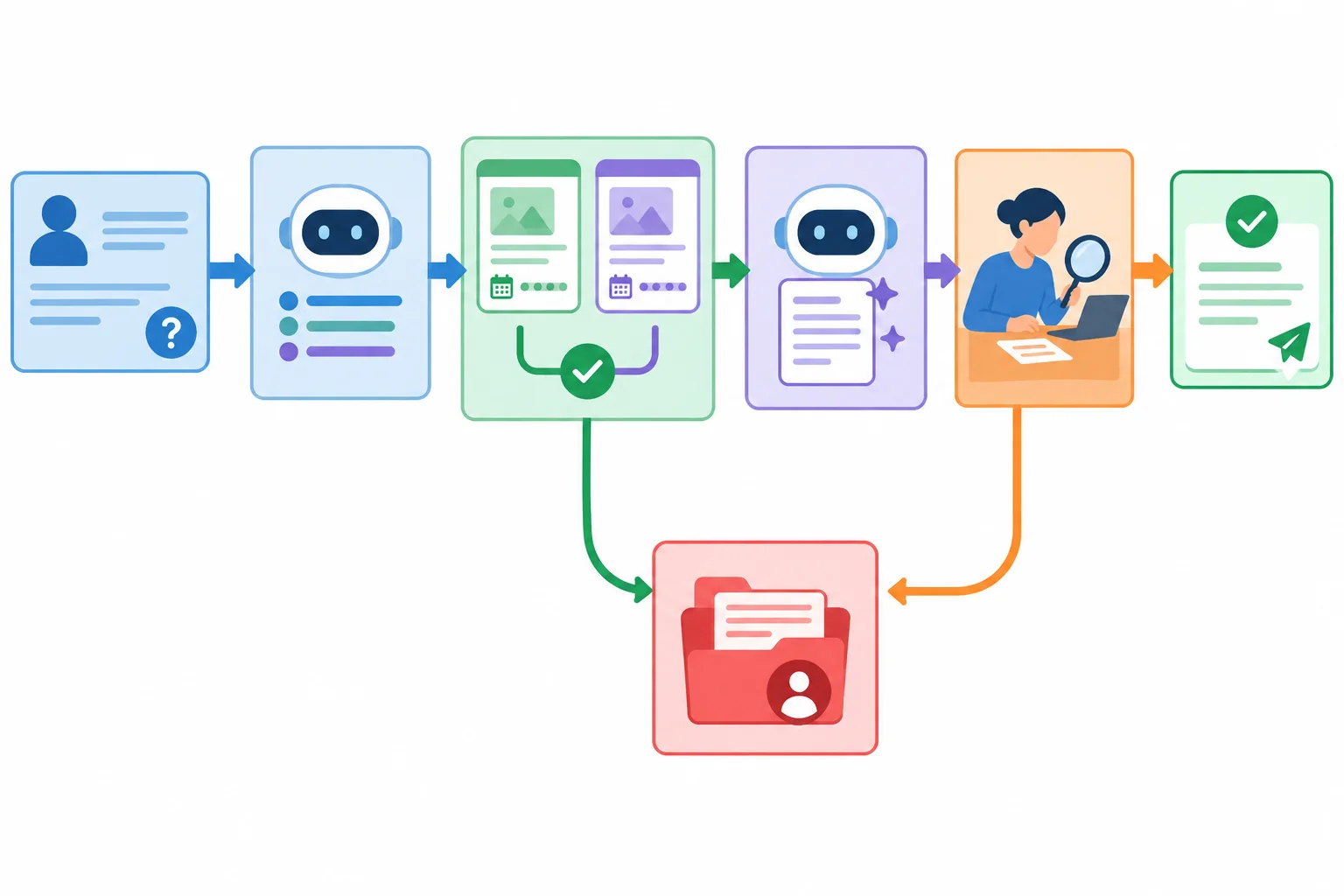
Authorized-source lookup and its gap/conflict route occur before a candidate can become a supported final outcome.
Tip
A deterministic presence check can establish only that a reference was attached or that a routing condition occurred. It cannot establish factual truth. Likewise, an AI-generated confidence statement is not approval. The Front-desk coordinator remains accountable for checking actionable claims against the authorized sources before a reply becomes ready to send.
This conceptual flow defines outputs and routing conditions. It does not prescribe a tool, prompt, field, or configuration.
| Workflow stage | Component responsibility | Expected output | Move forward when | Human checkpoint and owner |
|---|---|---|---|---|
| Interpret inquiry | AI component | Requested workshop facts and task-boundary needs | The request can be assessed against the authorized source pack | None |
| Authorized source lookup → coverage route | Deterministic operation | Relevant Workshop Schedule and Visitor FAQ entries with internal references, or a source-gap/conflict flag | Supported entries → draft; gap or conflict flag → exception decision | Front-desk coordinator receives the flagged case |
| Draft supported reply | AI component | Candidate reply using only supplied supported facts and internal source references | Candidate is available for review; attached-reference presence may be checked but does not prove claims | None |
| Review claims → decide | Human decision | Approved candidate, returned candidate, or escalation decision | Approval → final status; return → correction and re-review; unresolved support → escalation route | Front-desk coordinator |
| Resolve exception | Human decision | Confirmed escalation note, source-clarification request, or process decision | If support remains unresolved, the escalation note proceeds to final status | Front-desk coordinator confirms outcome; Program coordinator owns source clarification; Service lead owns a process decision |
| Set final status | Deterministic operation | Ready-to-send reply or recorded escalation note | Only documented approval permits ready-to-send; only a confirmed escalation permits the exception outcome | Front-desk coordinator approval or escalation record |
Example
Supported routine route: The source lookup supplies the Paper Collage entry from Workshop Schedule, version 2026-07-01: 2026-07-18, 14:00–15:30, Room B. It also supplies the Visitor FAQ, version 2026-07-01, for the statement that materials are included. The AI component drafts from those supplied facts with internal references. A reference-presence check may route the candidate onward, but the Front-desk coordinator compares every actionable claim with the sources and may approve or return it.
Exception route: An inquiry asks whether parking is available. Neither authorized source supports a parking claim. The Deterministic operation flags the coverage gap rather than passing an invented answer to drafting. The Front-desk coordinator confirms an escalation note. The Program coordinator owns any source clarification; if the issue is a process or scope decision, the Service lead owns that decision. The case is not marked ready to send while support is unresolved.
Arrange this conceptual flow from intake to its permitted final outcomes.
Step 4 of 7
Link each requirement to its authorized basis, workflow responsibility, human checkpoint, observable condition, and planned evidence.
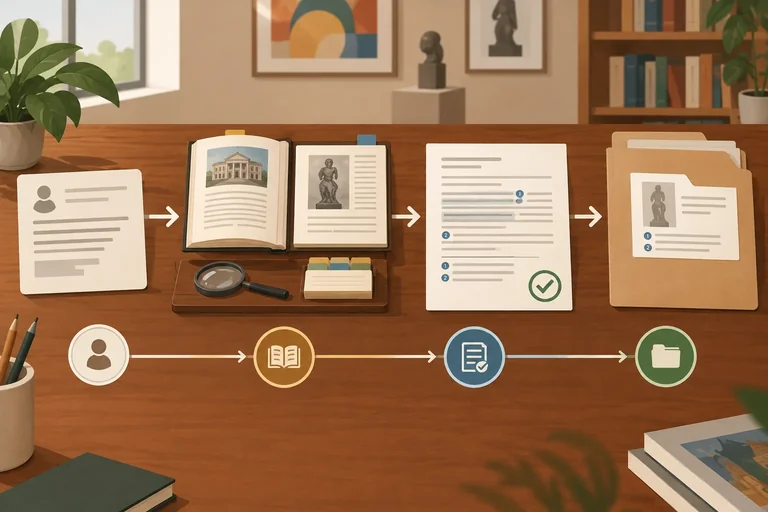
A traceability row follows one requirement from its authorized basis through the workflow to intended proof of the completed outcome. It does not merely state that an AI component can draft text.
Use these linked fields: Requirement; Authorized source or rule; Workflow stage; Component responsibility; Human checkpoint and owner; Acceptance criterion; Planned evidence.
An acceptance criterion is an observable condition that must hold. Planned evidence is the intended artifact or record that would demonstrate that condition. It is not observed evidence: no workflow has been run or evaluated yet.
Every workflow stage needs an accountable responsibility. For example, source lookup is not an unexplained handoff: a Deterministic operation supplies matching authorized entries and internal references, or flags missing or conflicting support before drafting.
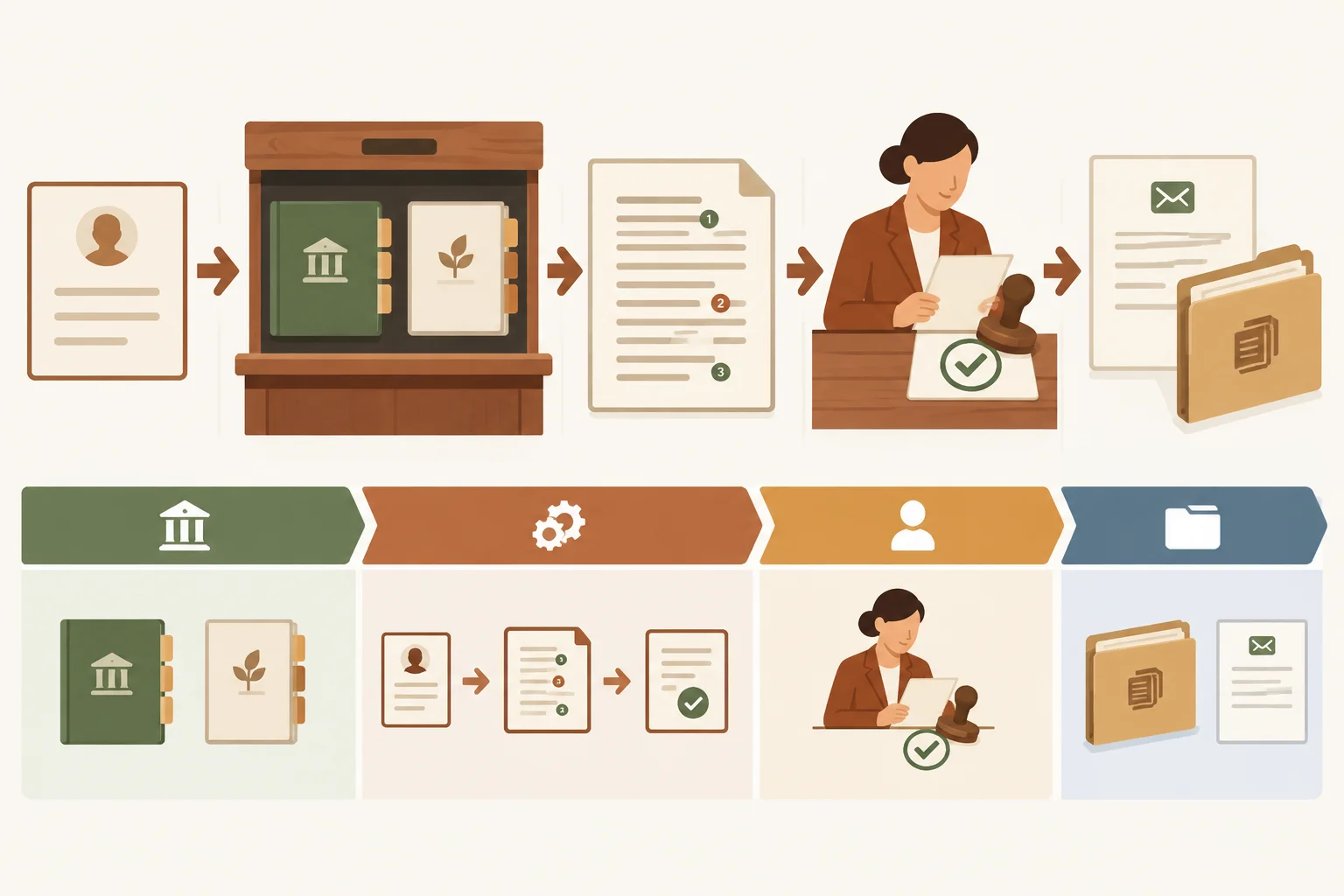
Final-outcome evidence can span the reply, its internal source references, and its associated approval record.
A compact specification can use two linked table views instead of one oversized table. Keep the Requirement wording identical in both views so a reader can reconnect the chain. Notice that authorized-source lookup has an explicit responsibility before any AI drafting begins.
| Requirement | Authorized source or rule | Workflow stage | Component responsibility |
|---|---|---|---|
| Workshop details with source reference | Workshop Schedule, version 2026-07-01 | Authorized source lookup → draft | Deterministic operation retrieves the matching schedule entry and internal reference; AI component drafts only from supplied facts. |
| Reviewer approval before ready to send | Operating rule: every reply is approved before becoming ready to send | Review → final status | Deterministic operation prevents ready-to-send status without recorded approval; Human decision approves, returns, or confirms escalation. |
| Safe unsupported-request outcome | Operating rule: unresolved source gaps or conflicts produce an escalation note rather than an invented answer | Authorized source lookup → coverage route → escalation note | Deterministic operation supplies available authorized records and flags an absent or conflicting support record; Human decision confirms the escalation outcome. |
The second view supplies the reviewer checkpoint, observable condition, and intended proof. “Planned” matters: these are records the future process should produce, not results already collected.
| Requirement | Human checkpoint and owner | Acceptance criterion | Planned evidence |
|---|---|---|---|
| Workshop details with source reference | Front-desk coordinator checks actionable workshop claims against the authorized source and approves or returns the reply. | Each actionable workshop detail in the final reply is supported by the Workshop Schedule and checked by the reviewer. | Final reply with internal Workshop Schedule reference and reviewer approval record. |
| Reviewer approval before ready to send | Front-desk coordinator approves, returns for correction, or confirms escalation. | No reply becomes ready to send without Front-desk coordinator approval. | Final reply linked to a ready-to-send status record and approval record. |
| Safe unsupported-request outcome | Front-desk coordinator confirms the escalation note; Program coordinator owns source clarification; Service lead owns a process decision. | An unresolved source gap or conflict produces an escalation note rather than an invented answer. | Escalation note, source-gap or conflict record, and reviewer decision record. |
A traceability row has this workflow stage: “Authorized source lookup → draft.” Its Component responsibility says only: “AI component drafts the reply.” What is missing from the row?
Repair the two incomplete traceability entries below. For each entry, write the missing Component responsibility, Human checkpoint and owner, Acceptance criterion, and Planned evidence.
A. Requirement: Workshop details with source reference
Authorized source or rule: Workshop Schedule, version 2026-07-01
Workflow stage: Authorized source lookup → draft
B. Requirement: Safe unsupported-request outcome
Authorized source or rule: Operating rule for unresolved source gaps or conflicts
Workflow stage: Authorized source lookup → coverage route → escalation note
Use the responsibility categories AI component, Deterministic operation, and Human decision where applicable. Then explain why each planned-evidence package demonstrates the final deliverable level rather than only an AI draft.
Write at least 300 characters (0/300).

Step 5 of 7
A conflict is real when two desirable requirements pull the workflow in incompatible directions. In the Cedar Arts Center case, the supplied planning inputs are an 8 min mean staff handling-time baseline and a 5 min target for comparable completed routine inquiries. The work includes source lookup, drafting, review, and corrections.
Trying to reach the target by weakening review would conflict with mandatory thresholds: every actionable factual claim must be supported by an authorized source and checked by the reviewer, and every reply must be approved before it is ready to send. Faster handling cannot compensate for an unsupported claim or bypassed approval.
Treat the time target as an expectation to examine later, not as evidence that this design already saves time.
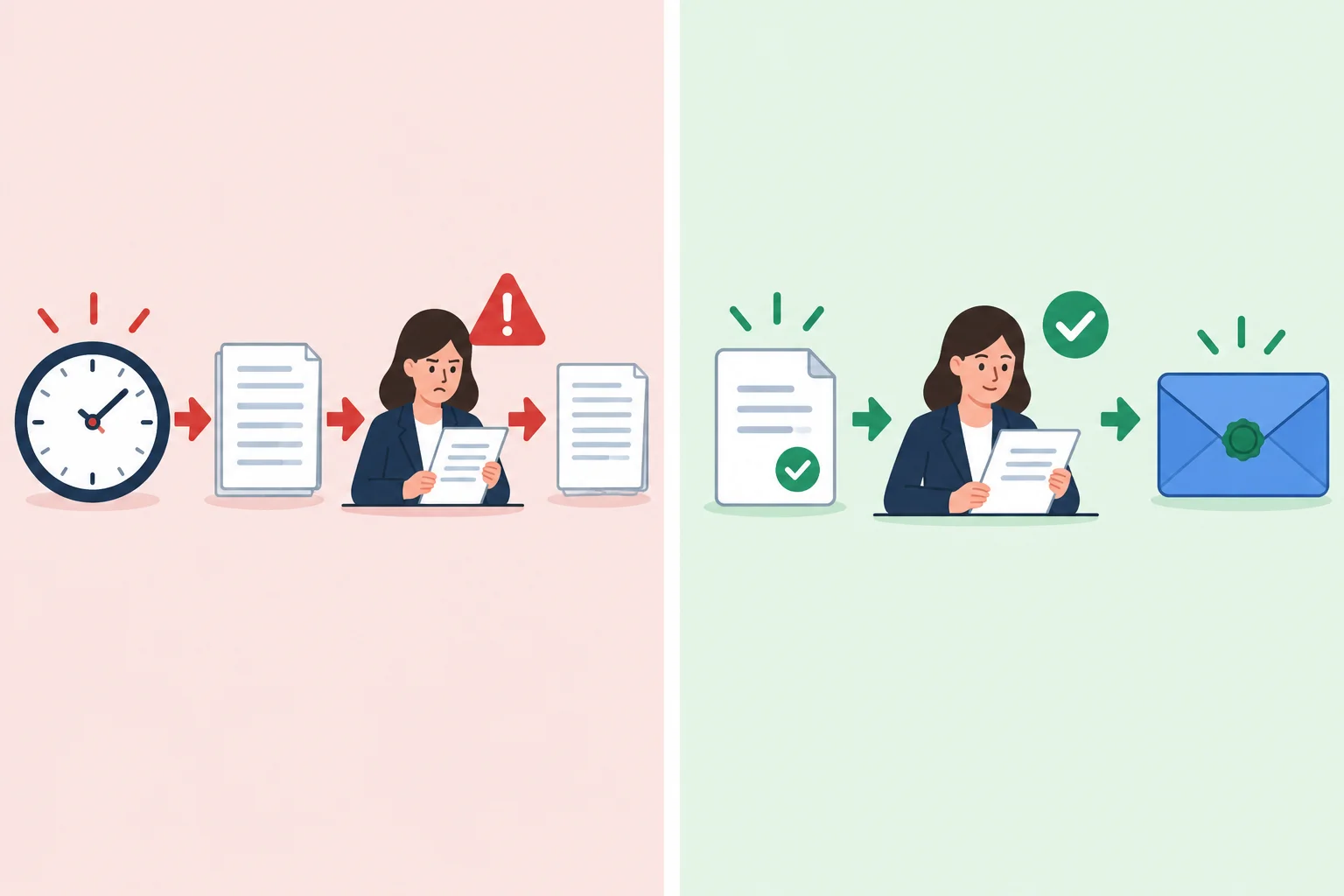
The defensible response changes optional scope, not the mandatory verification gate.
Resolve the conflict by separating mandatory constraints from an optional benefit that can change. In this case, source-supported claims and Front-desk coordinator approval are mandatory. Broad, highly personalized routine replies are optional.
The chosen design limits routine replies to supported workshop facts while retaining source lookup, claim verification, and approval. If a supported reply cannot be produced, the permitted result remains an escalation note. The consequence is less optional detail and personalization—not less checking. Any time saving remains an unverified expectation until it is assessed under comparable conditions.
A design-decision record makes the resolution inspectable. It records what was chosen, what was rejected, the consequence, the remaining uncertainty, and the accountable owner.
| Requirement conflict | Chosen approach | Rejected alternative | Tradeoff | Remaining limitation | Decision owner |
|---|---|---|---|---|---|
| The 5 min target for comparable completed routine inquiries can pressure verification of every actionable factual claim. | Limit routine replies to supported workshop facts; retain claim verification and approval. | Broaden replies by shortening or bypassing reviewer verification. | Replies may be less personalized and include less optional detail. | Time savings are an unverified expectation; comparison requires comparable scope and conditions. | Service lead |
A decision is incomplete if it exists only in a decision record. Propagate it into the task contract and the traceability chain. The narrowed routine path changes what a supported reply may contain, but it does not remove the escalation outcome or any original exclusion.
It can also affect baseline comparability. Use the supplied 8 min baseline and 5 min target only for routine inquiries handled under comparable scope and conditions. If limiting optional breadth makes a case materially different from the current process, record that difference rather than presenting the comparison as like for like.
The final deliverable now makes the narrowed routine path visible. The task can still receive an inquiry that cannot be supported; that route ends in an escalation note.
| Scope heading | Updated statement |
|---|---|
| Starting input | An anonymized public workshop inquiry |
| Intended user | Front-desk coordinator |
| Final deliverable | A staff-approved reply with internal source references, ready for staff to send, limited to supported workshop facts; or an escalation note when a supported reply cannot be produced |
| Exclusions | Booking changes, live availability, payments, and automatic sending |
This view assigns the full chain, including authorized-source lookup. The narrowed scope is operational: the AI component receives supplied authorized facts rather than extending the reply with unsupported optional detail.
| Requirement | Authorized source or rule | Workflow stage | Component responsibility | Human checkpoint and owner | Acceptance criterion |
|---|---|---|---|---|---|
| Supported staff-approved reply | Workshop Schedule, version 2026-07-01; Visitor FAQ, version 2026-07-01; operating rule for factual support and approval | Authorized source lookup → draft → review → ready to send | Deterministic operation retrieves relevant authorized entries and internal references, or flags a gap or conflict; AI component drafts only from supplied supported facts; Human decision verifies claims and approves, returns, or confirms escalation. | Front-desk coordinator checks every actionable factual claim against the authorized sources and approves, returns, or confirms escalation. | The final reply is limited to supported workshop facts; every actionable factual claim is supported and checked; approval occurs before ready-to-send status. |
| Comparable routine handling-time target | Supplied planning inputs: 8 min mean current-process baseline and 5 min target for comparable completed routine inquiries | Authorized source lookup → draft → review → corrections → final outcome | Deterministic operation supplies authorized records or routes a gap or conflict; AI component drafts within supported scope; Human decision reviews and directs corrections or escalation. | Front-desk coordinator reviews the completed routine outcome; Service lead owns the scope decision used when judging comparability. | Only routine inquiries with comparable scope and conditions may be compared with the supplied 8 min baseline and 5 min target; failed attempts and escalations are accounted for separately. |
Planned evidence remains intended proof, not observed evidence. The scope note is important: it shows whether a future time comparison genuinely concerns comparable routine work.
| Requirement | Planned evidence |
|---|---|
| Supported staff-approved reply | Final reply with internal Workshop Schedule and Visitor FAQ references, reviewer claim-check record, and approval record; or escalation note with source-gap or conflict record and reviewer decision record. |
| Comparable routine handling-time target | Planned end-to-end case log with source lookup, drafting, review, correction, and final-outcome times; scope and condition notes; separate failed-attempt and escalation log. |
Cedar Arts Center wants to pursue its supplied planning target of 5 min for comparable completed routine inquiries while preserving authorized-source support and Front-desk coordinator approval.
Write one concise design-decision record using all six headings: Requirement conflict; Chosen approach; Rejected alternative; Tradeoff; Remaining limitation; Decision owner.
Your record must preserve mandatory verification, identify a genuine sacrifice, name the decision owner, and avoid presenting expected time savings as proven.
Write at least 280 characters (0/280).

Step 6 of 7
Finalize observable acceptance criteria that combine baseline-linked value, mandatory quality and safety gates, exception accounting, and honest limits on planned evidence.
Acceptance is about the completed outcome for the Front-desk coordinator—not whether an AI component produced an appealing draft. For Cedar Arts Center, the permitted outcomes are a staff-approved reply with internal source references, ready for staff to send, or an escalation note when the available support is insufficient.
A whole-solution criterion therefore follows the work from authorized source lookup to the final reviewed outcome. It does not treat fast drafting, a confidence score, or a source-reference field by itself as success.
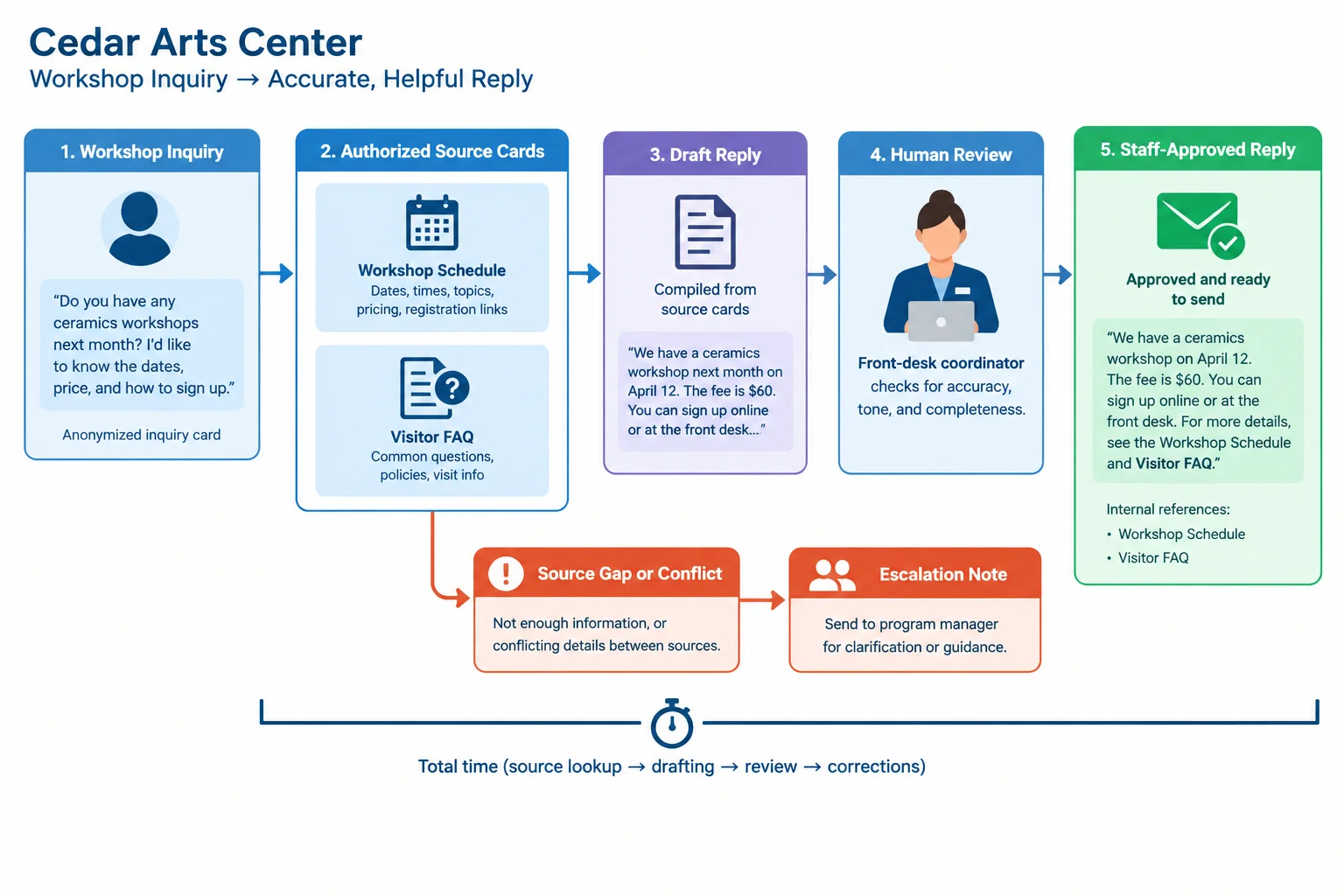
The effort measure covers the end-to-end routine path. The exception route is also an intended outcome, not missing data.
Write each criterion so that another person could later determine what outcome category it applies to, what can be observed, the threshold or required gate, and the planned evidence. Planned evidence is the record intended to demonstrate a condition; it is not observed evidence or a result already collected.
The values below are supplied planning inputs, not observed AI-solution results. Compare time only when scope and conditions are comparable.
These compact criteria cover the Cedar Arts Center case.
| Outcome or case category | Observable condition and threshold | Planned evidence |
|---|---|---|
| Comparable completed routine inquiries | Source lookup → drafting → review → corrections produces an approved reply ready to send; mean staff handling time is at most 5 min, compared with the supplied 8 min baseline under comparable scope and conditions. | Timed end-to-end case log, with stage times and scope notes |
| Every reply ready to send | Every actionable factual claim is supported by an authorized source and checked by the reviewer; every reply is approved before it becomes ready to send. | Final reply with internal source references, reviewer checklist, approval record |
| Source gap or source conflict | An escalation note is produced rather than an invented answer. | Escalation note, source-status record, reviewer record |
Example
Keep the effort target independent from the mandatory gates. A reply handled in less than 5 min still fails if an actionable claim lacks authorized support or if approval was bypassed.
Account for failed attempts and escalations separately rather than removing them to improve the routine-completion average. Their planned evidence can be an attempt-and-exception log recording case category, outcome, reason, and handling time.
A manual simulation may demonstrate the same intended reply, approval, and escalation outcomes. It can produce planned artifacts, but it cannot prove automated execution, integration, or real timing. Label those claims as untested until results are actually collected.
Which proposed effort criterion is suitable for comparable completed routine inquiries?
Repair the following draft acceptance set for the Cedar Arts Center task. Write a compact revised set of criteria with planned evidence.
Your revision must: measure the completed user outcome; include source lookup, drafting, reviewer approval, and corrections in the comparable routine effort criterion; use the supplied 8 min baseline and 5 min target correctly; account for failed attempts and escalations separately; preserve the factual-support and approval gates; require escalation instead of invention for source gaps or conflicts; and state the limit of simulation evidence.
Write at least 450 characters (0/450).
Step 7 of 7
Complete and consistency-check a compact end-to-end solution specification before later assembly work.
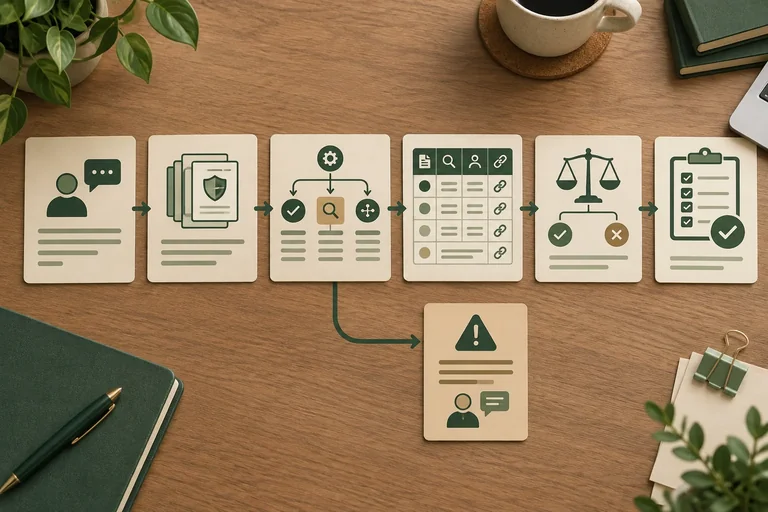
A compact specification is one connected argument—not a stack of separate notes. For the Cedar Arts Center case, make these parts agree:
The path starts with an anonymized public workshop inquiry. It ends with a staff-approved reply with internal source references, ready for staff to send, or an escalation note when a supported reply cannot be produced. Booking changes, live availability, payments, and automatic sending remain excluded.
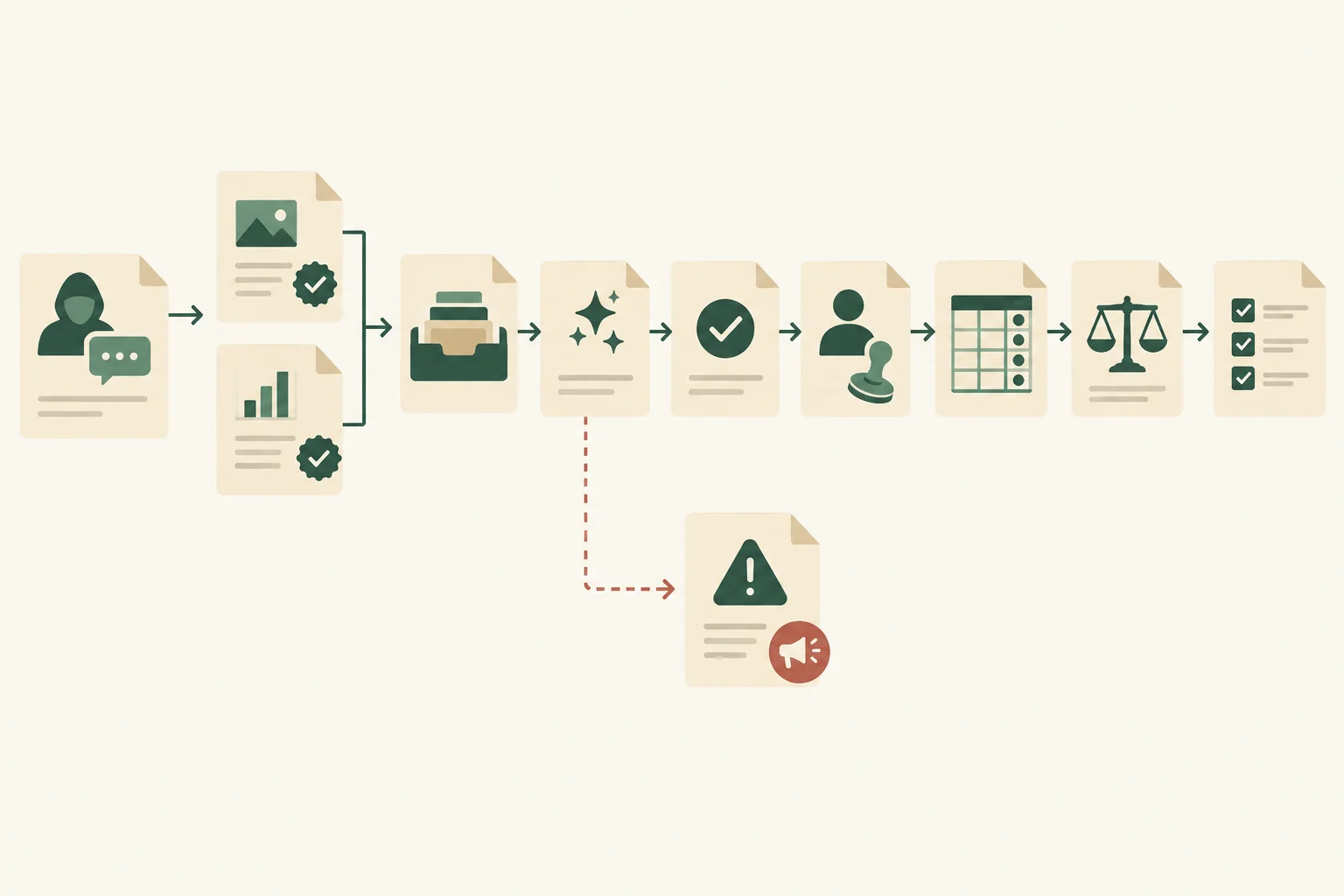
Every required link, including authorized source lookup, must remain connected from the initial inquiry to planned evidence.
Tip
“Complete” means the specification has enough structure to guide later assembly. It does not mean a prototype has been assembled, tested, accepted, or approved for launch.
Use linked table views to inspect both permitted outcomes. Keep the same Requirement name across views so a reader can trace it without guessing which notes belong together. Crucially, authorized source lookup is a responsibility of the Deterministic operation in both routes: it supplies relevant authorized records and internal references, or flags absent or conflicting support before any outcome is finalized.
Each row identifies the authorized basis, workflow route, responsibility categories, and accountable human check. The arrows show direction, not an implementation design.
| Requirement | Authorized source or rule | Workflow stage | Component responsibility | Human checkpoint and owner |
|---|---|---|---|---|
| Supported staff-approved reply | Workshop Schedule, version 2026-07-01; Visitor FAQ, version 2026-07-01; operating rules for factual support and approval | Authorized source lookup → draft → review → ready to send | Deterministic operation retrieves relevant authorized entries and internal references; AI component drafts only from supplied supported facts; Human decision verifies claims and approves or returns. | Front-desk coordinator checks every actionable factual claim against authorized sources and approves or returns the reply. |
| Safe unsupported-request outcome | Operating rule: unresolved source gaps or conflicts produce an escalation note rather than an invented answer | Authorized source lookup → coverage route → escalation note | Deterministic operation retrieves available authorized records and flags an absent or conflicting support record; Human decision confirms the escalation outcome. | Front-desk coordinator confirms the escalation note; Program coordinator owns source clarification; Service lead owns a process decision. |
Planned evidence is intended proof, not observed evidence, until results have actually been collected. Evidence for a final outcome must show more than a candidate draft.
| Requirement | Acceptance criterion | Planned evidence |
|---|---|---|
| Supported staff-approved reply | Every actionable factual claim in the final reply is supported by an authorized source and checked by the reviewer; every reply is approved before becoming ready to send. | Final reply with internal Workshop Schedule and Visitor FAQ references, reviewer claim-check record, and approval record. |
| Safe unsupported-request outcome | An unresolved source gap or conflict produces an escalation note rather than an invented answer. | Escalation note, source-gap or conflict record, reviewer decision record, and any source-clarification or process-decision record. |
The recorded decision preserves verification rather than treating speed as a substitute for quality or safety.
| Requirement conflict | Chosen approach | Rejected alternative | Tradeoff | Remaining limitation | Decision owner |
|---|---|---|---|---|---|
| The 5 min target for comparable completed routine inquiries can pressure review of every actionable factual claim. | Limit routine replies to supported workshop facts; retain claim verification and approval. | Broaden replies by shortening or bypassing reviewer verification. | Replies may be less personalized and include less optional detail. | Time savings are an unverified expectation; comparison requires comparable scope and conditions. | Service lead |
In a local note or editor, consolidate the specification and run two checks.
First, follow one must-have requirement from the Starting input through the Final deliverable and its planned evidence. Confirm that authorized source lookup has a defined responsibility before drafting or escalation.
Second, follow an exception route. Confirm who receives the gap or conflict, who confirms the permitted escalation outcome, who owns source clarification, and who owns a process decision.
Do not substitute a source reference, a deterministic presence check, or an AI confidence statement for the designated human approval. Explicitly list assumptions that are still unsupported, such as an untested timing expectation or an implementation detail to be addressed later.
Summary
Use this scan before calling the specification ready for assembly.
| Check | Question |
|---|---|
| Scope | Can the stated input reach either the approved deliverable or the escalation deliverable without entering an exclusion? |
| Source support | Does each factual-claim requirement identify an authorized source or an explicit rule, and does lookup have an assigned responsibility? |
| Ownership | Can a reader identify who approves, returns, confirms escalation, clarifies sources, or decides on a process issue? |
| Evidence | Would the planned evidence demonstrate the final user outcome rather than only an AI draft? |
| Assumptions | Are untested implementation, timing, or evidence assumptions named rather than presented as results? |
In your local notes, consolidate the Cedar Arts Center specification. Then write a concise final review here with three labeled parts:
Finish with a short readiness verdict: identify one link you verified in the exception route and state why this is ready for later assembly rather than proven to work.
Write at least 500 characters (0/500).
Congratulations! You completed: Specifying an End-to-End AI-Assisted Solution
Thousands of online courses in video, ebooks and audiobooks.
To test your knowledge during online courses
Generated directly from your cell phone's photo gallery and sent to your email

Download our app via QR Code or the links below:.


Carry knowledge in your pocket.
Download the Cursa app.
There are hundreds of free courses available, with a free certificate of completion that is saved in your mobile image gallery.
Download the app to access the Course Completion Certificate for Free.


+ 10 million
students

Free and Valid
Certificate

60 thousand free
exercises

4.8/5 rating in
app stores

Free courses in
video and ebooks