Step 1 of 7
Follow an Input Through a Network
Trace a vehicle photo through a simplified network and identify the roles of the input, internal layers, and output.

Learning path · Level 2 · Tutorial 3
Trace how a neural network transforms an input through learned layers and explain why suitable data and sufficient computation both matter.
 Follow an Input Through a Network
Trace a vehicle photo through a simplified network and identify the roles of the input, internal layers, and output. 2 min
 Understand What Weights Do
See how adjustable connection influences affect the way a Vehicle classifier processes the same input. 2 min
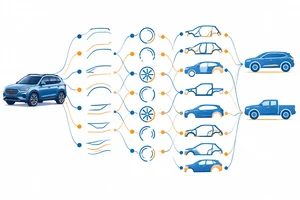 See Patterns Build Across Layers
Trace how the Vehicle classifier can build increasingly combined illustrative visual patterns across internal layers. 2 min
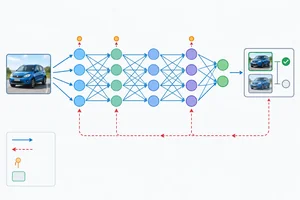 Connect Feedback to Weight Changes
See how training feedback guides repeated small weight adjustments in the Vehicle classifier. 2 min
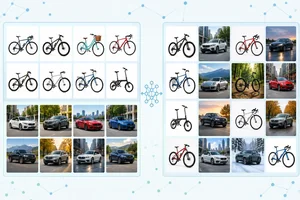 Recognize What the Data Makes Learnable
Compare photo collections to see how relevant coverage and data quality shape what a Vehicle classifier can learn. 2 min
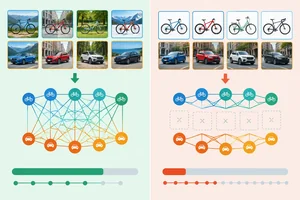 Explain What More Computation Can—and Cannot—Do
Distinguish when additional training effort may help and when improved training data must come first. 2 min
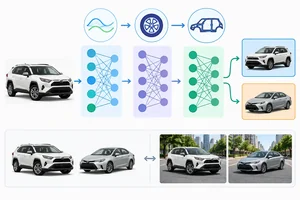 Apply the Layered-Learning Explanation
Integrate the Vehicle classifier's input-to-output path, layered illustrative representations, training feedback, and the limits of longer training on poorly covered data. 2 min
Step 1 of 7
Trace a vehicle photo through a simplified network and identify the roles of the input, internal layers, and output.
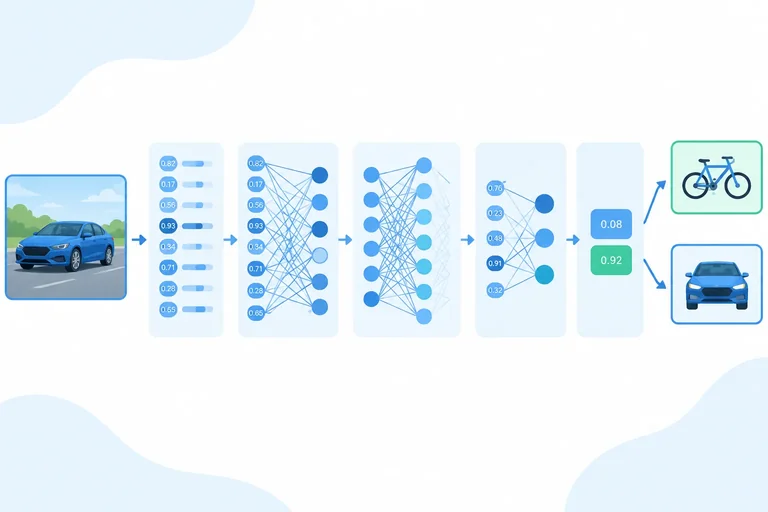
The Vehicle classifier is a simplified artificial neural network: a set of connected computational units. A unit is a computational node that receives numerical information, transforms it, and passes information onward.
It is not a miniature human brain. When it classifies a photo containing one vehicle, it performs computation on numbers; it does not have a human-style visual experience of the photo.
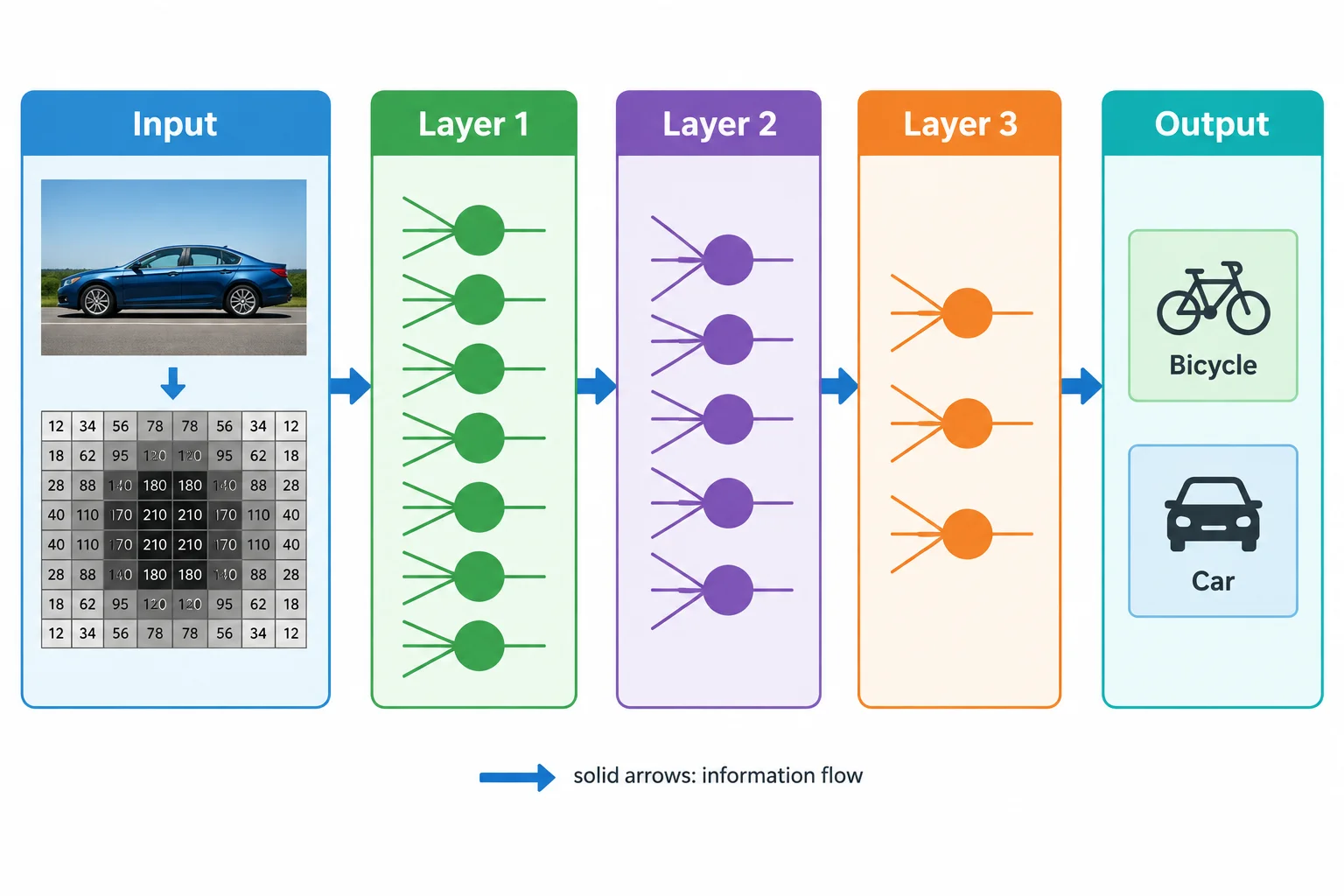
Solid arrows show the information flow from Input to Output.
Follow one direction through this simplified diagram:
Bicycle or Car.The three numbered layers are a teaching simplification, not a required design for every neural network. During inference, the already-trained Vehicle classifier follows this solid-arrow path to make a prediction.
Tip
Read the diagram from left to right. The internal layers are not storage boxes containing human-written descriptions. They are stages of numerical computation between the pixel input and the category prediction.
Arrange the stages of the Vehicle classifier from the incoming photo to its category prediction. Treat the diagram as a computation flow, not as a human-like way of seeing.
Step 2 of 7
See how adjustable connection influences affect the way a Vehicle classifier processes the same input.
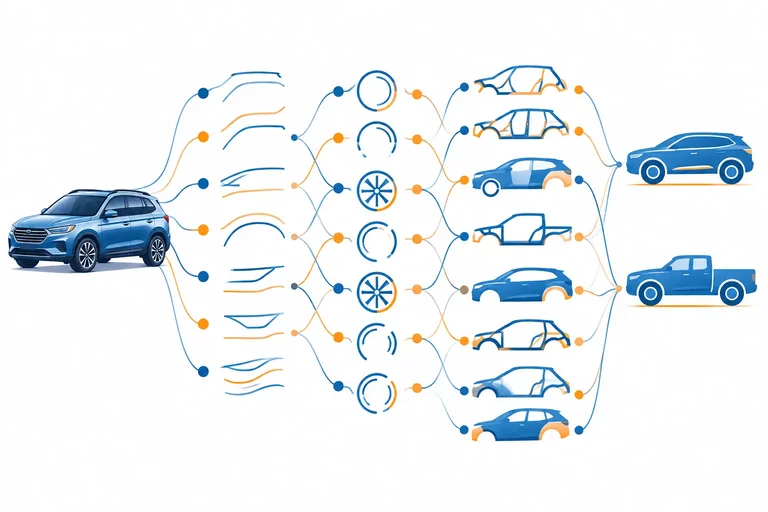
A weight is an adjustable numerical influence on one connection between two units. It affects how much an incoming signal contributes to the next unit’s processing.
In the Vehicle classifier, weights help determine how numerical information from the same vehicle photo is transformed as it moves through the network. A weight is not a confidence rating, and it is not a human-written label such as “wheel” or “car.”
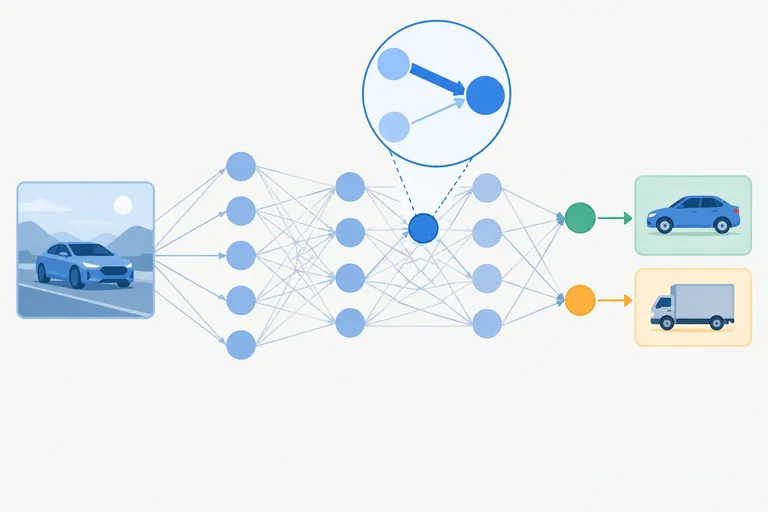
The same input can travel along many connections. Each connection’s weight helps set its influence on the receiving unit.
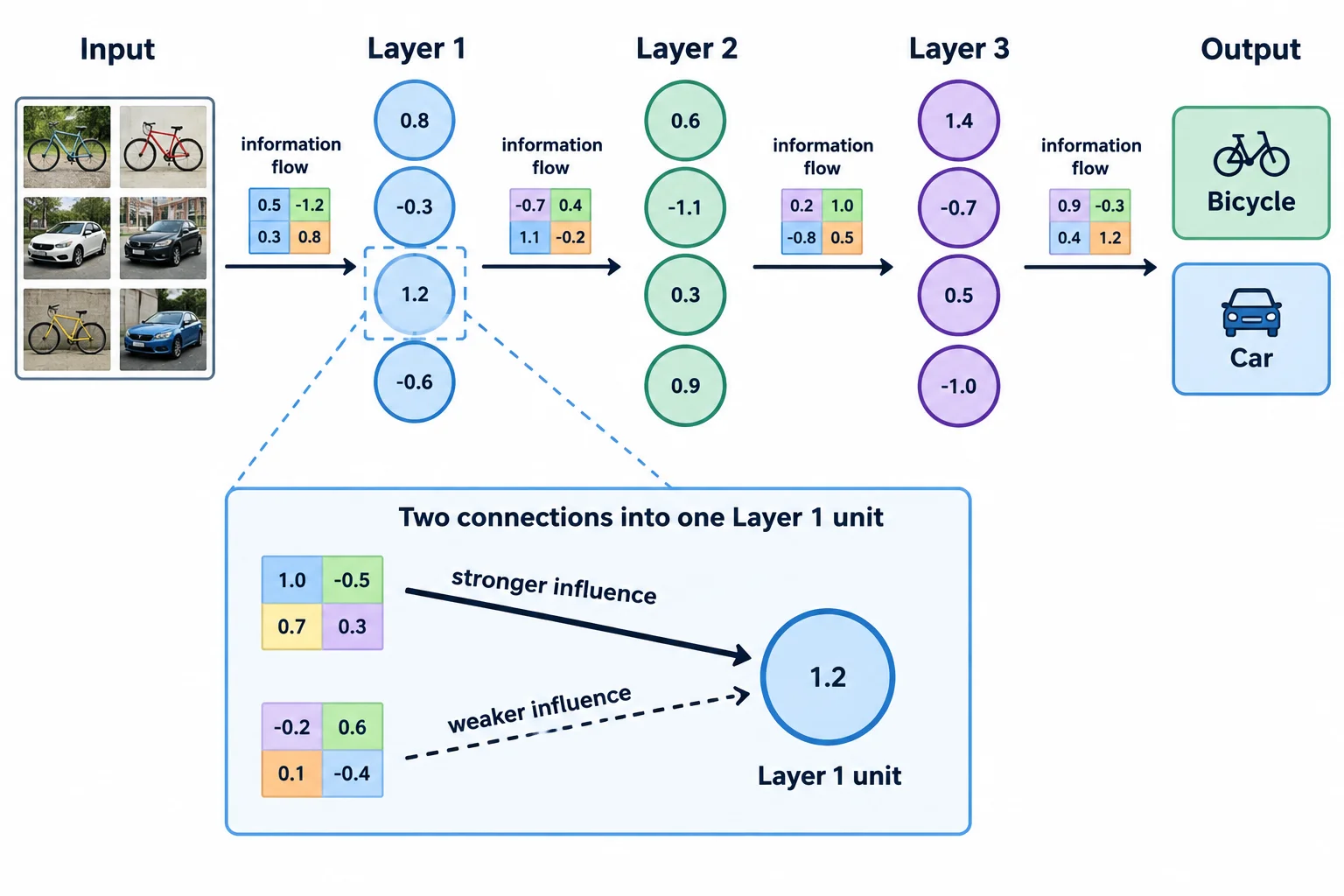
Solid arrows show information flowing from the input toward the prediction.
A unit receives signals through several connections. It combines those weighted signals, transforms the result, and passes numerical information to the next layer.
A stronger influence means a signal contributes more to that unit’s processing. A weaker influence means it contributes less. Some weighted contributions can also oppose others: they can push the unit’s processing in a different direction. These are influences on numerical signals, not separate object detectors.
Example
Consider the same photo entering the Vehicle classifier twice. If a connection weight has changed, the receiving unit can send different numerical information onward. Later units may then receive different signals, so the final prediction may change.
This does not mean that one weight controls an entire Bicycle or Car concept, or that changing one weight guarantees a particular prediction. Many connections and units contribute to the overall processing.
Tip
Do not read a weight as a human-style belief or a manually entered object description. It is an adjustable influence within the network’s numerical processing.
Which statement correctly explains what a weight controls and why changing a weight may affect the Vehicle classifier’s prediction for the same photo?
Step 3 of 7
Trace how the Vehicle classifier can build increasingly combined illustrative visual patterns across internal layers.
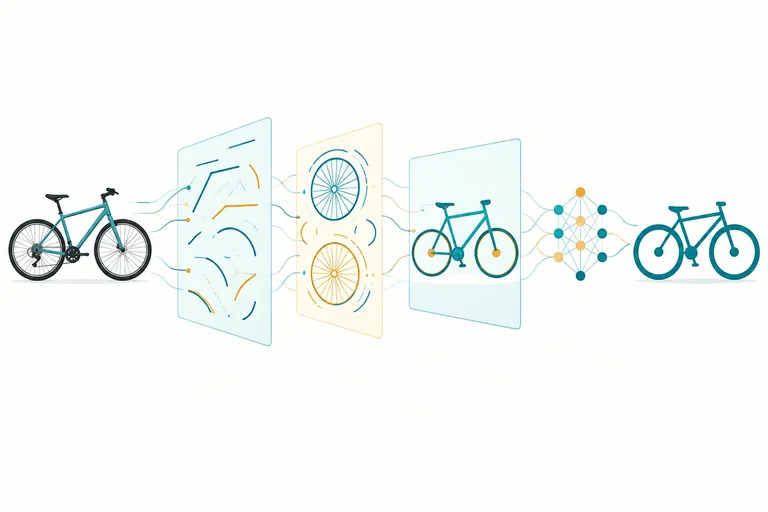
The Vehicle classifier does not pass a human-style picture from layer to layer. Each internal layer produces a representation: an internal pattern of numbers that makes some characteristics of the photo available to later layers.
A representation is not usually a written description such as “this is a wheel.” It is a numerical result distributed across units. Later layers use those numerical results as their input.
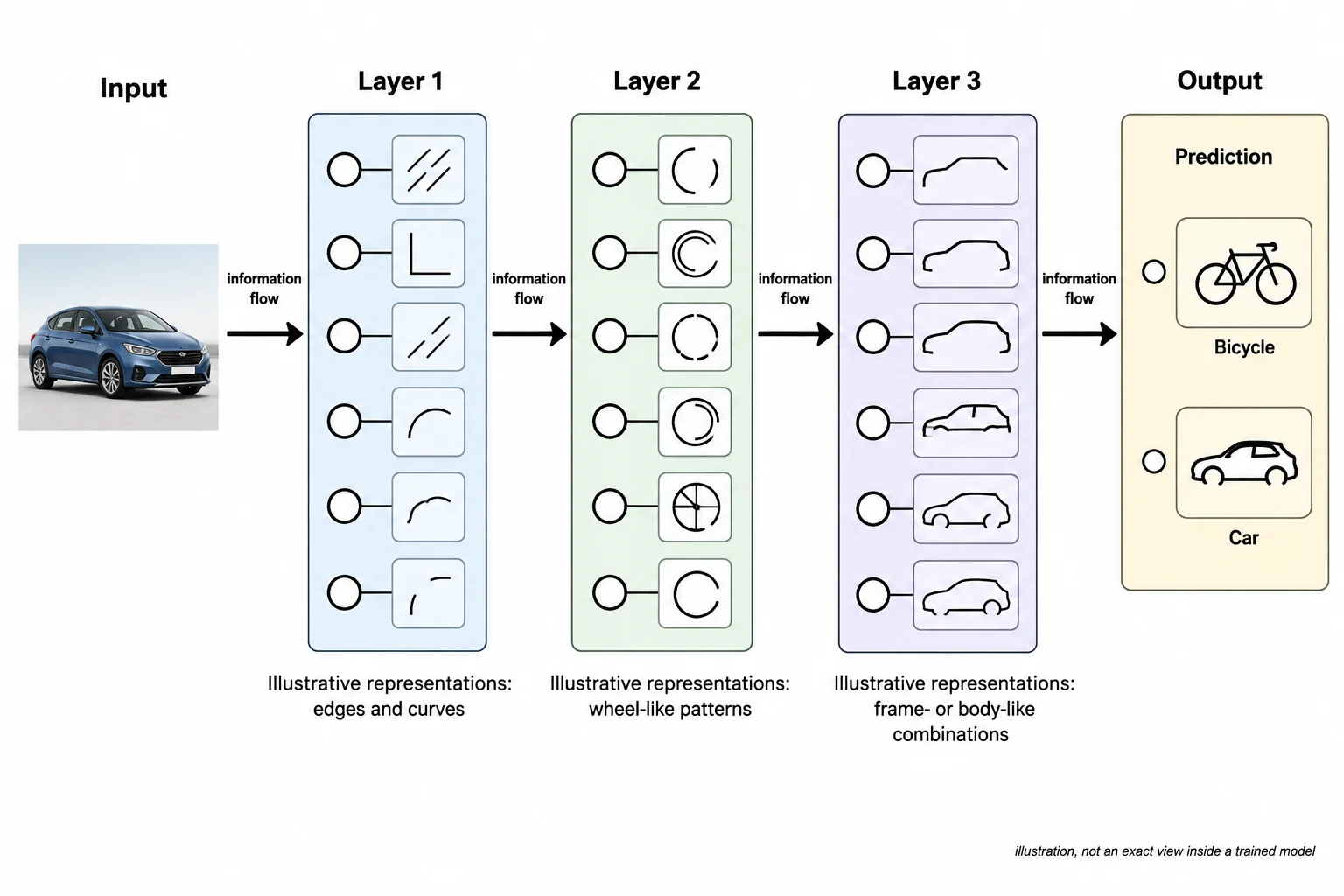
Illustrative representations can become more combined across layers; they are not literal snapshots of a network’s internal view.
For this illustration, units in Layer 1 make information about edges and curves available. Units in Layer 2 can combine earlier information into wheel-like patterns. Layer 3 can combine information again into frame- or body-like combinations that may help with the Vehicle classifier’s prediction.
The network is not given human-written object descriptions at each layer. It transforms the representations received from the preceding layer.
Tip
Do not read the diagram as a map with one unit per object part. Useful information can be spread across many units and connections. A single unit may not correspond to anything a person could name.
The simple-to-complex sequence is a helpful illustration for visual tasks, not a universal rule or a complete explanation of every neural network’s internal processing.
Match each statement on the left to its best partner.
Tap an item and then its matching pair.
Step 4 of 7
See how training feedback guides repeated small weight adjustments in the Vehicle classifier.
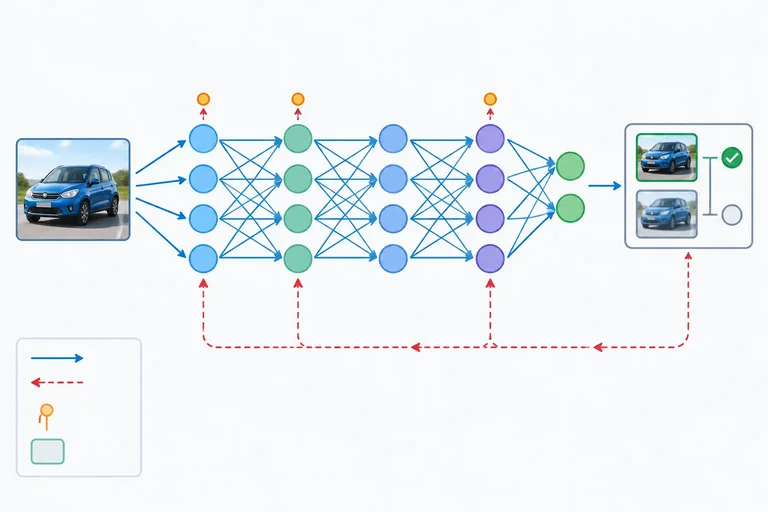
During training, the Vehicle classifier receives a labeled photo. It first makes a prediction by passing the photo’s pixel numbers through connected units: Input → Layer 1 → Layer 2 → Layer 3 → Output.
The training procedure then compares that prediction with the supplied label. When they differ, the comparison produces feedback about the error. That feedback is used to guide small changes to weights across the network.
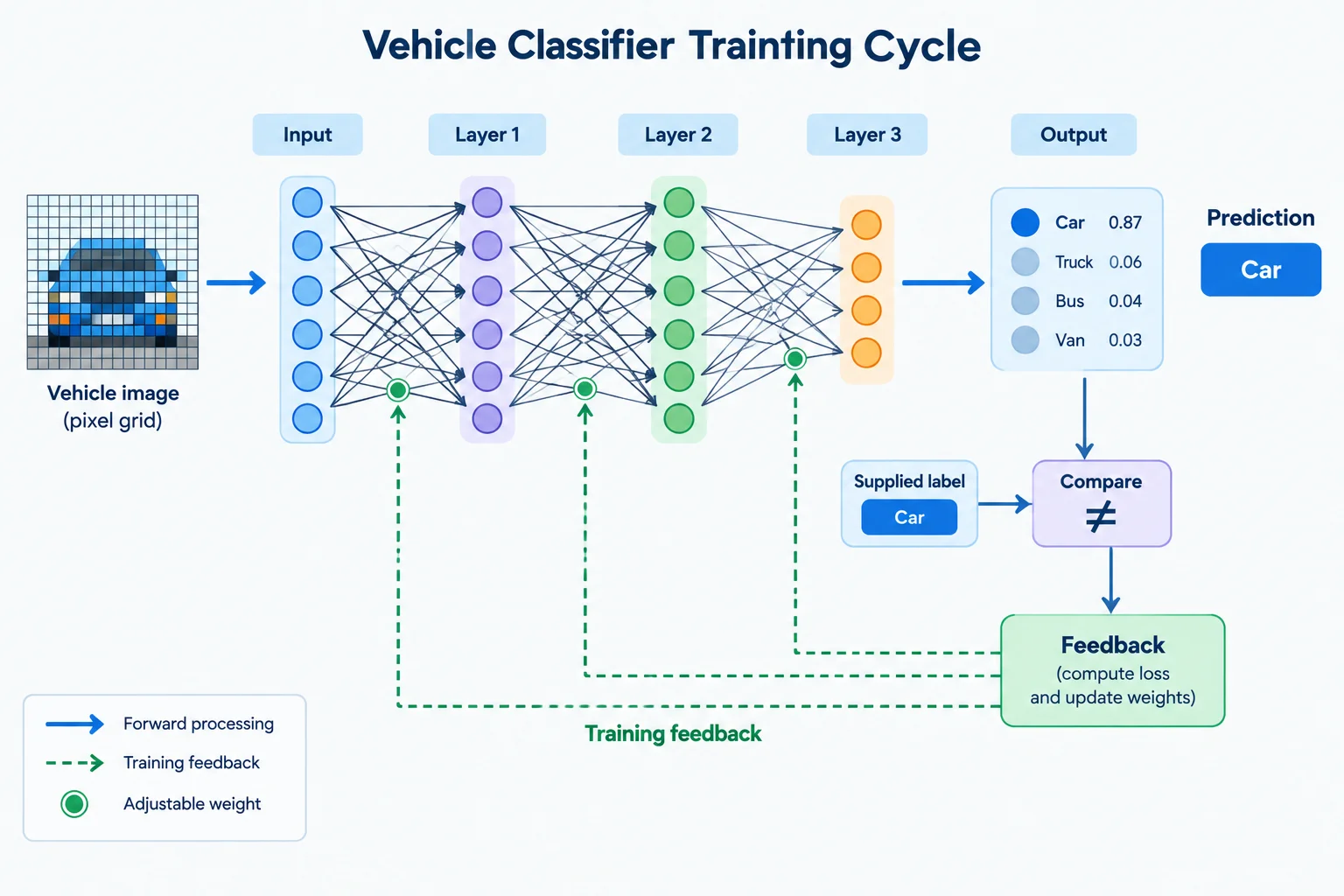
Solid arrows show forward processing. Dashed arrows show training feedback that guides weight changes.
Example
Suppose a labeled bicycle photo enters the Vehicle classifier, but its training prediction is Car. The supplied label remains Bicycle. A comparison identifies the mismatch and creates feedback.
The training procedure uses that feedback to adjust many connection weights by small amounts. It does not rewrite the label, and it does not insert a hand-written rule such as “detect this wheel.”
Across many labeled photos, this cycle repeats: predict, compare, adjust, and try another example. The accumulated adjustments can make internal representations more useful for the task.
For example, patterns related to edges and curves can become useful building blocks for later wheel-like patterns and frame- or body-like combinations. These are learned through weight changes; people do not need to fully hand-code every useful visual feature.
One update does not guarantee a better prediction on every photo. Learning is a repeated process, not a single correction.
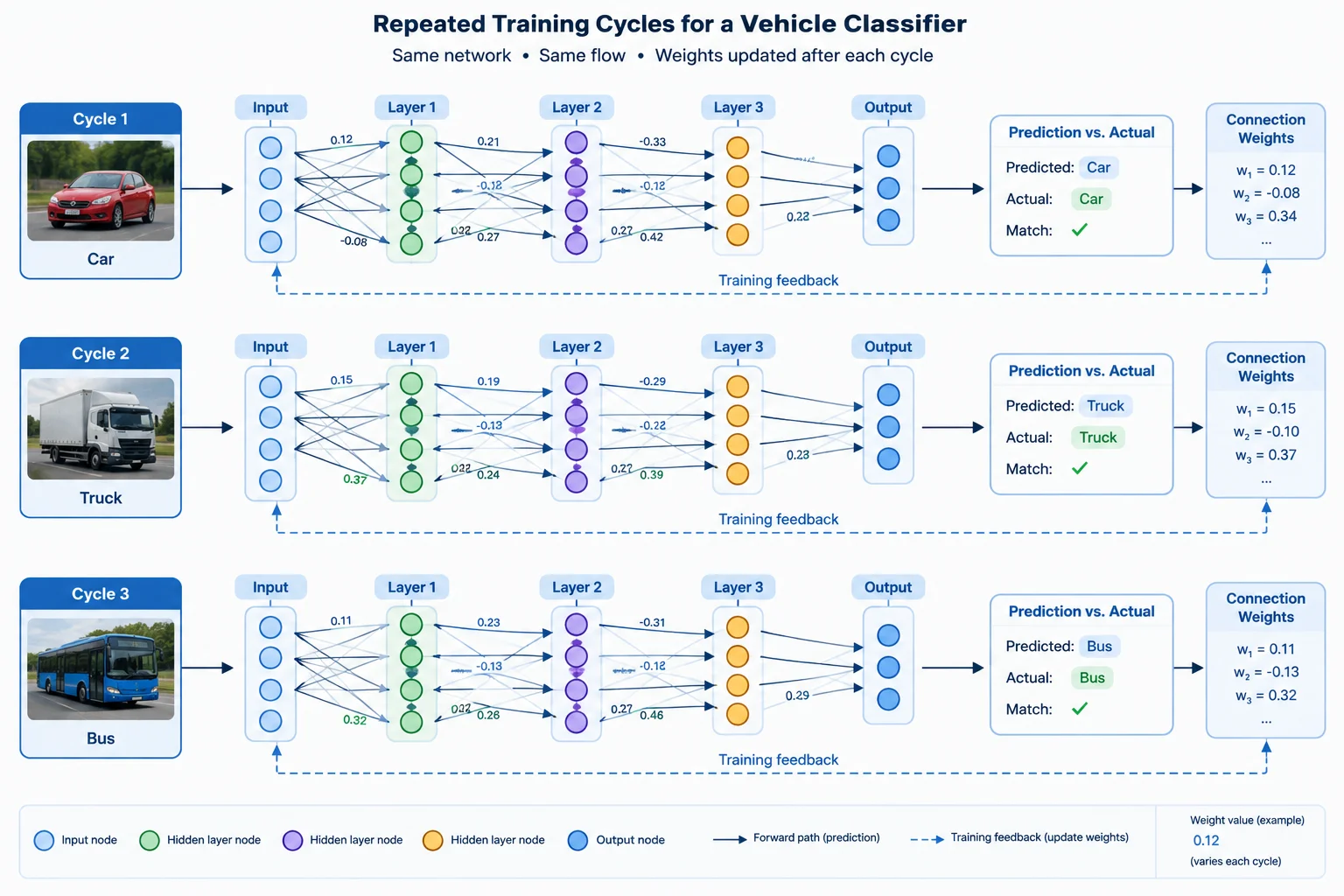
Repeated feedback-guided adjustments can improve representations, but no single update guarantees improvement on every image.
Put the stages of one training cycle in the correct order.
Write the four stages of the training cycle in order. Then explain why this process changes weights rather than fully hand-coding useful visual features. Mention why repeating the cycle matters.
Write at least 180 characters (0/180).
Step 5 of 7
Compare photo collections to see how relevant coverage and data quality shape what a Vehicle classifier can learn.
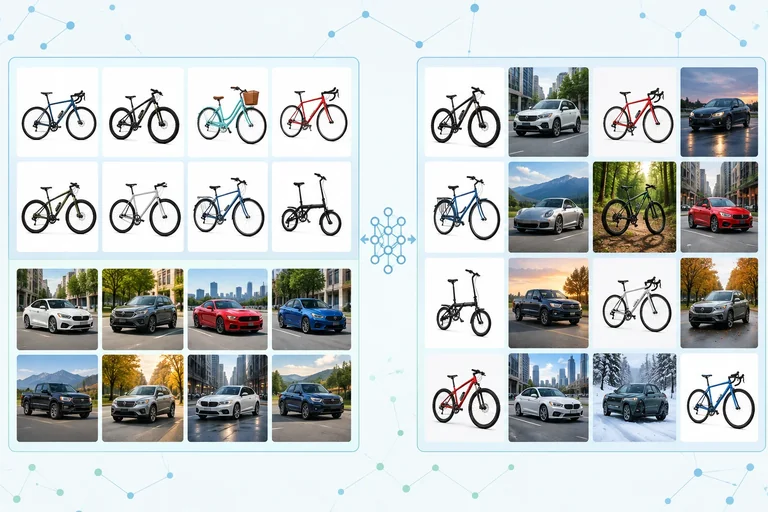
Training data gives the Vehicle classifier opportunities to learn from the variations it contains. If a relevant situation never appears in the photos, the network has no direct training example for that situation.
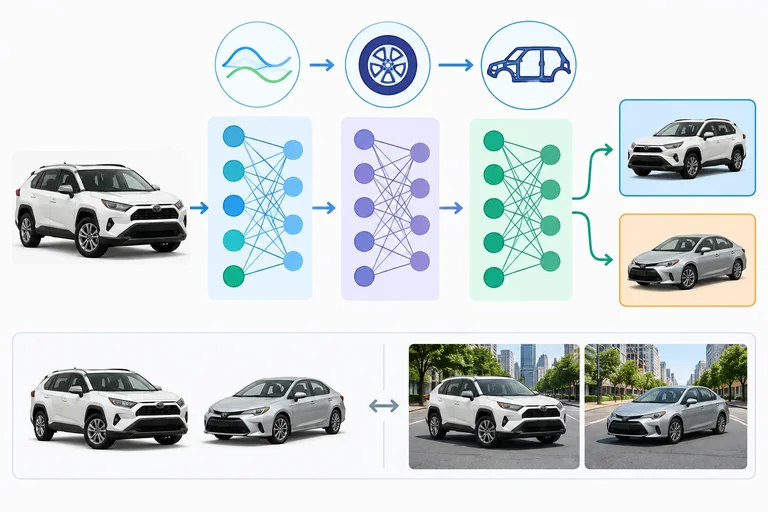
Compare two collections with the same total number of correctly labeled photos:
The collections are the same size, but they offer different coverage of the situations the classifier may encounter.
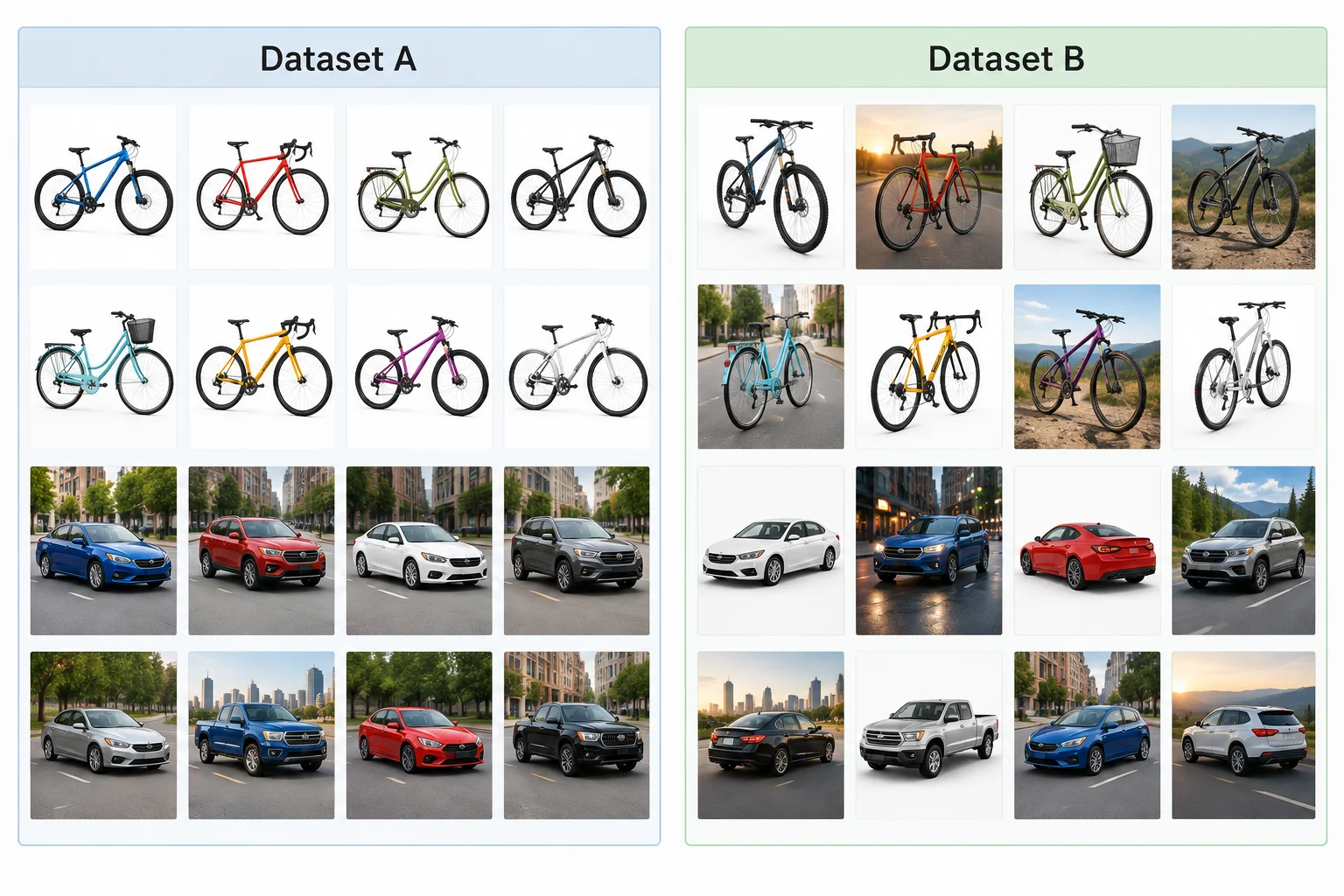
Dataset B provides broader relevant coverage even though both collections have the same number of correctly labeled photos.
Dataset A creates a repeated association: white background with Bicycle, and street with Car. During training, the Vehicle classifier may develop a pattern that uses background information because it consistently occurs with the category.
A wrong prediction on a new background could be consistent with that possibility, but one wrong prediction alone does not prove which internal representation caused it. Dataset B gives the network a better opportunity to learn vehicle-related distinctions because each category appears across the relevant backgrounds, angles, and lighting conditions.
Warning
Coverage is not the only data requirement. A photo with an incorrect label gives misleading feedback: the training procedure treats the supplied label as the target. A photo that is heavily blurred, cropped, or obscures the vehicle may not contain enough useful visual information for the classification task.
More photos do not automatically fix these quality problems if their labels or necessary visual information remain poor.
A training photo clearly shows a Bicycle, but its supplied label is Car. What is the most direct problem with this example?
A Vehicle classifier will be used with Bicycle and Car photos on plain white backgrounds and streets, under different viewing angles and lighting. You can choose Dataset A or Dataset B, which have the same total number of correctly labeled photos.
Choose the better dataset. Explain your choice using coverage, not dataset size. Then name one separate data-quality problem that could still mislead training even in the better dataset.
Write at least 120 characters (0/120).
Step 6 of 7
Distinguish when additional training effort may help and when improved training data must come first.
Computation is the processing work used to run the Vehicle classifier and perform its repeated training updates. It requires hardware resources and time.
A larger network can have more capacity: more possible ways to represent patterns. But its extra units and connections generally require more computation to train. Neither larger capacity nor more computation automatically makes a prediction useful or reliable.
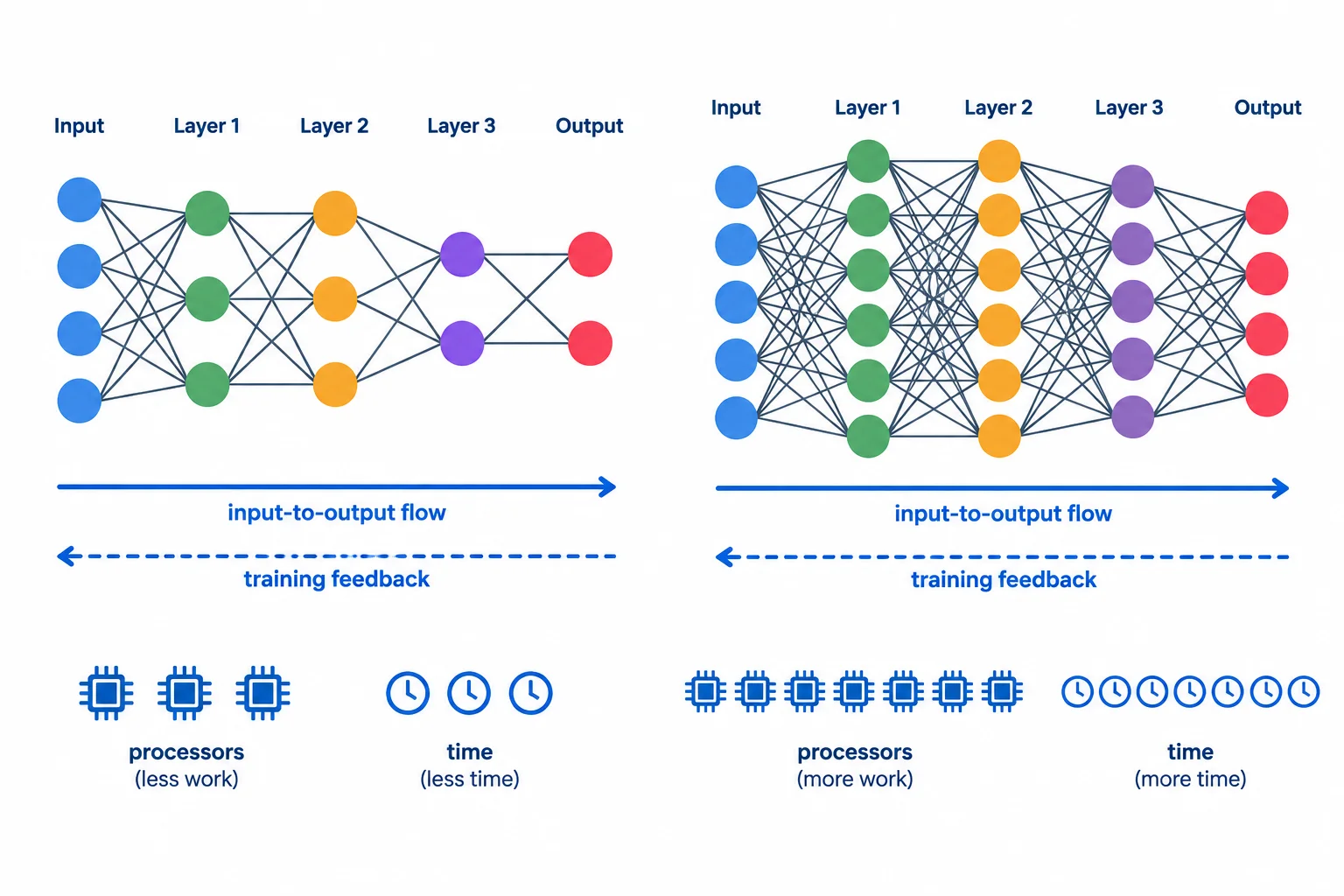
More capacity can allow more possible representations, while also increasing the computation needed for training.
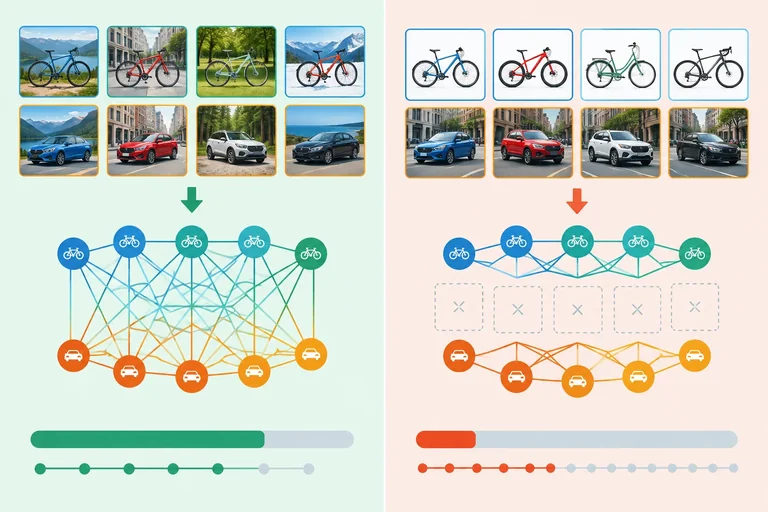
To tell whether training effort is the issue, change one condition at a time. In each comparison below, the network and dataset stay unchanged; only the training effort changes.
Dataset B contains correctly labeled Bicycle and Car photos across both backgrounds, varied viewing angles, and varied lighting. Dataset A has correctly labeled Bicycle photos on plain white backgrounds and Car photos on streets.
The comparisons separate an undertrained model with suitable examples from a model whose examples lack important combinations.
| Dataset and effort | What changes? | Possible effect | What is still missing? |
|---|---|---|---|
| Dataset B — Shorter training | Starting condition | The network may not yet have made enough useful updates. | No conclusion yet about whether more effort will help. |
| Dataset B — Longer training | Only training effort | More updates may help the same network learn from its relevant, varied examples. | No guarantee of a useful or reliable result. |
| Dataset A — Shorter training | Starting condition | The network can only learn from its limited combinations. | Bicycles on streets and Cars on plain white backgrounds. |
| Dataset A — Longer training | Only training effort | It may further strengthen patterns already available in Dataset A. | The missing vehicle-background combinations remain absent. |
The Vehicle classifier uses Dataset B, correct labels, the same network, and Shorter training. Evidence suggests it has not yet learned enough from the available examples. Which statement is best?
Compare these two Vehicle classifier situations in your own words:
Explain what additional training may do in each situation. Then explain why it cannot automatically repair missing coverage or incorrect labels, and state what Situation 2 needs first.
Write at least 180 characters (0/180).
Step 7 of 7
Integrate the Vehicle classifier's input-to-output path, layered illustrative representations, training feedback, and the limits of longer training on poorly covered data.
Use the Vehicle classifier as one complete story. A vehicle photo enters as pixel numbers at Input. Solid arrows carry transformed information through Layer 1, Layer 2, and Layer 3 to Output, where the network produces a prediction: Bicycle or Car.
During training, a supplied label can be compared with that prediction. Dashed feedback arrows represent information used to guide small weight adjustments across connections. The network changes weights; it does not receive a hand-written rule for every wheel or body shape.
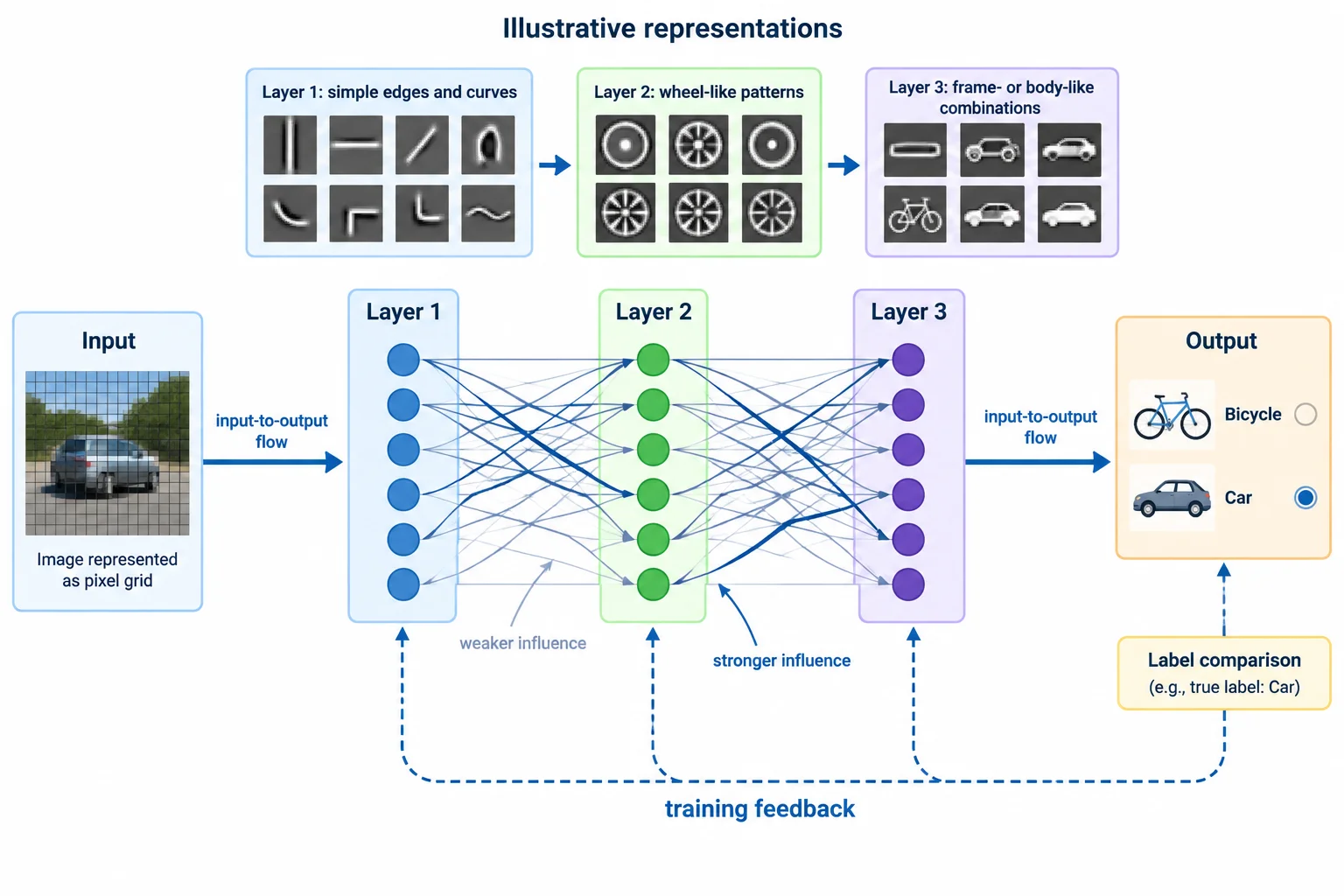
Solid arrows show the prediction path. Dashed arrows show training feedback used to adjust weights.
A wrong prediction on a new background is evidence to investigate, not a direct view of the network's internal cause. Compare what each data-and-effort situation can provide.
Dataset coverage and training effort for the Vehicle classifier
| Situation | What the training photos contain | What it can change | What it cannot establish |
|---|---|---|---|
| Dataset A | Bicycle photos on plain white backgrounds; car photos on streets | It can support repeated weight updates | It does not show both vehicle classes on both backgrounds |
| Shorter training | Dataset A with less training effort | May leave useful patterns insufficiently learned | It does not test whether missing combinations would help |
| Longer training | The same Dataset A with more training effort | May further fit patterns available in Dataset A | It cannot add missing category-and-background combinations |
| Dataset B | Same total correctly labeled photos; both classes on both backgrounds, varied angles and lighting | Offers more relevant vehicle and condition variation | It does not guarantee every future prediction is correct |
A photo containing a car on a white background is given to the Vehicle classifier, and its prediction is Bicycle.
Write one connected explanation of this case. Include all of the following:
Car label would provide feedback that guides weight changes during training.Treat a background shortcut as a possibility, not a proven internal cause. Do not claim that the change guarantees success.
Write at least 420 characters (0/420).
Summary
Congratulations! You completed: How Neural Networks Learn Layered Patterns
20 XP
Thousands of online courses in video, ebooks and audiobooks.
To test your knowledge during online courses
Generated directly from your cell phone's photo gallery and sent to your email

Download our app via QR Code or the links below:.



Carry knowledge in your pocket.
Download the Cursa app.
There are hundreds of free courses available, with a free certificate of completion that is saved in your mobile image gallery.
Download the app to access the Course Completion Certificate for Free.


+ 10 million
students

Free and Valid
Certificate

60 thousand free
exercises

4.8/5 rating in
app stores

Free courses in
video and ebooks