Step 1 of 7
Start with Fixed-Rule Automation
See how a directly configured schedule can produce repeated automatic behavior.

Learning path · Level 1 · Tutorial 1
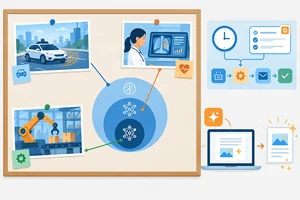
Use everyday examples to distinguish automation, AI, machine learning, deep learning, and generative AI without treating them as interchangeable terms.
 Start with Fixed-Rule Automation
See how a directly configured schedule can produce repeated automatic behavior. 1 min
 AI Is Broader Than Learning
Use mechanism-based evidence to distinguish fixed-rule automation from rule-based AI, without assuming that automatic systems are AI or that every AI system learns from data. 2 min
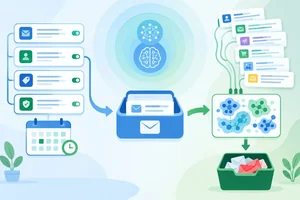 Machine Learning Finds Patterns in Data
Distinguish explicit rules from patterns learned from data, and place machine learning within artificial intelligence. 2 min
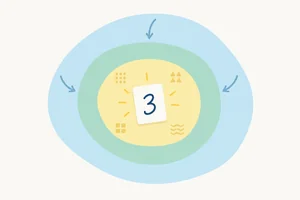 Place Deep Learning Inside Machine Learning
2 min
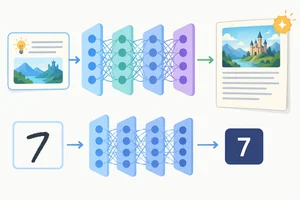 Generative AI Describes a Capability
Recognize generative AI as a content-producing capability that can overlap with machine learning and deep learning. 2 min
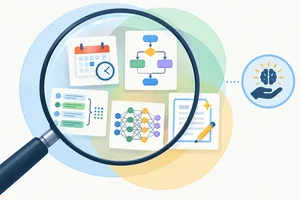 Choose Labels from the Evidence
Use stated clues to assign compatible labels while leaving unsupported details unresolved. 2 min
 Apply the Distinctions
Use evidence from unfamiliar scenarios to apply the distinctions among automation, AI, machine learning, deep learning, and generative AI. 2 min
Step 1 of 7
See how a directly configured schedule can produce repeated automatic behavior.
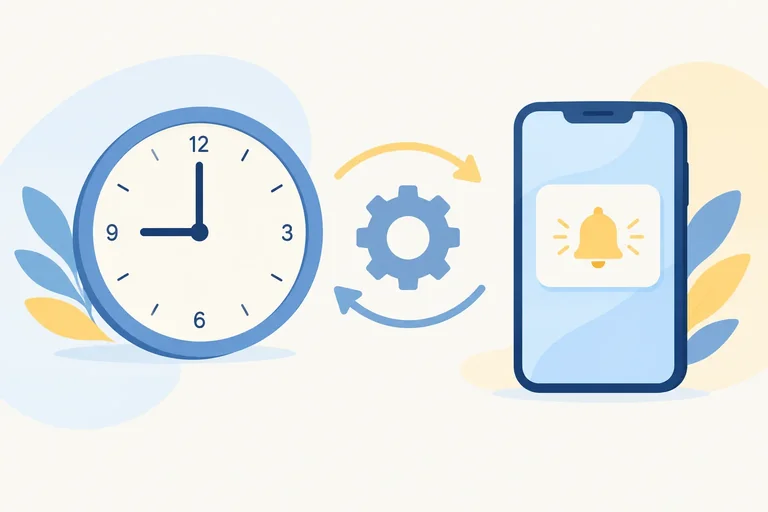
Automation carries out a process with less repeated human action. A person sets it up once; then the system performs the defined action when the relevant time or condition occurs.
In fixed-rule automation, the behavior comes from explicitly configured instructions. The system does not need to decide a new rule each time.
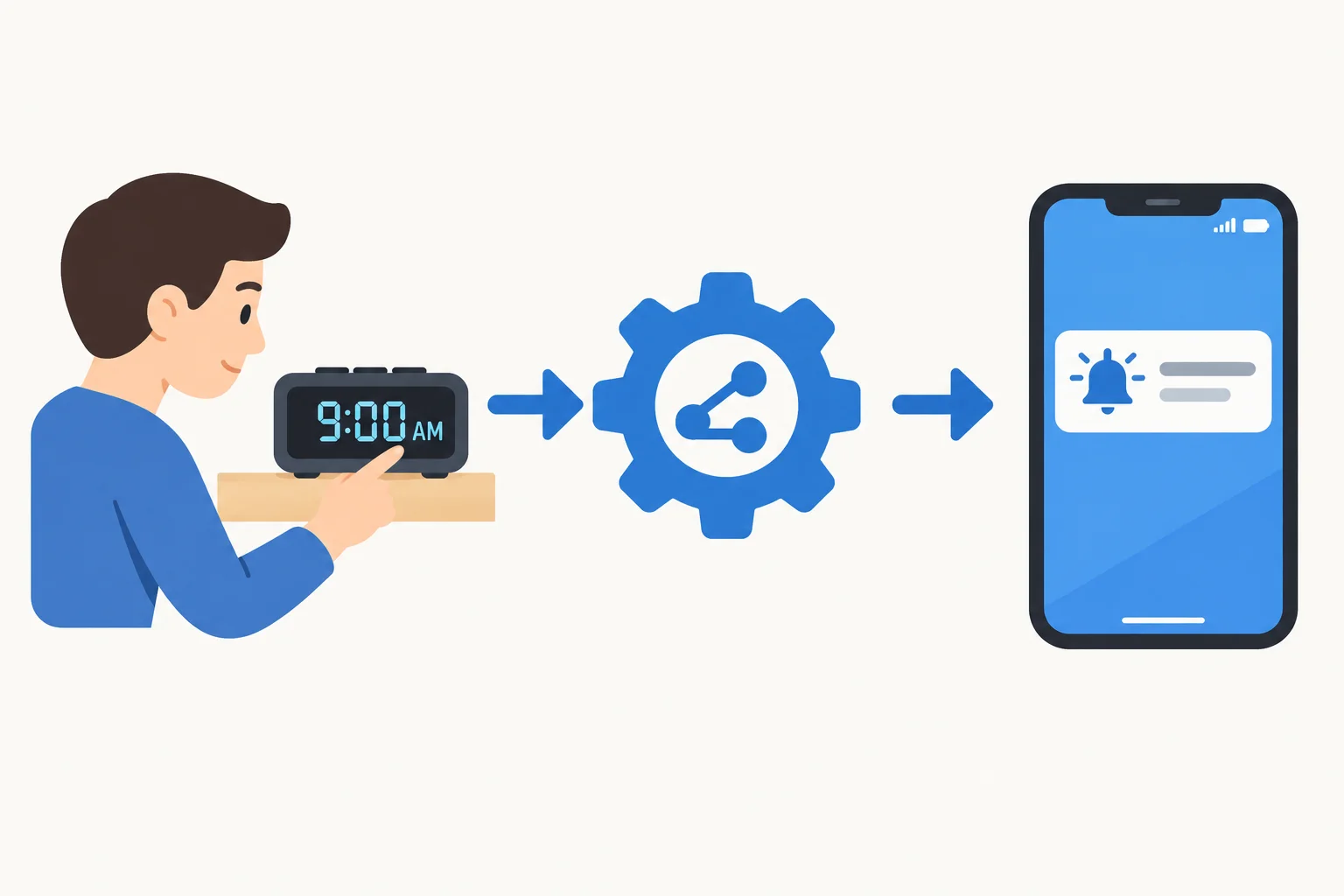
A configured schedule leads the system to perform an action automatically.
Consider Reminder Timer. A person explicitly configures this instruction:
“At 9:00 AM every day, send a reminder.”
After that setup, Reminder Timer checks the time and sends the reminder each day. The person does not have to press a button every morning.
Example
Configured instruction
Schedule: 9:00 AM every day
Action: send a reminder
The repeated behavior is specified directly by the person who configured the schedule.
Tip
A fixed rule can have a condition and an action. Here, reaching the configured time is the condition; sending the reminder is the action.
Put the stages of Reminder Timer in the order that explains why it sends a reminder automatically.
Step 2 of 7
Use mechanism-based evidence to distinguish fixed-rule automation from rule-based AI, without assuming that automatic systems are AI or that every AI system learns from data.
Artificial intelligence (AI) is a broad field concerned with systems that perform tasks such as reasoning, recognizing patterns, and producing content.
AI does not describe one single way of building a system. Some AI systems use expert-written rules. Other AI systems learn patterns from data. A system operating automatically is not, by itself, evidence that it uses AI.
To label a system carefully, look for the mechanism described—not merely for an action that happens without repeated human input.
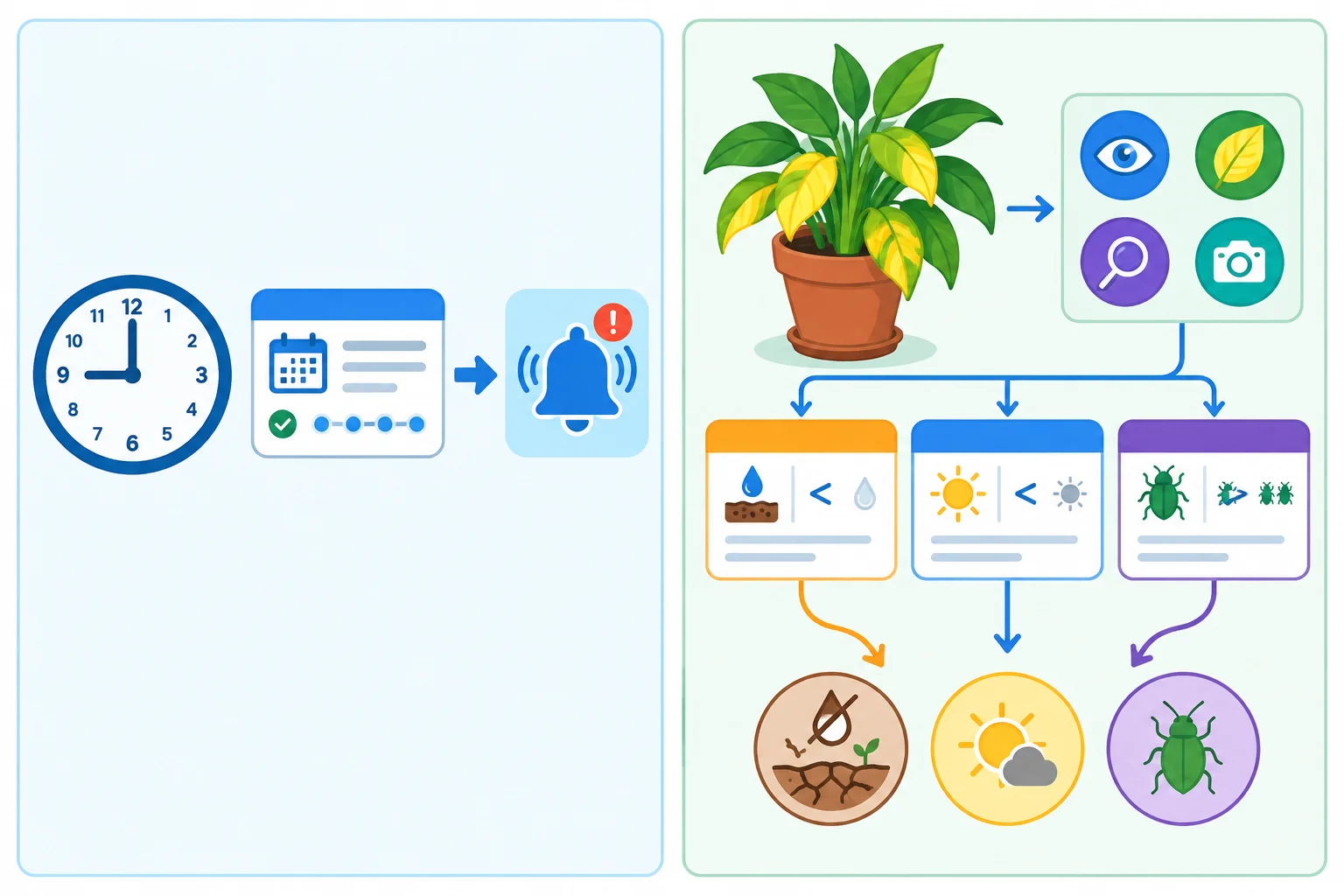
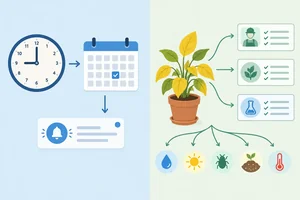
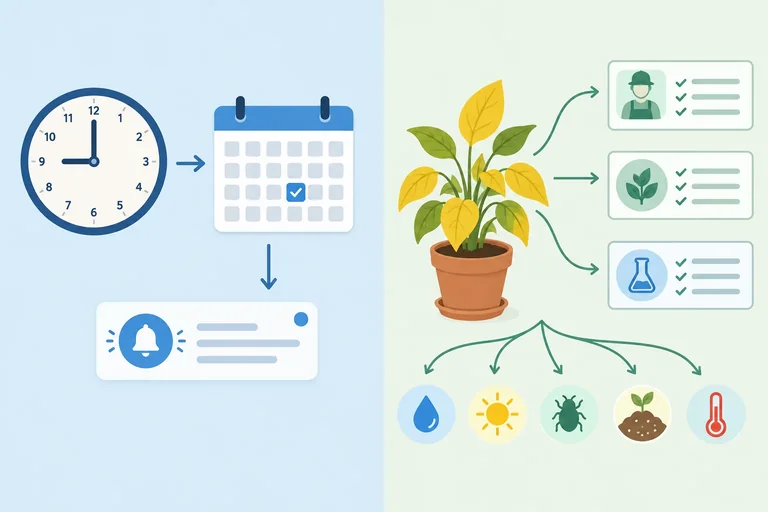
The Reminder Timer follows a configured schedule directly. The Plant Adviser combines observations with expert-written rules to infer possible causes.
The Plant Adviser is a rule-based AI expert system. A person reports observations about a houseplant, such as yellow leaves or dry soil. The system combines expert-written rules to infer possible causes.
Its rules were supplied by experts; in this description, it does not learn those rules from example cases. It can still be AI because reasoning with expert rules is one approach within AI.
This differs from the Reminder Timer, whose person-configured schedule directly specifies when to send a reminder.
Read the descriptions as evidence for a label. A label can be supported, or it can be not established when the description does not provide enough evidence.
| System | Described mechanism | AI label |
|---|---|---|
| Reminder Timer | Configured schedule sends a reminder at 9:00 AM | Not established |
| Plant Adviser | Expert-written rules combine observations to infer possible causes | Supported |
True or false: If a system operates automatically, its description establishes that it uses artificial intelligence (AI).
Reject both claims using the mechanisms described for the Reminder Timer and the Plant Adviser. For each claim, explain what the description does or does not establish.
Write at least 120 characters (0/120).
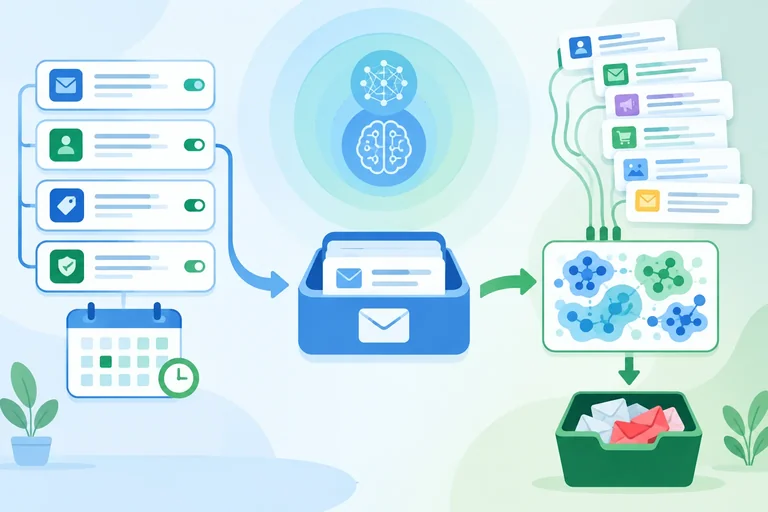
Step 3 of 7
Distinguish explicit rules from patterns learned from data, and place machine learning within artificial intelligence.
Machine learning (ML) is an approach within artificial intelligence (AI) in which a system learns useful patterns from data.
Consider the fictional Spam Filter. It learns patterns from example emails to flag spam. A person does not need to write every possible rule for recognizing spam. The important distinction is how its task behavior was developed: patterns were learned from examples.
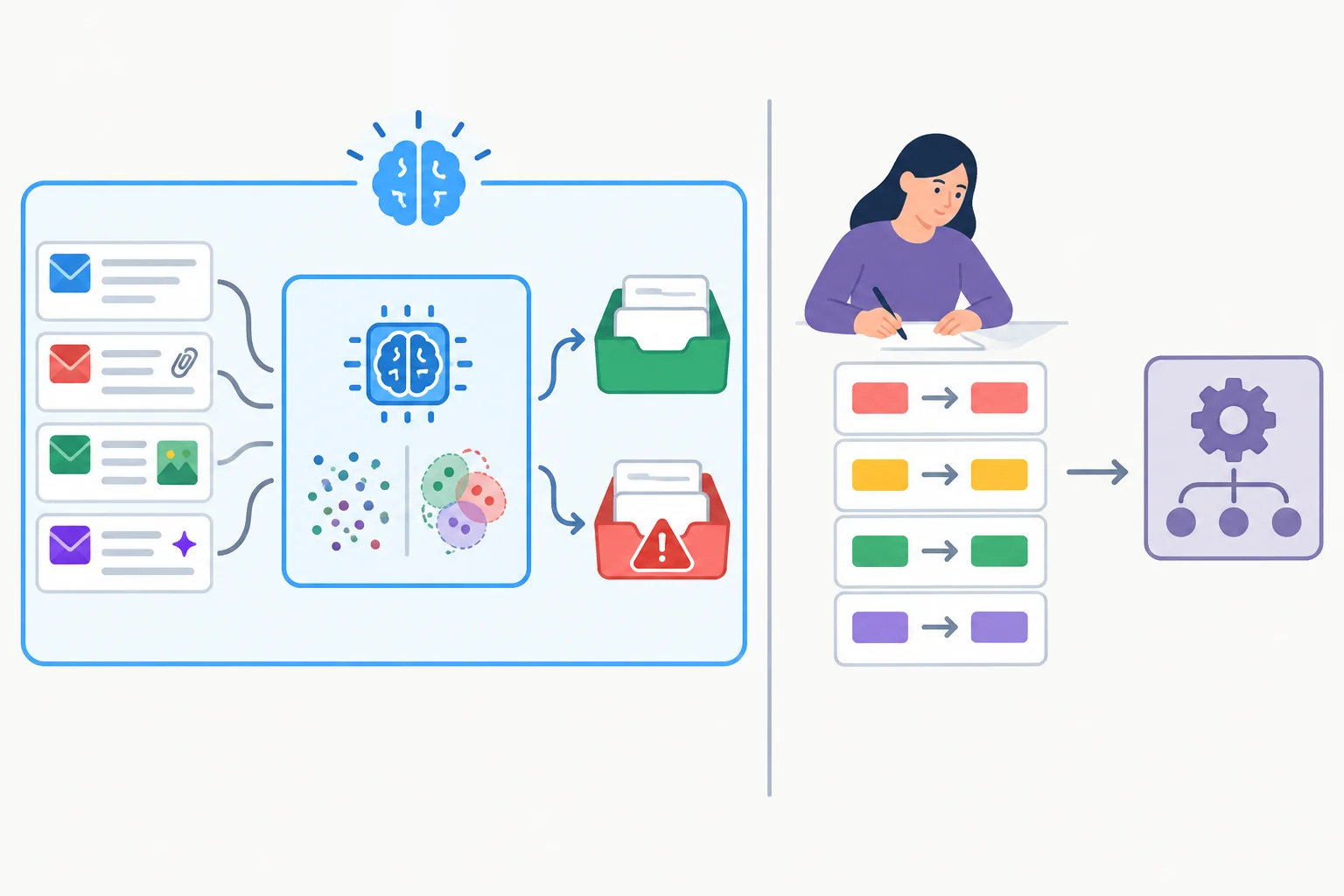
The difference is how task behavior is developed: learned patterns versus rules written directly by people.
Both kinds of systems can operate automatically after they are set up. Automatic operation does not tell you whether a person wrote the rules or whether the system learned patterns from data.
Ask this question instead: Was the behavior specified directly with rules, or developed by learning patterns from examples?
Compare the source of task behavior, not whether the system runs without repeated human action.
| System | How its behavior is developed | Can it operate automatically? |
|---|---|---|
| Reminder Timer | A person configures a schedule and reminder action | Yes |
| Plant Adviser | Experts write rules it combines to infer possible causes | Yes |
| Spam Filter | It learns useful patterns from example emails | Yes |
Tip
A data-learned approach still runs as software and follows instructions when it operates. “Learned from data” describes how useful task behavior was developed; it does not mean the system acts without any software instructions.
Machine learning is inside AI: it is one approach used within the broader AI field. But AI is broader than machine learning. For example, the Plant Adviser is rule-based AI; its expert-written rules do not learn from data.
So, an AI description may establish machine learning, or it may establish a different AI approach. Look for evidence of learned patterns before applying the machine learning label.
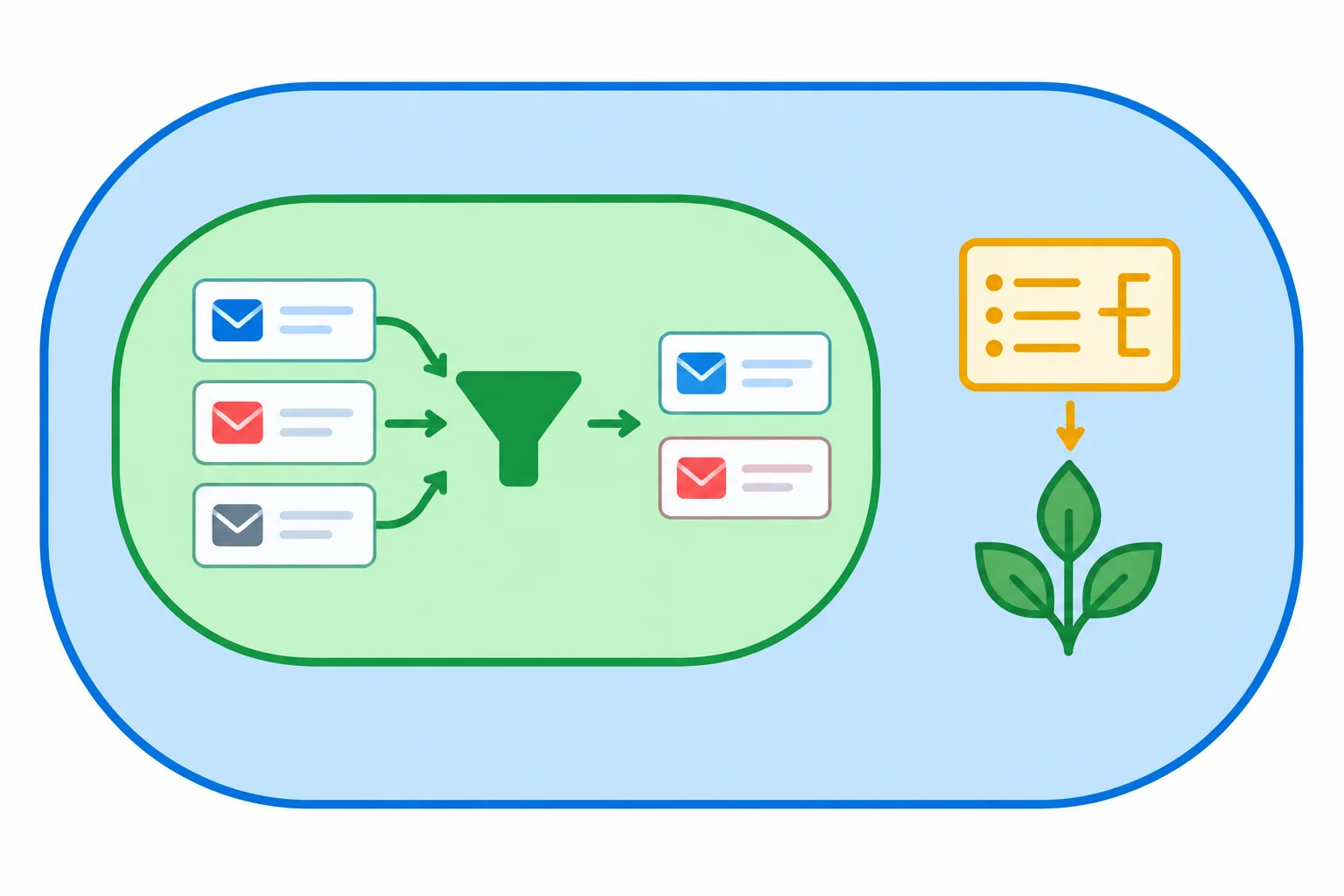
Machine learning belongs within AI, while some AI uses expert-written rules rather than machine learning.
Match each description to the conclusion supported by its evidence.
Match each description with its supported conclusion.
Tap an item and then its matching pair.
Step 4 of 7
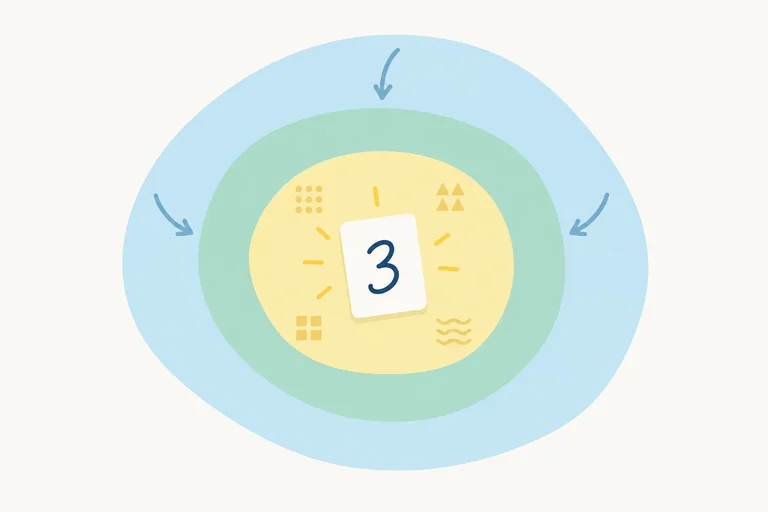
Machine learning (ML) is part of artificial intelligence (AI) and learns patterns from data. Deep learning (DL) is a narrower approach within ML. It uses artificial neural networks with many processing layers.
Think in terms of containment: a deep learning system is automatically an ML system and an AI system. The reverse is not guaranteed.
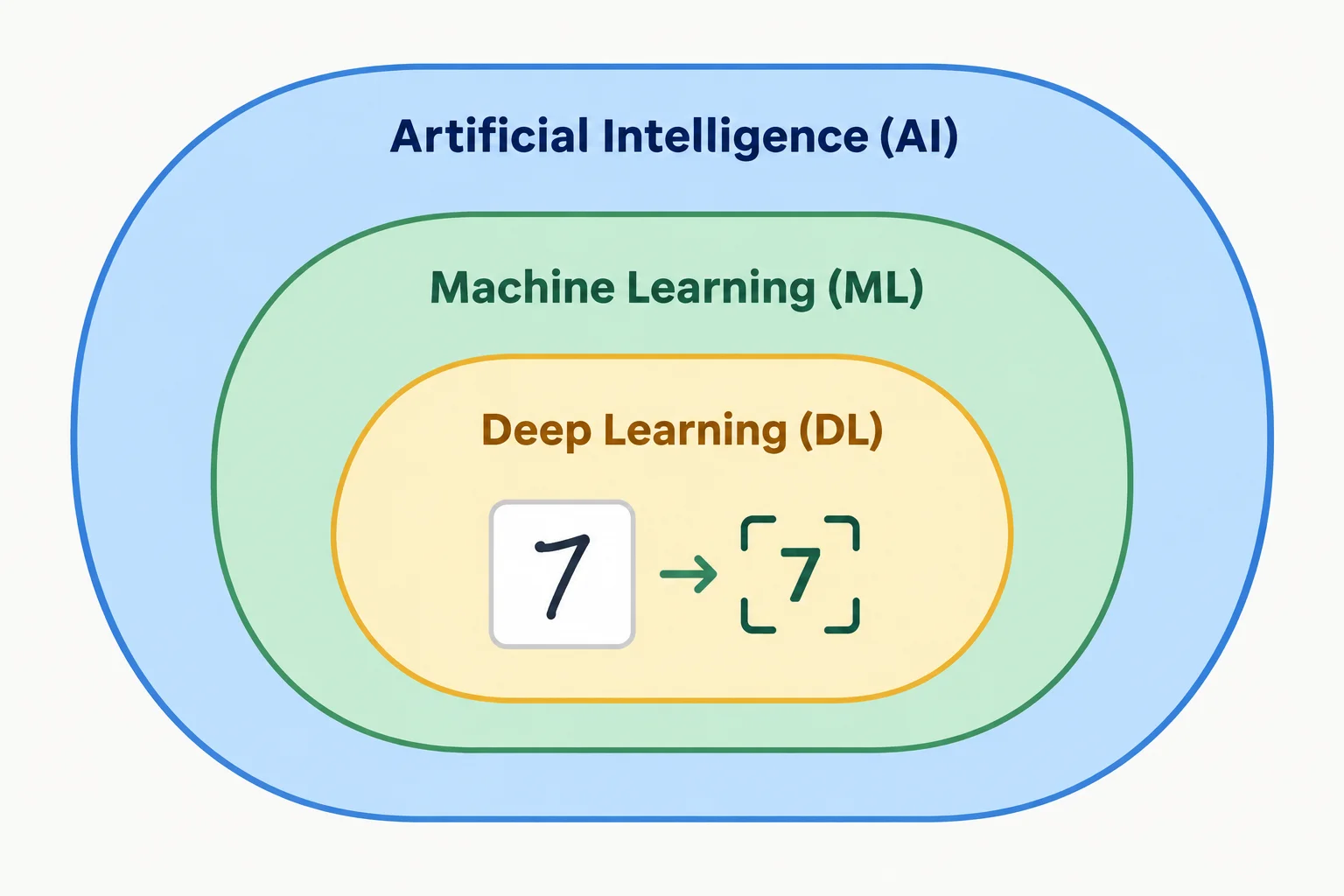
Deep learning is contained within machine learning, which is contained within artificial intelligence.
Example
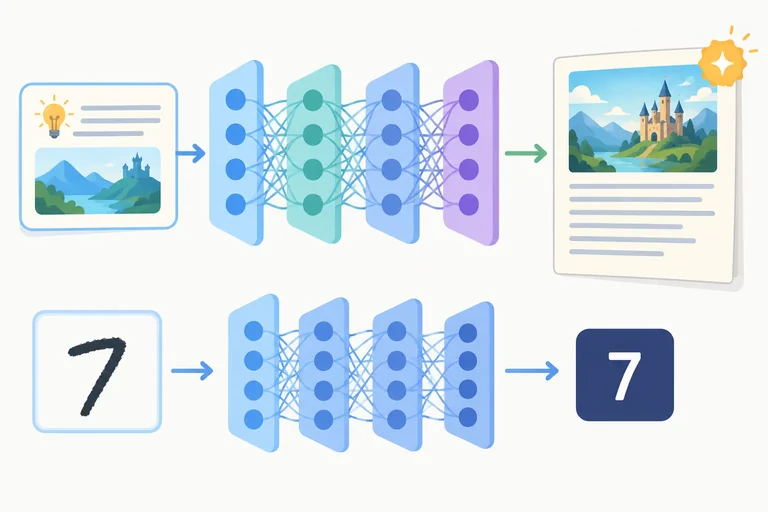
Digit Reader recognizes handwritten digits. Its description explicitly says that it uses an artificial neural network with many processing layers. That evidence makes the deep learning label Supported.
Since deep learning is within machine learning and AI, Digit Reader is also an ML system and an AI system.
Be careful with the direction of the inference. If a description says only that a system uses ML, deep learning is Not established. It may use deep learning, but the description has not supplied the needed evidence.
A broad label does not automatically prove a narrower one.
Which conclusion is justified when a system is explicitly described as using deep learning?
Complete the statement: Deep learning is a subset of _.
A system explicitly described as using deep learning must also have which two broader labels?
Step 5 of 7
Recognize generative AI as a content-producing capability that can overlap with machine learning and deep learning.
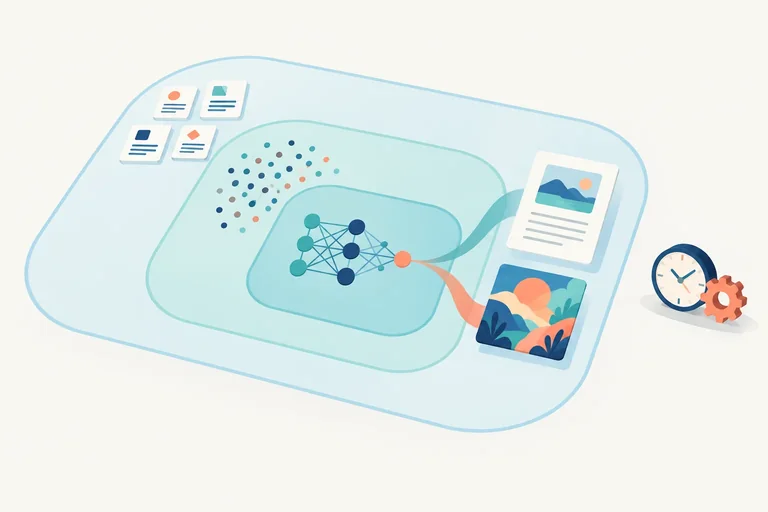
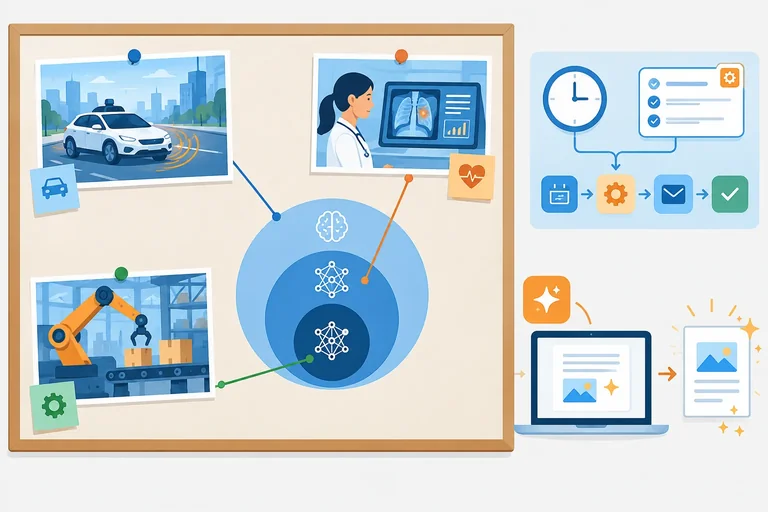
Generative AI describes a capability: producing new content in response to an input. That content can be text, images, audio, or video.
This is different from a label for how a system was built. Machine learning (ML) and deep learning (DL) are approaches used to build systems. Generative AI tells you what a system can do: create content.
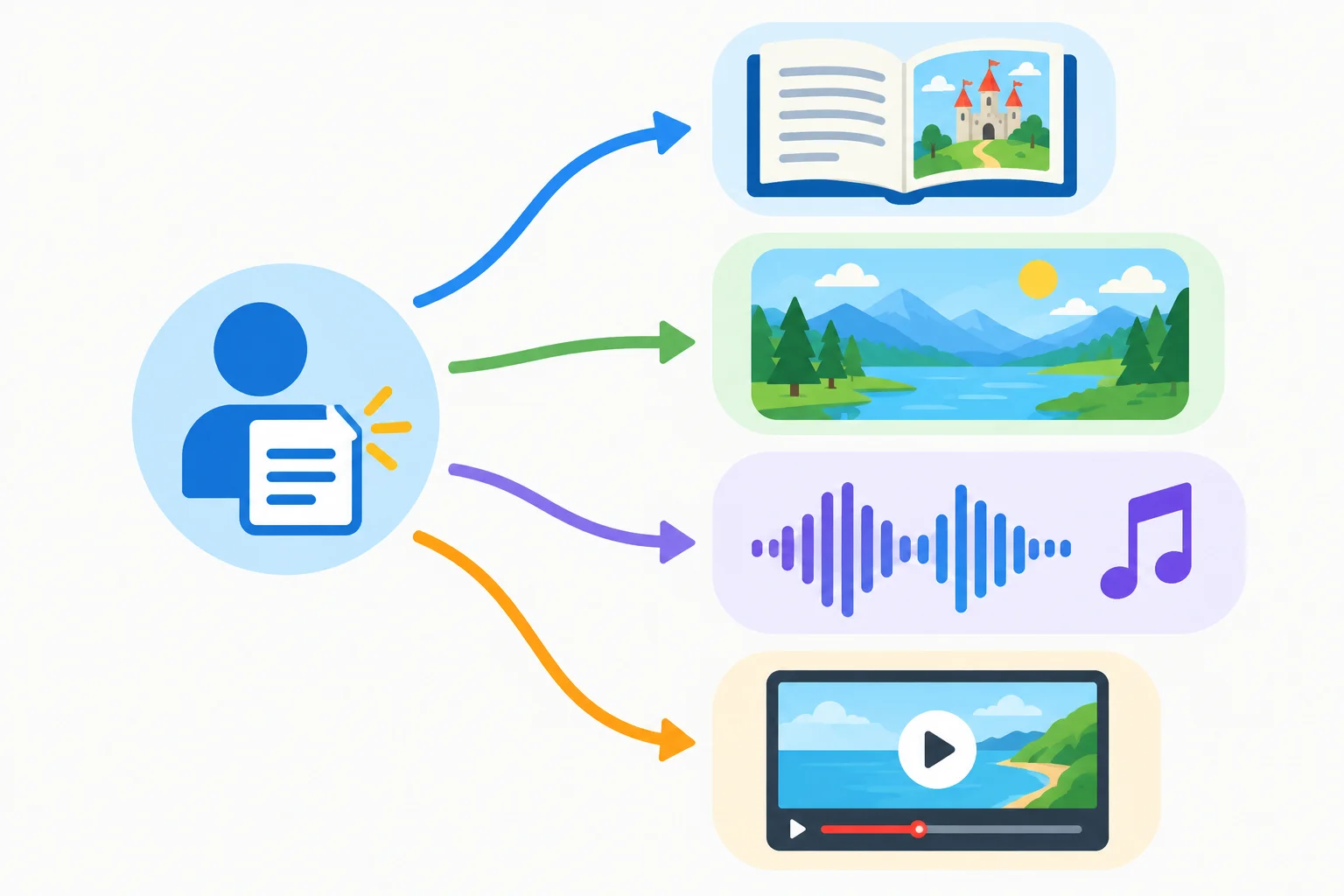
Generative AI can produce different forms of content from an input.
Consider two systems whose descriptions give different evidence:
So, deep learning does not automatically mean generative AI.
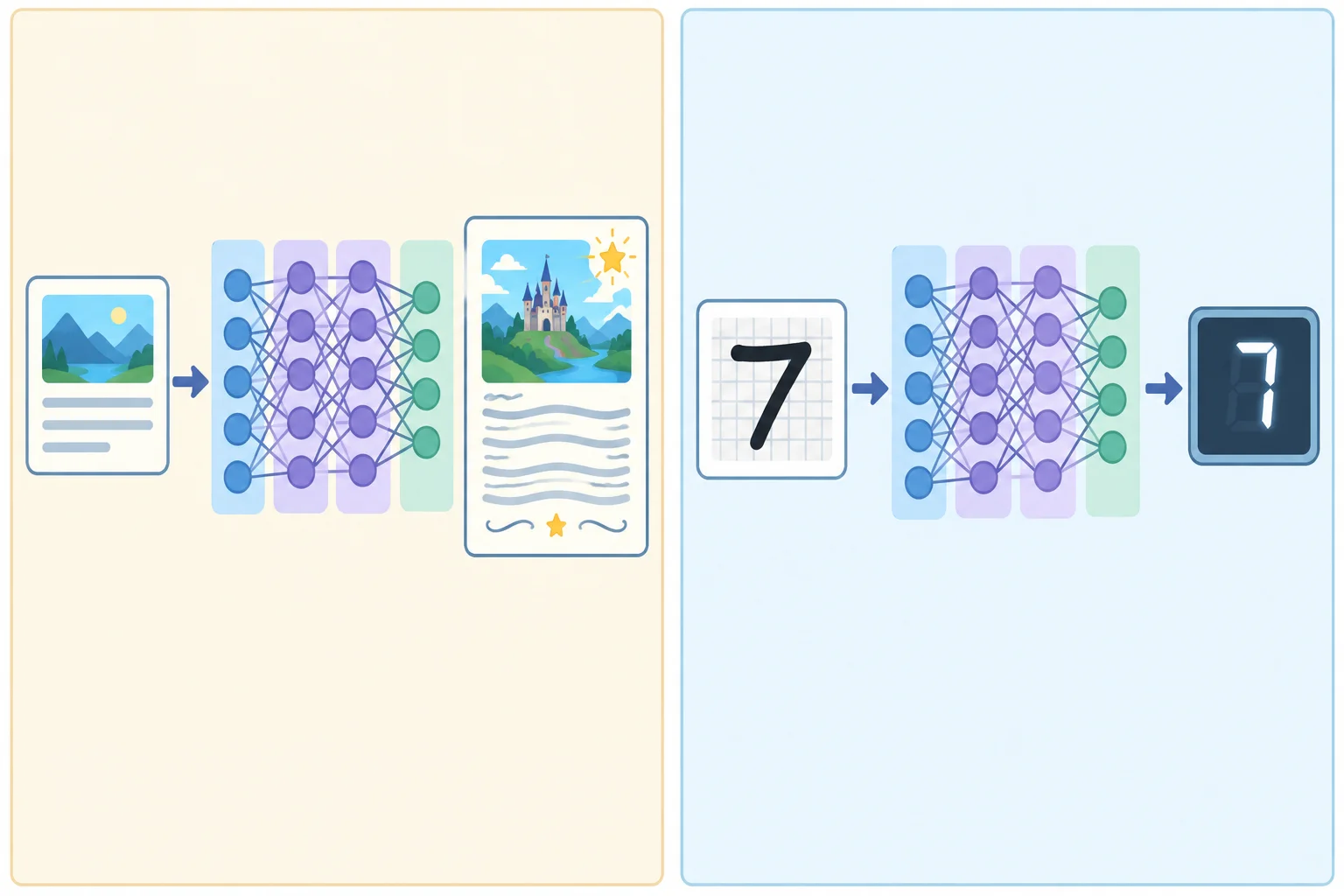
Both examples use deep learning; only Story Writer is described as producing content.
Example
Labels can overlap.
For Story Writer:
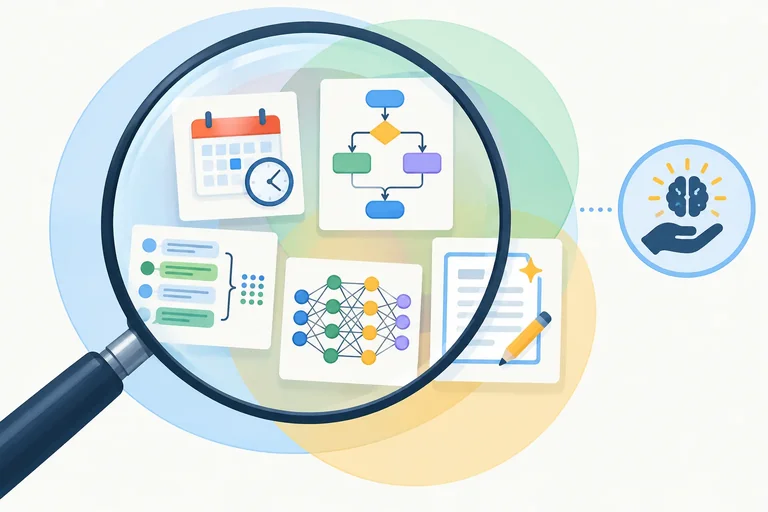
Generative AI is best pictured as a capability badge attached to an applicable system, not as a new region outside or above AI, ML, and DL.
Which description provides evidence of generative AI?
Why can Story Writer correctly be labeled both deep learning and generative AI?
Step 6 of 7
Use stated clues to assign compatible labels while leaving unsupported details unresolved.
When you label a system, use only what its description actually establishes. Labels can stack rather than compete.
A stated learning-from-data clue supports machine learning (ML), and ML is inside artificial intelligence (AI), so AI is supported too. A stated artificial neural network with many processing layers supports deep learning (DL), which also supports ML and AI.
Likewise, a clue that a system produces new content supports both generative AI and AI. If a description lacks a narrower clue, mark that label Not established. That does not mean the label is false; it means the description does not justify it. A familiar product name or an “AI-powered” claim does not establish a particular learning method.
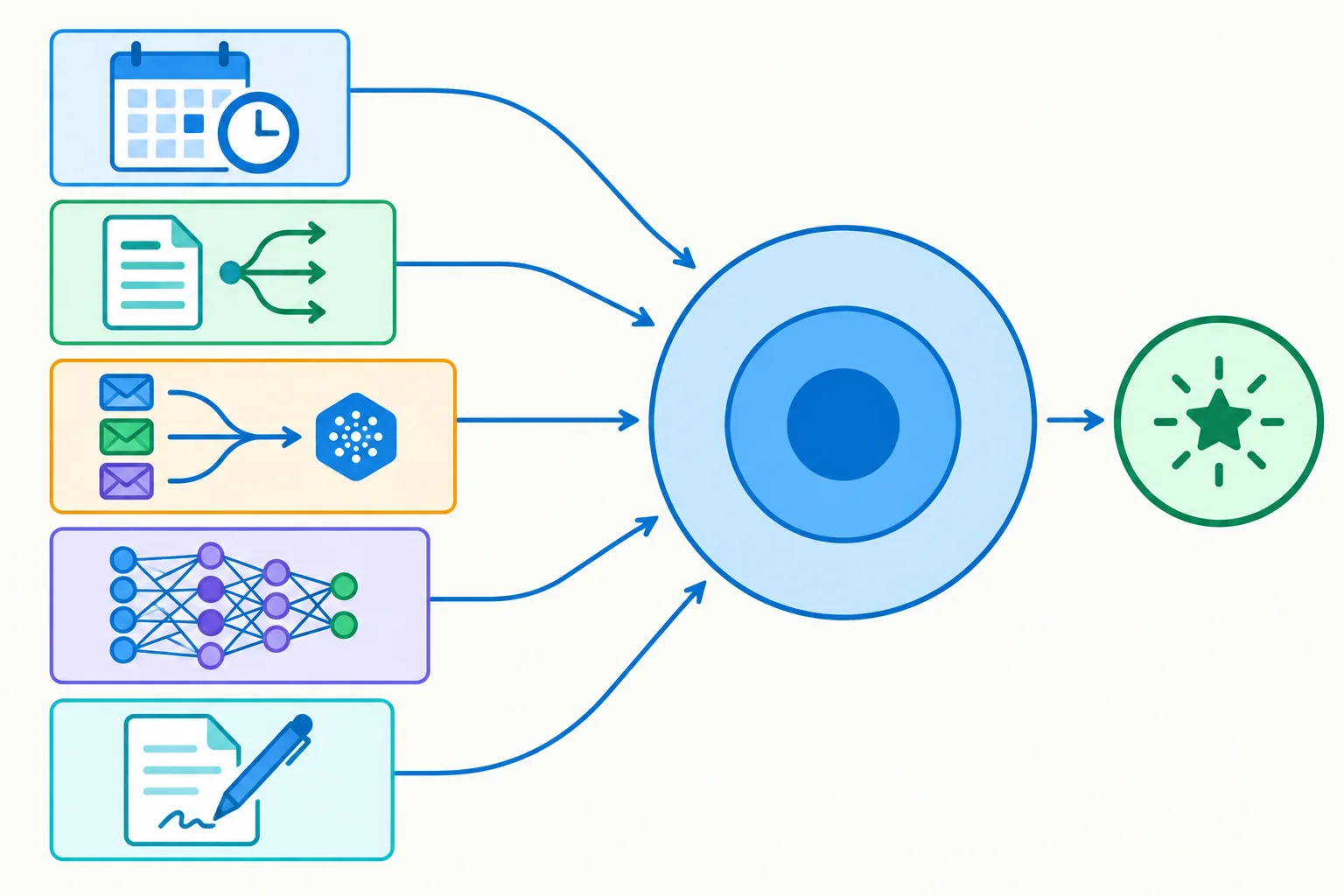
Look for the implementation or capability clue: rules, learned patterns, many layers, and newly produced content each support different labels.
Use a compact evidence table to keep supported labels separate from details that are not established. A label may be supported because it is directly stated or because it follows from the AI–ML–DL hierarchy.
| Description clue | Supported | Not established |
|---|---|---|
| Expert-written rules infer possible plant causes | rule-based AI; AI | ML; DL; generative AI |
| Learns patterns from example emails | ML; AI | DL; rule-based AI; generative AI |
| Artificial neural network with many layers recognizes digits | DL; ML; AI | rule-based AI; generative AI |
| Drafts a new fictional story from a request; method not stated | generative AI; AI | ML; DL; rule-based AI |
| Configured schedule sends a reminder at 9:00 AM | fixed-rule automation | AI; rule-based AI; ML; DL; generative AI |
Match each system description with the evidence statement it justifies.
Tap an item and then its matching pair.
A Message Sorter learns patterns from thousands of previously categorized messages. It automatically routes each new message to a folder. Its description does not mention an artificial neural network with many processing layers, explicitly configured rules, or producing new content.
In 3–5 sentences, identify every supported label and every relevant label that is Not established. Cite the clue for each conclusion.
Write at least 120 characters (0/120).
Step 7 of 7
Use evidence from unfamiliar scenarios to apply the distinctions among automation, AI, machine learning, deep learning, and generative AI.
Use the description as evidence—not a product name or the fact that something runs automatically.
A label can be Supported, or Not established when the description does not provide enough evidence. Labels can overlap; they are not a forced single choice.
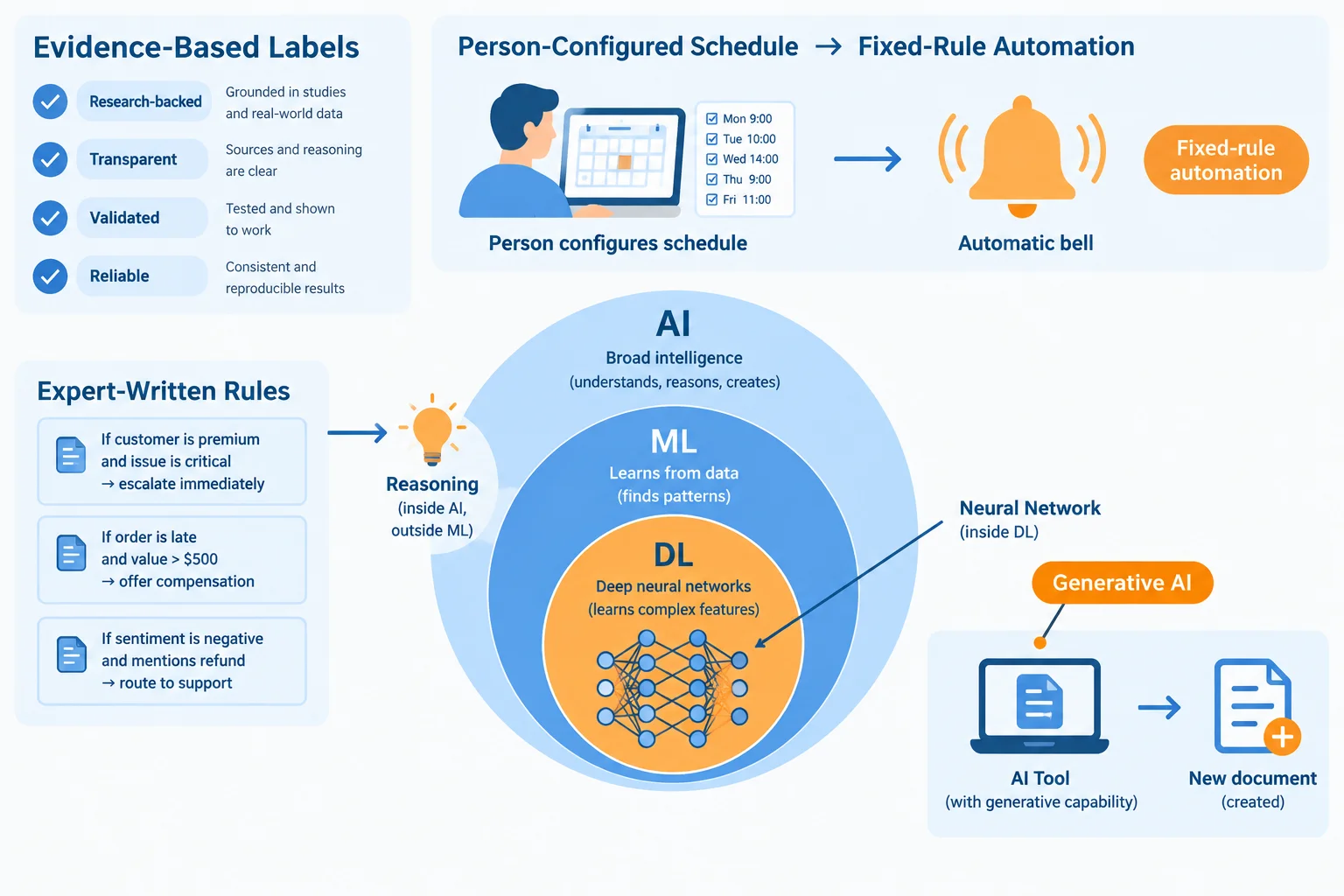
Read labels from the evidence supplied: DL is within ML, which is within AI; generative AI is a capability that can overlap with them.
Summary
A warehouse manager configures Shelf Signal: “When the count of item A falls below 12, send a reorder alert.” Shelf Signal sends the alert without the manager repeating the action.
Which conclusion is best supported?
Invite Studio learns visual patterns from many example invitations. Its artificial neural network has many processing layers. When a user describes an event, it creates a new invitation image.
Which set of labels is Supported?
Write a short evidence-based analysis of all three scenarios below. For each one, name the labels that are Supported and identify any narrower labels that are Not established. Cite the clue that led you there.
Finish with one sentence explaining why the terms are related but not interchangeable.
Write at least 350 characters (0/350).
Congratulations! You completed: Distinguishing AI, Machine Learning, and Generative AI
Thousands of online courses in video, ebooks and audiobooks.
To test your knowledge during online courses
Generated directly from your cell phone's photo gallery and sent to your email

Download our app via QR Code or the links below:.


Carry knowledge in your pocket.
Download the Cursa app.
There are hundreds of free courses available, with a free certificate of completion that is saved in your mobile image gallery.
Download the app to access the Course Completion Certificate for Free.


+ 10 million
students

Free and Valid
Certificate

60 thousand free
exercises

4.8/5 rating in
app stores

Free courses in
video and ebooks