
Step 1 of 8
What Documents Add to an Answer
See how selected passages, rather than an entire document collection, can support an assistant’s answer.

Learning path · Level 6 · Tutorial 1
Explain how an assistant retrieves document passages to support an answer, and distinguish this process from retraining a model or simply pasting more text into a conversation.
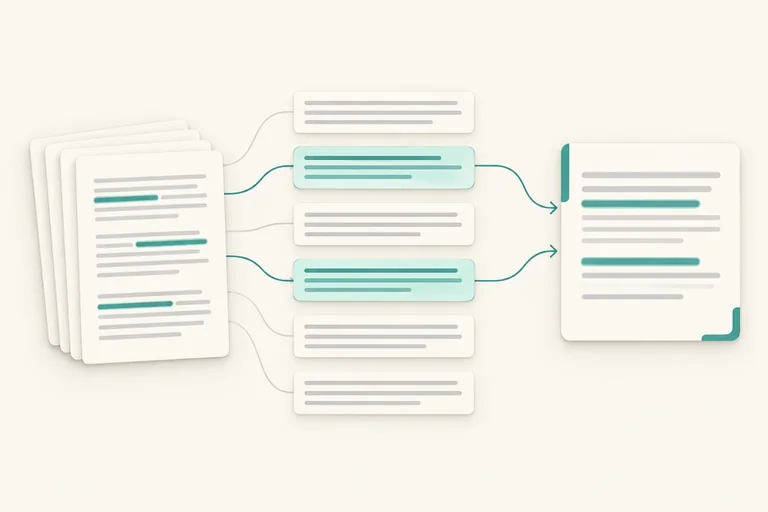
 What Documents Add to an Answer
See how selected passages, rather than an entire document collection, can support an assistant’s answer. 1 min
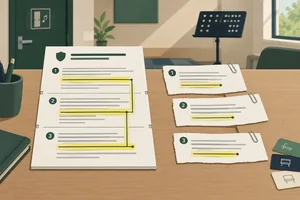 Chunks Keep—or Lose—Meaning
Learn how separately retrievable document passages can preserve—or separate—the conditions needed to interpret a rule. 2 min
 Embeddings Compare Meaning
Learn how embeddings represent questions and document chunks in a compatible way so a system can compare meaning beyond exact keyword matches. 2 min
 Relevant Is Not the Same as Sufficient
Learn why semantic relevance is not enough: a retrieved passage must also apply to the right resource and include the condition needed to support an answer. 2 min
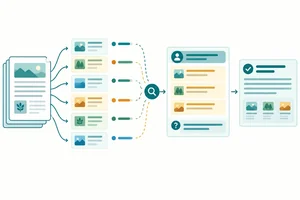 Follow the Question Through RAG
Trace how prepared document passages become retrieved context and support an answer at question time. 2 min
 Retrieval, Pasted Context, or Retraining?
Compare retrieval-augmented generation (RAG), manually pasted context, and retraining by following how document information reaches the model. 2 min
 Where a Document-Grounded Answer Can Fail
Inspect visible collection, retrieval, and answer stages to distinguish a retrieval miss, unsupported generation, and evidence absent from the collection. 2 min
 Trace and Explain a Document-Grounded Answer
Trace a Cedar Studio booking question through chunks, embeddings, semantic search, retrieved context, and a supported answer. 2 min
Step 1 of 8
See how selected passages, rather than an entire document collection, can support an assistant’s answer.
retrieval-augmented generation (RAG) helps an assistant answer with selected document passages.
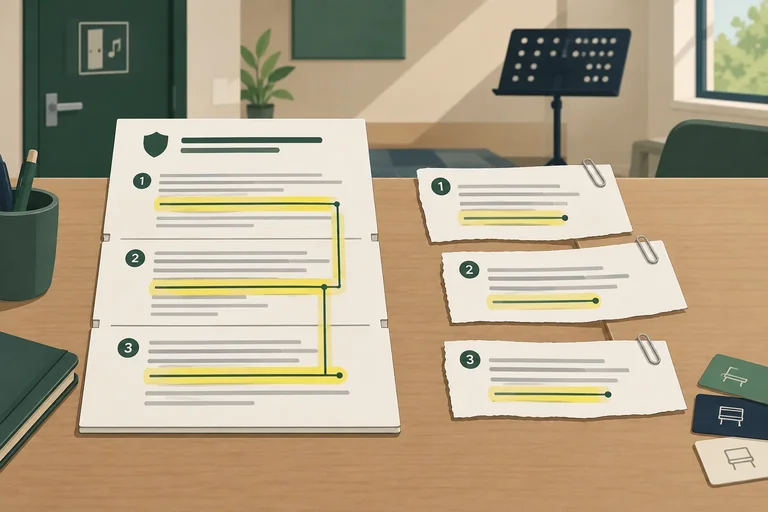
A document collection can contain many guides. For one question, the assistant is given only selected passages as retrieved context. It then uses that context while generating its answer.
So, access to a collection does not mean every document—or every fact in every document—is available in the answer.
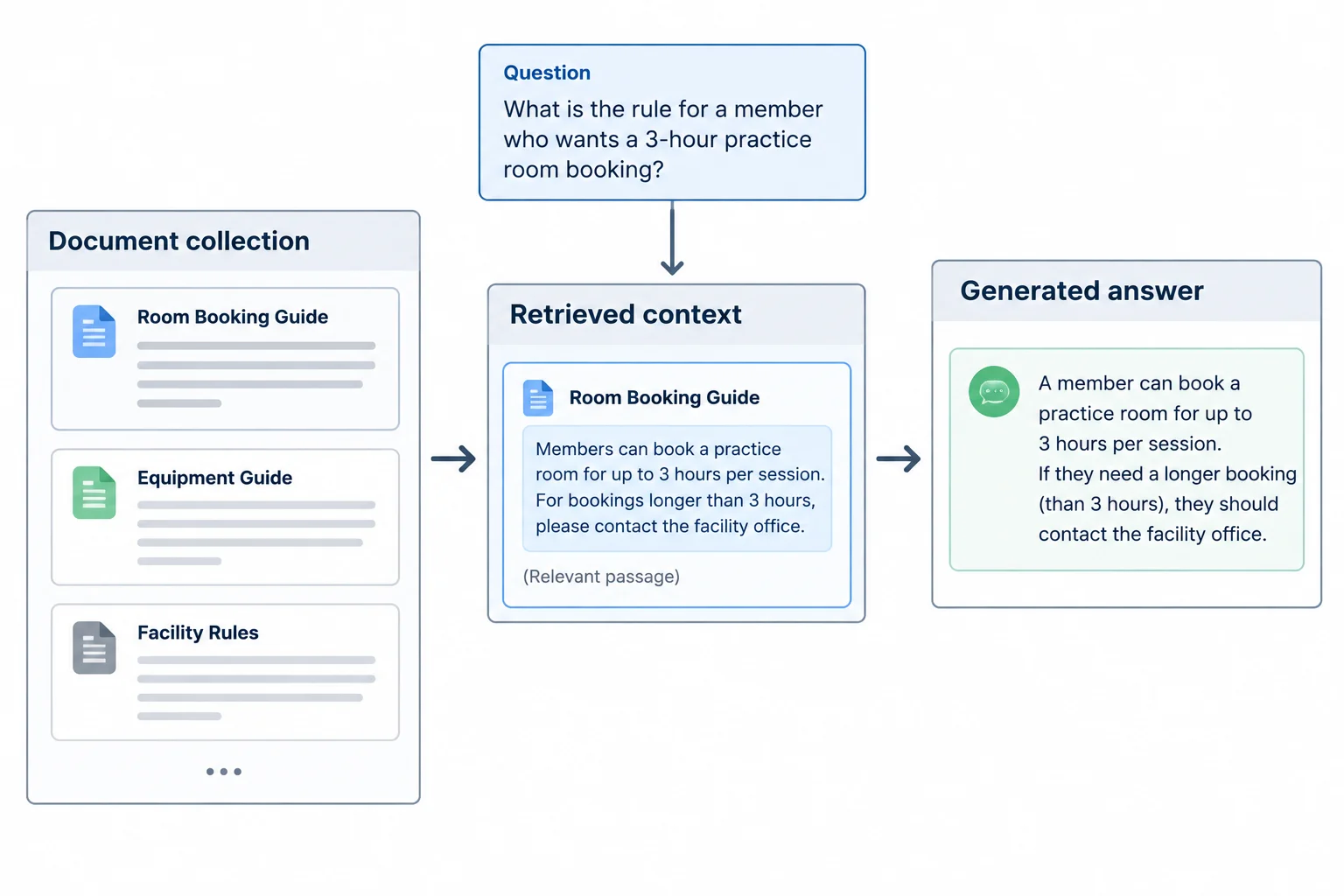
Only selected passages move from the document collection into retrieved context for this answer.
For Cedar Studio, the question needs the rule for practice rooms. A general-sounding answer is not enough; the answer needs the documented rule that applies to that resource.
A passage from the right guide can support the conclusion. A passage about another resource cannot establish the practice-room rule, even if it also mentions 3 hours.
Example
Question: What is the rule for a member who wants a 3-hour practice room booking?
Selected passage from “Room Booking Guide”: Members may book practice rooms for up to 2 hours without staff approval. Bookings longer than 2 hours require staff approval.
Generated answer: A 3-hour practice room booking requires staff approval.
The passage supports that requirement. It does not guarantee that approval will be granted or that a room is available.
Tip
“Equipment Guide” says members may borrow projectors for up to 3 hours. That rule is about projectors, not practice rooms. A collection may contain related material without containing support for the specific conclusion you need.
Match each description to its role in the Cedar Studio example.
Tap an item and then its matching pair.
Step 2 of 8
Learn how separately retrievable document passages can preserve—or separate—the conditions needed to interpret a rule.
A chunk is a document passage small enough to retrieve separately. One document can provide many chunks, so a retrieved chunk is not necessarily a whole document—or even a whole page.
For Cedar Studio, the assistant needs a passage from the "Room Booking Guide" that keeps the booking rule connected to the condition that changes it. A passage that sounds relevant but leaves out that condition can mislead the answer.
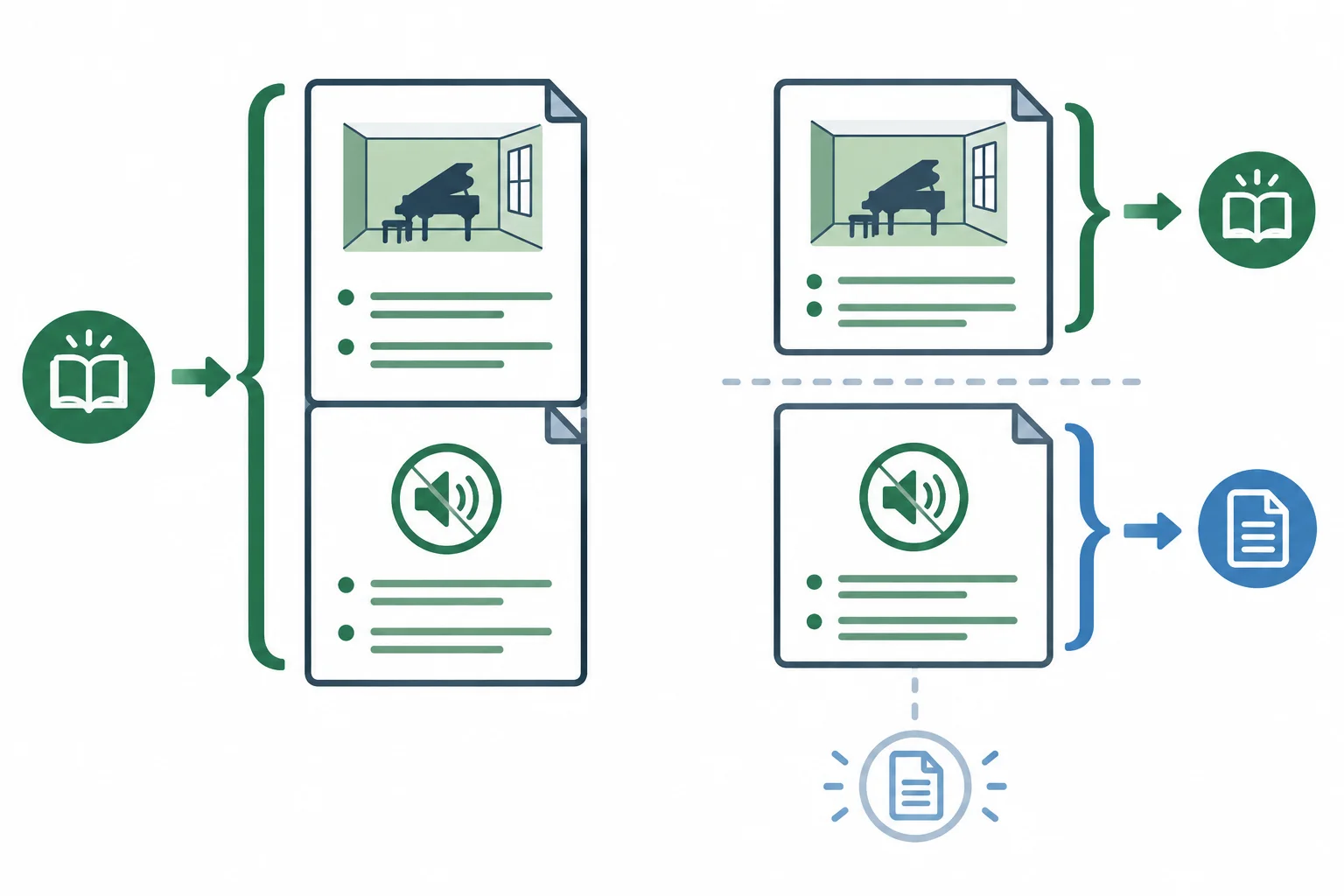
A chunk boundary can leave a condition outside the passage that was retrieved.
Example
Consider this complete passage from the "Room Booking Guide":
Members may book practice rooms for up to 2 hours without staff approval. Bookings longer than 2 hours require staff approval.
As one chunk, the passage connects the limit, the exception, and the required action. It can support the conclusion for a member requesting a 3-hour practice room booking: staff approval is required. It does not guarantee that approval or room availability.
Now imagine a boundary divides the two sentences. A retrieved chunk containing only the first sentence tells you what happens up to 2 hours, but it does not state the rule for a longer booking.
Shorter is not automatically better or worse. What matters here is whether the separately retrievable passage retains the meaning needed for the question. If related conditions are split apart, the system may need to retrieve multiple chunks to recover the full rule.
Tip
Ask: “If this passage were retrieved by itself, would it still include the condition needed to interpret the rule?”
Which description best fits a chunk in a document collection?
Choose the best answer.
For the question, “What is the rule for a member who wants a 3-hour practice room booking?”, which grouping best preserves the booking rule and its approval condition within one retrievable passage?
Select the grouping with the strongest retained meaning.

Step 3 of 8
Learn how embeddings represent questions and document chunks in a compatible way so a system can compare meaning beyond exact keyword matches.
An embedding is a numerical representation of text that a system can use to compare aspects of meaning. You do not need to read the numbers yourself.
A question and a document chunk can be turned into compatible embeddings. The system can then compare those representations to find text that appears meaningfully related, even when the wording is not identical.
In retrieval-augmented generation (RAG), this comparison can help connect a question to useful document passages.
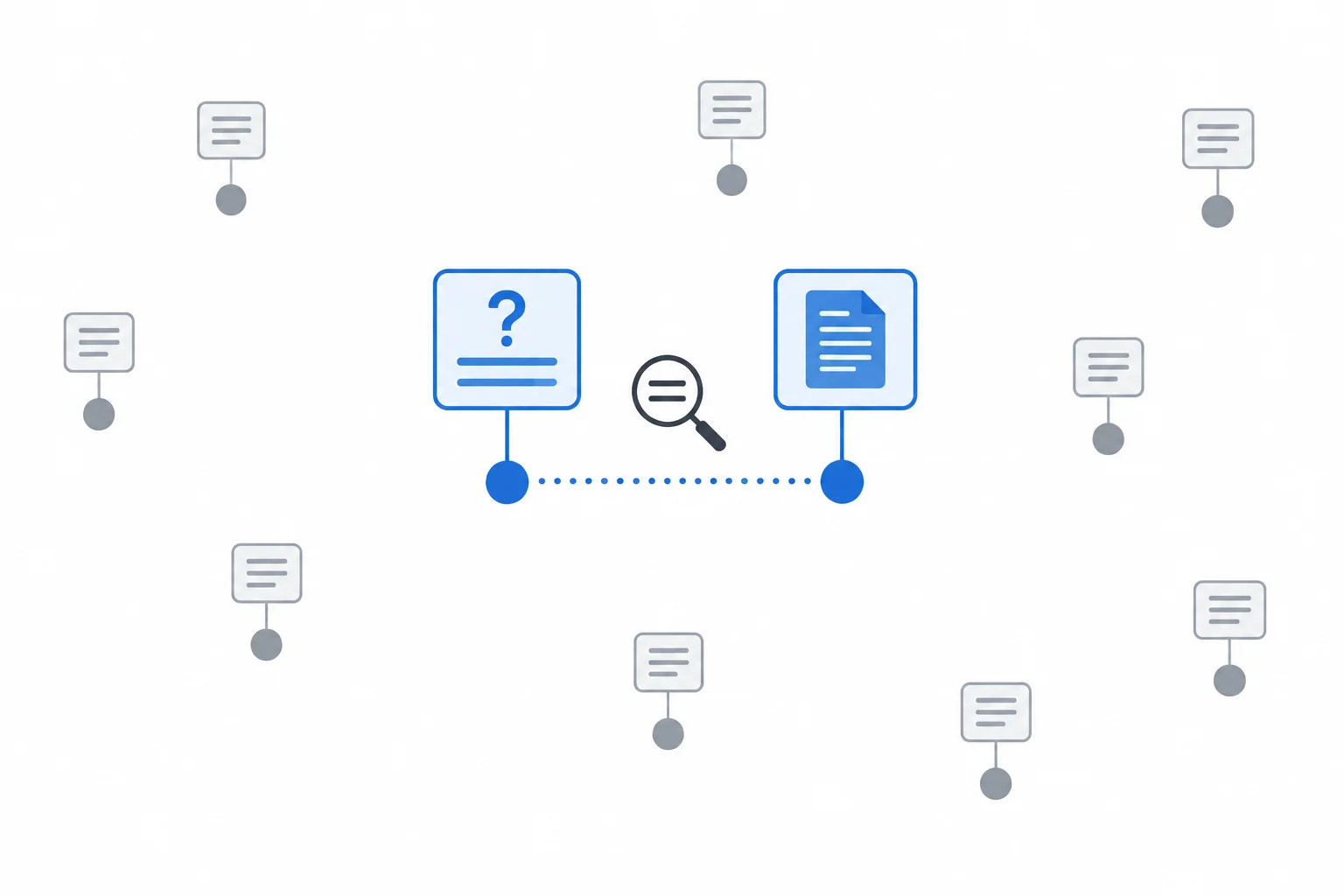
Illustrative similarity map: nearby points represent text that the system considers more similar in meaning.
Tip
Treat the map as a metaphor. Real embeddings are not readable summaries, and they are not literally arranged on a flat page.
Example
Consider the central question:
What is the rule for a member who wants a 3-hour practice room booking?
A chunk from the "Room Booking Guide" says that members may book practice rooms for up to 2 hours without staff approval, while bookings longer than 2 hours require staff approval.
The question says “wants a 3-hour practice room booking.” The chunk says “book practice rooms” and “bookings longer than 2 hours.” The wording is not an exact copy, but both texts concern the same kind of request and duration rule. Compatible embeddings can capture enough of that relationship for comparison.
Embedding proximity means the representations appear similar for the comparison task. It does not prove that a passage is true, authoritative, complete, or the right basis for a final answer.
Think of proximity as a clue about related meaning—not a verdict about correctness.
True or false: A question and a passage can have similar embeddings even when their wording differs; however, their proximity alone does not prove the passage is correct.

Step 4 of 8
Learn why semantic relevance is not enough: a retrieved passage must also apply to the right resource and include the condition needed to support an answer.
Semantic search can rank chunks as candidates for a question by meaning-related similarity. In this simplified example, the ranking is a useful shortlist—not proof that a passage is true, authoritative, complete, or applicable.
For Cedar Studio’s question, a passage about a 3-hour projector loan may resemble a 3-hour practice room booking because both involve a member, a duration, and access to a resource. But projectors and practice rooms are different resources. Similar wording does not make the projector rule evidence for a room-booking answer.
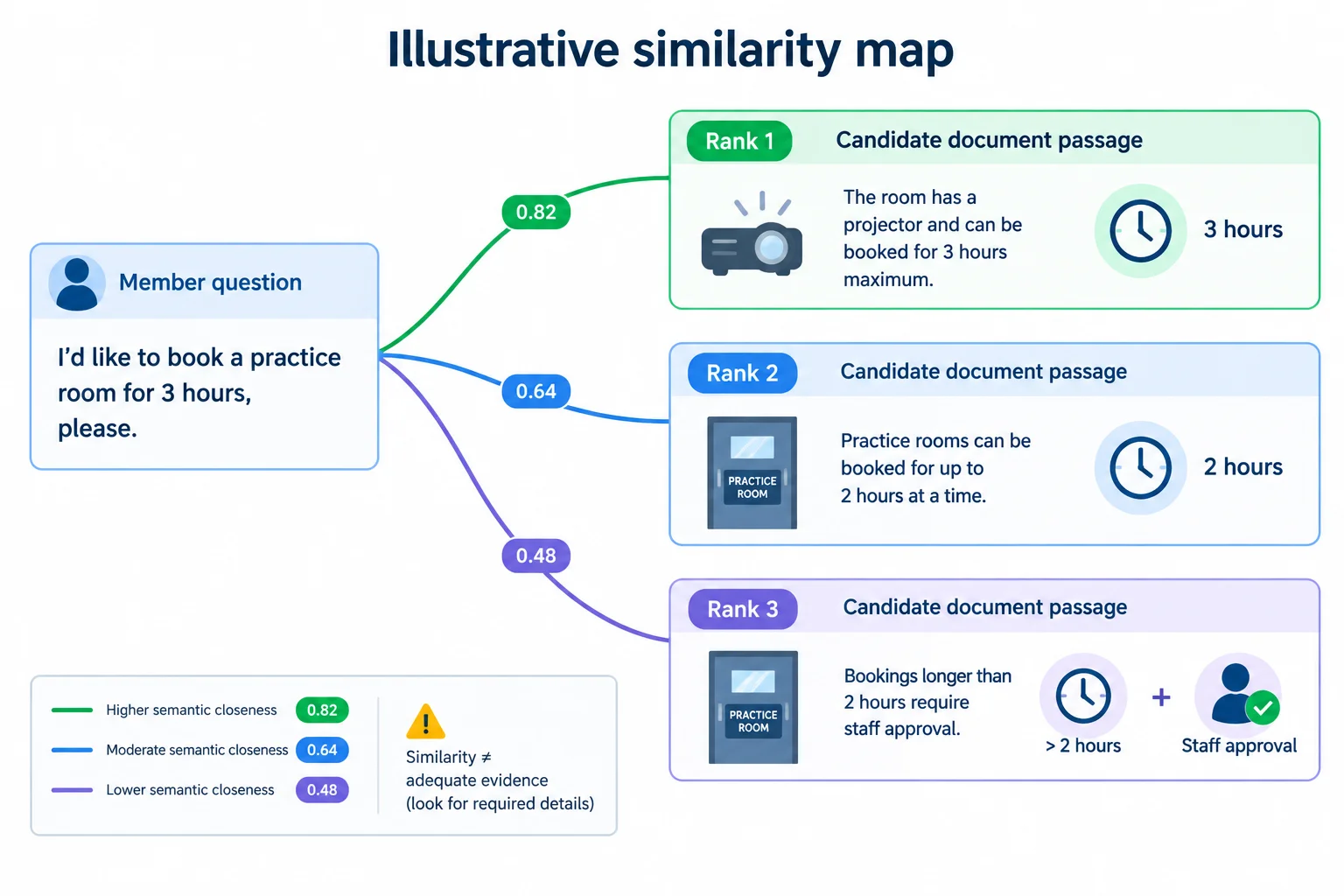
Illustrative similarity map: semantic similarity can rank a passage highly even when it addresses the wrong resource or lacks a needed condition.
To support the requested conclusion, inspect more than rank. Ask:
A candidate can be on-topic yet still fail one of these checks. In particular, a rule for bookings up to 2 hours does not tell you what happens for a 3-hour booking.
The ranks below are illustrative. A lower-ranked candidate can provide stronger support than a higher-ranked one.
| Rank | Candidate passage | Support check | Sufficient? |
|---|---|---|---|
| Rank 1 | “Equipment Guide”: Members may borrow projectors for up to 3 hours. | Wrong resource: projectors are not practice rooms. | No |
| Rank 2 | “Room Booking Guide”: Members may book practice rooms for up to 2 hours without staff approval. | Right resource, but it omits the rule for bookings longer than 2 hours. | No |
| Rank 3 | “Room Booking Guide”: Practice room bookings longer than 2 hours require staff approval. | Covers the relevant duration condition and staff approval. | Yes |
For the question “What is the rule for a member who wants a 3-hour practice room booking?”, which assessment is correct?
Step 5 of 8
Trace how prepared document passages become retrieved context and support an answer at question time.
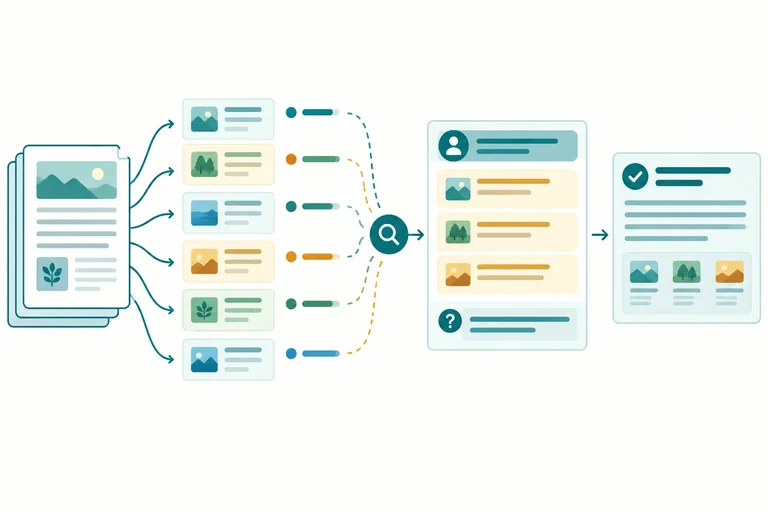
A representative retrieval-augmented generation (RAG) flow has two phases. During Document preparation, the system divides the Document collection into retrievable Chunks and creates Passage embeddings for those chunks. This makes passages available for later search.
For Cedar Studio, the "Room Booking Guide" can provide chunks containing the practice-room duration rule and its staff-approval condition. Preparation is done ahead of questions; it is not restarted from scratch every time a member asks about a booking.
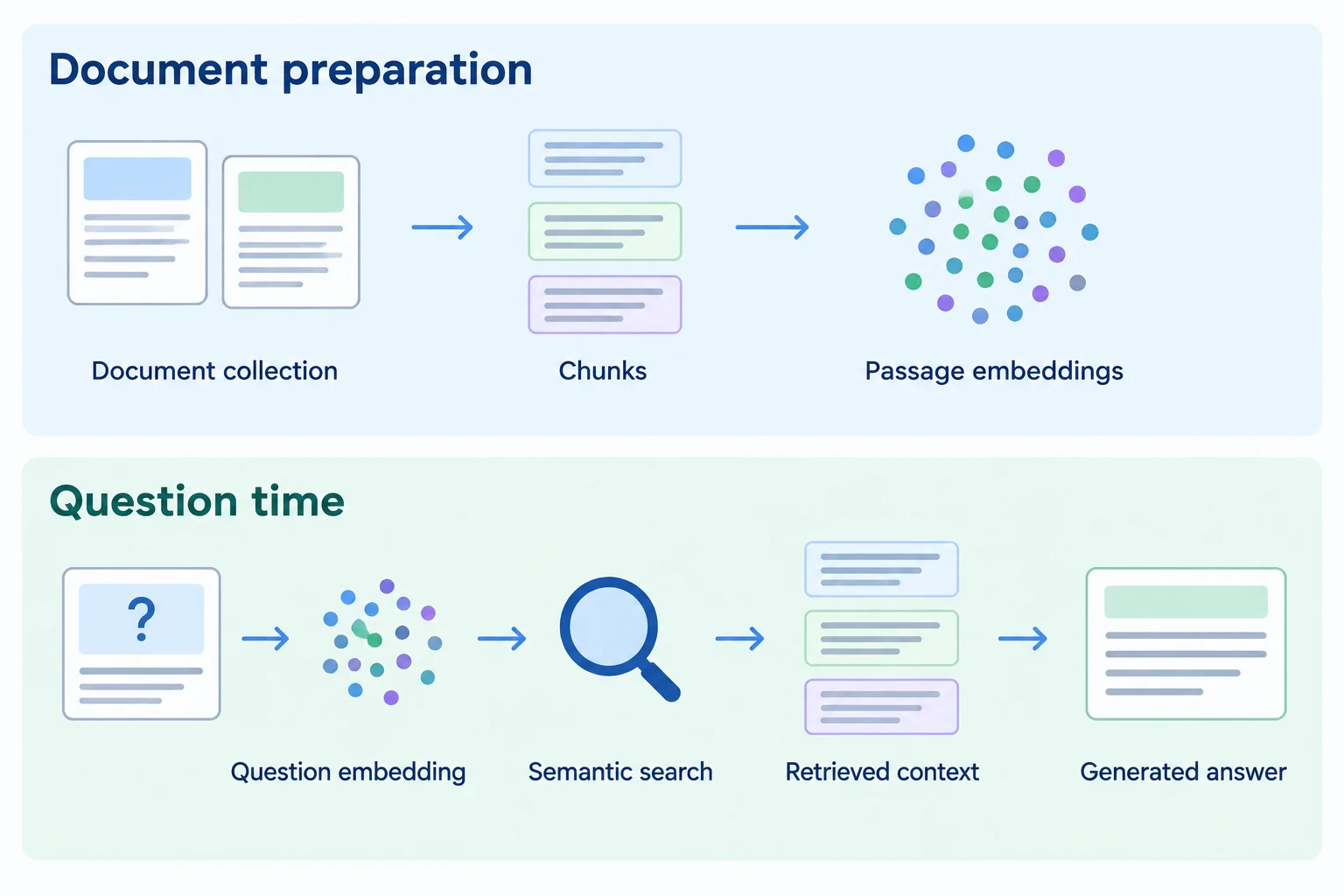
Document preparation makes chunks searchable; Question time selects passage text and uses it to generate an answer.
At Question time, the system represents the new question as a Question embedding. Semantic search compares that representation with the available Passage embeddings and ranks candidate chunks by meaning-related similarity.
The system then selects passages to form Retrieved context. For generation, the model receives the question, applicable instructions, and the selected passage text. It does not receive only embedding numbers. In this simplified flow, chunks that were not selected are not automatically available to the model for this answer.
Retrieval selects material; generation writes an answer from the supplied context. They are separate operations.
Tip
A RAG flow that uses embeddings is common, but it is not the only possible implementation. The key distinction here is the sequence: prepared passages can be searched at question time, selected passage text becomes retrieved context, and then a model generates an answer using that context.
Example
Question: What is the rule for a member who wants a 3-hour practice room booking?
A projector passage from "Equipment Guide" is not selected and is not automatically supplied to the model. The answer does not guarantee staff approval or room availability.
The motion emphasizes selection before generation.
Which action belongs to Document preparation, rather than being repeated for each new question?
Choose the preparation activity.
Put the Question time stages in order for the Cedar Studio booking question.

Step 6 of 8
Compare retrieval-augmented generation (RAG), manually pasted context, and retraining by following how document information reaches the model.
The same rule can influence an answer in different ways. The key question is how the information reaches the model.
All three can support useful answers, but they are different mechanisms.
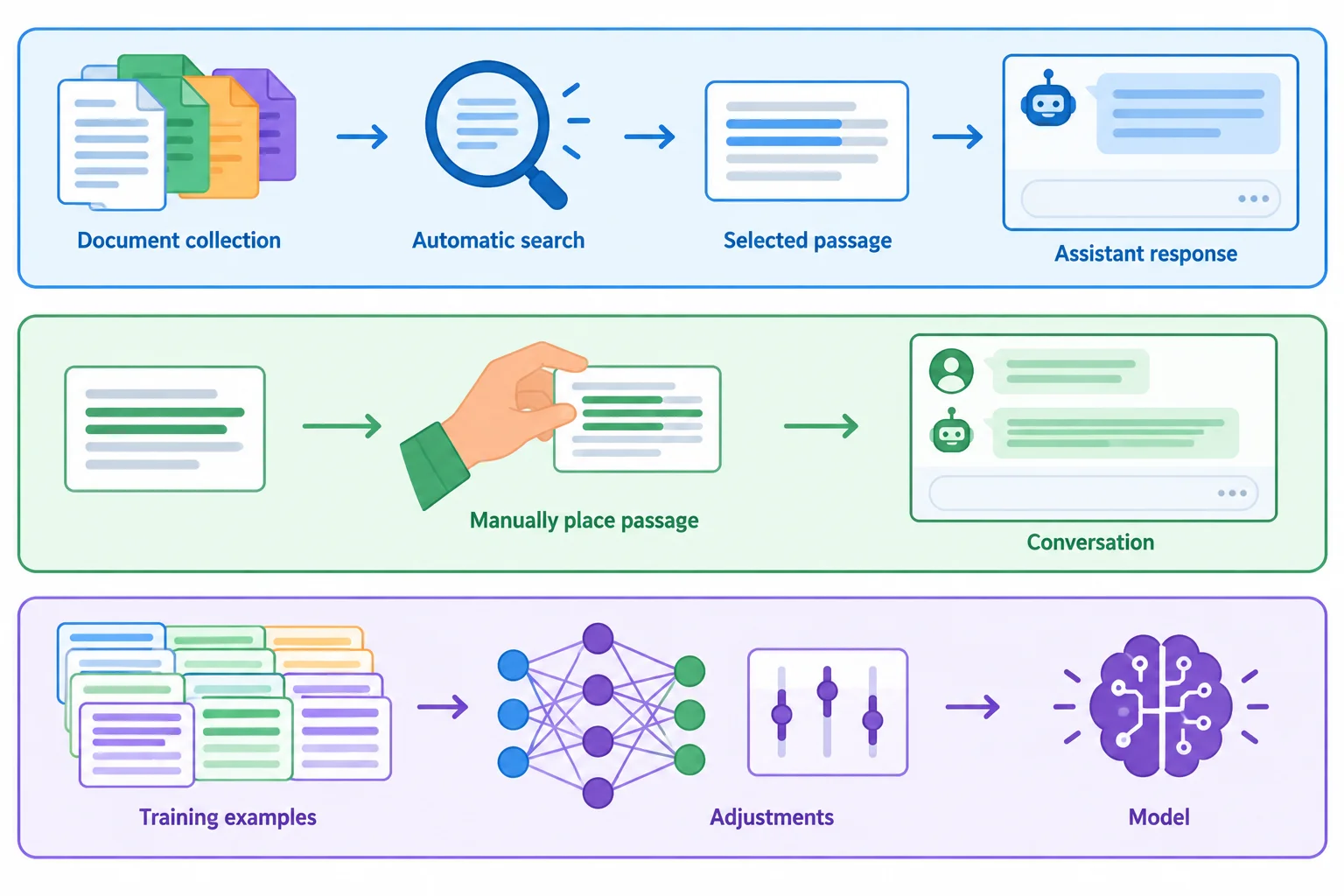
RAG selects passage text automatically at question time. Direct-context prompting receives text chosen manually. Retraining changes the model rather than selecting a passage for this question.
Use these distinctions when you hear that an assistant “uses documents.”
| Approach | How document information arrives | At question time | Changes learned parameters? |
|---|---|---|---|
| RAG | Automatic selection from a collection | Selected passages become retrieved context | No |
| Direct-context prompting | A person inserts chosen text into the conversation | Inserted text is already in the prompt | No |
| Retraining | A training process adjusts the model | The answer can draw on changed parameters | Yes |
Tip
These mechanisms are not mutually exclusive. For example, a system can use a retrained model and also use RAG for a particular question. But pasting a longer excerpt into a conversation, by itself, does not turn that interaction into RAG.
Match each scenario to its document-use mechanism.
Tap an item and then its matching pair.

Step 7 of 8
Inspect visible collection, retrieval, and answer stages to distinguish a retrieval miss, unsupported generation, and evidence absent from the collection.
A wrong answer alone does not reveal where a document-grounded process failed. Compare three visible layers:
A retrieval miss occurs when needed evidence exists in the collection but is absent from retrieved context. Unsupported generation occurs when needed evidence is present in retrieved context, but the answer changes it or adds a claim it does not support. Evidence absent from the collection means the visible sources never state the fact the question requires.
These issues can occur separately or together. When a case shows more than one issue, name all that apply rather than forcing one label.
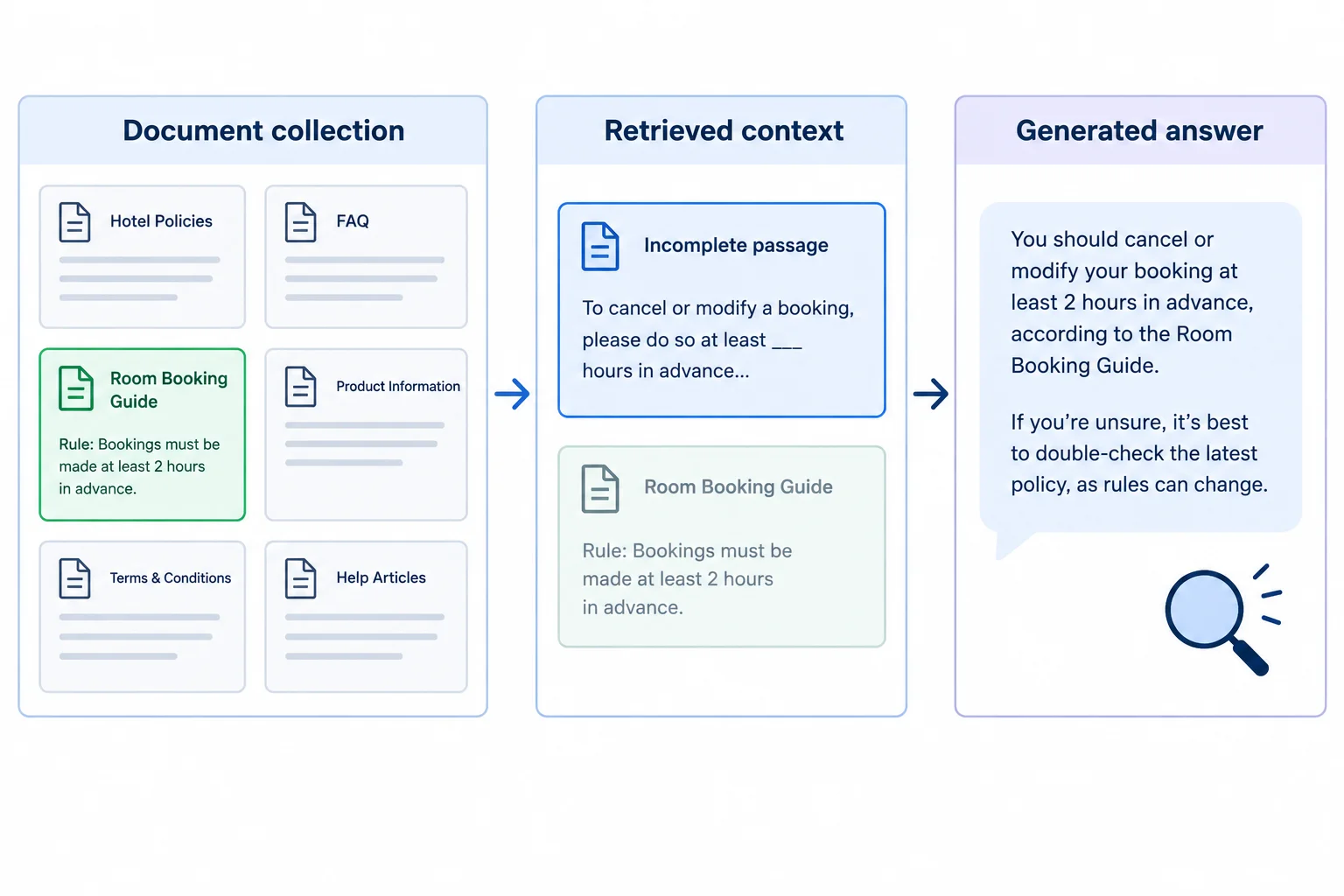
Compare the collection with retrieved context before deciding whether retrieval or generation is the visible problem.
Example
Question: What is the rule for a member who wants a 3-hour practice room booking?
Document collection: “Room Booking Guide” states: “Members may book practice rooms for up to 2 hours without staff approval. Bookings longer than 2 hours require staff approval.”
Retrieved context: “Members may book practice rooms for up to 2 hours without staff approval.”
Generated answer: “The supplied passage does not state the rule for a 3-hour practice room booking.”
The needed approval rule exists in the collection, but it was not selected. This is a retrieval miss. The answer is cautious; it does not create an unsupported claim.
Keep the layers distinct. A visible passage can be enough for the requested conclusion, yet the generated answer can still go beyond it. Conversely, a system can correctly acknowledge that the collection lacks a requested fact.
The examples below intentionally isolate one classification each. In a real RAG case, more than one failure can be visible at once, so an evaluator should identify each applicable issue.
Example
Question: What is the rule for a member who wants a 3-hour practice room booking?
Retrieved context from “Room Booking Guide”: “Members may book practice rooms for up to 2 hours without staff approval. Bookings longer than 2 hours require staff approval.”
Generated answer: “Staff approval is guaranteed for a 3-hour practice room booking.”
The retrieved passage supports that staff approval is required. It does not say approval will be granted. Retrieval supplied the needed rule, but the answer distorted it. This is unsupported generation.
Example
Question: Will a practice room definitely be available for a member’s 3-hour booking?
Document collection: “Room Booking Guide” states the booking-duration and staff-approval rules. “Equipment Guide” states that members may borrow projectors for up to 3 hours.
Generated answer: “The visible collection does not state whether a practice room will be available.”
No visible source states an availability rule. This is evidence absent from the collection. The cautious answer accurately identifies the gap instead of inventing an availability claim.
Match each transparent case to its most direct classification.
Tap an item and then its matching pair.
For each case, name the classification and point to the visible information that supports it. Use this format: A — classification; evidence: ...
A. The collection includes “Bookings longer than 2 hours require staff approval” in “Room Booking Guide.” Retrieved context contains only “Members may book practice rooms for up to 2 hours without staff approval.” The answer says, “The supplied passage does not state the rule for a 3-hour practice room booking.”
B. Retrieved context includes “Bookings longer than 2 hours require staff approval.” The answer says, “Staff approval is guaranteed for a 3-hour practice room booking.”
C. The visible collection contains the practice-room duration rules and the projector borrowing rule, but no statement about practice-room availability. Asked whether a room will definitely be available, the answer says, “The visible collection does not state whether a practice room will be available.”
Write at least 180 characters (0/180).

Step 8 of 8
Trace a Cedar Studio booking question through chunks, embeddings, semantic search, retrieved context, and a supported answer.
Use this complete miniature collection for one question.
“Room Booking Guide”
“Equipment Guide”
A chunk is separately retrievable. The collection contains all three chunks, but only selected chunks become retrieved context for a particular question.
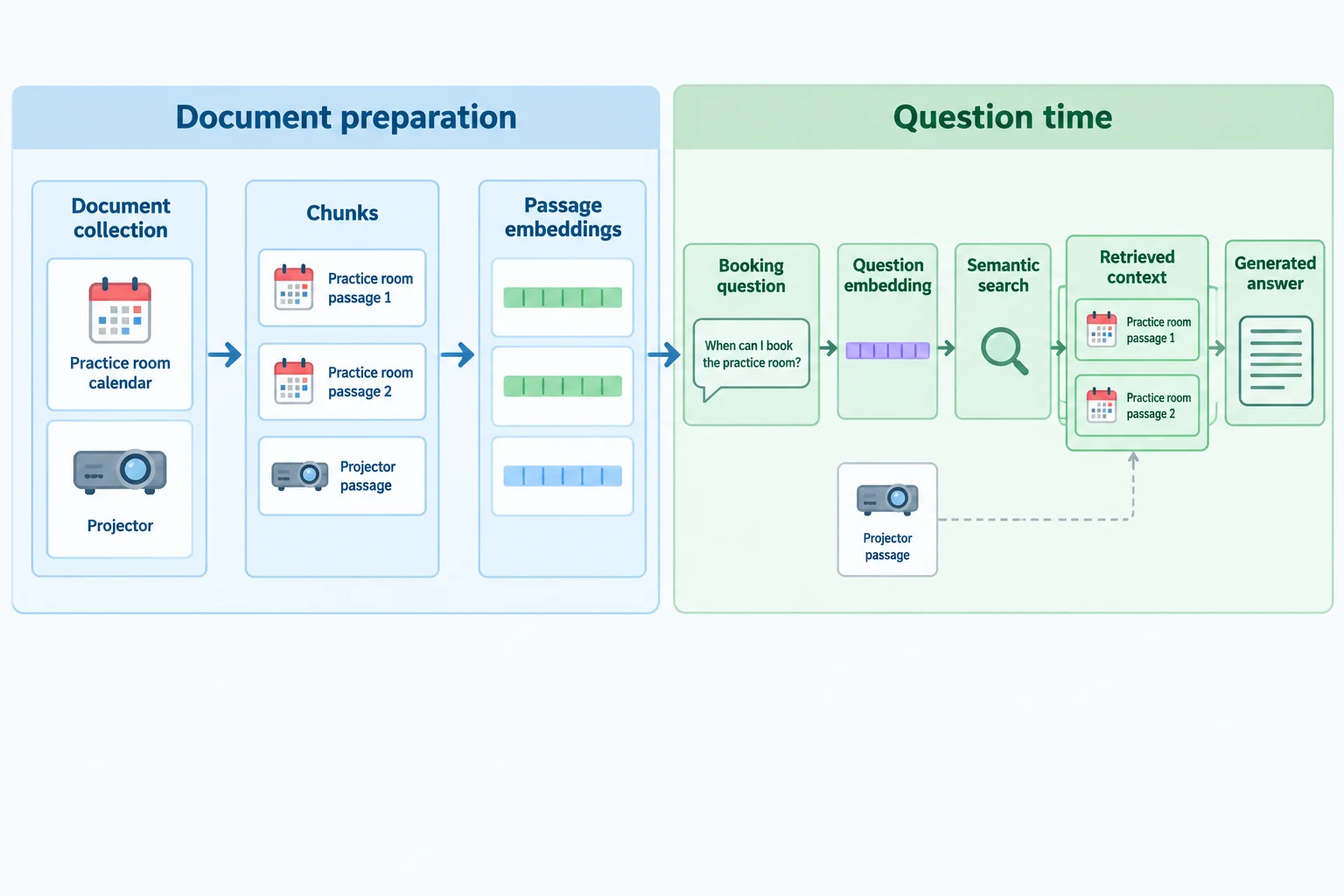
The retrieved context contains selected passage text, not every chunk in the Document collection.
Example
Question: What is the rule for a member who wants a 3-hour practice room booking?
Retrieved context
Not selected: “Equipment Guide” — Chunk C concerns projectors, not practice rooms. Its 3-hour limit cannot answer the booking question.
During Document preparation, the system separates the Document collection into chunks and represents each chunk with a passage embedding. At Question time, it represents the question with a question embedding and uses semantic search to rank chunks by similarity.
The selected passage text—not embedding numbers—is supplied as retrieved context. Here, Chunk B is the evidence needed for the approval condition. Chunk A adds the contrast with bookings of up to 2 hours. A chunk boundary matters because separating a condition from its rule can leave a relevant passage insufficient to support an answer.
Example
The supported answer is: A 3-hour practice room booking requires staff approval.
This does not mean approval is guaranteed, and it does not say a room is available.
This is retrieval-augmented generation (RAG) because the system selected chunks from a collection at question time. If a person manually copied chosen passages into a conversation, that would be direct-context prompting. Neither action changes learned model parameters; changing those parameters would be retraining.
Summary
Put the simplified Cedar Studio RAG flow in order.
Write 4–6 sentences about the Cedar Studio case. Explain what chunks do and what embeddings do, then trace the question through semantic search, retrieved context, and answer generation. Identify the exact “Room Booking Guide” evidence needed for the 3-hour practice room conclusion, including what the conclusion does not guarantee. Finally, explain why this is RAG rather than retraining or direct-context prompting.
Write at least 350 characters (0/350).
Congratulations! You completed: How Retrieval-Augmented Generation Uses Documents
Thousands of online courses in video, ebooks and audiobooks.
To test your knowledge during online courses
Generated directly from your cell phone's photo gallery and sent to your email
Download our app via QR Code or the links below:.


Carry knowledge in your pocket.
Download the Cursa app.
There are hundreds of free courses available, with a free certificate of completion that is saved in your mobile image gallery.
Download the app to access the Course Completion Certificate for Free.

+ 10 million
students

Free and Valid
Certificate

60 thousand free
exercises

4.8/5 rating in
app stores

Free courses in
video and ebooks