
Step 1 of 8
Start with the Use and Its EU Connection
Identify the facts needed to begin an EU AI Act applicability check without making a compliance claim.

Learning path · Level 8 · Tutorial 4
Use a simplified scenario to identify possible EU AI Act requirements and provider-versus-deployer responsibilities. Record what must be confirmed through current official sources and qualified advice rather than making a definitive compliance claim.

 Start with the Use and Its EU Connection
Identify the facts needed to begin an EU AI Act applicability check without making a compliance claim. 2 min
 Read the Regulatory Map
2 min
 Classify the Use, Not the Product Label
3 min
 Identify Providers, Deployers, and Role Changes
Assign provisional provider and deployer roles for HireAssist, then identify when a changed intended purpose requires reassessment. 2 min
 Match Possible Duties to the Responsible Role
Allocate illustrative high-risk and transparency duties to the responsible role while keeping the result provisional and evidence-based. 3 min
 Separate the Model Layer from the System Layer
2 min
 Verify Sources and Application Dates
Trace possible EU AI Act duties to authoritative sources, distinguish original application dates from current legal status, and record what remains unverified. 3 min
 Create a Dated Verification Note
Produce a dated, evidence-aware verification note for Cedar Services’ proposed Applicant ranking extension without making a compliance claim. 3 min
Step 1 of 8
Identify the facts needed to begin an EU AI Act applicability check without making a compliance claim.
Begin an EU AI Act check with a fact pattern, not a product label or a claim that a system is compliant.
Capture four things:
These facts support educational triage: identifying possible requirements and questions to escalate. They do not establish a legal compliance conclusion.
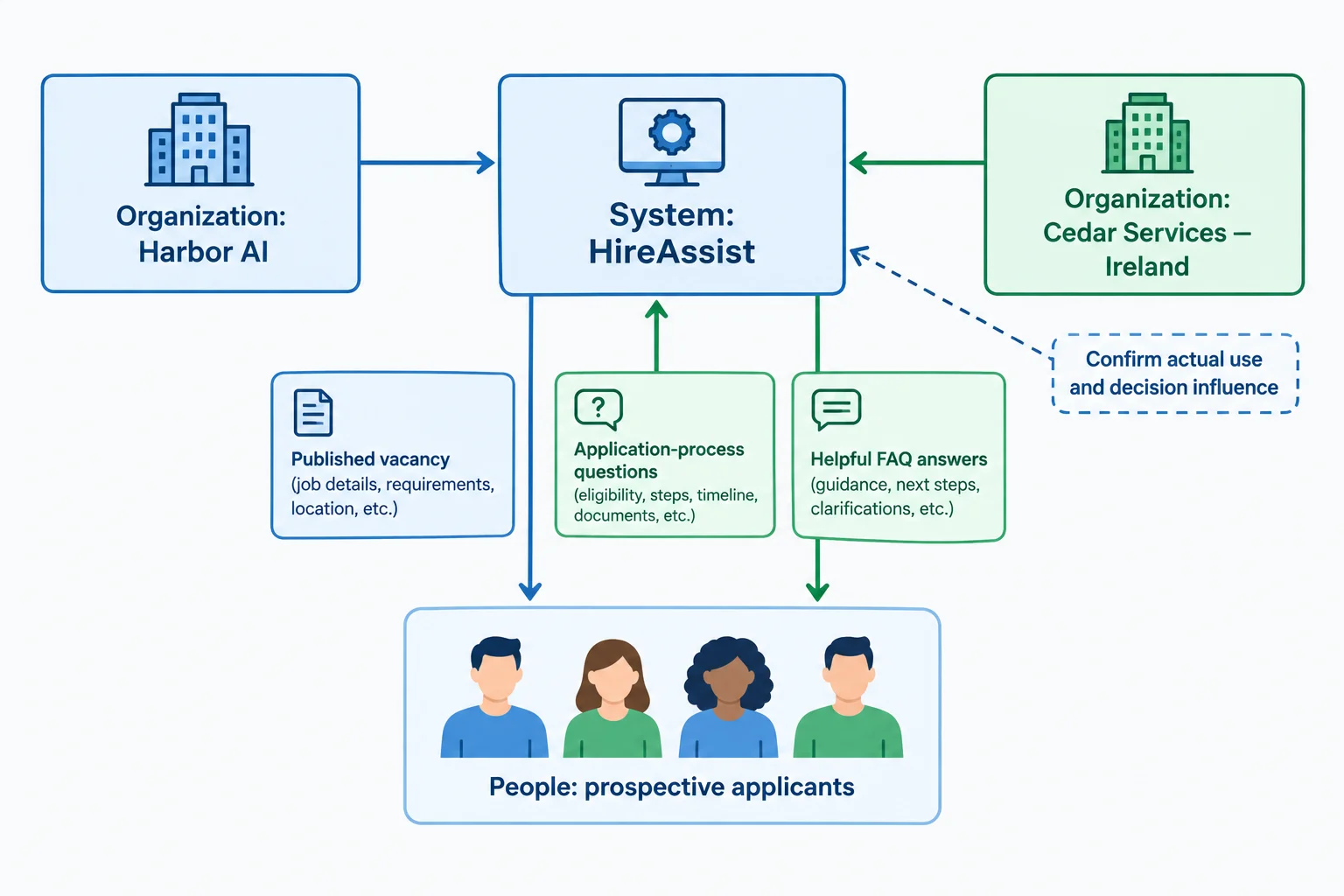
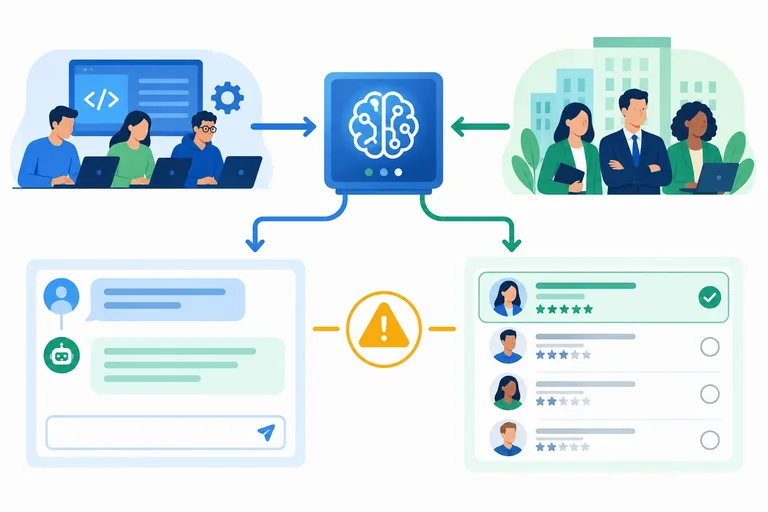
The diagram is a fact map, not a legal classification. It separates organizations, the AI system, affected people, and the use to investigate.
Example
The running scenario is deliberately narrow:
Cedar Services is an employer established in Ireland. It uses the AI system HireAssist for FAQ chat: answering questions about published vacancies and the application process. The stated baseline does not evaluate applicants or rank them.
Harbor AI develops and markets HireAssist under its own name. Those facts matter, but an organization’s address and a label such as “chatbot” do not settle whether or how the EU AI Act applies.
Compare the stated purpose with evidence of the live configuration and real workflow. A system can be described one way yet used more broadly.
Use this short inventory to keep established facts separate from facts that still need confirmation.
| Area | Established in the scenario | Still to confirm |
|---|---|---|
| Intended purpose | FAQ chat about vacancies and the application process | The documented intended purpose and any stated limits |
| Actual use | No applicant evaluation or ranking is described | Whether the live system and staff workflow remain FAQ-only |
| Affected people | People seeking information about vacancies | Which user groups access it and whether others are indirectly affected |
| Decision influence | FAQ answers are described, not hiring evaluation | Whether outputs influence applicant screening or hiring decisions |
| EU connection | Cedar Services is established in Ireland | Relevant market placement, use locations, and any output use in the EU |
Article 2 of Regulation (EU) 2024/1689 is a starting point for scope, together with relevant definitions and exclusions. A useful first question is whether there is a relevant EU connection—for example, an AI system placed on the market, put into service, or used in the EU.
Location alone is not decisive. The scope can also matter when an organization is outside the EU but outputs produced by an AI system are used in the EU, in the circumstances specified by the legal text.
For Cedar Services, its establishment in Ireland is an important fact to record. It is not, by itself, a complete applicability analysis. Confirm the system’s route to market, deployment context, actual use, and any relevant exclusions from current official sources.
Tip
Keep this exercise educational and evidence-aware. The EU AI Act operates alongside privacy, copyright, employment, and other sector-specific requirements. Existing safeguards remain relevant; they do not substitute for checking the applicable legal text and obtaining qualified advice when the facts or consequences warrant it.
Using the FAQ chat scenario, write four brief bullets:
Write at least 80 characters (0/80).

Step 2 of 8
The EU AI Act’s risk-based approach asks what an AI system is used for, its likely impacts, and whether defined legal conditions are met. It does not sort systems simply by model capability, output quality, or an AI product label.
For example, HireAssist’s FAQ chat may be useful or inaccurate, but neither quality alone determines its Possible treatment. The use, context, and legal conditions must be examined.
Use this map for educational triage, not as a compliance conclusion.
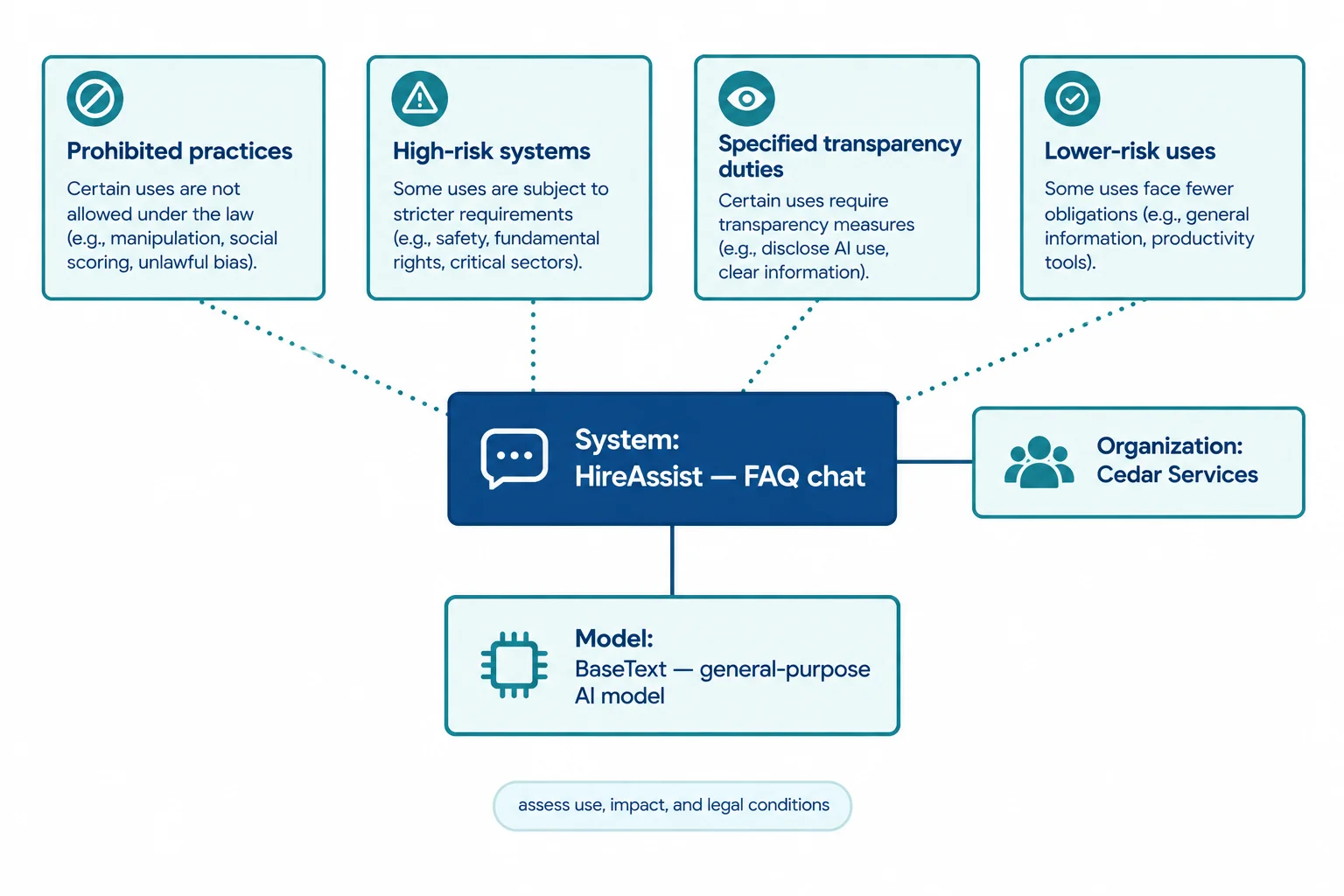
A treatment follows the use and applicable legal conditions; it is not a rating of the model’s intelligence.
The four labels below are an orientation tool. They should not be treated as four sealed boxes or as a final legal result.
| Treatment label | Core consequence | What it does not mean |
|---|---|---|
| Prohibited practices | The practice cannot proceed when the legal prohibition applies. | Disclosure or human review makes it acceptable. |
| High-risk systems | The system is subject to specified requirements. | The system is automatically prohibited. |
| Specified transparency duties | Defined interactions or synthetic-content situations can trigger information or disclosure duties. | Every AI-assisted output needs a label. |
| Lower-risk uses | An explanatory shorthand for uses outside those treatments in the simplified map. | No EU AI Act duties or other laws can apply. |
A system can have more than one relevant treatment. In particular, a high-risk AI system can also have a specified transparency duty.
Rules concerning a general-purpose AI model are another layer. A model such as BaseText may support systems with very different uses. Recognizing that separate layer does not decide the treatment of HireAssist.
Tip
Do not treat lower-risk as risk-free. The label is useful shorthand, but privacy, copyright, employment, consumer-protection, and other applicable rules may still matter.
True or false: If HireAssist is subject to a specified transparency duty, it cannot also be a high-risk AI system.
Write at least 4 characters (0/4).
Match each treatment label to the consequence that best describes it.
Match each treatment to its regulatory consequence.
Tap an item and then its matching pair.
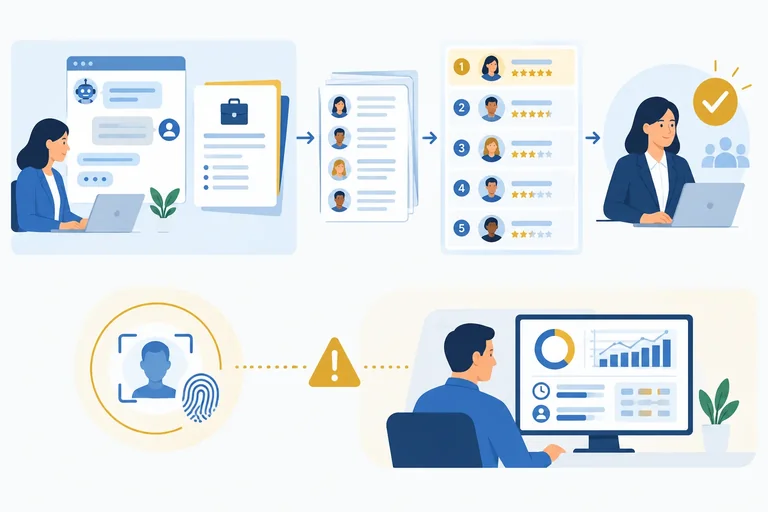
Step 3 of 8
A product label such as “chatbot” or “employment AI” is not a legal classification. Start with the AI system’s intended purpose, what it actually does, who is affected, and how its output affects a decision.
FAQ chat is HireAssist answering questions about published vacancies and the application process. It does not evaluate applicants.
The proposed Applicant ranking extension evaluates applications and ranks candidates for hiring decisions. That changed function—not the system’s name—is the important starting fact.
Use Possible treatment for a provisional result. Definitions, exceptions, evidence, and current official sources still need checking.
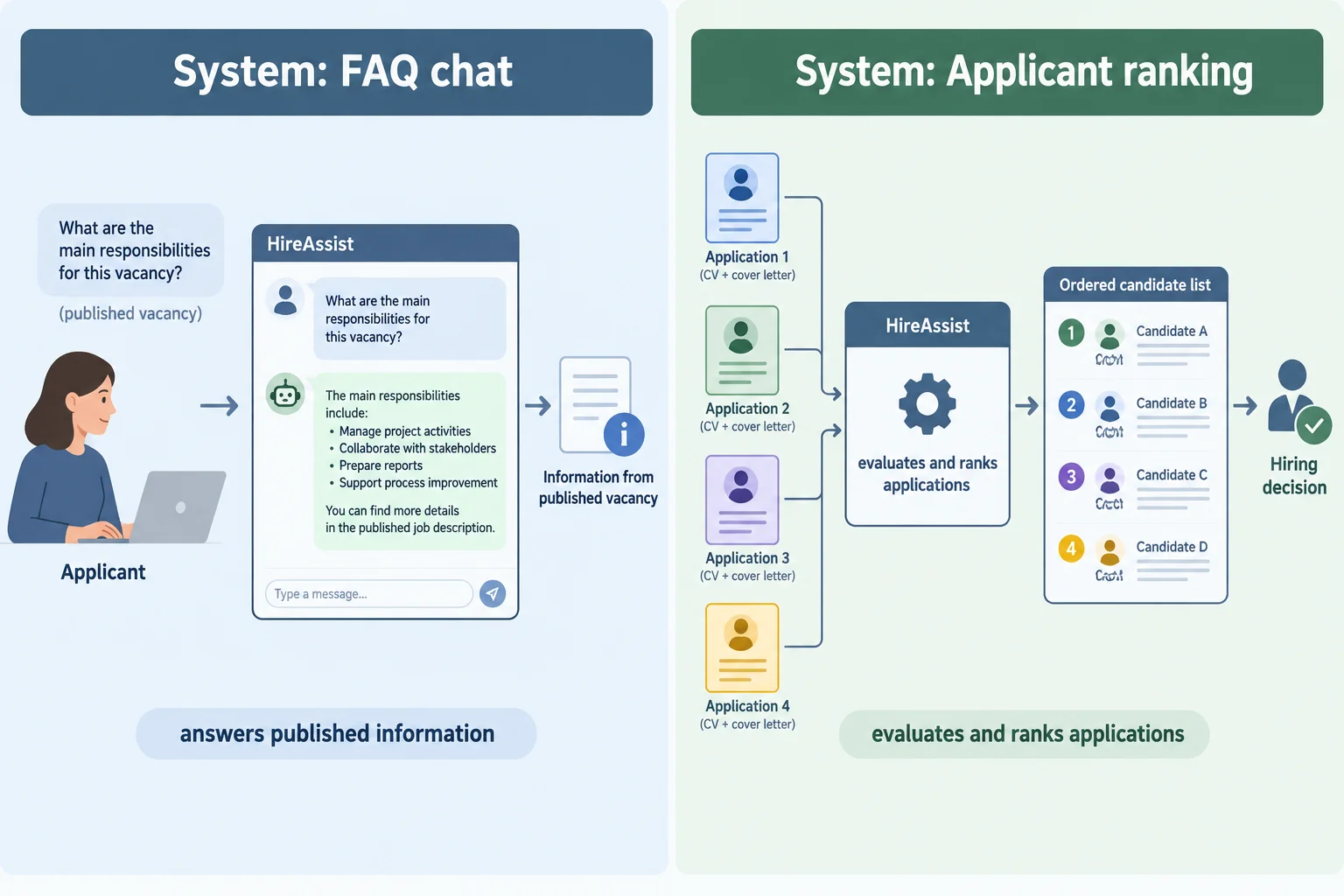
The decisive difference is whether the AI system evaluates people for a hiring decision.
Warning
This is educational triage, not a compliance determination. The EU AI Act must be checked alongside other applicable requirements and current official sources.
Article 6 provides two main high-risk routes.
Article 6(1) concerns an AI system that is a product, or a safety component of a product, covered by specified Union harmonisation law in Annex I—and that must undergo a third-party conformity assessment under that law.
Article 6(2) concerns AI systems with an intended purpose listed in Annex III. For Applicant ranking, the relevant starting point is Annex III’s employment provisions, because applications are evaluated and candidates are ranked for hiring.
This is a starting analysis, not a final classification.
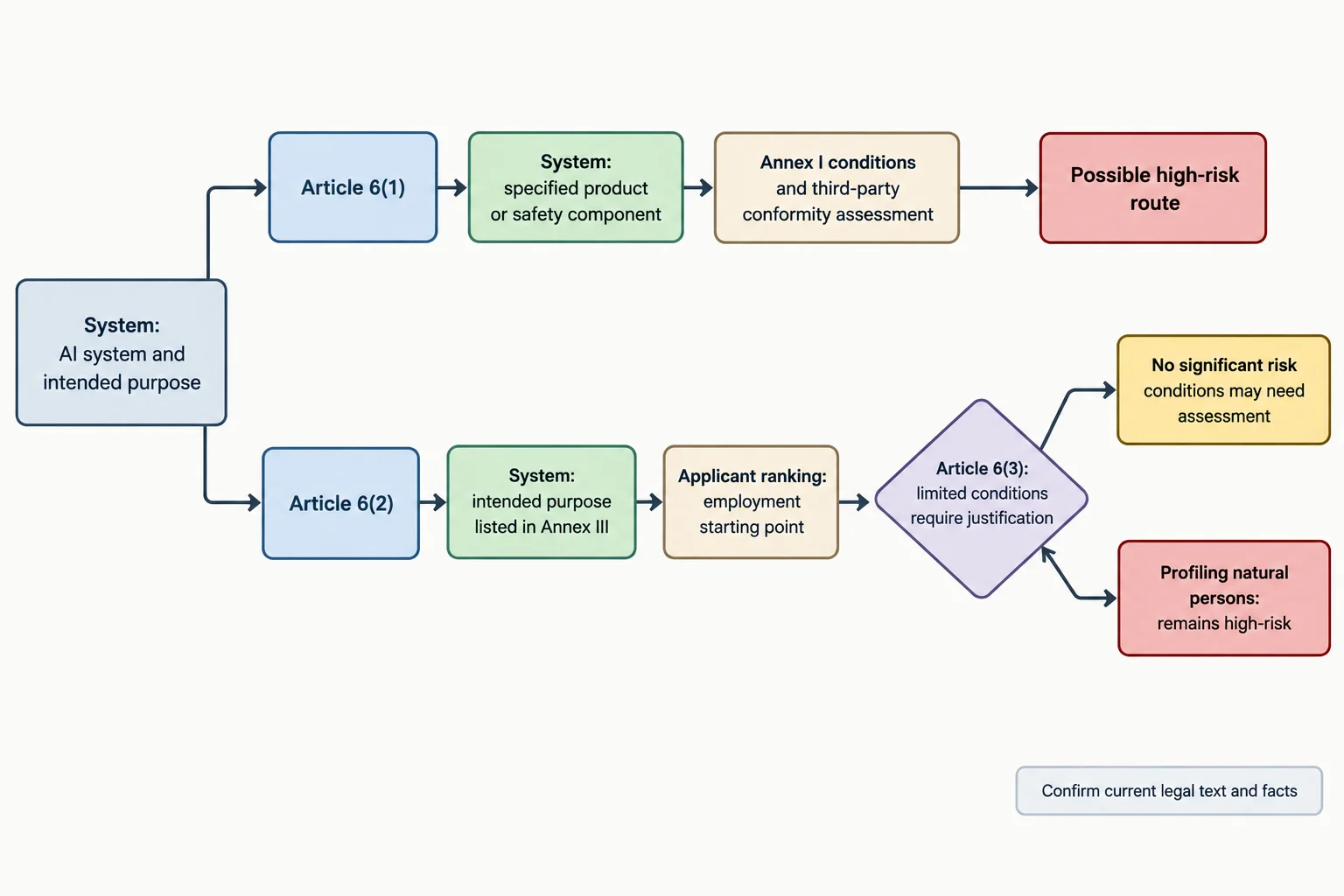
Article 6(3) is a limited conditional assessment within the Annex III route; it is not an automatic exemption.
Article 6(3) contains limited conditions under which an Annex III use may not be high-risk because it does not pose a significant risk to health, safety, or fundamental rights. Those conditions require justification; they are not created by simply adding a human reviewer.
An Annex III use involving profiling of natural persons remains high-risk. The scenario does not provide enough facts to rely on an Article 6(3) exception. Confirm the intended purpose, decision influence, system features, and current legal text before reaching a conclusion.
Use the route and conditions together; neither route is determined by a broad sector label alone.
| Provision | Starting question | Scenario signal | What still needs checking |
|---|---|---|---|
| Article 6(1) | Is it a specified regulated product or safety component requiring third-party assessment? | No such product facts are given. | Product status and applicable Annex I law. |
| Article 6(2) and Annex III | Is the intended purpose a listed use? | Ranking applications for hiring is the relevant employment starting point. | Exact function and decision influence. |
| Article 6(3) | Could a limited Annex III exception be justified? | Human review alone is insufficient. | Risk, profiling, justification, and legal conditions. |
A separate boundary check applies when an AI system infers emotions in the workplace from biometric data for productivity monitoring. Do not generalize from the word “emotion” alone.
Article 5 includes a prohibition relevant to emotion inference in workplaces, while recognizing an exception where the system is intended for medical or safety reasons. For a productivity-monitoring proposal, record a Possible treatment of Prohibited practices and check the Article 5 scope and whether any exception genuinely applies.
A beneficial claim, disclosure, or human review does not itself answer that Article 5 question.
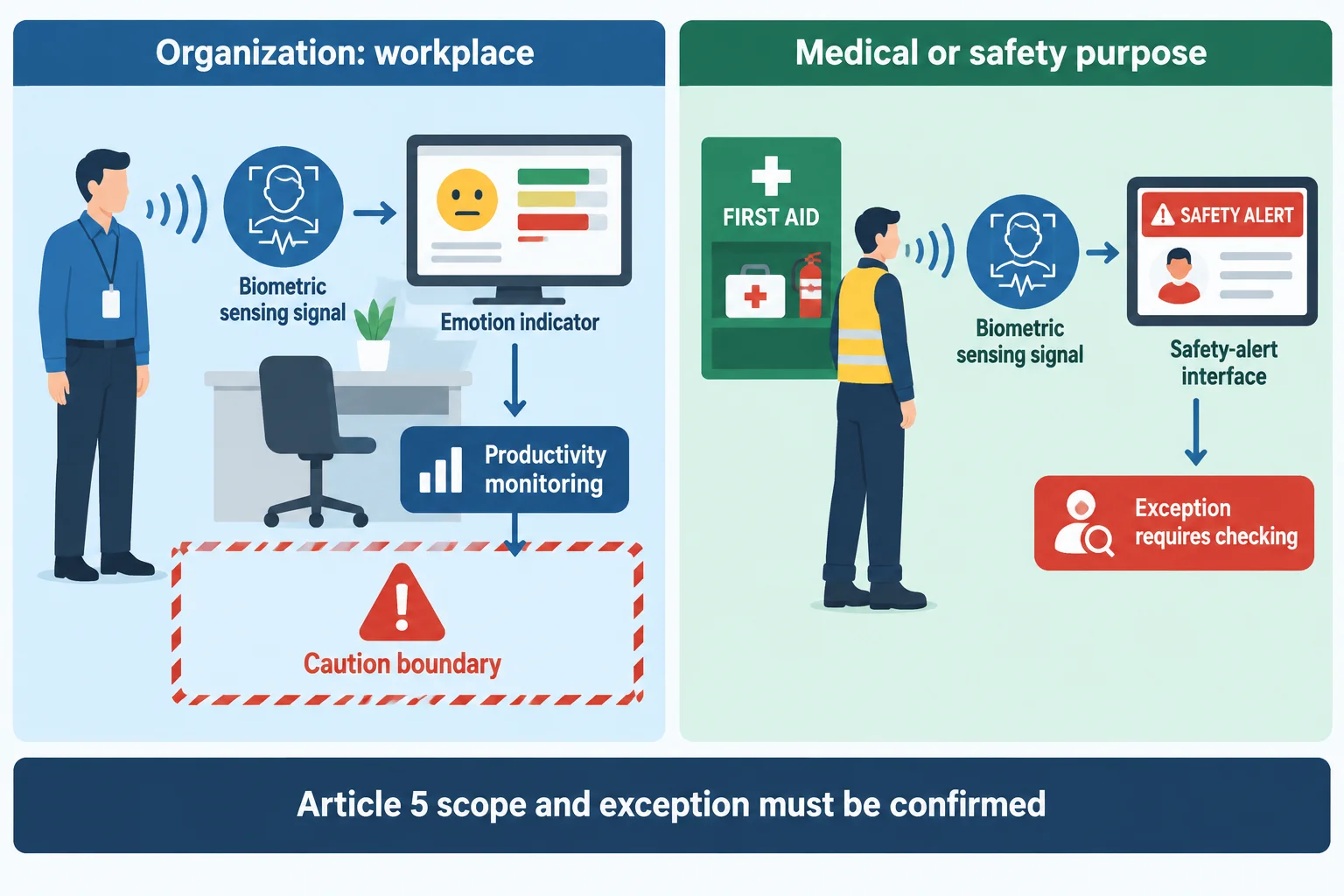
The workplace purpose is decisive. Do not assume that every emotion-related system has the same treatment.
Cedar Services proposes a tool that infers workers’ emotions from biometric data for productivity monitoring. What is the sound provisional next step?
Write a short triage note covering all three uses:
For each, state a Possible treatment, name the decisive fact, and identify any exception or unresolved point that must be checked. Keep the result provisional rather than claiming compliance.
Write at least 300 characters (0/300).
Step 4 of 8
Assign provisional provider and deployer roles for HireAssist, then identify when a changed intended purpose requires reassessment.
A provider develops an AI system, or has it developed, and places it on the market or puts it into service under its own name or trademark—subject to the legal definition.
A deployer uses an AI system under its authority. Personal, non-professional use is excluded from that definition.
These are role labels, not rankings. Organization size, subscription price, or who pays the invoice do not decide the role. Start with what each organization does with the AI system.
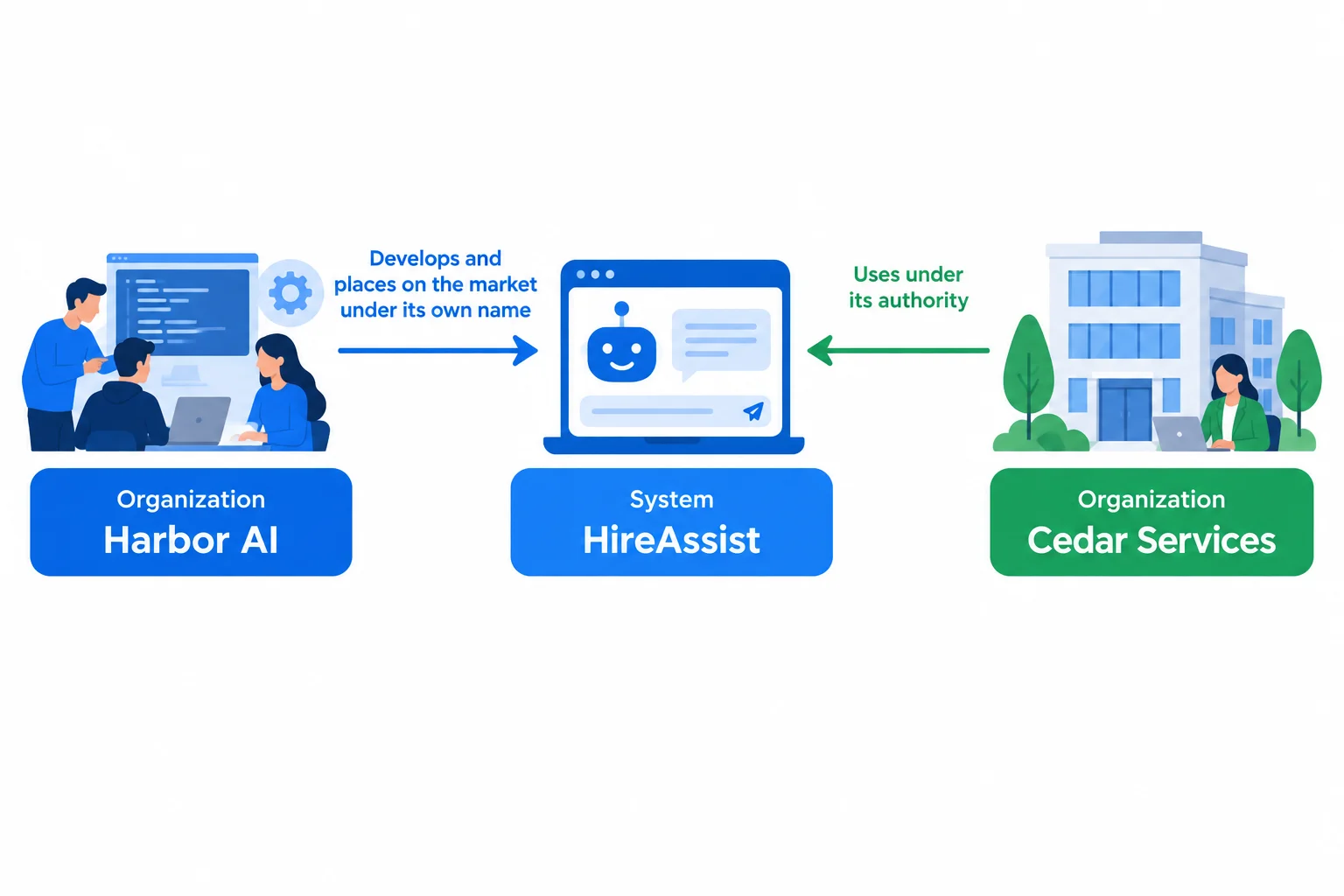
Map the actions around the AI system before assigning provisional roles.
In the baseline use, HireAssist provides FAQ chat: it answers questions about published vacancies and the application process. It does not evaluate applicants or rank them.
This is a provisional, system-level map for educational triage. Confirm the actual arrangements, documentation, and applicable definitions before relying on it.
The same organization can hold more than one role in a different arrangement.
| Organization | Relationship to HireAssist | Possible role |
|---|---|---|
| Harbor AI | Develops and markets HireAssist under its own name | provider |
| Cedar Services | Uses HireAssist for recruitment FAQ chat | deployer |
Roles must be reassessed when the relevant facts change. One organization can hold multiple roles, and an AI system developed for internal use can still raise provider responsibilities.
For high-risk AI systems, Article 25 identifies circumstances that can shift provider responsibilities. They include specified rebranding, substantial modification, and changing a previously non-high-risk system’s intended purpose so that it becomes high-risk.
Ordinary configuration does not automatically turn a deployer into a provider. But a material change of purpose cannot be dismissed because the original supplier label remains unchanged.
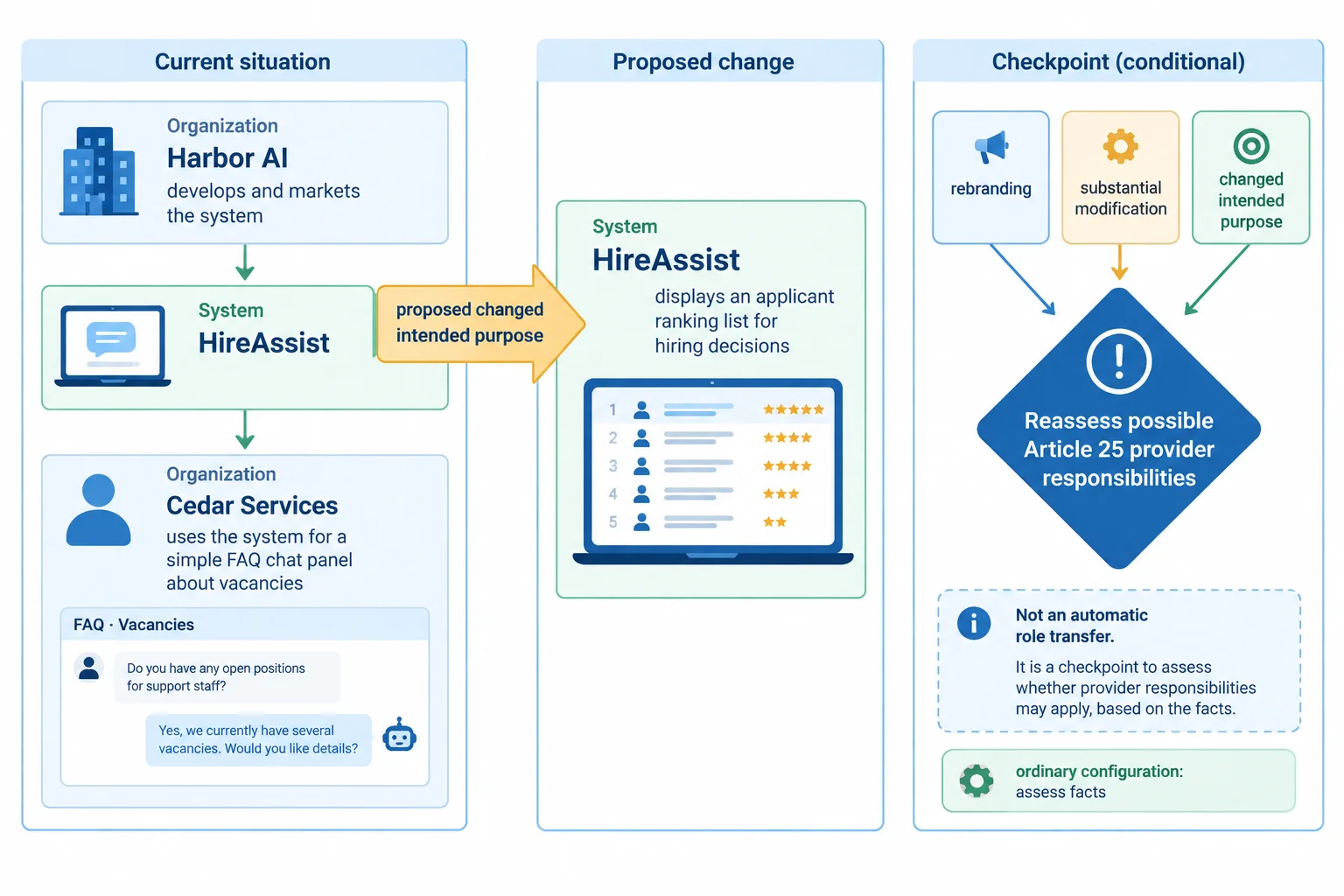
The proposed use change calls for reassessment; it does not automatically transfer the provider role.
Example
Cedar Services proposes Applicant ranking: HireAssist would evaluate applications and rank candidates for hiring decisions. This is outside Harbor AI’s stated FAQ-only intended purpose.
The earlier treatment check makes this consequential employment use a reason for fresh assessment. Record the intended-purpose documentation, who made the change, what was modified, and whether the Article 25 conditions apply. Do not make a definitive role or compliance claim from the product name alone.
Which statement best records the baseline roles and the appropriate response to Cedar Services’ proposed Applicant ranking extension?

Step 5 of 8
Allocate illustrative high-risk and transparency duties to the responsible role while keeping the result provisional and evidence-based.
For the proposed Applicant ranking use, first confirm whether HireAssist is a high-risk AI system. If it is, duties are allocated by role—not by who paid for the tool.
Possible treatment: Harbor AI is the system provider because it develops and markets HireAssist under its own name. Cedar Services is the deployer when it uses HireAssist for hiring. This is a provisional scenario mapping, not a compliance determination.
A high-risk provider may need a risk-management process, relevant data governance, technical documentation, instructions for deployers, conformity assessment, and post-market monitoring. Conformity assessment is a defined compliance process; it does not automatically mean every case needs an external certification service.
A high-risk deployer may need to follow instructions, assign competent human oversight, monitor operation, retain relevant logs under its control, and act when it identifies risks or serious incidents.
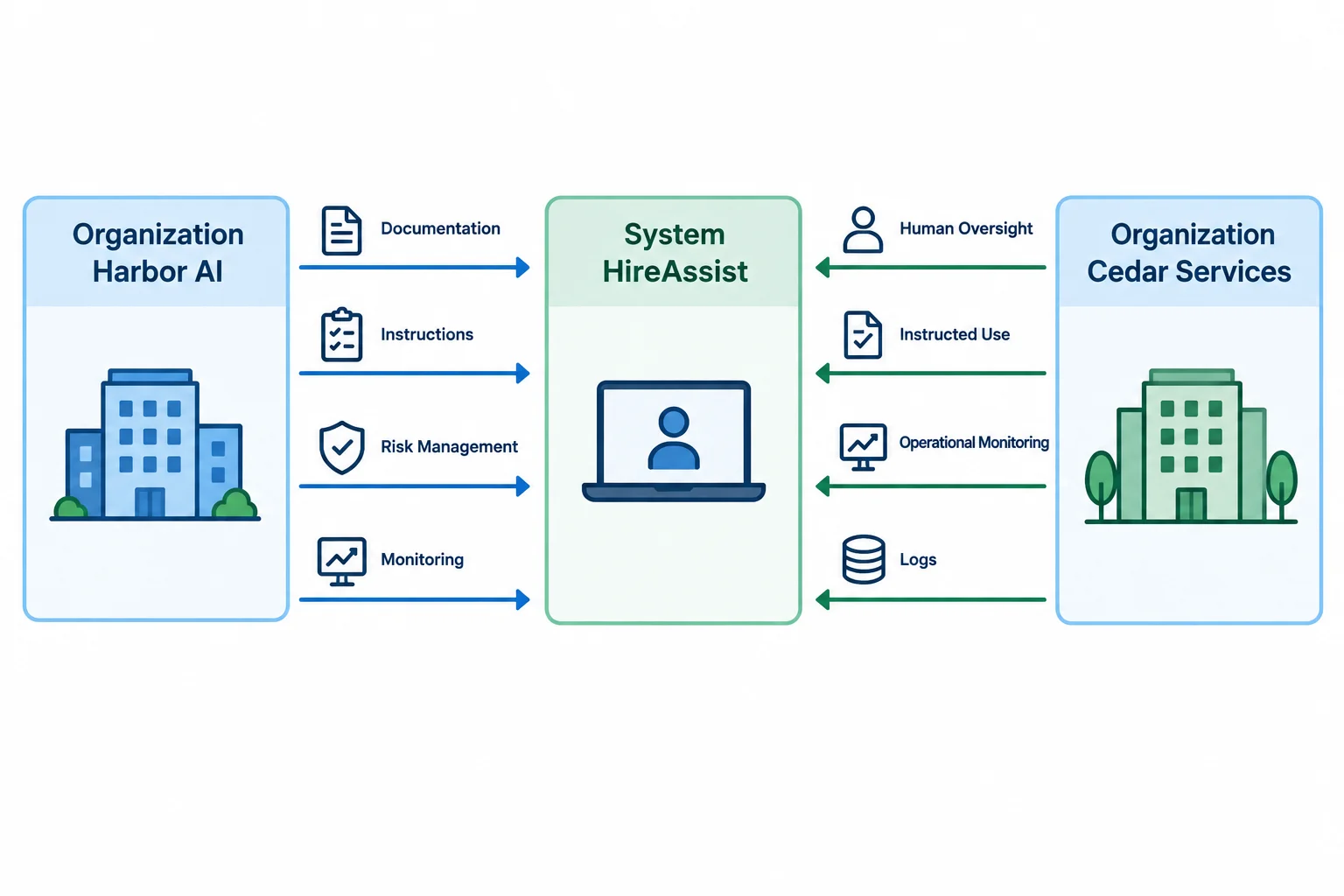
The same AI system can create different possible duties for its provider and deployer.
Use this as an evidence-request map, not as a complete checklist or proof that Regulation (EU) 2024/1689 applies to the scenario.
| Role | Possible duties | Evidence to request |
|---|---|---|
| Provider: Harbor AI | Risk management; data governance; documentation; instructions; conformity assessment; post-market monitoring | Intended-purpose documents, instructions, technical documentation, assessment records |
| Deployer: Cedar Services | Instructed use; competent oversight; monitoring; relevant controlled logs; response to risks or serious incidents | Oversight assignment, operating procedure, monitoring records, log-access process |
High-risk duties are not the only possible layer. Article 50 includes specified transparency duties that depend on the system's function and context.
For an AI system intended to interact directly with people, the provider has an information duty so people are informed that they are interacting with AI, subject to conditions including whether that interaction is obvious from the circumstances and context. A notice is therefore not a universal substitute for every other duty.
For specified synthetic outputs, provider-side machine-readable marking and deployer-side disclosure of deepfakes are different possible responsibilities. Their conditions, exceptions, and the facts of a particular output must be checked in the current legal text.
AI literacy is another cross-cutting duty: in-scope providers and deployers should take measures for a sufficient level of AI literacy among people dealing with AI on their behalf. It is not limited to high-risk systems.
Separate the output-related roles before deciding what evidence to request.
| Situation | Possible responsible role | Possible action to examine |
|---|---|---|
| Direct AI interaction with a person | Provider | Information that the person is interacting with AI, where Article 50 conditions apply |
| Specified synthetic output | Provider | Machine-readable marking of output as artificially generated or manipulated |
| Deepfake use or dissemination | Deployer | Disclosure that the content has been artificially generated or manipulated |
| Staff use of an AI system | Provider and deployer | Appropriate AI literacy measures for relevant people |
Warning
Do not treat a chatbot notice, a human reviewer, or a short role-to-duty table as a complete compliance result. Possible duties can overlap, and applicability depends on the use, legal conditions, current text, and evidence.
For the proposed Applicant ranking use, match each possible duty to the most relevant role.
Tap an item and then its matching pair.
Write a short provisional duty note for the proposed Applicant ranking extension.
Use conditional language such as “possible” and “if confirmed high-risk.”
Write at least 220 characters (0/220).
Step 6 of 8
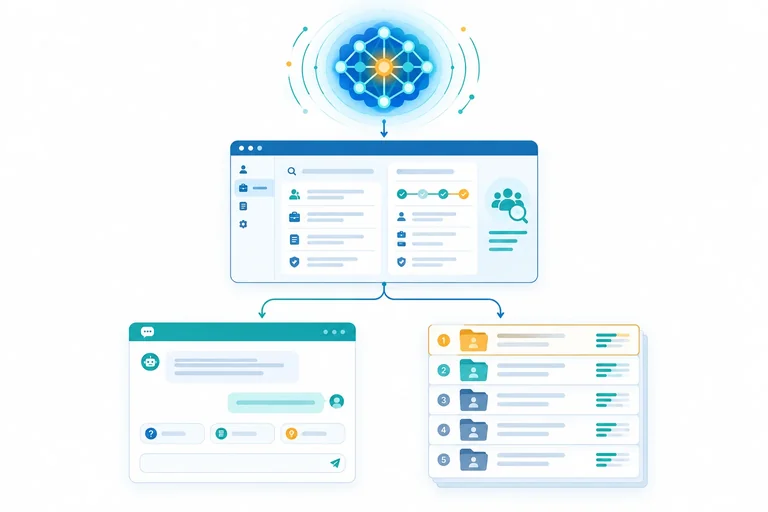
A general-purpose AI model can be incorporated into many downstream products. After introducing that term, it is often shortened to general-purpose AI (GPAI).
Keep three layers separate in this scenario:
The same BaseText model may support HireAssist for FAQ chat and, if the extension proceeds, Applicant ranking. Those uses can have different Possible treatments. A model’s capabilities alone do not settle the treatment of a particular AI system or its use.
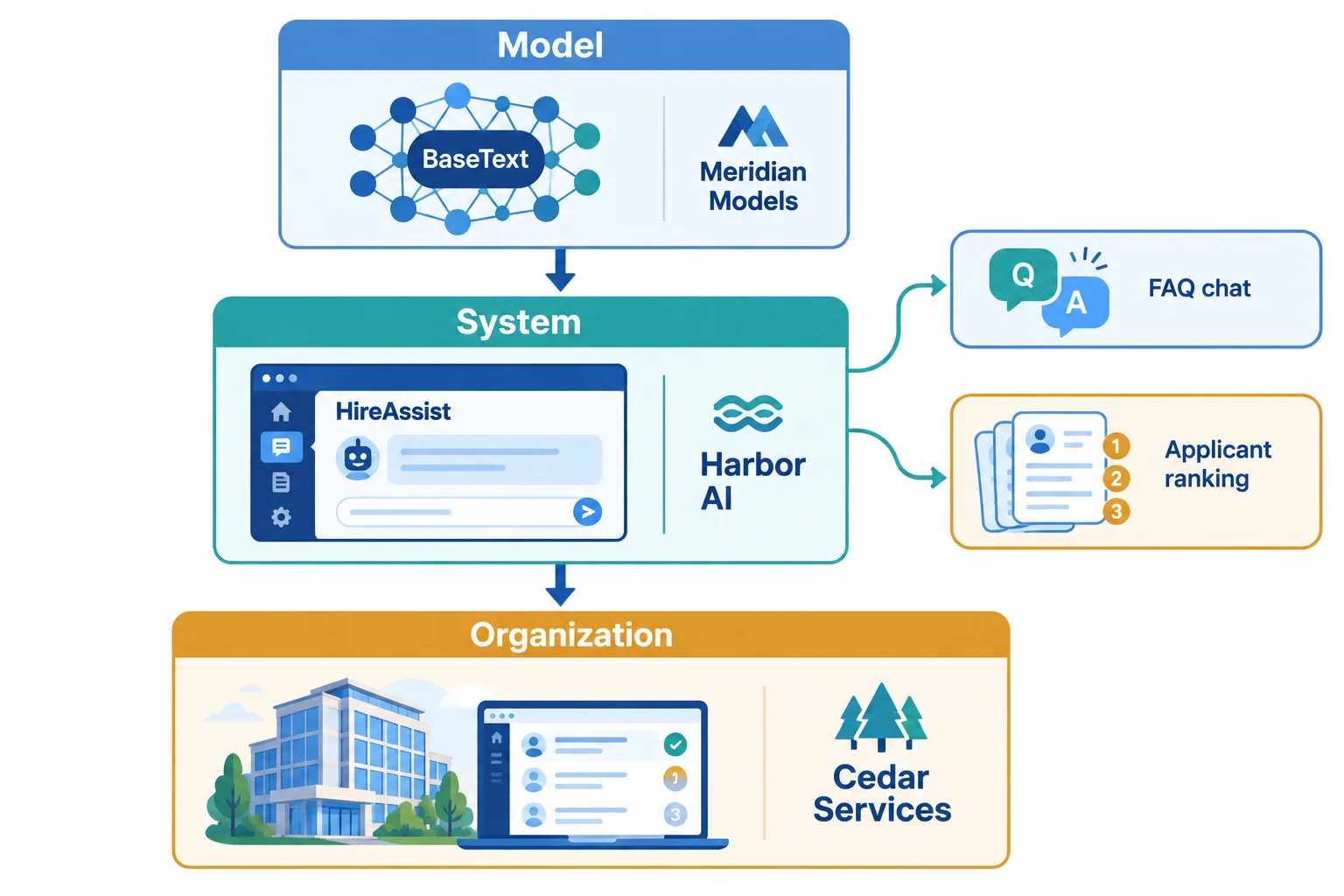
The Model, the AI system, and the Organization’s use are connected—but they are not the same regulatory layer.
Possible duties should be mapped to the actor and layer they concern. This is an educational triage map, not a conclusion that any actor has met every requirement.
Illustrative responsibilities to investigate for the scenario
| Layer | Actor and object | Possible focus |
|---|---|---|
| Model | Meridian Models / BaseText | Technical documentation; information for downstream system providers; copyright-compliance policy; sufficiently detailed public summary of training content. |
| System | Harbor AI / HireAssist | System-provider responsibilities relevant to its intended purpose and Possible treatment, including any consequences of Applicant ranking. |
| Use | Cedar Services / Applicant ranking | Deployer responsibilities connected to use under its authority, including duties previously mapped for a high-risk use if that treatment applies. |
Tip
A GPAI model with systemic risk can face additional model-level obligations. That is not the same classification as a high-risk AI system. Do not infer either conclusion from the other, and do not assume that Meridian Models’ possible model-level duties replace Harbor AI’s or Cedar Services’ system-level duties.
True or false: A GPAI model with systemic risk and a high-risk AI system are the same regulatory classification.
Match each organization to its place in the model-to-system-to-use chain and the duty layer to assess for the proposed Applicant ranking extension.
Tap an item and then its matching pair.

Step 7 of 8
Trace possible EU AI Act duties to authoritative sources, distinguish original application dates from current legal status, and record what remains unverified.
Begin with authority, then check currency. Use EUR-Lex to read Regulation (EU) 2024/1689, identify the relevant Article or Annex, and check the version and any applicable amendments. That legal text is the starting point for a possible duty.
European Commission and AI Office materials can provide official implementation guidance. They can help explain a process, but guidance does not replace a binding legal provision. A legislative proposal describes a possible future change; it is not an enacted change.
For every source, record its title, specific provision or topic, version, and the date you accessed it.
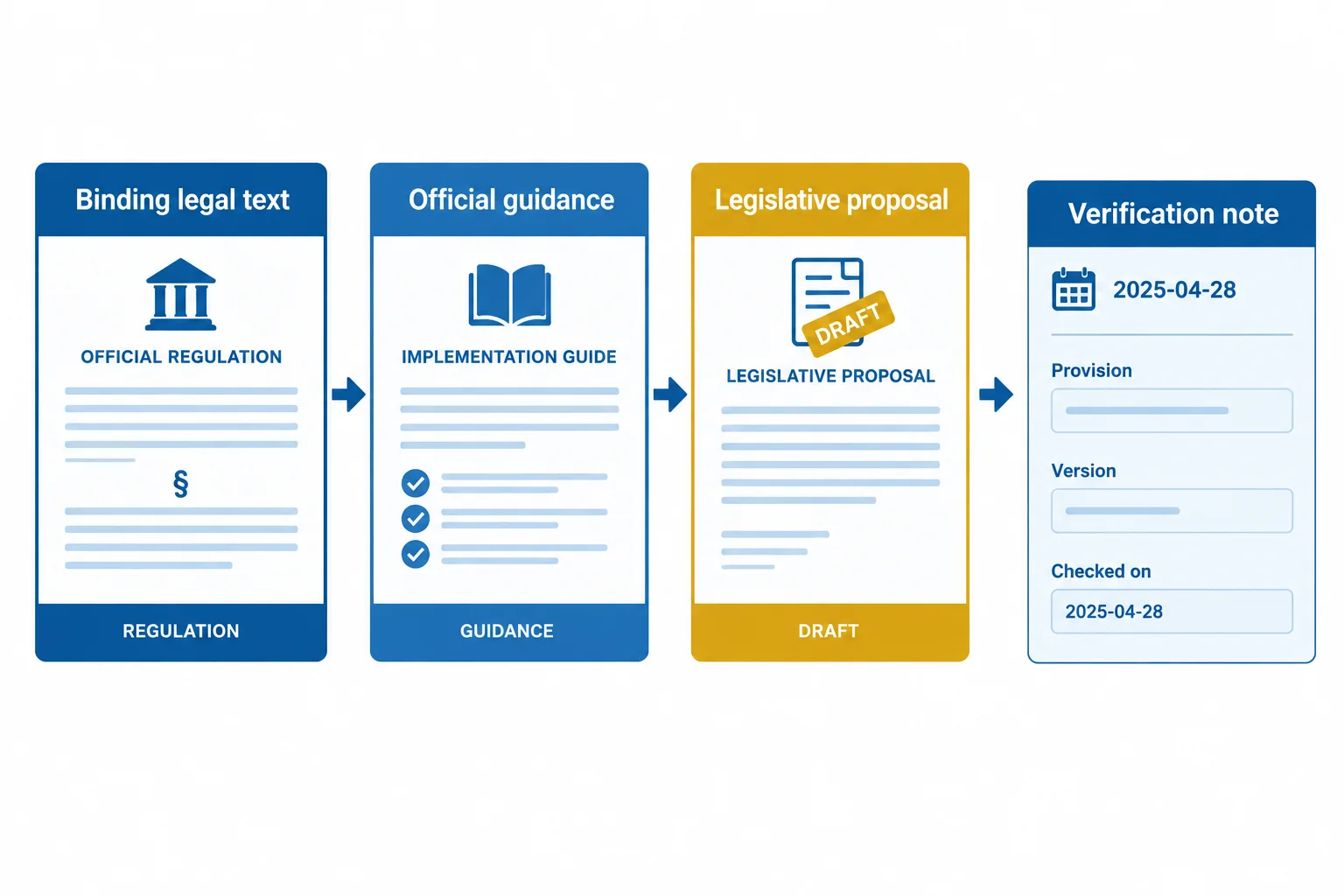
Identify what a source is before relying on it. The enacted legal text is the source of a binding provision.
Tip
Use Checked on for the date you accessed a source. It records access; it does not prove the source will remain current. A later amendment, consolidated version, or transitional rule may change what needs assessment.
Do not turn the schedule into one generic deadline. Entry into force and application are different questions: entry into force concerns when the Regulation became legally effective, while application asks when a particular provision and its obligations apply.
The table and timeline below show the Original enacted schedule. Use them only as a historical starting point. Then confirm the current provision, amendments, and transitional rules that apply to the facts.
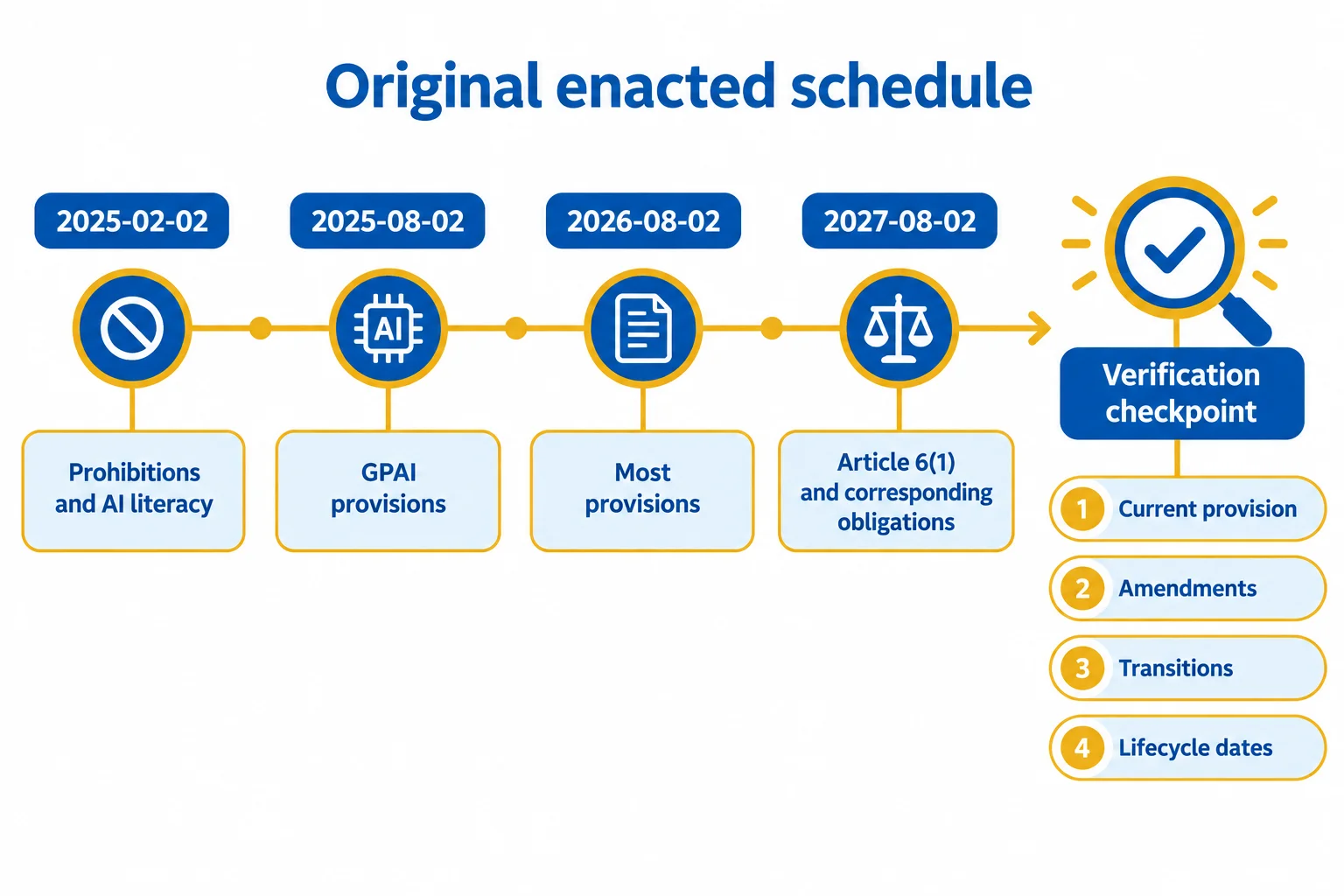
Use the historical schedule to frame a question, then verify the provision-specific date against current law and the system’s lifecycle facts.
Historical starting point only. Confirm the current legal text and relevant transitional rules before relying on a date.
| Area | Starting date | What to verify |
|---|---|---|
| Prohibitions and AI literacy | 2025-02-02 | Relevant Article and scope |
| GPAI provisions | 2025-08-02 | Transitions and applicable model provision |
| Most provisions | 2026-08-02 | Specific duty and any amendment |
| Article 6(1) and corresponding obligations | 2027-08-02 | Product or safety-component route and transition |
Ask a date question that fits the facts: “Which application date and transitional rule apply to this possible duty?” Record when HireAssist was placed on the market or put into service, and when a relevant change of purpose occurred.
Do not assume that FAQ chat and the proposed Applicant ranking extension share one deadline simply because they use the same AI system name.
Example
Sources and status
Practice entry: EUR-Lex, Regulation (EU) 2024/1689, Article 50; version shown on the source page; Checked on: 2026-05-14; status: Checked.
Application dates and transitions
Possible duty: information for people interacting with an AI system. Confirm the current application rule for the specific provision; do not infer it from a general schedule.
Open questions
When was HireAssist put into service? When would Applicant ranking begin? Has a change in intended purpose been documented?
This illustrates an evidence record. It does not verify today’s law.
Warning
If a source cannot be opened or read, label it Not yet checked, not Checked. A dated illustrative extract can support practice, but it does not establish that current legal text has been verified. Use Needs clarification for a material claim or fact that remains uncertain and needs follow-up.
Use the dated training records below to draft five short bullets.
Write at least 240 characters (0/240).

Step 8 of 8
Produce a dated, evidence-aware verification note for Cedar Services’ proposed Applicant ranking extension without making a compliance claim.
A verification note is a dated triage record—not a compliance certificate. It separates three things:
For this scenario, keep the two uses distinct. Cedar Services continues using HireAssist for FAQ chat about published vacancies and applications. It proposes Applicant ranking, which evaluates applications and ranks candidates for hiring decisions. Harbor AI markets HireAssist under its own name with an FAQ-only stated intended purpose. Meridian Models provides the general-purpose AI model BaseText within HireAssist.
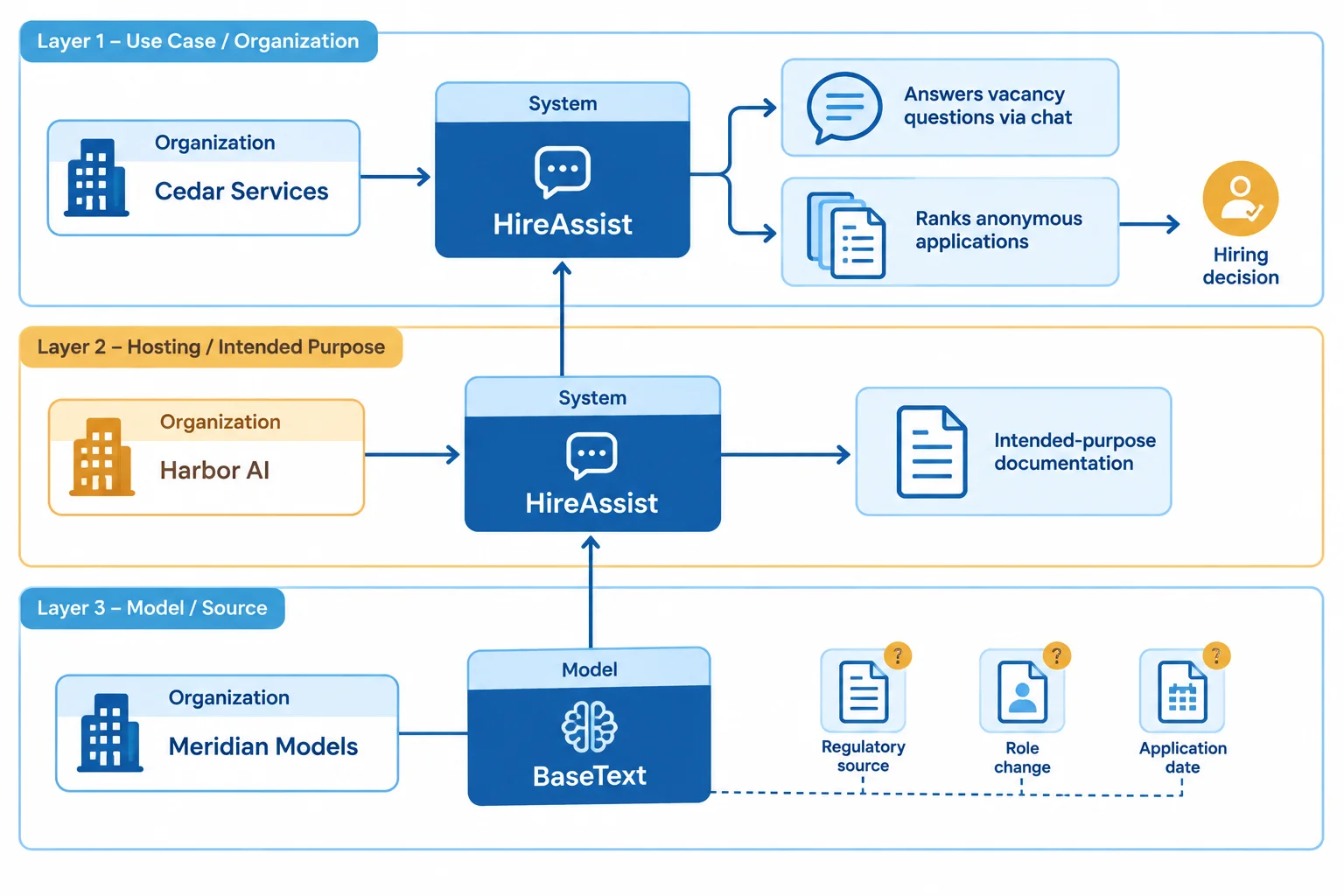
The proposed use can change the analysis even while the FAQ chat remains available. Record the system, model, organizations, evidence, and unanswered questions separately.
Use the required headings below as a compact drafting frame. A useful note gives each possible conclusion a reason to verify it; it does not turn a short checklist into proof of compliance.
Draft each row briefly. Add source title, provision, version, and a Checked on date only after you actually access the source.
| Heading | What to record |
|---|---|
| As-of date | Date of the note, in YYYY-MM-DD format |
| Use and EU connection | Baseline and changed use; relevant EU facts |
| Possible treatment | Provisional treatment and provisions to verify |
| Roles | System and model actors; possible role reassessment |
| Possible duties | Role-linked duties or evidence to investigate |
| Sources and status | Official source, provision, status, and Checked on date |
| Application dates and transitions | Original enacted schedule plus current-law questions |
| Open questions | Missing facts and the evidence needed |
| Escalation and next action | Proportionate action before expanded use proceeds |
Example
Write facts, findings, and questions differently.
Established fact: Harbor AI states an FAQ-only intended purpose for HireAssist.
Possible finding: Using HireAssist for Applicant ranking may require reassessing Cedar Services’ role under Article 25 if the legal conditions are met.
Open question: Has Cedar Services changed the system’s intended purpose in a way that triggers that provision, and when would the changed system be put into service?
Use cautious words such as may, possible, subject to confirmation, and needs clarification. A statement that an official page will be consulted belongs under Not yet checked until it has actually been accessed and recorded.
Create a concise verification note for this self-contained exercise scenario.
Exercise date: 2025-09-01. Cedar Services is established in Ireland. It uses Harbor AI’s HireAssist for FAQ chat about published vacancies and the application process. Harbor AI markets HireAssist under its own name and documents an FAQ-only intended purpose. Cedar proposes Applicant ranking: HireAssist would evaluate applications and rank candidates for hiring decisions, while FAQ chat remains available. HireAssist uses Meridian Models’ general-purpose AI model BaseText. No official legal or guidance source has been accessed for this exercise, and the dates of market placement, putting into service, and the proposed change are unknown.
Use every required verification-note heading. Identify the likely high-risk issue, a possible provider-role reassessment, continuing transparency considerations, and the separate GPAI model layer. Record official sources and their accurate status; identify application-date and transition questions; then state why qualified review is needed before the expanded use proceeds.
Write at least 700 characters (0/700).
Summary
Congratulations! You completed: Navigating the EU AI Act's Risk-Based Rules
20 XP
You completed this level!
Up next: AI Strategy for Teams and Small Businesses
 Prioritizing AI Use Cases for a TeamCreate an evidence-backed shortlist of AI opportunities for a team or small business, balancing user needs and potential value against feasibility, data readiness, and unacceptable risks.
Thousands of online courses in video, ebooks and audiobooks.
To test your knowledge during online courses
Generated directly from your cell phone's photo gallery and sent to your email

Download our app via QR Code or the links below:.



Carry knowledge in your pocket.
Download the Cursa app.
There are hundreds of free courses available, with a free certificate of completion that is saved in your mobile image gallery.
Download the app to access the Course Completion Certificate for Free.

+ 10 million
students

Free and Valid
Certificate

60 thousand free
exercises

4.8/5 rating in
app stores

Free courses in
video and ebooks