
Step 1 of 7
Separate Support from the Final Decision
Separate useful AI preparation from a decision a person must retain.

Learning path · Level 1 · Tutorial 3
Decide whether AI should assist with a task, whether a person must retain the decision, or whether AI use is inappropriate for the situation.

 Separate Support from the Final Decision
Separate useful AI preparation from a decision a person must retain. 1 min
 Consider What Happens If AI Is Wrong
Compare AI-related errors by their consequences and by how easily they can be corrected before people rely on them. 2 min
 Do Not Confuse Plausibility with Dependability
Learn to recognize when polished AI wording hides uncertainty that matters for the proposed use. 2 min
 Ask Whether You Can Check the Result
Decide whether an AI output can be meaningfully assessed before people rely on it. 2 min
 Recognize When Human Expertise Is Essential
Distinguish personal judgment from qualified professional expertise, while keeping useful AI preparation within clear boundaries. 2 min
 Choose an Appropriate Role for AI
Choose an appropriate role for an AI assistant by applying the tutorial's five assessment headings to the exact proposed use. 2 min
 Make and Explain Your Decision
Choose an appropriate AI role for everyday tasks and explain the boundary between support and decision-making. 2 min
Step 1 of 7
Separate useful AI preparation from a decision a person must retain.
An AI assistant may be able to produce an answer, but that alone does not decide its role. Ask: what is the assistant doing, and who determines the outcome?
A Support task helps a person prepare: drafting, suggesting, sorting, or organizing. The person considers the result.
A Final decision determines what will happen, what will be promised, or which option will be chosen. A person must retain that decision.
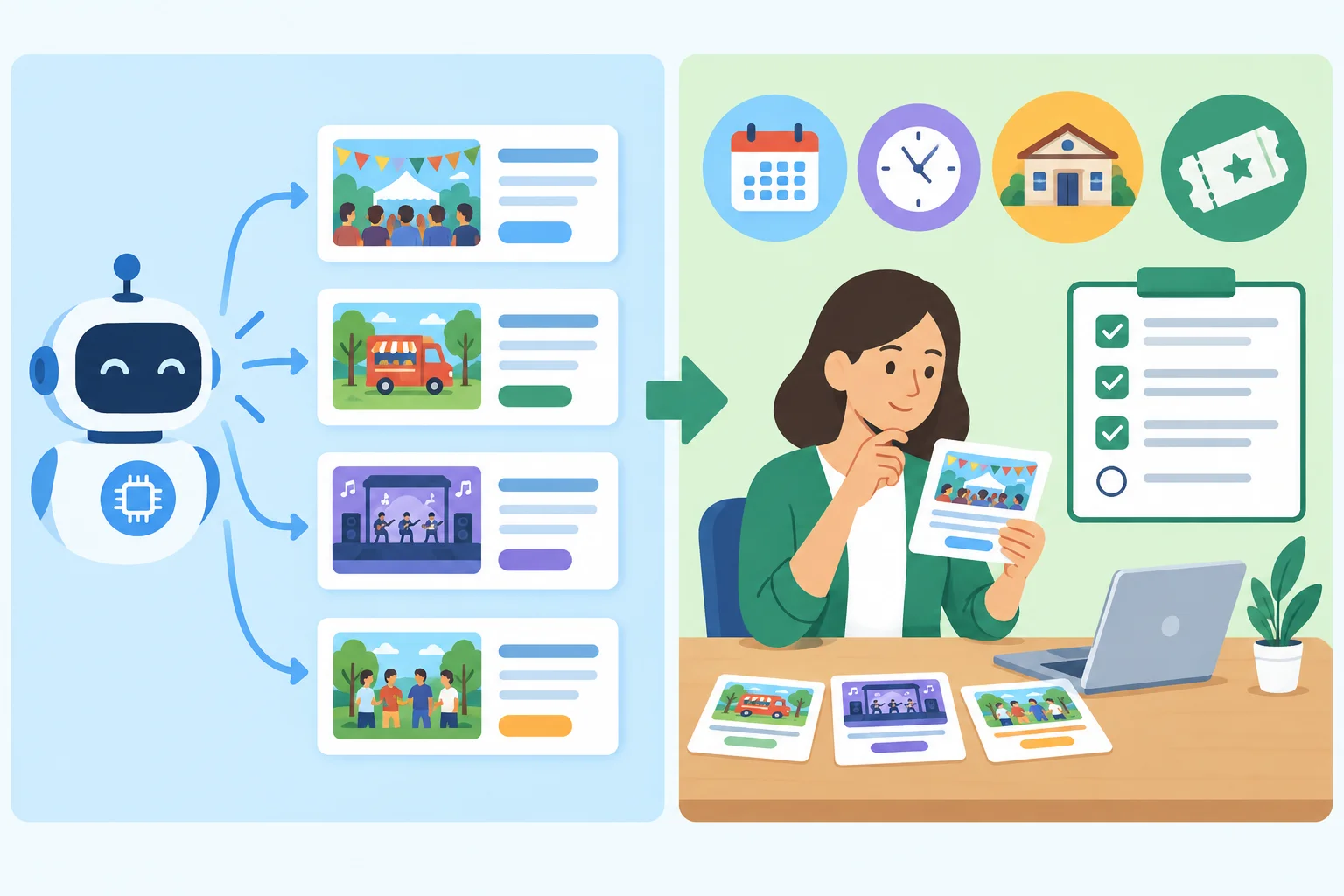
The AI assistant can prepare announcement drafts. Alex, the organizer, retains the decision about what Riverside Community Day will promise attendees.
Delegation means allowing AI to determine the outcome without meaningful human judgment. It is not meaningful review if a person simply accepts whatever the AI assistant says.
Instead, separate a larger request into two parts:
This separation lets a person use useful output without handing over responsibility.
Example
Alex needs an announcement for Riverside Community Day.
Support task: Ask an AI assistant to draft a short announcement using these confirmed facts: Saturday, 10:00–12:00, Community Hall, and free entry.
Final decision: Alex decides whether the announcement should promise anything else to attendees, such as a particular activity or service. The AI assistant may suggest wording, but it must not make that promise for Alex.
Tip
A draft is material to consider. A promise is a commitment that someone must choose and stand behind.
Match each action to its role in Alex's event work.
Tap an item and then its matching pair.

Step 2 of 7
Compare AI-related errors by their consequences and by how easily they can be corrected before people rely on them.
An AI assistant can produce an answer quickly, but the important question is: what happens if that answer is wrong?
Consequences are the effects of an error and the people affected by it. An awkward event announcement may be inconvenient. A wrong instruction that attendees follow can disrupt their plans.
Reversibility asks whether the error can be fixed before it causes lasting effects. A draft can usually be changed before anyone sees it. Once people have acted on incorrect information, a correction may arrive too late for some of them.
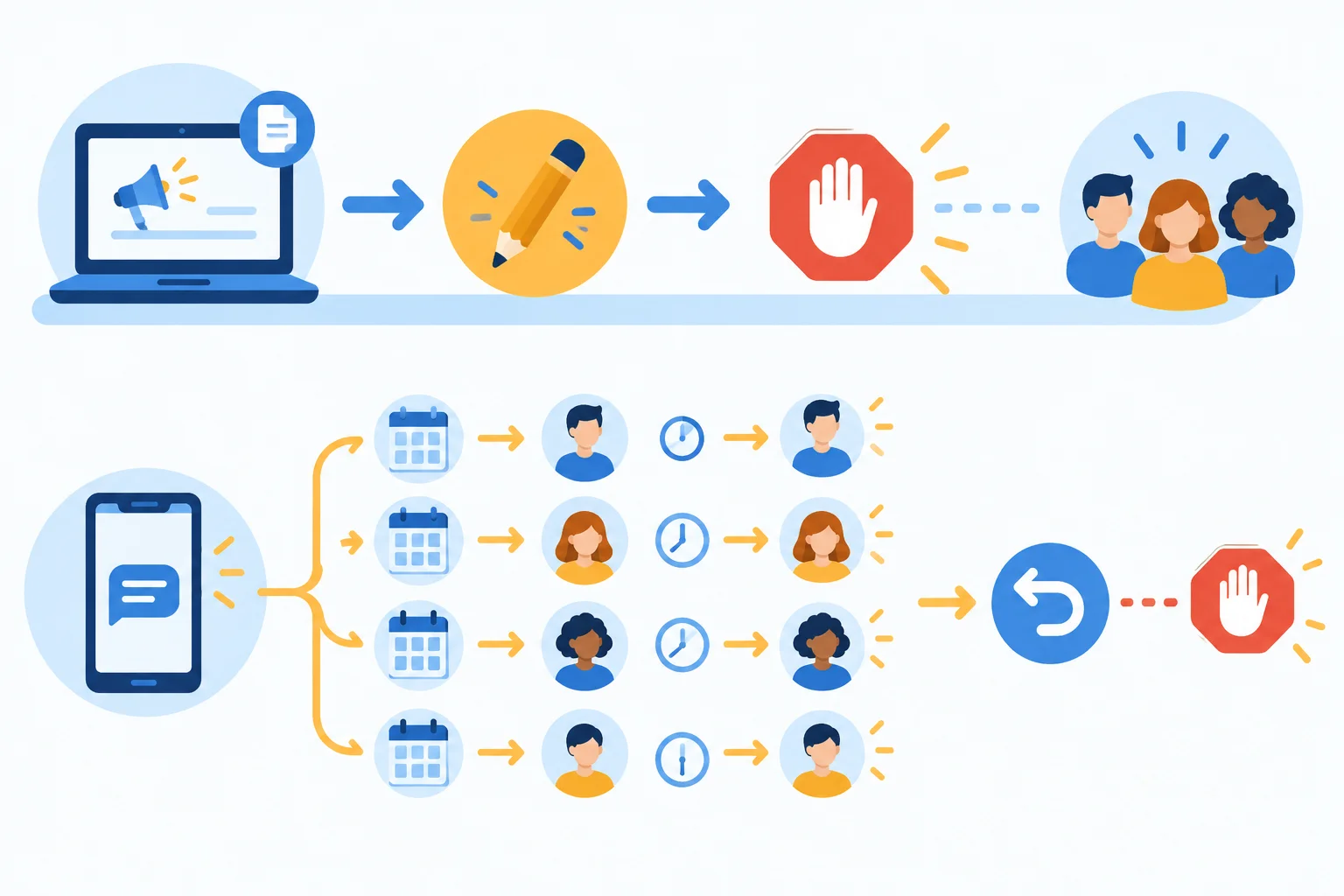
The same type of error can have very different consequences depending on whether people have already acted on it.
Compare the stage of the error, not just how polished the AI output sounds. Speed and convenience do not make an error less important.
Example
Alex is organizing Riverside Community Day: Saturday, 10:00–12:00, at Community Hall, with free entry.
The first case remains under Alex’s control because it is still a draft. In the second case, correcting the message cannot fully undo a visitor’s wasted journey or missed time. As consequences become more serious or less reversible, a person needs stronger control over what is released or decided.
Compare the effect of each error.
| Proposed AI output | Consequences if wrong | Reversibility |
|---|---|---|
| Unshared event draft has awkward wording | Alex can revise it; no attendee has acted on it | Easy to correct before sharing |
| Sent attendee message gives the wrong start time | Visitors may arrive at the wrong time or miss part of the event | Harder to undo after visitors act |
Two AI assistant errors occur for Riverside Community Day. Which one needs stronger human control, based on its consequences and reversibility?

Step 3 of 7
Learn to recognize when polished AI wording hides uncertainty that matters for the proposed use.
An AI assistant can produce an answer that sounds clear, confident, and reasonable. That makes it plausible—but not automatically correct or suitable for the situation.
A dependable answer needs the right facts and context for the use you plan. Polished wording cannot supply facts that were missing from the request or resolve an ambiguous instruction.

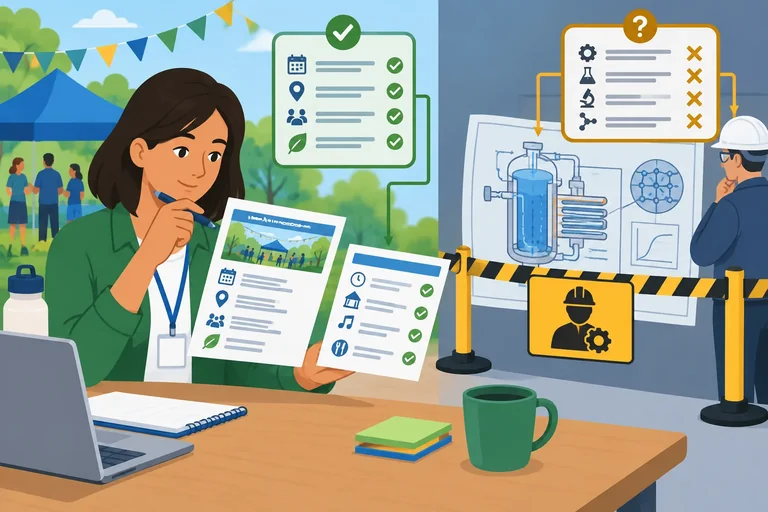
Creative options can be discarded. A polished factual claim may still be uncertain when important information is missing.
Uncertainty increases when a request leaves out relevant facts, provides incomplete context, or can reasonably mean more than one thing. The answer may still sound certain because fluent wording is not evidence that those gaps disappeared.
The important question is not “Does this sound convincing?” It is “What is still unknown, and will anyone rely on this claim?”
Example
Alex asks an AI assistant for three playful headline ideas for Riverside Community Day: Saturday, 10:00–12:00, Community Hall, free entry. The ideas are disposable creative options: Alex can select one, revise it, or discard all of them.
Now imagine the AI assistant adds: “Free parking is available all day.” Alex did not provide that fact. The sentence may sound helpful and polished, but people could plan around it. Here, unresolved uncertainty matters much more.
A confident, polished AI answer is dependable even when the request leaves key facts unstated.
Which statement best distinguishes acceptable uncertainty from concerning uncertainty?
Step 4 of 7
Decide whether an AI output can be meaningfully assessed before people rely on it.
Checkability means having a realistic way to judge the relevant quality or correctness of an AI output before anyone relies on it.
Ask three practical questions:
Rereading a polished answer may improve its wording, but it does not show that a factual or technical claim is correct.
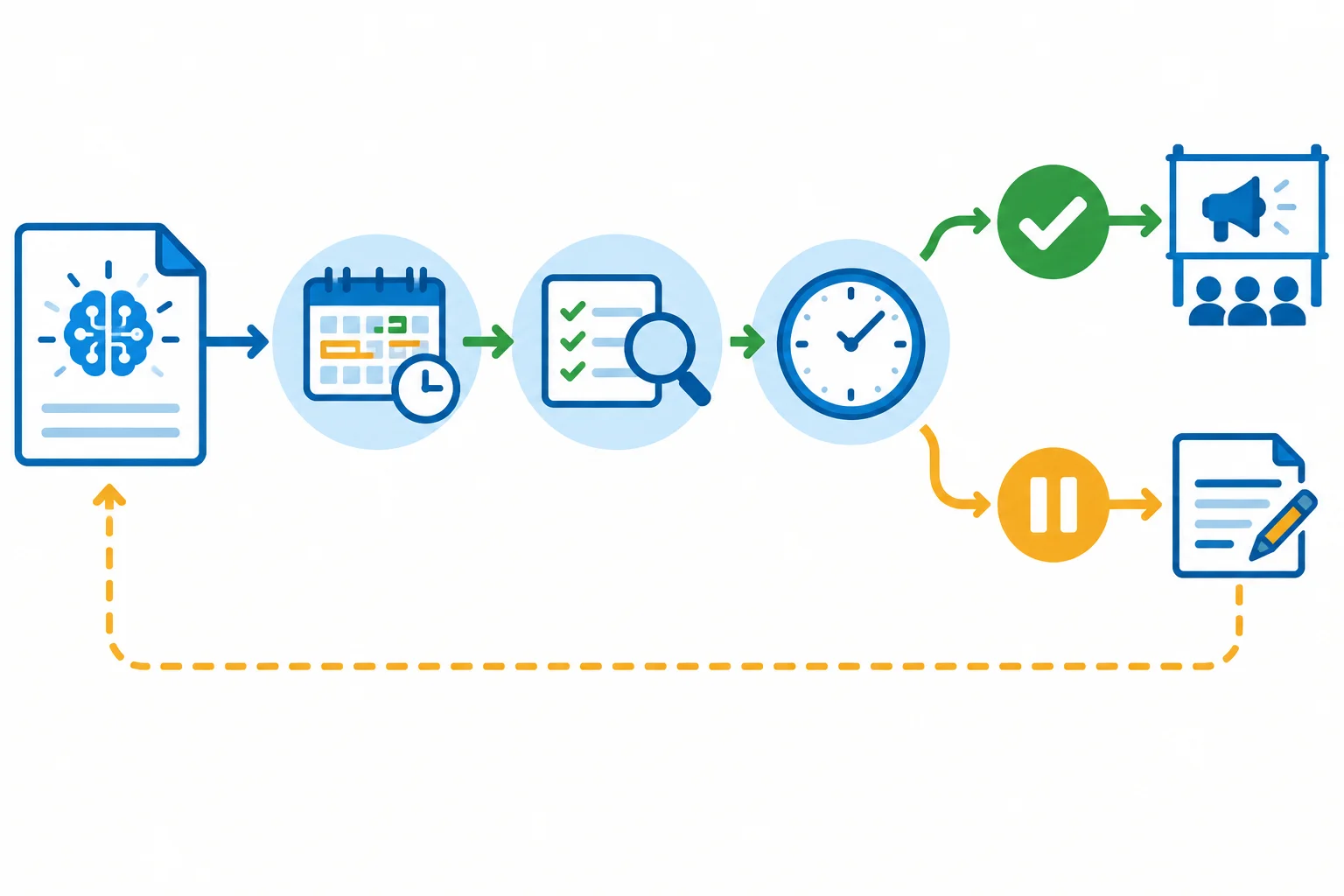
Before use, an output needs a checking route: relevant information, enough understanding, and enough time.
Checkability depends on the exact output and the person who must assess it. It is not the same as proving that there is one perfect answer.
| Proposed output | What the checker needs | Can Alex check it before use? |
|---|---|---|
| An event blurb | The supplied schedule: Saturday, 10:00–12:00, Community Hall, free entry | Yes. Alex can compare each fact before sharing. |
| A technical safety claim | Relevant technical expertise | Not realistically. Alex cannot judge the claim from wording alone. |
| Creative title ideas | The event purpose and audience | Yes. Alex can judge fit and discard unsuitable ideas. |
Example
Alex asks an AI assistant to draft an announcement for Riverside Community Day using the supplied facts: Saturday, 10:00–12:00, Community Hall, and free entry.
The Support task is drafting clear wording. Alex can check the result against the short schedule before posting it. That is a realistic checking route.
If the same AI assistant makes a technical safety claim about equipment at Community Hall, confident wording is not enough. Alex lacks the relevant understanding to assess that claim, so simply rereading it cannot establish correctness.
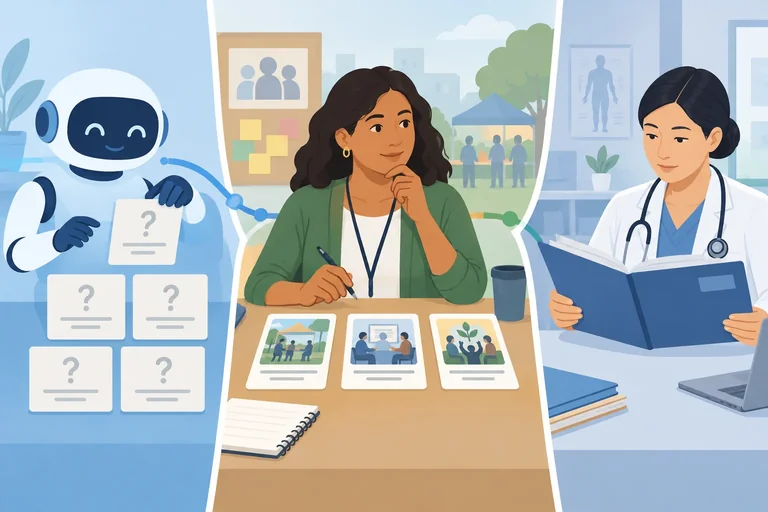
Match each proposed AI output to the realistic checking condition for Alex.
Tap an item and then its matching pair.
Step 5 of 7
Distinguish personal judgment from qualified professional expertise, while keeping useful AI preparation within clear boundaries.
Some Final decisions depend on values, relationships, local context, or trade-offs. An AI assistant may organize options as a Support task, but a person should make the Final decision when those human considerations matter.
Other decisions need more than personal judgment: they need a qualified professional. For a personalized medical or legal decision, a polished AI answer—or approval by someone who cannot recognize the relevant errors—is not a dependable basis for action.
Use AI assistance for bounded preparation. Use Human-led work when a person must weigh the context. Choose Avoid AI for this use when the proposed AI role tries to determine a decision that requires a qualified professional.
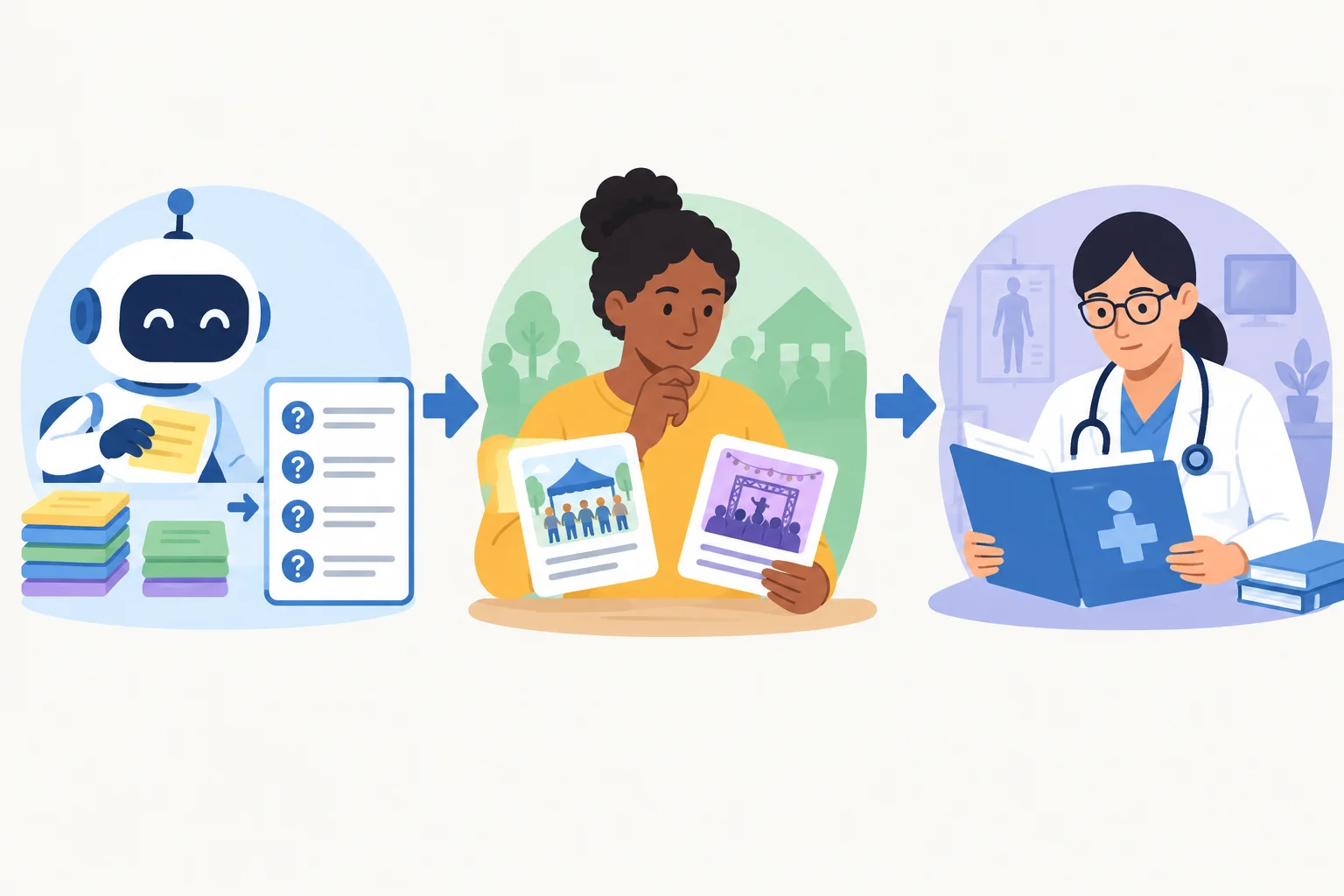
The same broad topic can contain different roles: AI preparation, personal judgment, and qualified professional expertise.
Example
Jordan notices symptoms and considers asking an AI assistant which medication change to make.
Choice: Avoid AI for this use
Reason: Choosing a personalized medication change can depend on health details and clinical judgment. A generic review cannot reliably check whether the choice is suitable.
Boundary: An AI assistant may help draft general questions for a clinician as a Support task. A clinician—not the AI assistant or an unqualified reviewer—makes the Final decision.
Warning
A human approval step is meaningful only when the reviewer has the information, understanding, and authority needed to recognize the relevant errors. A generic sign-off does not turn an expert decision into a dependable AI-assisted one.
Match each proposed role to the appropriate choice label.
Tap an item and then its matching pair.

Step 6 of 7
Choose an appropriate role for an AI assistant by applying the tutorial's five assessment headings to the exact proposed use.
Choose a role for the exact proposed use—not for an entire topic or product. Use five headings to guide your judgment:
This is a judgment map, not a numerical score. A task can be suitable for a limited Support task while its Final decision remains with a person.
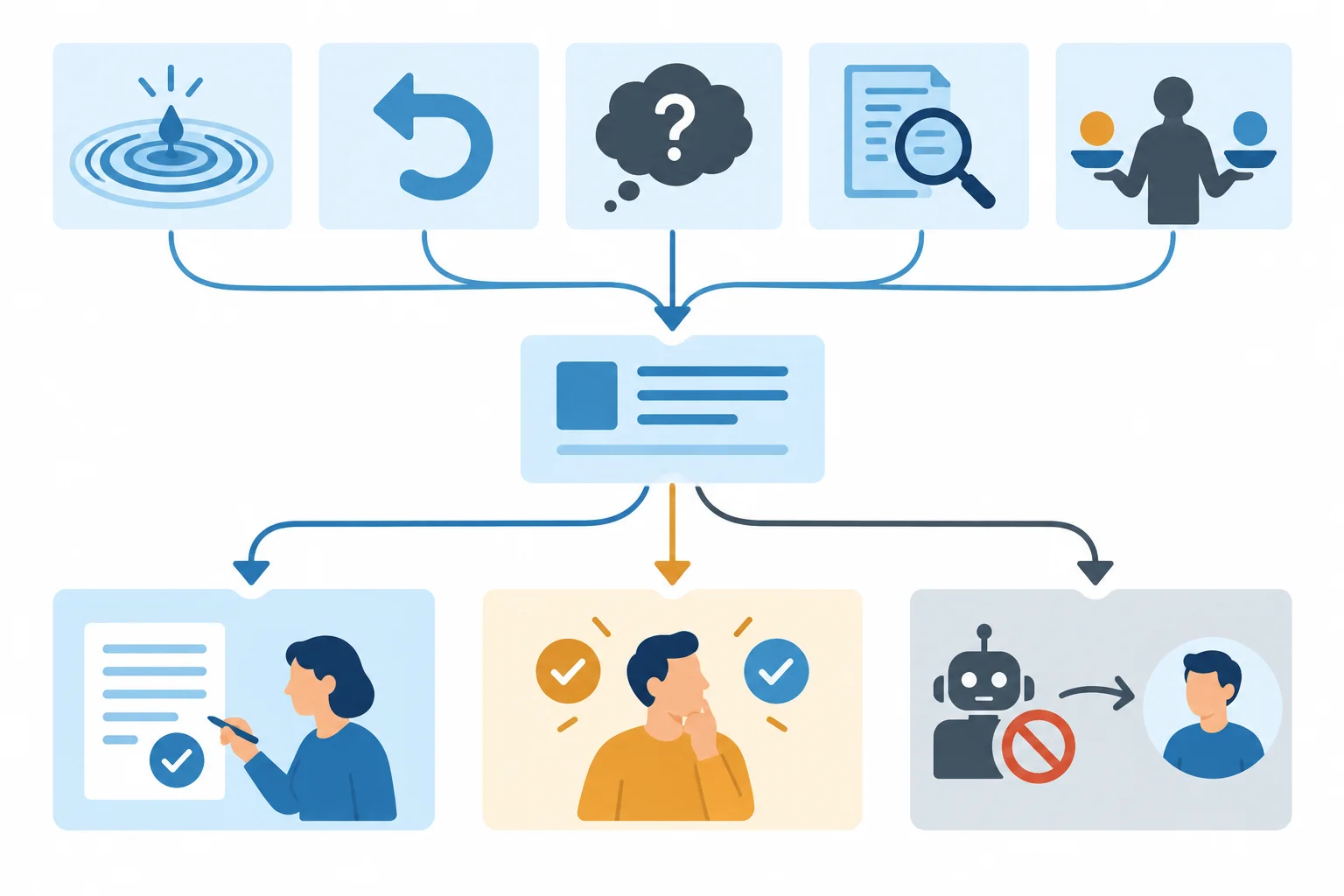
Consider all five headings before choosing the role for a specific proposed use.
The boundary is as important as the choice. It states what an AI assistant may prepare and what it must not determine.
Apply the label to the role that is actually proposed. Changing the role can change the choice, even within the same subject area.
| Choice | When it fits | Boundary |
|---|---|---|
| AI assistance | A bounded output can be checked or discarded before use. | The AI assistant supports a Support task; a person retains the Final decision. |
| Human-led work | The proposed workflow leaves the Final decision with a capable person or qualified professional. | The AI assistant may prepare checkable material but does not determine the outcome. |
| Avoid AI for this use | The proposed AI role delegates a decision that AI cannot determine dependably in the available conditions. | Reject that AI role. Use a human or non-AI alternative for the decision. |
Example
Alex gives an AI assistant only these confirmed facts: Riverside Community Day is Saturday, 10:00–12:00, at Community Hall, with free entry. Alex asks for two short announcement drafts.
Choice: AI assistance
Reason: The drafts are disposable and can be checked against the supplied facts before anything is shared.
Boundary: The AI assistant may draft wording. Alex makes the Final decision about what to publish and must not let the draft invent promises for attendees.
Alex receives three requests for services at Riverside Community Day on Saturday, 10:00–12:00 at Community Hall, with free entry. Alex asks an AI assistant to choose which services the event will promise attendees. Information about venue limits, costs, and available volunteers is incomplete.
Write three labeled lines:
Write at least 120 characters (0/120).

Step 7 of 7
Choose an appropriate AI role for everyday tasks and explain the boundary between support and decision-making.
Use the same decision map for the exact proposed use:
Consequences: What happens if this is wrong, and who is affected?
Reversibility: Can an error be corrected before lasting effects?
Uncertainty: What important facts are missing or unclear?
Checkability: Can the result be realistically assessed before anyone relies on it?
Who should decide?: Does the outcome require personal judgment or a qualified professional?
Then explain the result briefly:
Choice: use exactly one choice label.
Reason: name the decisive concern.
Boundary: state what an AI assistant may do as a Support task and what it must not decide as the Final decision.
There is no blanket rule about AI. Decide for the specific role proposed.
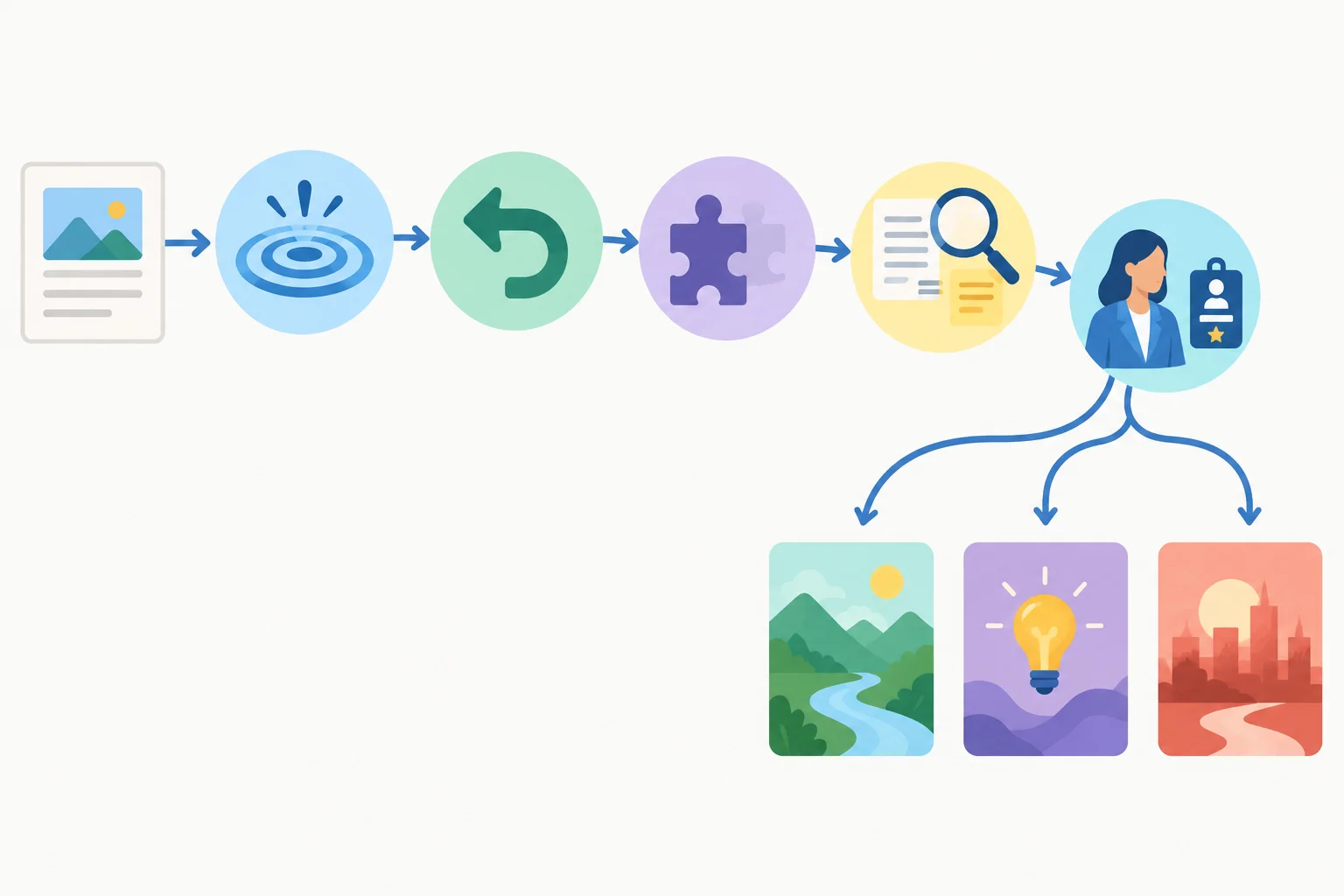
Assess the proposed role through all five headings before stating a choice and boundary.
Match each complete proposed workflow to its best choice label. Classify the workflow as described—not a different request you could make to an AI assistant.
Tap an item and then its matching pair.
Classify each complete proposed workflow below. For each scenario, write three labeled lines using exactly one choice label: AI assistance, Human-led work, or Avoid AI for this use.
A. A book-swap organizer gives confirmed event details to an AI assistant and requests three cheerful poster taglines. The organizer will review every tagline and may edit or discard it before use.
B. A neighbourhood group is considering a new time for its weekly meeting. Members have different transport needs, caring commitments, and preferences. The proposed workflow asks an AI assistant to group written comments into themes; group members will review those themes and make the Final decision about the meeting time.
C. A person asks an AI assistant to decide whether they should reduce the dose of prescribed medication at a routine medication review because of an ongoing side effect. The AI assistant has no complete medical record or clinical examination.
For every response, state a decisive reason and a clear boundary. For C, name the qualified professional who should make the Final decision. Different wording is fine when the choice and boundary fit the facts.
Write at least 300 characters (0/300).
Summary
You can make a reasoned choice about an AI assistant without treating it as always useful or always inappropriate.
Congratulations! You completed: Deciding When AI Should Assist
Thousands of online courses in video, ebooks and audiobooks.
To test your knowledge during online courses
Generated directly from your cell phone's photo gallery and sent to your email

Download our app via QR Code or the links below:.


Carry knowledge in your pocket.
Download the Cursa app.
There are hundreds of free courses available, with a free certificate of completion that is saved in your mobile image gallery.
Download the app to access the Course Completion Certificate for Free.

+ 10 million
students

Free and Valid
Certificate

60 thousand free
exercises

4.8/5 rating in
app stores

Free courses in
video and ebooks