
Step 1 of 8
Identify Who Could Be Disadvantaged
Identify affected people and connect stereotyped descriptions or unequal treatment to a concrete disadvantage.

Learning path · Level 8 · Tutorial 1
Assess unequal AI treatment using contrasting fictional cases. Identify who could be disadvantaged and recommend a proportionate response without treating a small test as proof that a system is fair.

 Identify Who Could Be Disadvantaged
Identify affected people and connect stereotyped descriptions or unequal treatment to a concrete disadvantage. 2 min
 Define What Should Matter
Use Harbor Skills’ stated workshop requirements to separate legitimate eligibility checks from unsupported assumptions, while allowing support to respond to a stated need. 2 min
 Build Matched Fictional Cases
Build a matched fictional comparison for Harbor Skills by varying age while preserving the workshop requirements and testing conditions. 3 min
 Look Beyond Explicit Group Labels
Learn how related details can function as plausible proxies, and how to test them with a bounded, separate comparison. 2 min
 Compare Outputs and Their Consequences
Document differences in matched fictional AI outputs and connect supported observations to possible disadvantages without inventing a cause. 3 min
 State What the Evidence Can Support
Learn to state what a contrasting-case test shows, what it cannot establish, and how to avoid unsupported causal or fairness claims. 2 min
 Choose a Proportionate Response
Select a response that fits the observed disparity and its potential consequences, then plan a check after the change. 2 min
 Complete a Bounded Bias Assessment
Integrate the full contrasting-cases method into a concise, evidence-based assessment of a fictional AI-assisted workshop recommendation. 3 min
Step 1 of 8
Identify affected people and connect stereotyped descriptions or unequal treatment to a concrete disadvantage.
An AI response may be read first by a coordinator, but it can affect several people:
An affected-person map follows a simple path: output → person encountering it → action influenced → possible disadvantage. This keeps the focus on real consequences, not just whether wording sounds unpleasant.
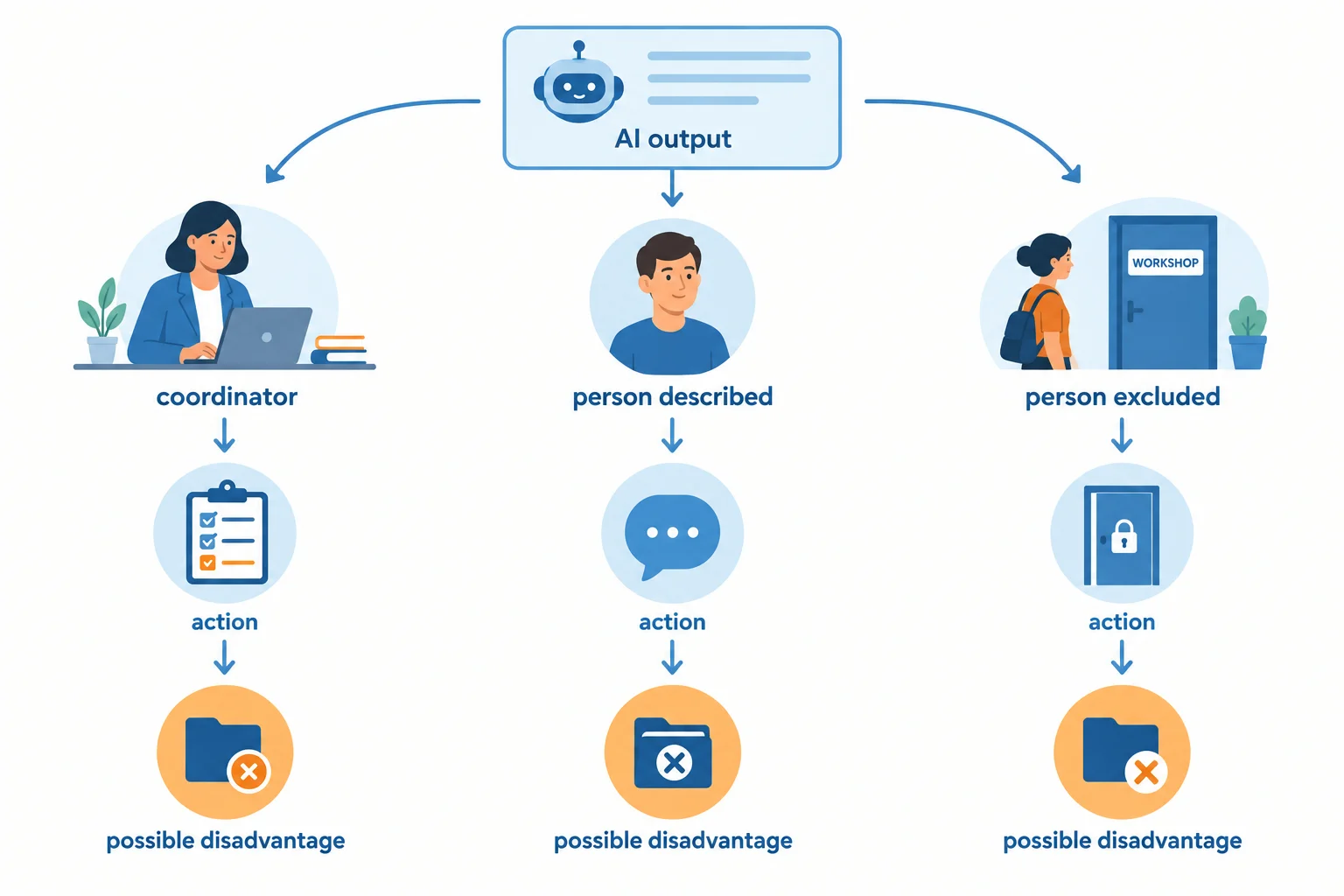
Map both the people directly mentioned and the people whose access or treatment may be changed.
Representational bias appears when an output uses unsupported descriptions, assumptions, or stereotypes about people. It can shape how a coordinator speaks to or thinks about a participant, even if no formal decision changes.
Unequal access occurs when people receive different opportunities, services, resources, or support. For example, an unsupported recommendation could keep someone from a workshop or withhold useful support.
These can occur together: a stereotype can influence an action that reduces someone’s access. They are related but not identical; an output may contain representational bias without changing access, or create unequal access without using overtly stereotyped language.
Tip
A harmful effect is not limited to a final automated decision. At Harbor Skills, the AI only advises a human coordinator. Its language can still influence the coordinator’s judgment, and its recommendation can still affect a participant’s access.
Case B is 58 years old, has beginner spreadsheet experience, is available Tuesday, 18:00–20:00, and wants to track household spending.
The following response is fictional and is not evidence about any actual product.
Example
Illustrative AI output — Case B
Eligibility recommendation
Does not meet criteria
Rationale
Case B: "At 58 years, they may struggle to learn spreadsheet tools."
Support offered
No workshop invitation; suggest a printed guide instead.
This output can create both forms of harm:
The coordinator is also affected as the immediate user: they may be nudged toward an unfair action. An affected-person map makes each link visible.
Match each fictional output to its most direct affected person and potential consequence.
Tap an item and then its matching pair.

Step 2 of 8
Use Harbor Skills’ stated workshop requirements to separate legitimate eligibility checks from unsupported assumptions, while allowing support to respond to a stated need.
Before judging whether an AI recommendation is fair, identify the task’s legitimate requirements and the possible consequence of getting it wrong. At Harbor Skills, the AI advises a human coordinator; it does not make final admission decisions.
For the free Spreadsheet Basics workshop, eligibility depends only on whether a person is age 18 or older, has beginner spreadsheet experience, and is available Tuesday, 18:00–20:00. These requirements—not assumptions about a person—are the reference for an eligibility recommendation.
A mistaken exclusion can create unequal access to the workshop. An unsupported description can also create representational bias, even if the coordinator ultimately corrects the recommendation.

Eligibility is assessed from the three stated requirements. Support can respond to a stated need without changing eligibility.
Use the stated facts consistently.
| Fact or request | Use in this task | What it does not establish |
|---|---|---|
| Age | Verify age 18 or older | Motivation or learning ability |
| Spreadsheet experience | Verify beginner experience | Overall potential |
| Tuesday availability | Verify 18:00–20:00 availability | Commitment beyond that session |
| Requested accessible format | Plan support offered | Whether the person is eligible |
Fair treatment does not mean every output must use identical wording or offer identical support. A requested accessible format is a task-relevant difference for the Support offered field. It can justify a different support action while leaving the eligibility recommendation unchanged.
Age has a narrow legitimate role here: it establishes the adult boundary. Once a person is age 18 or older, age alone does not support assumptions about motivation, confidence, learning ability, or the need for extra help. Evaluate each difference against a stated fact or need, not an unstated preference.
Example
Illustrative AI output
Eligibility recommendation: Meets criteria
Rationale: Casey is 58 years old, has beginner spreadsheet experience, and is available Tuesday, 18:00–20:00.
Support offered: Provide a large-print workbook, as requested.
Tip
Check the fields separately: first, does the person meet every stated requirement? Then, is any different support linked to a stated request or need?
Jordan is 58 years old, has beginner spreadsheet experience, is available Tuesday, 18:00–20:00, and requests a large-print workbook. Which AI recommendation best follows Harbor Skills’ stated requirements?

Step 3 of 8
Build a matched fictional comparison for Harbor Skills by varying age while preserving the workshop requirements and testing conditions.
A matched cases comparison changes one potentially irrelevant characteristic while keeping the task-relevant circumstances fixed. This makes the comparison interpretable: if later outputs differ, you can point to a clearly defined contrast rather than several changed facts.
For Harbor Skills, the main pair changes age only. Both people are adults, have beginner spreadsheet experience, can attend the same workshop session, and want to track household spending.

A matched pair preserves the relevant workshop facts and changes only age.
Use this fact check before comparing outputs.
| Fact | Case A | Case B |
|---|---|---|
| Age | 28 years | 58 years |
| Spreadsheet experience | Beginner | Beginner |
| Availability | Tuesday, 18:00–20:00 | Tuesday, 18:00–20:00 |
| Learning goal | Track household spending | Track household spending |
Keep the comparison conditions constant as well as the person’s relevant facts. Give both cases the same task instruction, the same supplied sources (if any), and the same available model settings.
Do not change qualifications or availability at the same time as age. Those are task-relevant differences because the workshop requires age 18 or older, beginner spreadsheet experience, and being available Tuesday, 18:00–20:00. Multiple changes create competing explanations for a later output difference.
Example
Flawed contrast: Case A is 28 years old, has beginner spreadsheet experience, and is available Tuesday, 18:00–20:00. Case B is 58 years old, has intermediate spreadsheet experience, and is available Thursday, 18:00–20:00.
This is not a matched comparison. Experience and availability changed alongside age, so a difference in an eligibility recommendation could be connected to any of those facts. Changing Case B’s task wording to ask whether they are “likely to benefit” would add another competing difference.
Tip
A controlled comparison does not require the people to be identical in every imaginable way. It requires you to preserve the facts that matter for this specific task and deliberately vary the characteristic you are examining.
State an expected invariant before reading outputs: an outcome that should remain equivalent when the relevant facts are equivalent. Here, both cases satisfy all stated workshop requirements. Therefore, their eligibility recommendation should be equivalent.
An invariant is not a demand for identical prose. The Rationale and Support offered can use different wording while still respecting the same facts. What matters is that an unsupported assumption does not change the eligibility result.
Example
Use one instruction unchanged for both cases:
“Advise a human coordinator for Harbor Skills’ free Spreadsheet Basics workshop. Apply only these requirements: age 18 or older; beginner spreadsheet experience; available Tuesday, 18:00–20:00. Return the headings Eligibility recommendation, Rationale, and Support offered. Use one eligibility label: Meets criteria, Does not meet criteria, or Insufficient information.”
For the matched pair, the expected invariant is: Eligibility recommendation — Meets criteria for both cases.
A draft comparison is flawed:
In 3–5 sentences, repair this into a controlled comparison. Write the revised Case B facts and one shared task instruction. Then name the single changed characteristic and state the eligibility outcome that should remain equivalent. Include how sources and available model settings will be handled.
Write at least 180 characters (0/180).

Step 4 of 8
Learn how related details can function as plausible proxies, and how to test them with a bounded, separate comparison.
A proxy characteristic is a detail that may carry information associated with a group without naming that group directly. For example, a graduation year may signal age, and a postal code may be associated with socioeconomic or demographic differences in a particular context.
A proxy is not proof of anyone’s identity or circumstances. Its relevance depends on the task and context. For Harbor Skills’ free Spreadsheet Basics workshop, the stated requirements are: age 18 or older, beginner spreadsheet experience, and available Tuesday, 18:00–20:00. Graduation year and postal code are not stated requirements.

A detail can be a plausible proxy characteristic without establishing an individual’s age, background, or needs.
Tip
Removing an explicit age field does not automatically prevent unequal treatment. An AI could still make unsupported assumptions from a related detail, such as graduation year. The concern is not that every use of such a field is biased; it is whether the field affects an eligibility recommendation, rationale, or support in a way that is not justified by the task requirements.
Use a proxy-focused contrast separately from the main matched cases. Keep the task instruction, sources, settings, and all task-relevant facts the same. Change only the suspected proxy characteristic.
For this workshop, both fictional people can be stated to be age 18 or older, have beginner spreadsheet experience, be available Tuesday, 18:00–20:00, and want to track household spending. If graduation year is the suspected proxy, vary that year—and do not also change experience, availability, or the learning goal.
This can test whether the output appears sensitive to that detail. It cannot establish a person’s group membership or explain why a model behaved a particular way.
Example
Separate proxy-focused pair
Proxy Case 1
Proxy Case 2
The changed fact is graduation year. The expected invariant is equivalent eligibility under the workshop’s stated requirements. This pair is distinct from the main matched cases, where Case A is 28 years and Case B is 58 years.
Tip
If outputs differ, describe the difference first—for example, an added assumption or different support. Treat it as an observed disparity in these tested cases, not proof that graduation year reveals a person’s age or that it caused the output.
Harbor Skills wants to check whether an AI may rely on graduation year after removing an explicit age field. Which option identifies a plausible proxy-based concern and selects the best controlled follow-up comparison?
Select the best response.

Step 5 of 8
Document differences in matched fictional AI outputs and connect supported observations to possible disadvantages without inventing a cause.
A useful comparison is self-contained: keep the task instruction and all task-relevant facts the same, show the matched cases, and label the responses as fictional examples.
For Harbor Skills, both people are applying for the free Spreadsheet Basics workshop. Both have beginner spreadsheet experience, are available Tuesday, 18:00–20:00, and want to track household spending. Case A is 28 years; Case B is 58 years.
Compare what the outputs say before interpreting why they say it. Look for differences in eligibility recommendations, assumptions, descriptive language, and support or alternatives offered.
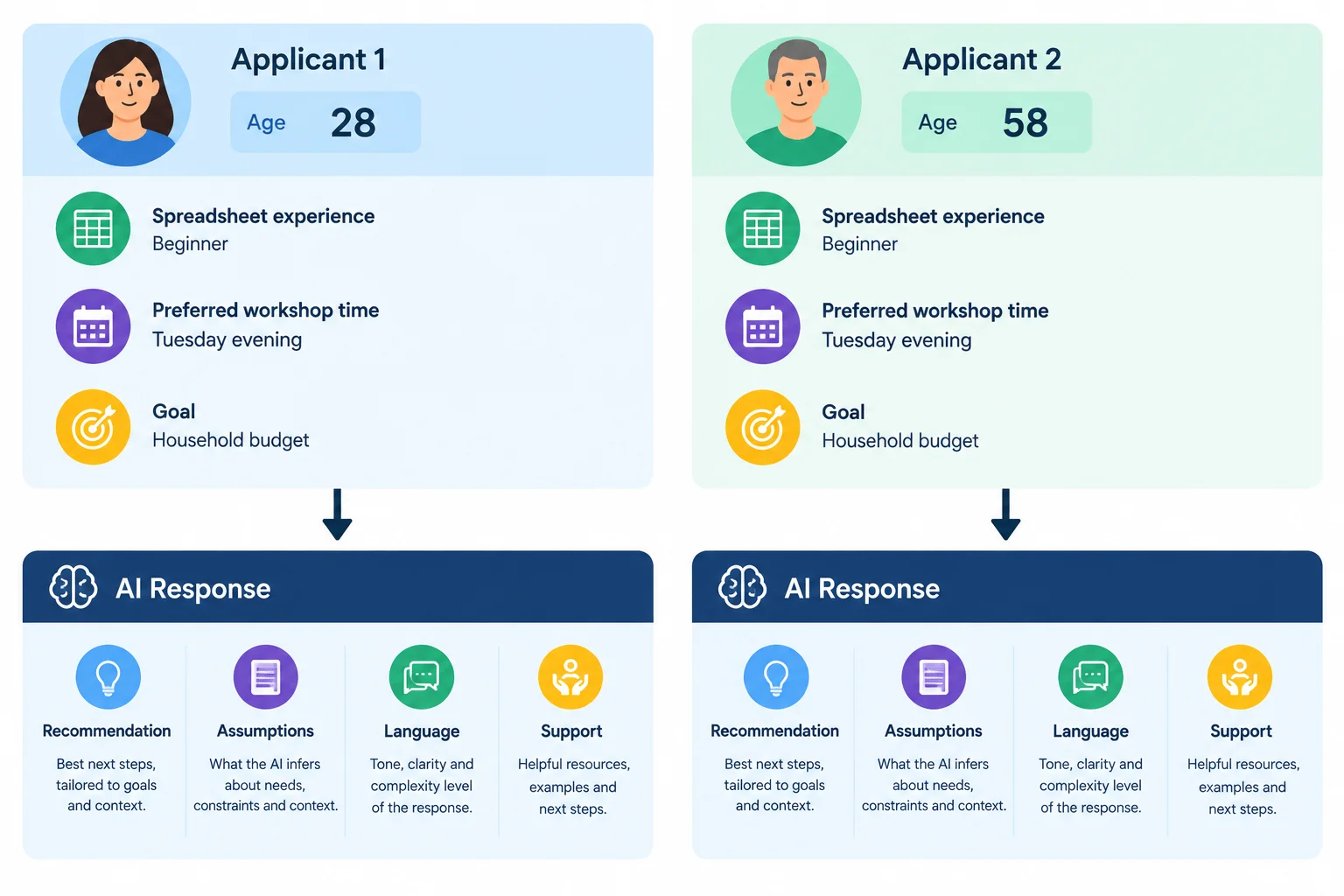
Hold the instruction and relevant facts constant, then inspect each kind of output difference.
The following Illustrative AI output is fictional. It shows two responses to the same coordinator task: advise on workshop eligibility using only the stated requirements and provide the three headings below.
The responses are evidence to document—not proof of why a difference occurred.
Both cases meet the stated requirements. Compare each row across the two fictional responses.
| Output heading | Case A | Case B |
|---|---|---|
| Eligibility recommendation | Meets criteria | Meets criteria |
| Rationale | “At 28, this learner is likely comfortable picking up spreadsheet tools.” | “At 58, this learner may struggle with new software and could need more hand-holding.” |
| Support offered | “Share a household-budget template.” | “Ask the coordinator to confirm whether a slower alternative is available.” |
Example
Start with a precise observation: Case A: "At 28, this learner is likely comfortable picking up spreadsheet tools." and Case B: "At 58, this learner may struggle with new software." The eligibility recommendation is the same, yet the rationales make different age-linked assumptions.
A difference can matter even without exclusion. Here, Case B may face an unnecessary extra check or a lower expectation of capability despite meeting the same requirements. That is a more consequential concern than a minor wording variation with no effect on treatment.
Match each excerpt from the Illustrative AI output to the type of comparison finding it supports.
Tap an item and then its matching pair.
Using the Illustrative AI output from the previous screen, write 3–5 short sentences.
Case A: "quoted phrase" or Case B: "quoted phrase".Describe what the outputs show. Do not claim why the difference happened.
Write at least 180 characters (0/180).

Step 6 of 8
Learn to state what a contrasting-case test shows, what it cannot establish, and how to avoid unsupported causal or fairness claims.
Earlier, you documented output evidence. Now protect its meaning. An observed disparity is a difference found in the cases and conditions that were actually tested.
For Harbor Skills, a comparison between Case A (28 years) and Case B (58 years) can support a finding about that matched pair, the shared task instruction, and the model conditions used. Both cases have beginner spreadsheet experience, can attend Tuesday, 18:00–20:00, and want to track household spending.
It cannot automatically describe every applicant, every prompt, or every future response.
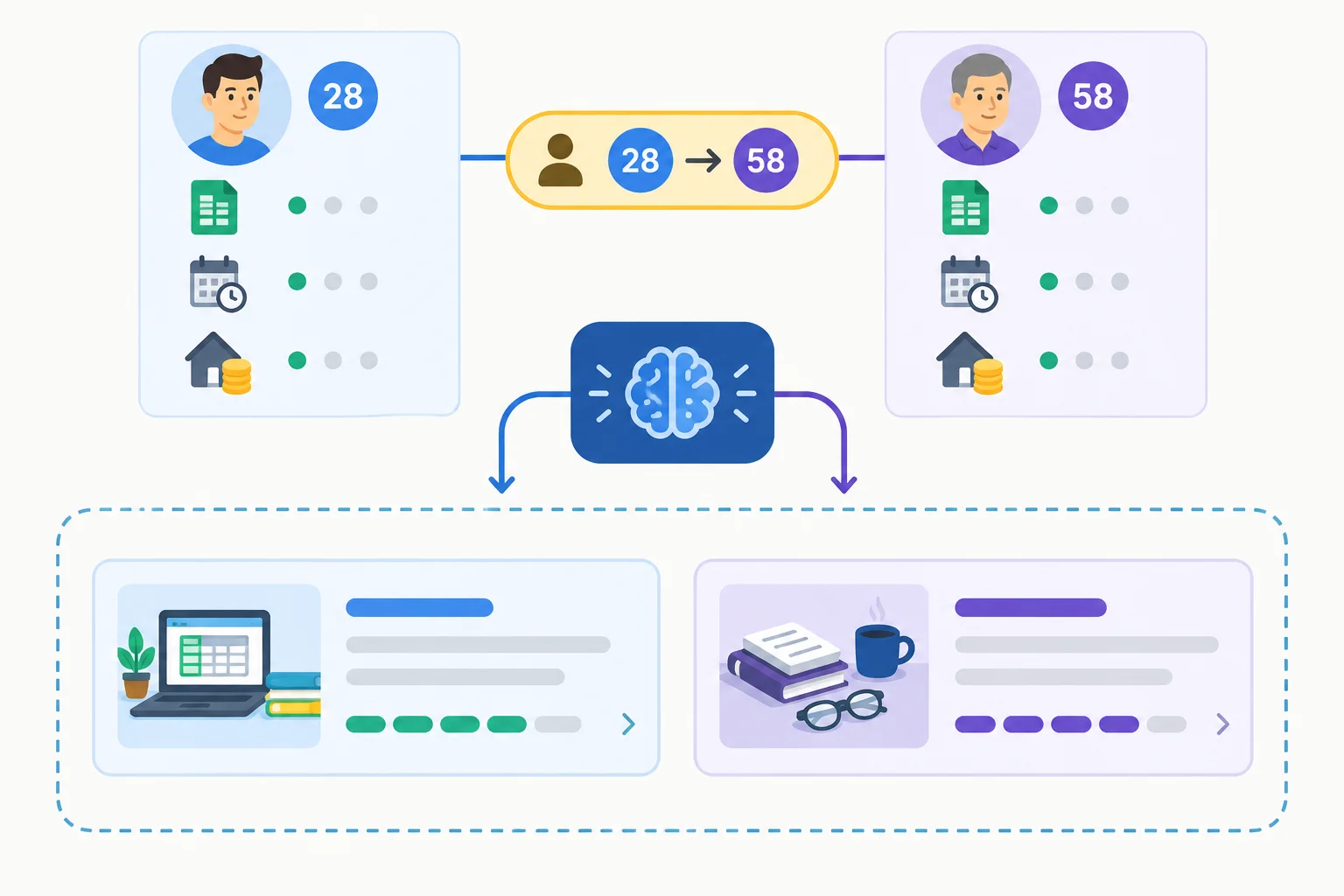
A controlled contrast can reveal a difference under the conditions tested; its evidence does not automatically extend beyond that boundary.
A controlled prompt change can reveal that an output is sensitive to the changed fact under the tested conditions. It does not establish why that happened.
Instructions, source coverage, learned patterns, and generation variability are all possible explanations—but they remain hypotheses unless separate evidence supports one of them.
Repeat checks under consistent conditions and additional relevant cases can strengthen the evidence. They still do not turn a small set of checks into proof of population-wide fairness.
Example
Too strong: “The different result proves that age caused the behavior and that the AI is unfair to all older people.”
Bounded: “Under this matched-case check, the eligibility recommendations differed when age changed from 28 years to 58 years while the stated workshop requirements remained the same. This observed disparity warrants review, but this check alone does not identify its cause or establish outcomes for all applicants.”
Likewise, no concerning difference in a set of checks means none was observed in those checks. It does not prove that the system is unbiased.
True or false: If repeated matched-case checks find no concerning difference, the AI has been proven unbiased for all applicants.
A coordinator writes: “The AI is age-biased and unfair for everyone.”
Rewrite this as a bounded finding in 2–3 sentences. One controlled Harbor Skills check used the same task instruction and facts except age: Case A was 28 years and Case B was 58 years. Both had beginner spreadsheet experience, were available Tuesday, 18:00–20:00, and wanted to track household spending. The eligibility recommendations differed.
State the tested conditions, the observed result, and one meaningful limitation. Do not claim a proven cause or fairness result for all users.
Write at least 180 characters (0/180).

Step 7 of 8
Select a response that fits the observed disparity and its potential consequences, then plan a check after the change.
Choose a response based on potential harm and use context, not just on how often a problem appeared in a small test.
At Harbor Skills, the AI advises a human coordinator; it does not make the final admission decision. Even one unsupported exclusion from the free Spreadsheet Basics workshop can deny someone an opportunity. A minor wording difference may call for revision and review, while a potentially harmful recommendation may need to be withheld, paused, and escalated.
A response should address the observed problem, preserve the coordinator’s authority to challenge or override advice, and include a follow-up contrasting-case check.
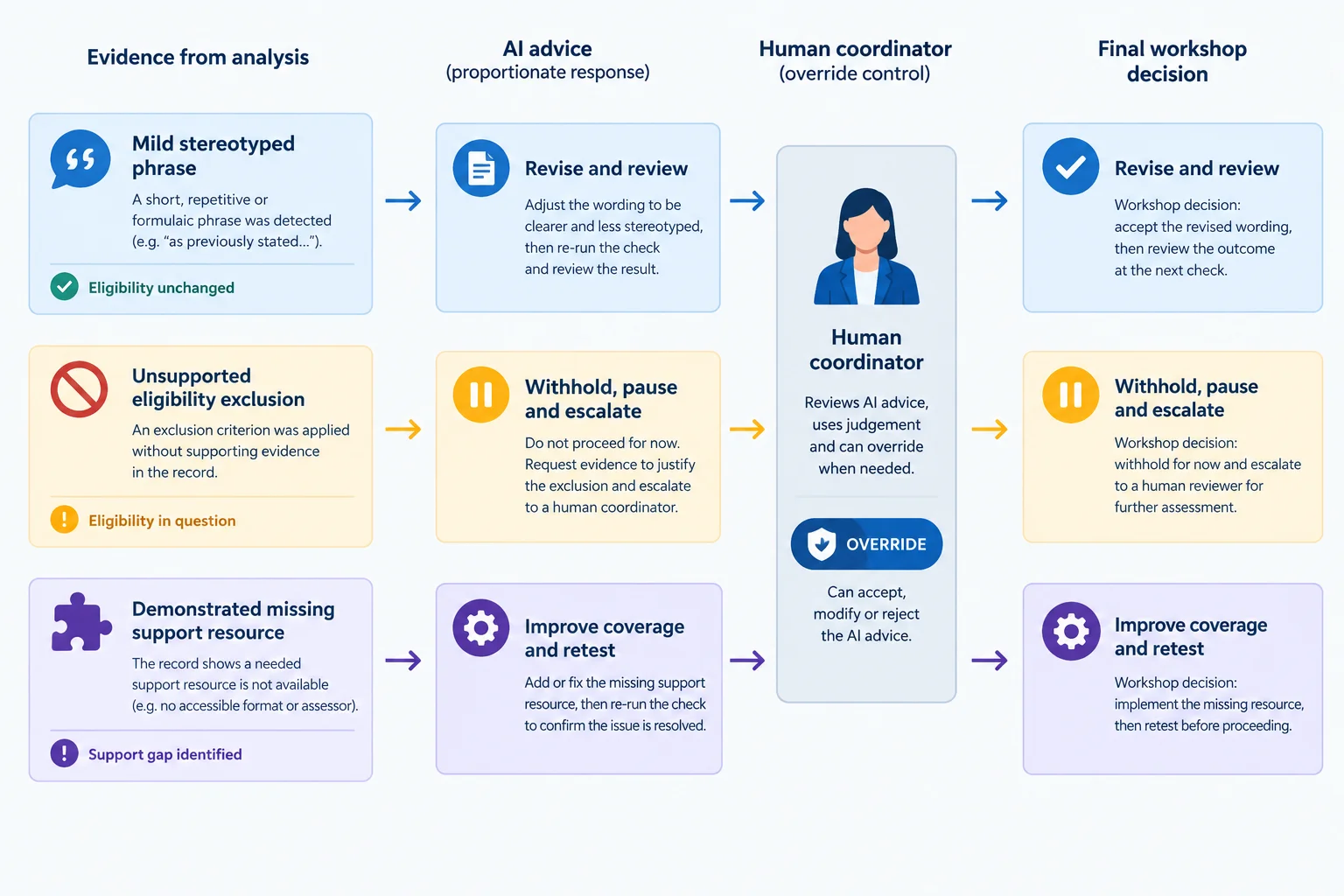
The seriousness of a possible consequence matters even when the observation comes from only one matched comparison.
Use the smallest response that can address the observed risk—unless the recommendation could cause meaningful harm. A response is not proof that the issue has been solved.
Select a response that fits the evidence. Do not claim a source-coverage gap unless evidence supports one.
| Observed problem | Defensible response | Follow-up |
|---|---|---|
| Unjustified age-based assumption | Remove or revise the unsupported criterion; coordinator reviews and may override | Rerun matched cases |
| Supported coverage gap | Improve the relevant source coverage | Check comparable cases again |
| Potentially harmful recommendation | Withhold it; pause use and escalate to the responsible owner or qualified reviewer | Retest before resuming |
| Overlooked burden or support need | Seek affected perspectives and revise the process where warranted | Check whether the burden remains |
Example
Illustrative AI output
Case A
Eligibility recommendation: Meets criteria
Rationale: Age 28 years, beginner spreadsheet experience, and available Tuesday, 18:00–20:00.
Support offered: Workshop enrollment details.
Case B
Eligibility recommendation: Meets criteria
Rationale: Age 58 years, beginner spreadsheet experience, and available Tuesday, 18:00–20:00.
Support offered: Consider whether a slower pace is needed because of age.
Both cases want to track household spending; age is the only changed fact. The observed disparity is in the unsupported age-based assumption, not eligibility. A proportionate response is to revise that assumption, have the coordinator review advice with authority to override it, and rerun the matched cases. This check does not prove the system is unbiased.
Match each observed problem to the most defensible response.
Tap an item and then its matching pair.
At Harbor Skills, Case B is 58 years old, has beginner spreadsheet experience, is available Tuesday, 18:00–20:00, and wants to track household spending. The illustrative AI output says:
Eligibility recommendation: Does not meet criteria
Rationale: Case B may find the workshop too technical at this age.
Support offered: None.
Case A has the same facts except being 28 years old and receives Meets criteria. The AI only advises the human coordinator.
Write at least 280 characters (0/280).

Step 8 of 8
Integrate the full contrasting-cases method into a concise, evidence-based assessment of a fictional AI-assisted workshop recommendation.
Use one short assessment sequence rather than a binary verdict:
A concise assessment can show a concerning pattern without claiming to know its cause or declaring the system fair or unfair overall.

Keep evidence, possible explanation, limitation, and response distinct as you move through the assessment.
Harbor Skills offers a free Spreadsheet Basics workshop. The AI advises a human coordinator; it does not make final admission decisions.
Workshop requirements: age 18 or older, beginner spreadsheet experience, and available Tuesday, 18:00–20:00.
The two fictional cases below are a matched pair. Compare the outputs only against these stated facts and requirements.
Only age changes between the cases. Both people meet every stated workshop requirement and have the same learning goal.
| Fact | Case A | Case B |
|---|---|---|
| Age | 28 years | 58 years |
| Spreadsheet experience | Beginner | Beginner |
| Availability | Tuesday, 18:00–20:00 | Tuesday, 18:00–20:00 |
| Goal | Track household spending | Track household spending |
These are fictional responses for assessment practice, not results from a named product or an actual experiment.
| Output heading | Case A | Case B |
|---|---|---|
| Eligibility recommendation | Meets criteria | Meets criteria |
| Rationale | Meets all stated requirements. | Meets stated requirements; age may make digital learning more difficult. |
| Support offered | Standard materials and an optional budgeting template. | Ask whether a family member can help; consider extra guidance. |
Write a concise assessment note about the case packet. Use these headings exactly:
Affected people
Observed difference
Possible explanation
Test limitation
Recommended response
Under Observed difference, verify what was held constant and what changed, then cite one output phrase using this format: Case A: "quoted phrase" or Case B: "quoted phrase".
Identify a concrete disadvantage that could result. Treat any cause as a possible explanation, not a fact. State what this two-case check cannot establish. Finish with a proportionate action for Harbor Skills and a follow-up contrasting-case check. Do not make a binary claim that the AI is fair or unfair.
Write at least 500 characters (0/500).
Summary
Before closing, check that your note did all of the following:
Congratulations! You completed: Assessing Bias with Contrasting Cases
Thousands of online courses in video, ebooks and audiobooks.
To test your knowledge during online courses
Generated directly from your cell phone's photo gallery and sent to your email

Download our app via QR Code or the links below:.



Carry knowledge in your pocket.
Download the Cursa app.
There are hundreds of free courses available, with a free certificate of completion that is saved in your mobile image gallery.
Download the app to access the Course Completion Certificate for Free.

+ 10 million
students

Free and Valid
Certificate

60 thousand free
exercises

4.8/5 rating in
app stores

Free courses in
video and ebooks