
Step 1 of 8
Define the Pilot's Boundaries
Define a bounded pilot charter for Cedar Office Supplies before collecting evidence or changing a live process.

Learning path · Level 9 · Tutorial 3
Write a bounded pilot plan that can establish whether a proposed approach improves the current process without concealing review effort, operating costs, or quality failures. Keep the work at the planning stage rather than building or testing the final solution.
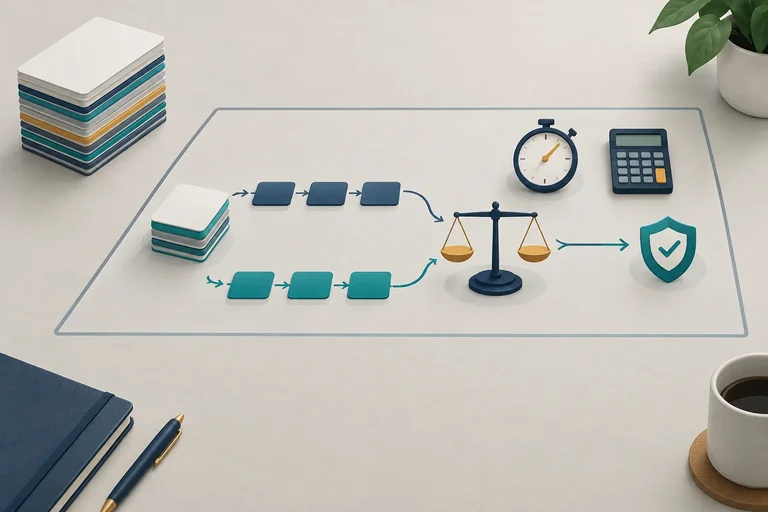
 Define the Pilot's Boundaries
Define a bounded pilot charter for Cedar Office Supplies before collecting evidence or changing a live process. 3 min
 Specify the Current-Process Baseline
Define a baseline record for the current process so that comparable completed work, rework, waiting, and unfinished effort remain visible. 3 min
 Plan a Comparable Measurement
Plan a representative, paired comparison that makes future pilot evidence interpretable without running the pilot. 4 min
 Set Benefit, Quality, and Safety Gates
Define measurable benefit, quality, recurring-capacity, and safety gates so faster output alone cannot establish pilot success. 3 min
 Account for the Full Effort and Cost
Create a transparent inventory of pilot and operating effort, separating staff time from cash spending and avoiding hidden or duplicated work. 3 min
 Model Volume and Interpret the Savings
Estimate recurring staff effort and cash spending under Low, Expected, and High monthly demand scenarios, while distinguishing time released from cash savings that can actually be avoided. 4 min
 Predeclare the Review Decision
Predeclare how Cedar Office Supplies will interpret pilot evidence so that safety gates, comparison limitations, and resource limits remain visible in the final review. 3 min
 Complete and Check the Pilot Plan
Synthesize the Cedar Office Supplies pilot charter into a concise, internally consistent evidence-gathering plan, then check its claims and limits before any later pilot is run. 4 min
Step 1 of 8
Define a bounded pilot charter for Cedar Office Supplies before collecting evidence or changing a live process.
A pilot is a limited evidence-gathering exercise, not a commitment to deploy a solution. Its charter makes the limits visible before any evaluation begins.
For Cedar Office Supplies, the proposed change is specific: the current process has support staff draft routine returns-policy replies; the AI-assisted process uses an existing assistant to draft from approved policy documents for human review.
A useful improvement hypothesis connects that change to an observable benefit while preserving constraints. For example: the AI-assisted process may reduce active staff handling effort for the permitted task, provided that human review remains in place and quality and safety boundaries are respected.
This tutorial creates a planning document only. It does not build, test, deploy, or authorize the assistant.
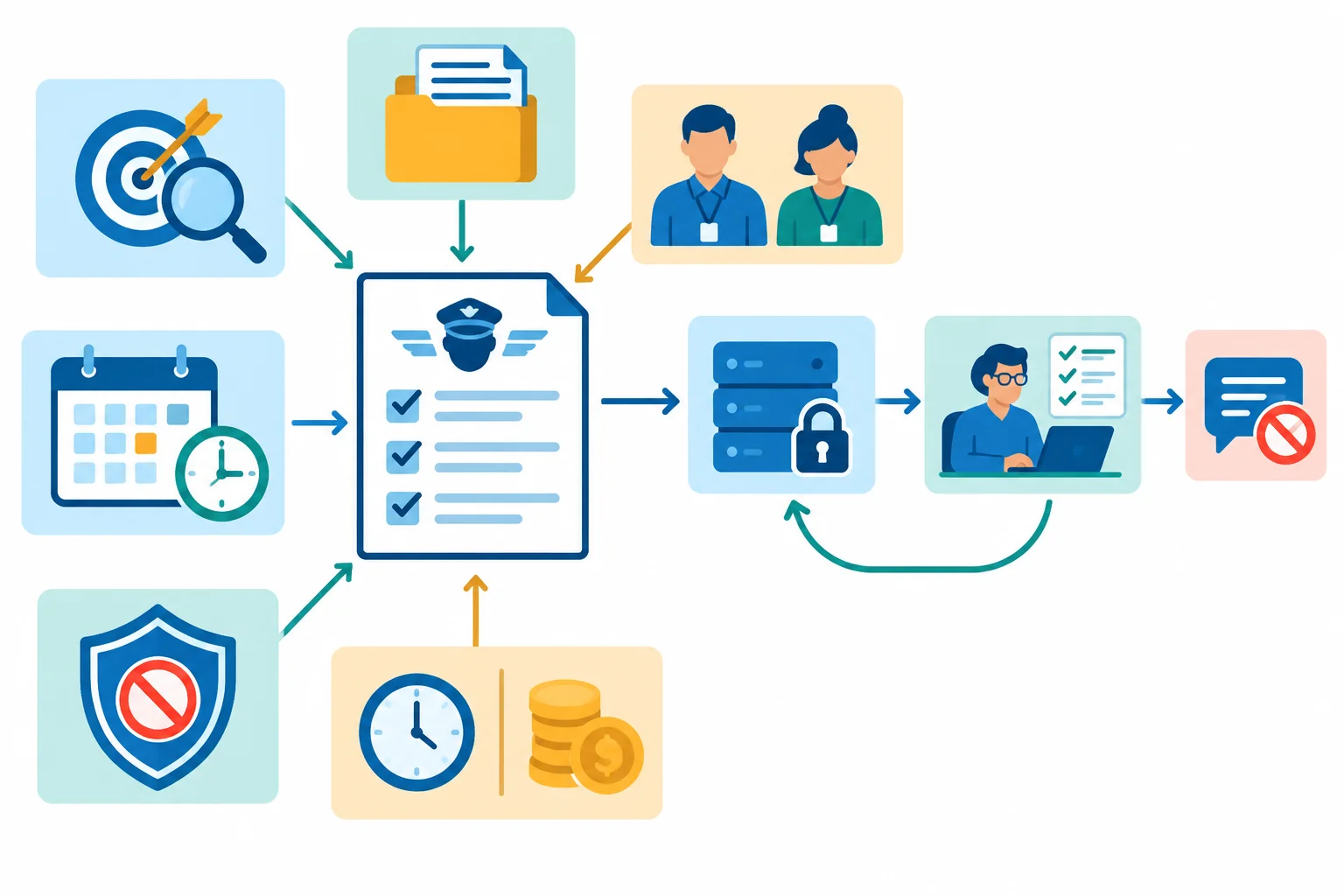
A charter links the question being investigated to explicit operating boundaries.
Tip
Keep two boundaries separate:
Do not describe a planned pilot as though it has already produced results. Label assumptions and limits clearly, and do not imply a production change.
Example
Worked pilot charter — Cedar Office Supplies
Question and hypothesis: Planning estimate — Using the existing assistant to draft permitted replies from approved policy documents may reduce active handling effort compared with the current process, while retaining human review and the established safety boundaries.
Task scope: Routine returns-policy replies only. Planning estimate — 40 unique, authorized, de-identified historical cases: 24 straightforward cases, 12 multi-part cases, and 4 insufficient-information cases. This is a planning assumption, not a claim about actual demand.
Participants and duration: Planning estimate — 2 support staff over 2 weeks. Accountable pilot contact: Cedar Support Operations Lead.
Delivery boundary: Internal replay only. No replies are sent to customers and no production process changes.
Exclusions: Account-specific requests, refund decisions, disputes, and legal claims.
Resource limits: Planning estimate — no more than 24 staff-hours across all pilot activities and no more than USD 100.00 in incremental cash spending.
A charter should state each boundary in plain language. The values below are planning estimates for this example, not measured outcomes.
| Charter field | What Cedar Office Supplies specifies |
|---|---|
| Change under review | Existing assistant drafts permitted replies; staff review them |
| Included work | Routine returns-policy replies from approved policy documents |
| Participants | Planning estimate: 2 support staff |
| Duration | Planning estimate: 2 weeks |
| Workload | Planning estimate: 40 unique historical cases under internal replay |
| Excluded work | Account-specific requests, refund decisions, disputes, legal claims |
| Staff-time ceiling | Planning estimate: 24 staff-hours across all pilot activities |
| Cash ceiling | Planning estimate: USD 100.00 incremental cash spending |
Using the Cedar Office Supplies planning constraints from the preceding screen, draft a compact pilot charter in 120–180 words.
Include:
Do not invent results or claim that the proposed approach has already improved the process.
Write at least 300 characters (0/300).
Step 2 of 8
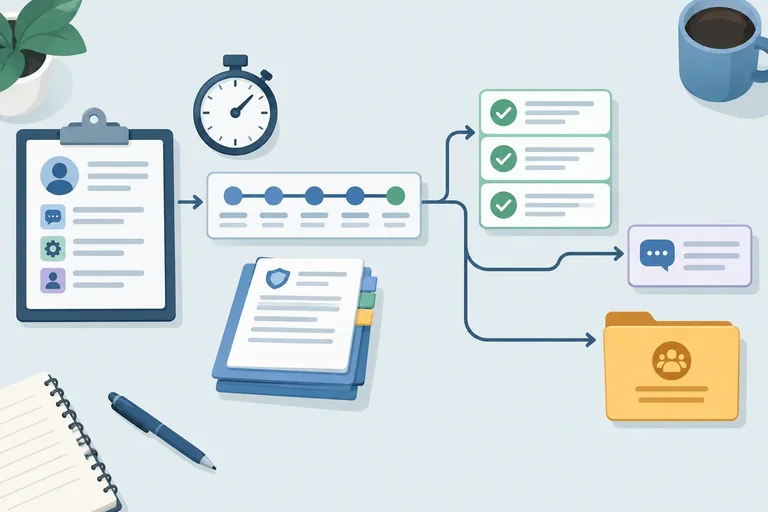
Define a baseline record for the current process so that comparable completed work, rework, waiting, and unfinished effort remain visible.
A current process baseline measures how comparable work is completed today, without the proposed change. It is evidence to collect, not a story about how the process usually feels.
For Cedar Office Supplies, record what staff do when preparing routine returns-policy replies from approved policy documents under the current process. A draft alone is not enough: the record follows the work to a defined usable outcome.
Planning estimate: current active handling time is 10 min/case. Keep this explicitly marked as an estimate until baseline records produce a measured mean.
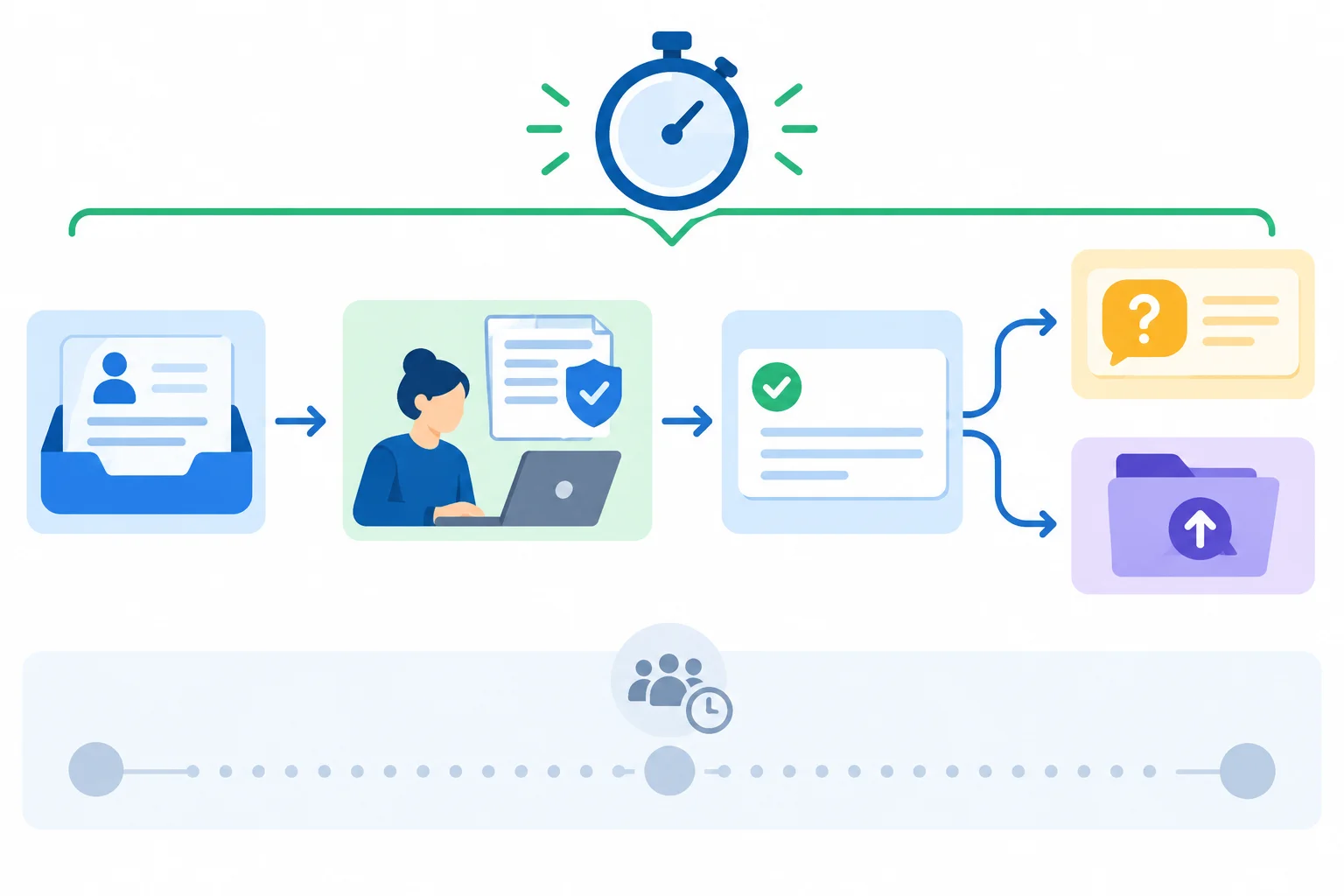
Define the same start and finish boundaries for every baseline record. A valid clarification or escalation can be a completed case.
Set an operational boundary before collecting times:
Count active handling from start to finish: reading the case, finding policy support, drafting, checking, correcting, and any rework. If work stops before a valid finish, record its effort and status; do not make it disappear.
The planned pilot uses internal replay, so no reply is sent to a customer. That delivery boundary does not change what counts as a completed case.
Active staff time and elapsed time answer different questions. Keep them in separate fields; do not add them together as though both were staff effort.
| Observation | Record as | Reason |
|---|---|---|
| Staff reads policy, checks a draft, and fixes an error | Active handling time | This is staff work, including rework |
| A case sits in a queue before work begins | Waiting time | No staff member is actively handling it |
| A case waits for a permitted internal input | Elapsed turnaround or waiting time | Useful service context, but not automatically staff effort |
| Staff returns after a wait and continues work | Additional active handling time | Count the work when it occurs |
A baseline record needs enough detail to show both the outcome and the effort behind it. For each started case, record:
Calculate mean active handling time using completed cases, but report the completion rate alongside it: completed cases divided by started cases. This prevents a low average from concealing cases that were abandoned, deferred, or excluded after consuming staff effort.
Use one row per started case. The exact task categories and case set will be planned next; this is the record structure, not a claim about actual demand.
| Field | What to capture | Status |
|---|---|---|
| Task type | Nature of the returns-policy request | To measure |
| Completion status | Ready reply, clarification, escalation, or unfinished | To measure |
| Active handling | All staff work from start through correction | To measure |
| First-check error and rework | Whether a correction was needed and the work performed | To measure |
| Waiting or turnaround | Elapsed delay recorded separately from staff work | To measure |
| Current mean | Mean active handling time per completed case | To measure |
| 10 min/case | Initial current-process assumption only | Planning estimate |
Match each hypothetical baseline observation to the correct recording decision.
Tap an item and then its matching pair.
Step 3 of 8
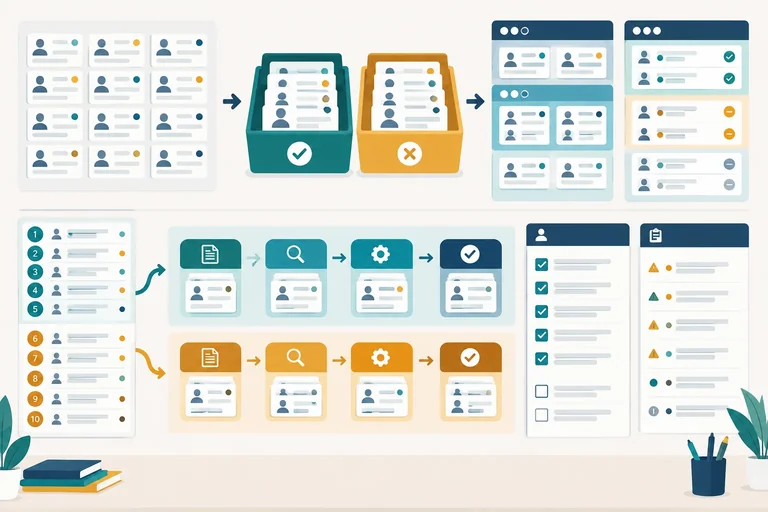
Plan a representative, paired comparison that makes future pilot evidence interpretable without running the pilot.
A comparable measurement starts with the intended workload, not with cases that seem likely to make the AI-assisted process look good.
First, define an eligible case pool: authorized, de-identified historical cases available for internal replay that concern routine returns-policy replies and can be assessed under the shared completion rules. Exclude account-specific requests, refund decisions, disputes, legal claims, duplicate records, and records that cannot be authorized or de-identified. Record every exclusion and its reason before comparing either process.
Classify the eligible pool before observing process outcomes. The planned mix includes straightforward, multi-part, and insufficient-information cases. An insufficient-information case remains eligible: an appropriate clarification or escalation can be a completed case.
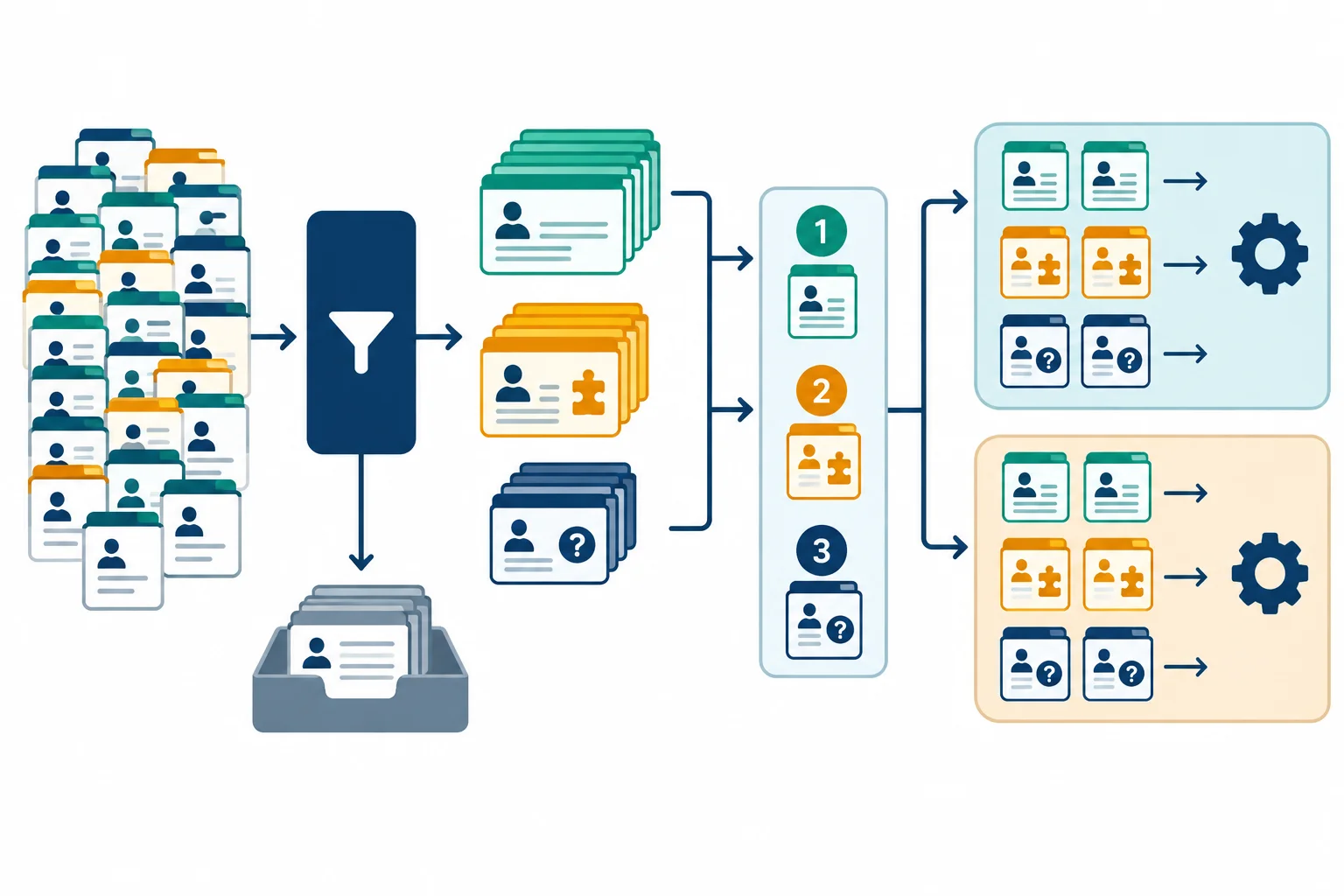
Planning estimate: select 40 unique cases from a defined eligible pool—24 straightforward cases, 12 multi-part cases, and 4 insufficient-information cases. Each selected case is assessed under both processes.
Check the planned mix against available workload records before calling it representative. Compare the category definitions and the planned proportions with the records, and document any mismatch. The fixed mix is a Planning estimate for this pilot, not an established description of Cedar's actual demand.
Use a repeatable selection rule within each category. Number the eligible cases after sorting them by a stable record identifier. Before either process is assessed, create and save a random ordering for each category. Select the first 24, 12, and 4 cases from those saved orderings. Keep the pool list, category decision, ordering, and selection date in the planning record.
If a selected record is later found objectively ineligible under the predeclared rules, retain its exclusion record and take the next unused record from that category's saved ordering. Do not replace a case because it was slow, required clarification, produced a weak draft, or was unfinished: those are outcomes to record, not reasons to improve the sample.
Use the same 40 unique cases under the current process and the AI-assisted process. Apply the same completed-case definition and the same evaluation rubric in both runs. This keeps the comparison focused on the process change rather than different cases or standards.
Repeated exposure can distort active handling time: a staff member may be faster on a familiar case regardless of the process used. Planning estimate: with 2 support staff, divide each task category across both staff members and counterbalance which process comes first. For example, distribute the 24 straightforward cases evenly between staff and have half begin with each process. Record staff member, category, process order, and case sequence.
Keep approved policy source material and tool configuration fixed where possible. Log relevant differences such as practice time, source version, access problems, or configuration changes. These records do not remove every difference, but they make possible distortions visible during review.
Example
Planned comparison procedure — not a result
Internal replay remains the delivery boundary: no reply is sent to a customer and no production process is changed.
Plan the evidence record before internal replay begins. Report outcomes by task category as well as for the full planned sample, because an overall average can conceal a category-specific difference.
Keep extra risk-focused challenge cases separate from the representative-workload summary. They can expose an edge case or boundary concern, but they do not belong in the workload mix unless they were selected through the same documented rule.
State limitations beside the results. A Planning estimate of 40 cases is a small sample; internal replay does not test live customer interaction; and unobserved conditions may differ from those in the future. These limitations qualify the evidence—they do not erase the records collected.
Use one shared record format so a later review can trace selection, comparison conditions, and outcomes.
| Evidence | What to capture | Responsible person | When |
|---|---|---|---|
| Eligible pool | Case identifier, category, eligibility decision, exclusion reason | Pilot contact | Before selection |
| Selection log | Saved category ordering, selected cases, documented replacements | Pilot contact | Before replay; when replaced |
| Paired process record | Case identifier, staff member, process, process order, sequence | Assigned support staff | During replay |
| Comparable outcome | Completion status, active handling time, rubric result, unfinished-work reason if applicable | Assigned reviewer | For each assessed case |
| Condition log | Practice time, source version, configuration, access issue, or other difference | Pilot contact | When a difference occurs |
| Challenge-case record | Risk-focused case and finding, reported outside workload summary | Assigned reviewer | If challenge cases are used |
| Attempt record | Model attempts recorded separately from completed cases | Assigned support staff | During AI-assisted replay |
For Cedar Office Supplies, write a concise measurement plan using the fixed Planning estimate of 40 unique cases and the stated task mix.
Use three labeled bullets:
Keep this at the planning stage. Do not claim that the pilot has run or that either process achieved a result.
Write at least 250 characters (0/250).

Step 4 of 8
Define measurable benefit, quality, recurring-capacity, and safety gates so faster output alone cannot establish pilot success.
A pilot must not pass because it is faster alone. Predeclare separate gates for benefits, quality, and safety. Each gate must pass independently; do not average them into one score.
For Cedar Office Supplies, the AI-assisted process is an existing assistant that drafts permitted routine returns-policy replies from approved policy documents for human review. The primary benefit gate tests whether active handling time is lower than in the observed current process. A second benefit gate checks whether recurring staff capacity is actually released after the full recurring AI-assisted effort is counted.
A fast result cannot compensate for weak first-pass quality, an observed safety-boundary breach, or negative recurring staff time released.
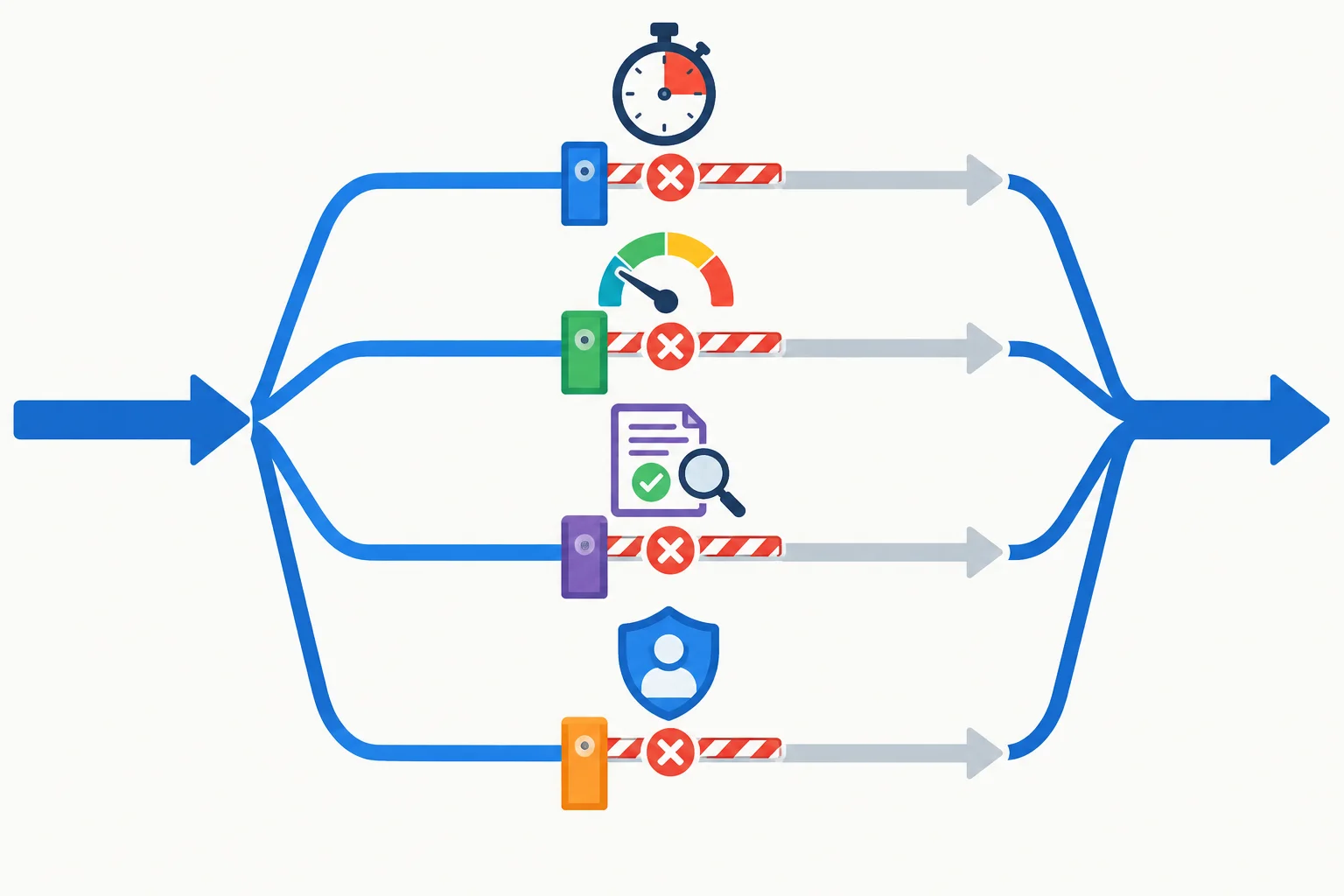
A pilot needs evidence for every independent gate; speed does not outweigh a failure elsewhere.
Specify each gate before results exist. State the observed quantity or numerator, denominator or comparison point, unit, evidence source, and threshold.
Use the observed current-process baseline, not an unverified estimate, for the handling-time comparison. Planning estimate: the current process takes 10 min/case and the AI-assisted process takes 7 min/case. These inputs help plan the pilot; they do not show that a gate has passed.
For recurring staff time released, compare equivalent recurring work at the same stated monthly volume. Its calculation will include AI-assisted handling and the separate recurring maintenance and support effort. The detailed Low, Expected, and High projections come later.
The same completed-case rules and evaluation rubric apply to the current process and AI-assisted process. Thresholds are requirements To measure, not results.
| Gate | Observed quantity or numerator | Denominator or comparison | Unit | Evidence source | Requirement |
|---|---|---|---|---|---|
| Handling-time benefit | Current mean active handling time minus AI-assisted mean | Observed current-process mean active handling time | % reduction | Timed records for completed cases | To measure: at least 20% lower |
| Recurring-capacity benefit | Current recurring staff effort minus total AI-assisted recurring staff effort | Equivalent stated monthly volume | staff-hours/month | Scenario assumptions and recorded effort | To measure: positive net recurring staff time released |
| First-pass quality | Eligible case runs whose first work product passes the rubric without correction | All eligible case runs for that process | % first-pass quality | Shared rubric records | To measure: at least 95% for AI-assisted process and no decline from current-process rate |
| Safety | Observed boundary breaches | Observed count; no rate denominator | count | Human-review and boundary log | To measure: 0 observed breaches |
First-pass quality asks whether the initial work product meets the shared rubric before a reviewer corrects it. The rubric checks factual correctness, support in approved policy documents, completeness, and an appropriate clarification or escalation when information is insufficient.
Use like-for-like denominators. For the AI-assisted process, the denominator is all eligible AI-assisted case runs, including a run where the first model attempt produces no usable output. A no-usable-output first attempt is a first-pass failure, even if a retry or manual fallback later produces a completed case.
For the current process, the denominator is all eligible current-process case runs. Its numerator is the initial current-process work products that pass the same rubric without correction. Compare the two rates; the AI-assisted rate must not decline from the observed current-process rate.
A completed case and a first-pass-quality pass answer different questions. Record both, rather than allowing later human work to hide an initially weak result.
| Record stage | What to record | Why it matters |
|---|---|---|
| AI-assisted first work product | Rubric pass or failure; no usable first model attempt is a failure | Measures initial AI-assisted quality |
| Current-process first work product | Same rubric pass or failure before correction | Creates a like-for-like no-decline comparison |
| Post-review outcome | Completed, clarified, escalated, or unfinished | Shows what happened after review, correction, retry, or fallback |
| Safety check | Any boundary breach and when it was identified | Protects non-negotiable limits |
Warning
Human review is required for every completed reply. The planned pilot uses only authorized, de-identified historical cases and approved policy documents in internal replay. No reply is sent to a customer.
To measure: 0 observed safety-boundary breaches is a required result for this sample. It does not prove that the process is risk-free beyond the cases and conditions observed. Any observed breach requires an immediate pause for review; a favorable handling-time result does not override that boundary.
Complete the metric specification and apply the independent-gate rule.
Benefit metric:
((observed current-process mean active handling time − observed AI-assisted mean active handling time) / ) × 100
Requirement: To measure — at least 20% lower

AI-assisted first-pass quality:
(first work products passing the rubric without correction / ) × 100

Current-process first-pass quality:
(first work products passing the same rubric without correction / ) × 100
Requirement: To measure — at least  for the AI-assisted process, with no decline from the observed current-process rate

Net recurring staff time released requirement: To measure —

A pilot is faster but has one observed safety-boundary breach.
Status: 
Step 5 of 8
Create a transparent inventory of pilot and operating effort, separating staff time from cash spending and avoiding hidden or duplicated work.
A complete inventory makes the pilot’s resource limits testable. It does not try to prove savings yet.
For every activity, record whether it is one-time or recurring; staff effort or cash outlay; fixed or volume-dependent; and included in the pilot ceiling, a routine-operation projection, or neither.
Include the work that can otherwise disappear: setup, training, both process replays, human review, corrections, retries, manual fallback, measurement, coordination, maintenance, and support. A missing activity can make an approach appear more efficient than it is.
For Cedar Office Supplies, the planned pilot assesses the same 40 unique cases under both the current process and the AI-assisted process. Both assessments consume pilot staff time.
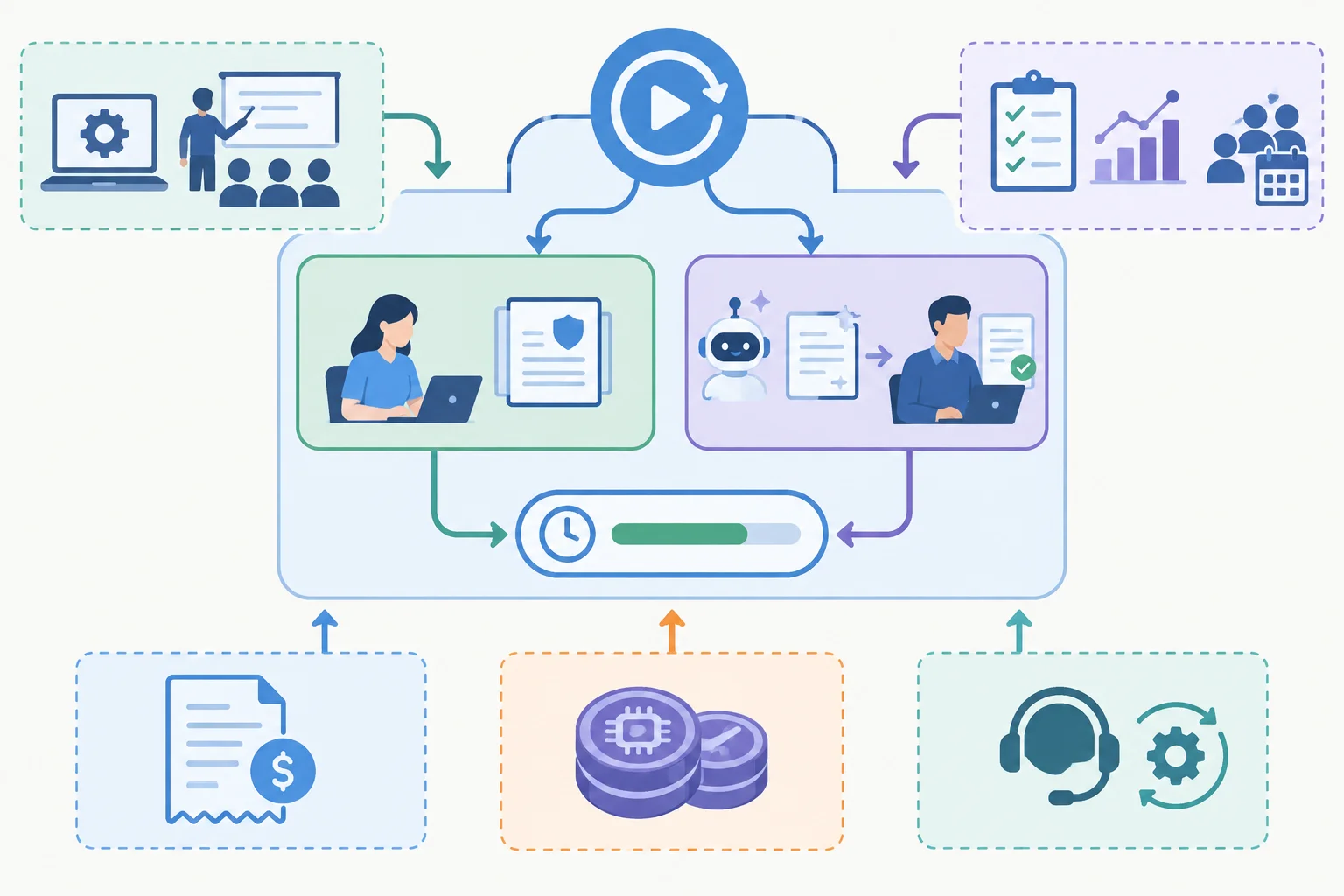
Count both process replays in the pilot; keep recurring routine operation separate.
Tip
Keep three boundaries separate:
The delivery boundary is unchanged: the planned work uses authorized, de-identified historical cases in internal replay. No replies are sent to customers.
Use a plain-language table so another reviewer can trace each total back to an activity and assumption. All numerical entries below are Planning estimates, not pilot findings.
Planning estimate for Cedar Office Supplies. “Included” identifies which ceiling receives the item; it does not make staff effort an additional cash payment.
| Activity | Timing | Quantity, rate, or unit price | Status | Ceiling treatment |
|---|---|---|---|---|
| Setup and training | One-time pilot work | 6 staff-hours | Planning estimate; staff effort | Include in 24 staff-hours |
| Current-process replay handling | Pilot work | 40 cases × 10 min/case = 6.67 staff-hours | Planning estimate; includes checking, corrections, and rework | Include in 24 staff-hours |
| AI-assisted replay handling | Pilot work | 40 cases × 7 min/case = 4.67 staff-hours | Planning estimate; includes preparation, review, corrections, retries, and manual fallback | Include in 24 staff-hours |
| Measurement and coordination | Pilot-only work | Estimate before launch | To measure or estimate; do not omit | Include in 24 staff-hours |
| Subscription for 2 users | Full monthly billing period | 2 × USD 15.00/user/month = USD 30.00 | Planning estimate; cash outlay | Include in USD 100.00 |
| Model usage | Pilot use | 48 model attempts × USD 0.05 = USD 2.40 | Planning estimate; retries and unsuccessful attempts count | Include in USD 100.00 |
| Maintenance and support | Recurring routine operation | 2 staff-hours/month | Planning estimate; staff effort outside pilot-only total | Project separately |
| Unchanged shared system | Existing operation | No incremental change identified | To identify for context | Record separately |
Example
Check the ceilings with the work already quantified. The two process replays must be counted separately because the same cases are assessed twice. However, each process’s full handling estimate should be counted only once.
Planning estimate — quantified pilot staff effort: 6 staff-hours for setup and training + 6.67 staff-hours for current-process replay + 4.67 staff-hours for AI-assisted replay = 17.33 staff-hours. This reserves at most 6.67 staff-hours within the 24 staff-hour ceiling for measurement and coordination.
Planning estimate — quantified pilot cash: USD 30.00 subscription + USD 2.40 model usage = USD 32.40. This leaves USD 67.60 within the USD 100.00 incremental cash ceiling. Confirm that planned measurement and coordination fit the reserved staff capacity before the pilot starts.
Avoid two common distortions.
Do not double count bundled handling work. The Planning estimate of 7 min/case for the AI-assisted process already includes preparation, human review, corrections, retries, and manual fallback. Name those activities so they remain visible, but do not add separate review or retry hours to that same per-case total.
Do not convert staff value into cash spending. At USD 30.00/staff-hour, the Planning estimate of 6 staff-hours for setup and training has a staff-effort value of USD 180.00. That value is useful for understanding effort, but it is not automatically an additional cash payment.
For a later comparison, retain the relevant current-process effort and identify costs shared by both processes. An unchanged shared cost is not an incremental AI cost.
Warning
A two-week pilot does not necessarily mean a half-month subscription. Cedar’s Planning estimate assumes a full monthly charge: 2 users × USD 15.00/user/month = USD 30.00. Confirm billing periods, authorized-user limits, and model-usage rules before treating access as free or prorated.
Match each inventory entry to its correct treatment.
Tap an item and then its matching pair.
Step 6 of 8
Estimate recurring staff effort and cash spending under Low, Expected, and High monthly demand scenarios, while distinguishing time released from cash savings that can actually be avoided.
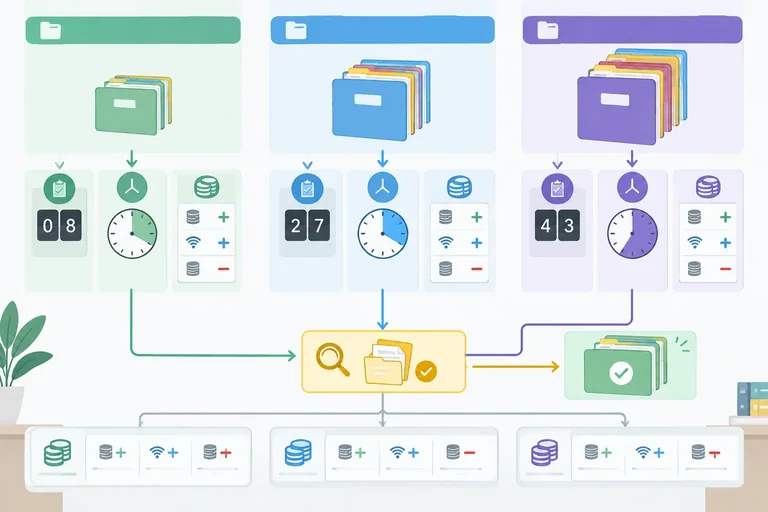
The planned internal replay remains bounded; these monthly scenarios do not enlarge its sample or produce pilot results. They are Planning estimates for recurring operation at three stated volumes.
Use Low, Expected, and High rather than one optimistic demand total. Each scenario assumes that every case is eventually a completed case, including a case completed through manual fallback. If later evidence shows unfinished work, report its count and completion rate separately. Do not make unresolved cases disappear from the operating picture.
A model attempt is not a completed case. Planning estimate: use 1.2 model attempts/case, including unsuccessful attempts and retries. Attempts determine billable usage; completed cases determine case-handling volume.
Planning estimate: 7 min/case for the AI-assisted process already includes preparation, human review, corrections, retries, and manual fallback. Do not add separate hours for those activities again. Planning estimate: the current process is 10 min/case.
All numerical values are Planning estimates.
| Scenario | Completed cases/month | Model attempts/case | Current process | AI-assisted process |
|---|---|---|---|---|
| Low | 100 | 1.2 | 10 min/case | 7 min/case |
| Expected | 300 | 1.2 | 10 min/case | 7 min/case |
| High | 600 | 1.2 | 10 min/case | 7 min/case |
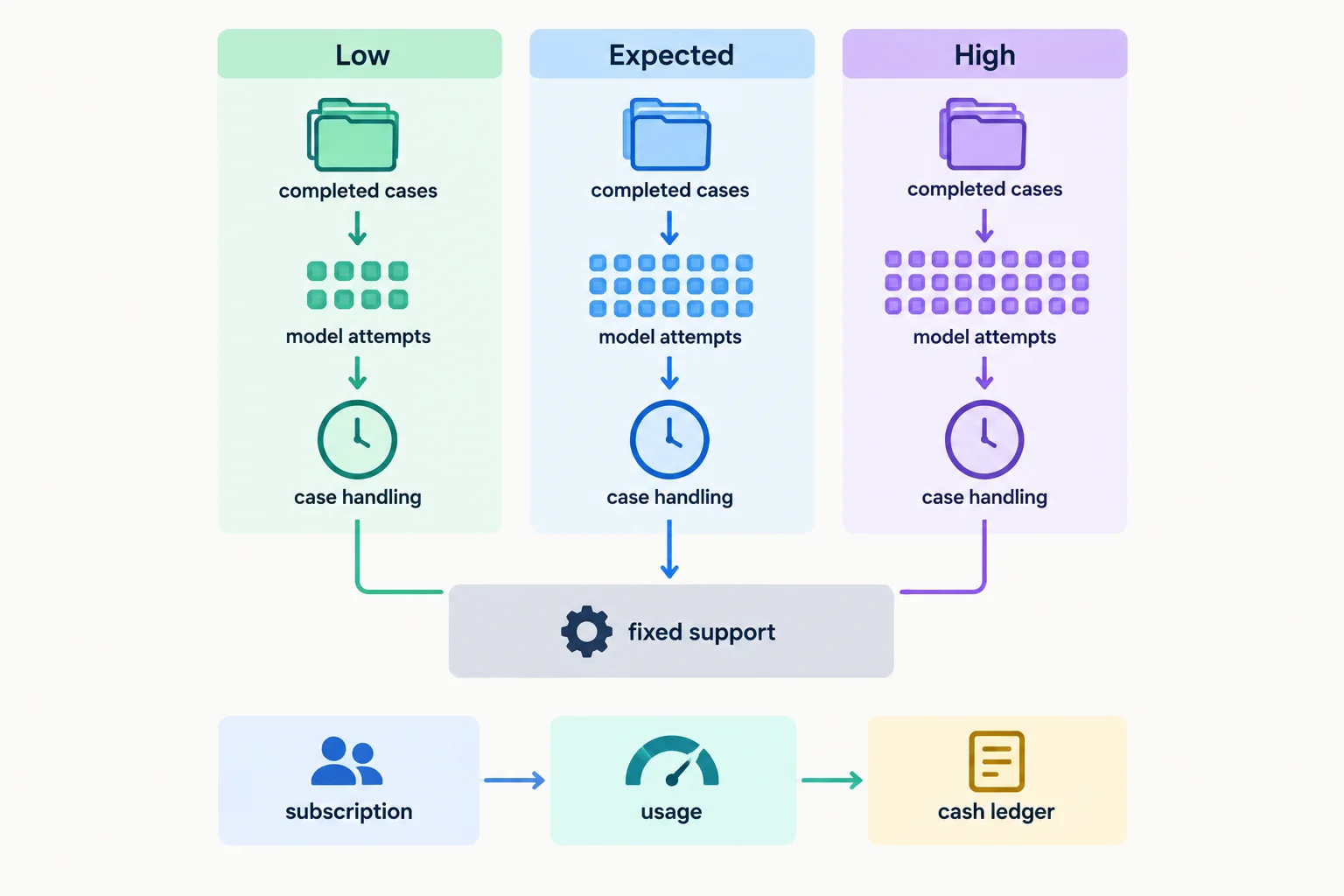
Completed cases drive handling effort. Model attempts drive usage charges. Fixed support is added once per month, not once per case.
Use the same calculation structure for each volume. Convert minutes to staff-hours by dividing by 60. Planning estimate: add 2 staff-hours/month for recurring maintenance and support after calculating AI-assisted case handling.
The recurring-capacity gate remains separate from the handling-time gate: To measure — net recurring staff time released must be positive. For each stated equivalent volume, calculate current-process staff effort minus total AI-assisted recurring staff effort. A positive Planning estimate is not evidence that the gate has passed; observed handling and support effort must later support it.
All formulas use Planning estimates. Display staff-hours to two decimal places when needed.
| Measure | Formula | Purpose |
|---|---|---|
| Paid model attempts | completed cases × 1.2 | Counts unsuccessful attempts and retries |
| Current-process staff effort | completed cases × 10 ÷ 60 | Comparable monthly handling effort |
| AI-assisted case handling | completed cases × 7 ÷ 60 | Includes review, corrections, retries, and fallback |
| AI-assisted total staff effort | AI-assisted case handling + 2 | Adds fixed maintenance and support |
| Net recurring staff time released | current-process effort − AI-assisted total | Required to be positive; reusable capacity |
| Recurring cash spending | USD 30.00 + (model attempts × USD 0.05) | Subscription plus billable usage |
All values are Planning estimates. The final column tests the direction of the recurring-capacity calculation only; it is not a measured gate result.
| Scenario | Model attempts/month | Current staff-hours/month | AI staff-hours/month | Time released | AI cash/month |
|---|---|---|---|---|---|
| Low | 120 | 16.67 | 13.67 | 3.00 staff-hours/month; positive projection | USD 36.00 |
| Expected | 360 | 50.00 | 37.00 | 13.00 staff-hours/month; positive projection | USD 48.00 |
| High | 720 | 100.00 | 72.00 | 28.00 staff-hours/month; positive projection | USD 66.00 |
Tip
Keep incomplete work visible. These scenarios assume eventual completion, including manual fallback. If that assumption fails in a later evaluation, report unresolved cases and completion rate beside the per-completed-case figures.
Avoid double counting: the 7 min/case Planning estimate already carries human review for every completed reply, corrections, retries, and manual fallback. Naming this work makes it visible; adding it again as separate case-handling time inflates the projection.
Planning estimate: setup and training require 6 staff-hours once. At the Planning estimate of USD 30.00/staff-hour, this has a staff-effort value of USD 180.00. It is not automatically an additional cash payment.
Show this one-time effect separately. For the first period in which setup occurs, subtract 6 staff-hours from recurring time released. This first-period view does not replace the required recurring gate, which concerns positive net recurring staff time released after routine recurring effort is counted.
All values are Planning estimates. “After setup” includes the one-time 6 staff-hours in that period.
| Scenario | Current effort | AI-assisted recurring effort | Recurring time released | Time released after setup |
|---|---|---|---|---|
| Low | 16.67 staff-hours/month | 13.67 staff-hours/month | 3.00 staff-hours/month | -3.00 staff-hours/month |
| Expected | 50.00 staff-hours/month | 37.00 staff-hours/month | 13.00 staff-hours/month | 7.00 staff-hours/month |
| High | 100.00 staff-hours/month | 72.00 staff-hours/month | 28.00 staff-hours/month | 22.00 staff-hours/month |
Warning
Hypothetical claim: “The Expected scenario releases 13.00 staff-hours/month, so Cedar saves USD 390.00/month.” This is unsupported merely because 13.00 × USD 30.00 equals USD 390.00.
Call 13.00 staff-hours/month time released: it is potential reusable capacity. Call something cash savings only when a credible expense can actually be avoided, such as documented reduced paid overtime. If no avoidable expenditure is identified, report recurring cash spending and time released separately.
Complete the selected cells. Use digits and two decimal places where the worksheet shows currency or rounded staff-hours.
Projection worksheet — all figures are Planning estimates

LOW — 100 completed cases/month
paid model attempts =
AI-assisted total staff effort = (100 × 7 ÷ 60) + 2 =  staff-hours/month

EXPECTED — 300 completed cases/month
paid model attempts =
recurring cash spending = USD 30.00 + (attempts × USD 0.05) = USD /month

HIGH — 600 completed cases/month
AI-assisted total staff effort = (600 × 7 ÷ 60) + 2 =  staff-hours/month

Cash savings conclusion when no avoidable cash expenditure is identified: 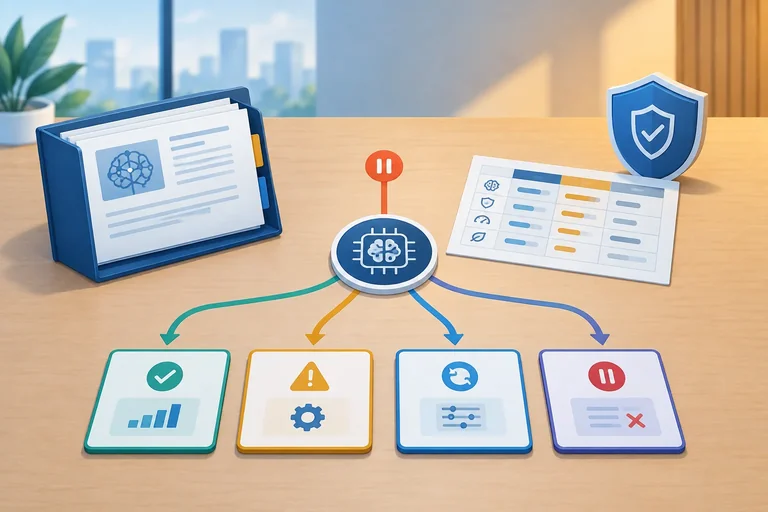
Step 7 of 8
Predeclare how Cedar Office Supplies will interpret pilot evidence so that safety gates, comparison limitations, and resource limits remain visible in the final review.
A review decision should be predeclared: write the evidence requirements before results exist. This prevents a promising-looking result from changing the definition of success after the fact.
For Cedar Office Supplies, the review compares the measured current process with the AI-assisted process against the declared benefit, quality, safety, and resource requirements. It does not authorize a rollout. It selects the appropriate next decision for this bounded pilot.
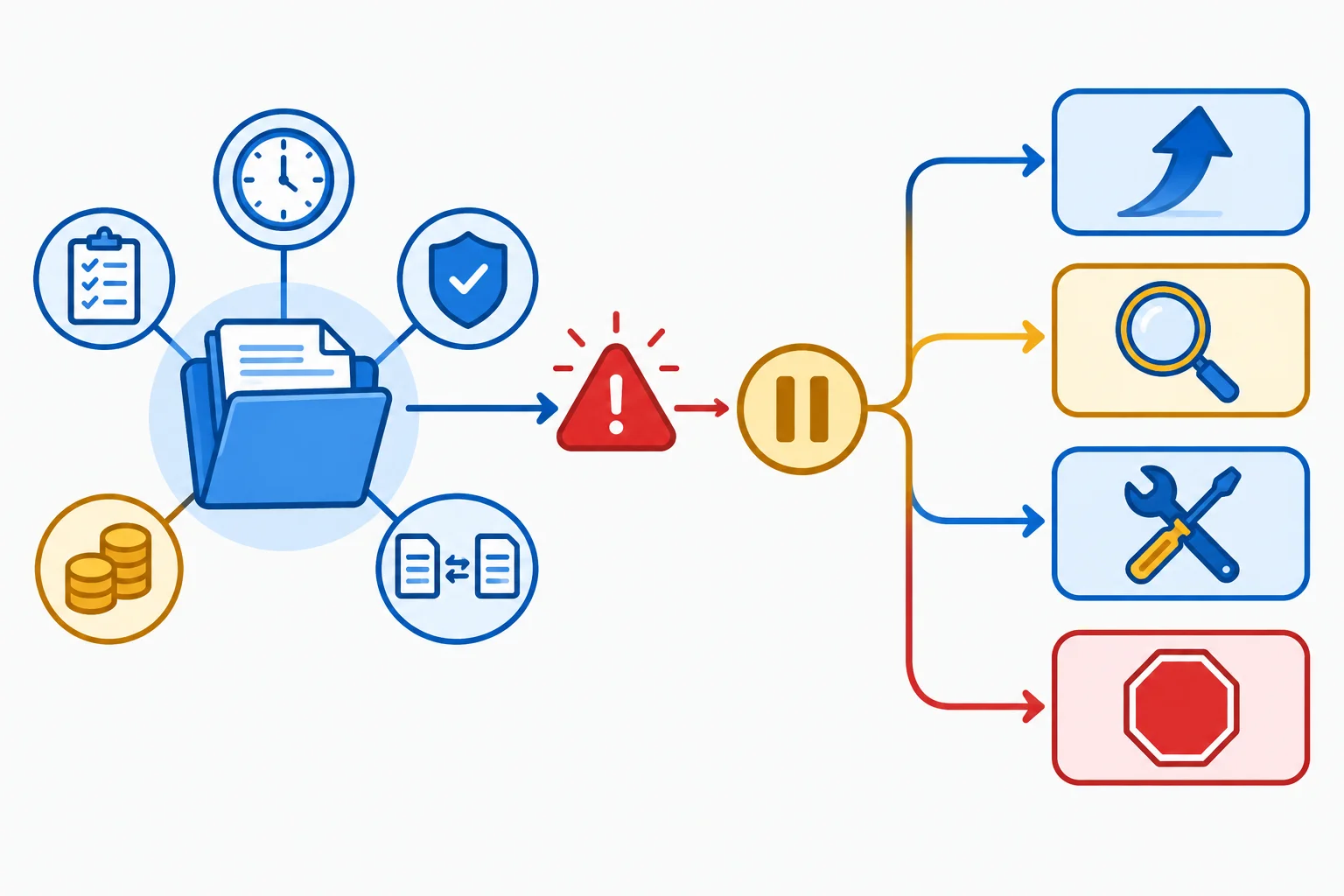
An immediate pause protects the pilot while evidence is reviewed. It is not one of the four review outcomes.
Tip
If an observed safety-boundary breach occurs, pause the pilot immediately for review. Do not continue merely to collect a larger sample. After the evidence is examined, the later review can determine whether the appropriate outcome is Revise or Stop.
Record the accountable pilot review contact and set a decision date before the pilot begins. For this example, the accountable contact is the Cedar Support Operations Lead.
Use exactly four review outcomes. A short review record should connect the selected outcome to baseline comparisons, gate results, resource use, limitations, and unresolved questions. This makes the reasoning inspectable rather than based on an overall impression.
Use these conditions before the pilot begins. They are decision rules, not predictions about what Cedar Office Supplies will observe.
| Outcome | Evidence basis | What the review record must state |
|---|---|---|
| Consider wider adoption | All required gates pass; resource use is acceptable; limitations do not undermine the bounded comparison | Baseline comparison; threshold results; staff effort and cash spending; limitations; unresolved questions |
| Investigate further | Evidence is insufficient, or comparison conditions are too unclear to interpret a result | Specific unanswered question; additional evidence needed; renewed bounded limit |
| Revise | A remediable weakness requires a changed approach before another evaluation | Weakness found; proposed change; reason a new bounded evaluation is needed |
| Stop | An unacceptable safety failure, infeasible resource demand, or no credible benefit is established | Failure evidence; resource implications; limitations; unresolved questions |
Tip
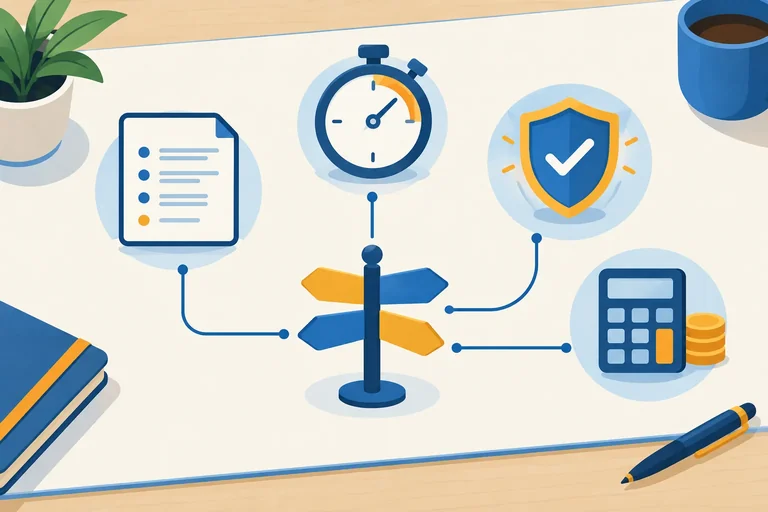
For Consider wider adoption, every independent gate must pass: To measure — at least 20% lower mean active handling time; positive net recurring staff time released; at least 95% first-pass quality with no decline from the current-process rate; and 0 observed safety-boundary breaches. Resource use must also remain acceptable.
Use time released for reusable staff capacity. Do not call it cash savings unless the evidence identifies spending that can actually be avoided.
During internal replay, an AI-assisted draft appears to handle an excluded account-specific request. Human review catches it before anything is sent externally. What must happen first?
Choose the required immediate action.
Hypothetical result — All 40 unique cases reached completed-case status under both processes. The measured current-process mean active handling time was 10 min/case; the AI-assisted mean was 7.5 min/case, a 25% reduction. First-pass quality was 38 of 40 (95%) for each process, and there were 0 observed safety-boundary breaches. Pilot resource use was 22.00 staff-hours and USD 32.40 in incremental cash spending.
For the Expected scenario of 300 completed cases/month, the observed handling means plus 2.00 staff-hours/month for maintenance and support project 50.00 current-process staff-hours/month and 39.50 AI-assisted staff-hours/month. This is 10.50 staff-hours/month of positive net recurring staff time released.
However, process order was not balanced: staff completed the current process first for every case and the AI-assisted process second. Repeated exposure could explain some or all of the time difference.
Name exactly one predeclared review outcome and justify it in 2–4 sentences. Address the safety evidence, the positive recurring time result, and why the comparison issue represents insufficient evidence or demonstrated failure.
Write at least 220 characters (0/220).
Step 8 of 8
Synthesize the Cedar Office Supplies pilot charter into a concise, internally consistent evidence-gathering plan, then check its claims and limits before any later pilot is run.
A complete pilot charter is a connected argument, not a list of attractive estimates. It links one bounded change to a fair comparison, independent gates, full resource accounting, and a predeclared review decision.
For Cedar Office Supplies, keep three kinds of statements visibly separate:
This distinction prevents a plan from presenting assumptions as results.
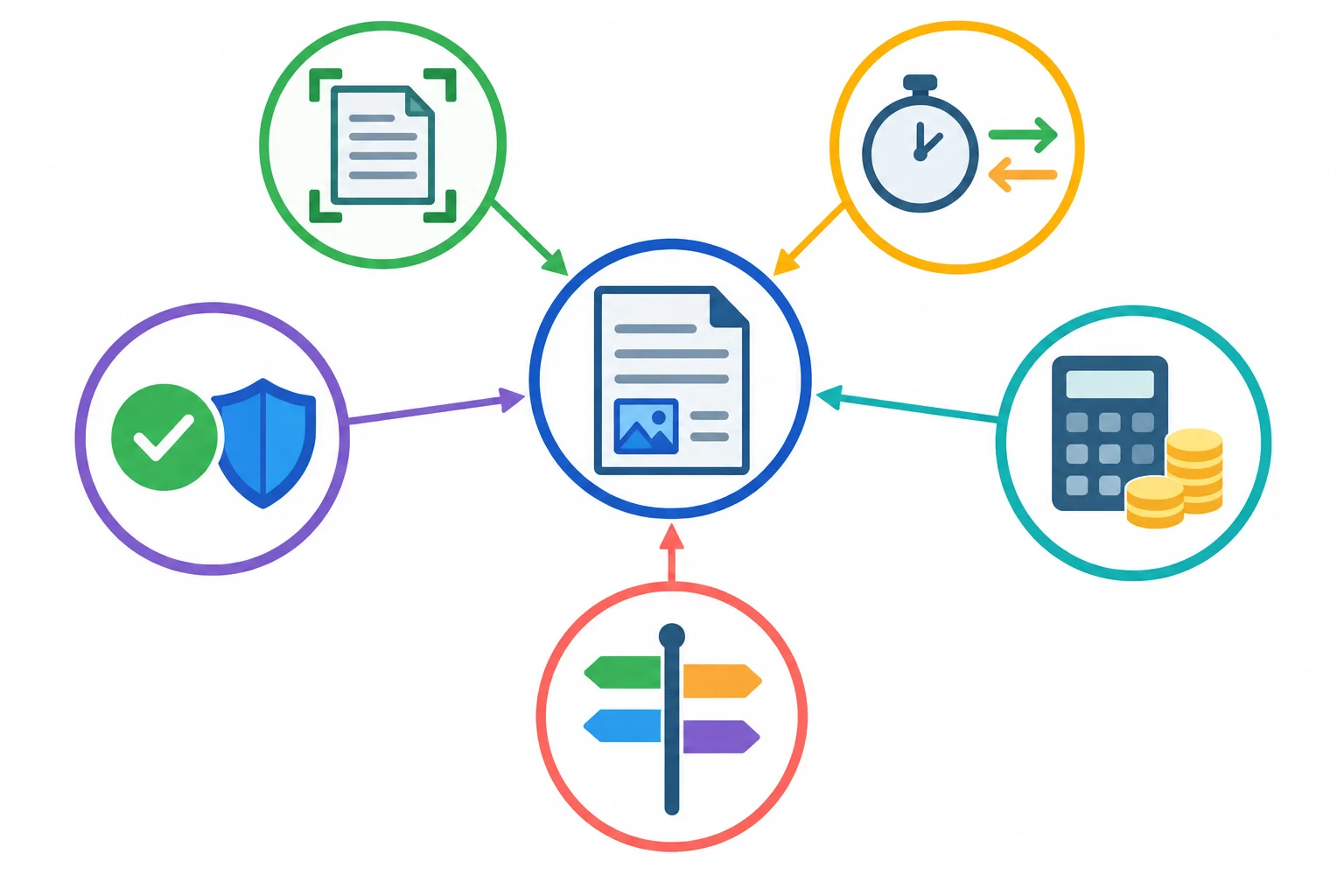
Use one coherent plan: boundaries determine the cases; the same completion rules support comparison; measured evidence is checked against gates; resource use and limitations inform the review decision.
Tip
A bounded plan does not claim that the assistant works, creates cash savings, or is ready for rollout. It states what a later evidence-gathering exercise could answer—and what it cannot answer outside its replay sample and stated conditions.
Before finalizing, test the internal links. The same definition of a completed case must apply to both processes; an appropriate clarification or escalation can count as completed. The AI-assisted active-time estimate already includes preparation, human review, corrections, retries, and manual fallback, so do not add those activities again.
Check that the proposed work fits the ceilings before the pilot begins. The figures below are planning calculations, not results. If measurement and coordination need more than the remaining staff time, reduce the scope or revise the ceiling before proceeding.
Each row is a pre-pilot check. Numerical requirements are marked To measure: they are predeclared requirements, not observed results.
| Check | Record or calculation | Planning conclusion | Status |
|---|---|---|---|
| Boundaries | 2 support staff; 2 weeks; internal replay only | No live customer messages or production changes | Planning estimate |
| Sample | 40 unique cases assessed under both processes | 24 straightforward; 12 multi-part; 4 insufficient-information | Planning estimate |
| Comparable completion | Same start and finish rules and evaluation rubric | Report completion rate alongside per-completed-case measures | To measure |
| Active handling | 40 × 10 min/case + 40 × 7 min/case = 680 min | 11.33 staff-hours across both comparisons | Planning estimate |
| Staff ceiling | 6 staff-hours setup/training + 11.33 staff-hours handling = 17.33 staff-hours | At most 6.67 staff-hours remain within 24 staff-hours | Planning estimate |
| Pilot cash | USD 30.00 subscription + 48 model attempts × USD 0.05 = USD 32.40 | Within the USD 100.00 incremental cash ceiling | Planning estimate |
| Handling-time gate | Mean active handling time at least 20% lower | Compare with the measured current-process baseline | To measure |
| Recurring-capacity gate | Net recurring staff time released is positive | Compare equivalent monthly volumes after maintenance and support | To measure |
| Quality and safety gates | At least 95% first-pass quality; no decline from baseline; human review; 0 observed breaches | Evaluate independently from speed and capacity | To measure |
| Review outcomes | Four predeclared outcome labels | Link each outcome to gates, costs, limitations, and unanswered questions | To measure |
The handling-time projection includes 2 staff-hours/month for recurring maintenance and support. Cash includes a full USD 30.00 monthly subscription for two users plus billable model attempts. A model attempt is not a completed case.
At the Planning estimate of USD 30.00/staff-hour, 6 setup and training hours have a USD 180.00 staff-effort value. That value is not automatically an additional cash expense, and released time is not automatically cash savings. The positive recurring-time gate must later be supported by measured handling and maintenance effort.
| Scenario | Cases/month | Current staff-hours/month | AI staff-hours/month | Net time released | AI cash/month |
|---|---|---|---|---|---|
| Low | 100 | 16.67 | 13.67 | 3.00 staff-hours/month | USD 36.00 |
| Expected | 300 | 50.00 | 37.00 | 13.00 staff-hours/month | USD 48.00 |
| High | 600 | 100.00 | 72.00 | 28.00 staff-hours/month | USD 66.00 |
Tip
The projected positive values above are Planning estimates, not proof of a benefit. In a later review, call these values time released only when observed current-process effort exceeds total observed AI-assisted recurring effort at the same volume. Call anything cash savings only when Cedar can credibly avoid an actual expense, such as paid overtime. A staff-hour value alone does not establish an avoided cash payment.
Now write the plan as a concise decision document. Use the supplied Cedar Office Supplies assumptions from the earlier screens; do not invent results.
Your draft must connect the hypothesis and boundaries to the baseline, paired comparison, independent gates, complete effort and cost inventory, and all four review outcomes. Finish by naming one uncertainty that requires evidence rather than assertion.
Write a concise plain-text pilot charter for Cedar Office Supplies. Include:
Mark assumptions as Planning estimate and future observations as To measure. State what the pilot can answer and one claim it cannot support.
Write at least 700 characters (0/700).
Summary
Congratulations! You completed: Designing a Bounded AI Pilot
Thousands of online courses in video, ebooks and audiobooks.
To test your knowledge during online courses
Generated directly from your cell phone's photo gallery and sent to your email

Download our app via QR Code or the links below:.


Carry knowledge in your pocket.
Download the Cursa app.
There are hundreds of free courses available, with a free certificate of completion that is saved in your mobile image gallery.
Download the app to access the Course Completion Certificate for Free.


+ 10 million
students

Free and Valid
Certificate

60 thousand free
exercises

4.8/5 rating in
app stores

Free courses in
video and ebooks