Step 1 of 8
Set the Requirements Before Comparing Tools
Define Cedar Office Supplies' technology-neutral comparison brief before evaluating any AI or non-AI option.

Learning path · Level 9 · Tutorial 2
Compare AI and non-AI delivery options for a shortlisted task and recommend an approach using explicit requirements, evidence, access constraints, pricing structures, and switching risks.
 Set the Requirements Before Comparing Tools
Define Cedar Office Supplies' technology-neutral comparison brief before evaluating any AI or non-AI option. 2 min
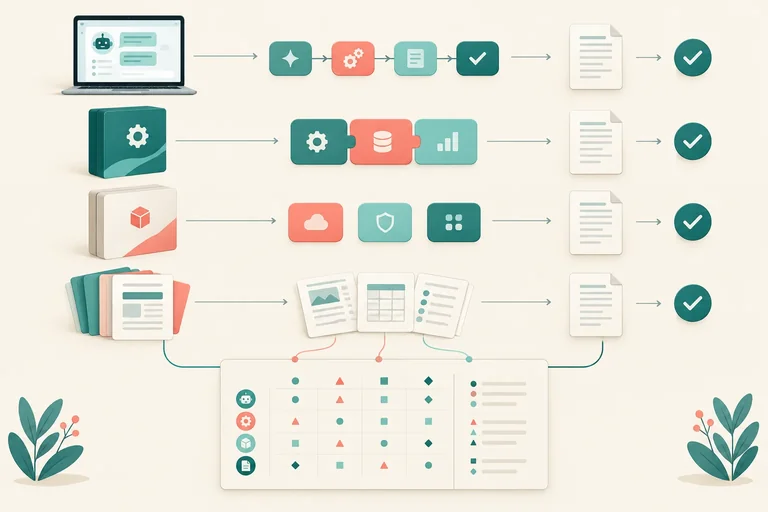
 Compare Four Ways to Deliver the Same Outcome
Compare four delivery approaches for the same policy-grounded reply task while preserving the common requirements and staff approval boundary. 2 min
 Separate Evidence from Claims
Classify observed behavior, documented commitments, unverified claims, and missing evidence while keeping each conclusion within its recorded scope. 3 min
 Check Team Access and Integration Fit
Identify team-access and integration dependencies that could prevent an otherwise capable option from meeting Cedar Office Supplies’ common brief. 2 min
 Read Pricing Without False Comparisons
Identify billing units, known subtotals, pricing dependencies, and unanswered pricing questions before comparing solution options. 2 min
 Look Beyond Export Buttons
Assess switching risk by checking which workflow artifacts can actually move, be reused, or must be rebuilt. 2 min
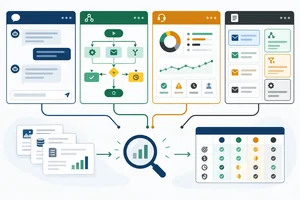 Build the Decision Matrix
Construct an evidence-linked matrix that exposes requirement failures, unresolved questions, and meaningful tradeoffs. 3 min
 Recommend an Approach and Explain the Tradeoffs
Synthesize Cedar Office Supplies’ completed decision matrix into an evidence-based recommendation that preserves unresolved limits and distinguishes further consideration from deployment approval. 3 min
Step 1 of 8
Define Cedar Office Supplies' technology-neutral comparison brief before evaluating any AI or non-AI option.
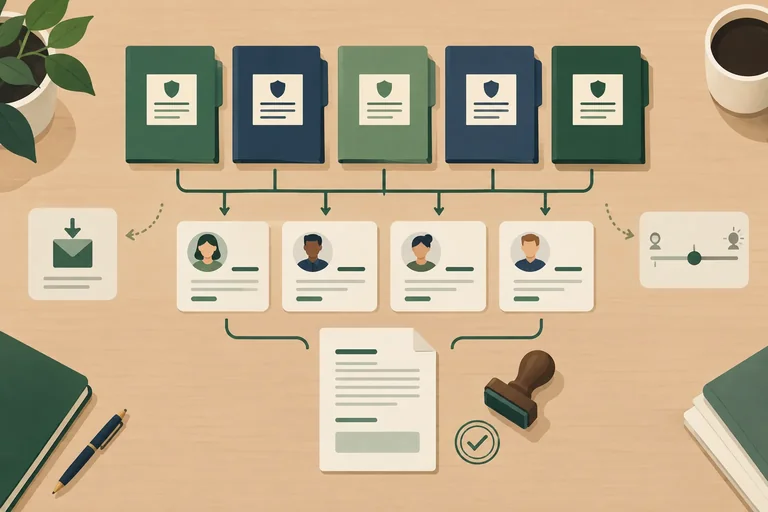
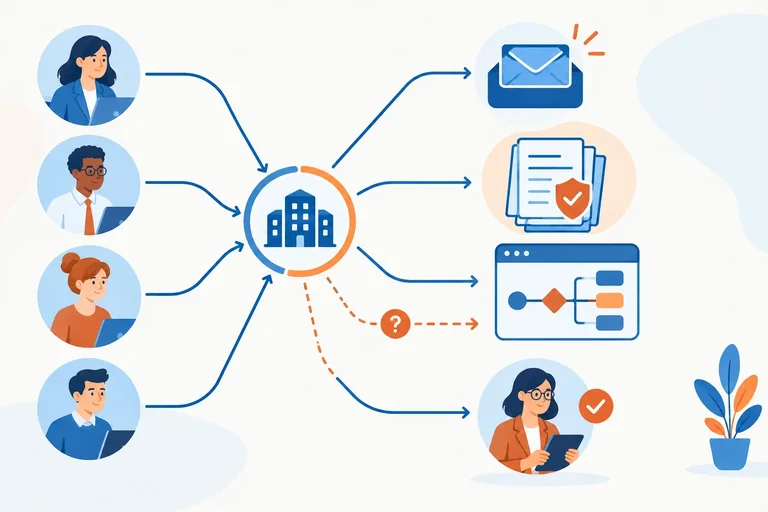
Before comparing tools, write one brief that every option must serve. Cedar Office Supplies needs draft replies to routine delivery and returns questions for 4 staff handling 400 inquiries/month.
Permitted input: the 5 approved policy documents, within the existing data-handling restrictions.
Required output: a draft reply that staff can review, approve, and copy as plain text before sending.
This is a task definition, not a tool choice. Each later option must be tested against this same outcome and boundary.
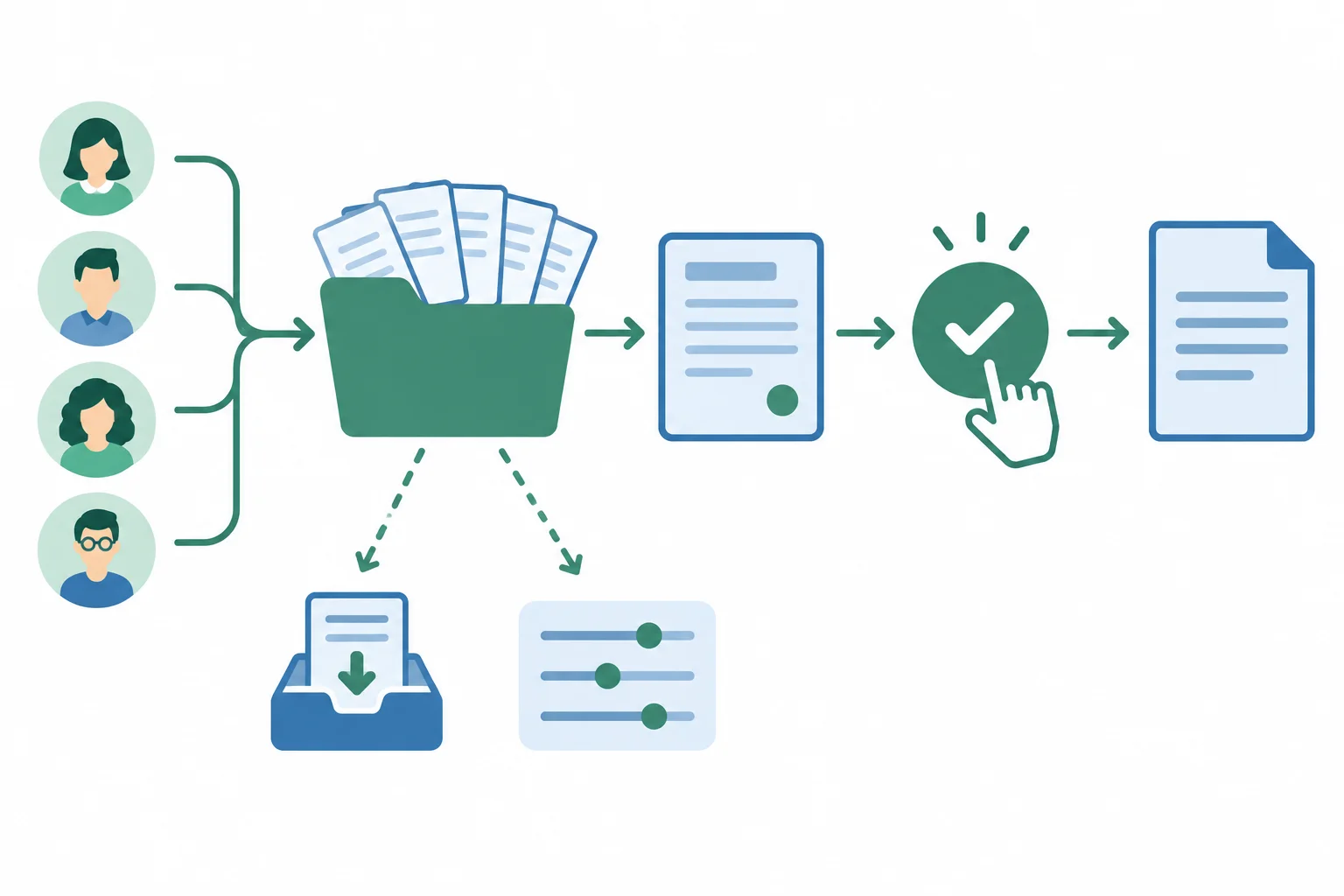
The central path is required for every candidate. The side branches are conveniences, not a new definition of the task.
Tip
Keep the required outcome and the human review boundary fixed. A tool may prepare a draft, but a staff member approves it before it is sent. Comparing different tools against different outcomes would make the comparison unfair.
A must-have requirement is an observable need that every acceptable approach must meet. An optional benefit would improve the process but is not required for the task to work.
Write requirements in technology-neutral language. Describe what people must be able to do and what the process must produce—not a preferred product, model, connector, or feature. A named feature can be considered later, but it must not redefine the task.
Use this common brief before looking at any product features.
| Need | Category | Technology-neutral wording |
|---|---|---|
| Individual access for 4 staff | Must-have requirement | Each staff member can use the process. |
| 5 approved policy documents | Must-have requirement | Drafts use the approved policies. |
| Unclear questions | Must-have requirement | Unclear questions are referred to staff. |
| Approval before sending | Must-have requirement | Staff approval is required before sending. |
| Plain-text transfer | Must-have requirement | Approved drafts can be copied as plain text. |
| Inbox transfer | Optional benefit | The process transfers an inquiry automatically. |
| Tone customization | Optional benefit | Staff can adjust the draft's tone. |
Example
Good requirement: “Staff can approve a policy-based draft before sending.”
Feature preference: “The process must use a named AI feature.”
The first can be checked across different approaches. The second prematurely picks a technology and may exclude a sufficient non-AI process.
Match each statement from Cedar's brief to its category.
Tap an item and then its matching pair.

Step 2 of 8
Compare four delivery approaches for the same policy-grounded reply task while preserving the common requirements and staff approval boundary.
The outcome is fixed: Cedar Office Supplies needs draft replies to routine delivery and returns questions using 5 approved policy documents. All 4 staff need individual access; unclear questions go to staff; staff approval is required before sending; and approved drafts must be copyable as plain text.
Compare a complete delivery approach, not an isolated feature. Every option needs a route from permitted policy material to draft preparation, human review, and usable output transfer. The tool or process may change, but the must-have requirement and approval boundary do not.
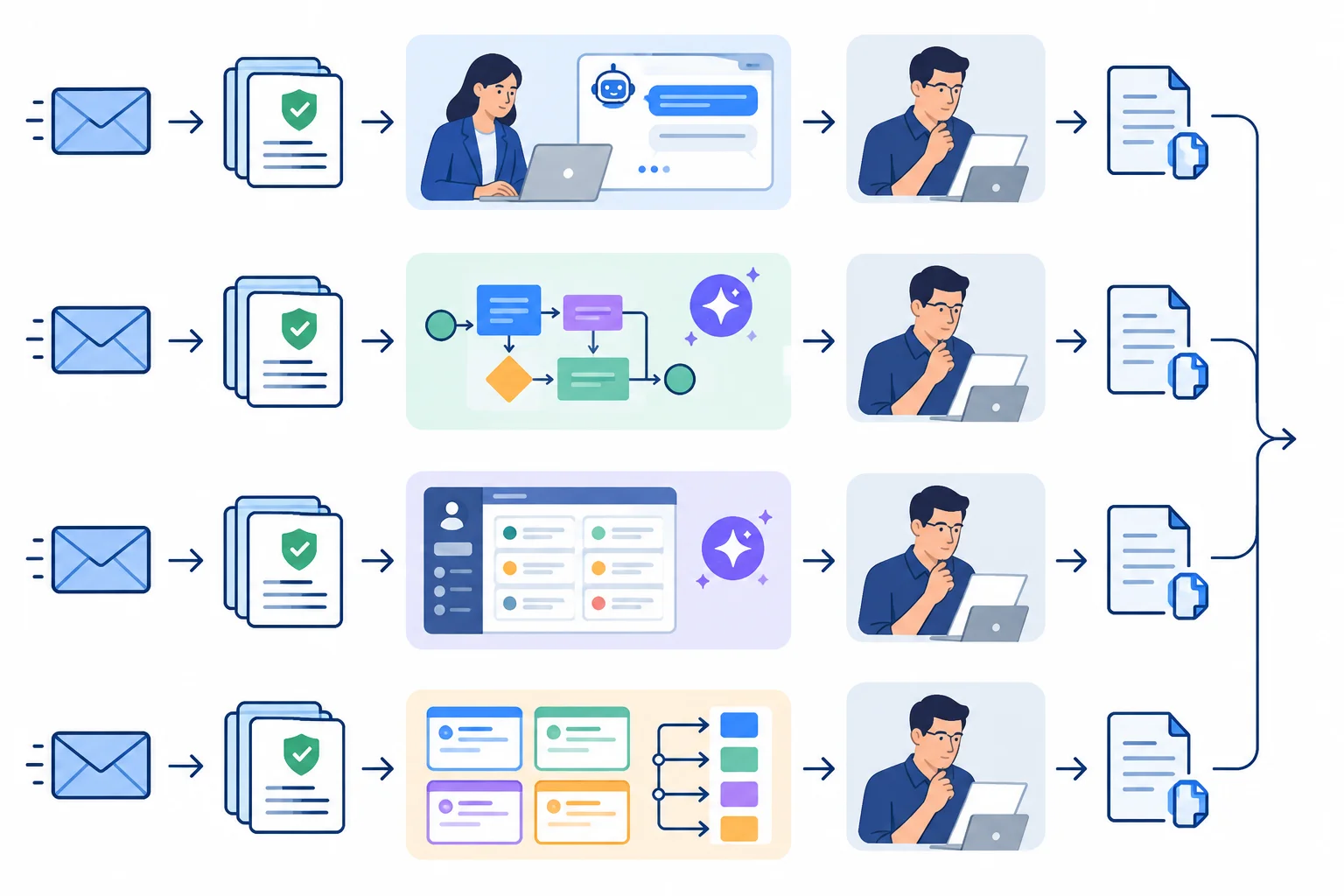
A — Existing assistant, B — No-code solution, C — Specialized vendor, and D — Non-AI alternative can differ in preparation method while retaining the same policy source, human review, and plain-text transfer boundary.
The following are four possible operating designs. They are not evidence that a particular product already provides every step. Later, you will test each design against evidence and constraints.
Each row includes the work around the drafting component—not just the component itself.
| Approach | Complete route |
|---|---|
| A — Existing assistant | Staff accesses permitted policy material, provides relevant context to the assistant, reviews the draft, and copies approved text. |
| B — No-code solution | A no-code workflow uses permitted policy inputs and an AI-enabled step to prepare a draft; staff reviews it and transfers approved text. |
| C — Specialized vendor | An AI-enabled support product uses an authorized policy source to prepare a draft; staff reviews it and transfers approved text. |
| D — Non-AI alternative | Staff uses shared approved reply templates and deterministic rules to prepare a draft; staff reviews it and copies approved text. |
Tip
“No-code” describes how a workflow may be assembled, and “specialized vendor” describes a product category. Neither label guarantees task capability, better results, or less human review.
D — Non-AI alternative is a real candidate, not a failure to modernize. It uses shared approved reply templates and deterministic rules rather than AI-generated wording.
It can be sufficient when routine inquiry patterns can be directed to an appropriate approved template without interpretation beyond the rules. It must still preserve the same boundaries: use approved policies, refer unclear questions to staff, require staff approval before sending, and allow plain-text copying.
Example
A fictional routine inquiry asks about returning an unopened item. A deterministic rule directs the staff member to the relevant approved return-reply template. The staff member fills in permitted case details, checks the draft against the approved policies, and approves or edits it before copying the text.
If the inquiry has an unclear exception or does not fit a rule, it is referred to staff rather than forced into a template.
Tip
Automation can change who prepares the first draft. It does not remove the need for human review when the task requires staff approval before sending.
Which conclusion is the fairest comparison for Cedar Office Supplies?

Step 3 of 8
Classify observed behavior, documented commitments, unverified claims, and missing evidence while keeping each conclusion within its recorded scope.
For Cedar Office Supplies, evidence must answer a specific question about preparing draft replies from 5 approved policy documents. Do not rank evidence labels from “best” to “worst.” Instead, ask what a source actually establishes.
A successful draft in one example supports a narrow task-capability observation. It does not establish reliability across varied inquiries, errors, exceptions, or staff correction needs.
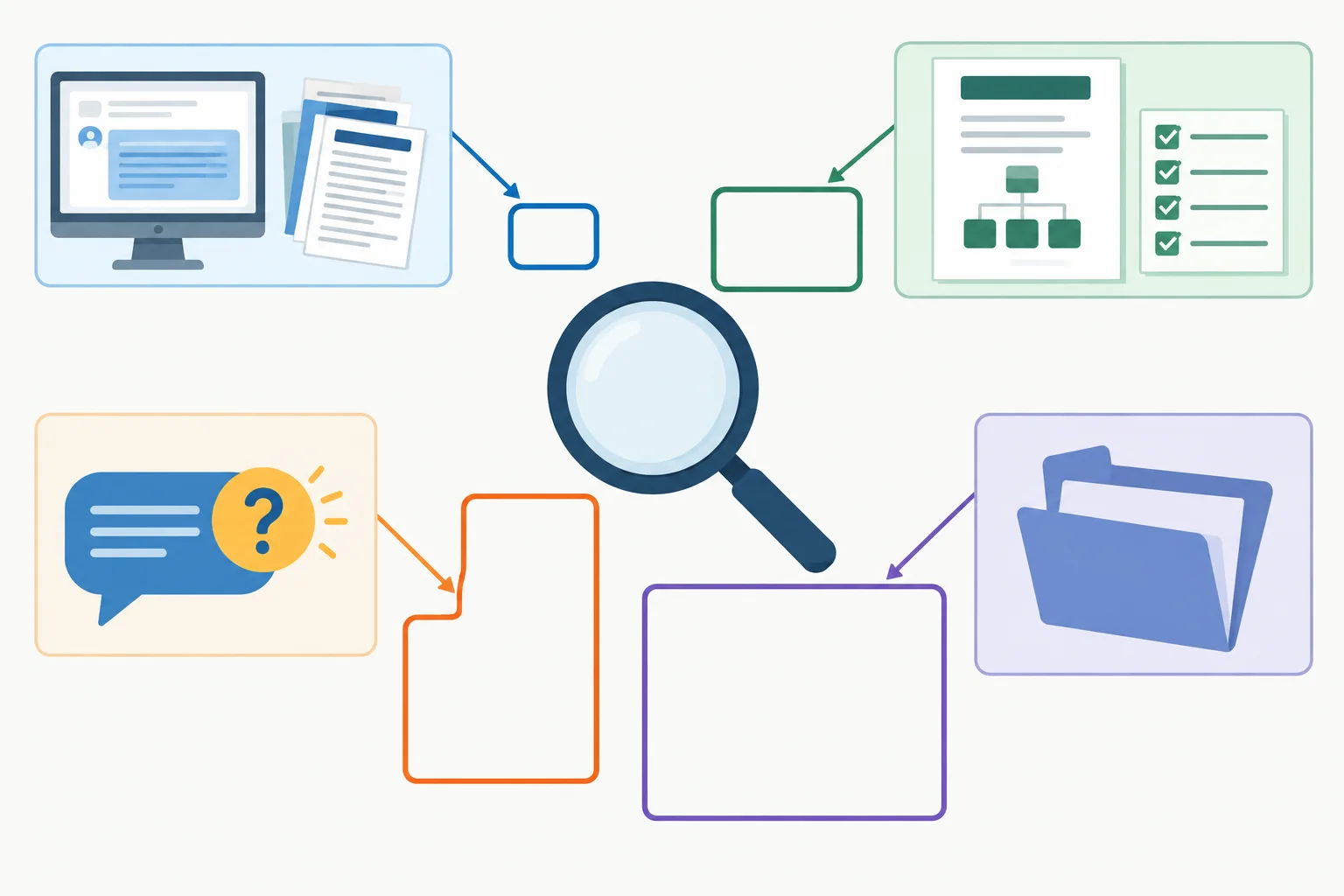
Classify the source, then state the limited conclusion it supports.
Tip
Record enough context for another person to check the claim later: Source, Date, Plan/version, and Scope. If a detail is not recorded, write that it is not recorded; do not silently fill the gap with an assumption.
This compact packet uses the same shortlisted task and approval boundary for all options. It is selection evidence only: none of these entries proves production reliability.
Each row preserves both the evidence category and its limit.
| Evidence label | Source | Date | Plan/version | Scope | What it establishes |
|---|---|---|---|---|---|
| Observed behavior | Internal task observation | 2026-03-01 | A workspace; version not recorded | One routine delivery inquiry using approved policies | A produced one draft; not consistency across inquiries |
| Observed behavior | Internal template walkthrough | 2026-03-01 | Existing office license; version not recorded | One routine return inquiry and one unclear-question referral | D followed its templates and deterministic rules in these examples |
| Documented commitment | B workflow plan page | 2026-03-01 | B Business plan | Individual accounts and approval-step configuration | B documents these workflow features; no observed Cedar task result |
| Documented commitment | C commercial terms | 2026-03-01 | C workspace plan | Stated user allowance and draft-reply allowance | C documents commercial terms; not task quality |
| Unverified claim | C sales presentation | 2026-03-01 | C workspace plan | Claim of accurate policy-grounded drafts; scenarios and results absent | A claim needing corroboration |
| Missing evidence | Evidence review log | 2026-03-01 | C workspace plan | Varied inquiry results, error patterns, and correction needs | Reliability and human review effort remain unresolved |
A documented statement that B has an approval-step configuration proves that B has already drafted Cedar’s routine inquiries accurately.
Match each fictional excerpt to the most accurate evidence category and scope conclusion.
Tap an item and then its matching pair.
Step 4 of 8
Identify team-access and integration dependencies that could prevent an otherwise capable option from meeting Cedar Office Supplies’ common brief.
For Cedar Office Supplies, Team access means more than proving that one person can open a tool. All 4 staff need permitted individual access to the features used in the process, the shared approved resources they need, and the review route.
Check these separately:
Keep the candidate configuration precise. For B — No-code solution, the candidate is B Workflow Pro. A personal trial can reveal a limitation of that trial, but it does not establish the status of B Workflow Pro. Existing data-handling restrictions remain binding at every handoff; this check applies them without reopening the full assessment.
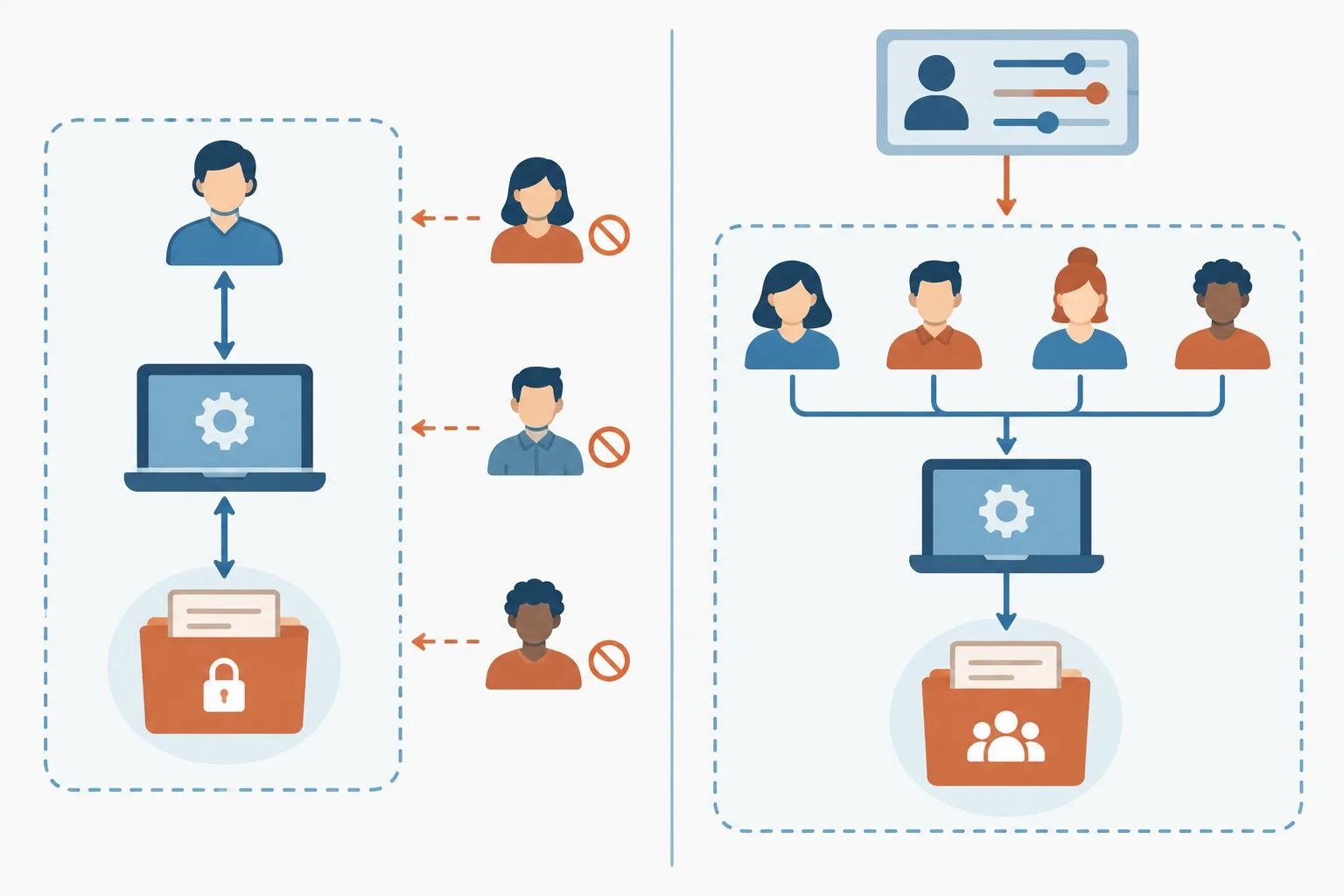
One personal account, shared resources, and team-level administration are different access questions. The brief requires permitted individual access for all 4 staff.
Tip
A paid-only administration feature or connector is an access dependency. It may be acceptable, but record it before treating the feature as available to the team.
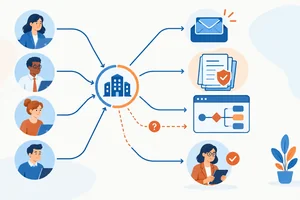
Map the whole delivery path, not only the candidate tool. Cedar’s path includes the inquiry inbox, the 5 approved policy documents, the candidate approach, staff approval, and a plain-text reply.
At each handoff, ask:
Automatic inbox transfer is an optional benefit. The must-have requirement is still met when staff can use a permitted manual route, unclear questions go to staff, staff approve before sending, and the approved draft is copyable as plain text.
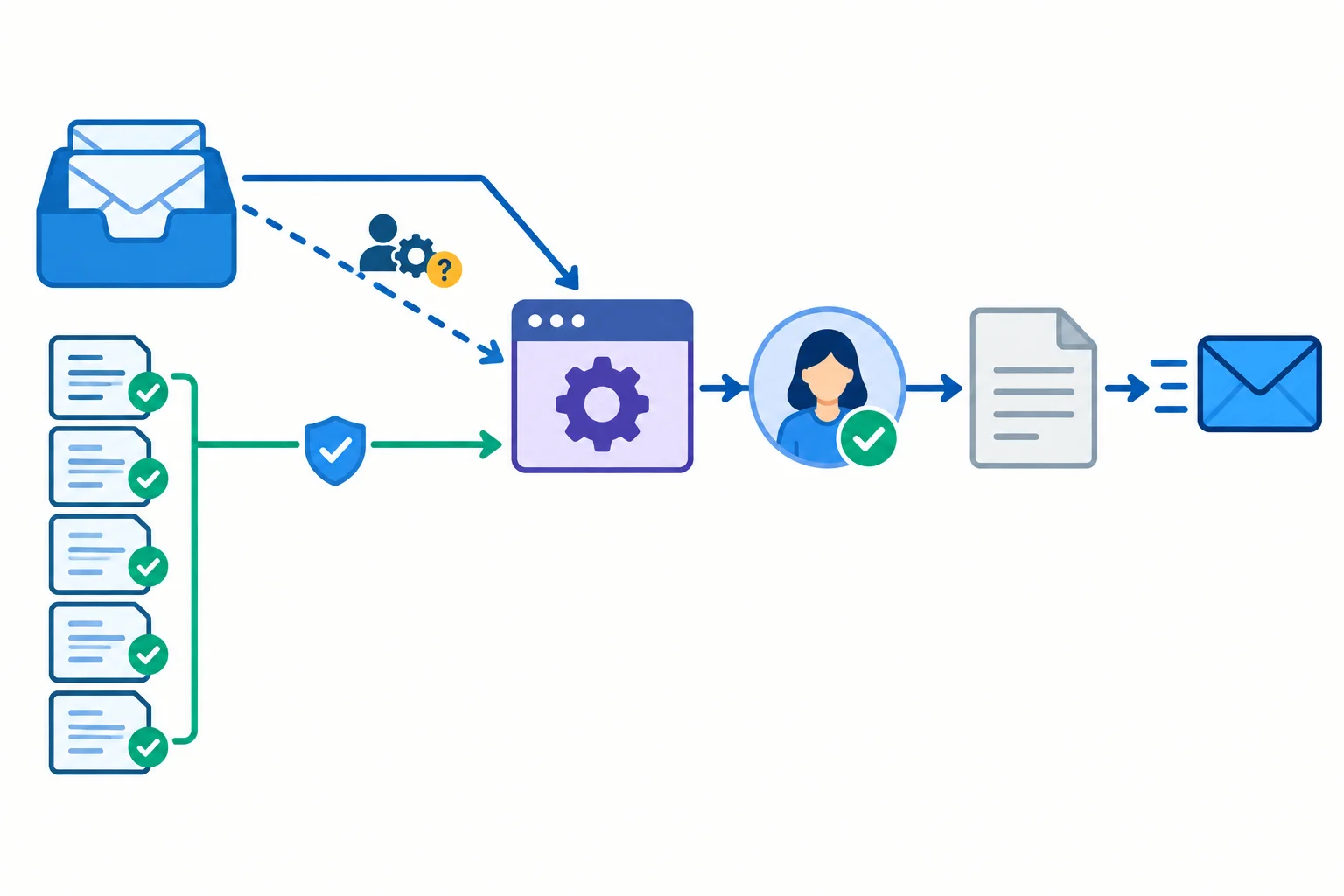
The solid route can use permitted manual transfer. The dashed inbox connector may reduce steps, but it is optional and can depend on plan, organization, or regional enablement.
Read access evidence at the stated plan/version and scope. In this selection snapshot, B Workflow Pro is the B candidate—the same configuration used in the decision matrix.
Meets means that the displayed selection evidence supports the stated requirement within its scope. It does not validate deployment or prove that every optional connector is available. This snapshot concerns access and handoffs, not detailed pricing or configuration work.
The core route allows manual transfer. The automatic inbox connector remains an optional benefit, even when its availability is unresolved.
| Criterion | Requirement | A | B | C | D |
|---|---|---|---|---|---|
| Team access | Individual access for 4 staff using permitted accounts | Meets — Documented commitment: A plan sheet; 2026-03-01; A Team; 4 individual accounts | Meets — Documented commitment: B workflow guide; 2026-03-01; B Workflow Pro; at least 4 permitted individual member accounts and member roles | Meets — Documented commitment: C service terms; 2026-03-01; C Team; up to 4 users | Meets — Documented commitment: D office record; 2026-03-01; existing office license; 4 staff accounts |
| Integration fit | Staff approval and plain-text output; inbox transfer optional | Meets — Observed behavior: A task check; 2026-03-01; A Team; staff hold and plain-text copy | Meets — Documented commitment: B workflow guide; 2026-03-01; B Workflow Pro; reviewer step and plain-text output; connector not recorded | Meets — Documented commitment: C service terms; 2026-03-01; C Team; reviewer queue and text copy | Meets — Documented commitment: D office record; 2026-03-01; existing office license; staff approval and manual plain-text copy |
Example
A configuration comparison note dated 2026-03-01 records Observed behavior for a different setup: a B personal trial allowed only its creator, and personal accounts could not hold the approved policies. That is a blocking access gap for that trial configuration.
It does not change the candidate status for B Workflow Pro. For B Workflow Pro, at least 4 permitted individual member accounts are a Documented commitment in the B workflow guide. Its automatic inbox connector is still Missing evidence for Cedar’s organization and region, but that connector is optional because the core route can use permitted manual transfer.
Using the plan-feature table and the handoff diagram, which conclusion correctly identifies the blocking access gap, the unresolved dependency, and the optional integration?

Step 5 of 8
Identify billing units, known subtotals, pricing dependencies, and unanswered pricing questions before comparing solution options.
A price is meaningful only with its billing unit. Cedar Office Supplies has 4 staff and handles 400 inquiries/month, but an inquiry is not automatically a user, a workflow run, or a draft reply.
Before comparing options, name what is billed: a seat, a workspace, a run, a draft-reply allowance, or a separate provider service. A quoted subscription is not the same as the complete operating cost.
Illustrative pricing, not current vendor offers.
| Option | Quoted pricing | Billing unit or allowance | Known limitation |
|---|---|---|---|
| A — Existing assistant | $20.00/user/month | Individual user | 4 users can produce a license subtotal |
| B — No-code solution | $30.00/workspace/month + $0.02/run | Workspace and runs | Separate AI-provider fees unspecified |
| C — Specialized vendor | $120.00/workspace/month | Up to 4 users and 500 draft replies | Overage pricing unspecified |
| D — Non-AI alternative | $0.00/month | Software subscriptions under existing office license | Staff effort is still required |
A simple license subtotal is valid only when both the price and quantity are known. For A — Existing assistant: 4 individual users × $20.00/user/month = $80.00/month.
That is a known subscription subtotal, not a complete operating-cost estimate. For B — No-code solution, the workspace fee is known, but the number of billable runs is not. The separate AI-provider fees are also unspecified. Do not assume 400 inquiries means 400 runs.
For C, 500 draft replies are an included allowance, not evidence that Cedar will create 500 billable replies. For D, $0.00/month in added subscriptions does not mean no staff work is needed.
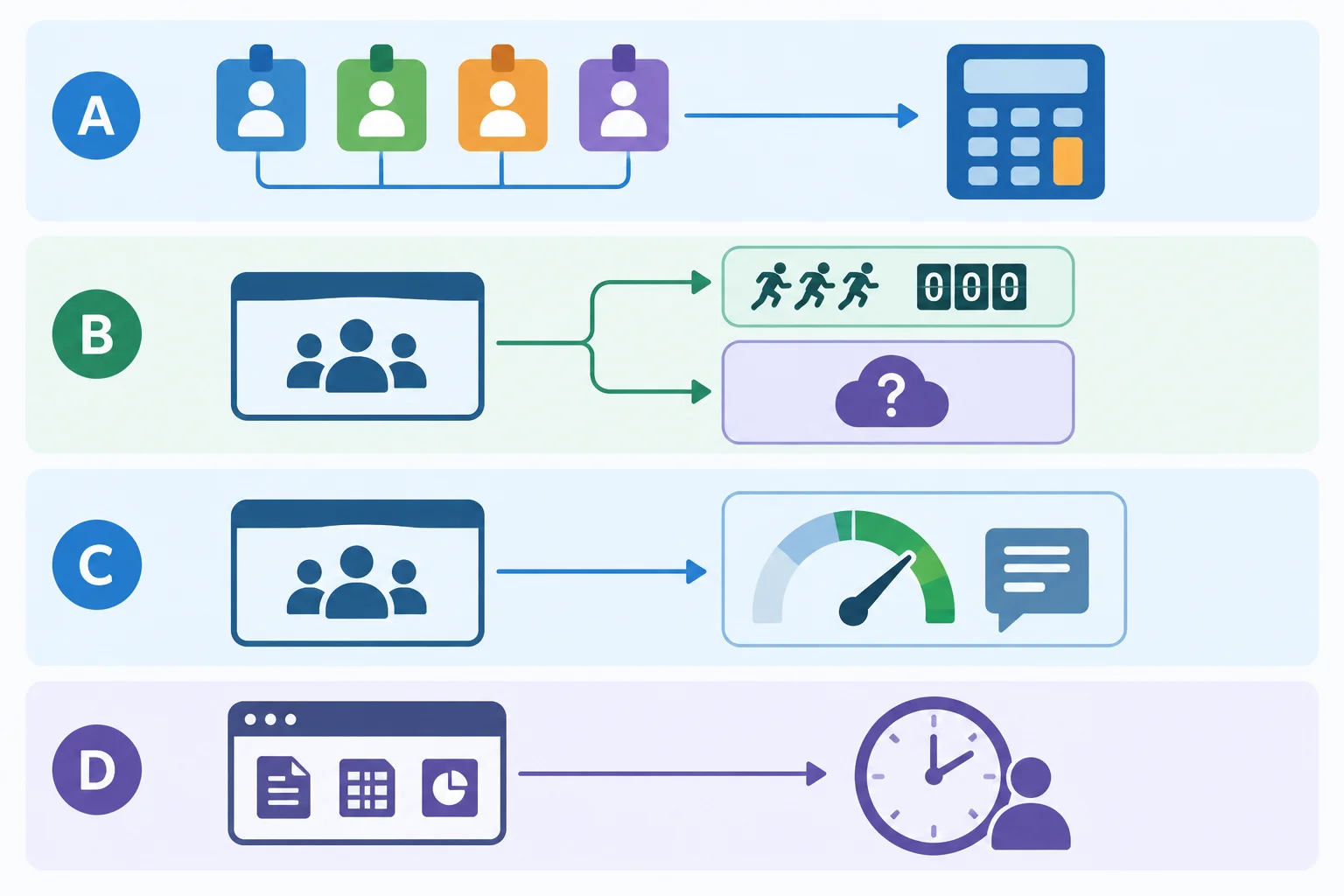
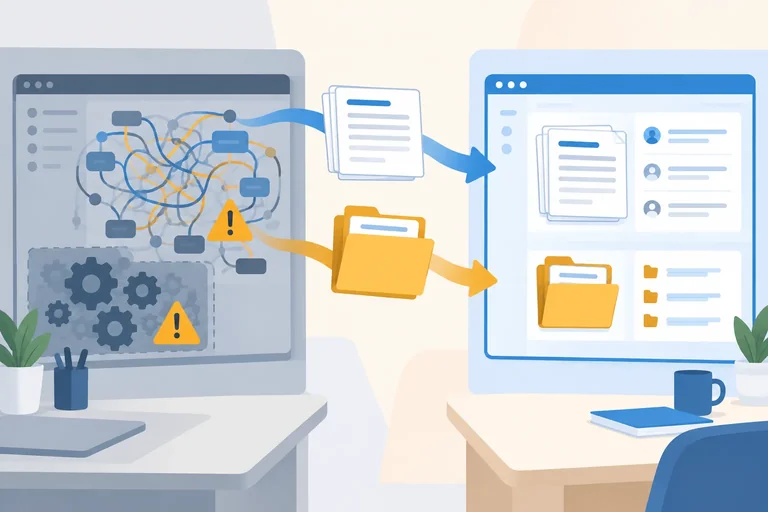
A dependency diagram reveals charges and unknowns that a single advertised price can hide.
Tip
Record unanswered questions rather than filling gaps with assumptions. For B, ask what event creates a billable run, whether retries create additional runs, and what the separate AI provider charges. For C, ask what happens above the included draft-reply allowance. These questions clarify pricing structure; they do not produce a complete operating-cost estimate.
Using only the illustrative pricing, which statement is correct?
Step 6 of 8
Assess switching risk by checking which workflow artifacts can actually move, be reused, or must be rebuilt.
A claim such as “export available” does not establish low switching risk. First ask: Which artifact can leave, in what format, and can the next approach use it?
For Cedar Office Supplies, approved reply text may be easy to copy as plain text. That is useful, but the working approach also depends on the 5 approved policy documents, reusable instructions or rules, workflow configuration, and possibly run history.
Portability is about preserving useful work—not merely producing a file. Greater dependence can be acceptable, but its benefit, limitation, and evidence should be explicit before commitment.
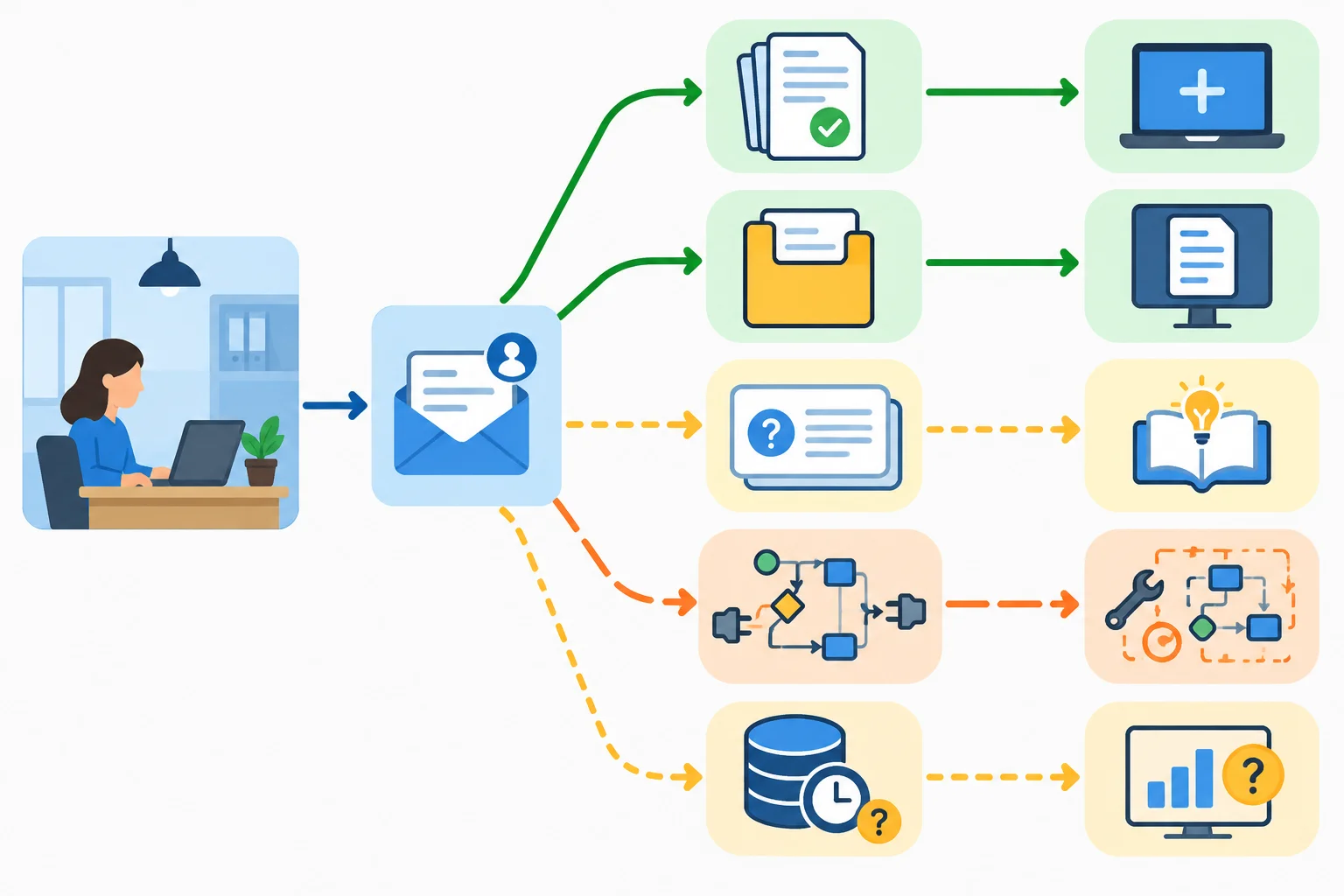
Check each artifact separately: direct transfer, rebuilding effort, or unresolved portability.
Use an artifact-by-artifact check. A file is portable only when the destination can meaningfully use it; a vendor-specific export may be readable but still require manual reconstruction.
Record a focused evidence request with its Source, Date, Plan/version, and Scope. If no answer or sample is available, label the point Missing evidence rather than assuming either success or failure.
Illustrative portability questions for Cedar Office Supplies
| Artifact | What to verify | Possible result |
|---|---|---|
| Approved draft replies | Can staff copy them as plain text? | May move directly |
| 5 approved policy documents | Can the next approach receive the current files? | May move directly |
| Reusable instructions or rules | Can they be exported in a usable form? | May need rewriting |
| Workflow configuration | Are steps and mappings visible outside the tool? | May need rebuilding |
| Run history | Can it be exported, and is it usable elsewhere? | May be unavailable or limited |
| Connector setup | Is it proprietary, plan-limited, or reusable? | May create switching effort |
Example
A product statement says, “Approved draft replies can be exported.” This supports only the export of approved reply text within the stated plan and scope. It does not show whether reusable instructions, workflow configuration, connector settings, or run history can move to another approach.
A focused request could be: “Please provide a sample export of the workflow configuration, identify its file format, and show whether its connector mappings can be reused outside this product.”
Until that request is answered for the relevant plan/version, those artifacts remain Missing evidence.
A tool exports approved draft replies as a CSV file. No information is provided about its reusable instructions, connector mappings, or workflow configuration.
Does the CSV export alone prove that the complete reply-preparation workflow is portable?
Does this export alone prove that the complete workflow is portable?
For Cedar Office Supplies, explain why exporting approved draft replies as plain text does not by itself prove that a reply-preparation workflow is portable. Then name one specific artifact or format that should be verified before commitment.
Write at least 80 characters (0/80).
Step 7 of 8
Construct an evidence-linked matrix that exposes requirement failures, unresolved questions, and meaningful tradeoffs.
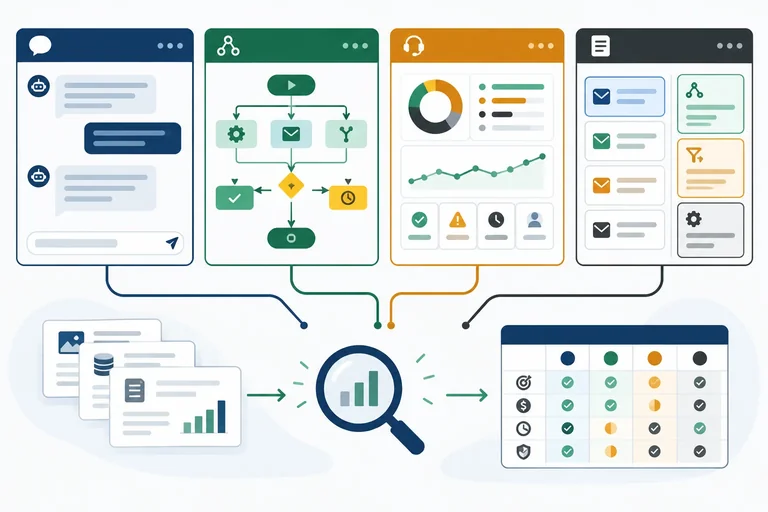
A decision matrix compares each approach against the same brief rather than turning unlike facts into one unexplained score. Use the fixed columns Criterion | Requirement | A | B | C | D and the same seven criteria for every option.
Each cell has a status and a short evidence note. Meets means the displayed selection evidence supports the stated requirement within its scope; it does not mean approved for deployment. Does not meet requires evidence of a confirmed failure. Unresolved means the evidence is incomplete, narrow, or does not establish the full requirement.
Keep the common must-have requirement set fixed: individual access for all 4 staff; use of the 5 approved policy documents; referral of unclear questions to staff; staff approval before sending; and approved drafts copyable as plain text. Automatic inbox transfer and tone customization are optional benefits.
A status is an evidence-linked judgment, not a product rating.
| Status | Meaning | What the note retains |
|---|---|---|
| Meets | The requirement is supported within the evidence scope | Source and relevant scope limit |
| Does not meet | A stated requirement is confirmed absent or fails | Failure evidence and source |
| Unresolved | The packet cannot support a full conclusion | Gap, narrow scope, or unsupported claim |
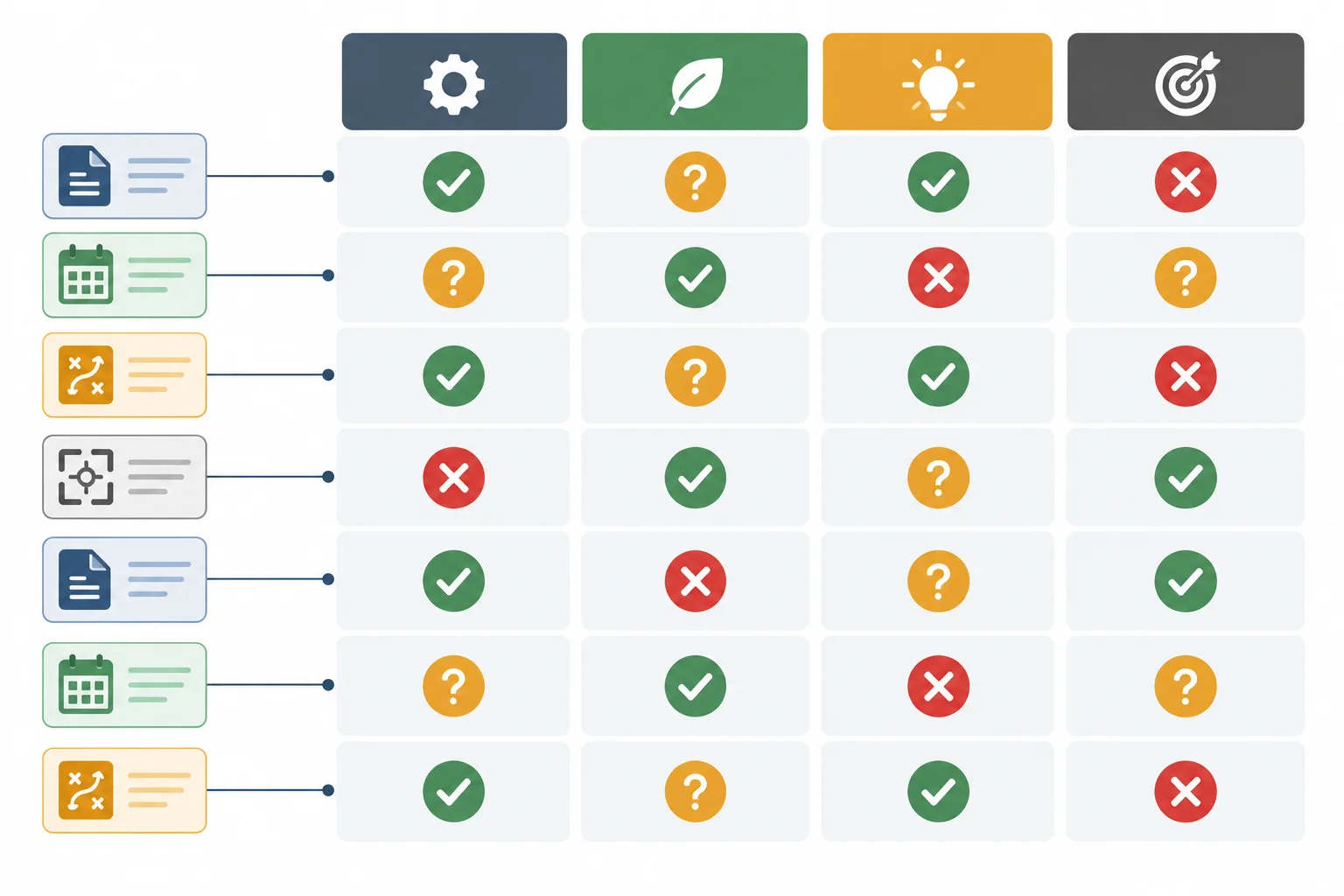
A matrix cell preserves both its judgment and the evidence limitation behind it.
Read the selection evidence before assigning a status. A limited observation can support a narrow behavior, but it cannot establish reliability across Cedar Office Supplies’ 400 inquiries/month. A documented feature can support an access or review commitment, but it does not substitute for an observed task result.
The candidate configurations are A Team, B Workflow Pro, C Team, and D under the existing office license. Prices below are Illustrative pricing, not current vendor offers. An inquiry, a run, and a draft reply are different billing units.
All entries are fictional selection evidence for Cedar Office Supplies.
| Evidence label | Source and Date | Plan/version | Scope |
|---|---|---|---|
| Observed behavior | A task check; 2026-03-01 | A Team | One routine delivery draft used approved policies; staff held and copied plain text; unclear-question referral not tested |
| Documented commitment | A plan sheet; 2026-03-01 | A Team | 4 individual accounts; $20.00/user/month |
| Documented commitment | B workflow guide; 2026-03-01 | B Workflow Pro | Policy-input configuration, reviewer step, plain-text output, and at least 4 permitted individual member accounts |
| Documented commitment | B pricing sheet; 2026-03-01 | B Workflow Pro | $30.00/workspace/month + $0.02/run; separate AI-provider fees unspecified |
| Documented commitment | C service terms; 2026-03-01 | C Team | Up to 4 users, reviewer queue, text copy, $120.00/workspace/month, and 500 draft replies |
| Unverified claim | C sales presentation; 2026-03-01 | C Team | Accurate policy-grounded delivery and returns drafts claimed; no scenarios or results supplied |
| Observed behavior | D template walkthrough; 2026-03-01 | Existing office license | One routine return used an approved-policy template; one unclear question was referred; staff approved and copied text |
| Documented commitment | D office record; 2026-03-01 | Existing office license | 4 staff accounts, shared templates, manual plain-text copy, and $0.00/month added subscriptions |
| Missing evidence | Selection review log; 2026-03-01 | All four candidate configurations | Varied-case results, error patterns, and correction needs |
| Missing evidence | Selection review log; 2026-03-01 | All four candidate configurations | Usable export formats or direct reuse evidence for instructions, rules, configuration, connectors, or history |
| Missing evidence | Selection review log; 2026-03-01 | C Team | Overage pricing after 500 draft replies is not recorded |
Tip
Do not fill gaps with assumptions. A requirement with two parts needs evidence for both. A’s task check supports one policy-grounded routine draft, but it does not test referral of an unclear question. If the matrix requirement includes both behaviors, that cell is Unresolved.
A documented commitment that B Workflow Pro provides at least 4 permitted individual member accounts supports its Team access requirement. However, that access evidence does not establish B’s task capability. An optional benefit cannot cancel either a confirmed must-have failure or an Unresolved must-have requirement.
Build the matrix in short sections. Keep performance, price structure, and portability separate: a stated subscription price is not evidence of task capability, and an export claim is not evidence of low switching risk.
For the pricing row, use this requirement: Material provider, usage, and overage charges are known. This does not require a total operating-cost estimate. It does require that material charge dependencies are known. Therefore, unspecified separate AI-provider fees or unspecified overage pricing leave the relevant cell Unresolved.
No candidate configuration in this packet has a confirmed must-have failure, so none of these model cells uses Does not meet. That does not make every option eligible: an Unresolved must-have requirement still needs clarification.
These rows model concise, traceable notes. The evidence packet supplies the full Source, Date, Plan/version, and Scope for each note.
| Criterion | Requirement | A | B | C | D |
|---|---|---|---|---|---|
| Task capability | Policy-grounded routine draft and unclear-question referral | Unresolved — A task check; referral not tested | Unresolved — B guide; no Cedar task result or referral evidence | Unresolved — C claim; task performance unverified | Meets — D walkthrough; routine template and unclear referral |
| Human review | Staff approval before sending | Meets — A task check; staff hold | Meets — B guide; reviewer step | Meets — C terms; reviewer queue | Meets — D walkthrough; staff approval |
| Team access | Individual access for all 4 staff | Meets — A plan sheet; 4 accounts | Meets — B guide; at least 4 permitted individual member accounts | Meets — C terms; up to 4 users | Meets — D office record; 4 accounts |
| Pricing dependencies | Material provider, usage, and overage charges are known | Meets — A plan sheet; $20.00/user/month | Unresolved — B pricing sheet; AI-provider fees unspecified | Unresolved — C terms; overage pricing unspecified | Meets — D office record; $0.00/month added subscriptions |
Create Cedar Office Supplies’ complete seven-row decision matrix using the evidence packet. Use these exact criterion labels: Task capability, Reliability evidence, Human review, Team access, Integration fit, Pricing dependencies, and Switching risk.
For each criterion, state the requirement and give A — Existing assistant, B — No-code solution, C — Specialized vendor, and D — Non-AI alternative a status plus a short source-based note. Use Meets, Does not meet, and Unresolved precisely.
Then add two concise conclusions:
Write at least 700 characters (0/700).

Step 8 of 8
Synthesize Cedar Office Supplies’ completed decision matrix into an evidence-based recommendation that preserves unresolved limits and distinguishes further consideration from deployment approval.
A matrix is a decision aid, not a contest for the most automated option. Start with the same must-have requirement set for every approach: 4 staff need individual access; drafts use the 5 approved policy documents; unclear questions are referred to staff; staff approve before sending; and approved drafts are copyable as plain text.
Then state a proportionate recommendation:
An optional benefit, such as automatic inbox transfer or tone customization, cannot cancel an Unresolved must-have requirement. A recommendation for further consideration is not approval to deploy. Existing data-handling restrictions remain binding.
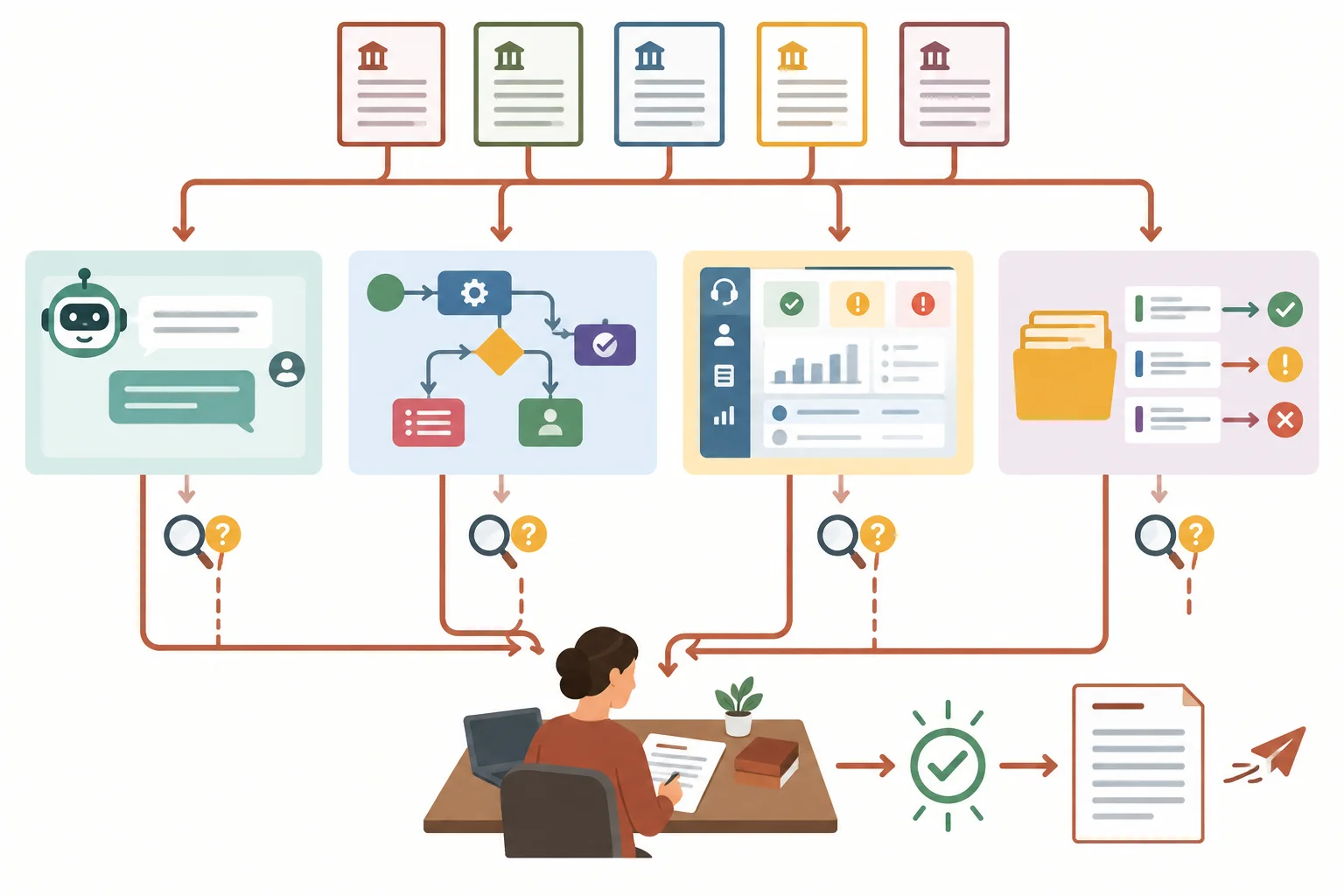
Compare benefits and limits against the same outcome. Evidence gaps remain visible instead of being replaced with assumptions.
Example
For all options, varied-case results, error patterns, correction needs, and usable reuse/export formats remain Missing evidence.
This recap preserves the completed matrix’s requirements, candidate configurations, and evidence-linked statuses. Meets means supported within the stated selection evidence; it does not establish deployment readiness. No new evidence is introduced here.
Selection-evidence recap for Cedar Office Supplies.
| Criterion | Requirement | A | B | C | D |
|---|---|---|---|---|---|
| Task capability | Policy-grounded routine draft and unclear-question referral | Unresolved — A task check; referral not tested | Unresolved — B guide; no task result or referral evidence | Unresolved — C claim; task performance unverified | Meets — D walkthrough; routine template and unclear referral |
| Reliability evidence | Evidence across varied cases, errors, and correction needs | Unresolved — selection review log; no varied-case evidence | Unresolved — selection review log; no observed task result | Unresolved — selection review log; claim is not reliability evidence | Unresolved — selection review log; no varied-case evidence |
| Human review | Staff approval before sending | Meets — A task check; staff hold | Meets — B workflow guide; reviewer step | Meets — C service terms; reviewer queue | Meets — D walkthrough; staff approval |
| Team access | Individual access for all 4 staff | Meets — A plan sheet; 4 accounts | Meets — B guide; at least 4 permitted individual member accounts | Meets — C terms; up to 4 users | Meets — D office record; 4 accounts |
| Integration fit | Staff approval and plain-text output; manual inbox transfer acceptable | Meets — A task check; hold and plain-text copy | Meets — B guide; reviewer step and plain-text output | Meets — C service terms; reviewer queue and text copy | Meets — D office record; approval and manual plain-text copy |
| Pricing dependencies | Material provider, usage, and overage charges are known | Meets — A plan sheet; $20.00/user/month | Unresolved — B pricing sheet; AI-provider fees unspecified | Unresolved — C terms; overage pricing unspecified | Meets — D office record; $0.00/month added subscriptions |
| Switching risk | Usable export or direct reuse evidence for working artifacts | Unresolved — selection review log; reuse evidence absent | Unresolved — selection review log; configuration reuse absent | Unresolved — selection review log; configuration reuse absent | Unresolved — selection review log; template/rule reuse unverified |
Tip
Do not turn the pricing row into a total-cost claim. A has a known license subtotal of $80.00/month for 4 users. B has a $30.00/workspace/month fee plus $0.02/run, while separate AI-provider fees are unspecified. C has $120.00/workspace/month for up to 4 users and 500 draft replies, while overage pricing is unspecified. D adds $0.00/month in software subscriptions under the existing office license.
An inquiry, a run, and a draft reply are different billing units. The 400 inquiries/month do not establish how many runs or draft replies will be billed.
A defensible current conclusion is to recommend D — Non-AI alternative for further consideration, not for deployment. D is the only option whose selection evidence currently supports the full task-capability requirement, including a routine approved-policy template and referral of an unclear question. It also meets the recorded human review, team access, integration-fit, and pricing-dependency requirements.
Its principal benefit is a straightforward process for routine delivery and returns questions using shared approved reply templates and deterministic rules. Its tradeoff is narrower handling of variation: staff may need to choose and adapt templates manually, and automatic inbox transfer and tone customization remain optional benefits.
Do not state that D has low switching risk. Its reusable template and rule formats remain Unresolved, as does its reliability across varied inquiries. The recommendation is proportionate because D is supported for this narrow task, while its important limits remain visible.
Example
A cautious alternative conclusion could be to delay commitment entirely, because reliability evidence and switching risk are Unresolved for every option. That conclusion is not anti-AI; it follows the evidence limits.
Before any commitment, make focused evidence requests:
These requests reduce uncertainty. They do not approve deployment or replace the existing data-handling restrictions.
A sound comparison sequence is: common requirements → evidence and limits → team access and integration fit → pricing dependencies → switching risk → proportionate recommendation.
| Check | Decision discipline |
|---|---|
| Common brief | Keep the same must-have requirement and human review boundary for A, B, C, and D. |
| Evidence | Use Observed behavior, Documented commitment, Unverified claim, and Missing evidence within their stated scope. |
| Access and cost | Keep individual access and pricing dependencies visible; inquiries, runs, and draft replies are different units. |
| Portability | An export claim does not settle switching risk for instructions, rules, configuration, connectors, or history. |
| Recommendation | A non-AI approach can be sufficient; further consideration is not approval to deploy. |
Using the matrix recap, write a short recommendation for Cedar Office Supplies in three labeled sections.
You may recommend the non-AI approach, an AI-enabled approach, or delay. Do not treat a recommendation for further consideration as approval to deploy.
Write at least 500 characters (0/500).
Congratulations! You completed: Comparing AI and Non-AI Solution Options
Thousands of online courses in video, ebooks and audiobooks.
To test your knowledge during online courses
Generated directly from your cell phone's photo gallery and sent to your email

Download our app via QR Code or the links below:.



Carry knowledge in your pocket.
Download the Cursa app.
There are hundreds of free courses available, with a free certificate of completion that is saved in your mobile image gallery.
Download the app to access the Course Completion Certificate for Free.

+ 10 million
students

Free and Valid
Certificate

60 thousand free
exercises

4.8/5 rating in
app stores

Free courses in
video and ebooks