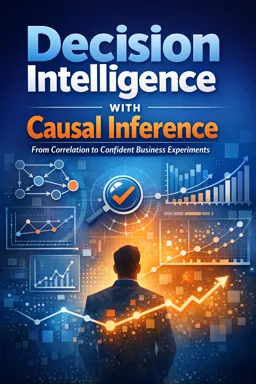


Free ebook on causal inference and decision intelligence for designing business experiments beyond correlation.
Free ebook + audiobook content
-

Decision Intelligence as Causal Thinking for Business Outcomes
+ Exercise: Which framing best reflects decision intelligence as causal thinking for business outcomes? 21 minutes
-
Counterfactuals, Confounders, and Selection Bias in Real Decisions
+ Exercise: Which analysis choice is most likely to introduce selection bias when estimating the effect of a retention email on churn? 20 minutes
-
Causal Diagrams and Identification Using DAGs and the Backdoor Criterion
+ Exercise: When estimating the total causal effect of a treatment T on an outcome Y using the backdoor criterion, which adjustment choice is most appropriate? 21 minutes
-
Defining Treatments, Outcomes, and Metrics That Match the Decision
+ Exercise: Which definition best avoids the pitfall of treating a post-treatment behavior as the treatment? 23 minutes
-
From Business Hypotheses to Testable Causal Questions
+ Exercise: Which rewrite best turns a business hypothesis into a testable causal question? 23 minutes


-
Randomized Controlled Trials and Practical A/B Testing Design
+ Exercise: Which choice best explains why eligibility rules in an A/B test should be based only on information available before assignment? 19 minutes
-
Common Experiment Pitfalls: Interference, Novelty Effects, and Logging Errors
+ Exercise: In an A/B test, the control group outcome increases as the local density of treated users increases. What is the most likely explanation? 21 minutes
-
Sample Size Intuition, Power, and Guardrail Metrics for Safe Rollouts
+ Exercise: In planning an online experiment, why might a team keep a small holdout control group during a staged rollout? 24 minutes
-
Estimating Treatment Effects and Understanding Uncertainty
+ Exercise: When users have multiple correlated observations (for example, many sessions per user), what is the main risk of treating each observation as independent when estimating uncertainty? 19 minutes
-
Heterogeneous Effects and Personalization with Uplift Modeling
+ Exercise: Which targeting strategy best reflects the goal of uplift modeling for personalization? 21 minutes
-
Matching and Propensity Scores for Observational Data Decisions
+ Exercise: Which situation is most likely to make propensity score matching produce an unstable or hard-to-interpret causal estimate? 21 minutes
-
Difference-in-Differences for Policy Changes, Pricing Shifts, and Operational Tweaks
+ Exercise: In a Difference-in-Differences (DiD) setup, what does the estimator primarily achieve? 21 minutes
-
Regression Discontinuity for Threshold-Based Rules and Eligibility Cutoffs
+ Exercise: In a fuzzy regression discontinuity design, what does the cutoff primarily provide for estimating the treatment effect near the threshold? 22 minutes
-
Instrumental Variables for Hidden Confounding and Imperfect Compliance
+ Exercise: In an encouragement design with imperfect compliance, why is the IV estimate typically interpreted as a Local Average Treatment Effect (LATE)? 20 minutes
-
Choosing the Right Causal Approach with a Step-by-Step Workflow
+ Exercise: Why does the workflow recommend writing the decision memo before choosing a causal method? 20 minutes
-
Hands-On Python Workflows with pandas and statsmodels
+ Exercise: In a reproducible statsmodels workflow, why should missing values be handled explicitly before fitting a model? 23 minutes
-
Interpreting Results Without P-Hacking and With Clear Stakeholder Narratives
+ Exercise: Which practice best reduces the risk of p-hacking while still allowing useful learning from an experiment? 20 minutes
-
Ethical Causal Inference: Fairness, Privacy, and Unintended Consequences
+ Exercise: Which practice best reflects ethical causal inference when evaluating a new policy? 20 minutes
-
Case Studies: Marketing Campaigns, Product Features, Pricing, and Process Changes
+ Exercise: In a staged rollout of a new B2B feature, which effect estimate is most relevant for deciding whether to ship the feature to 100% of accounts? 20 minutes
-
Reusable Checklists and Templates for Experiment Design and Communication
+ Exercise: Which template design choice best prevents later confusion about who made key experiment decisions and when? 22 minutes
About the free ebook with audio
Decision Intelligence with Causal Inference: From Correlation to Confident Business Experiments
This free ebook helps entrepreneurs, product teams, marketers, and analysts make stronger business decisions by asking a crucial question: what caused the outcome? Rather than treating correlation as proof, it explains how causal inference turns evidence into practical, defensible action.
Make decisions with evidence that fits the question
Learn to frame business hypotheses around treatments, outcomes, and decision-ready metrics. The ebook clarifies counterfactual thinking, confounders, selection bias, causal diagrams, and the backdoor criterion so you can identify when data supports a causal claim—and when it does not.
Design experiments that produce reliable results
Explore randomized controlled trials and A/B testing for product changes, campaigns, pricing, and operations. Practical guidance covers sample-size intuition, statistical power, guardrail metrics, treatment-effect estimates, uncertainty, novelty effects, interference, and data-logging errors.
Use causal methods beyond A/B tests
When randomization is unavailable, discover how matching, propensity scores, difference-in-differences, regression discontinuity, and instrumental variables can support observational-data decisions. You will also examine heterogeneous effects and uplift modeling to understand which audiences benefit most from an intervention.
Communicate results responsibly
Use Python workflows with pandas and statsmodels to organize analysis, then translate findings into clear stakeholder narratives without p-hacking or overstating certainty. The ebook also addresses fairness, privacy, unintended consequences, and reusable templates for planning, evaluating, and communicating experiments.
Built for business application
- Connect causal questions to business outcomes.
- Choose an appropriate method for the available evidence.
- Interpret uncertainty and protect against harmful rollouts.
- Apply lessons to marketing, product, pricing, and process decisions.
How does causal inference improve business decisions?
It helps distinguish true intervention effects from misleading correlations, bias, and outside influences.
What business problems can A/B testing address?
It can evaluate marketing campaigns, product features, pricing changes, and operational improvements.
Which causal methods work when an experiment cannot be randomized?
The ebook covers matching, propensity scores, difference-in-differences, regression discontinuity, and instrumental variables.
This ebook/audiobook includes:

7 hours and 14 minutes of audio content

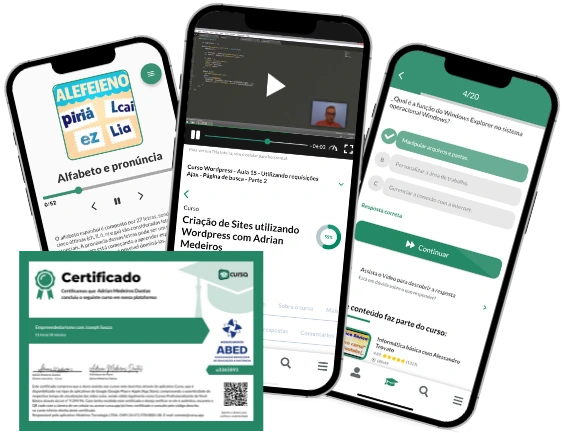
Digital certificate of course completion (Free)

Exercises to train your knowledge

100% free, from content to certificate
Ready to get started?

 recommended
In the app you will also find...

Over 5,000 free courses
Programming, English, Digital Marketing and much more! Learn whatever you want, for free.

Study plan with AI
Our app's Artificial Intelligence can create a study schedule for the course you choose.

From zero to professional success
Improve your resume with our free Certificate and then use our Artificial Intelligence to find your dream job.
You can also use the QR Code or the links below.