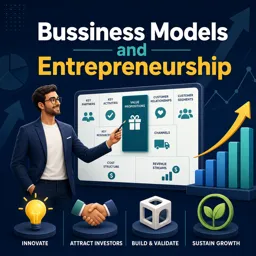
Free Course Image Bussiness Models and Entrepreneurship

Free online courseBussiness Models and Entrepreneurship

Duration of the online course: 21 hours and 44 minutes

4

StarStarStarStar

(1)

Build a winning business model and entrepreneurial mindset in this free online course, with practical innovation tools and a certificate option.

In this free course, learn about

  • How innovation, business models, and entrepreneurship connect in creating and scaling ventures
  • Methods to analyze current business scenarios and challenges from rapid environmental change
  • Innovation drivers: creativity, problem identification, and why innovation is critical today
  • Types of innovation (incl. process innovation) and design thinking as a human-centric approach
  • End-to-end innovation management: discovery, idea selection, experimentation, and execution
  • Idea management systems, divergent vs convergent thinking, and systems thinking for solutions
  • Low-cost experimentation, rapid prototyping, incubation, and what enables startup graduation
  • Participative innovation, co-creation, and G-D vs S-D logic in value creation
  • Business model fundamentals, modern vs traditional models, and crafting strong value propositions
  • Entrepreneur and social entrepreneur roles; linking innovation to societal impact and sustainability
  • Blue Ocean Strategy to create uncontested markets and reduce head-to-head competition
  • Marketing of innovation: integrating customer/value focus into innovation adoption and diffusion
  • Technology innovation processes, planning/strategy (e.g., first-mover) and forecasting (Delphi)
  • IPR management: intellectual capital vs IP, patents/copyrights/GI, and patenting challenges in India

Course Description

Turn ideas into ventures by learning how business models, innovation, and entrepreneurship work together in today’s fast-changing markets. This course helps you move beyond inspiration and into structured thinking: how to read a business environment, spot opportunities, and shape solutions that customers actually value. You’ll build a clearer entrepreneurial mindset while understanding what makes modern business models different from traditional approaches and why some models fail even with a great product.

You’ll explore innovation as a disciplined process rather than a lucky event, connecting creativity with methods such as design thinking, divergent and convergent thinking, and human-centered problem solving. The course emphasizes how organizations and entrepreneurs manage ideas from early exploration through low-cost experimentation, rapid prototyping, and incubation. Along the way, you’ll see how participation and co-creation strengthen outcomes, and how value creation changes when you shift from goods-dominant logic to service-dominant logic.

To sharpen competitive thinking, you’ll work with strategic lenses that help differentiate in crowded markets, including Blue Ocean concepts that focus on escaping head-to-head rivalry. You’ll also understand how marketing supports innovation by translating technical or novel solutions into meaningful customer benefits, and how technology innovation progresses from concept to real-world impact, guided by planning, forecasting, and strategy choices that shape timing and leadership.

The course also broadens entrepreneurship beyond profit alone, linking innovation with sustainability and social impact. You’ll consider the role of government and ecosystems in supporting sustainable conditions, and how small and medium enterprises can contribute across economic, social, and environmental dimensions. Finally, you’ll learn why intellectual property matters for innovators, how IP differs from intellectual capital, and how tools like patents, copyright, and geographical indicators can protect value while encouraging disclosure and development.

With a practical perspective that bridges startups and established organizations, this course supports anyone aiming to validate ideas, improve decision-making, and build resilient models designed for real customers, real constraints, and real opportunities.

Course content

  • Video class: Innovation Business Models and Entrepreneurship 03m
  • Exercise: What is emphasized as an essential part of the innovation process in the course on business models and entrepreneurship?
  • Video class: Analizing the Current Bussiness Scenario 30m
  • Exercise: What is a major challenge organizations face today due to rapidly changing business environments?
  • Video class: Innovation and Creativity-An Introduction 32m
  • Exercise: What is a critical element that initiates the process of innovation according to the course content?
  • Video class: Innovation in Current Environment 36m
  • Exercise: Why is innovation considered critical in the current business environment?
  • Video class: Types of Innovation 33m
  • Exercise: Which type of innovation primarily focuses on improving existing processes and eliminating inefficiencies within organizations?
  • Video class: School of Innovation 38m
  • Exercise: What is the primary focus of design thinking in the context of innovation?
  • Video class: Challenges of Innovation 32m
  • Exercise: Which of the following approaches is described as a human-centric approach to innovation?
  • Video class: Steps of Innovation Management 25m
  • Exercise: What is the primary focus during the initial stage of innovation management according to the course 'Business Models and Entrepreneurship'?
  • Video class: Idea Management System 35m
  • Exercise: What is one of the primary objectives of an idea management system in the context of innovation management?
  • Video class: Divergent v/s Convergent Thinking 31m
  • Exercise: What is a key concept to effectively harness innovation for solving problems in business models, according to the discussed text?
  • Video class: mod2lec10 25m
  • Exercise: Which concept involves creating a larger synchronized picture with interconnected elements in entrepreneurship?
  • Video class: Experimentation in Innovation Management 32m
  • Exercise: What is the main reason for encouraging low-cost experimentation in the innovation management process according to the text?
  • Video class: Idea Championship 32m
  • Exercise: In the context of business incubation, what is essential for ensuring the successful graduation of companies from an incubator?
  • Video class: Participation for Innovation 30m
  • Exercise: Which of the following is NOT considered a key element to develop participative innovation in organizations?
  • Video class: Co-creation for Innovation 32m
  • Exercise: What is the primary distinction between Goods-Dominant (G-D) logic and Service-Dominant (S-D) logic in value creation?
  • Video class: Prototyping to Incubation 32m
  • Exercise: In the context of innovation management and idea development, which statement correctly describes the role of rapid prototyping?
  • Video class: What is Business Model? 39m
  • Exercise: What key aspect distinguishes contemporary business models from traditional ones?
  • Video class: Who is an Entrepreneur? 26m
  • Exercise: What is one of the primary roles of an entrepreneur in the context of organizing a business?
  • Video class: Social Entrepreneurship? 27m
  • Exercise: What is a primary focus of social entrepreneurship, as discussed in the text?
  • Video class: Blue Ocean Strategy-I 28m
  • Exercise: Which of the following is a key element of creating a blue ocean strategy in business?
  • Video class: Blue Ocean Strategy-II 34m
  • Exercise: What is a primary goal of the Blue Ocean Strategy framework in terms of market competition?
  • Video class: Marketing of Innovation 24m
  • Exercise: When integrating marketing with innovation, what key aspect does this approach primarily emphasize?
  • Video class: Technology Innovation Process 32m
  • Exercise: In the technological innovation process, which of the following sequences correctly represents the progression from concept to societal impact?
  • Video class: Technological Innovation Management Planning 38m
  • Exercise: What is one primary reason for incorporating Research and Development (R&D) as a central function in third and fourth generation companies, according to the concept presented about technological planning?
  • Video class: Technological Innovation Management Strategies 37m
  • Exercise: Which strategy involves a company being the first to introduce a new innovation, thereby leading in a new industry life cycle?
  • Video class: Technology Forecasting 37m
  • Exercise: When planning for technological innovation, what is a key method employed to forecast the future of technology that incorporates both expert opinions and iterative feedback?
  • Video class: Sustainability Innovation and Entrepreneurship 26m
  • Exercise: In the context of social entrepreneurship, what is a significant factor that links innovation and societal elements?
  • Video class: Innovation Sustainable Conditions 34m
  • Exercise: What is a primary role of the government in promoting sustainability through entrepreneurship and innovation?
  • Video class: Innovation: Context and Patterns 30m
  • Exercise: What is a systematic approach to innovation as opposed to a random approach in the context of business models and entrepreneurship?
  • Video class: SME’S strategic involvement in sustainable development 36m
  • Exercise: What are the three main dimensions of sustainable development discussed in the context of SMEs?
  • Video class: Insight and Entrepreneurship 27m
  • Exercise: In the context of entrepreneurship, which element is crucial for developing insights, according to the lecture content provided?
  • Video class: Management of Innovation, creation of IPR-I 32m
  • Exercise: What is the primary difference between intellectual capital and intellectual property as described in the course content on innovation?
  • Video class: Management of Innovation, creation of IPR-II 37m
  • Exercise: What is the main reason why organizations invest in creating intellectual property rights?
  • Video class: Types of IPR 37m
  • Exercise: What is a geographical indicator (GI) in relation to intellectual property rights?
  • Video class: Patents and Copyrights 35m
  • Exercise: What is one of the main objectives of the patent system as discussed in the session?
  • Video class: Patents in India 32m
  • Exercise: What is a major reason for the slow growth of patent culture in India compared to other countries like China?
  • Video class: Business Models and value proposition 29m
  • Exercise: In understanding a business model's association with value proposition, what aspect is crucial in delivering and capturing value for both the organization and its stakeholders?
  • Video class: Business Model Failure: Reasons and Remedies 27m
  • Exercise: What is the main reason suggested for business model failure according to the text?
  • Video class: Incubators : Business Vs Technology 38m
  • Exercise: What is the primary goal of a startup incubator?
  • Video class: Managing Investors for Innovation 37m
  • Exercise: What is the primary role of incubators in the entrepreneurial journey?
  • Video class: Future markets and Innovation needs for India 27m
  • Exercise: What does the discussion suggest is a crucial factor for ensuring sustainable development in India?

This free course includes:

21 hours and 44 minutes of online video course

Digital certificate of course completion (Free)

Exercises to train your knowledge

100% free, from content to certificate

Ready to get started?Download the app and get started today.

Install the app now

to access the course
Icon representing technology and business courses

Over 5,000 free courses

Programming, English, Digital Marketing and much more! Learn whatever you want, for free.

Calendar icon with target representing study planning

Study plan with AI

Our app's Artificial Intelligence can create a study schedule for the course you choose.

Professional icon representing career and business

From zero to professional success

Improve your resume with our free Certificate and then use our Artificial Intelligence to find your dream job.

You can also use the QR Code or the links below.

QR Code - Download Cursa - Online Courses

More free courses at Entrepreneurship

Free Ebook + Audiobooks! Learn by listening or reading!

Download the App now to have access to + 5000 free courses, exercises, certificates and lots of content without paying anything!

  • 100% free online courses from start to finish

    Thousands of online courses in video, ebooks and audiobooks.

  • More than 60 thousand free exercises

    To test your knowledge during online courses

  • Valid free Digital Certificate with QR Code

    Generated directly from your cell phone's photo gallery and sent to your email

Cursa app on the ebook screen, the video course screen and the course exercises screen, plus the course completion certificate