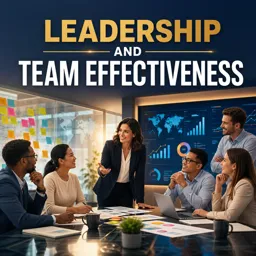
Free online course Leadership and Team effectiveness
Duration of the online course: 34 hours and 1 minutes
4.8
(15)
Lead with confidence and build high-performing teams in this free online course—learn influence, ethics, motivation, and teamwork skills to advance your career.
In this free course, learn about
Difference between management and leadership; core leadership concepts and myths
Interactional leadership: how leader, follower, and situation shape outcomes
Early leader transition skills: what to do in the first 90 days
AOR (Action–Observation–Reflection) model for continuous leader development
LMX theory: building high-quality leader–member relationships
Decision and situational models: normative decision-making and Hersey–Blanchard styles
Contingency and Path–Goal: aligning leader behaviors with task and follower needs
Charismatic/transformational and servant leadership; ethics, values, and character
Great ideas rarely succeed on effort alone; they succeed when people align, trust each other, and execute with clarity. This free online course helps you strengthen the leadership mindset and practical team skills needed in entrepreneurship and modern organizations, whether you are stepping into a first leadership role, leading peers, or scaling a growing venture. You will learn how leaders differ from managers, how leadership myths can limit decision-making, and how to replace assumptions with approaches grounded in real workplace dynamics.
As you progress, you will explore how leadership emerges from the interaction between the leader, followers, and the situation, and why the first 90 days matter so much when taking charge. You will also develop a repeatable way to improve through action, observation, and reflection, so your leadership becomes intentional rather than accidental. The course connects key frameworks with day-to-day challenges such as choosing an effective decision style, adapting to team maturity, and guiding performance without losing trust.
You will build a deeper understanding of the human side of leadership, including personality, intelligence, emotional intelligence, power, influence, values, and ethics. These topics are treated as tools for better judgment, communication, and credibility, especially when stakes are high. You will also examine the darker side of leadership, including derailment and destructive patterns, so you can recognize early warning signs and protect team culture.
Team effectiveness is a central outcome. You will learn what makes groups work, how to form and develop teams, and how to foster collaboration through delegation, empowerment, coaching, and feedback. Practical focus is given to conflict management, decision-making in teams, multicultural and virtual environments, and building relationships that increase motivation and satisfaction. By the end, you will be better equipped to create the conditions for high performance and to lead with consistency, fairness, and impact.
Course content
Video class: Leadership and Team Effectiveness02m
Video class: Lecture 01: Introduction to Leadership48m
Exercise: What is one key difference between a manager and a leader according to the lecture?
Video class: Lecture 02: Leadership Myths20m
Exercise: What is a common myth about leadership?
Video class: Lecture 03: Leadership Myths32m
Exercise: What is a myth regarding leadership levels within organizations?
Video class: Lecture 04: Interactional Framework for Analyzing Leadership36m
Exercise: What are the key factors in the interactional framework for analyzing leadership?
Video class: Lecture 05: Leadership Development: The First 90 Days as a Leader36m
Exercise: What is considered the most crucial period for a new leader to establish themselves and drive organizational change effectively?
Video class: Lecture 06: Leader Development: The Action-Observation-Reflection Model34m
Exercise: What is the role of the action-observation-reflection (AOR) model in leadership development according to the lecture from ITT Roorkee?
Video class: Lecture 07: Leader–Member Exchange (LMX) Theory38m
Exercise: What is the primary concept of Leader-Member Exchange Theory?
Video class: Lecture 08: Normative Decision Model36m
Exercise: What is a key characteristic of the Normative Decision Model?
Video class: Lecture 09: Situational Leadership Model31m
Exercise: According to the Hersey-Blanchard Situational Leadership Model, how should a leader adjust their leadership style in response to team member maturity levels?
Video class: Lecture 10: Contingency Model and Path-Goal Theory34m
Exercise: Which leadership model focuses on matching the right leader to a specific situation?
Video class: Lecture 11: Charismatic and Transformational Leadership33m
Exercise: What defines charismatic leadership according to the video transcript?
Video class: Lecture 12: Leadership for Tomorrow36m
Exercise: What are the key components that leadership development programs should focus on according to contemporary business needs?
Video class: Lecture 13: Leadership Attributes35m
Exercise: Which theory suggests leaders are born with innate qualities?
Video class: Lecture 14: Personality Traits and Leadership37m
Exercise: What primary factor is emphasized as crucial for leadership success in the video transcript?
Video class: Lecture 15: Personality Types and Leadership32m
Exercise: According to Holland's theory, which personality type is generally characterized by practical hands-on tasks and enjoys working with tools, machines, or animals?
Video class: Lecture 16: Intelligence and Leadership34m
Exercise: What are the three components of Sternberg's triarchic theory of intelligence?
Video class: Lecture 17: Emotional Intelligence and Leadership34m
Exercise: How does emotional intelligence impact leadership success?
Video class: Lecture 18: Power and Leadership31m
Exercise: What is a distinguishing factor between coercive power and other forms of power in leadership?
Video class: Lecture 19: The Art of Influence in Leadership36m
Exercise: What is the primary focus of a leader when it comes to influence?
Video class: Lecture 20: Leadership and “Doing the Right Things28m
Video class: Lecture 21: Character Based Approach to Leadership34m
Exercise: What differentiates servant leadership from traditional leadership?
Video class: Lecture 22 : Role of Ethics and Values in Organisational Leadership34m
Video class: Lecture 23: Leadership Behaviour36m
Video class: Lecture 24: Leadership Pipeline34m
Exercise: Which of the following leadership competencies is most closely associated with being an effective enterprise manager?
Video class: Lecture 25: Assessing Leadership Behaviors: Multi-rater feedback instruments36m
Video class: Lecture 26: The Dark Side of Leadership- Destructive Leadership33m
Video class: Lecture 27: Managerial Incompetence and Derailment30m
Exercise: Which of the following correctly describes the formula for managerial competence presented in the ITT Roorkee session on Managerial Incompetence and Derailment?
Video class: Lecture 28: Negotiation and Leadership33m
Video class: Lecture 29: Leadership in Crisis Situation35m
Video class: Lecture 30: The Situation and The Environment33m
Exercise: According to the leader-follower-situation framework, what plays the most important role in determining who emerges as a leader?
Video class: Lecture 31: Culture and Leadership35m
Video class: Lecture 32: Global Leadership35m
Video class: Lecture 33: Motivation and Leadership30m
Exercise: What is the distinction between intrinsic and extrinsic motivation according to the lecture?
Video class: Lecture 34: Introduction to Groups and Teams33m
Video class: Lecture 35: Characteristics of Leader, Follower and Situation33m
Video class: Lecture 36: Group Dynamics30m
Exercise: Which principle of group dynamics emphasizes the need for group members to feel a strong sense of belonging to the same group in order to be effective?
Video class: Lecture 37: Team Formation27m
Video class: Lecture 38: Delegation and Empowerment32m
Video class: Lecture 39: Leading Teams: Enhancing Teamwork within a Group34m
Exercise: What is a key role of a leader in enhancing teamwork within a group?
Video class: Lecture 40: The Leader’s Role in Team-Based Organizations33m
Video class: Lecture 41: Leader Actions That Foster Team Effectiveness33m
Video class: Lecture 42: Offsite Training and Team Development33m
Exercise: Which of the following is NOT a benefit of offsite training in team development?
Video class: Lecture 43: Understanding Team Processes and Team Coaching38m
Video class: Lecture 44: Team Decision Making and Conflict Management34m
Video class: Lecture 45: Virtual teams30m
Exercise: Which of the following is NOT a common challenge faced by leaders in a virtual team environment?
Video class: Lecture 46: Managing Multicultural Teams33m
Video class: Lecture 47: Building Great Teams29m
Video class: Lecture 48: Experiential Learning31m
Exercise: What distinguishes experiential learning from traditional learning approaches?
Video class: Lecture 49: Action Learning39m
Video class: Lecture 50: Development Planning: GAPS Analysis36m
Video class: Lecture 51: Coaching and Mentoring38m
Exercise: What is the primary focus of coaching in a professional context?
Video class: Lecture 52: Women in Leadership Roles41m
Video class: Lecture 53: Building Effective Relationship with Subordinates and Peers33m
Video class: Lecture 54: Fostering Followers' Satisfaction33m
Exercise: Which of the following is NOT a theory of follower satisfaction discussed in the session?
Video class: Lecture 55: The Art of Communication28m
Video class: Lecture 56: Setting Goals and Providing Constructive Feedback34m
Video class: Lecture 57: Enhancing Creativity Problem Solving Skills29m
Exercise: What does the creative problem solving process fundamentally involve?
Video class: Lecture 58: Building High-Performance Teams: The Rocket Model31m
Video class: Lecture 59: Building Credibility and Trust29m
Video class: Lecture 60: Skills for Developing Others37m
Exercise: What are the key factors that contribute to effective team leadership?
What leadership theories are covered in the Leadership and Team Effectiveness course?
The course covers LMX theory, situational leadership, contingency and path-goal theories, transformational leadership, the normative decision model, and leadership pipeline concepts.
How does the course explain improving team effectiveness?
It explores group dynamics, team formation, delegation, empowerment, conflict management, team coaching, virtual teams, multicultural teams, and high-performance team practices.
What leadership development tools are taught in this course?
Topics include the first 90 days, action-observation-reflection, multi-rater feedback, GAPS analysis, coaching, mentoring, experiential learning, and action learning.
Ready to get started?Download the app and get started today.