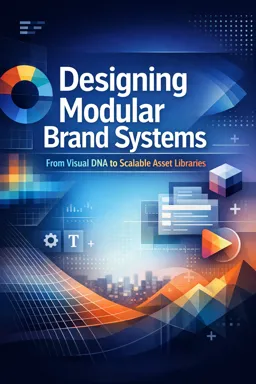


Free ebook on designing modular brand systems, from visual DNA and design tokens to scalable asset libraries and governance.
Free ebook + audiobook content
-

Defining Visual DNA and System Constraints
+ Exercise: In a modular brand system, why are constraints considered part of Visual DNA? 21 minutes
-
Mapping the Brand System into Modular Building Blocks
+ Exercise: In a modular brand system, what is the main benefit of mapping deliverables into reusable building blocks like tokens, components, patterns, and templates? 19 minutes
-
Design Tokens for Color, Type, Spacing, and Motion
+ Exercise: Why should components usually reference semantic tokens instead of base palette or spacing tokens? 29 minutes


-
Logo Families and Responsive Identity Rules
+ Exercise: What is the main benefit of defining measurable responsive identity rules for switching between logo variants? 20 minutes
-
Typography Systems and Hierarchy Specifications
+ Exercise: Which approach best describes a scalable typography system for a modular brand? 22 minutes
-
Grid Logic, Layout Patterns, and Spacing Standards
+ Exercise: Which approach best helps a brand system stay consistent across web, product, and marketing pages while still responding to different screen sizes? 21 minutes
-
Iconography and Illustration Styles as Reusable Components
+ Exercise: Which approach best helps icons remain reusable components across different UI sizes without visual drift? 21 minutes
-
Motion Cues and Interaction Principles for Multi-Channel Consistency
+ Exercise: What is the main goal of defining a cross-channel motion and interaction layer in a modular brand system? 22 minutes
-
Naming Conventions, File Structures, and Versioning Workflows
+ Exercise: Which workflow best prevents confusion about which brand asset version is safe to use while preserving traceability? 22 minutes
-
Asset Library Assembly and Component Packaging
+ Exercise: Which approach best prevents an asset library from becoming noisy and brittle? 20 minutes
-
Brand Playbook Documentation with Do/Don’t Examples
+ Exercise: In a modular brand playbook, what makes Do/Don’t examples more effective than rules alone? 20 minutes
-
Governance Models and Consistency Enforcement Across Teams
+ Exercise: In a modular brand system, what approach best describes healthy consistency enforcement across teams? 19 minutes
-
Extending Systems for Sub-Brands, Campaigns, and Product UI
+ Exercise: In a modular brand system, what is the recommended way to handle a time-bound campaign so it feels distinct without permanently changing the brand? 24 minutes
-
Collaboration with Non-Designers Without Diluting the System
+ Exercise: What is the main purpose of using progressive disclosure (tiered controls) in tools for non-designers? 19 minutes
-
Auditing, Refreshing, and Evolving Modular Brand Systems Over Time
+ Exercise: Which activity best describes a targeted improvement that keeps a modular brand system recognizable and compatible while minimizing breaking changes? 21 minutes
-
Delivery Templates, Checklists, and Rollout Planning
+ Exercise: Which approach best reduces template drift after templates are widely adopted across teams? 21 minutes
About the free ebook with audio
Designing Modular Brand Systems
This free ebook shows how to turn a brand’s visual DNA into a flexible, governable system of reusable assets. Learn to define the rules that protect recognition while giving teams the freedom to create consistently across print, social, campaigns, product interfaces, and future channels.
Build a system, not a collection of files
Explore modular building blocks for color, typography, spacing, logos, grids, icons, illustration, and motion. The ebook explains how design tokens, responsive identity rules, and component-based asset libraries make brand decisions repeatable instead of subjective.
Create clarity for every contributor
Establish naming conventions, file structures, versioning practices, and practical documentation that make approved assets easy to find and use. Learn how do/don’t examples, delivery templates, and checklists reduce friction without making the brand rigid.
Scale with confidence
- Define visual constraints that support creative consistency.
- Package reusable components for multiple formats and teams.
- Set governance models for review, ownership, and quality control.
- Extend the system to sub-brands, campaigns, and product UI.
- Audit and refresh assets as business needs evolve.
For designers building durable identities
Use this guide to create a practical brand system that helps designers and non-designers collaborate, ship faster, and preserve a recognizable visual language at every touchpoint.
What are design tokens in a brand system?
Design tokens are named, reusable values for elements such as color, type, spacing, and motion.
How do responsive logo rules support brand consistency?
They define which logo versions, clear space, sizes, and placements work across different formats.
What should a scalable asset library include?
It should include approved components, usage guidance, naming rules, file structures, and version control.
This ebook/audiobook includes:

5 hours and 49 minutes of audio content

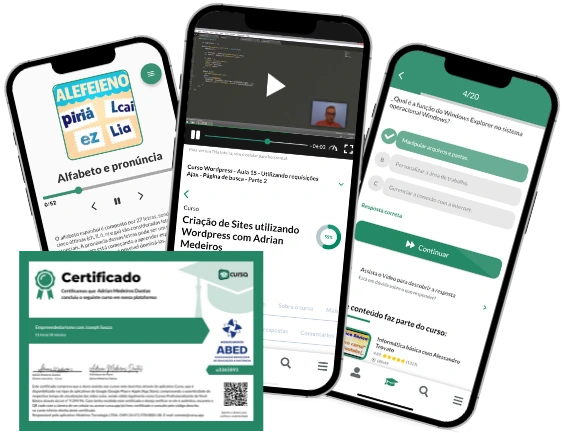
Digital certificate of course completion (Free)

Exercises to train your knowledge

100% free, from content to certificate
Ready to get started?

 recommended
In the app you will also find...

Over 5,000 free courses
Programming, English, Digital Marketing and much more! Learn whatever you want, for free.

Study plan with AI
Our app's Artificial Intelligence can create a study schedule for the course you choose.

From zero to professional success
Improve your resume with our free Certificate and then use our Artificial Intelligence to find your dream job.
You can also use the QR Code or the links below.