
Legibility is how easily individual letters can be recognized, while readability is how comfortably a block of text can be read.

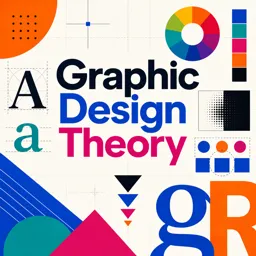
Duration of the online course: 3 hours and 8 minutes
New
Build design confidence with a free graphic design theory course on color, type, contrast and layout—learn rules that make visuals clearer and more impactful.
Strong visual design is not a mystery talent—it is a set of principles you can learn, practice, and apply to any project. This free online course in graphic design theory helps you move beyond guessing and start making intentional choices that improve clarity, consistency, and impact. Whether you are designing for social media, marketing materials, interfaces, presentations, or a personal brand, you will learn how to shape what people notice first, what they understand, and what they remember.
You will begin with color theory in a practical way, exploring how color characteristics influence mood, emphasis, and usability. Instead of treating color as decoration, you will learn to use it as a tool for communication—supporting hierarchy, reinforcing meaning, and improving accessibility. From there, the course dives into contrast, showing how differences in tone, size, and visual weight create separation and focus. Contrast is one of the fastest ways to make designs readable and persuasive, and you will learn how to use it without making layouts feel harsh or cluttered.
Typography is a core part of professional design, and this course clarifies the difference between legibility and readability so you can make better choices for real-world audiences. You will also learn how to pick and pair fonts with intention, avoiding common mismatches and creating a consistent voice. Along the way, you will explore widely applicable design rules and the often-misunderstood distinction between justification and alignment—details that can quietly determine whether a layout feels polished or amateur.
To help you design compositions that feel organized and easy to scan, you will work with concepts such as Gestalt principles, visual hierarchy with type, and layout systems like grids. These ideas show you how viewers naturally group elements, how to guide attention through a page, and how to build structure that supports creativity rather than limiting it. You will also learn about leading lines, negative space, and focal points—techniques that bring order, elegance, and emphasis to your work.
Finally, you will examine how constraints can sharpen your decisions, including practical considerations like text color limitations for small type and the idea of propositional density in logo design. By the end, you will have a stronger design vocabulary and a more reliable process for evaluating and improving your own work. If you want to understand why great designs feel effortless—and learn to create that effect yourself—this course offers a solid, theory-driven foundation you can use immediately.

3 hours and 8 minutes of online video course

Digital certificate of course completion (Free)

Exercises to train your knowledge

100% free, from content to certificate
What is the difference between legibility and readability in graphic design?
Legibility is how easily individual letters can be recognized, while readability is how comfortably a block of text can be read.
How do grids improve a graphic design layout?
Grids organize content, create alignment and consistency, and help viewers scan information more easily.
Why is negative space important in logo and graphic design?
Negative space prevents clutter, improves clarity, and can add visual meaning by shaping the space around and between elements.
Ready to get started?Download the app and get started today.
Install the app now
to access the course
Over 5,000 free courses
Programming, English, Digital Marketing and much more! Learn whatever you want, for free.

Study plan with AI
Our app's Artificial Intelligence can create a study schedule for the course you choose.

From zero to professional success
Improve your resume with our free Certificate and then use our Artificial Intelligence to find your dream job.
You can also use the QR Code or the links below.



Free CoursePro Logo Design
4.9

(9)

10h16m

45 exercises
Free CourseBeginners guide to Graphic Design
4.8
(289)
6h26m
22 exercises
Free CourseGame artist using Krita
4.8
(9)
8h54m
31 exercises
Free CourseGraphic design for Beginners
4.8

(12)
11h12m
Free CourseCanva Video Editor
4.7
(15)
21m
5 exercises
Free CourseAdobe illustrator
4.7
(54)
5h32m
20 exercises
Free CourseCorelDRAW for Beginners: Complete Graphic Design and Vector Tools Training
4.7
(3)
8h03m
46 exercises
Free CourseAnimation
4.6
(8)
31m
5 exercises
Free CourseCanva tool for beginners
4.6
(36)
32m
11 exercises
Free CourseGraphic design Basics
4.6
(20)
48m
8 exercises
Carry knowledge in your pocket.
Download the Cursa app.
There are hundreds of free courses available, with a free certificate of completion that is saved in your mobile image gallery.
Download the app to access the Course Completion Certificate for Free.


+ 10 million
students

Free and Valid
Certificate

60 thousand free
exercises

4.8/5 rating in
app stores

Free courses in
video and ebooks
Course comments: Graphic Design Theory
Bulelani
excellent