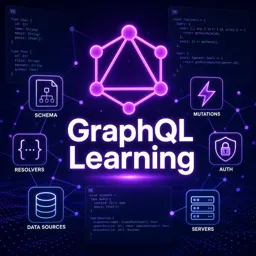


Free ebook on GraphQL API design, resolvers, performance, security, testing, and production-ready backend architecture.
Free ebook + audiobook content
-

Schema-First API Design for Flexible Backends
+ Exercise: In schema-first GraphQL design, which approach best supports safe evolution without breaking clients? 18 minutes
-
Core GraphQL Building Blocks: Types, Queries, Mutations, and Inputs
+ Exercise: Why might a GraphQL mutation return a payload object instead of returning only the mutated entity or a boolean? 16 minutes
-
Modeling with Enums, Interfaces, and Unions for Evolving Domains
+ Exercise: In an evolving GraphQL domain, when should you prefer a union over an interface for a field that can return multiple types? 20 minutes
-
Resolver Architecture and Mapping Schema to Data Sources
+ Exercise: When resolving a nested field that requires I/O for many parent objects in a list, what strategy best avoids N+1 queries while keeping resolvers thin? 18 minutes
-
Database Integration and Data Modeling for GraphQL Workloads
+ Exercise: When designing database models for GraphQL workloads, what is a recommended approach to avoid overloading the database for frequently requested computed fields like totalCount or averageRating? 14 minutes
-
Pagination Patterns with Cursor-Based Connections
+ Exercise: When paginating a newest-first connection ordered by (createdAt DESC, id DESC), why must the cursor and ordering include id as a tie-breaker when multiple items share the same createdAt? 18 minutes
-
Filtering and Sorting Design for Predictable Client Queries
+ Exercise: Which design choice most improves predictable and stable ordering when sorting results that may have ties (for example, many records share the same createdAt value)? 16 minutes
-
Error Handling Strategy and Client-Safe Failure Modes
+ Exercise: In a GraphQL API, which approach best distinguishes expected domain outcomes from unexpected failures to keep client behavior predictable? 19 minutes
-
Versioning Without Breaking Clients Using Deprecation and Schema Evolution
+ Exercise: Which approach best avoids breaking existing GraphQL clients when you need to change a field in an incompatible way? 20 minutes


-
Eliminating the N+1 Problem with Batching and DataLoader Patterns
+ Exercise: Which change most directly eliminates the N+1 pattern when resolving Post.author for a list of posts? 19 minutes
-
Caching Layers: Response, Field, and Data-Source Caching
+ Exercise: In a GraphQL backend with highly diverse queries, which caching approach is generally most effective for improving performance across many different operations? 17 minutes
-
Persisted Queries and Operational Controls for Safer Production Traffic
+ Exercise: Which production setup most effectively prevents clients from introducing new GraphQL operations at runtime while improving predictability? 19 minutes
-
Query Complexity Limits and Depth Controls to Prevent Abuse
+ Exercise: Which approach best prevents shallow but very wide GraphQL queries that request many expensive fields across large lists? 17 minutes
-
Authentication Options: JWT, Sessions, and Context Construction
+ Exercise: In a GraphQL server, what is the main reason to build a request-scoped context after authenticating the caller? 18 minutes
-
Authorization Design: Role-Based and Field-Level Permissions
+ Exercise: Why should authorization in GraphQL be path-independent? 18 minutes
-
Security Hardening: Introspection Control, Injection Vectors, and Rate Limiting
+ Exercise: Which approach best prevents bypasses when applying per-operation rate limits in a GraphQL API? 18 minutes
-
Observability for GraphQL: Structured Logging, Tracing, and Metrics
+ Exercise: Why should GraphQL metrics avoid labels like raw query text or user ID, and prefer operationName and operationHash? 21 minutes
-
Testing Strategy: Unit, Integration, and Contract Tests for Schemas and Resolvers
+ Exercise: Which testing layer is primarily responsible for preventing accidental breaking changes that could silently impact GraphQL clients? 15 minutes
-
Deployment and Operations: CI/CD, Configuration, and Environment Management
+ Exercise: Why is it recommended to build the deployable artifact once and then promote the same image through dev, staging, and production? 20 minutes
-
Project Walkthrough: Building a Production-Ready GraphQL Server End to End
+ Exercise: Which approach best reflects how a production-ready GraphQL server should be started and marked ready to receive traffic? 27 minutes
-
Capstone: Designing a Marketplace or Learning Platform API with Benchmarks and Production Readiness Checklist
+ Exercise: Why should you define stable golden path operations and keep their documents constant across benchmark runs? 21 minutes
About the free ebook with audio
GraphQL API Design and Performance
This free ebook helps backend developers design GraphQL APIs that remain flexible, secure, and fast as products and data models evolve. It takes a schema-first approach to defining clear contracts for clients while keeping resolver and data-source responsibilities maintainable.
Build dependable GraphQL contracts
Learn how to model domains with types, inputs, enums, interfaces, and unions. The ebook explains practical patterns for queries, mutations, cursor-based pagination, filtering, sorting, errors, deprecation, and schema evolution without unnecessarily breaking client applications.
Improve resolver and database performance
Explore resolver architecture, database-aware modeling, and the techniques needed to avoid inefficient request behavior. Topics include batching with DataLoader, the N+1 problem, response and field caching, persisted queries, query-depth controls, and complexity limits.
Secure and operate production APIs
Strengthen a GraphQL server with authentication context, JWT and session options, role-based and field-level authorization, rate limiting, introspection controls, and protections against common injection vectors. You will also examine logging, tracing, metrics, testing, CI/CD, configuration, and environment management.
Apply the patterns end to end
- Design client-friendly schemas for changing domains.
- Create predictable query and mutation behavior.
- Control costly or abusive production traffic.
- Validate resolvers, schemas, and API contracts through testing.
- Build a production-ready server and assess it with a practical capstone.
Ideal for developers building modern backend services: this ebook connects GraphQL design decisions with performance, security, and operational reliability.
How can GraphQL APIs avoid the N+1 query problem?
Use batching and caching patterns such as DataLoader to combine repeated resolver lookups.
What is cursor-based pagination in GraphQL?
It returns ordered records through opaque cursors, enabling stable pagination as data changes.
How do GraphQL query complexity limits improve security?
They reject overly expensive or deeply nested queries before they can consume excessive server resources.
This ebook/audiobook includes:

6 hours and 38 minutes of audio content

Digital certificate of course completion (Free)

Exercises to train your knowledge

100% free, from content to certificate
Ready to get started?

 recommended
In the app you will also find...

Over 5,000 free courses
Programming, English, Digital Marketing and much more! Learn whatever you want, for free.

Study plan with AI
Our app's Artificial Intelligence can create a study schedule for the course you choose.

From zero to professional success
Improve your resume with our free Certificate and then use our Artificial Intelligence to find your dream job.
You can also use the QR Code or the links below.