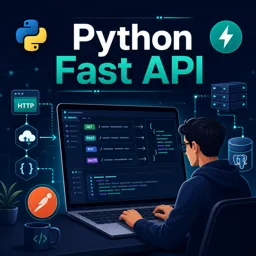

Free ebook on building a production-ready FastAPI REST API with validation, databases, JWT authentication, testing, and deployment.
Free ebook content
-

FastAPI Project Setup and Developer Workflow
+ Exercise: In a scalable FastAPI project, what is the main reason to keep routers thin and move business logic into services?
-
Routing and REST Endpoints in FastAPI
+ Exercise: In a REST-style FastAPI endpoint for updating an item, what is the key difference between using PUT and PATCH?
-
Request and Response Models with Pydantic in FastAPI
+ Exercise: In a PATCH-style update endpoint using a Pydantic update model where fields default to None, how can you ensure only the fields actually sent by the client are applied to the stored item?
-
Validation Rules and Data Parsing for API Inputs
+ Exercise: A client calls /users/not-a-uuid for an endpoint that annotates user_id as UUID in the path. What is the expected FastAPI behavior?
-
Error Handling and Consistent API Responses in FastAPI
+ Exercise: In a FastAPI project aiming for consistent error responses, what is a key benefit of raising domain-specific exceptions in services and converting them to HTTP responses at the API boundary?


-
Dependency Injection Patterns in FastAPI
+ Exercise: In FastAPI, what is the main benefit of defining a database session as a yield-based dependency (e.g., get_db) instead of creating and closing the session inside every endpoint?
-
Background Tasks and Non-Blocking Workflows in FastAPI
+ Exercise: When should you choose a dedicated queue + worker system instead of FastAPI BackgroundTasks?
-
Interactive API Documentation with OpenAPI, Swagger UI, and ReDoc
+ Exercise: When an endpoint’s behavior looks wrong in Swagger UI or ReDoc, what is the fastest way to debug what the docs are showing?
-
Database Integration with SQLAlchemy or SQLModel in FastAPI
+ Exercise: In a FastAPI app using SQLAlchemy, what is a production-friendly way to manage database sessions to avoid connection leaks?
-
Migrations with Alembic and Schema Evolution
+ Exercise: When adding a new NOT NULL column to a table that already has rows, what migration approach helps avoid failures and keep the change controlled?
-
Authentication Basics with OAuth2 and JWT in FastAPI
+ Exercise: In a FastAPI app using OAuth2 Password flow with JWT, which situation should result in a 403 Forbidden response instead of 401 Unauthorized?
-
Configuration Management and Environment Separation
+ Exercise: In a FastAPI project using a validated settings class, what is the main benefit of loading configuration from environment variables and enforcing production rules with validation?
-
Testing FastAPI Applications with Pytest and TestClient
+ Exercise: When testing a JWT-protected FastAPI endpoint, what approach keeps route tests fast and stable while still allowing you to verify authorization behavior?
-
Deployment Considerations for a Production-Ready FastAPI REST API
+ Exercise: Which approach best matches a production-ready strategy for database readiness checks in a FastAPI deployment?
About the free ebook
FastAPI for Beginners: Build a Production-Ready REST API
Build practical, reliable backend services with this free online ebook on FastAPI. Designed for developers moving into modern Python API development, it explains how to turn an initial application into a REST API that is structured, validated, documented, tested, and prepared for deployment.
Develop modern Python APIs with confidence
FastAPI combines Python type hints, automatic validation, asynchronous capabilities, and standards-based API documentation. This ebook focuses on the decisions that make an API easier to maintain: clear endpoint design, dependable request and response contracts, useful error messages, and reusable application components.
From local development to production practices
Learn how to organize a FastAPI project and establish an efficient developer workflow. Work with Pydantic models to parse and validate incoming data, use dependency injection to keep code modular, and handle background work without blocking requests. You will also explore database persistence, schema changes, authentication foundations, environment-specific configuration, and automated testing.
Practical API engineering skills
- Create REST endpoints with predictable behavior.
- Validate data and return consistent responses.
- Document APIs automatically with OpenAPI tools.
- Connect applications to databases and manage migrations.
- Apply OAuth2 and JWT concepts for protected routes.
- Prepare a FastAPI service for testing and deployment.
By the end, you will understand how the pieces of a production-ready FastAPI REST API fit together. The examples and concepts provide a strong foundation for building internal services, web backends, and data-driven applications with Python.
How does FastAPI validate request data?
FastAPI uses Pydantic models and Python type hints to parse inputs, enforce rules, and return validation errors automatically.
How can I add JWT authentication to a FastAPI API?
Use OAuth2-compatible flows to issue tokens, verify JWTs on protected routes, and inject the authenticated user into endpoints.
What is the role of Alembic in a FastAPI project?
Alembic tracks database schema changes and applies versioned migrations as your models evolve.
This ebook includes:

14 content chapters

Digital certificate of course completion (Free)

Exercises to train your knowledge

100% free, from content to certificate
Ready to get started?

 recommended
In the app you will also find...

Over 5,000 free courses
Programming, English, Digital Marketing and much more! Learn whatever you want, for free.

Study plan with AI
Our app's Artificial Intelligence can create a study schedule for the course you choose.

From zero to professional success
Improve your resume with our free Certificate and then use our Artificial Intelligence to find your dream job.
You can also use the QR Code or the links below.